 I wonder if I would have liked No Great Mischief more if I’d never moved to Nova Scotia. Then its invocation of the landscape and culture of Cape Breton might have appealed to me as much as any other intensely local fiction does: I might have appreciated unreservedly its artfully crafted sentences offering a vicarious journey into an unfamiliar place, its tender but unsentimental portrait of the people who live there and love it, its artful and often touching intertwining of stories about the past and the present. No Great Mischief does offer these things, and I did understand, as I read it, why it is so admired.
The problem I had, though, is that No Great Mischief seemed too much part and parcel of the things I don’t like about Nova Scotia, things that from a distance might be engagingly quaint or exotic but that up close I have found wearing, even alienating: clannishness, insularity, a backwards-tugging resistance to change, hostility to outsiders. Soon after we bought our first house in Halifax, one of our watchful neighbors commented “you’re not from around here, are you?” That there’s even a common expression for people like us (“come-from-aways”) perhaps says enough. And there’s not just suspicion and resentment of new people who arrive: there’s also perpetual mourning and resentment about Maritimers who go away, whether they choose to or have to, and a reflexive and (in my experience, anyway) largely unjustified insistence that this is the best place on earth, with the best people. “We’re the salt of the earth!” declared one of those same neighbors–neighbors who watched thieves make off with the newly planted flowerpots from the front of our house and didn’t interfere, note the license plate, or knock on our door to give us a heads up. (We have since moved.) 
It’s not that there aren’t good things about life in Nova Scotia. Over time (and I’ve been here 23 years now, so nearly half my life) I’ve learned to appreciate and even cherish many aspects of it. We’ve also met many lovely people–though it’s interesting how many of the ones we are friendliest with have also come from away. But No Great Mischief is basically a paean (if a somewhat melancholy one) to Cape Breton and its way of life. That its narrator, one of several Alexander MacDonalds in the novel, has moved on (he is a successful orthodontist in Ontario) seems to him something faintly sorrowful, even a little bit shameful, as if his profession is somehow less authentic than fishing or mining, or his modern urban life, with its comforts and conveniences, is somehow a lesser life than his parents’ or grandparents’ back on the island. These attitudes are not unique to the Maritimes–somehow, city-dwellers and urban professionals never seem to count as “real” citizens the way farmers do–but they are certainly conspicuous here.
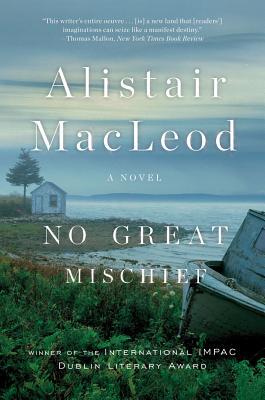 Unfortunately, then, in spite of its admirable literary qualities including its quietly powerful evocation of place, No Great Mischief grated on my nerves, precisely because it is so invested in the fixity of Maritime culture and its fixation on its roots. For a short novel about contemporary Canada, No Great Mischief sure dedicates a lot of space to Culloden and Glencoe and Killiecrankie, and everywhere our Alexander goes he runs into yet another member of clann Chalum Ruaidh (there’s a lot of Gaelic in the novel too). Not that there’s anything wrong with all of this! It’s just that in my experience it is a nicer world to visit as a tourist (fiddles and bagpipes and tall ships, oh my!) then to live in as an outsider. Sure, the cashiers at Tim Hortons call me “honey” and “sweetie”–but I’ve found people in New York or Vancouver or London just as helpful and friendly, and beneath the surface display of folksiness here there can be a deeper layer of suspicion. (In case it doesn’t go without saying, #notallMaritimers, your mileage may vary, etc.)
 As I was reading No Great Mischief I found myself thinking a lot about my own upbringing, which was quite unlike Alexander’s. That difference might, I suppose, be another contributing factor in my resistance to the novel (and to this region). I don’t just mean the geographical differences, though there’s no question that to me the North Shore Mountains will always look more beautiful and lift my spirits higher than anything here. For one thing, my immediate family was (is) the opposite of sprawling. The only relative I knew well outside of my parents and two siblings was my paternal grandmother; although she came from a large family, we had very little contact with any of its other branches, and my mother’s relatively small family was far away. Our family life revolved almost exclusively around the five of us: we did a lot of activities together, and we developed an array of family traditions, especially around holidays, that gave us a strong but highly specific and idiosyncratic sense of continuity and identity. It is inconceivable to me that I would ever run into anyone else anywhere in Canada and feel an immediate bond, as happens to the novel’s many MacDonalds. We enjoyed a kind of self-sufficiency that in retrospect was quite empowering (my siblings and I are nothing if not self-directed) though it may also have allowed us a little too much freedom to cultivate our eccentricities. (Our significant others are banned from commenting on this point!)
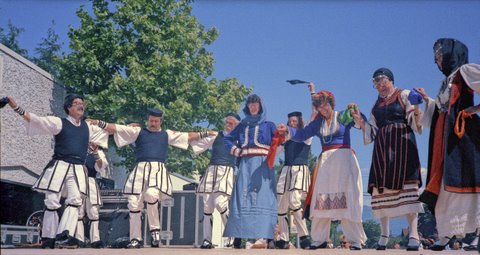
At the same time, in other ways my upbringing was anything but insular, as the interests, activities, and friends we were engaged with were more global than local. One thing we were all involved in one way or another, for example (not always actively or voluntarily, as my brother would attest) was international folk dancing, which meant that we were very aware that different places in the world had rich and complex histories as well as their own traditional music, dances, and food. Many of the people we met through folk dancing were from these other countries, too, which made the cultural diversity of the world something real and embodied for us, not just an abstraction or a spectacle. I don’t mean to idealize this somewhat peculiar if often delightful subculture–just to observe that it arises from and cultivates people’s interests in how other people live in the world. My own most sustained form of involvement was my participation (along with my father’s) in a Greek performing group called the Philhellenic Dancers: the leader was Austrian, his wife was Irish, and the rest of us came from many places–some were even actually Greek! Here we are at Greek Day c. 1985, festive if blurry:
Besides folk dancing, there were other ways in which my childhood attention was drawn outwards: classical music, which brought us into contact with a lot of different musicians, again mostly from elsewhere; reading, which for me, for whatever reason, rarely meant reading Canadian literature; travel, which for us was limited and not glamorous, as we mostly went camping, but was as likely to take us south into Washington State and Oregon as north up the B.C. coast. The U.S. border crossing was familiar and easy in those days: we used to drive all the way to Bellingham, WA just to go to Baskin Robbins, before it opened in Canada. My mother was American (she hails from New Hampshire – live free or die!) and my sister and I were both born in the U.S., so although I knew it was a different country, I didn’t think that difference mattered very much. I still find eastern Canada more foreign than I ever did Seattle! Winter, hockey, Tim Hortons: out here these are assumed to define the Canadian experience, but I knew nothing of them. Vancouver itself I experienced as a place where people from all over came and went–again, I don’t want to idealize the city or gloss over its faults and complexities, which are naturally much more apparent to me now than they were then, but for better and for worse I was raised when multiculturalism was the buzzword and that’s what I thought I saw and what I thought was good. (For some reflections on ways the feel-good message of multiculturalism obscured lessons I should have learned about the history of my own country, see this post.) The cumulative effect of all of these factors is that while I love and miss Vancouver, I feel tied to it individually, not because I developed a strong sense of regional identity.
All of this is by way of saying, not that my own background is the “right” way, but that because of it the close-knit but wide-ranging family depicted in No Great Mischief and the constant pull they all feel back towards a specific history and a particular place both seemed somewhat claustrophobic to me, and that my personal experience has made me skeptical of the hold a certain idea(l) of the Maritimes still has. To be fair, MacLeod’s novel is not naively nostalgic and he doesn’t unreservedly romanticize the world or the people he depicts. The novel is structured, after all, around the consequences of an act of tragic violence that is itself the result of a clash between two strongly defined and irreconcilable group identities. There and in the historical allusions lurk powerful warnings against holding grudges or deciding people’s worth because of who you think they are, because of an inability to move on, or past. Still, those larger implications seemed to me not nearly as important to the novel’s affect and ethos as the idea that there is only ever one place where you really belong and it isn’t for everybody. 
I realize that I’ve given hardly any actual details about and no specific quotations from MacLeod’s novel. It turns out that’s not what I felt like writing about! If you’re interested in a proper review of No Great Mischief, here’s the New York Times review from 2000, which seems a judicious one to me, and here’s a pretty warm one from Quill and Quire.

 I should say, as a disclaimer, that I am not at all an expert on Sophocles’ Antigone: though I have known the play’s basic story for many years and seen one production of it, my sense of what it’s fundamentally about depends almost entirely on Eliot’s commentary on it, which I have thought about often as an interpretive key to her fiction, especially The Mill on the Floss. So it is entirely possible that Shamsie has captured nuances of its characters’ principles and actions that make her retelling accurate in ways I can’t see–or, alternatively, that she has up-ended key elements of it for her own purposes in ways that, again, I can’t grasp the significance of. That said, I think it’s fair to expect the novel itself to convince me of the urgency of its central conflict, and it just didn’t. Most importantly, there’s nothing in Aneeka’s relationship with her brother before his recruitment as a terrorist that made her final vigil by his body seem like an inevitable and principled result: her love for her twin was never depicted in a way that gave it tragic potential. Further, her relationship with Eamonn was deceitful and manipulative from the start, and the novel did not convince me that she had come to love him sincerely enough to justify either his sacrifice or her final gesture. As a result, the novel’s final image, though poetic, range false to me.
 Home Fire is a good contemporary novel and its central theme of conflicting loyalties, especially tensions between personal feelings and legal, political, and moral obligations is interesting and obviously topical. I didn’t find Shamsie’s prose particularly artful: on the back cover Aminatta Forna is quoted as calling it “simple” and “lucid” but I would describe it as flat and sometimes awkward, if also sometimes rising to eloquence. I have
  As a member of Jo VanEvery’s
  For me personally, the “retreat” (how I hate that term, which falsely suggests there’s something soothing about being closeted for hours with my colleagues and having to talk about fraught topics about which in some cases we profoundly disagree) was extremely stressful and undid some of the progress I’d made,
  Anyway, Jo recommends taking stock of what we did accomplish in May, and dealing with meetings and administrative tasks was a big part of that. I also completed the final draft of a report: I was part of the Faculty of Graduate Studies’ internal review committee for the
  One of the things I’d intended to do in May is work out a definite plan for some larger writing projects to focus on over the summer. For some reason I have found this very difficult to do: I have sketched out and even done scraps of writing for a lot of possibilities but I have struggled to commit to any one of them. I have continued to explore places to pitch pieces that aren’t book reviews, and I have some ideas I like, as well as a firm commitment to doing a piece for The Reader, a publication I have long admired for its combination of sophistication and accessibility. I really want to get back to writing about George Eliot; I think what I may need is to stop focusing on venues for a while and just write, the way I could when I always had the option of running something in Open Letters Monthly. Trying to think of the pitch first becomes an exercise in self-defeating second-guessing. Getting going on this–whatever it turns out to be–is a top priority for me this month.
 These are all work things, and of course that’s never everything that’s going on. Maddie had her wisdom teeth out on May 18th, for example, and that meant a week or so of disruption (and a lot of smoothies) while she recovered, but she is basically better now.
 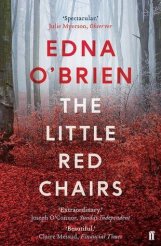 Last but not least, Edna O’Brien’s
 It’s not just Fidelma’s, though, and here again O’Brien’s narrative choices are interesting. Though there is some shifting around of perspective in the first section, the movement of the novel is fairly linear until Dr. Vlad’s identity is revealed and he is arrested. One of the consequences of his discovery is an attack on Fidelma so horrific that it was difficult for me to read to the end of the few pages it takes up. It is not the first scene of appalling violence in the novel, but it is by far the most immediate and personal. It changes everything–not just Fidelma, now herself a kind of casualty of war, but the novel. From this point on it follows Fidelma’s attempt to make a new life for herself away from Cloonoila, but rather than focusing on her singular experience it folds in other stories of victims and refugees from violence.


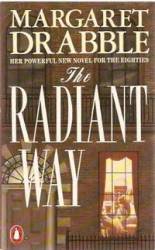 Jane Austen recommended three or four families in the Country Village as the thing to work on when planning a novel. . . . A few families in a Country Village. A few families in a small, densely populated, parochial, insecure country. Mothers, fathers, aunts, stepchildren, cousins. Where does the story begin and where does it end?
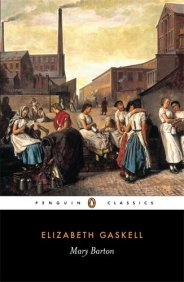 As this passage illustrates, The Radiant Way is about the condition of England in the 1980s, and its treatment of that era matches, rather than counters, what it suggests is the spirit of the age: it is (mostly) satirical, snide, cynical, bitter. I wonder if that is why it seemed to me so much more dated than, say, Mary Barton, with its heartfelt appeals to our common experiences and better natures. There is something naive, of course, about Gaskell’s novel, and many of her attitudes are outdated. Maybe I just prefer her kindness and optimism to Drabble’s somewhat ruthless explication of people’s weaknesses and compromises. The extent to which her analysis is still painfully current, too, shows that if anything she was prescient about the corrosion of the welfare state, the devaluation of art and education, and the instability of love as a foundation for happiness. Maybe I just wish it were dated.
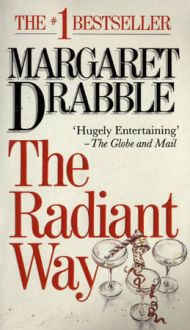 I read The Radiant Way for my book club (it’s our follow-up to
  I’ve been in a bit of a reading slump lately, which has been reflected in the slow pace of my blogging. I’m not sure exactly what is behind it this time, but I think it happens to all of us occasionally, and it always passes eventually. Still, it’s a disheartening phase when it comes, to be picking up books and putting them down again without much caring!
 I also started Lee Child’s Killing Floor, the first of his hugely popular Jack Reacher thrillers. I admit it had never occurred to me to try this series until Stig Abell, the editor of the TLS, sang its praises. I had no particular assumptions about Lee Child, good or bad, it’s just that the books had never stood out to me until Abell said how much he’d enjoyed reading through them all last year–so I picked up a couple at a book sale. I got about half way through Killing Floor before I lost interest. I don’t think there’s anything really wrong with this book any more than there is anything wrong with The Mirror Thief: in fact, I thought Killing Floor seemed quite good of its kind. But for whatever reason I just wasn’t gripped–I wasn’t even slightly curious about how the knotty plot was going to turn out, and so I eventually stopped picking it up again after I put it down. When I started it, it reminded me of Robert B. Parker’s Spenser mysteries, which I love. It is much wordier, and it may be that I wouldn’t enjoy Parker’s books if it took a lot longer for things to happen in them–or if Parker spent as much more time on the really grim bits as Child does here. I also didn’t bond with Reacher. I was intrigued by Child’s introduction, in which he outlines his own motivations for the style of the series as a whole and for Reacher’s character in particular. Reacher is deliberately both arrogant and hard to like, which are not qualities I’m against in principle, in a main character–but again, I don’t imagine I would like Parker’s books if I didn’t find Spenser’s combination of strength and honor so appealing. Maybe I’ll appreciate Reacher more as a character if/when I get to know him better. For now, though, I’ve put him on hold.
 It’s not as if I haven’t read any books all the way through since classes ended. One thing that works is coercion! I’ve read two books for reviews, one an interesting study of Agatha Christie, the other a new novel by Canadian writer Merilyn Simonds. (My review of the former has been filed; my review of the latter is underway.) I’m also making good progress on Margaret Drabble’s The Radiant Way, which I need to finish for next weekend’s meeting of my book club. Deadlines are useful things. In the interstices of my days I’ve also reread all three of
  Classes have been over for a while now, but the business of the teaching term isn’t quite over. I mentioned before that one unfortunate feature of marking season is academic integrity hearings: I had more this year than I’ve ever had before, which has taken up a lot of my time and also given me a lot to think about. Individual cases are confidential, of course, but at some point I plan to write a separate post about some trends I’ve noticed around plagiarism and some ideas I have about how to address both its causes and its consequences. Some of what I’ve been dealing with and thinking about is addressed in
  Since classes ended, I’ve been thinking a lot about what seemed to work and what didn’t this term. It’s always hard to know what are actual lessons about pedagogy that you can carry forward and what are idiosyncratic reactions or developments based on the specific and unpredictable population of a particular class. For instance, I thought that overall Pulp Fiction went much better this year than last. What did I do differently? Not much logistically: I used the same readings and course structure, and more or less the same assignments. Class participation was way up, though, and most of the time the atmosphere felt happier: is that because (anxious to avoid whatever went wrong last year) I tried even harder than usual to be positive, friendly, and encouraging? Did we all benefit from my having broken in this material last year and so being more adept with it this time? Or did I just get lucky and have a larger proportion of reasonably talkative students who softened the atmosphere for others to join in and thus helped increase overall engagement?
 I have also concluded that Valdez Is Coming is not a good choice for my representative Western. When I read it on my own,
  As for Victorian Sensations, I thought it was quite a successful seminar. Participation levels were consistently high and (as important) were of high quality; as I told the class at the end of term, I genuinely looked forward to showing up and talking with them about our readings. The only novel I hadn’t taught before was Cometh Up As A Flower; we found it provocative and sometimes puzzling, and quite a few students chose to include it in their term paper, which is a sign that they were engaged with it. It might be fun to include it in one of my standard Victorian fiction class, where it would fit well with other novels in which passion and duty collide (The Mill on the Floss, for instance), or in which the ‘romance’ of marrying for money is overtly stripped away. One slight surprise for me was that discussion flagged a bit for Fingersmith. Everyone seemed to really enjoy reading it, but it was conspicuously harder to get them to talk about it. This might have been (a bit paradoxically) because they found it fun to read and so their critical faculties shut down in ways they really can’t with a novel like East Lynne (which is pretty hard work to slog through, honestly); it might also have been that we read Fingersmith last, and by the final weeks of term everyone’s tired and overwhelmed with work.
 Less of a surprise, but still a challenge, was how difficult it was to generate discussion on the classes I’d set aside for “critical approaches” to our novels. After the first of these sessions I realized that I needed to approach them differently, so I ran those classes more overtly than I usually do in a seminar class, adding some contextual information about the history of literary criticism and devising a set of “metacritical” discussion questions to supplement students’ questions on the specific readings. Even so, discussion was halting. I think the main reason was actually closely related to my goals for these readings. In my experience, when students read criticism they are often mining it for usable quotations, which they then drop into their own arguments as if the fact that somebody else said it proves their claim. I wanted to get them to engage with other scholars in a more equal and conversational way, learning how to see what kind of criticism they are reading (by considering its original date of publication, the venue it was published in, the kinds of questions it asks, and the kinds of evidence it considers) and then if they use it in their own work, signaling how and why in a different way. Just saying “As Critic Smartypants argues” instead of “Critic Smartypants argues” is an improvement: it implies “I’ve thought about this and agree,” not “Smartypants said it, so it’s true.”



 Last week and this week, actually. That’s not quite all I’ve been doing since classes wrapped up on April 10: there has been a spate of committee work, and also (one of the less pleasant features of this time of term) some academic integrity hearings, which take up a fair amount of time. Then on the home front, Maddie was in her high school’s production of The Drowsy Chaperone, which had its four-performance run April 19-21, so in addition to ferrying her to and from rehearsals and doing what I could to mitigate the stress on her schedule in other ways, I’ve also been to two performances–which, on the bright side, was the most fun I’ve had in ages. (In case you know the musical, she played Mrs. Tottendale, with great comic flair. The whole cast was great, actually, as was the production, especially the costumes.)
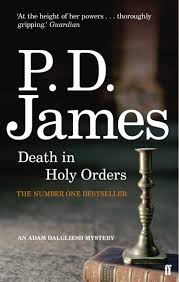
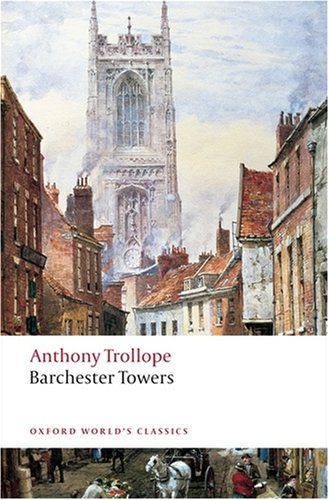
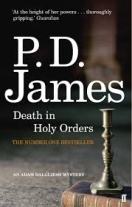 I’ve been too busy and distracted to settle in for any intense reading, though I did join a few Twitter friends in reading The Warden last weekend. Then I had to take all the books off my mystery bookcase (we needed to move it out of the way temporarily, to do a household project) and in the process of sorting them I was reminded how long it has been since I read most of my P. D. James collection. I’ve put An Unsuitable Job for a Woman back on the reading list for Mystery & Detective Fiction in the fall, so it seemed like a good time to revisit one or two. As a result, I’m happily rereading Death in Holy Orders, which turns out to follow very well on The Warden as it has a number of explicit references in it to Barchester Towers. James herself said she saw the 19th-century novelists as her predecessors more than the Golden Age mystery writers, and in a book like this, that genealogy is clear. There are plenty of murderous moments in Trollope but his world is (mostly) too genial a place, his morality too committed to shades of grey, to allow for outright irremediable violence. (There are exceptions, of course). Like Trollope, James is very good at depicting institutions, with all their intricate politics and emotional dynamics. She’s also exceptionally good at setting, something I emphasize when we discuss Unsuitable Job (where the beauty of Cambridge makes a poignant contrast to the horrors of the novel’s central crime). After reading several hastier or lazier stylists in this genre recently, I am appreciating the leisurely pace of her descriptions, along with the meticulous depth of her characterizations. I don’t like all of her novels equally, but when she is good, she’s very very good.
 Novel Readings