He lies beside her and his fear colonizes the darkness around him, hiding under the bed, scaling the pitched roof, rustling among the garments on the line, shivering under the blankets, and he reaches for her hand and whispers, are you sleeping, and she answers at once, her voice is as clear and resolute as if she’s swept away all petty cares, she puts her arm around him and lays her head on his chest and tells him about the day he taught her to ride a bicycle, about the taste of wild strawberries and how they laughed at the farmer who thought she was a man, and he thinks she knows it too, their life is built on quicksand, one false step and they’ll drown together.
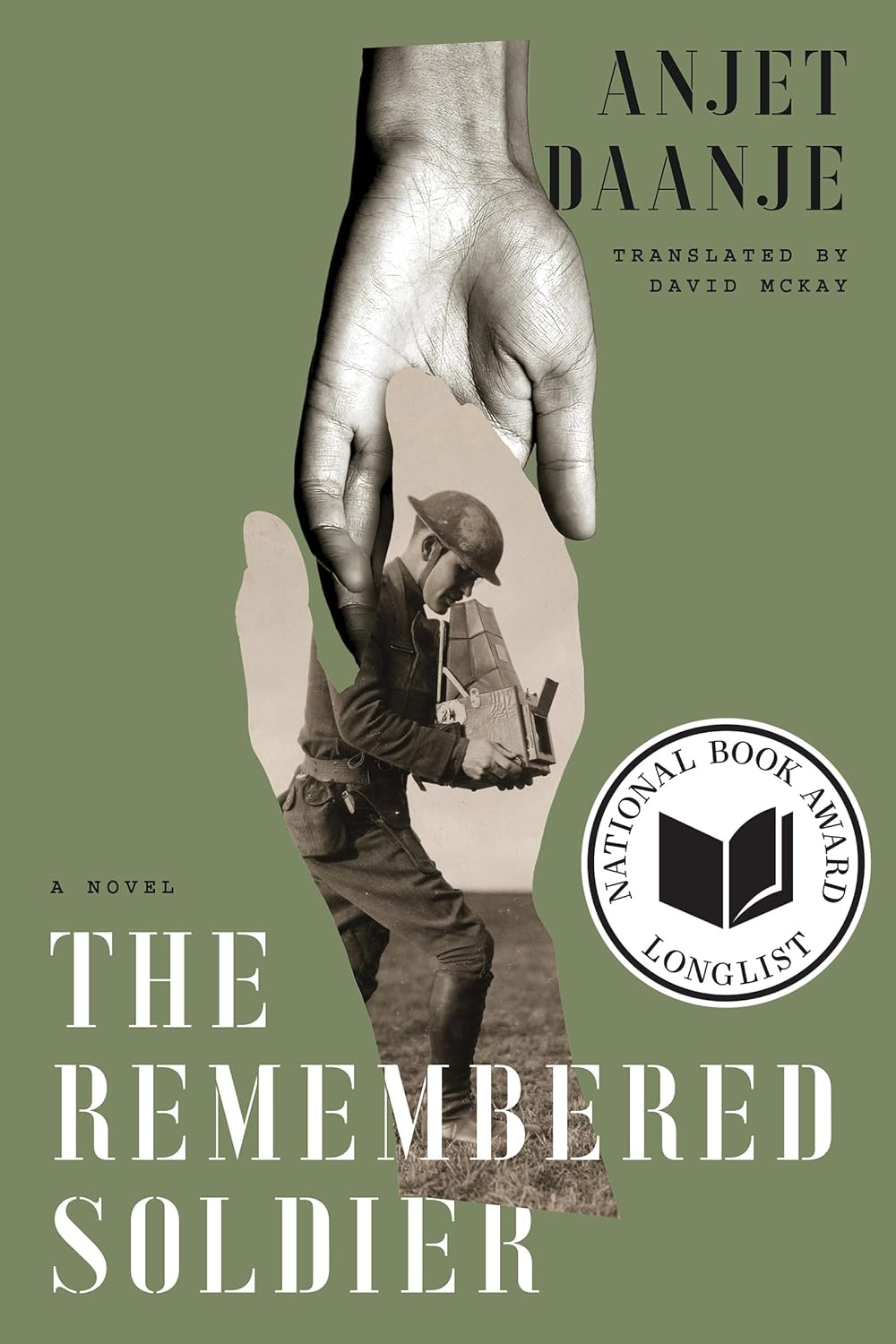
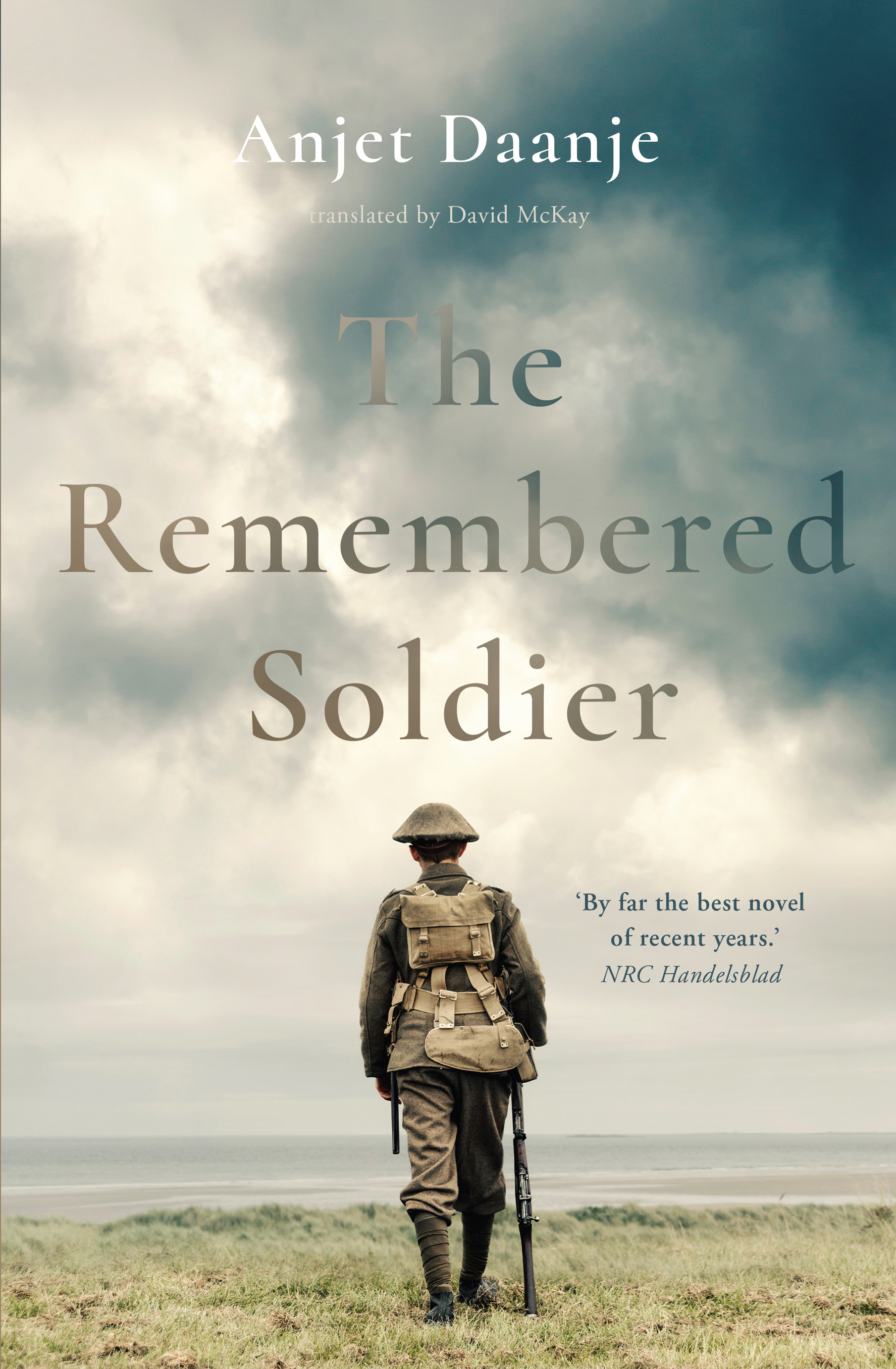
The Remembered Soldier is a variation on the familiar “is he / isn’t he” imposter story–The Return of Martin Guerre, for instance, or Brat Farrar or The Scapegoat–except that in Anjet Daanje’s dreamlike (sometimes nightmarish) story of a soldier home from the war, the “is he / isn’t he” comes not from the soldier’s own assertion of his identity but from his amnesia and the story that Julienne, who claims him as her long-lost husband, tells him about the past.
Julienne finds him–after years of searching, she tells him–at the asylum where he has been living, where his memory loss makes him envied by the other residents, “never tormented by memories or nightmares.” “Everyone fills him in just as they please, like a coloring book,” he knows, “and he cannot stop them.” Julienne is so overjoyed at the sight of him that it seems unthinkable that he isn’t her husband Amand: “never before has he seen so much genuine beaming happiness,” “he had no idea one person could look at another that way.” She understands that he cannot remember her, or their children, or their life together, or their photography business, but once he returns with her to their modest home, she works tirelessly to fill in the vast emptiness where his memories should be.
It is an effortful business, rebuilding Amand into the man Julienne tells him he used to be, especially because he is subject to blackouts, spells he cannot remember afterwards and during which he can wander away, or become violent. Julienne is persistent, patient, relentless, and loving, and bit by bit they do become a couple, falling in love all over again, as they come to characterize it. Through the story of their reconnection, though, wind slight but ominous threads of doubt: inconsistencies in Julienne’s account of their past, details that don’t quite hang together, recollections Amand thinks come back to him that don’t quite match what he has learned as his, as their, history. Each time, Julienne explains it all away, but in his dreams especially, Amand is constantly struggling with conflicting images that keep him confused about what is truth and what is not. The blackouts become long spells in which he is “another man,” but who is that man, and are the thoughts and memories he has signs that Amand is sinking back into the madness from which Julienne rescued him, driving out the newly relearned facts of his past life, or are they symptoms that his actual memory is coming back, threatening to expose his new life as the lie? Who is he–and who does he want to be?
The plot of The Remembered Soldier is easy enough to summarize. What makes it an extraordinary novel is the intensity created by our immersion in the soldier’s point of view, so that we move with him in and out of his waking and dreaming, of the gruesome glimpses of the war that recur and then become interwoven with both real and dreamed experiences. Daanje’s sentences (as rendered by translator David McKay) are long and winding and constantly moving forward, which seems appropriate to the soldier’s feeling of being propelled along by a narrative over which he has little control. It’s a long novel, but that too feels fitting, because although there is a mystery element to it, a question that needs to be answered, the answer to that question turns out to be a complicated one, and its resolution depends less on concrete facts than on the soldier’s long experience of trying to understand who he is. If that resolution is satisfying to us (and for me the ending was entirely satisfying, and quite moving) that’s because of our long experience, with him and with Julienne, as they struggle to find their way forward in a relationship that, whether he has always been her husband or not, is new now, something trying to flourish amid the rubble of their pasts.
There are a lot of specific elements within the novel that tie into its ideas about love and mourning and marriage and memory. A central one is the photography business Julienne and Amand run. Their most profitable enterprise is posing Amand, uniformed, in photos for women whose husbands are lost or dead in the war: he fills in for their loved one, providing them with the memory they wish they had. Is this what Julienne has also done, on a more literal and expansive level, by bringing home a soldier to fill the hole in her heart and her life left by her missing husband? The story of Amand’s miraculous return is great publicity for them; it gives their customers hope that perhaps one day their men will also come home. How much does the truth of the story matter, if it creates meaning and does good? Similarly, how much does the past matter, if out of the present you can make something real? What is it, too, that makes a marriage? Is it a shared history, or is it the day to day effort to be together, to be present for each other?
It feels hard to do justice to this novel without quoting it a lot, because it is written in such a particular way. I worried a bit at the outset that I would tire of it, but I found it mesmerizing and almost hypnotic. I did not try to read it in a ploddingly word-for-word way; I let myself be carried along, not skimming but just constantly moving forward, with the momentum of the prose. Because it is so intense, I found even this quite exhausting and could only read it for an hour or so at a time. I put a lot of post-its in to mark key passages, so I’ll include a couple of samples. Here’s a bit from relatively early on:
Did you see me, she whispers, was that you, and he tries to remember sitting in that train full of foolhardy soldiers, the chaos in the station, her and Gus, himself in uniform, and he is seized by the certainty that he embraced her there on the platform amid all the other parting couples, he pressed her to him, and she asked him if he would say her name one last time, in her ear, and he did, over the hissing of a locomotive, and he felt her breath catch as if she had to cry, but she controlled herself, and he was a traitor, because he was secretly looking forward to the war, he remembers that, a feeling of excitement because of the adventure that lay ahead of him, and he was leaving her behind in their old, monotonous life.
And he tells her about that, the embrace, the adventure awaiting him, and she says, you must be wrong, and she tells her version again and then he tells his, and they compare and repeat and negotiate, and the longer they talk, the more she starts to doubt, she says maybe she felt so guilty about her naivete that she rewrote his departure without realizing, and she tells it as he says it was, trying out the new sentences, fitting them into her old story, and then she tells it again herself, in exactly the same words, like a magic charm, and he notices she’s relieved now it seems he was just as naive as she was, even more naive, at least she had the sense to be scared.
And here’s some from later on, when his doubts have intensified without bringing any certainty:
And she opens the door and says he can wash now, he walks past her into the kitchen and asks her, speaking German on purpose, if she wants him to wake her when she has a nightmare, and he can see she understands, she’s about to answer, just in time she swallows the words on the tip of her tongue, hmmm, she asks vaguely, and he repeats the German sentence, and she shakes her head, can’t you speak German, he asks, and she says she can’t, just Flemish and French, she says. And when she sees he doesn’t believe her she changes her story, she tells him she can get the gist of it because it’s so much like Flemish, but he should never speak it, she warns him, it’s the language of the occupiers, so it’s dangerous, and he closes the kitchen door and she waits in the hallway while he’s washing in her soapy water with her hair floating in it. And what if she’s Käthe, what if he made up Käthe to escape her and her conviction that she can cure him of his guilt, what if this is his life, this life with her, not for one more week but until his death, and a suffocating feeling grips his throat, an immense, irrepressible longing for a place where he could belong, and the war is over and Käthe doesn’t exist, so now where can he go.
I can honestly understand why someone might read those excerpts–less then two pages total out of almost 600–and think “not for me.” I’m surprised I was so gripped. My summary account of the novel has of course left out a lot of the details that create such an immersive world, including the historical setting and the local terrain. There is plenty of the kind of stuff we expect from WWI fiction–trenches, horrors, senseless death. This material also feeds the novel’s interest in blurring lines between what’s real and what’s not: all of the soldiers in the novel struggle to reconcile what they have done and witnessed in the war with the ordinary lives they have returned to. If only all that were just a nightmare! I’m not an expert in WWI literature but I have paid some attention to it, partly through my interest in Vera Brittain’s memoir, and also just from reading and teaching Timothy Findley’s The Wars and some of the WWI poets. Nothing about The Remembered Soldier felt tired or cliched to me. I’m not surprised it was longlisted for the International Booker and won the Republic of Consciousness Prize.
Sam Sacks, whose praise for The Remembered Soldier helped convince me to read it, mentioned on Bluesky that he thinks Daanje’s newest novel to be translated, The Song of Stork and Dromedary, is even better. And it’s inspired by Emily Bronte! I guess that goes on the “must read” list.
As I wrote in my review, just when you think there are no more novels to emerge from the carnage of The Great War, Anjet Daanje has produced a masterpiece.
I had a fight with an editor once over my use of “scintillating” – it just really was the exact word I needed! Not my fault that it has been cheapened by overuse! 🙂
I agree entirely with your assessment. I too was surprised — given its length — how eagerly I returned to it day by day. My only quibble, and it’s small, is that the children had such minor roles; I would have thought there would have been more interaction.
Loved this, shortlisted for my book of the year last year, and I’ve coincidentally just finished writing my review for her next book in English (out on 29/9 here in Oz – review and book!). This one is built around a pair of sisters based on the Brontës, so it may well be one for you (even if it is 700pp!).


As I wrote in my review, just when you think there are no more novels to emerge from the carnage of The Great War, Anjet Daanje has produced a masterpiece.
LikeLiked by 1 person
It seems like “mesmerizing” and “immersive” are irresistible terms for trying to capture the reading experience!
LikeLike
LOL I read a critique once of all the clichés people use to write about books (uputdownable etc). I was guilty of them all.
But what can one do? Sometimes, mesmerising and immersive are just the right words and we users of the English are lucky to have them!
LikeLike
I had a fight with an editor once over my use of “scintillating” – it just really was the exact word I needed! Not my fault that it has been cheapened by overuse! 🙂
LikeLiked by 1 person
I agree entirely with your assessment. I too was surprised — given its length — how eagerly I returned to it day by day. My only quibble, and it’s small, is that the children had such minor roles; I would have thought there would have been more interaction.
LikeLiked by 1 person
Loved this, shortlisted for my book of the year last year, and I’ve coincidentally just finished writing my review for her next book in English (out on 29/9 here in Oz – review and book!). This one is built around a pair of sisters based on the Brontës, so it may well be one for you (even if it is 700pp!).
LikeLiked by 1 person
I am definitely going to read it!
LikeLike
I probably preferred ‘The Remembered Soldier’, but it’s certainly a cut above your average contemporary novel 🙂
LikeLike
I must read this, not least to see if the theory I developed just reading the review, which I will not divulge, is in any way correct.
>
LikeLike