Daily practice with images both written and drawn is rare once we have lost our baby teeth and begin to think of ourselves as good at some things and bad at other things. It’s not that this isn’t true . . . but the side effects are profound once we abandon a certain activity like drawing because we are bad at it. A certain state of mind . . . is also lost. A certain capacity of the mind is shuttered and for most people, it stays that way for life.
The drawing class I’ve signed up for begins in about ten days. When I first mentioned on Twitter that I might do something like this, to be honest I wasn’t that committed to the idea: I was just floating it. But making a possibility public inevitably makes it more real, and the feedback I got was so encouraging that my motivation increased and I started looking around in earnest for plausible options. The one I settled on is called “Drawing for Adults.” Though the description explicitly promises that no experience is necessary, as it gets closer I get increasingly anxious about it, because as far as I’ve ever discovered I have absolutely no talent for drawing, not to mention no skill at it.
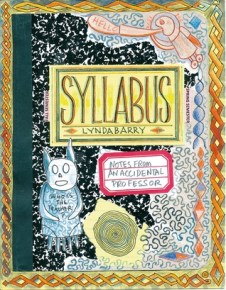
 I am glad, therefore, that one of the tips I got on Twitter (initially from Dorian, then endorsed by others) was to look at Lynda Barry’s book Syllabus. I wasn’t really sure what kind of book it was, but I have great faith in Dorian’s recommendations, so I promptly put a hold on it at the library and I’ve had it on loan ever since. My first reaction to the book was bewilderment. I do not have a good working relationship with graphic novels, and while Syllabus is not a novel, it is definitely a graphic something. (Syllabus reproduces and lightly contextualizes Barry’s teaching notebooks for courses she offered at the University of Madison-Wisconsin, where she runs the Image Lab.) Worse (I thought), it doesn’t even tell a story, so there isn’t even a narrative thread for a text-bound person like me to cling to. Every page seemed chaotic! I had no idea where to look first, or next, or after that. Finally, Syllabus focuses (I thought) on drawing comics, which isn’t really the kind of drawing I’m interested in.
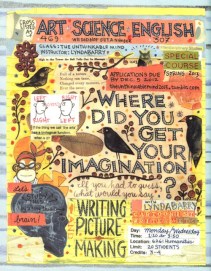 Still, my curiosity was piqued, so I decided to stop trying to figure the book out (which is a hard habit for an academic and literary critic to break!) and just browse around in it for a while to see what it might have to say to me. It turns out it did speak to me: both to the part of me that wants to, but is afraid to, put pencil to paper and draw something, but also, and perhaps more significantly, to the part of me that writes stuff. This is because Syllabus isn’t just a book about drawing comics: it’s a book about creativity more generally, about the interaction between our conscious (and often inhibiting) thoughts and our unconscious mind, and about the way our fears of doing something badly hold us back from discovery and improvement–and also just from the potential fun and rewards of artistic self-expression.
Syllabus is loosely about these things, because it is not a textbook or a scholarly study (although Barry alludes to several of these, including especially Ian McGilchrist’s The Master and His Emissary, the introduction to which–following Barry’s instructions to her students–I have downloaded as further reading). This looseness, which frustrated me a lot at first, is actually what ended up making Syllabus accessible to me, because it let me just focus on comments or ideas or exercises that resonated with me and then sit with them for a bit. Then I carried them with me as I went through the book again from the beginning, and a lot more of it (including its seeming disorder) made more sense to me.
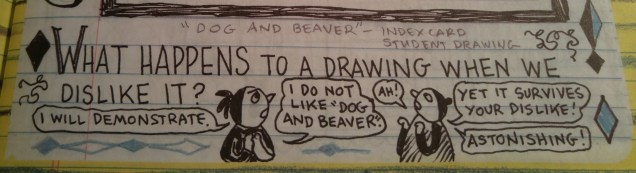
Syllabus includes a lot of different interesting, entertaining, and thought-provoking elements, many of them not really suited for direct application to my own classroom or working / writing life–though it’s possible I underestimate the ways I could incorporate sketching, concentration exercises, or notebooks into my pedagogy. What I liked best about it was the way Barry directly addresses our (OK, my) fear of putting things out into the world that (other people might think) are not very good. This does not mean I don’t think we should strive to do the best work we can–but especially at the beginning of a process, or during a creative process, focusing on external judgment or validation, or even focusing on our own critical responses, might stop us from even beginning. “When we are in the groove,” Barry says, for example,
we are not thinking about liking or not liking what is taking shape, and it isn’t thinking about us either. . . . Liking and not liking can make us blind to what’s there. In spite of how we feel about it, it is making its way from the unseen to the visible world, one line after the next, bringing with it a kind of aliveness I live for: right here, right now.
“Worrying about its worth and value to others before it exists,” she remarks in a later section, “can keep us immobilized forever. Any story we write or picture we make cannot demonstrate its worth until we write it or draw it. The answer can’t come to us any other way.” I don’t see this as insight or advice that commits us to the kind of “half-assed” model of creativity championed by Elizabeth Gilbert in Big Magic. At least as I see it, it’s one thing to find the courage to start, to take chances, to see what answer comes to us, as a project takes shape; it’s quite another to quit working on it when we know it’s only “good enough” instead of as good as we can make it. Where along that spectrum we’ll stop with any particular project will, of course, depend on its purpose in our lives.
 One particular bit from Syllabus that I know I will keep thinking about is the one I chose as my epigraph for this post, about abandoning activities we are bad at. I’ve often thought that one of the best things about advancing through life, and particularly through one’s education, is the freedom you gain to abandon things you dislike and/or aren’t good at. As I’ve often said to my own children, one of the best things about university is that you can finally choose your courses to play to your interests and strengths. It’s not that I don’t think we can get good (or at least better) at things: I wouldn’t be a teacher if I believed that! I believe in program requirements, too, because that’s how we discover what else we might be good at, or want to be good at, or just put a lot of effort into. (That’s how I became an English major, after all, with lasting consequences!) Still, I was very glad to leave some kinds of effort and attention behind me (I’m looking at you, calculus!). I hadn’t really thought about the way this process, while it enables you to flourish in your chosen domain, can also end up making you more risk-averse, or reinforce reductive narratives about what you are in fact “good” at.
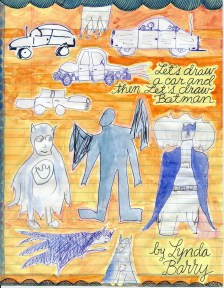
It has occurred to me before that there is pedagogical value in being, once again, a beginner at something. (Appropriately, in this context, those reflections were prompted by my struggles to read graphic fiction well.) That is certainly what I’ll be at my drawing class. Syllabus gives me a bit more courage to face it, and some useful ways to talk to myself about it. I’ve also had a little fun already drawing some self-portraits “in the style of Ivan Brunetti,” which she proposes as “a quick and workable alternative to stick figures.” This alone could mean a significant improvement in the illustrative (?) sketches I sometimes make on my classroom whiteboards! I admit I really hope, though, that my teacher doesn’t start by asking us to draw Batman.

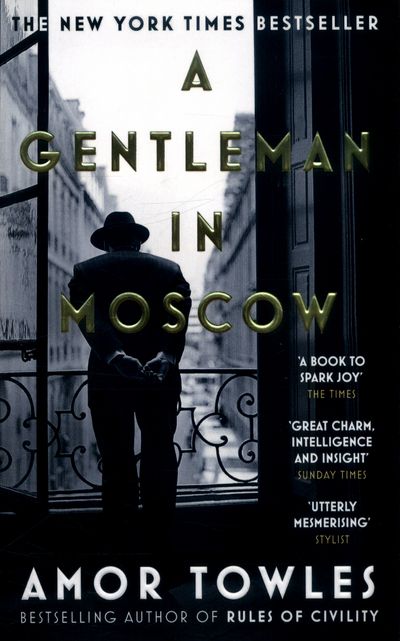

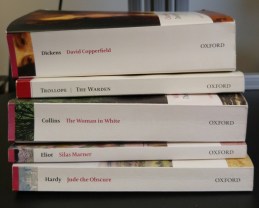 As if things in this term’s classes aren’t busy enough (and about to get busier, as next week I get in both sets of term papers and give the final exam for Pulp Fiction) but book orders for next fall were also due. It’s not a set-in-stone deadline, and quite reasonably a lot of my colleagues put it off until the summer, but I’ve actually been playing around with possible book lists for my Dickens to Hardy class since Austen to Dickens wrapped up last term, so I figured I could at least get that one settled.
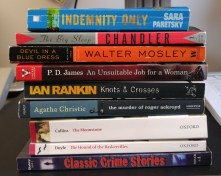 In the end I also submitted my book order for Mystery and Detective Fiction today. If I’d waited I might have made more changes to what has become my ‘standard’ book list for the course, but though I have been considering some more recent Canadian books for inclusion, I wasn’t completely convinced either of them would work well in class (
 Those are my only two courses for the fall and then I’ve got a half-year sabbatical next winter, so that’s it: my book orders for next year are done! For the first time in a long time I’m not teaching a first-year class in 2018-19. I’m glad, not because I don’t enjoy teaching introductory classes but because I want to think carefully about which one I’ll teach next, and especially about whether I’ll put in for Pulp Fiction again. We recently revised
  The Honourable Schoolboy itself is anything but brief, and that turned out–more or less–to be my problem with it. Of course, I am no stranger to long books, and I would never use scale on its own as a measure of literary merit. I’m also very aware that one person’s “too long” is another person’s “wonderfully immersive” or “lavish” or whatever. The question has to be whether, for you as a reader, the pay-off is proportional, or whether the book’s scope (whether broad or narrow) is the appropriate means to its ends. George Eliot said of Middlemarch, “I don’t see how the sort of thing I want to do could have been done briefly”: I have decades of experience now at explaining why I think she’s right about that, not to mention how we can approach Middlemarch so as to appreciate how she uses all the space she claims for it. The conspicuously shorter Silas Marner, in contrast, is pretty much perfect as it is. Being long, or being short, is not in itself either a necessary or a sufficient condition for admiration or pleasure.
 I can imagine that having taken these risks to get so much material, a writer would want to make use of it all! But maybe that personal investment also worked against him, making him reluctant to leave anything out, or unable to choose between what he knew and what his story actually needed.
 The other thing I really liked about The Honourable Schoolboy is Le Carré’s prose–which might seem contradictory, given my complaints about the novel’s length, but that just goes to show that good writing isn’t everything! Here’s just one example of the kind of sharply evocative description that is over-abundant in the novel:
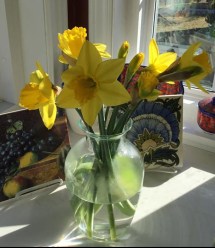 The good news isn’t specifically about what’s happening in my classes this week (although I hope there is some connection): it’s good news about my teaching more generally. This week I learned that I am this year’s recipient of the Faculty of Arts and Social Sciences Award for Excellence in Teaching.
 Given the role that Novel Readings has played in my teaching life–as a vehicle for reflection and a place where I have both shared and received ideas and encouragement about teaching–it is gratifying to know that my blogging was part of the case made on my behalf, and that my success at generating “conversations both within the university and in wider circles” was cited by the committee that selected me to receive the award this year. I started blogging about pedagogy when this kind of outward-facing work was still relatively uncommon for academics and was (as it still largely remains) not entirely congruent with the university’s standard operating procedures. I have found it intrinsically valuable, for the process itself and for the conversations and communities it has brought me into. For that reason alone I would keep it up in any case, but I admit it is nice to have some institutional recognition that it contributes to our core mission.
 And it has felt even better sharing my good news and basking in people’s happiness on my behalf. I got a lot of help from my friends, both online and off, when things went badly for me; now everyone has been wonderfully supportive about this good news. Social media certainly has its down sides (as we are only too well aware at this point), but there’s also something magical about the way it creates a vast web of connections–intangible perhaps, but still very real–between so many people across such distances. I hesitated before putting my good news out there in case it seemed self-aggrandizing, but I’m so glad I did. Why should we be afraid to invite a bit of cheering for our accomplishments, after all? I was reminded of one of my favorite points from Molly Peacock’s wonderful and inspiring book
  One of the things (OK, the many things) I can be persnickety about is what to call whatever it is that I write here when I write about books. I call the results “posts,” not “reviews,” not because I consider a book review a limited or limiting form (not by definition, anyway, though in practice published reviews are very often limited, in scope if in nothing else) but because when I’m writing what I think of as a review I feel accountable, both to the book and to the implied audience. As a bare minimum, that accountability means reading every word in the book scrupulously, and then crafting a narrative about it that is very carefully considered. No review is authoritative in any absolute sense, of course, but when I’m wearing my Official Reviewer hat I aspire to a certain kind of confidence in my understanding of the book I’m writing about. Here, in contrast, I can write whatever I want, no matter how inadequate my understanding might be. My blog posts are narratives of my own reading experience, and so I’m answerable only for being honest and thoughtful about that.
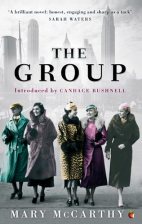 That’s an awfully long preamble to these remarks about Mary McCarthy’s The Group, which my book club met yesterday to discuss. As you might have predicted, I was putting off getting to the book until I’d said all that other stuff because I did not do a good job reading it, and as a result I wasn’t sure I should write about it. But then I remembered that I was blogging about it, not reviewing it, and so it’s okay for me to admit that and write about it anyway! If you want commentary by someone who is much better informed about The Group, I highly recommend
 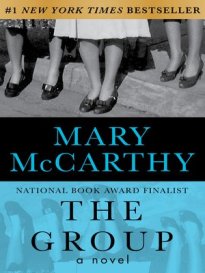 I never had a conversion moment, but I’m glad I persisted with my reading, not just because it meant I could show my face at my book club but also because the book did turn out to be better than my first impressions of it. My experience improved as I got more used to the style–but I also gave myself permission to skim some of the relentless cascade of details that made up so many of those dense paragraphs. I understand that this may seem precious coming from a Victorianist! I tried to put my finger on what made McCarthy’s exposition seem so long and unpleasant to me in spite of my love for long and excessively detailed 19th-century novels, and I think it’s the same thing that made me recoil from most of her characters: she treats everything, and everyone, so coldly. Ultimately a lot about The Group is very sad, in some cases even tragic, but the novel has none of the humanity, none of the compassion, that its own stories could reasonably summon up. The word ‘sociological’ came up a lot in our book club discussion, and by and large we’d all found her depiction of her women’s lives interesting. But there’s something clinical about each of the women’s stories, with McCarthy observing them shrewdly, scrupulously, often wittily, but never sympathetically.
 I’m not sure if I liked the second half of the book better than the first because I adjusted to (or compensated for) McCarthy’s prose or because I liked the later characters better. Libby’s story was the first one that really engaged me, for the not especially good reason that I’m interested in writing and publishing, and that whole world has a sordid kind of glamour to me as a result. At my book club we were unanimous in liking Polly’s story the best; her relationship with her father is perhaps the only tender one in The Group, and her marriage also seemed like a respite from the acidity of the novel’s other relationships. (I should say that overall everyone else was quite enthusiastic about the novel–listening to them explain why helped me appreciate it better.) Kay’s reappearance in her story in a very different situation made me rethink my earlier reactions to her and her marriage, and the novel’s ending also made me realize that I had missed something of the forest because I was focusing too hard on the individual trees.
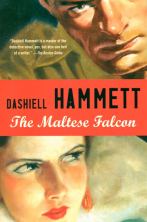 But good things happen in the second part of term too. For one thing, students have got their bearings in the course materials and expectations, so I can spend less time on logistics and reminders and saying “it’s in the syllabus.” And for another, the reading and discussion continues and sometimes even gets better because we’ve all warmed up. In Pulp Fiction last week, I thought there was a noticeable improvement in the students’ Reading Journals, as if they “get” The Maltese Falcon better than they did Valdez Is Coming–which, I’ve belatedly realized, is a more subtle novel than I thought, hard to get an interpretive grip on if you aren’t used to reading that way. Though the actual plot of The Maltese Falcon is plenty bewildering as it unfolds, the prose and the issues and the characters give us more to grab on to. The class is writing their papers on it now: we’ve got an editing workshop for their drafts on Friday, then they turn in revised versions next week and we start our unit on romance, which I’m quite looking forward to. I hope they are too!
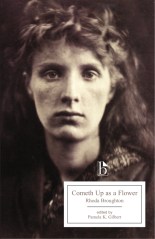 In Victorian Sensations we’ve started Rhoda Broughton’s Cometh Up as a Flower. When I first read it I wasn’t convinced of its merits, but it turns out the magic trick is to read it right after you finish reading East Lynne! What a relief to turn from Wood’s dreary moralizing and Isabel’s unrelenting gloom and repentance and the whole tawdry, disorganized assortment of subplots to a sassy young heroine who hates her sister, canoodles with a handsome soldier in the garden and finds it blissful, not shameful, and just adores her dear old dad! Not much actually happens in Broughton’s novel, but in the context of our discussions of other sensation novels, that in itself has provoked some discussion, as has figuring out what made Broughton’s very different work equally scandalous–mostly, Nell herself. In general, the consensus in the class seems to be that Nell is refreshing, if not altogether likable; there will be lamentations, I’m sure, about the turn her story is about to take as well as the shift in her tone from defiant to repentant by the end. I’m so impressed with this group of students: often on the way to class I’m wondering a bit anxiously if we’ll find enough to talk about, and I always end up surprised that we’ve run out of time and I have to shut down discussion. One factor is that there are always two students charged with bringing in talking points to get us started, and of course I bring notes and materials myself–but basically, they’ve got this, which is great.
 In Pulp Fiction, this is our second and final week on The Maltese Falcon (no, it does not seem like enough time, but we have other work to do too!). Leading up to our discussions of the novel I made a big deal about Raymond Chandler’s claim that the novel “demonstrated that the detective story can be important writing. The Maltese Falcon may or may not be a work of genius,” he says in “The Simple Art of Murder,” “but an art which is capable of it is not ‘by hypothesis’ incapable of anything.”
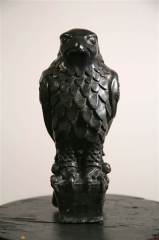 Two of the questions I asked my students to think about for class discussion this week were what the falcon ultimately stands for–to individual characters and, perhaps not the same thing, in the book as a whole; and how they viewed Brigid O’Shaughnessy by the end–as a femme fatale or a woman fighting for survival in a man’s world. Today we also considered what it means that the actual statuette the characters have been chasing (and have killed and died for) in the novel turns out to be a fake. It’s one thing to imagine what it might mean to actually get whatever it is that you most want: what if it isn’t worth it after all, or it is but now you don’t know what to do next? But what if you think you’ve got it and it isn’t real? Gutman recovers quickly and proposes they keep looking: after all, the real one is still out there, isn’t it? Isn’t it the quest itself that really matters? Or in chasing their dream are they missing their chance to actually live?
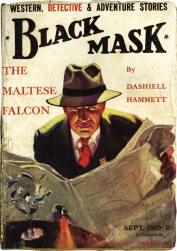 It seems pretty clear that Sam is missing some kind of chance by following his dream, except that his is a dream of justice for his murdered partner. One of my favorite things about this novel–which in many ways I find deeply unpleasant–is how shadowed Sam’s choices are by their consequences. In the end he chooses justice over love, which is (as Effie comments) the right thing to do; Sam himself gives a long list (literally numbered) of reasons why he should turn Brigid in, against which there is only “the fact that maybe you love me, and maybe I love you.” “It isn’t always easy to know what to do,” he tells Brigid when she first comes to see him pretending to be the innocent and vulnerable “Miss Wonderly.” He may in fact know exactly what to do, but the ending to the novel shows that that, too, isn’t easy: he may live up to his principles, but he also has to live without love, without trust, and probably without happiness. In a different novel, the alternatives might not be so stark, but Sam lives in world where “if they hang you, I’ll always remember you” really does, I think, count as romantic. While Effie may agree with him in principle, though, she also recoils from him, a judgment I share.
 In Victorian Sensations we finished up East Lynne this week–with some relief, I think, though I was glad to hear some students saying they did enjoy it: curiosity about what would happen next helped them keep going, even though it dragged a bit at times. One of the reasons I think this novel falls short of being “important writing” is its ineptness, artistically speaking: a lot of it seems quite haphazard or just plain incoherent, and our well-trained desire to find patterns and unities was frequently frustrated. That’s not to see it doesn’t contain many interesting elements, but I don’t really think that, through them, Wood is saying something worth really thinking about. She does have plenty to say, but it’s the very heavy-handedness of her overt message that becomes tedious. I said before that the novel reads very clearly like a cautionary tale–but so, of course, is Vanity Fair, which has a similar moral lesson for us: live well so you have no regrets on your deathbed. “Oh, Barbara,” says the tediously honorable Mr. Carlyle after presiding over the pathetic deathbed of his first wife:
 It’s inconsistent, I realize, to say that I found I Am, I Am, I Am disappointingly slight and to say that I’m also glad it did not fall into philosophizing. But my dissatisfaction and my relief actually go hand in hand: it’s hard to be profound, and books that try and fail seem worse, to me, than a book with fewer pretensions. That’s why I preferred Atul Gawande’s

 Novel Readings