All were in sorrow, or had been, or soon would be. [roger bevins iii]
It was the nature of things. [hans vollman]
Though on the surface it seemed every person was different, this was not true. [roger bevins iii]
At the core of each lay suffering; our eventual end, the many losses we must experience on the way to that end. [hans vollman]
We must try to see one another in this way. [roger bevins iii]
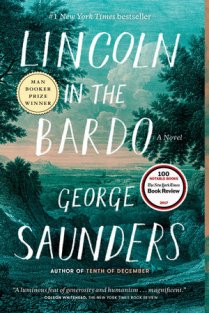
I realized Lincoln in the Bardo was going to work for me about a dozen pages in. The first little bit was hard going: who are these people? are they going to prattle and pontificate like this for the whole book? (By the end of the novel, I knew these two well enough to want them to stay, even though by then I also understood that it was better they should go.) Then the voices multiplied, and it was easier, if still disorienting; then we were at the party, and there were flower arrangements and “hives … filled with charlotte russe” and venison steaks; and then there was this:
Yet there was no joy in the evening for the mechanically smiling hostess and her husband. They kept climbing the stairs to see how Willie was, and he was not doing well at all. [Kunhartdt and Kunhardt, op. cit.]
A lot else goes on in Lincoln in the Bardo besides the illness, death, and interment of 11-year old Willie Lincoln.Saunders takes Lincoln’s mourning for his lost son and his own extraordinary, creative, phantasmagorical vision of the inhabitants in Willie’s new home, at once among and apart from the living, and builds up a powerful story about both historical particulars and human universals. Lincoln enters the Georgetown cemetery a man broken by grief; he is ultimately overtaken by what seems like an entire nation, with all its sins and aspirations and accomplishments and omissions. In the process we too take on a multitude of stories, no less powerful (to my ongoing surprise) for coming to us in fragments. The novel is a swirl of voices, but they are placed and paced so that the narrative accumulates momentum and gains rather than loses power from the juxtaposition of the drama in the cemetery with comments about the Lincolns and their loss from observers and historians.
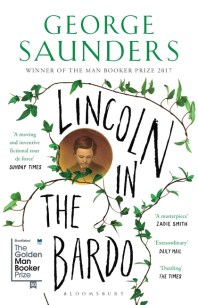 It’s a bravura display of narrative ingenuity, and especially given how fantastical the premise is, the result could easily have been (and I fully expected it would be) flamboyant gimmickry, clever and original but soulless. It isn’t, though: I think Lincoln in the Bardo is actually one of the most touching and heartfelt novels I’ve read in years. However far it spirals away from reality, and however abstract its political or philosophical or historical implications become, it always comes back to the hardest and most intimate truth of all: nothing we love lasts. “None of it was real,” says roger bevins iii near the end:
nothing was real.
Everything was real; inconceivably real, infinitely dear.
These and all things started as nothing, latent within a vast energy-broth, but then we named then, and loved them, and, in this way, brought them forth.
And now must lose them.
This is the reality Lincoln faces as he puts his beloved son in a box in a marble crypt and walks away (“imagine the pain of that, Andrew, to drop one’s precious son into that cold stone like some broken bird & be on your way [in ‘Wartime Washington: The Civil War Letters of Isabelle Perkins…]). “The president,” reports Mr. Samuel Pierce in his “private correspondence,”
turned away from the coffin, it appeared by sheer act of will, and it occurred to me how hard it must be for the man to leave his child behind in a place of such gloom and loneliness, which never, when responsible for the living child, he would have done.
“When a child is lost there is no end to the self-torment a parent may inflict”:
When we love, and the object of our love is small, weak, and vulnerable, and has looked to us and us alone for protection; and when such protection, for whatever reason, has failed, what consolation (what justification, what defense) may there possibly be? [Milland, op. cit.]
 Willie’s death is as much the occasion for Lincoln in the Bardo as its subject, and there are many other sorrows recorded in it–many losses as or even more wrenching, many deaths as arbitrary or worse, and many lives that before those deaths were more deprived, more isolated, than Willie’s, that never had the kind of love that brings his stricken father out into the dark, cold night to sit one last futile time with his son. The world is much bigger, and has much bigger problems, than little Willie. His Presidential father, for one thing, carries the burden of leadership alongside his personal responsibilities and feelings. Lincoln imagines his own grief multiplied by the thousands dying in the Civil War:
He is just one.
And the weight of it about to kill me.
Have exported this grief. Some three thousand times. So far. To date. A mountain. Of boys. Someone’s boys. Must keep on with it. May not have the heart for it. One thing to pull the lever when blind to the result. But here lies one dear example of what I accomplish by the orders I–
How should such personal suffering be weighed against the political and moral causes for which these boys are dying? “Did the thing merit it,” Lincoln wonders. “Merit the killing”:
On the surface it was a technicality (mere Union) but seen deeper, it was something more. How should men live? How could men live?
Lincoln believes that there is an ideal, an aspiration, worth fighting for: “all of it, all of that bounty, was for everyone, for everyone to use, seemingly put here to teach a man to be free, to teach that a man could be free.” “The thing,” he concludes, “would be won”; he leaves the cemetery with his resolve restored and, significantly, accompanied in spirit by someone whose sadness is a motive not for retreat but for battle:
Sir, if you are as powerful as I feel you are, and as inclined towards us as you seem to be, endeavor to do something for us, so that we might do something for ourselves. We are ready, sir; are angry, are capable, our hopes are coiled up so tight as to be deadline, or holy: turn us loose, sir, let us at it, let us show what we can do. [thomas haven]
They ride “forward into the night, past the sleeping houses of our countrymen,” their unity a hopeful symbol of common cause, an optimistic invocation of a better, if distant, future.
But Saunders never lets these big ideas overpower the simplicity and finality of death, which is what gives his novel its almost unbearable poignancy. After all, whatever our unfinished business or our unfulfilled promise, no matter the strength of our loves or our hates, one day our wish for “the great mother-gift: Time. More time” will be refused. He does at least offer some consolation in his enumerations of the “things of the world,” things that are no less precious–that are perhaps even more so–for being impermanent:
Pearls, rags, buttons, rug-tuft, beer-froth.
Someone’s kind wishes for you; someone remembering to write; someone noticing that you are not at all at ease. . . .
Geese above, clover below, the sound of one’s own breath when winded. . . .
Tying a shoe; tying a knot on a package; a mouth on yours; a hand on yours; the ending of the day; the beginning of the day; the feeling that there will always be a day ahead.
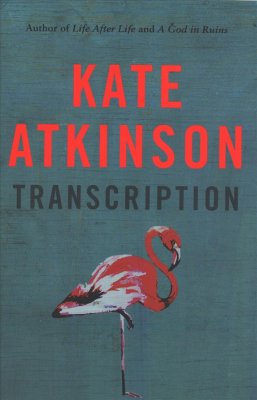 I wasn’t looking forward to Transcription with quite as much enthusiasm of some readers I know, as my own history with Atkinson is a bit mixed. But I know her to be an excellent story teller, with smooth fast-paced prose and an eye for vivid detail and an ear for good dialogue, and the reason I have quibbled with some of her recent books is because I have found them interesting enough to take seriously and ultimately quarrel with.
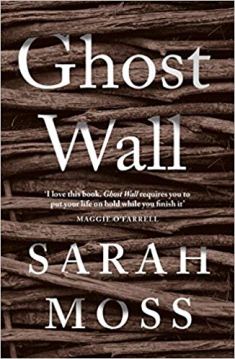 Cold Earth literalizes that haunting in a way that Ghost Wall doesn’t quite: in the newer novel, the spirits animated by artifacts of the past are those of contemporary people acting on what they think they’ve learned, while in Cold Earth Moss teases and frightens her characters and her readers with the possibility that the dead still move among us. Imagination? Delusion? Projection? Perhaps–but to at least one member of the team digging in their remote archaeological site on the coast of Greenland, it is a near certainty that their work has disturbed something more than relics and bones.
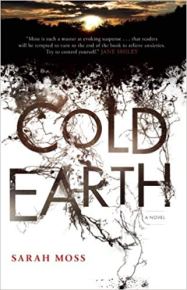 Cold Earth is intense and suspenseful, but it is not a thriller or a horror novel, or (except indirectly) a dystopian one. Moss focuses above all on her characters–the novel is told by several of them in turn, in the form of letters they write to people back home–as they puzzle over their finds and try to interpret how their predecessors in that location lived and died. Each of them has brought a personal history to Greeenland: each of them, in a way, is like an archaeological site of a different kind, and there is something at once comforting and devastating in the way Moss, by setting them down among the ruins of a past community, evokes the inevitable and unpredictable continuity of death. Most of us probably imagine that “history” is something that happens to other people, but by the end of Cold Earth all of its characters have been forced to see they too will eventually be the ones in the ground. The chilling question the novel provokes is whether there will be anybody left to dig them up and wonder about their lives.
 In Mystery and Detective Fiction we’ve just wrapped up our discussion of The Murder of Roger Ackroyd. It’s been an interesting fall to be teaching this course. I always open it with some discussion of the differences between “literary” and genre fiction–not just what those differences are presumed to be but how they shape people’s expectations and evaluations of books on either side of the supposed divide. I imagine, however, that to students already accustomed to a literature curriculum that incorporates not just popular culture but a wide range of media (we have courses on both Chaucer and comics, on Shakespeare as well as Tolkien, on poetry and on television and video games) it sometimes seems as if in advocating for the intellectual gravitas of our course material I am arguing against a straw man.
 This term, however, both Margaret Wente in the Globe and Mail and Luke Brown in the TLS stepped up to show my students in real time that the debates about the literary merits of crime fiction are ongoing and can be both intense and judgmental. Wente published an op-ed decrying the degradation of our curriculum–yes, ours in particular: she singled out Dalhousie’s English department and Mystery & Detective Fiction was among the courses she specifically mentioned as symptoms of our decline. (I won’t link to Wente’s column, because I don’t want her bad faith and shoddy practices rewarded with clicks, but
 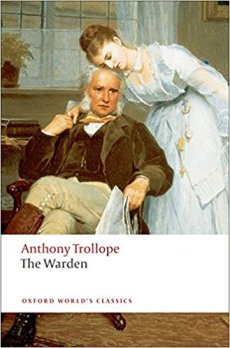 In 19th-Century Fiction we’ve just finished our work on The Warden. I’ve written a couple of times already about why Trollope feels unexpectedly pertinent to our current moment, whether as
  The Warden is an odd little book, and in many respects it is hardly a radical one. As we discussed in class, for instance, the bedesman who speak up for what they think is theirs by right are characterized as greedy and ungrateful, and they are ultimately punished for it, ending up worse off both economically and emotionally than they were under Mr. Harding’s wardenship. The novel’s social vision is fundamentally paternalistic. There is something at least potentially radical, though, about its ethical vision–about its casting as a modern-day hero someone who, when criticized, does not lash out but turns inward, and who then will not be dissuaded even by the most powerful people around him into ignoring what his conscience decides is right. Mr. Harding’s resignation does not really fix anything: the novel explores at several levels the complicated relationship between individuals and larger systems and institutions, and in doing so it raises timely questions about the possibility of meaningful moral agency in corrupt circumstances. I think a lot of us are struggling with this right now: the things we can do on our own seem so insufficient that it is tempting to stop trying to do anything. There’s some encouragement to us in the vicarious satisfaction we get from seeing the Warden persist. Even Archdeacon Grantly, imposing bully that he is, is ultimately no match for him! We all probably face a version of the Archdeacon’s exasperated “Good heavens!” sometimes, maybe especially when we try to take some small, imperfect, corrective action of our own. The Warden is not about taking to the barricades–but most of us aren’t going to do that anyway. Mr. Harding might at least inspire us to play our imaginary cellos with renewed vigor as we carry on living our own ethically complicated lives as best we can.
 Nance is a a healer and “handy woman” (midwife) who offers herbal cures and charms and other services to the local people. She believes (as do most of her neighbors) in the presence and power of the ‘Good People’ or fairies. Kent takes her time establishing how pervasive and powerful this belief is, distinguishing it from casual “superstition” and working to convey what the world looks and feels like to people imbued with convictions about threatening supernatural beings with designs on them–the effort they go to warding off misfortune and illness, the fear of missing a crucial sign or step that might have ominous consequences in their lives. “Sure, ’tis a dangerous time for a woman when she’s carrying,” Nance warns a man who comes seeking her help to protect his pregnant wife:
 My attention had been flagging a bit before the women’s efforts to cure Micheál picked up the pace of the novel; I wasn’t sure we needed quite so much time and detail spent on context, on evoking the place and time (Ireland in the 1820s) and people’s lives without much action. In retrospect, I understand better why Kent balanced the elements of her novel the way she did: we need to arrive at Micheál’s treatment / torture prepared to counter the visceral horror it evokes against the truth she has set up, which is that to the women involved it is not abuse or cruelty but a good faith attempt to save a child they genuinely believe has been stolen by the fairies. The novel is not set up (as, for instance, Emma Donoghue’s The Wonder is) as a contest between competing belief systems, much less an interpretive challenge to us about which version of events to believe, the ‘rational’ or the supernatural. We do end up at a trial in which both Nance and Nóra are held accountable in ways that run completely contrary to their version. Though it is hard not to agree with the prosecution that they have done a terrible thing, Kent has made sure we see their actions as reasonable and justifiable to them.

 Thinking about this has reminded me that I should finish reading Rita Felski’s The Limits of Critique, which looks like it will give me a more sophisticated way to understand and talk about the tension I feel between what I do and what I sometimes think I’m supposed to be doing. In her introduction she comments that many current critical approaches “subscribe to a style of interpretation driven by a spirit of disenchantment.” That sounds right to me. “Why,” she asks a bit later on “are we so hyperarticulate about our adversaries and so excruciatingly tongue-tied about our loves?” Since I escaped graduate school, my own critical practice has, I think, focused on becoming as articulate as I can about my loves, but I’ve sometimes felt a little sheepish about that, as if my methods, if challenged, wouldn’t really stand up to scrutiny. I look forward to Felski’s arguments–even more since I noticed that one of her chapters is on crime fiction, which rather neatly brings this post back to where it began.

 We’re barely a week into the term but already the sultry summer weather has mostly given way to the cooler crispness of fall. There will still be plenty of warm days well into October, but we won’t be able to take them for granted: they will have the golden haze of precious time stolen from looming winter. I am grateful, this year, for the change in seasons; the heat and humidity were oppressive this summer and the sense of being stifled and confined by the weather made my usual difficulties
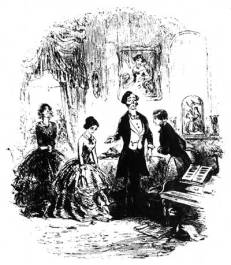
 In 19th-Century Fiction from Dickens to Hardy we’ve had a couple of classes on David Copperfield already. I used the first session to give some general introductory remarks on Dickens and then on Copperfield–comments on the exuberant excesses of Dickens’s style, for instance, and how we might think of it as a deliberate or strategic response to the kinds of problems his fiction is typically about. What could be less utilitarian than the joyful abundance of character and incident in a novel like David Copperfield? And what could be better nourishment for our hearts and imaginations than its sentimentality, its humor, its pathos, and its metaphorical and symbolic richness?