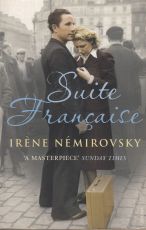
How sad the world is, so beautiful yet so absurd . . . But what is certain is that in five, ten or twenty years, this problem unique according to our time, according to him, will no longer exist, it will be replaced by others . . . yet this music, the sound of this rain on the windows, the great mournful creaking of the cedar tree in the garden outside, this moment, so tender, so strange in the middle of war, this will never change, not this. This is for ever . . .
There are two aspects to Suite Française: the (unfinished) novel itself–two parts of an imagined five–and the story of its author, whose arrest, transportation, and eventual death at Auschwitz haunt her fiction about occupied France. It is difficult for me to disentangle my reading of the former from my response to the latter. I was interested enough in Suite Française, which is almost uncomfortably cool and acerbic in its depiction of its characters’ various trials and traumas. There’s no room for sentiment or heroism in Némirovsky’s portraits of people under extraordinary pressure–almost everybody is to some degree petty and self-absorbed, but her upper-class characters in particular are more afraid of losing their luxuries and privileges than they are of the larger and more dire implications of the German occupation.
I found Part I (“Storm in June”), about the flight from Paris as the Germans approached, more gripping than Part II (“Dolce”), about the uneasy relationship between the French characters and the occupying forces: the drama was more overt. Part II is more subtle, both morally and emotionally, as it deals with the difference between “the enemy” in the abstract and the all-too-real human beings sharing homes and gardens and public spaces with the vanquished. One thing that particularly struck me about Part I was that Némirovsky mostly avoided clichéd wartime melodrama: although the evacuees are bombed, for instance, the carnage seems almost incidental, and the two most shocking deaths in that part are only indirectly caused by the war. Part II is primarily about character and atmosphere until near the end, when it turns out Némirovsky has been laying the groundwork for a plot twist that, as her notes show, was going to drive a lot of the action in the subsequent parts.
 I was interested, as I said, yet I wasn’t really captivated. The novel has a rather flat affect–perhaps the result of translation, but also reminiscent of Olivia Manning, who writes about war and violence and what survives with similar restraint. Némirovsky’s novel follows a cast of loosely or incidentally connected characters; the overall effect is somewhat like a sampler, or (as the title suggests) a “suite.” If Némirovsky had been able to finish the novel, the cumulative effect might well have been more than the sum of its parts; it seems shoddy to judge what seem like imperfections knowing that what we’ve got is only a fragment.
Having said that, I did appreciate the novel’s long descriptive passages, which–in contrast to its typically more stilted and utilitarian prose–are often very beautiful, even poetic. Here’s an example that also captures some of the paradoxes of the war-time world Némirovsky depicts. The French villagers have gathered to watch the Germans celebrate the anniversary of their occupation of Paris:
Little by little, darkness spread across the lawns; they could still make out the gold decorations on the uniforms, the Germans’ blond hair, the musicians’ brass instruments on the terrace, but they had lost their glow. All the light of the day, fleeing the earth, seemed for one brief moment to take refuge in the sky; pink clouds spiralled round the full moon that was as green as pistachio sorbet and as clear as glass; it was reflected in the lake. Exquisite perfumes filled the air: grass, fresh hay, wild strawberries. The music kept playing. Suddenly, the torches were lit; as the soldiers carried them along, they cast their light over the messy tables, the empty glasses, for the officers were now gathered around the lake, singing and laughing. There was the lively, happy sound of champagne corks popping.
“Oh, those bastards! And to think it’s our wine they’re drinking,” the Frenchmen said, but without real bitterness, because all happiness is contagious and disarms the spirit of hatred.
It is a memorable vignette, one of many such striking moments in the novel. If it sounds as if Némirovsky is holding out beauty or happiness as in any way the antidote to war and cruelty, though, that would be misleading: the aesthetic pleasure the French take in this spectacle does nothing to undo their resentment and fear at the German presence in their lives, or to compensate for their grief for the loss of their sons and husbands at German hands.
 The individual stories Némirovsky tells all have their interesting details, but one thing I thought was missing as I read along was any acknowledgment of the specific risk to Jews. This made me wonder exactly what Némirovsky would have known while she was writing in 1941-2. The Appendices include her notebooks and then correspondence from her and her husband Michael including his letters, increasingly desperate, to friends and connections after her arrest in July 1942. It is clear that he, at any rate, did not realize what it means–that it is almost certainly a death sentence. Not only does he try every means he can think of to find her and bring her home, but he even offers to take her place: “Can you please find out,” he writes a couple of months after her arrest,
if it would be possible for me to be exchanged for my wife–I would perhaps be more useful in her place and she would be better off here. If this is impossible, maybe I could be taken to her–we would be better off together.
By the time he sent this letter Irène had been dead for over a month. Michael himself was arrested in October 1942 and sent on to Auschwitz, where he died in the gas chambers. Their daughters survived only thanks to the courageous efforts of friends who sheltered them.
Maybe if I hadn’t read these documents immediately after finishing Suite Française the novel itself would have made a stronger impression on me. I found the appendices so compelling and immediate, though, so painfully real, that they overshadowed Némirovsky’s more muted and analytical fiction. The juxtaposition did raise questions for me about the kind of novel she wrote: about whether it deliberately lacks melodrama and avoids the horror and urgency her own story evokes or whether–though the included Preface to the French edition notes that she and her family “all openly wore the Jewish star” as restrictions on French Jews increased–she was spared the full painful understanding of what was really at stake until it was too late for her to write about it. (I’m sure there are answers about who know what when, though who believed what when is probably a somewhat different question. Then as now, it would have been hard to grasp the worst realities.) In any case, it is her personal story more than Suite Française that will stay with me, I think, which seems somehow both all wrong and entirely right.

 At first most of the tension of the novel comes directly from Anna’s personal situation, but when Anna and the children uncover a baby’s skeleton while digging in the garden, further layers accumulate. Anna becomes preoccupied with finding out the baby’s identity and thus gets drawn away from her book and into research on Colsay. We learn about the island with her, from her sources, and also from the 19th-century letters that make up yet another facet of the novel. The letters–which Anna eventually reads and incorporates into her work–are from May Moberly, younger sister of Alethea Moberly, the protagonist of Moss’s later novels


 I was relieved to discover that nobody else in my book club liked A Fortunate Age either. For once, I feel reasonably confident saying it’s not me, it’s the book! I don’t think we’ve been so unanimous in our dislike of any our choices, in fact, since the disaster that was Paula McLain’s
  I particularly puzzled over why I found its detailed exposition so tedious. I am on record as a fan of exposition! But by half way through A Fortunate Age I was impatiently skimming through its dense paragraphs of stuff that just didn’t seem worth taking more time over. Rakoff inadvertently furnished a clue with her epigraph, which is from Daniel Deronda. (Beware: If you’re going to invite a comparison to George Eliot, it may well work against you!) True, Gwendolen Harleth is every bit as self-absorbed and ignorant of the wider world as the characters in A Fortunate Age, but (and for me this is crucial) George Eliot is not: her account of Gwendolen’s youthful egotism and willfulness is suffused with wry compassion; the context for Gwendolen’s story is not just the relentless minutiae of her immediate experience but everything else the narrator knows and thinks about the world she lives in. Gwendolen’s limitations do not limit her novel–but Rakoff’s characters are all we get in A Fortunate Age, and they don’t repay our sustained attention. I’m not saying the novel needed exactly what Daniel Deronda has–an intrusive narrator, for instance, or profundity, both of which are risky ventures if you aren’t George eliot–but it needed a broader perspective somewhere, a sense of what kind of story it is ultimately telling about these people and this age, especially since the book aspires (as its title indicates) to be about an era, not just a few individuals.
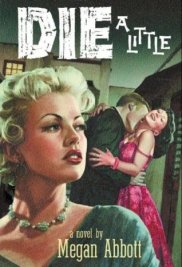 I didn’t think I had read any Megan Abbott before this year, but when I was at the library picking up You Will Know Me I realized that I had signed out one or two of her noir novels at some point in the past–probably while shopping around for ideas for Mystery & Detective Fiction or Pulp Fiction. I hadn’t put the pieces together, mostly because those books are (fairly cleverly) decked out with vintage-style covers which quite simply don’t look as if they belong with Abbott’s contemporary thrillers. (Shallow of me, I know.) I expect it’s also because I didn’t actually read them, or at least not more than the first few pages. It wasn’t personal; it’s just that noir is not my favorite genre–in fact, to a degree that might surprise the students in Mystery & Detective Fiction, I’m not a voracious reader of crime fiction at all, in any flavor, or not any more. When I do read mysteries nowadays, it’s almost always because I want to keep up with old friends, though I do try new writers intermittently, especially if there’s buzz, and sometimes I do like them–Tana French comes particularly to mind. Apparently, on the basis of that admittedly skimpy sample, Abbott was not among them.
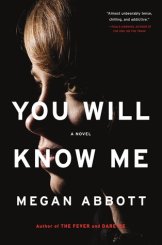 Anyway, lately I’ve been picking up enough buzz about Abbot (who has a new book out) that I thought I would give her what turned out to be another try. First I got hold of The End of Everything–but again I didn’t persist past the first chapter or so. It read like a YA novel, not just because it was centered on teenage girls but because it sounded as if it was written for them. Abbott seems like a self-conscious enough writer that I’m sure she was doing something on purpose with this style, and maybe she went on to do something twisty and surprising with it, but the scenario too seemed a bit pat and familiar and I wasn’t interested in reading on.
 I’m not necessarily calling You Will Know Me a bad book. These are (or are they?) the feelings, the reactions, a thriller depends on and aspires to–which is why I don’t typically read them. There is definitely overlap between thrillers and crime fiction, but for me, the best crime fiction depends on our taking a genuine interest in the people and the outcome, caring about what happens both because it’s possible for us to empathize with at least some of them and because of what’s at stake–the immediate consequences for people’s lives and then beyond that, the possibility of justice, if not realized, than imagined. Other kinds of fiction can also be very suspenseful: Daphne du Maurier or Sarah Waters, for instance. But a novel like Fingersmith is engrossing only initially because it makes us voyeurs and lures us in: then it turns on us, exposes us, and makes us interrogate and repent of our self-absorption. It shows us the moral consequences–for us and for its subjects–of the kind of objectification that a thriller depends on. Fingersmith is also 100 times more subtle and ambitious than You Will Know Me, but that’s not really my point, which is just that I found Abbott’s particular brand of suspense a bit distasteful and ultimately unrewarding.
 Perhaps tangential, perhaps not: A lot of people were pretty annoyed at the recent piece about Emily Brontë in the Guardian, and I agree it was a sloppy job, and unconvincing about its complaints. But






 Here in Halifax we have been socked in with fog and cloud a lot lately, and the last two days in particular have been relentlessly overcast and muggy. The humidity alone is demoralizing, and the absence of sunlight just compounds the gloom. Happily we’re supposed to see at least some sun later today–but most of the rest of the week is forecast to be pretty grey. This kind of disappointing weather is typical of May and June here, but by July we’re usually enjoying a bit more brightness! As our long-awaited and always too-brief summer slips away, it’s hard not to feel a bit depressed, especially as constant construction noise in our usually tranquil neighborhood has made even the few really nice sunny days harder to enjoy. I have hardly spent any time reading on the deck, which is the one summer activity I really look forward to!
 My mopey mood has not been helped by the constant barrage of bad news, or by the ceaseless cascade of angry responses to one thing after another on social media. My twitter feed yesterday was heavily dominated, for example, by people being angry about a terrible “take” on libraries and an ill-conceived hit job on Wuthering Heights. I didn’t disagree with (most of) the complaints: I love libraries as much as the next person in my feed, and though Wuthering Heights is
 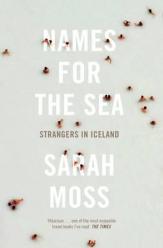 On the bright side, I just finished reading a pretty good book, Sarah Moss’s Names for the Sea, which I will write a bit more about here soon. I also really liked Kathy Page’s Dear Evelyn, which I just finished writing up for Quill & Quire, and now I’m focusing on a short essay on Carol Shields’ Unless, a novel that has come to be one of my very favorites. I also feel good about my piece on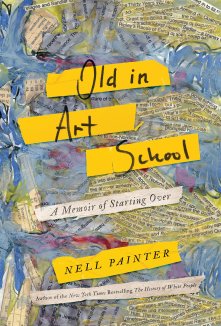




 I’m just back from a great week visiting family and friends in Vancouver. It was mostly family this time, as Maddie came with me. She had not been to Vancouver since she was 7 and has not had very many opportunities to spend time with my parents or my brother and sister and their families–it seemed important to make them a priority, and I’m glad we did. The highest cost of my professional life has been the distance it put between me (and thus my children) and them.
 For once I didn’t buy any books (Maddie and I frugally shared a suitcase, which meant there wasn’t room for much besides the essentials), but I did make off with two books from my mother’s collection: Jenny Erpenbeck’s Go, Went, Gone and Margaret Drabble’s The Pattern in the Carpet. I didn’t steal them! My mother is trying to clear some space on her shelves, so really I was helping. My airplane reading was Nell Painter’s awkward but engaging memoir Old in Art School, which I have now finished and will write more about here soon–once my jet lag subsides and I can concentrate properly. In the meantime, here are a couple of pictures from the trip. Vancouver is such a breathtakingly beautiful place! The last photo is of my parents’ garden, a verdant oasis that always reminds me of




 Against these rare soaring moments, and in contrast also to the tension and pathos of Adam’s anxiety for Miriam, Moss sets Adam’s wry commentary on being a stay-at-home dad and some terrific low-key satire of academic life. “Like all universities,” he says about the one where he teaches, “it is always building,” paving over the green spaces for car parks then digging up the car parks for new buildings so that “a swarm of angry drivers is permanently circling campus.” “I imagine there is some market research,” he goes on,
 I found The Tidal Zone gripping, moving, funny, and smart. It is written in a higher emotional register and with a faster pace than Moss’s Bodies of Light and Signs for Lost Children, which
