 Not only is February a short month already but it includes two of the winter term’s time-outs (times-out?): Munro Day and Reading Week. Because February is often one of our most difficult months weather-wise, it’s usually a big relief to have the pressure ease up at work a bit, even if there’s always still plenty to do. This year, the February weather actually hasn’t been that bad, but the change of pace is welcome just the same.
So what’s on my to-do list for this week? Well, of course, though there are no classroom hours, I still have teaching-related work to do. The students in Pulp Fiction turned in their first formal assignments last week, and I’d like to make a dent in my portion of them before lectures start up again. They’ll also be wanting details about their next assignment soon, so I will be finalizing the topics and instructions. Then I have to be ready to go for next Monday’s class, which means rereading our first installment of The Maltese Falcon and refreshing my lecture notes–which reminds me that I also need to post the topic for their next Reading Journals in time for them to write on it for Monday, which is just the kind of routine business it’s easy to lose track of when we aren’t otherwise following our weekly routine! For Sensation Fiction, I need to keep rereading East Lynne and prepare some notes for our class discussion. In this class I have the luxury of a group of students who are generally both well prepared and keen, so I get to play coach and prompter more than teacher, which is as it should be (but isn’t always) in an upper-level seminar.

I’d have all that to do even if we didn’t have a week “off.” But in that case I wouldn’t also be hoping to write a book review (I finished reading the book for the first time this morning, so that’s one task well underway), and I wouldn’t have been able to schedule nearly two full days’ worth of meetings–I’m one of two members of an “internal review committee” for the MFA in Creative Nonfiction at King’s. Reviews of this kind are a regular part of academic life; I’ve been on many such committees doing reviews of individual departments in the Faculty of Arts and Social Sciences and this year my own department is itself the subject of just such a review. The review I’m working on now is on behalf of the Faculty of Graduate Studies, but the process is basically the same; we’ve got a lot of documents to read and this week we will be interviewing faculty, staff, and students. It’s a program I’ve taken a peripheral interest in since it was launched, so I’m glad to be getting a closer look.
Finally, in terms of formal obligations, I have two reference letters to take care of a.s.a.p. This has been kind of a slow year for reference requests (though that can always change). I think one factor is that fewer and fewer students are asking me for letters to MA or PhD programs (and thus for letters for SSHRC funding). Students applying to graduate programs need multiple letters, as do graduate students moving into the academic job market, so when their numbers decline there’s an exponential decline in references. One reason I don’t have a lot of these requests this year is presumably that I’m not teaching in our own graduate program right now, so I’m not a highly visible resource for them, but I’ve also stopped actively encouraging students I know to apply for MA or PhD programs. This puts me somewhat at odds with some of my colleagues, who in response to the decline in applicants to our own MA and PhD programs (and thus a corresponding slump in admissions) have been urging the rest of us to do what we can to improve the numbers. If students approach me about graduate school on their own, I’m happy to talk over the pros and cons and support them if they are sure about their direction, but knowing what I know, I just can’t bring myself to recruit them. (On that topic, I thought this recent piece in University Affairs did a good job pointing out some problems with the narrative about how valuable PhDs are for non-academic jobs.) In any case, more of the letters I’ve been asked for in recent years have been for options such as Dal’s MLIS or MPA programs, as well as (as always) for law school and education degrees.
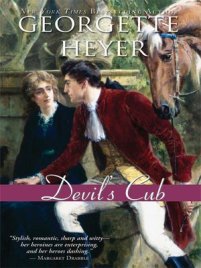 I haven’t started a new book since I finished Tinker, Tailor, Soldier, Spy, though I did reread Georgette Heyer’s Devil’s Cub last week after recommending it to a Twitter friend looking for a Valentine’s Day present for his wife. I hope she liked it! Sometimes I reread just the final third but this time I started from the beginning. It does take a little while for all the pieces of Heyer’s plot to get lined up, but once they’re in place it’s comedy gold, I think, and also pretty romantic–though YMMV depending on your tolerance for bad boy heroes. (But Mary is so having none of his self-indulgent nonsense!) It’s also good preparation for teaching Lord of Scoundrels, which will be up in Pulp Fiction in just a few weeks!
Then when I’ve had enough of feeling busy and just want to relax and be entertained, I’m watching Bones, which I am really enjoying. It’s strangely perky for a show about grisly deaths and serial killers! The plots can be kind of absurd (I just finished Season 3, and the whole Gormogon plot was pretty annoying, especially the twist ending!) but I like the camaraderie between Booth and Bones a lot. Although I have avoided more specific details, I do know that their relationship eventually changes, but for now what I like best about it is precisely that it is a partnership and not a romance. The idea that a man and a woman actually can be just colleagues and friends seems not just realistic and refreshing but, in this #metoo era, valuable.
And that’s how my February break looks from here! I’ve had busier ones, and snowier ones: this one looks like it might be a good balance of useful work and welcome diversion, with minimal shoveling.
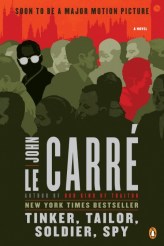
 As I did with Spy, I read Tinker, Tailor with mostly passive fascination, not trying to get ahead of Smiley to the truth about the mole known as “Gerald”–which is not to say I didn’t have my guesses, but the novel is not written to satisfy fair play conventions, and we only get information as it is doled out, by Le Carré as he chooses whose story to tell next and by Smiley, whose tactical reticence is its own form of genius. Smiley is of course the greatest of the characters here, but they are all–from gruff Jim Prideaux and his “watcher,” little Bill “Jumbo” Roach, to the four members of the Circus who give the novel its name–rendered with memorable specificity. Le Carré creates not just a world but multiple worlds, too, the best of them the damp, grubby, second-hand London in which Smiley conducts his backwards investigation. As he carries out his inquiries, we make excursions to other times and places, some louder and more lively, some even darker and more fraught with menace. But we always come back with Smiley to the Hotel Islay in Sussex Gardens, where he stays still while moving, in his mind, without cease:
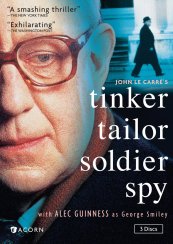 What’s particularly brilliant, though, is the way that in its very final chapters–once the mole’s identity is confirmed and thus the puzzle that is supposedly central to the novel has been solved–Tinker, Tailor, Soldier, Spy turns on itself. After all that time and work, there is no satisfaction, no triumph, for Smiley, in his own success. Instead, abruptly, what was almost an abstract research exercise becomes all too real, its consequences all too human: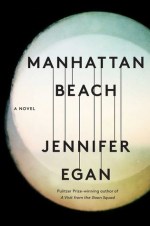
 Anyway, hype aside (and as I was once reminded, it’s not as if publicists are going to put nuanced commentary on the cover instead of high praise or pitch it to readers with modest claims such as “a good traditional novel by one of the top 30 American writers of our time”) Manhattan Beach is an excellent traditional historical novel. By “traditional” I mean it is deeply researched and refreshingly (to me) laden with the results of that work. I like exposition, I like artfully displayed period detail, I like neepery–and Manhattan Beach has plenty of all three. Since Goon Squad was my only previous experience with Egan’s fiction, I didn’t know what to expect of her as a historical novelist, or even really as a prose stylist (at least not at any length). I was glad she did not opt for the currently fashionable minimalism. She does not go into Dunnett-like detail, but both the criminal underworld–what gangster Dexter Styles thinks of as the “shadow world”–and the bustling, hi-tech world of the navy yard where Anna Kerrigan works are evoked with great specificity. It is a very atmospheric novel: Egan moves us repeatedly through several different environments, from the upper-crust world of the city’s elite to the rowdy bars where gangsters and dock workers mingle, from the grime and clamor of life aboard ship to the murkily dreamlike underwater world accessible only to divers like (eventually) Anna:
 Though there’s some mystery around Eddie Kerrigan’s fate, Manhattan Beach isn’t really built as a mystery novel; its gangster elements add suspense and occasionally give it twists like a thriller’s, but I thought it was really a novel of character, or rather of characters–tangled, most of them, in circumstances they are trying (with very mixed success) to change. The ruthlessness of the gangster story line is tinged with unexpected pathos, and Anna’s pursuit of work below the surface of the sea she has always loved to watch is both a professional and a personal quest that connects (in ways she eventually learns) to her father’s story, as if she has been unconsciously drawn all her life to the one place she might find answers.
 When I visited my parents in Vancouver last May, one of the many nice things we did was watch the recent adaptation of Doctor Thorne. I thoroughly enjoyed it. Trollope (like Austen) adapts very well–much better, in my opinion, than Dickens or George Eliot, the brilliance of whose fiction lies so much in the narrator’s voice and in the other very written qualities of their novels that (for me) adaptations almost always seem inadequate.
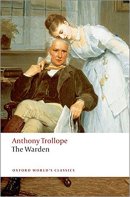 The very qualities that make Trollope such a pleasure to read, though, also make him a bit challenging to teach. The thing about people just “going about their daily business” is that often not much is really happening–there’s not much action, or at least not much dramatic action. To put it another way, the action and the drama in Trollope are often internal, and usually subtle: the characters puzzle through personal and moral problems in infinite shades of grey, rather than the more “glaring colours” of a writer like Dickens (that’s Trollope’s own characterization of Dickens’s method, from the parody of him as “Mr. Popular Sentiment” in The Warden). Given that Trollope’s novels are mostly also quite long, there’s a significant risk that students’ reaction will be boredom: pressed for time as they are, and unaccustomed to fiction that rolls out quite so slowly, they can struggle to find pleasure or interest in the process.
 That, at least, has been my experience with Barchester Towers, which I have tried in my standard 19th-century fiction class a couple of times. I’ve had somewhat better reactions to
  It was the longing to get away from just those humming distractions that sent me back to Doctor Thorne last week: not just my own to-do list, but the overwhelming clatter and clutter of the rest of the world. Especially on the news and on social media, what a constant clamor of catastrophes there is, big and small, near and far away, with everything from Can Lit to the CDC in crisis, all demanding attention, all generating takes and counter-takes in an unceasing cascade of anger, fear, and weaponized self-righteousness–much of it wholly justified, but all of it eventually exhausting. It’s all very well to advise simply “unplugging,” but even setting aside the obligation we might have to be informed citizens of both our personal and our political worlds, for me there’s a lot of good mixed in with the bad–a lot of people and issues I don’t want to lose contact with or miss insight into.
 Both of my classes are focusing a lot on masculinity right now, particularly on representations of or challenges to ideas of masculine heroism.
 Once he faces injustice, though, and especially once he’s felt the full force of Tanner’s malicious bullying, he becomes the unrelenting agent of retribution he needs to be. In that sense he’s an interesting parallel to Robert Audley, whom we are currently discussing in Victorian Sensations. When his novel begins, he just wants to laze around Fig Tree Court and read French novels and not be bothered; like Valdez, he’s forced out of his relative placidity by an injustice he can’t leave unaddressed. The morality of Robert’s mission is murkier, though: what exactly the stakes are in his pursuit of the truth about Lady Audley is something we’re discussing a lot at the moment. It’s true he believes she has murdered his best friend, but he often seems more concerned about the pain her presumed duplicity will cause his uncle than anything else.







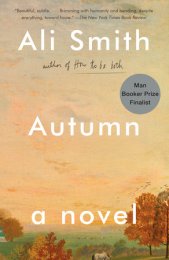
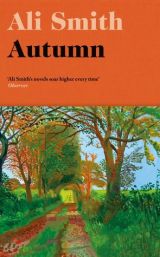 What did “I myself particularly like” in Autumn? I liked the meticulous descriptions of the landscape as it changes with the season:
 I liked all of these parts and more about the novel, and yet while I could find a lot more examples to quote with pleasure or admiration, I don’t know quite how to talk about or conceptualize the novel as a whole, and that leaves me somewhat frustrated with it overall. I trusted Smith’s bricolage more than that of some other more fragmented novels I’ve read in recent years (Jenny Offil’s Department of Speculation, for instance, or Jennifer Egan’s A Visit From the Goon Squad, neither of which I actually enjoyed much at all). I think that’s because there’s a stronger narrative thread running through Autumn, and it gives a deeper grounding in its central characters while still (especially in Daniel’s case) leaving them somewhat opaque or enigmatic. There was enough in Autumn for a reader like me to enjoy in my usual way, though Smith clearly wants to do something more, or something other, than that.



 Novel Readings