
“Well, personally I kind of want to slay the dragon.” – Angel (S5 E22, “Not Fade Away”)
I recently finished my first complete run-through of Angel. I can tell that, as has already been the case with Buffy, re-watching will complicate my response to particulars as well as to the show overall. It’s interesting to me, though, that I can already imagine watching it again (though maybe not all of it, especially not the second half of Season 4, which I really did not enjoy). Like Buffy, Angel seems to do things that are worth taking another look at after the dust has settled, after you know the answer to “what happens next?” There are ideas at stake in it, sometimes confused or swamped by the action, but at other times driving it towards moments of real insight. Unlike the other shows I happily rewatch in order to bask in their familiar pleasures, Angel and Buffy are shows that seem to change, and often deepen, when you go back to them.
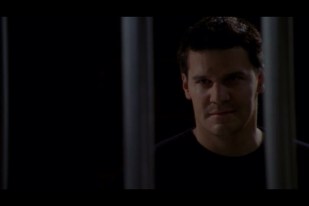 My initial thought at this point is that overall, while I like Buffy the series better than Buffy the character, I like Angel the character more than Angel the series. I would happily watch another two or three (or more!) seasons about Angel, despite how dreadful Angel occasionally was, because I find him complicated and fascinating, whereas Buffy (though she does develop over the course of her series) always seems somewhat two-dimensional to me. I suppose this is a version of the age-old artistic problem that virtue is intrinsically less interesting than vice, except that of course with Angel we’ve got the best of both worlds: good and evil in unending tension, Angel and Angelus distinct but never entirely separable. Buffy, on the other hand, has a clear and singular role to play: while she sometimes rebels against it, when things turn bad she always, always, rises to the occasion — which is great and inspiring, because she’s strong and principled and brave and autonomous, but also somewhat predictable.
Angel is quite limited in Buffy, too: I was actually startled, in the early episodes of Angel, to see him laughing and talking and generally interacting with people, and with the world, like a real person, rather than just brooding in his crypt. (I’m not sure I ever saw Angel really smile in Buffy, never mind sing or dance — though I suppose that’s just as well.) I loved the way Angel made a running gag out of his broodiness, rather than romanticizing it, and I appreciated that the other characters and also many of the plots that unfolded over the series challenged him to think about his life and choices in varied and often quite ethically complicated ways. His role as a “champion” is never as straightforward as Buffy’s, because he carries Angelus with him, with all the baggage of his past sins but also the lurking possibility of reverting to evil. In some ways I think that gives his moral choices more weight than Buffy’s can ever have, because she’s never actually going to do the wrong thing, and when Angel does the right thing (like destroying the Gem of Amara) it’s often at considerable cost to himself.

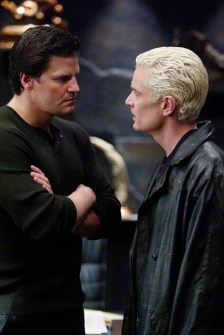
This is one reason I liked it so much when Spike joins Angel: their different paths to the same place become so mutually illuminating. Spike made a deliberate decision (and went to considerable pain and trouble) to get his soul back, and that heroic quest makes him more noble in some ways than Angel, whose transformation was involuntary. But Spike has nothing like Angel’s experience of repentance. As Spike eventually says to Angel, “I never looked back at the victims,” and in that respect Angel, who has suffered years of tormenting guilt and chosen over and over to seek redemption, has something of a moral lead. “I spent a hundred years trying to come to terms with infinite remorse,” Angel expostulates; “you spent three weeks moaning in a basement and then you were fine.” (Spike’s entrance into the show also, as that line shows, brought back the wonderfully comic quality that Season 4 is mostly missing, and that keeps the show from falling into self-importance. Here’s an entertaining compilation of some funny Angel-and-Spike moments. 🙂 )
I enjoyed the noir atmosphere of the earlier seasons, with its blend of superhero crime fighting and hard-boiled private eye investigations: it’s Batman meets Philip Marlowe. I can see, though, how that genre could lose momentum: while having a vampire as the investigator is initially a cool twist, it could easily have become just a gimmick. So it makes sense that they moved the show away from that episodic approach towards larger arcs in which Angel’s ongoing fight for redemption, and the overarching conflict between good and evil in the world, gave it purpose and depth. (This is how Buffy develops too, with the first season — as others warned me when I first started watching it — following pretty tedious “monster of the day” plots and then later seasons taking on more ambitious unifying themes and story lines.) I know that I’m not alone in feeling that in Angel the result can sometimes be terrible (did I mention that I don’t really want to watch Season 4 again?), but a show with a reach that exceeds its grasp is still preferable in lots of ways to one that doesn’t even try. And even the worst story lines in Angel sometimes yielded great moments. I hated everything about the way Jasmine came into the show, for instance — parts of that plot were truly abhorrent — but the episode in which she finally faces off against Angel was both dramatically satisfying and philosophically significant.
 I didn’t like the Angel ensemble as much as the Scoobies in Buffy, but another thing Angel and Buffy have in common is that they both show individual characters transforming in ways that leave them astonishingly far from where they started but that somehow happen in utterly believable ways. Other long-running shows I’m familiar with put fairly consistent characters into lots of new situations, but what happens with Spike in Buffy happens with both Cordelia and Wesley in Angel. If you’d told me while I was watching Buffy that one day Wesley would make me cry, I would not have believed you! As for Cordelia, I couldn’t possibly do better than Jennifer Crusie at explaining how good her character becomes and how terribly she is ultimately treated. Kudos to the actors, of course, as much as the writers. As for our new friends, Gunn was good; I found Lorne a bit bland and Fred annoying ditsy — until she wasn’t any more.

Since I’ve only seen them all once so far, I can’t really say much in detail about individual episodes, though there are a few that do already stand out in my mind, including “I Will Remember You,” “Epiphany,” “Reprise,” and “You’re Welcome.” (Oh, and “Smile Time,” of course — though I still haven’t decided if it’s awful or brilliant. Maybe it’s both? Ditto “The Girl in Question,” which was almost too hilarious.) I also thought the final episode of Season 5 was quite wonderful: each character chose to have a day that beautifully represented who they were. My favorite bit there was Spike reciting his poem: what a nice return to our love-lorn William. When the season, and the series, was over, I felt satisfied with the way it went out, but also bereft because now there’s nowhere new left for me to go in this imagined universe that, to my surprise, I have ended up enjoying so much.
After I finished watching Buffy I discovered this excellent series of episode guides, which includes a pretty smart one called “Why You should Watch Buffy the Vampire Slayer.” I knew from watching that video that if I watched the matching one about “Why You Should Watch Angel” I might inadvertently pick up some spoilers from the illustrative clips he uses, so I didn’t watch it until I’d seen the whole series. I’ve watched it now, and like the Buffy one, I think it makes a pretty good case, as well as offering some insights into the plots, characters, and themes of the show.
 Earlier this year there was a lot of buzz when a Princeton professor published a “
 I have been thinking about the question of failure in academia again since my promotion was denied. The appeal is ongoing, so I don’t yet know how the story will finally turn out, but no matter how it does, the fact will always remain that I was not successful in this process.** It has recently occurred to me that one reason last year was so difficult for me is that when things took a turn for the worse, one of my most intense reactions was humiliation. I felt profoundly embarrassed, because I had been held up for scrutiny and found wanting: I had not passed the test, and in this world, that feels not just like a professional evaluation but also like a very personal and all-too-public shaming. I know that this is not an entirely rational response, but I bet it also isn’t unusual for academics who fail in this way, especially when you add in
  What I have been thinking about more recently, though, is how much worse this cringing attitude made the whole experience for me, because it led me to be not just discreet but downright secretive about what was going on. I’m not saying that I should have made all aspects of the case public (and I don’t plan to now, either): I have some doubts about the advice on
  I don’t rule out that some of the intensity of my own reactions might be idiosyncratic: I myself was surprised that I took it all so hard, and that has been cause for some self-reflection. (Indeed, I have experienced fits of meta-failure in which I have been thoroughly unimpressed with myself for not handling everything better!) That’s what got me thinking again about the general context, though — about what failure means and how failure is treated in the academic world. And it also got me thinking about other failures in my own life, along the lines of the ‘CV of Failures.’ It isn’t, after all, as if this is the first time I have swung at something and missed. So in the spirit of Johannes Haushofer, here are a few more of my own failures. I’ll restrict the list to things that quantify more easily than, for instance, my general failure to thrive during my graduate coursework, and that are on a larger scale than, say, the many books I have failed to understand.
 High Rising is the first of Angela Thirkell’s Barsetshire novels. I read the second, Wild Strawberries, a few years ago — that I barely remember it and also apparently didn’t write about it hints at what to me is both the appeal and the limitation of Thirkell (so far, since this is a pretty small sample): she offers charm without much substance, so the reading experience is light and enjoyable but not particularly memorable.
 The series clearly aims to be associated with Trollope’s Chronicles of Barsetshire, and my edition even includes a map with Barchester at the center. Based on the two novels I’ve read, Thirkell doesn’t really deserve to stand as Trollope’s equal: for all their similarly companionable charm, his novels are both more subtle and more profound. (Jenny at Shelf Love is further along in the series; from her review of
  In Close Reading I always start with poetry, partly because it’s just easier to model and practice mining details for meaning when working with shorter, denser texts. Even in Middlemarch (don’t tell anyone I said this!) there are places it’s probably okay not to scrutinize every word, but a sonnet such as Robert Frost’s “Design” demands our unrelenting attention. I reviewed some key terminology on Monday, and then Wednesday and Friday were all about scansion, something I think is not just vital (who can talk well about poetry without considering rhythm?) but kind of fun. However, despite my best efforts, I am almost never able to convince the majority of my students that it is anything but aggravating: the stress was palpable in both tutorials on Friday!
 I almost always end up using lines from Donne’s Holy Sonnet X (“Death, Be Not Proud”) to illustrate just how interesting, important, and even exciting scanning poetry can be. For one thing, it’s a poem that quickly teaches you not to read it in anything like mechanical iambic pentameter: “Death, BE not PROUD, though SOME have CALLed THEE / mighTY and DREADful, FOR thou ART not SO”? You wouldn’t. You mustn’t. And not just because that’s not how you pronounce “mighty.” You’re standing up to Death! At the very least, you have to call him out in that first syllable: “DEATH, BE not PROUD.” You might even do four stresses in a row — “DEATH, BE NOT PROUD” — or maybe that’s too much. I’m tempted to do “for THOU ART NOT SO” as well, but my reading of the poem may be more confrontational than others would like. At any rate, you have to say it as if you mean it, which makes scanning the poem actually quite a profound exercise:
 I started reading Rebecca West’s Black Lamb and Grey Falcon four years ago. I’m still reading it – or, more accurately, I am reading it again. I didn’t stop reading it then because it was no good or I wasn’t interested. On the contrary, I was fascinated and endlessly impressed. But the very thing that so fascinated and impressed me – the astonishing density and rhetorical brilliance of
  Now that I’m almost half way through the book, I am still impressed above all by West’s writing. In his introduction, Christopher Hitchens (after acknowledging some of the idiosyncrasies and problems of West’s commentary on the world she was exploring) concludes that “writing on this level must be esteemed and shown to later generations, no matter what the subject.” I’m not sure that quality of prose (even if we had a 100% reliable and universal measure for it) is or should always be a sufficient condition for reading something. One of the challenges of Black Lamb and Grey Falcon for me is that it is so vast and complex that I doubt my own ability, even when I finally finish it, to evaluate its worth on other grounds, though. At this point I do feel some frustration, in fact, at being so immersed in details and yet still so unable to perceive, never mind assess, larger patterns.
 I was struggling over what to write about in this post, which begins the 10th season of my
 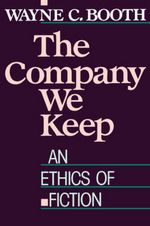 I opened Close Reading on Wednesday with a lecture focused primarily on choices: first ours, in the department, to include the course among our suite of requirements; then theirs to take it, which includes their choice to major in English (not something I’ve ever heard of anyone being pressured into); then, moving into the course materials, the choices writers make, from the biggest (to write anything at all) to the smallest (to use this word or that one). My broader pitch is for the connection between aesthetics and ethics; I quote Wayne Booth, which won’t surprise regular visitors here:
 In today’s tutorials we looked at one writer’s specific choices, comparing Robert Frost’s “In White” to the later, much more famous version, “Design.” You can see the two poems side by side
  For a somewhat different perspective, we’re also reading Margaret Oliphant’s essay “The Condition of Women.” (Both are in Susan Hamilton’s excellent
  I decided to ease out of the summer with some light reading on this long weekend — first
  The novels of
 The case itself is cleverly contrived but not, I think, particularly meaningful. On a completely personal and thus mostly irrelevant note, I enjoyed that it turned on the victim’s fondness for retsina: retsina is actually the first wine I ever drank, back when I was a regular in a Greek dance performing group, so for some time I didn’t realize just how distinctive (many would say, just how disgusting) it actually is. I haven’t had any in years, but now I’m tempted to see if our local wine store carries any. As I recall, it certainly goes well with the robust flavors of Greek cooking — garlic, lemon, and lamb especially. It isn’t really key to the crime, though, except that because nobody likes it but the victim, it proves a useful vehicle for delivering the fatal poison. (This is not a spoiler, as the method of the murder is one of the first things we find out!)
 I finished Honest Doubt thinking that, though I didn’t love it this time either, I should reread more of the series. Even 2000 was a long time ago in my own academic career, and for all that aspects of Honest Doubt seemed faintly archaic already, some of its truths hit home in a way they didn’t before. Even its title, in fact, has new resonance to me, taken as it is from Tennyson’s lines (from In Memoriam) “There lives more faith in honest doubt / Believe me, than in half the creeds.” My own doubts about a range of academic values and practices have made me seem to some, I think, like a negative force, maybe even a threat (or, and I’m not sure if this is better or worse, like an irrelevance). I’ve described myself as feeling sometimes like “a nonbeliever in church”: to me, though, my doubts have always been indications of my faith that what we do not only is valuable but can be even more so.
 September is here, which means that even though technically it’s still summer, it feels like fall. From now on, every nice day is to be cherished and even the sunniest Sunday will be under the shadow of Monday’s impending classes — though not quite yet, because my first class meetings of the new term aren’t until Wednesday. And as it happens, I will be able to wind up my summer without too much angst: yesterday I realized that right now, though as always there are plenty of things I could be doing, there’s really nothing I must be doing. All the writing I’d promised has been sent along to editors; my courses are prepped, including handouts, lecture notes, and slides for the first day(s); other odds and ends of administrative tasks have been completed. I suppose this is my reward for not really taking a vacation: though I did take it easy when I could, I didn’t travel, and I was in my office almost every weekday getting things done. As a result, I will head into the last long weekend of the summer without either the ambition or the pressure to be working.
 I had intended to create another book club site, probably for The Mill on the Floss, but in the end the time that would have gone into this project went instead into doing more book reviews than I had anticipated. One of my more general goals has been to get more experience and also more recognition for my criticism by writing for a wider range of venues. Because reviews are usually commissioned rather than pitched, I wasn’t sure quite how to do this, but I reached out to a couple of editors and was contacted by a couple of others, and in the end I was kept fairly busy! I consider this time very well spent for a number of reasons. First, I read and thought about a lot of books, some of them ones I would probably not have sought out if left entirely to my own devices. Then, in addition to the intellectual and literary benefits of engaging with a wide range of books, I had to work to deadlines and within space constraints set by other people, and also work with their editorial feedback. I cherish the freedom I have at Open Letters, but sometimes it paralyzes me a bit as I look for “just the right book” to review. I also think my colleagues there are among the very best editors around, but it’s bracing to venture outside, if only to find out what else I might learn. And I do feel that I’ve learned a lot this summer, partly about the genre of reviewing, and partly about my own writing process. I had hoped that writing more and faster would make me, ultimately, a more confident as well as a more widely competent writer, and I think it has.
 Here’s the tally of my summer reviewing, meaning books read and written about since classes got out in April:
 Novel Readings