 My book club met last night to discuss Jane Smiley’s Some Luck. We didn’t choose it with this in mind, but it ended up feeling like a good choice to talk about the night before the American election, because it is pretty clearly meant not so much as a story about a particular American family as a story about America told through a particular family. You can’t quite tell this at first (though the structure of the novel, a chapter a year, is a hint), but by the time this novel — the first in her ‘Last 100 Years’ trilogy — ends in 1953, it’s the march of time and the sense of a changing nation that predominate, not the details of individual lives.
How much the different readers in the group enjoyed the novel turned to a large extent on how they felt about this concept, which along with the relentless year-at-a-time pace, necessarily meant a degree of superficiality in Smiley’s treatment of any particular story line. Most of us felt that she had struck a good balance between getting us interested in her character through judicious details with moments of greater depth and the rapid movement across time necessitated by her chosen form. We were interested enough in her people that we wanted to know what turns their lives took. For one of us this had already meant reading on into the next book, Early Warning, though she said she had begun to tire a bit of the trilogy’s concept, which began to seem too much like a gimmick as, Forrest-Gump-like, her people managed to keep turning up, one way or another, at every landmark event in 20th-century America. I haven’t decided yet if I’ll read more of the series; that’s where my hesitation would come from, that the concept might overwhelm the humanity, but I was pleasantly surprised by how engaged I was with the Langdon clan and their extended family by the end of Some Luck, so that gives me some confidence that Smiley can pull it off.
 I think it is in part because the election was on all of our minds that our discussion turned quite a bit on what kind of story Smiley had chosen to tell about America. One conspicuous feature of Some Luck, for instance, is that it’s very much a story of white rural America: if Smiley intends the trilogy to be something of a national biography or a broader chronicle of the country, that seemed to us like a strategic error, one that replicates a certain vision of America’s “heartland” as the “real” America. That said, as some people argued last night, Smiley’s focus on an Iowa farming family and how it is affected by social changes that often seem to come upon them from elsewhere is itself certainly a very American story, even if it is not the story of America as a whole, and there’s not in principle anything wrong with her choice of a starting point. One reason I’d like to read on is that I’m curious about whether Smiley finds a way to complicate her origin story — to highlight its partiality as a story about America. Clearly, even in Some Luck, she is taking us well beyond Iowa as the family members spiral outwards into places and lives very different from those of our first couple, Walter and Rosanna.
Another possibility that came up is that the specific story she’s telling might illuminate the causes of what is now such a prominent divide in American life and politics as the Langdons disperse and bring new differences with them when they return home (as has already happened to some extent), but also as the Langdons still rooted to the land find their way of life harder to sustain. We talked about the way that technology has already transformed life on the farm: Smiley is good about not idealizing the ‘old’ ways even as she shows how unsettling it is to adapt to new ones. We all had found the shift from horses to tractors, for example, particularly effective in confronting us with the inexorability of change and the possibility it brings of both pathos and liberation.
One particular challenge for me with Some Luck is that the stories Smiley focused on the most were not the ones I wanted most to read a novel about. I would love, I expect, the whole book that took Eloise — writer, agitator, city dweller — as its protagonist, but though she’s a recurrent presence in Some Luck she’s peripheral, never well understood by the rest of her family, impossible to completely integrate into their way of being in the world. Smiley spends a lot more time on Frank, whom I felt, in my turn, I did not understand very well. I think the next generations will become increasingly congenial to me, but that in a way is a testament to the value of Smiley’s chosen focus: for me, there is something quite foreign about the Langdons’ America so far, so by taking such a prototypical American story as her beginning she has reminded me that my own norms are partial too.
 This week will be our first ever week-long fall break, one of several adjustments to the academic schedule that have come into effect this year. I’m against it in principle, because no matter how long the break, more and more students (in my experience) leave early for it and come back late, which, along with the extra effort it always takes to get back into the rhythm of classes, means more lost time and attention at this point in the term than I’d like. However, I find myself completely in favor of it in practice: for one thing, it means I haven’t spent the weekend prepping for or worrying about my Monday classes, and I’ll have some time this week to do non-course-related reading and writing.
 My other work-related ambition for this reading week is to buckle down and do more preparatory research for the Pulp Fiction class, specifically background reading for teaching

 As that excerpt shows, Lodge enjoys the opportunity to have his post-structuralist cake and eat it too. And his novel overall is built around the difference between theory and practice as embodied in the inconsistency between Robyn’s theoretical beliefs and her insistent engagement with the world as if it is made up of individuals acting out of their own agency — something Vic Wilcox eventually points out to her: “If you don’t believe in lofve, why do you take such care over your students? . . . You care about them because they’re individuals.”
 It’s an entertaining story, and like Gaskell Lodge does a good job exposing both the pride and the prejudices of his main characters without condemning them: both have simply taken their own insular worlds for granted, and both benefit from having someone challenge their starting premises as well as their daily practices. Unlike Austen or Gaskell, however, Lodge does not carry them (or us) forward to a happy resolution of the conflicts that initially divide them: the allusive thread he lets go of is the romance plot (Vic and Robyn do have sex, but that, as Robyn vehemently insists, is not at all the same thing as love). I think this is not just consistent with the cynical tone of Nice Work (which, like all of Lodge’s academic novels, is primarily satirical) but also a sign of a broader rejection of the hope that personal transformation makes much difference in a world riven by systemic injustices. That’s one way, then, in which Nice Work moves on, or away, from North and South. More generally — and this is only partly a function of the novel’s genre, I’d say — Lodge has little of Gaskell’s compassion for his characters, which means his fiction also does not radiate any warmth outwards towards his readers. His is too modern a sensibility for that, which you might think means Nice Work has more to say to us than North and South. For me, though, the effect is the opposite: Lodge’s lack of faith in any transcendent values or virtues made Nice Work actually seem more dated to me than North and South ever does. To put it another way, North and South can be updated precisely because there’s something lasting about its central commitments (to learning, to changing, to caring), whereas Nice Work itself, while clever and amusing, is a literary dead end.
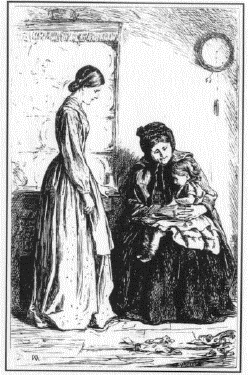 Our reading for today in The Victorian ‘Woman Question’ was Elizabeth Gaskell’s 1850 short story “
 Gaskell’s most obvious literary device in the story is pathos.
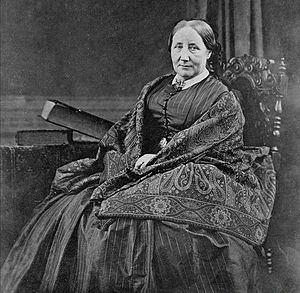 Gaskell was a minister’s wife and “Lizzie Leigh” casts its story of forgiveness in explicitly Christian terms. Susan “is not one to judge and scorn the sinner,” Anne insists to her son Will, for instance (soothing his horror that she has shared Lizzie’s story with one he sees as “downright holy”); “She’s too deep read in her New Testament for that.” What I think is so powerful about the story is the way Gaskell pits Anne’s (and Susan’s) definition of Christian virtue against the “hard, stern, and inflexible” judgments, first of Anne’s husband James (who had forbidden her to seek out “her poor, sinning child”) and then of Will, who has inherited his father’s patriarchal role and with it his rigid righteousness. Anne grows into her own authority as the story progresses, eventually confronting Will directly:
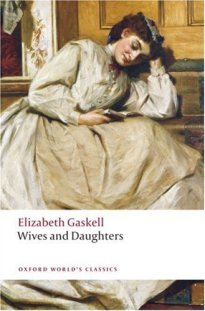 There are definitely things about “Lizzie Leigh” that are hard to take, including the fate of “the little, unconscious sacrifice, whose early calling-home had reclaimed her poor, wandering mother” as well as the extreme seclusion that is Lizzie’s fate after her reclamation. She’s not (like Hetty, or Little Emily) sent entirely out of her world, but Gaskell can’t quite imagine a place for her fully in it either. What I love about “Lizzie Leigh,” though, is the same thing I love about Mary Barton, North and South, and
 From the Novel Readings Archives: I still find myself thinking a lot about the questions raised by Brian McCrea’s book Addison and Steele Are Dead, which I wrote about during my first year of blogging. Apparently I’m in something of a minority, or presumably I’d be able to find the actual cover image online somewhere! But rereading this post nearly a decade later, McCrea’s theory about the relationship between literature, professionalism, and teaching still seems well worth considering.
 As he develops his argument, McCrea offers an interesting overview of the 19th-century and then 20th-century critical reception of Addison and Steele. He explains the Victorians’ admiration for these 18th-century predecessors largely in terms of the different understanding that prevailed about the relationship of literature, and thus of the literary critic, to life. Rightly, I’d say (based on my own work on 19th-century literary criticism), he sees as a central Victorian critical premise that literature and criticism are public activities, that their worth is to be discussed in terms of effects on readers; hence the significance attached, he argues, to sincerity as well as affect. Especially key to McCrea’s larger argument is his observation that the 19th-century writers were not “academicians” or “specialists in a field”:
 While we can all share a shudder at the very idea, to me one strength of McCrea’s discussion is his admission that marginalizing affect, pleasure, and aesthetic response is, in a way, to be untrue to literature, and that the professional insistence on doing so also, as a result, marginalizes our conversation, alienating us, as McCrea says, “from our students, our counterparts in other academic departments, our families [unless, he allows, they include other professional critics–otherwise, as he points out, even they are unlikely to actually read our books and articles], and, ultimately, any larger public.” (In Democracy’s Children, John McGowan makes a similar point: “There remains a tension between the experience of reading literature and the paths followed in studying. . . . To give one’s allegiance to the academic forms through which literature is discussed and taught is to withdraw [at least partly] allegiance to literature itself”).
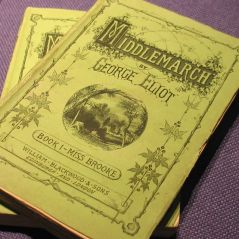 I’ve been feeling a bit downcast since Friday, because attendance absolutely plummeted in the tutorials for my Close Reading class and I can’t stop worrying about why — and wondering what to do about it.
 But that is a general pet peeve that’s probably never going to get resolved, while Friday’s collapse is a specific instance that I’d actually like to get to the bottom of. Is it because we’re spending so many weeks on Middlemarch that this first tutorial seemed expendable? (But why would anyone think that, given how much material we clearly have to work through? It isn’t as if we’re going to spend all those weeks on Book I.) Are a lot of students finding the novel difficult to engage with? (But wouldn’t that be an incentive to come to class and learn and talk more about it, rather than opt out — to increase the odds that you’ll enjoy the next 4 weeks?) Do some of them figure they’ve got this covered and don’t need to do the tutorial exercises? (But in that case, they could still come and help out their classmates with their insights, raising the quality of the experience for everyone — and maybe even learning a little something new themselves.) Is the pay-off from our tutorial work in general not clear enough, or actually less than I fondly imagine? On Friday we worked on tracking the movement of point of view in particular passages — but we also just talked about the themes and characters set up in the first section of the novel: both activities seemed pretty valuable to me, at least.
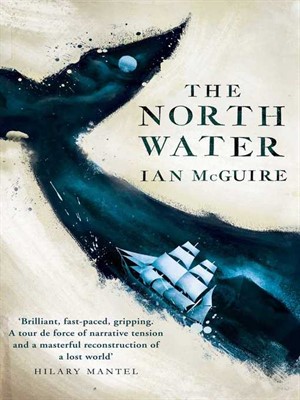
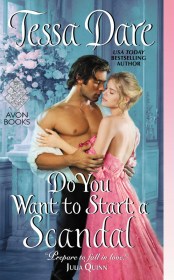 There’s realism, and then there’s utterly, relentlessly, graphic and gruesome realism, which is very much the aesthetic principle of The North Water — McGuire offers not just a vision of the world warts and all, but of the world as warts only. I’ve also been reading Tessa Dare’s Do You Want to Start a Scandal? and the juxtaposition of the novels got me wondering about whether we have a label for McGuire’s style that would be the grim equivalent to the kind of (usually pejorative) terms used for romance writing — “flowery language,” “purple prose.” The implication of such labels is typically that the writing is excessive rather than expressive, that it’s artlessly out of control, rather than artfully serving its own purposes. (I still struggle with this reaction to some of it, but
 The absence of meaning can, of course, itself be meaningful, but The North Water didn’t read to me like an investigation or revelation of existential vacancy, and certainly not like a purposeful response to the possibility that “there is no why.” Compare
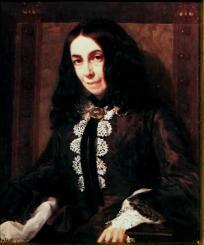 First of all, where did this past week even go? It feels like just yesterday I was writing my previous post, in a flush of enthusiasm about
 In Close Reading, we’ve just started Middlemarch — always a happy occasion for me, of course! Here’s hoping I can make it a good experience for the students as well. In a break from the usual rhythm of this course, I open with a fairly formal lecture to establish some biographical and philosophical context: as I explained to the class, with short texts it’s reasonable to expect them to be able to put specific details into the context of the whole right away, but with a text this long we can’t do meaningful close reading exercises without my providing some preliminary interpretive frameworks. I’ll do a bit more of that tomorrow, and then they’ll have some general concepts to guide their reading and analysis as we keep going. We’re only reading Book I this week: it’s always nice to move through it relatively slowly (we’ll take about two more weeks on it in Close Reading than I usually allow for it in my 19th-century fiction class).
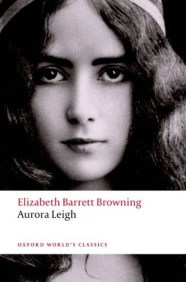 In my seminar on the Victorian ‘Woman Question,’ we started work last week on Elizabeth Barrett Browning’s 1856 verse-novel Aurora Leigh. It’s usually kind of hard going for the students: although it does have many of the familiar features of a Victorian marriage plot novel, it also includes (among quite a bit of more miscellaneous material) long meditations on, and also arguments about, the nature and purpose of poetry in the modern world — and its 9 books of blank verse add up to a total of approximately 15,000 lines of iambic pentameter, which, let’s face it, is not the easiest reading even when the verse itself is thrilling … which, frankly, for long stretches Aurora Leigh is not.


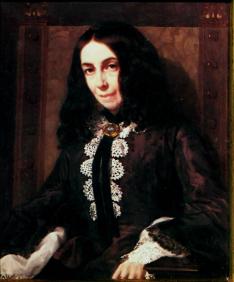 That Aurora Leigh has not lost its radicalism — that we are still fighting on some of the same fronts — was made unexpectedly clear to me this past weekend, as with so many others I watched the story of Donald Trump’s now-infamous bus tape break, and then one pontificating man after another denounce it in the name of his daughters (or his wife or his great aunt or whatever). For some men — too many men — women are still seen primarily as complementary, their value uncomfortably entangled with ownership (all those possessive pronouns!), their right to respect and dignity somehow contingent on their belonging to someone else (someone else male, of course). My
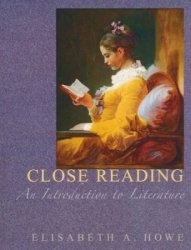 Over the past few weeks in Close Reading we have been working on disentangling specific elements of poetry and fiction in order to improve the precision of our analysis. We’ve focused, for instance, on tone and diction, on figurative language, on imagery, on symbolism, on rhythm, on point of view, on narrative voice, on characterization, and on setting. Often separating these elements is quite an artificial exercise, but there’s value in it nonetheless, as it helps us moves from impressionistic responses to focused observations that can be the foundation of critical conversation and analysis.

