 From the Novel Readings Archives: Since I started this blog almost ten years ago, one of its most important roles for me has been as a place for me to reflect on my teaching, which is the part of my professional life I value the most and that takes up, usually, the majority of my time and energy.
Universities talk a lot about the importance of teaching, but in practice, as we all know and are frequently reminded, in big ways and small, it’s of secondary — possibly tertiary — value when it comes to our professional advancement. A lot of the discussion about teaching at the higher levels of administration seems to turn on the lure of new technologies or the promise of impersonal kinds of efficiency. To those of us who stand in the classroom every day — at least, those of us in the humanities — much of that discussion misses the point entirely. What we want is to engage with our students in ways that are at once rigorous and profound, that serve both the head and the heart.
Standing in front of my students this morning, talking with them as passionately as I could about the final sequences, and the beautiful Finale, of Middlemarch, I hoped I had gotten better at combining the intellectual and what, for want of a better word, I’ll call the spiritual. If I have, it’s partly through the work I’ve been doing outside the classroom (indeed, outside the university altogether), including here on this blog, and including especially the kinds of thinking out loud I did in this post from 2010. I’m so grateful to everyone who reads and comments for helping me sustain and improve this ongoing project of finding (and sharing) both meaning and inspiration in literature.
Standing in Chartres Cathedral Unmoved
I’ve been thinking more about this passage from May Sarton’s The Small Room that I quoted in my earlier post on the novel, from Lucy’s irate speech to her students on returning their woefully inadequate assignments:
Here is one of the great mysterious works of man, as great and mysterious as a cathedral. And what did you do? You gave it so little of your real selves that you actually achieved bordeom. You stood in Chartres cathedral unmoved. . . . This is not a matter of grades. You’ll slide through all right. It is not bad, it is just flat. It’s the sheer poverty of your approach that is horrifying!
I’ve been marking assignments myself (in my more benign moments, I call it ‘evaluating assignments,’ which sounds less adversarial). But that’s not actually what has had the line about standing in Chartres cathedral unmoved running through my head. Instead, it’s our recent class meeting on James Joyce’s “The Dead,” which I know I am not alone in finding one of the greatest pieces of modern fiction: smart, patient, subtle, powerful, poignant. My very smart talented teaching assistant led the class, and as always happens when I hand over the reins, I learned a lot and was reminded why I ended up where I am today, namely, because I loved being an English student. (I had the same treat today because another of our very smart and talented graduate students kindly took over the class on T. S. Eliot. Boy, we can pick ’em!)
Because I was sitting among the students, I couldn’t see their faces, so I had less than my usual sense of whether they were engaged or listening, but there was certainly not a flurry of responses in answer to Mark’s questions about the story. Now, it’s not a hugely forthcoming group anyway, and for that I partly blame both the style in which I have decided to teach the course (basically, lectures, with some Q&A, which seemed to fit the purpose of the course) and also the room we were assigned (quite a formal tiered lecture hall, narrow but deep, which exaggerates the distance and difference between the front of the room and the back and makes the prospect of throwing up your hand to volunteer an idea more intimidating, I expect, to any usually reticent students). Anyway, I sat listening to Mark and looking at the moments on the page he called our attention to and filling up with the old excitement–but also simmering a little at what seemed to me an undue lack of excitement in the rest of the room. ‘Aha!’ I thought. ‘This is what Lucy was talking about! Here they are, in Chartres cathedral, unmoved!’
But the more I’ve thought about that moment and my reaction, the less satisfied I am–not with them (though come on, it’s “The Dead”!), but with myself and with the unfair lose-lose situation I am (silently) putting the poor students in.
The thing is, my classroom is nothing like Chartres cathedral. And I don’t mean just in the look and layout, though here are some pictures so you can imagine the scene for yourself:


No, the dissimilarity I’m thinking about is one of atmosphere. Or, perhaps more accurately, attitude. As I remarked in my write-up of The Small Room, Sarton seems to me to be appealing to”an old-fashioned view of literature as a kind of secular prophecy,” imagining a world in which “the professor’s scholarship giv[es] her the wisdom to speak ‘from a cloud,’ a ‘creative power,’ a ‘mystery.'” I wasn’t–and I’m not–lamenting that this is not my academy. I’m not a secular priest; I have no special creative power, no authority to speak to them from some mysterious height– no interest, either, in evoking spiritual revelations. That’s not my business. We can’t just stand there and emote, after all. There’s not much point in their bringing their “real selves” to their work in the way Lucy seems to want it: what would I grade them on? Failure (or success) at having their own epiphanies, rather than failure (or success) at explaining the concept of ‘epiphany’ in the context of Joyce’s fiction in general and “The Dead” in particular? As Brian McCrea writes,
People who want to become English professors do so because, at one point in their lives, they found reading a story, poem, or play to be an emotionally rewarding experience. They somehow, someway were touched by what they read. Yet it is precisely this emotional response that the would-be professor must give up. Of course, the professor can and should have those feelings in private, but publicly, as a teacher or publisher, the professor must talk about the text in nonemotional, largely technical terms. No one ever won a National Endowment for the Humanities grant by weeping copiously for Little Nell, and no one will get tenure in a major department by sharing his powerful feelings about Housman’s Shropshire Lad with the full professors.
And as I wrote in response to McCrea in a (much) earlier post,
While we can all share a shudder at the very idea, to me one strength of McCrea’s discussion is his admission that marginalizing affect, pleasure, and aesthetic response is, in a way, to be untrue to literature, and that the professional insistence on doing so also, as a result, marginalizes our conversation, alienating us, as McCrae says, “from our students, our counterparts in other academic departments, our families [unless, he allows, they include other professional critics–otherwise, as he points out, even they are unlikely to actually read our books and articles], and, ultimately, any larger public” (164-5). (In Democracy’s Children, John McGowan makes a similar point: “There remains a tension between the experience of reading literature and the paths followed in studying. . . . To give one’s allegiance to the academic forms through which literature is discussed and taught is to withdraw [at least partly] allegiance to literature itself” [65]).
 They aren’t standing in Chartres cathedral unmoved. I’m slamming the door of Chartres cathedral in their face. They might well have been feeling all the excitement I could hope for, or at least those who actually did the reading for the day might have. But it wouldn’t be their fault if they thought the CIBC Auditorium was no place to bring it up. It wouldn’t be Mark’s fault either, or mine. We do show enthusiasm and appreciation for the literature we’re covering, to be sure, but it’s not of the viscerally rapturous variety, or even the aesthetically transcendent variety. It’s a heavily intellectualized variety, and while I don’t think that makes it inauthentic, it isn’t something they are quite ready to emulate, not yet. I want them to feel the readings, and to show that they feel them, but there’s really no appropriate way for them to express that feeling in the ways they would find natural.
But what are we to do? I’m not a fan of the unreflexive response, and taking down the nets would open up our class discussions (at least potentially) to a particularly banal and subjective kind of verbal tennis (“I really like this” / “Can you say more about why?” / “Not really, I just thought it was nice / beautiful / relatable”). Nobody learns anything from that. I usually just hope that my enthusiasm (however peculiar its variety) catches their interest and makes them read more, and more alertly, then they otherwise would. I try to give them tools to notice and think about their more personal responses, too: how they might have been achieved by the formal strategies of the work, and what their implications might be. I was remembering, though, a conversation of my own with one of my undergraduate professors. We had been reading Matthew Arnold, including “To Marguerite–Continued,” at a time when a lot of emotionally difficult things were going on in my life, and after our seminar (in which, as I recall, we talked about things like faith and doubt, and modern alienation, and verse forms, and metaphors) I very tentatively went up to the professor–one of my favorites, a wry 18th-century specialist who always looked faintly sardonic (as is only fitting, of course, for that period). “But don’t you think,” I remember saying (and those who know me now would not, probably, believe how nervous it made me even to stand there and ask this kind but intimidating man anything at all) “don’t you think that life is like he says? that we are isolated like that?” “Perhaps,” was his only reply–that, and a quizzical lift of his eyebrow. Well, what else could he say? What did my angst have to do with his class?
But (I’m full of these equivocations tonight, apparently) I can’t help but think that, for all the gains involved in professionalizing the study of literature, one of the reasons our students don’t graduate and go out into the world and absolutely trumpet the value and significance of the work they did with us is precisely that we have given up that prophetic role. We stood with them outside the cathedral, perhaps, and told them it mattered, and explained its history and architecture and social role and so forth, but left them to stand inside, moved, on their own. To be sure, they might have ignored it altogether if it weren’t for us (how many of these kids would pick up Joyce on their own?), but no wonder they are left thinking that when it came to the things that really mattered, we weren’t there for them.
Originally published in Novel Readings November 10, 2010.
 In case you were wondering why it has been so quiet here at Novel Readings, I’ve been grading papers industriously, trying to get through them as efficiently as I could consistent with still paying really close attention. I did well at sticking with it, partly thanks to my students, many of whom wrote really good essays! Not only does that speed things up, but it makes the whole process more enjoyable.
 Before I put this term completely behind me, though, one question lingers after hours spent poring over student writing: what’s up with apostrophes? Actually, I have two questions, because my follow-up to that one is, should I care about apostrophes?
 I’ve just finished two Scottish-themed romance novels — Sarah MacLean’s A Scot in the Dark and Tessa Dare’s When a Scot Ties the Knot — and they have enough similarities that the juxtaposition has provoked me to figure out why I enjoyed one so much more than the other, a question that quickly expanded, in my mind, to the more general question of why some romance novels work for me and others just don’t, including novels by the same authors. Of these two, for instance, I much preferred Dare’s, though I really enjoyed The Rogue Not Taken, the previous novel in MacLean’s “Scandal & Scoundrel” series, and I liked but didn’t love Dare’s most recent novel, Do You Want to Start a Scandal.
 For instance, I have mentioned before that I don’t always read right to the end of the HEA. This is partly because while I can enjoy the development of a romantic relationship, especially when it involves witty sparring and plenty of sexual tension, I don’t find unmitigated happiness (which is where, of course, romance novels always end up, sooner or later) that dramatically interesting. But it’s also because I don’t really believe marriage itself is necessarily a particularly blissful state. For both of these reasons, the rosier things get for the protagonists, the more disengaged I become from their novel. Thus I usually prefer romances that defer the protagonists’ happiness until the end of the novel, or very nearly. In a lot of Georgette Heyer’s novels, for example, hero and heroine don’t come joyfully together until pretty much the last page. That keeps things interesting! Our attention then is also less on how delightful they find each other and more on their learning about each other, and / or on wondering how they will ever discover how delightful they are to each other, or on how they will overcome the personal or social obstacles keeping them apart.
 I also often find with more recent romances that the protagonists get intimately sexy too soon and too often for my taste. I don’t think this means I’m prudish! No doubt it’s partly the result of many years spent reading Victorian novels, which are full of erotic undercurrents but have vanishingly few explicitly sexual moments. When feelings (and body parts) are usually kept covered, it’s that much more exciting when you finally get a glimpse! As well, I don’t think lust and love are the same thing, and sometimes — including in A Scot in the Dark — they get too quickly conflated. I suppose this is a variation on my preference for deferring their happiness, and it’s also about the sacrifice of tension involved. (I think there may also be some problems with realism — but I’m really not an expert on sexual mores during the Regency, so I may be quite wrong about what well bred men and young, “respectable,” unmarried women would get up to in their carriages without anxiety, shame, or repercussions.)
 A specific romance-reading preference of mine that I know is about me more than about the novels is that I have a fondness for bluestocking heroines, or at least ones with an intellectual passion, who have a lot more on their minds than romance. I love Dare’s A Week to be Wicked and Courtney Milan’s The Countess Conspiracy for this reason, and of course my favorite romance of all — so far — is Loretta Chase’s Mr. Impossible. Madeline in When a Scot Ties the Knot, with her passion for illustrating natural history, is a good addition to this collection. I also prefer more mature heroines, and I have a fondness for prickly ones, like Claudia Martin in Mary Balogh’s Simply Perfect. I find ingenues annoying and get bored easily by heroines who are too nice. It’s not hard to see that I appreciate romance novels that show women at least somewhat like me as lovable!
 We had our last day of classes yesterday. Owing to a very peculiar scheduling plan devised (of course) by a committee, although yesterday was actually a Tuesday, it was designated an “extra Monday” to make up for “losing” a day of Monday classes to Thanksgiving (so much for the concept of a day off — must everything be weighed and measured?). Anyway, that meant two days of Monday classes in a row to bring us to the end of term. As I am not giving final exams in my courses, I now have a lull in immediately pressing teaching-related activities until the final essays come in, the first batch on Friday, the second on Sunday. Then I have to dig in and get through them all, and then do all the final record keeping so that I can compute and submit final grades.
 Though the cessation of classes doesn’t mean there’s not anything else to do at work (just for instance, today I put some time in organizing the Brightspace site and readings for one of next term’s courses), I usually take advantage of any break in the schedule at this time of year to get some holiday shopping done, especially for things I want to mail out west to my family. I was especially motivated to get as much done as I could today because so far (unlike my family out west, in a rare reversal!) we have no snow to deal with yet. Sadly, that can’t last, and everything gets harder once the roads and sidewalks are wintry. So once I’d taken care of some business at the office, out I went, and had a pretty nice time puttering around at the mall and in the rather more interesting shops at the

 But in fact it’s not always true that I don’t like “spare” novels. I read three of Kent Haruf’s novels recently, and the sparest of them all,
 Marilyn’s mother tries to talk her out of marrying James. “Think about your children,” she urges Marilyn; “Where will you live? You won’t fit in anywhere.” James and Marilyn believe they can — even in the small Ohio town where they settle and where their children Nath, Lydia, and Hannah are born and grow up. The children don’t really fit in, however, though they hide the truth, concealing their isolation and trying to placate the parental unease that, in the guise of loving concern, infects every aspect of their life. The burden of her parents’ hopes falls especially hard on Lydia: nothing is ever proffered that isn’t tainted with expectations that “drifted and settled and crushed you with their weight.” It’s because she loves her parents and wants them to be happy that she accepts, over and over, all the things they want for her that she does not want for herself. Only when it’s too late does Marilyn realize what this acceptance has meant to Lydia, who never told her because she never could.
 You never know what twists of fate will bring new relevance to the readings you’ve assigned. Teaching A Room of One’s Own soon after the
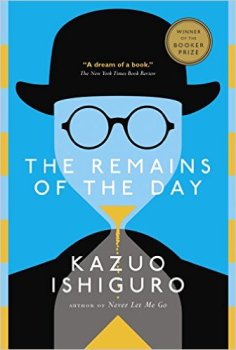
 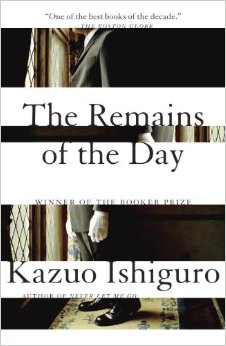 As much as the specific context of nascent fascism, this indirect approach to it through the internal ruminations of someone well-meaning but ultimately morally compromised, perhaps beyond redemption, seems timely to me. Stevens does not refuse Lord Darlington, for example, when instructed to dismiss two Jewish maids to preserve the “safety and well-being” of his guests. Against Miss Kenton’s passionate rebuke — “if you dismiss my girls tomorrow, it will be wrong, a sin as any sin ever was one” — he sets his own professional standards: “our professional duty is not to our own foibles and sentiments, but to the wishes of our employer.” It might seem a relatively modest act of bigotry to be complicit in, but it’s inexcusable nonetheless, intolerable both in itself (as Miss Kenton rightly notes) and as a concession to the creeping encroachment of worse horrors. Resistance may even mean the most on this personal scale, where you can act before events outsize and overtake you — but in any case the most anyone can do is refuse to cooperate with — or to normalize — what they know to be wrong. From inside Stevens’s head, we feel the appeal of compliance, of pretending that this one thing, or the next thing, doesn’t really matter very much. But against that dangerous ease, as we travel with him to a fuller understanding of what his political passivity has enabled, we can set our own rising horror — at the waste of his life, and at the possibility that
  After well over a year, my application for promotion to Professor finally concluded last week, with the disappointing news that my appeal of President Florizone’s negative decision was unsuccessful.*
 It is tempting, of course, to use this opportunity to lay out my whole case, to rehearse the ups and downs as my application went through its nine (nine!) stages of review, and to air my specific grievances as well as parade my allies and advocates. Militating against that self-indulgent impulse, though, is the conviction that even if it were professionally appropriate to expose all the parties involved in that way, nobody really wants to read that 10,000 word screed. Besides, I’ve done a lot of relitigating of details in the past 16 months. It will do me more good to pull back a bit, to get out of the weeds and try instead to articulate what seems to have been the fundamental problem, which I now think can be aptly summed up as (to borrow a phrase from Middlemarch) “a total missing of each other’s mental track.” I won’t name names or quote at length from any submissions, and I’ll try to avoid special pleading — though I can hardly be expected to hide which side I’m on! It will help me to write about it in this way, I hope: it will exorcise some of the frustration and bitterness I still feel. And then I will be done with it — publicly, at least — and I will do my best to gather up all the energy that has been dispersed among these professional and psychological hindrances for so long and rededicate it to the ongoing task of becoming the kind of literary critic and


 Though it’s only in America (or on American bases) that segregation is an explicit policy, Gilbert learns that his own loyalty to the British Empire is no defense against the equally pervasive racism of “the mother country.” Despite this discouragement, after the war Gilbert finds Jamaica too small for his dreams and yearns to return to England, which with Hortense’s collaboration he eventually does. His war service does nothing to earn him a welcome, however, and he has trouble even finding lodgings until he remembers Queenie’s London address. With Bernard still missing, Queenie has begun taking in lodgers herself to make ends meet, and Gilbert takes up residence in her house. Queenie’s experiences during the Blitz make up another thread of the novel, as does Bernard’s war experience and then his posting to Calcutta during the harrowing violence between Muslims and Hindus in 1946. All of these story lines come together when Bernard finally shows up again in Earl’s Court and our four protagonists end up under the same roof — but hardly, in any way that matters, in the same place.
 Though Small Island is not naively optimistic about progress, there are signs of hope, including faint glimmers of humanity in Bernard. When progress is made, it’s when people are startled out of their “certain ways” of seeing the world into realizations about how other people see and experience it. What Bernard needs most of all is something like Small Island itself: stories about people he struggles to recognize as equally human that make their humanity real to him. Gilbert tries to explain it to him in principle:
 My book club met last night to discuss Jane Smiley’s Some Luck. We didn’t choose it with this in mind, but it ended up feeling like a good choice to talk about the night before the American election, because it is pretty clearly meant not so much as a story about a particular American family as a story about America told through a particular family. You can’t quite tell this at first (though the structure of the novel, a chapter a year, is a hint), but by the time this novel — the first in her ‘Last 100 Years’ trilogy — ends in 1953, it’s the march of time and the sense of a changing nation that predominate, not the details of individual lives.
 I think it is in part because the election was on all of our minds that our discussion turned quite a bit on what kind of story Smiley had chosen to tell about America. One conspicuous feature of Some Luck, for instance, is that it’s very much a story of white rural America: if Smiley intends the trilogy to be something of a national biography or a broader chronicle of the country, that seemed to us like a strategic error, one that replicates a certain vision of America’s “heartland” as the “real” America. That said, as some people argued last night, Smiley’s focus on an Iowa farming family and how it is affected by social changes that often seem to come upon them from elsewhere is itself certainly a very American story, even if it is not the story of America as a whole, and there’s not in principle anything wrong with her choice of a starting point. One reason I’d like to read on is that I’m curious about whether Smiley finds a way to complicate her origin story — to highlight its partiality as a story about America. Clearly, even in Some Luck, she is taking us well beyond Iowa as the family members spiral outwards into places and lives very different from those of our first couple, Walter and Rosanna.
