 I don’t write up every TV show I watch, but I just finished a complete viewing of all 12 seasons of Bones and 12 seasons is a lot–so I thought it deserved a bit of comment. (Warning: spoilers ahead.)
The first thing that strikes me is that Bones is not actually a show that prompts a lot of reflection. It’s certainly unlike Buffy and Angel, both of which invite interpretation in a non-literal way that makes them quite different even from the other TV shows I have enjoyed thinking and writing about (Friday Night Lights, for example) or that I am always happy to dip into again (for me, this list includes Sex & the City, Gilmore Girls, and The West Wing, for example). Bones is not as good a show as any of these–it has no layers, its characters are remarkably static, its storylines are often ridiculous, and its favorite plot device is the manipulative fake-out. Overall I thought the show’s writers played it really safe: they just kept doing more or less the same kind of thing over and over and over.
And yet, having said that, I watched all 12 seasons because the kind of thing Bones did was pretty entertaining and its consistency made it a comfortable imaginative space to hang out it. I started watching it while running on the treadmill over the winter: it was perfect for that. Then I kept going because it was also perfect for the odd moment after work or after dinner or whenever nothing else in particular was going on that demanded my attention (something you never think will happen when your kids are small) but when I was too tired or distracted to feel like reading. The plots kept me just curious enough every time, and I cared just enough about the people involved, that I was never bored watching it. I just can’t imagine watching it all again.
 My biggest bone to pick with Bones is that the writers didn’t have the courage not to marry off Booth and Brennan. I understand that there’s a lot of cultural pressure to have a romantic relationship between your male and female lead and that this is something a lot of fans wanted. Watching the first few seasons in the wake of the #metoo and #timesup movements, though, I found it really refreshing to see a man and a woman in a working relationship who didn’t lust after each other. It felt really healthy, and I enjoyed the way Booth and Brennan pushed back against the constant assumption that because they trusted and fought for each other they must also be lovers. It’s true that marriage and children add elements to a series that are useful for both plot and character development–but I can easily imagine how much richer the arcs could have been if they had married other people, especially people outside law enforcement, and then dealt with the challenges of those people’s feelings towards their work and their partnership. I knew when I started the show that they did eventually marry, so I knew it was coming; still, I was disappointed. I got used to it, though, and I admit I thought their married relationship was pretty cute overall. I’m glad they never stopped bickering, at least.
 Probably my favorite thing about the show was the science. I read around a bit to see if it was any good, and I gather it’s at least not terrible, though of course it is all sped up and simplified. (I don’t know if any of the things Angela does are plausible: I found the “Angelatron” stuff the hardest to take seriously.) Regardless of the accuracy of it all, it’s always presented as if we should find it gripping, and I especially appreciated the unapologetic enthusiasm of Brennan and Hodgins for their work. (I loved Hodgins’s experiments.) Even Booth’s frequent impatience with the “squints” didn’t detract from the fact that in this show, nerds are not just cool–they are heroic! And with the exception of Avalon the psychic, the show had little truck with unscientific theories or methods. Booth’s “gut”–and his faith–are significant parts of his individual character, but solving the case always came down to the evidence.
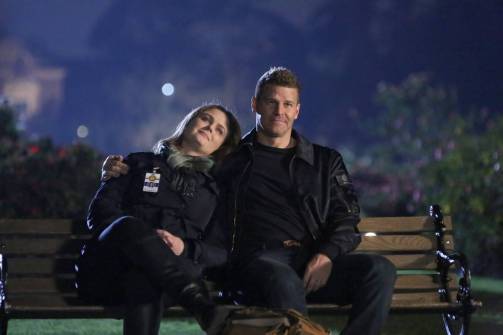
The other thing that kept me loyal to the show was how much I enjoyed the characters as a group. This was key to my enjoyment of Buffy and Angel as well. While the characters in Bones really don’t evolve–not at all, not just not in the remarkable way characters like Spike, Wesley, and Cordelia do in the Whedonverse–they are a nice group to (virtually) hang out with. By and large they are all good to each other, and they all aim to do good in the world. I will say that watching 12 seasons of David Boreanaz being staunch and upright–which of course he’s very good at–made me nostalgic for the moral complexity of Angel/Angelus. I’m pretty disappointed that Angel has disappeared from Netflix! I might have to somehow add it to my permanent collection. But not every show is worth that kind of commitment, and that’s OK. I mostly watch TV for a bit of company, and for all its gross decomposing corpses and creepy serial killers, Bones was just right for that.
 My drawing class met for the last time this week–it was just six sessions total. That’s obviously not enough time to get really good at anything (though I gather the “ten thousand hours of practice” theory has been more or less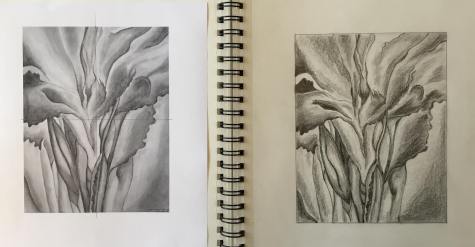


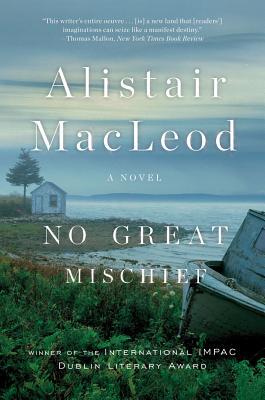
 I didn’t like it. In fact, I really didn’t like it. The comparison to Shirley Jackson on the cover tempted but misled me: there’s nothing sly or subtle in this novel, nothing to make you start and look again, or laugh then shudder and look away, the way you have to with We Have Always Lived in the Castle. The only reason I can think of that Eileen was nominated for prestigious prizes including the Booker is that in the rush to free women writers and female protagonists from the stifling obligation to be nice and likable some people have concluded that being mean and unlikable is an aesthetic virtue in and of itself. I have written about this trend a couple of times before:




 I should say, as a disclaimer, that I am not at all an expert on Sophocles’ Antigone: though I have known the play’s basic story for many years and seen one production of it, my sense of what it’s fundamentally about depends almost entirely on Eliot’s commentary on it, which I have thought about often as an interpretive key to her fiction, especially The Mill on the Floss. So it is entirely possible that Shamsie has captured nuances of its characters’ principles and actions that make her retelling accurate in ways I can’t see–or, alternatively, that she has up-ended key elements of it for her own purposes in ways that, again, I can’t grasp the significance of. That said, I think it’s fair to expect the novel itself to convince me of the urgency of its central conflict, and it just didn’t. Most importantly, there’s nothing in Aneeka’s relationship with her brother before his recruitment as a terrorist that made her final vigil by his body seem like an inevitable and principled result: her love for her twin was never depicted in a way that gave it tragic potential. Further, her relationship with Eamonn was deceitful and manipulative from the start, and the novel did not convince me that she had come to love him sincerely enough to justify either his sacrifice or her final gesture. As a result, the novel’s final image, though poetic, range false to me.
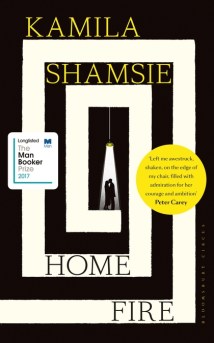 Home Fire is a good contemporary novel and its central theme of conflicting loyalties, especially tensions between personal feelings and legal, political, and moral obligations is interesting and obviously topical. I didn’t find Shamsie’s prose particularly artful: on the back cover Aminatta Forna is quoted as calling it “simple” and “lucid” but I would describe it as flat and sometimes awkward, if also sometimes rising to eloquence. I have
  As a member of Jo VanEvery’s
  For me personally, the “retreat” (how I hate that term, which falsely suggests there’s something soothing about being closeted for hours with my colleagues and having to talk about fraught topics about which in some cases we profoundly disagree) was extremely stressful and undid some of the progress I’d made,
  Anyway, Jo recommends taking stock of what we did accomplish in May, and dealing with meetings and administrative tasks was a big part of that. I also completed the final draft of a report: I was part of the Faculty of Graduate Studies’ internal review committee for the
  One of the things I’d intended to do in May is work out a definite plan for some larger writing projects to focus on over the summer. For some reason I have found this very difficult to do: I have sketched out and even done scraps of writing for a lot of possibilities but I have struggled to commit to any one of them. I have continued to explore places to pitch pieces that aren’t book reviews, and I have some ideas I like, as well as a firm commitment to doing a piece for The Reader, a publication I have long admired for its combination of sophistication and accessibility. I really want to get back to writing about George Eliot; I think what I may need is to stop focusing on venues for a while and just write, the way I could when I always had the option of running something in Open Letters Monthly. Trying to think of the pitch first becomes an exercise in self-defeating second-guessing. Getting going on this–whatever it turns out to be–is a top priority for me this month.
 These are all work things, and of course that’s never everything that’s going on. Maddie had her wisdom teeth out on May 18th, for example, and that meant a week or so of disruption (and a lot of smoothies) while she recovered, but she is basically better now.
 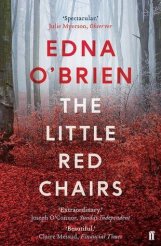 Last but not least, Edna O’Brien’s
 It’s not just Fidelma’s, though, and here again O’Brien’s narrative choices are interesting. Though there is some shifting around of perspective in the first section, the movement of the novel is fairly linear until Dr. Vlad’s identity is revealed and he is arrested. One of the consequences of his discovery is an attack on Fidelma so horrific that it was difficult for me to read to the end of the few pages it takes up. It is not the first scene of appalling violence in the novel, but it is by far the most immediate and personal. It changes everything–not just Fidelma, now herself a kind of casualty of war, but the novel. From this point on it follows Fidelma’s attempt to make a new life for herself away from Cloonoila, but rather than focusing on her singular experience it folds in other stories of victims and refugees from violence.


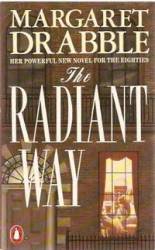 Jane Austen recommended three or four families in the Country Village as the thing to work on when planning a novel. . . . A few families in a Country Village. A few families in a small, densely populated, parochial, insecure country. Mothers, fathers, aunts, stepchildren, cousins. Where does the story begin and where does it end?
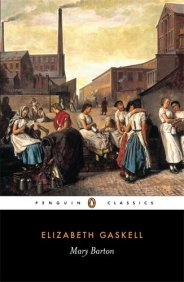 As this passage illustrates, The Radiant Way is about the condition of England in the 1980s, and its treatment of that era matches, rather than counters, what it suggests is the spirit of the age: it is (mostly) satirical, snide, cynical, bitter. I wonder if that is why it seemed to me so much more dated than, say, Mary Barton, with its heartfelt appeals to our common experiences and better natures. There is something naive, of course, about Gaskell’s novel, and many of her attitudes are outdated. Maybe I just prefer her kindness and optimism to Drabble’s somewhat ruthless explication of people’s weaknesses and compromises. The extent to which her analysis is still painfully current, too, shows that if anything she was prescient about the corrosion of the welfare state, the devaluation of art and education, and the instability of love as a foundation for happiness. Maybe I just wish it were dated.
 I read The Radiant Way for my book club (it’s our follow-up to
 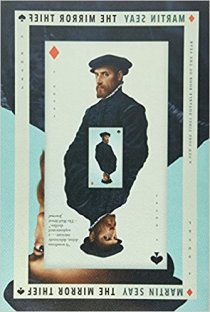 I’ve been in a bit of a reading slump lately, which has been reflected in the slow pace of my blogging. I’m not sure exactly what is behind it this time, but I think it happens to all of us occasionally, and it always passes eventually. Still, it’s a disheartening phase when it comes, to be picking up books and putting them down again without much caring!
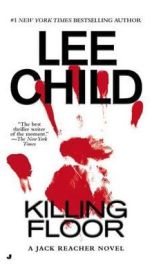 I also started Lee Child’s Killing Floor, the first of his hugely popular Jack Reacher thrillers. I admit it had never occurred to me to try this series until Stig Abell, the editor of the TLS, sang its praises. I had no particular assumptions about Lee Child, good or bad, it’s just that the books had never stood out to me until Abell said how much he’d enjoyed reading through them all last year–so I picked up a couple at a book sale. I got about half way through Killing Floor before I lost interest. I don’t think there’s anything really wrong with this book any more than there is anything wrong with The Mirror Thief: in fact, I thought Killing Floor seemed quite good of its kind. But for whatever reason I just wasn’t gripped–I wasn’t even slightly curious about how the knotty plot was going to turn out, and so I eventually stopped picking it up again after I put it down. When I started it, it reminded me of Robert B. Parker’s Spenser mysteries, which I love. It is much wordier, and it may be that I wouldn’t enjoy Parker’s books if it took a lot longer for things to happen in them–or if Parker spent as much more time on the really grim bits as Child does here. I also didn’t bond with Reacher. I was intrigued by Child’s introduction, in which he outlines his own motivations for the style of the series as a whole and for Reacher’s character in particular. Reacher is deliberately both arrogant and hard to like, which are not qualities I’m against in principle, in a main character–but again, I don’t imagine I would like Parker’s books if I didn’t find Spenser’s combination of strength and honor so appealing. Maybe I’ll appreciate Reacher more as a character if/when I get to know him better. For now, though, I’ve put him on hold.
 It’s not as if I haven’t read any books all the way through since classes ended. One thing that works is coercion! I’ve read two books for reviews, one an interesting study of Agatha Christie, the other a new novel by Canadian writer Merilyn Simonds. (My review of the former has been filed; my review of the latter is underway.) I’m also making good progress on Margaret Drabble’s The Radiant Way, which I need to finish for next weekend’s meeting of my book club. Deadlines are useful things. In the interstices of my days I’ve also reread all three of
