“I know he has a bad nature,” said Catherine; “he’s your son. But I’m glad I’ve a better, to forgive it; and I know he loves me and for that reason I love him. Mr. Heathcliff, you have nobody to love you; and, however miserable you make us, we shall still have the revenge of thinking that your cruelty rises from your greater misery! You are miserable, aren’t you? Lonely, like the devil, and envious like him? Nobody loves you–nobody will cry for you, when you die! I wouldn’t be you!”
I said that Wuthering Heights was near the top of my list of books to reread on my sabbatical, with my eye on refreshing the titles in regular rotation in my 19th-Century Fiction classes. Because I have never enjoyed reading it, I started it this time a bit reluctantly, and for the most part it gave me no more pleasure than it has before. I still don’t like it. But while liking or not liking a book may be, as Henry James put it, “that primitive, that ultimate, test” for us as readers, it really can’t be the ultimate test for those of us who are also scholars, teachers, or students! So as I reread the novel, I tried not just to keep an open mind about it but to imagine as actively as I could what it would be like to teach it, including both its individual features and how it might shake up discussions of other books on the reading list. And guess what: I think I’m going to try it!
One reason is that it is impossible to deny the novel’s emotional power. Its unrelenting, highly compressed intensity really does make it qualitatively unlike any of the other books I assign, and that difference alone is thought-provoking. Not only, as the introduction to my edition rightly notes, does “Emily Brontë [have] no interest in the moral response as a reason to soften her narrative,” but the effects she is interested in are discomfiting, even disturbing. Passion, hatred, violence, revenge: these are the novel’s animating forces, and while they are repellent, they are also grimly fascinating, with thematic (and, yes, moral) implications that are well worth discussing.
 Another is that while Emily Brontë may have had no “interest in shaping her story morally,” Wuthering Heights is a very complexly structured novel, with its multiple nested and embedded narratives. The many hours I’ve spent on other novels with multiple or unreliable narrators, such as The Moonstone or The Tenant of Wildfell Hall, have shown me what fun the interpretive work can be as you sort through who is saying what in particular, to whom and why and with what consequences for our reading of their words. I hadn’t paid that much attention to this aspect of Wuthering Heights before, though I knew it was the subject of a lot of the critical discussion. This time I was more attuned to it and felt some genuine enthusiasm at the prospect of working on it with my students, even if most of the voices we’ll be attending to are as unpleasant as young Catherine’s spiteful words to Heathcliff in my epigraph to this post.
Yet another reason: the mental exercise will be good for me! Yes, I still don’t like the novel: as I said on Twitter, it may be a masterpiece, but I can’t imagine it becoming a personal favorite. That’s exactly why I should work on it: learning to appreciate it will stretch and challenge me, intellectually and aesthetically. I will have to consider why it does the things I don’t like, for instance, and how that instinctive dislike might be inhibiting my critical sensibility–what my taste keeps me from appreciating. I will also, quite simply, have to learn new things, and that is always beneficial to me as a teacher: it keeps me both alert and humble. What do I need to know to teach Wuthering Heights effectively? I am sure that I will enjoy figuring that out more than I enjoyed rereading the novel. At the end of the process, I will probably like Wuthering Heights better, too, but if I don’t, that’s OK.
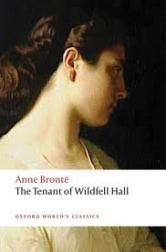 The one reason I’m still hesitating: Perhaps wrongly, I’ve been assuming that the Brontë portion of my reading list is a zero sum game, that if I assign Wuthering Heights I can’t also assign Jane Eyre or The Tenant of Wildfell Hall, and that makes me sad, because those are known pleasures. But the only person making up this rule is me, so maybe I can break it! Would it be so bad if two out of five novels were Brontë novels, especially given how different they are from each other? As I was finishing up Wuthering Heights I kept thinking how great it would be to read Tenant right after: then Heathcliff and Hindley and Hareton could face off against Huntingdon, Hattersley, and Hargrave. What if Wuthering Heights were crowding out Scott or Thackeray instead of Charlotte or Anne? Would that be so bad? (I mean, yes, it would, in a way, because I also love teaching Waverley and Vanity Fair, but you can’t do everything, at least not all at once.)
Another possibility that occurred to me is that Wuthering Heights might be a good option for the 19th-century novel I assign in my Brit Lit survey, rather than (or as well as) a good selection for 19th-Century Fiction. One theme I’ve been kicking around for the survey course is “belonging,” which seems like a concept that could work at the level of the course itself (for discussions about what’s included and what isn’t and what story you tell by deciding what belongs and what’s excluded) as well as at the level of particular texts (who do they implicitly or explicitly include or invite or leave out? what idea of community or nation or fellowship is at stake? etc.). I was having a hard time identifying a Victorian novel that really fit this theme, but clearly Wuthering Heights would, especially but not only because Heathcliff is the ultimate outsider. “But where did he come from,” wonders Nelly, “the little dark thing, harboured by a good man to his bane?”

 There is a lot to admire about the novel. Its characters are effectively, if somewhat schematically, established; their salient traits and values are distinct and the turns their stories take as they play their parts in Gissing’s depressing story of jockeying and dreaming and ailing and failing are always consistent with the strengths and weaknesses we know them to have. The intersecting plots play out with what in a more stylish writer I might call elegance, and Reardon’s story in particular reaches heights–or is it depths?–of pathos that are very nearly tragic, though Gissing’s tonal register is too prosaic for that label to sit comfortably. The novel is also very good about the way personal feelings are inextricably entangled with people’s money (or the lack of it) and ambition (or the lack of it): its marriages (actual, imagined, sought, and abandoned) play out in nice counterpart to, and sometimes illustrations of, the novel’s literary commentary.
 This underwhelmed reaction is, of course, very likely due to some analytical near-sightedness of my own, or to New Grub Street just not being the kind of novel that I like best to look harder at, while my preference for The Odd Women may just be because I know it better and have spent more time thinking, writing, and teaching about its central themes. But overall what I felt by the end of New Grub Street was that for a novel so self-consciously about fiction, it is surprisingly, disappointingly, not particularly metafictional: I couldn’t see a way in which Gissing was offering up a novel that is itself (in structure, form, style, or theme) more than the sum of the literary parts it includes. That lack of transcendence may be the point: if it is a novel about anything, it is about literary failure, including both the kind that presents itself as success and the kind that might actually be success but doesn’t seem like it, and so if New Grub Street was a brilliant, stylish, provocative, or formally innovative novel, its whole premise might implode. I don’t really think, though, that something so artistically self-conscious and deliberate is going on: Gissing is just describing a close possible world to his own, showing it to us in all its meticulous, dreary, disheartening detail. Adam Roberts is absolutely right that New Grub Street “works superbly as a detailed evocation of a particular social and cultural milieu,” but once you’ve acknowledged that, then what? (Adam, characteristically, does much better addressing that question than I have here:
  The next step after drawing up my plans for refreshing my reading lists was to get my hands on the books I’m interested in. This is easier for some courses than others. For instance, I already own copies of several of the Victorian novels I want to reread, and because I’m a regular customer, both Oxford University Press and Broadview Press are always very helpful about providing exam copies. As a result, I now have a nice TBR shelf of
 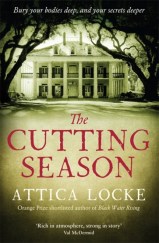 A small handful of titles are more easily available, including Attica Locke’s The Cutting Season, so I started with that because it had sounded like a promising option. It’s a decent enough novel but it sparked no excitement in me: it is slow moving and detailed in a way that made it seem drawn out rather than rich or textured, and in terms of innovations in or provocations about the genre, it didn’t seem to me to offer much. Next up, because it too is available locally, will be Rachel Howzell Hall’s
  I didn’t write a separate post about this because it’s a smaller scale project, but I’m teaching Pulp Fiction again this fall and with regret, I think I’m going to give up on Valdez Is Coming. I thought it was eminently “teachable” (that indefinable quality!) but both times I taught it most of the students in the class did not seem to agree! I took True Grit out of the library this week to review it and was quickly reminded
  The third course I plan to spend time rethinking during this sabbatical is British Literature After 1800, one of a suite of 2nd-year survey classes we originally established to orient students in the big picture (nationally and historically) as context and preparation for our more specialized upper-level courses. These curricular intentions are compromised (some might say, rendered inoperable) by the way our program
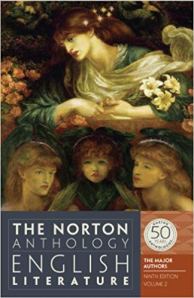 So I assigned the “major authors” edition of the Norton Anthology and we read Wordsworth and Coleridge, Keats and Shelley, Tennyson and Browning and Hopkins, Wilde and Joyce and Woolf, Yeats and T. S. Eliot and Auden, Heaney and Rushdie. A bit less predictably, we also read Elizabeth Barrett Browning and Christina Rossetti, and Katherine Mansfield, and while the first time around I assigned Great Expectations as our representative Victorian novel, the second time we read Mary Barton. Both times, our 20th-century novel was
  Looking over my notes, I actually think it was quite a good course of its kind. (You can read some blow-by-blow accounts of it while it was in progress if you’re interested; just scroll down
 I actually already have one specific idea, which is to substitute
  In
In  To date, the books I’ve chosen for this seminar have all been by women writers, about women detectives, and explicitly interested in gender and detection. They all, that is, bring a lot of self-consciousness to their engagement with detective fiction as a genre. Collectively, they also cover a good range of subgenres or types of detective fiction. While in these respects the list has reasonable breadth, however, in other respects it is quite narrow; the feminist tradition it covers is, to put it mildly, not very intersectional. I put in some time in the past trying to fix this problem; though I came up short, the good news is that I do, as a result, already have a preliminary list of names to start with, particularly of African American authors: among these are
  So far I have never assigned a Canadian writer in either of my detective fiction classes, primarily because I haven’t found one that takes the genre in what seems like a new direction or that really made me sit up and take notice. (Phonse Jessome’s
  One of the problems I ran into last time I went down this road was getting my hands on samples from the authors I was interested in. I probably just need to be more persistent and order a lot of titles through interlibrary loan. The other problem is that I’m not really a voracious or enthusiastic reader of mysteries (odd, I know, in the circumstances) so I tire easily of the necessary exploratory work and I can take a while to warm to books that are not immediately appealing to me (though I can eventually get there, as has happened with Walter Mosley’s Devil in a Blue Dress–still not a personal favorite, but one I have found very satisfying to teach). This is why I need help sifting through or coming up with good options so that I can make this reading list represent a wider range of voices. Ideas and recommendations would be very welcome.
 One of my plans for my upcoming sabbatical is to reconsider and possibly refresh my reading lists for courses I offer frequently. It may be that the reading and rereading I do confirms my usual selections, or that it gives me ideas for mixing things up a little, or that I get inspired to rethink my approach altogether–we’ll see! It isn’t that I’m dissatisfied or trying to fix anything in particular about these courses, which usually go very well. It’s just that book orders for the next year come due in the middle of term when I’m too busy to do this kind of exercise. I don’t want change for the sake of change, but I also don’t want to slide into complacency or let my classroom conversations stagnate.
 This context explains the choices I typically make for the 19th-Century Fiction Austen-Dickens-Hardy courses: in our curriculum, there are other courses that focus on particular kinds of fiction from the period, so I stay away from works in those categories (such as Frankenstein or Dracula, for example, or Alice in Wonderland) that I know students will read elsewhere and focus primarily on realist, domestic, historical, or social problem novels. I start with Austen, but I tilt English 3031 towards the Victorians, rather than the Romantics, because they have their own classes; similarly, I end English 3032 with Hardy and (with regret) leave Forster and his fellow Edwardians to the later courses.
 Besides books like Frankenstein that I know are covered frequently in other courses, probably the most obvious absence from this list is Wuthering Heights. I have read it more than once but never taught it, for the simple (if perhaps indefensible) reason that I like the Brontë novels I do teach much better and the maximum of five books per course that seems realistic to me is a zero-sum game. Also, my colleague Marjorie Stone, who loves Wuthering Heights, regularly offers an upper-level seminar on the Brontës. This winter is her last term in the department, however: her impending departure is another reason I am taking stock in this way. Wuthering Heights is (sigh) near the top of my “reread in 2019” list.
 So besides Wuthering Heights, what other alternatives
  There’s another dimension that I need to give further thought to, and that’s which less canonical writers or genres I should work into these plans. I’ve made it this far without reading any novels by Bulwer Lytton or Disraeli or Charlotte Yonge, any “silver fork” novels or Newgate novels or, besides The Odd Woman, any ‘New Woman’ novels. I haven’t read Ouida or Marie Corelli or Amy Levy, or H. G. Wells or* …. but then, the list of books I have read is always (and always going to be) much shorter than the list of books I could have read. The challenge is always deciding which of those are books I really should have read. In the end it’s about defining purposes and drawing lines, which are always exercises in artificial precision. For my current fairly narrow purpose–refreshing the reading list for two undergraduate courses already defined by what they are not–the authors I’ve already identified as priorities are probably more than enough to take on, but if there’s a story about the 19th-century novel from Austen to Hardy (that is, roughly from 1815-1890) that you think I can’t tell, or could tell better, with the help of someone I seem likely to overlook, I’d be happy to know!
 More clutter to clear out of my head, if I can — something that has been on my mind for about three weeks now, but in an unfocused or inconclusive form. In fact, I’ve started and then deleted a couple of posts about this already; I just couldn’t seem to get very far before either deciding I didn’t want to get into it after all or running out of energy. But now the topic feels like mental debris, so let’s see if I can make any kind of sense of it so I can move on. One thing my blog is supposed to be for is freeing me to write about things without having to be absolutely certain about them, after all.
 This is all good! That is, it is all good if these are the activities you want your students engaged in–and I genuinely have no problem with that. I’m just not interested in doing that kind of thing myself, and what I was trying to figure out is why, and then whether this signals a deficiency of some kind in my own pedagogical approach. After some reflection, I decided the answer to the first part of that question is that increasingly, I do not approach my classes as steps towards making students into scholars, as part of a program designed to train them to do academic things. Instead, I aim to engage and train them as readers–attentive, well-informed, rigorous readers, to be sure, but with their eyes first and foremost on the page, not on contexts or scholarly apparatus or digital tools.
 I’m not saying that the kinds of hands-on learning students get from constructing timelines (or whatever) can’t contribute to the conversations I prioritize, and clearly it can also give them valuable experience of other kinds, including building the skills set required to work with these kinds of digital tools. I can’t shake the feeling, though, that these projects take time away from, or redirect attention from, the books themselves, and there are so few contexts in which a sustained focus on reading is even possible, much less required and supported. If my own work and interests were in the field of book history, I expect I would find these tools more personally congenial. At the same time, my own estimation of the value of some forms of scholarly work has also eroded so much in the past decade or so–my own impatience with its insularity, with the feeling of playing insider baseball, has gotten so acute– that I have far less interest in drawing students into that world than I have in … well, in doing what I do in my own classes, which is pretty well documented here across the decade-plus history of
 I was looking back over some old posts in this series and November entries have a certain … similarity, shall we say! We’re all–students and faculty alike–tired, busy, and kind of gloomy. The introduction of a week-long break (coming next week for us) has not made as much difference as you might think: last year I was struck by how much more tired and behind a lot of my students seemed when classes started up again, and because the break also comes quite late in the month, we all felt a bit frantic after it because the end of classes was suddenly so close.
 We aren’t quite there yet, however: there’s still the rest of this week to get through. In Mystery and Detective Fiction we’ve just wrapped up our discussions of Ian Rankin’s Knots and Crosses. Although I think Knots and Crosses is gripping and clever, I’ve been wishing that I left The Terrorists in instead when I decided which book to cut to make room for An Unsuitable Job for a Woman, because its political engagement is in some ways more immediately relevant and its morality is more complicated. That said, Knots and Crosses offers a pretty direct engagement with what we now call “toxic masculinity.” Its Gothic games seemed a bit too pat to me this time, though–I don’t entirely disagree with Rankin’s own assessment of it as a bit too clever, a bit too much the self-conscious work of a young writer immersed in literary theory and history and eager to show off what he knew.
 In 19th-Century Fiction tomorrow we are finishing our time on Silas Marner. Because I have only taught Silas Marner once or twice before, and many years ago, I have been feeling my way a bit hesitantly, not being entirely certain which questions will catch students’ interests or draw them most naturally towards the novel’s big ideas or best moments. Oddly, perhaps, I’ve found it difficult precisely because the novel is so short, though I chose it hoping that its brevity would make George Eliot more accessible than usual. I dialed back the amount of context I provided at the outset, but even so it took up nearly one whole class, and that left us only three more to talk more freely about the novel. With Middlemarch, in contrast, I typically have at least three weeks’ worth of classes, or around nine hours, and we get even more time when I assign it in Close Reading. And yet three hours is actually plenty in some ways too: because not a great deal happens in Silas Marner just in terms of plot, I feel as if I have been struggling to work on the meaning of what does go on without repeating myself. Still, I think it has been OK overall. In fact, I have been pleased at both the quantity and the quality of participation in class discussion, which certainly suggests to me that they are finding the novel’s distinct combination of realism and moral fable engaging. We have already talked a fair amount about the importance of taking responsibility and making deliberate choices, rather than trusting to luck, fate, or God, as key to Eliot’s moral vision; tomorrow we will talk about this in the specific context of family, especially parenting, including both Silas’s choice to raise Eppie (in contrast to Godfrey’s actions) and Eppie’s choice to stay with Silas. I think this is the only one of Eliot’s novels that comes close to being unironically sentimental, at least in the main plot line–and it’s just so lovely.
 The three Cs are are Cold, Collins, and Chandler, and I am actually done with all of them now, but I haven’t blogged about my classes since they were all just starting up, so I thought it was time to get caught up. A trace of the first does remain in the form of a minor but lingering cough, but although I did end up having to cancel one day of lectures when I actually lost my voice for a bit, it wasn’t too bad. A number of my students and colleagues have been much sicker, poor things.
 I also felt just a bit impatient with The Woman in White, though it is a lot more fun than The Big Sleep. At one point in our discussions this time a student actually asked a question I ask sometimes too about different novels, that could perhaps be summed up as “Are we giving this novel too much credit?” — or “Are we putting more interpretive weight on this novel’s details than they can really bear?” I feel that more with Lady Audley’s Secret (which I think is fundamentally incoherent, or indecisive, about some of its central thematic questions) than I do with The Woman in White, but I think it’s always a fair question to ask. It’s not one that I think can ever be answered definitively either way, but there’s no doubt that some novels seem less in control of their own meaning than others, while some can rather deflate under scrutiny. Some novels, too (as I ended up saying about The Woman in White, though not, if I remember correctly, to the same student) raise a lot of interesting questions or stir the pot in thought-provoking ways without necessarily resolving every aspect.
 In 19th-Century Fiction we are actually on our penultimate novel, Silas Marner. I’ve been a bit nervous about how it would go, as it starts out pretty slowly and Eliot’s prose requires closer attention than any of our other novelists’. I also haven’t taught it very often–only twice before that I can remember, and never in a lecture class of this sort. Today was “big picture” day so I set up some key ideas and then we began talking about Silas himself, first as he is seen by his neighbors in Raveloe and then as we come to understand him thanks to the narrator’s explanations and commentary. I tried to emphasize the importance of noticing the different ways people arrive at their explanations for what they see, which I think is key not just to the themes of the novel but also to its pacing, in which not much often seems to be happening but we realize, if we know to look for it, that a lot of the action is in perception and interpretation. One student brought up Silas’s beloved pot, which I thought was a particularly nice detail to have picked up on:
 In Mystery and Detective Fiction we’ve just wrapped up our discussion of The Murder of Roger Ackroyd. It’s been an interesting fall to be teaching this course. I always open it with some discussion of the differences between “literary” and genre fiction–not just what those differences are presumed to be but how they shape people’s expectations and evaluations of books on either side of the supposed divide. I imagine, however, that to students already accustomed to a literature curriculum that incorporates not just popular culture but a wide range of media (we have courses on both Chaucer and comics, on Shakespeare as well as Tolkien, on poetry and on television and video games) it sometimes seems as if in advocating for the intellectual gravitas of our course material I am arguing against a straw man.
 This term, however, both Margaret Wente in the Globe and Mail and Luke Brown in the TLS stepped up to show my students in real time that the debates about the literary merits of crime fiction are ongoing and can be both intense and judgmental. Wente published an op-ed decrying the degradation of our curriculum–yes, ours in particular: she singled out Dalhousie’s English department and Mystery & Detective Fiction was among the courses she specifically mentioned as symptoms of our decline. (I won’t link to Wente’s column, because I don’t want her bad faith and shoddy practices rewarded with clicks, but
 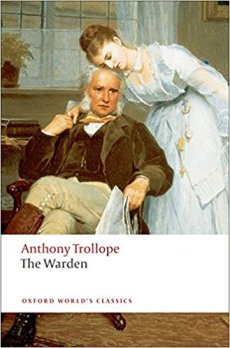 In 19th-Century Fiction we’ve just finished our work on The Warden. I’ve written a couple of times already about why Trollope feels unexpectedly pertinent to our current moment, whether as
  The Warden is an odd little book, and in many respects it is hardly a radical one. As we discussed in class, for instance, the bedesman who speak up for what they think is theirs by right are characterized as greedy and ungrateful, and they are ultimately punished for it, ending up worse off both economically and emotionally than they were under Mr. Harding’s wardenship. The novel’s social vision is fundamentally paternalistic. There is something at least potentially radical, though, about its ethical vision–about its casting as a modern-day hero someone who, when criticized, does not lash out but turns inward, and who then will not be dissuaded even by the most powerful people around him into ignoring what his conscience decides is right. Mr. Harding’s resignation does not really fix anything: the novel explores at several levels the complicated relationship between individuals and larger systems and institutions, and in doing so it raises timely questions about the possibility of meaningful moral agency in corrupt circumstances. I think a lot of us are struggling with this right now: the things we can do on our own seem so insufficient that it is tempting to stop trying to do anything. There’s some encouragement to us in the vicarious satisfaction we get from seeing the Warden persist. Even Archdeacon Grantly, imposing bully that he is, is ultimately no match for him! We all probably face a version of the Archdeacon’s exasperated “Good heavens!” sometimes, maybe especially when we try to take some small, imperfect, corrective action of our own. The Warden is not about taking to the barricades–but most of us aren’t going to do that anyway. Mr. Harding might at least inspire us to play our imaginary cellos with renewed vigor as we carry on living our own ethically complicated lives as best we can.
