 I miss writing my regular updates about what we’re doing in my classes. Given that I am still teaching, and covering much the same material as usual, I have been puzzling over why it nonetheless feels nearly impossible to talk about it right now–not the process or the logistics of it, which I have written about several times now, but the substance of it. So much is the same, even though we’re online, after all: as I’ve pointed out more than once to my students, we always read the books outside of the classroom, and we always did at least some of our work on them in writing, including sometimes reading journals or discussion boards much like what I’ve asked them to do for the online versions. Why is it that without the actual classroom time, I can’t figure out what to say about the weekly experience of my classes?
It’s nearly a year now since the Big Disruption: this time last January, and in February, and in early March, I was puzzling, not over what to say here, but over how to fix a class that felt like it was really faltering (the British Literature survey). I was also enjoying the usual (ah, usual!) challenges of running discussions in the 19th-century fiction class, working especially on my resolution to wean myself from lecture notes and allow it to be more spontaneous (ah, spontaneity!). Looking back at those posts this morning, it clarified for me that what I’m missing now is the sense of teaching as an occasion, something that is a clear and necessary casualty of the asynchronous model I am using now. Whatever else we were doing, at least several times a week we did something together, and a lot of my thought and energy went into those specific common experiences–what to do in them, what we talked about in them, what went well (or didn’t) in them.
 In contrast, our online class discussions, even though we cover the same kinds of topics, are diffuse. Lots of good replies get posted to questions; lots of good comments get made on passages. But these things happen really sporadically, on the students’ own schedules. The earlier someone posts, the more likely another student will specifically reply and so the more conversation-like it feels, but (especially since this term I have relaxed my earlier attempts to micromanage this process) it’s haphazard and unpredictable, and you can never be sure if the original poster will look at the replies or that other students, writing in other threads, will check in to see what is unfolding elsewhere. As a result, there is no common ‘discussion’ for me to write about here: I can’t say “today we focused on X” or “after today’s discussion I realized that the thing I really need to bring up is Y.” Even for me–and of course I’m trying diligently to be as attentive as I can across every thread–it is hard to gather up the various pieces into a story about what, collectively, has gone on. One of my original plans for my own role in online discussions was exactly that: I was going to mostly hover, during the week, and then post something synthesizing the main lines and insights and gaps. It proved much harder than I thought it would, though, and in the spirit of giving myself a break too, I stopped trying.
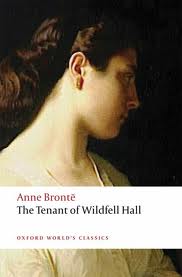 The other thing that muddles me up about reporting on ‘this week’ is that most weeks I am actually focused on next week in my classes, as I need to get the lectures composed and recorded, the discussion prompts up (when they are my job), the quizzes made up and created in the tedious quiz tool with its endless drop-down menus — everything needs to be ready to go ahead of time, so that when the module begins they actually can do it at their own pace, as the asynchronous model promises. Again, this is very different from a regular term, in which preparations for lectures, assessments, and activities are often done close to (sometimes too close to!) the specific hour in which I’m going to use them. This lets me shape them to our current discussions, and it keeps me mentally right in the moment. Today, though, as an example of what’s different, for Mystery and Detective Fiction I will be creating a lecture about “Chasing Meaning in The Maltese Falcon,” while my students work through materials on The Murder of Roger Ackroyd – which I completed almost two weeks ago. (Notice I say “for” this class, not “in” this class, and that’s the key to the difference!) For The Victorian ‘Woman Question’ I just made my slides for next week, our last week on The Tenant of Wildfell Hall, and I already made my slides introducing The Mill on the Floss for the week after that. My mind is all over the place, not here, now, in this week.
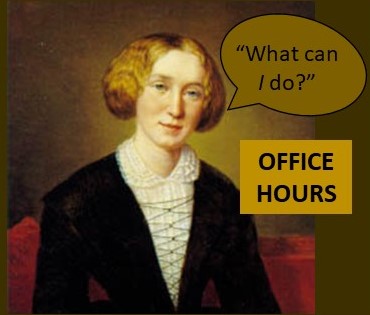
 I will spend two hours this week with my students, if not in my classes: Thursday mornings I meet for an online but real-time discussion with the students who are taking The Victorian ‘Woman Question’ cross-listed as a graduate seminar, talking about the novel and also about some secondary readings. Then Thursday afternoon I’m having a drop-in office hour, which I’m pitching as a chance to ask questions about the courses or just to come and hang out for a while. I floated the idea of having some actual real-time class discussion, but scheduling presented a lot of obstacles and students’ reluctance to be recorded (so as not to disadvantage those who couldn’t attend) also proved, understandably, another disincentive. So we won’t dig into questions about our reading except, perhaps, incidentally, but at least we can see each other’s faces and infuse a little shared time into the otherwise radically dispersed experience of this online semester–hopefully, possibly, maybe our last one. Also, maybe, hopefully, possibly, we’ll get nice enough weather in April, before this term is over, that we can try holding that drop-in office hour somewhere outside, near enough to see each other’s faces if still distant enough not to put each other at risk.


 As if converting my courses to online versions wasn’t challenging enough, I also used specifications grading for the first time this fall, for my first-year class “Literature: How It Works.” This is an experiment I had been thinking a lot about before the pandemic struck: in fact, on March 13, the last day we were all on campus, I actually had a meeting with our Associate Dean to discuss how to make sure doing so wouldn’t conflict with any of the university’s or faculty’s policies. Though I did have some second thoughts after the “pivot” to online teaching, it seemed to me that many features of specifications grading were well suited to Brightspace-based delivery, so I decided to persist with the plan, and I spent a great deal of time and thought over the summer figuring out my version of it.
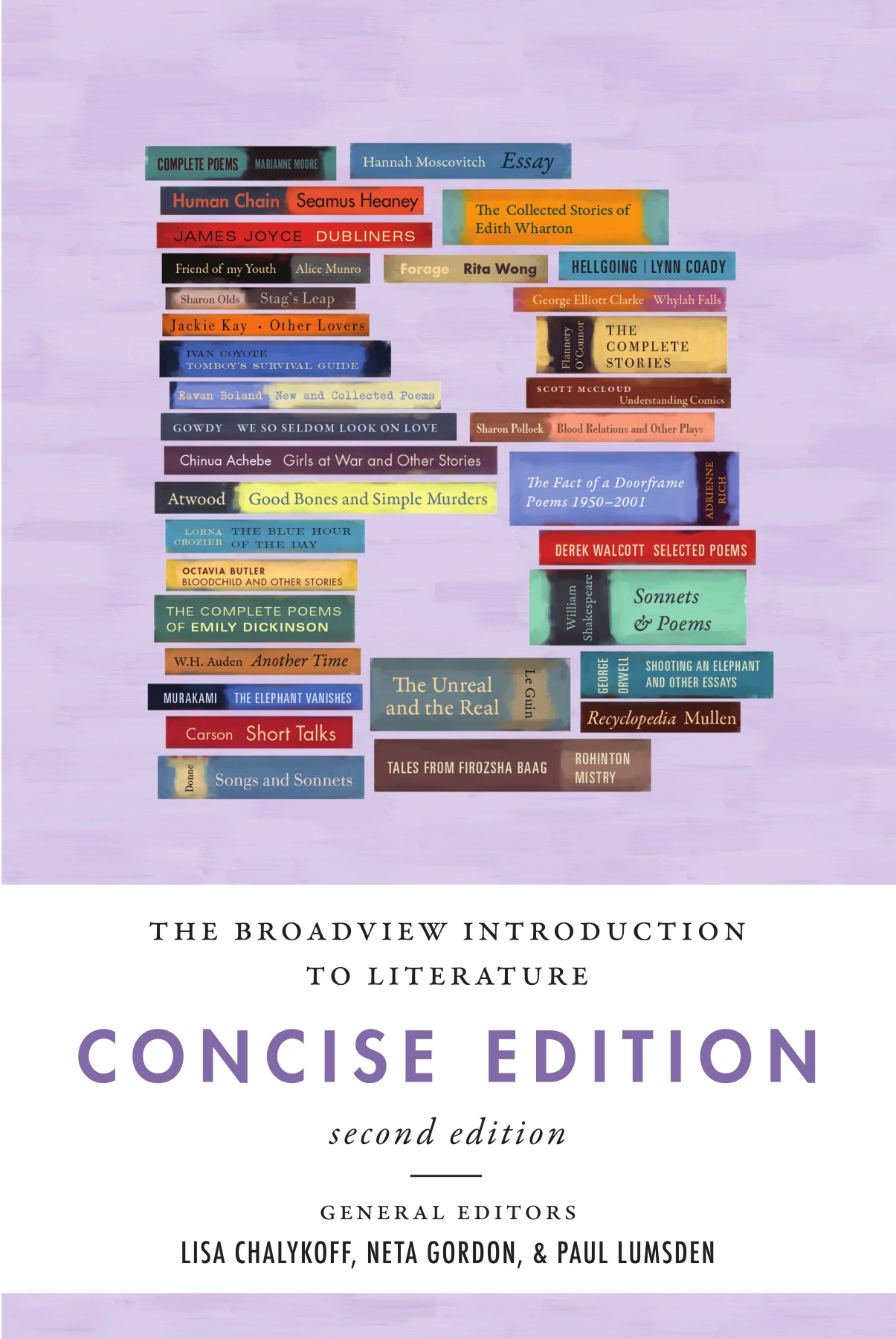 I won’t go into every detail of the plan I finally came up with (though if anyone is really keen to see the extensive documentation, I’d be happy to share it by email). Basically, I made a list of the kinds of work I wanted students to do in service of the course’s multiple objectives: reading journals, discussion posts and replies, writing worksheets, quizzes, and essays. Then I worked out what seemed to me reasonable quantities of each component for bundles I called PASS, CORE, MORE, and MOST. These bundles corresponded to D, C, B, and A grades at the end of term; students’ grades on the final exam determined if they got a + or – added to their letter grade. I also (and in many ways this is the most important part of the whole system!) drew up the specifications for what would count as satisfactory work of each kind: completing a bundle didn’t mean just turning in enough components but turning in enough that met the specifications. Following the lead of others who have used this kind of system, I tried to make the specifications equivalent to something more like a typical B than a bare pass.
 On a related note, something else that I think was good (though it was a bit hard for me to tell without having a chance to talk it over with the class in person) was that the system gave students a fair amount of control over their final grade for the course. Instead of trying to meet some standard that–no matter how carefully you explain and model it–often seems obscure to students, especially in first-year (“what do you want?” is an ordinarily all-too-frequent question about their essay assignments) they could keep a tally of their satisfactory course components and know exactly what else they needed to do to complete a particular bundle and thus earn a particular grade. That didn’t mean it was an automatic process; again, to be rated satisfactory, the work had to meet the specifications I set. I tried to make the specifications concrete, though: they didn’t include any abstract qualitative standards (like “excellence” or “thoughtful”). The core standards were things like “on time,” “on topic,” “within the word limit,” and, most important, to my mind, “shows a good faith effort” to do the task at hand. I suppose that last one is open to interpretation, but I think it sends the right message to students trying to learn how to do something unfamiliar: if they actually try to do it, that counts. When my TA and I debated the occasional submission that had arguably missed the mark in some other way, we used “good faith effort” as the deciding factor for whether they earned the credit: we used it generously, rather than punitively.
 One other way I consider the experiment a success was that it seemed to me that the students’ quantity of work–their consistent effort over time–did ultimately lead to improvements in the quality of their work. The skepticism I faced from some colleagues when I mentioned this plan tended to focus on concerns about rewarding quantity over quality, or about not sufficiently recognizing and rewarding exceptional quality. Over the term I did sometimes worry about this myself: much as I liked being freed from grading individual assignments, I didn’t always like giving the same assessment of ‘satisfactory’ to assignments that ranged from perfunctory or barely passable at one end of the scale to impressively articulate and insightful at the other. You can signal the difference through your feedback, though, and that’s the big shift specifications grading requires. The other key point is that most people really do get better at writing if they practice (and get feedback, and engage with lots of examples of other people’s writing) and so making it a requirement for a good grade that you had to write a lot had the side-effect (or, met the course objective!) of helping a lot of students improve as writers. Between reading journals and discussion posts and replies, there was no way to get an A in this version of the course without writing a few hundred words every week, which is a lot more than students necessarily have to do in my face-to-face versions of intro classes. Especially in their final batch of essays, I think that practice showed.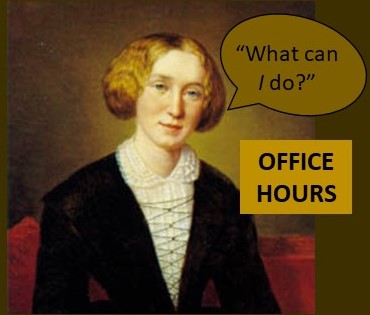
 It hasn’t been all bad, though.
  So what have I learned? In addition to the technical stuff – Brightspace and Panopto and Collaborate, oh my! – I have learned, as a lot of other people have too, that the best advice and methods for online teaching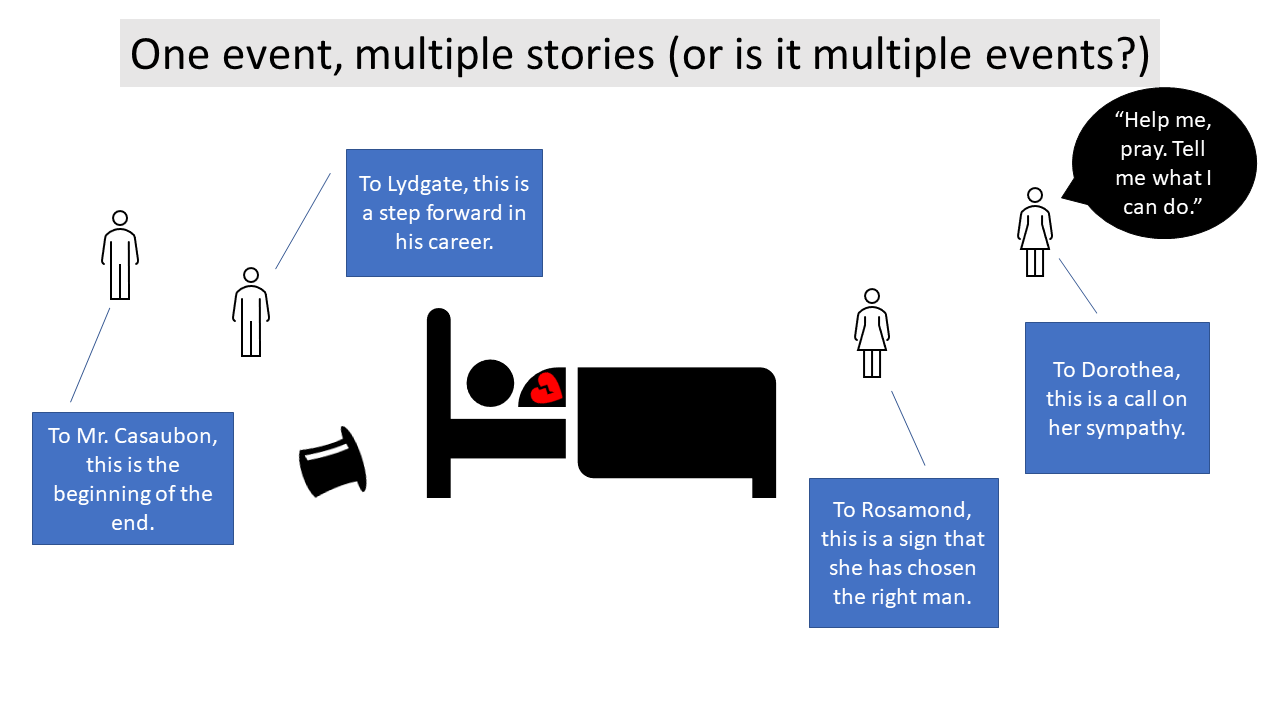
 But here I am now, ready once again to take stock of how things are going in my classes. And the disconcerting truth is that a third of the way through this strange term, I still don’t really know, because I have no base line for comparison, no past experience to check this one against. I’m working pretty incessantly on one teaching task or another, but I get very little feedback compared to the ongoing opportunity, in face-to-face teaching, to “read the room”–which could, of course, be discouraging if you could tell they weren’t with you, but at least there was some immediacy to that input and enough flexibility to the whole operation to let you change things up, on the fly or more deliberately. One of the most disorienting things about online teaching so far, in fact, is the time lapse: because a lot of materials need to be ready ahead of time, I’m usually working on next week’s lectures and handouts while the students are working on this week’s. (Yes, that gets very confusing sometimes!) If I sense that something isn’t clicking this week, it can be pretty hard to figure out where or how to adapt.
 Certainly some parts of this feel easier now than they did at first. The start of term is always chaotic, and this year it was worse than ever before because communicating by writing is just less efficient than talking to people or showing them things directly. (That said, at least when everything is written down there is less chance of details just getting lost or forgotten: the documents are always there for reference! The sheer quantity of written materials becomes its own kind of burden, but there’s still something to be said for having what amounts to a detailed instruction manual for the entire course.) By and large my classes seem to have settled into a rhythm now, though, and as a result the stress has gone down on both sides and the quality of actual work has gone up. It’s clear that the online model is harder for some students who would almost certainly be better off with more external structure and tangible support–but there are also students who find the move away from in-person pressures congenial. At this point I personally feel that, given the option, I would never teach online again: I have not had the transformative experience I’ve heard about from other instructors who ended up wholly converted to this mode of instruction. But it’s early yet, I suppose, and of course right now I don’t have a choice–and in spite of everything, I’m glad about that, as it’s not as if being in the classroom under current circumstances would be a return to the kind of work I loved. I’m also very grateful to have the job security I do, and that, along with my real desire to do the best I can for my students, keeps me pretty motivated and determined to keep trying to do this as well as I can.
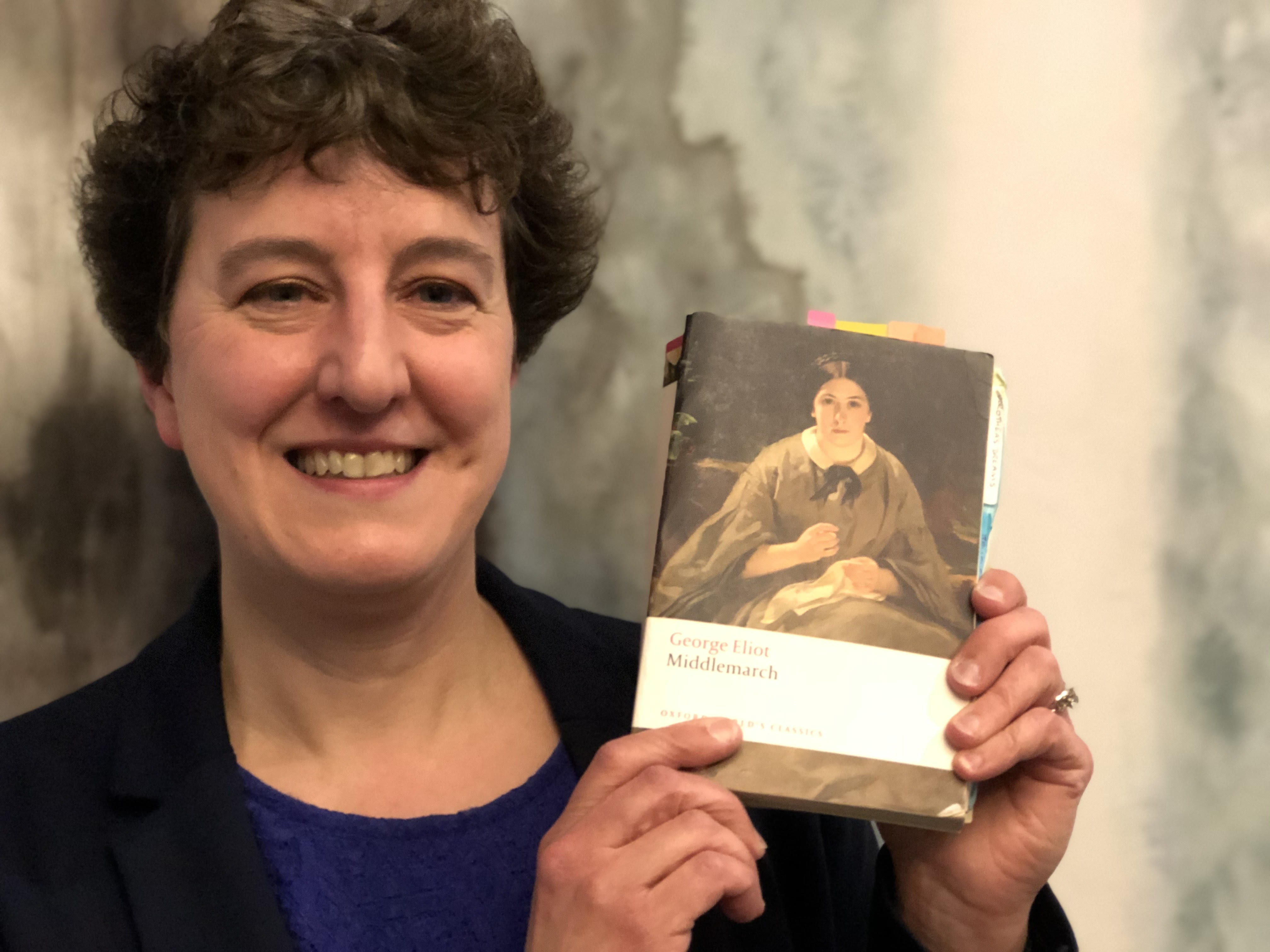
 In 19th-Century Fiction we start Middlemarch this week! I, at least, am very excited about this! (Honestly, though: isn’t the cover of the new OWC edition dreadful? They could hardly have made the novel look less fun and inviting. Dorothea is supposed to be blooming, not gloomy!) Rereading the novel and working on my slide presentations to launch our discussions of it has been pretty fun, and also very intellectually challenging, because I have had to make a lot of decisions about how to package the concepts and examples and approaches I would usually lay out over the first few class meetings. While I would certainly do some lecturing in a face-to-face course, I always prefer to draw students towards ideas about how the novel works and what it means through discussion, using a lot of open-ended questions and brainstorming on the white board (where I draw lots of what one of my students [hi, Bea!] recently described as “demented stick figures” 😊). This is hard to reproduce asynchronously!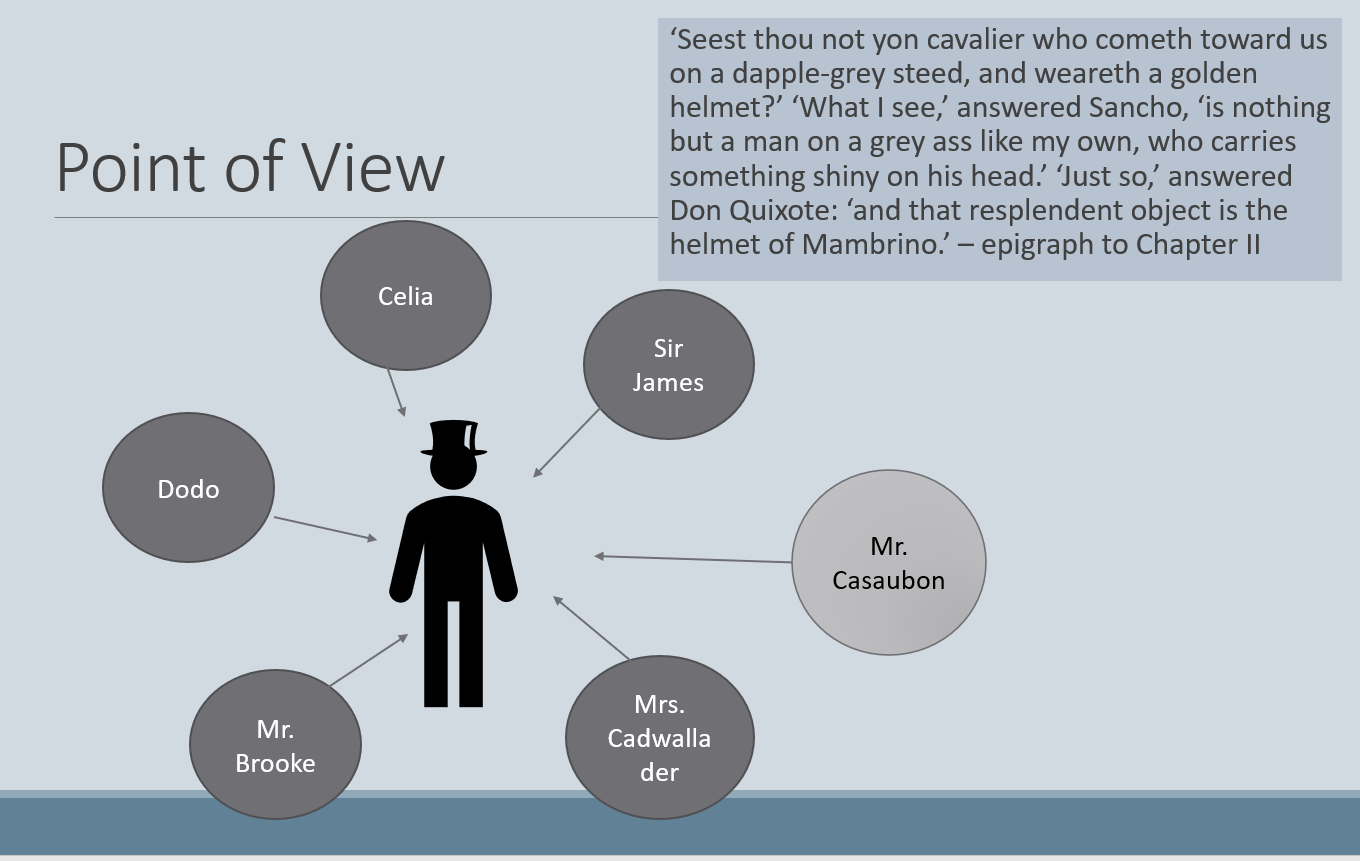
 I do expect a bit of stuttering as we get going on Middlemarch: my experience of teaching it in the classroom, where I can play ‘cheerleader-in-chief,’ has been that even with me absolutely radiating enthusiasm for it, it can be a hard sell at first, and though I am trying to be as enthusiastic as I can this time too, I have to communicate so much more indirectly that I can’t be sure it will come across, much less be contagious! The stumbling block is usually the amount of exposition, which requires a different kind of attention and patience and can muffle, on a first reading, the sharpness and comedy of the dialogue as well as of the narrator herself. I’m also often surprised by how little students like Dorothea: is idealism so out of fashion these days? But there are always some students who love the book, at first or eventually, and of course my job is not to make them like our readings but to help them learn about them.
 It has been two weeks since my last post. That sounds almost confessional: forgive me, gentle readers; it has been fourteen days since
  I think my overwhelming impression at this point (and it may get better as we all get more and more used to doing things this way) is that I am spending a lot more time managing logistics and a lot less time engaging robustly with my classes about our readings. I can understand how online structures of the sort we were encouraged to develop would work pretty well for more mechanical subjects, and I think, too, that there is some good cross-talk going on between the students that does accomplish some of the goals of classroom time. That I feel a bit left out does not mean it isn’t valuable: this is what the experts mean, I guess, when they tell us online teaching “decenters” the teacher. But I don’t think I have so far found the strategy that makes an asynchronous course feel like what a face to face class (at its best) feels like. I don’t see where the energy comes from this way: even if I admit that the best classroom discussion doesn’t actually generate that energy for everyone, it still does it for some of us, and I just really miss that.
 I expressed cautious optimism when the term began and I do still feel some of that, even if at times over the past couple of weeks it has been challenged by fatigue and frustration and sadness. The students are there and most of them are really trying; in my turn, I am doing my level best to demonstrate “instructor presence” and make them feel that I care and am paying attention, not just tracking submissions. I’ve already made a few adjustments to the requirements, too, to reflect what we are all learning about how long all of this takes. Also, although preparing recorded segments is not my favorite thing to do, I find devising topics and shaping them into what seem (to me at least) like engaging little packages intellectually stimulating and even fun sometimes.
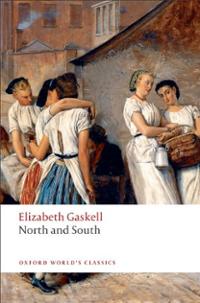
  The readings, too, are as good as they always are, and when I have time to linger over them, that really boosts my morale. I reread the first half of North and South this week (a bit hastily, but still all through) and got excited about the many ways it provokes comparisons with Hard Times, which we are just wrapping up. And in my intro class we are doing Woolf’s “The Death of the Moth,” which was also a tonic to revisit. It’s so beautiful and so sad and so oddly uplifting, in its contemplation of
 It is hard to know how to begin the 2020-21 iteration of
 I’m also genuinely pleased about the contributions that have come in, especially, in both courses, the introductions students have been posting on our “getting to know each other” discussion boards. As I said to them, our first crucial task is to begin building the class into a community, and it has been lovely to see them embrace that goal by telling us a little bit about themselves and then (best of all) responding with great friendliness to each other. I don’t usually solicit individual introductions in all of my F2F classes, only in the smaller seminars, so actually I know more about these groups than I think I ever have this early in the term. While a lot of what I read and practiced this summer was about how to make myself present to my students as a real, if virtual, person, this exercise has been great for making them present to me, not just “students” in the abstract but two really varied and interesting groups of people who bring different perspectives, interests, and needs to our collective enterprise.
 Still, I find the spread of the experience out over all hours of the day and all the days of the week disorienting, destabilizing, uncomfortable. Usually my weekly schedule involves regular build-ups to each class meeting: preparing notes and materials and ideas and plans, doing the reading, summoning the energy. Then there’s the live session, which in the moment absorbs all my concentration. When it’s over, I’m drained, even if (especially if!) there has been a really good, lively discussion: being in the moment for that kind of exchange is unlike anything else I do in terms of how focused but also flexible, how attentive to others but also on-task I need to be. I love it, and I really miss it already. I know we can have engaged and intellectually serious exchanges in our online format, but they won’t have the same rhythm, or perhaps any rhythm at all, who knows. Not having to be up and dressed and out the door early in the morning (or ever!) is some compensation, and I expect I will find more of a routine as we settle into the term, but (and I expect I’m going to be saying things like this a lot this term, so sorry for the repetition) it’s a strange new way of being a professor.
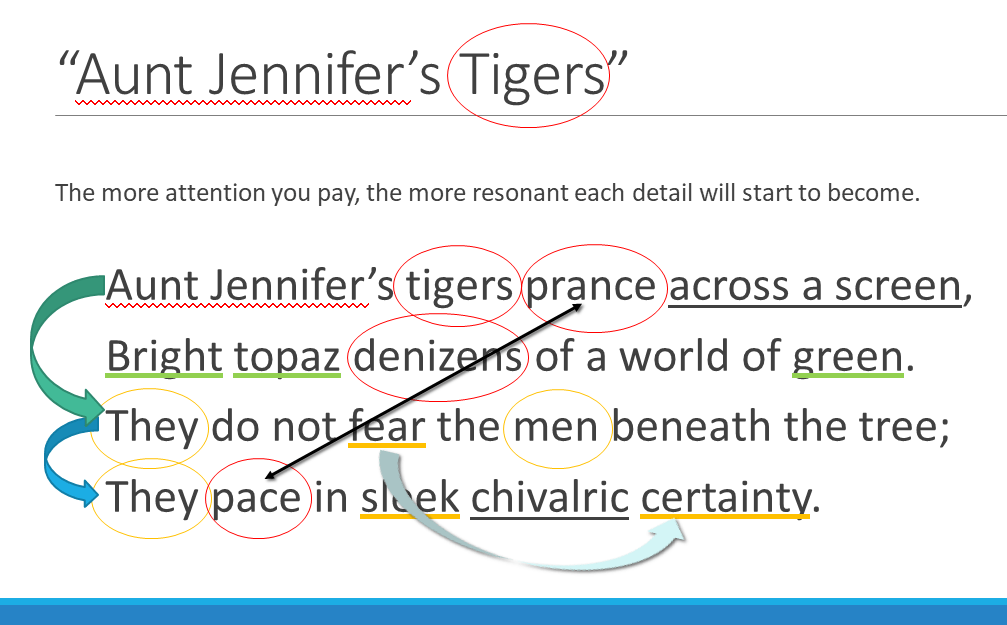
 As for specifics, well, we’re discussing Seamus Heaney’s “Digging” and Adrienne Rich’s “Aunt Jennifer’s Tiger” in my intro class this coming week, and in 19th-Century Fiction it’s time for Hard Times (which I assigned this term because we ended up cutting it last term when we ‘pivoted’ to online). These are all texts I like a lot, though in my experience Hard Times is often a hard sell, even to students who otherwise like Dickens (which is never all of them, of course). Will I be able to communicate my enthusiasm and generate the kinds of discussions I aspire to in the classroom without being in the classroom? I guess I’ll find out. I’m trying to create recorded lectures that open up into writing prompts, rather than drawing conclusions, much as I would move in the classroom through laying out some ideas, contexts, or questions and then opening things up to their input. I am actually having some fun with this, though yet one more unknown is how effective my first attempts will be. I have the next two weeks of material nearly completed, so that buys me a bit of time: as I see what works and what doesn’t, and which approach to the lectures they prefer, I can adapt the next round accordingly.
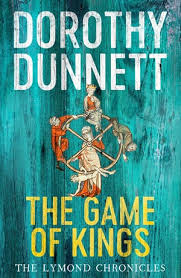 Good as she is, James turns out to be a poor choice for binge-reading, and yet a plan is a plan and a deadline is a deadline, so I have been persisting. The endeavor is not without its rewards: again, she’s good– very good, even! It’s just that she’s always good in exactly the same way, sometimes even in the exact same words. I was trying to think of other authors who have stood up better to this kind of determined march through their works. I remember really enjoying myself when I read all of Trollope’s Palliser novels straight through many years ago, and I have always loved rereading the Lymond Chronicles start to finish–but stories accumulate in a different way in those than in most detective series. While we are interested in and generally grow attached to the investigators in a long-running series, if the novels become more about them than about detecting, we’ve probably shifted genres–though having said that, counter-examples immediately occur to me, including Elizabeth George and Tana French, and of course there’s Gaudy Night, which perfectly balances case and character. In James’s novels, in any case, the personal arcs of her recurring cast are always peripheral to the main action, and while that strikes me as a principled decision, formally, it also has constricting effects. By the end of The Lighthouse I was far more interested in Dalgliesh’s relationship with Emma Lavenham than in whodunit–and that too is something my essay will most likely take up.
 I have been trying to read other things when I’ve had the energy, which hasn’t been often. I gave up on A Time of Gifts, though, which shames me somewhat to admit but there it is. There was a lot of fine writing but I couldn’t catch any momentum from it, and it turns out not to be as diverting as I’d hoped to read about someone else’s travels while unable to go anywhere myself. I’ve read a handful of romance novels–Christina Lauren’s The Unhoneymooners, Talia Hibbert’s Take a Hint, Dani Brown, and (most of) Jasmine Guillory’s Party of Two–just meh, all of them. I’m a hundred pages or so into Isabella Hammad’s The Parisian and it seems promising; once I finish The Private Patient, I want to settle in and really give it a chance. I’ve also just read Sarah Moss’s forthcoming Summerwater — but I have to save up what I think about that for the review I’ll be writing for the Dublin Review of Books.
 Then, instead of having three distinct conversations about the reading on three separate days (which, again, has always allowed me to pace us, and to model sorting out specific interpretive elements rather than facing everything that’s going on in the novel all at once), we’ll have discussion boards. Presumably, the topics will reflect the same questions I usually set in class, but I’m not sure if I should try to move us through these topics in some kind of sequence across the week, as I would in person, or think of the module as weighted towards reading at the beginning of the week and discussion at the end of the week. Probably the latter–though they might miss getting input and ideas from each other (and from me) earlier in their reading. I don’t want to be micromanaging participation on the discussion boards too much: I’m imagining how strange this all might feel to them, and ideally I’d like it to feel both easy and sort of natural to contribute. Super-rigid requirements (post once by Wednesday, reply once on Thursday, post again on Friday–whatever) really work against that and give me a lot to keep track of.
 I think the next step for me is actually to back away from the overwhelming amount of information and advice I’ve been contemplating about online teaching and go back to my actual teaching notes. Looking at the topics I usually cover with a modular redesign in mind will probably help me realize ways in which these bundles would actually work and think in more concrete ways about just how different the online experience needs or doesn’t need to be. Precisely because I’ve been teaching 19th-century fiction in such a similar way for so long, it is the one that feels the strangest to mess with, but it’s also the one where I have the simplest overall goal–to have the best conversations we can about our readings–and the most faith in the books themselves to get us talking, one way or another. Even if I don’t get everything right on my first attempt to do all this online, at least we’ll still be working our way through Middlemarch!
 Well, it’s official:
 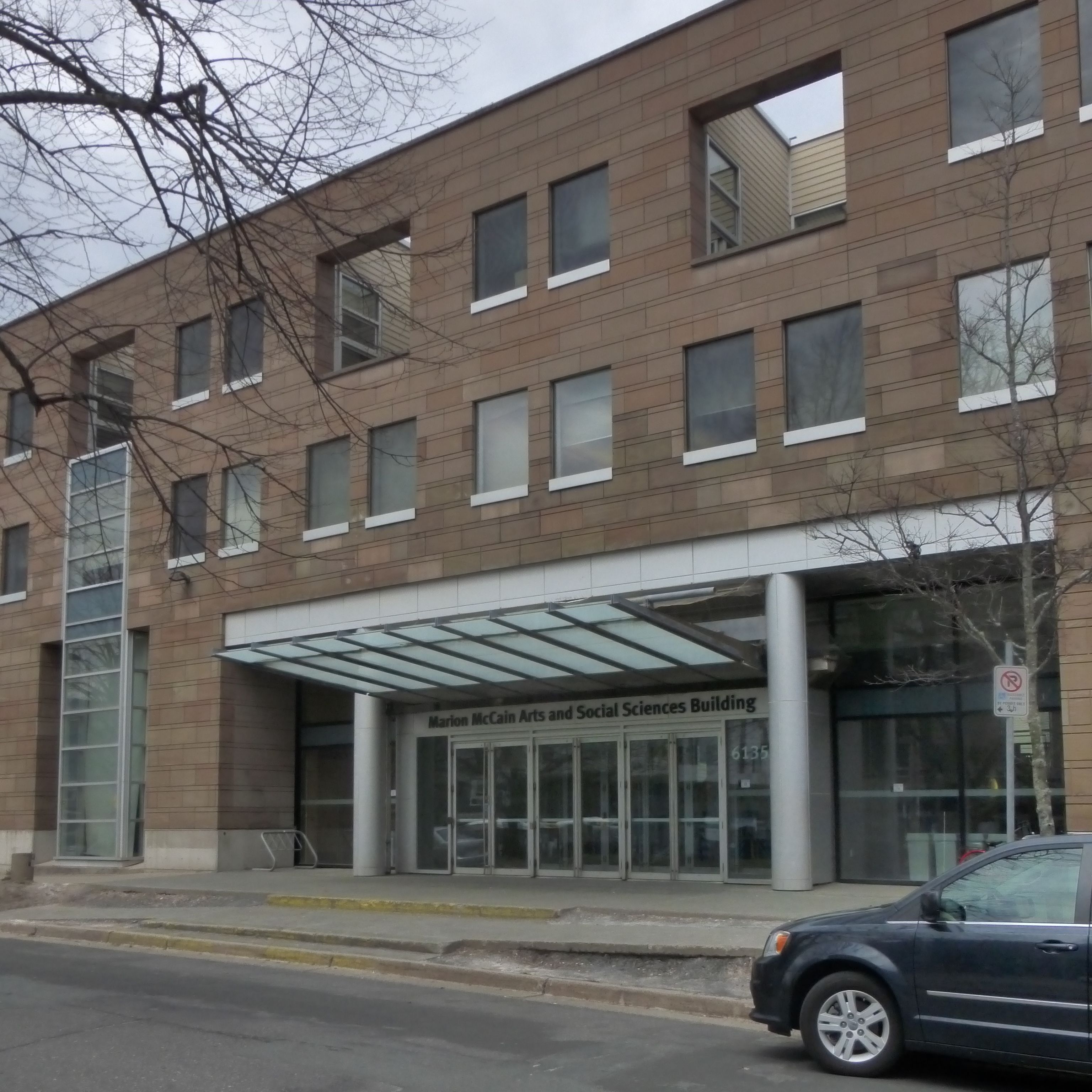 Having the decision made for me by circumstances hasn’t changed everything about how I feel about teaching online, but it has made a lot of those feelings irrelevant. Also, countering my wistfulness about what we’ll be missing are other, stronger feelings about what we will, happily, be avoiding by staying behind our screens. Every description I’ve seen of ways to make face-to-face teaching more or less safe for everyone involved has involved a level of surveillance, anxiety, and uncertainty that I think would make it nearly impossible to teach or learn with confidence: a lot of what is good about meeting in person would be distorted by the necessary health and safety measures, and even without taking into account the accessibility issues for staff, students, and faculty who would be at higher risk, being in a constant state of vigilance would be exhausting for everyone. Frankly, I’m relieved and grateful that Dalhousie has finally made a clear call that (arguably) errs on the side of caution. Now we can get on with planning for it.
 As my regret about the shift to online has been replaced by determination to make the best of it, I’ve also noticed something I’ve seen experienced online teachers point out before, which is a tendency to idealize face-to-face teaching, as if just being there in person guarantees good pedagogy. It doesn’t, of course. In my own case, I know that what I’ll miss the most is lively in-class discussions. But if I’m being honest, I have to admit that even the liveliest discussion rarely involves everyone in the room. Of course I try hard to engage as many people as possible, using a range of different strategies depending on the class size and purpose and layout: break-out groups, think-pair-share exercises, free writing from discussion prompts, discussion questions circulated ahead of time, handouts with passages to annotate and share, or just the good old-fashioned technique “ask a provocative question and see where it gets us.” Even what feels to me like a very good result, though, might actually involve 10 people out of, say, 40 — or 90, or 120 — speaking up. Others are (hopefully!) engaged in different ways, and there are different ways, too, to ask for and measure participation than counting who speaks up in class. Still, I’d be fooling myself if I pretended that there wasn’t any room for improvement–and what I want to think about as I make plans for the fall is therefore not how to try to duplicate that in-class experience online (ugh, Zoom!), partly because we are supposed to focus on asynchronous methods but also because maybe I can use online tools to get a higher contribution rate, which in turn might make more students feel a part of our collective enterprise. And, not incidentally, if all contributions are written, they will also get more (low-stakes) writing practice, which is always a good thing, and they will be able to think first, and more slowly (if that suits them), and look things up in the text, before having to weigh in.
 There are other ways in which (and we all know this to be true) face-to-face teaching isn’t perfect, and there are also teachers whose face-to-face teaching does not reflect best practices for that medium. Given these obvious truths, and especially since the shift to online teaching is driven by factors that themselves have nothing to do with pedagogical preferences, I have been getting pretty irritable about professors publicly lamenting these decisions, especially when it’s obvious that they haven’t made the slightest effort to learn anything about online teaching, or to reflect on the limitations of their own usual pedagogy. One prominent academic just published an op-ed in a national paper declaring that online teaching can only ever be a faint shadow of “the real thing”; others have been making snide remarks on Twitter about the obvious worthlessness of a term of “crap zoom lectures” (that’s verbatim) or questioning why students should pay tuition for the equivalent of podcasts. Besides the obvious PR downside of making these sweepingly negative and ill-informed statements when your institutions are turning themselves upside down to find sustainable ways forward, what kind of attitude does that model for our students? The situation is hard, I agree, and sad, and disappointing. But at the end of the day we are professionals and this, right now, is what our job requires. If we value that job–and I don’t mean that in the reductive “it’s what we get paid for” way (though for those of us with tenured positions, that professional obligation is important to acknowledge and live up to) but our commitment to teaching and training and nurturing our students–then, if we can*, I think we need to do our best to get on with it.
 And happily, though most of us are not trained as online teachers, we do have a superpower that should help us out: we are trained researchers! We can look things up, consult experts, examine models, and figure out how to apply what we learn to our own situations, contexts, pedagogical goals, and values. At this point, that’s what I’m working on: learning about online learning. Yes, I had other projects I was interested in pursuing this summer. In fact, I still do, but I have scaled back my expectations for them, because I can’t think of anything that’s more important right now than doing everything I can to make my fall classes good experiences, for my students and also for me. I have the privilege of a full-time continuing position, after all, and my university is making experts and resources available to me–plus there are all kinds of people generously offering guidance and encouragement through Twitter and I have been following up their leads and bookmarking
