“Hai mai! I go from one place to another as it might be a kickball. It is my Kismet. No man can escape his Kismet. But I am to pray to Bibi Miriam, and I am a Sahib”–he looked at his boots ruefully. “No; I am Kim. This is the great world, and I am only Kim. Who is Kim?” He considered his own identity, a thing he had never done before, till his head swam. He was one insignificant person in all this roaring whirl of India, going southward to he knew not what fate.
I read Kim because it–and Kipling more generally–seemed like a gap in my knowledge of “my” field. It seemed plausible to me before I read it that I might add it to the reading list for my course in the late(r) 19th-century novel (though strictly speaking, Kim is a 20th-century novel, as it was originally published in 1901). Without knowing much specific about it, I did know that it was about an English boy growing up in India and thus about empire and colonialism and national identity (again, strictly speaking, Kim turns out to be Irish, which is of course relevant to those themes as well). It is indeed about those things. I imagined it was some combination of adventure story and Bildungsroman–and, again, it is indeed both of those things. I also imagined it would be lively and entertaining to read. Hmmm.
 I guess it was lively and entertaining, occasionally, and it was also occasionally beautiful and poetic, and funny, and suspenseful. But I also found it something of a slog to get through, mostly because so much of the dialogue is a wearying blend of theatrical posturing and archaisms. The latter, and perhaps also the former, are meant (I assume) to give the language a “foreign” air so that we know the characters are not actually speaking in English–and there are also idioms and allusions drawn from the characters’ various cultures and languages that add to the effect. A small sample, from the first chapter:
“But I now see that he was but sent upon a purpose. By this I know that I shall find a certain River for which I seek.”
“The River of the Arrow?” said Kim, with a superior smile.
“Is this yet another Sending?” cried the lama. “To none have I spoken of my search, save to the Priest of the Images. Who art thou?”
“Thy chela,” said Kim simply, sitting on his heels. “I have never seen anyone like to thee in all this my life. I go with thee to Benares. And, too, I think that so old a man as thou, speaking truth to chance-met people at dusk, is in great need of a disciple.”
Perhaps it doesn’t seem so bad in a snippet, but I found it pretty tedious and sometimes just hard to follow when it goes on (as it often does) for pages. I suppose I would get better at it, feel more at home in it, with practice. I don’t find Scots dialect in Scott particularly hard to follow, after all–and I have even made a case for the value of an estranging idiom in Romola. I really did have a hard time with it here, though.
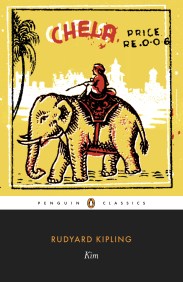 On the other hand, I loved Kipling’s scene setting, which is vivid and concrete and rich in detail. From the crowded streets of Lahore to the mountains of Tibet, he shows us the sights, and conjures up the sounds and smells of the landscape as well. “This was seeing the world in real truth,” Kim thinks as he looks around one bright morning on the road:
this was life as he would have it–bustling and shouting, the buckling of belts, and beating of bullocks and creaking of wheels, lighting of fires and cooking of food, and new sights at every turn of the approving eye. The morning mist swept off in a whorl of silver, the parrots shot away to some distant river in shrieking green hosts: all the well-wheels within ear-shot went to work. India was awake, and Kim was in the middle of it, more awake and more excited than anyone, chewing on a twig that he would presently use as a toothbrush; for he borrowed right-and left-handedly from all the customs of the country he knew and loved.
(As a side note, Kim is the only novel from the period that I can think of in which characters are so regular and explicit about cleaning their teeth! They mention it a lot.) Here’s another nice bit:
So they travelled very easily across and among the broad bloomful fruit-gardens. . . . After long, sweet sleep under the dry stars cane the lordly, leisurely passage through a waking village–begging-bowl held forth in silence, but eyes roving in defiance of the Law from sky’s edge to sky’s edge. Then would Kim return soft-footed through the soft dust to his master under the shadow of a mango-tree or the thinner shade of a white Doon siris, to eat and drink at ease. . . .
These are the kinds of passages I found myself flagging as I went along, not the ones about Kim’s involvement in the Great Game or the lama’s ruminations on the Way or the Wheel of Life, or the elaborate schemes and ruses and quackery of Hurree Babu.
 Kim himself is a bit of a delight. I was disappointed that the novel ended so inconclusively, without clearly answering his oft-repeated question about his identity. Reading the very thorough introduction to my Broadview edition by Máiri ní Fhlathúin, I was not surprised to learn that this “unsatisfactory” ending has “proved amenable to many readings, and resistant to any conclusive interpretation”; the readings she summarizes focus primarily on how or whether Kim’s Indian and British identities are reconciled, whether he turns away from or is subsumed by his role as an agent of empire. His relationship with the lama is very sweet, though I personally found the lama kind of tedious (I have limited patience for “holy men” unless they do worldly good, and in my admittedly limited experience of Buddhism I have never found it particularly congenial).
I think Kim would be really interesting to teach, not least because (as Máiri ní Fhlathúin discusses) it is controversial as a novel about the British in India, vulnerable to charges of perpetuating orientalizing stereotypes and colonial attitudes but also defensible as a sympathetic and not uncritical exploration of a time of complex intersections between East and West. Also, the storytelling is great sometimes, and Kim’s charm, fearlessness, and ingenuity make him a very appealing protagonist. I would have to learn a lot to teach it well, but that’s really not a disincentive. What is, is my concern that students would have the same trouble I did persisting with it. I’d be interested to hear from anyone who has taught or studied it, or just enjoyed reading it. Do I overestimate the problem? Perhaps (at least as likely) I underestimate the difficulty of, say, Dickens’s idiosyncratic dialects or Eliot’s carefully rendered midlands speech: Kim’s linguistic peculiarities may be no greater than these, only less familiar to me, and so not likely to be any more off-putting to students, in this respect at least, than Silas Marner or Hard Times.
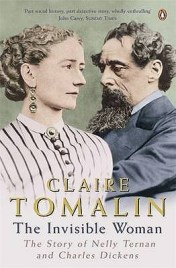
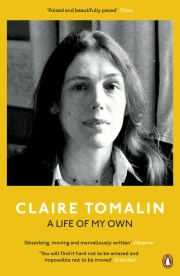 I don’t read a lot of memoirs, or a lot of biographies. The autobiography of renowned biographer Claire Tomalin, however, was so interesting that it made me think I should read more widely in both genres–starting, perhaps, with some of Tomalin’s own biographies, none of which I have read. Recommendations, anyone? I’m thinking perhaps The Invisible Woman, her book about Dickens and Nelly Ternan.
 Tomalin’s personal life was complicated in other ways too. She and Nick had four children. The youngest, Tom, was born with spina bifida. One of their daughters, Susanna, fell into a deep depression during her first year at college. “The transformation in her was unfathomable,” Tomalin writes:
 Tomalin’s personal life is only one aspect of A Life of My Own. Through it all she’s working, making her way through the literary world. Much of this material is, again, a somewhat perfunctory rehearsal of what happened when, with a lot of names dropped (which is totally fair, of course, since what’s she going to do, not mention the many famous writers who were in her orbit?). I was always glad when she let herself be a bit more expansive about her work as a writer and editor. About her aspirations as literary editor of the Sunday Times, for instance, she writes:
 From a more personal standpoint, what resonated most with me in A Life of My Own is Tomalin’s comment about how late she actually began focusing on the biographical work for which she is now best known. “My story should be cheering,” she says, “to anyone who is finding it hard to establish a career they find congenial. . . . I was in my mid-fifties before I could concentrate on full-time research and writing.” Obviously she had a very significant career up to that point, and the experience and perhaps especially the connections she made working at the heart of London’s literary scene not only counted for a lot in themselves but meant she was exceptionally well positioned for a next phase that would probably be much more difficult for someone else. Still, it is indeed cheering, as I look towards my own “mid-fifties,” to think that what feels like
  They had been married ten years, and until this present day on which Mr. Dombey sat jingling and jingling his heavy gold watch-chain in the great arm-chair by the side of the bed, had had no issue.
 That said, I think that if Dombey and Son were a better novel, I might have been fine on my own and not fallen, as I sadly did, into occasional fits of boredom, impatience, or irritation. Though obviously a first read is almost by definition an imperfect one, some books nonetheless make their greatness clear pretty promptly, and I didn’t think Dombey and Son ever did. It lacks the joyousness of David Copperfield: its children have all the pathos and none of the fun, its villains are more cardboard, its eccentrics are less quirky and more repetitive, its heroes and especially its heroine are much duller (imagine, a heroine who makes Agnes look subtle and complicated!). Though there is something impressive in the portrait of Mr. Dombey and the destructive vortex of his pride, Dickens does not take that critique and radiate it outward with anything like the breathtaking audacity of Bleak House, with its many variations on its central themes. The fairy tale quality of Florence’s story, with its long emotional exile as she is, so paradoxically, held captive by her father’s neglect, loses a lot of its impact as it drags on with its one repetitive idea: Louisa Gradgrind’s story has some of the same qualities but is so much more intense, and also so much more interesting because, unlike Florence, Louisa is capable of anger.
 And so it went for me, really, throughout Dombey and Son: it kept reminding me of other Dickens novels but the comparison was never in its favor. I flagged a lot of bits I liked, and over its 900+ pages there were certainly moments I found sad or funny or even great in that way that only Dickens can be great. I was pretty fond of Captain Cuttle by the end! But at the same time, overall it felt cluttered and it took (yes) a bit too long to get us to the one result that really mattered, namely Mr. Dombey’s realization that his daughter was always already the child he needed. In Novels of the Eighteen-Forties Kathleen Tillotson notes that “Dombey and Son stands out from among Dickens’s novels as the earliest example of responsible and successful planning; it has unity not only of action, but of design and feeling.” I suppose, then, that you could consider it practice for the masterpieces that would follow, a lesser but valuable trial run. I can’t imagine choosing it as a teaching text over any of the ones I usually assign.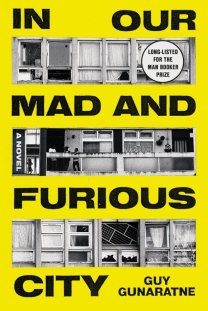
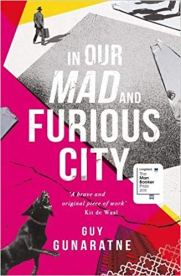 I’m not yet 100% sure that In Our Mad and Furious City is the right book for my purposes, but it is definitely the front-runner now: Liz has good instincts! For one thing, it is relatively compact: the edition I read is 274 not particularly dense pages. I also found it really engrossing. It took me a dozen or so pages to adjust to the voices–it is told by five different first-person narrators–and especially to their language, as most of the speakers use a vernacular which is unfamiliar to me. The effort to learn it, to hear it, to feel it, is part of the novel’s point, I think, and while I did continue to stumble occasionally over idioms I didn’t understand, it got much easier as I went along. (If I do teach it, I think I might bring in the audio book, which
  Although there are clearly big ideas at stake in the novel, Gunaratne does a good job making his characters’ lives seem intensely personal: they do not come across as devices serving only a didactic purpose. Perhaps oddly, the novel reminded me of S. E. Hinton’s classic teen novel The Outsiders: although almost everything about the context and action of In Our Mad and Furious City is different, I felt the same poignancy in it around the idea that youth is, or should be, a time of great but often thwarted possibility. Living on the margins as these young men do, pressed on every side by poverty and prejudice and impossible conflicts of loyalty, realizing even their modest dreams seems almost too much for them to hope for. While the novel is intimate in these ways, though, it is also about British history and politics, with the square at the Estate representing a microcosm of the larger society and its interconnected problems. The novel’s interwoven voices are at once a sign of its many divisions and (maybe) a formal reflection of how its complicated diversity could ultimately create a kind of unity.
 I’m 337 pages into my Oxford World’s Classics edition of Dombey and Son. It ends on page 925, which means I’ve read just over a third of the novel. Not all that much has actually happened–a birth, a few trips and some time at school, a misadventure or two, a death–but all of it has has happened at great length.
 I actually don’t know yet if I think Dombey and Son is too long for its purposes. I hardly know what it’s about yet! Reading it, however, especially after seeing that emphatic criticism tossed out on Twitter with such confidence, I have felt very aware of its length. I’ve been thinking about the strategies I suggest to my students when we read Bleak House, which is even longer (976 pages), many of which have to do with managing the information overload that comes with a first exposure to so many characters before you know who really matters or how they are connected, and with multiple unfolding plots that don’t yet have a known shape. My first class or two for any long novel is usually spent providing what I hope will be useful and widely applicable guidelines: look for variations on this theme, think about these kinds of contrasts between characters, pay attention to who does this and who does that. Students need what one critic calls “rules of notice.”
 When I taught David Copperfield in the fall, I addressed its length explicitly (the OUP edition is 944 pages). I always talk about length when teaching Middlemarch. “I don’t see how the sort of thing I want to do could have been done briefly,” Eliot wrote: that’s a good starting point for discussion about what exactly she is doing and how those purposes make the novel’s scale an important element of its form. (Interestingly, at least in the OUP edition Middlemarch, at 904 pages, is shorter than any of these Dickens novels, though I don’t know if the font size or page layout is standard. It reads longer, I think, perhaps because it demands scrupulous attention in a way that Dickens’s exuberant excesses may not appear to.) With Bleak House, we usually tie the novel’s multiplicities to the scale of its critique: it isn’t about one house or one family or one sad crossing sweeper but about a whole society.
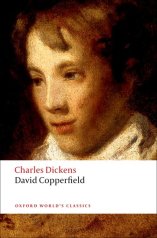 With David Copperfield, though, I found myself wanting to add another consideration, which is the particular ways Dickens makes his novels so long–when he does, because of course he doesn’t always, which is another reason to think about their length as meaningful rather than haphazard or (as those who object to Dickens’s novels as “too long” seem to imply) artistically lazy or inept. A lot of the length in Dickens’s fiction comes from what we might call “riffing.” (Merriam-Webster defines “riff” as “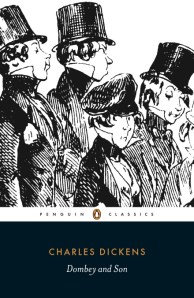
 Last Friday was Munro Day and I almost didn’t notice: usually it’s a highlight of the winter term, a day off right when things are starting to get real and so everyone’s starting to get tired. It’s true that I’ve been tired lately myself, but at least I haven’t had to show up for class! I’m mostly on my usual schedule, because I’m still dropping Maddie off at school, but it has definitely been nice not having to be ready for the day in quite the same way: evenings and weekends aren’t haunted by what’s yet to be done or taken up with prep and grading.
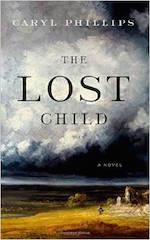 The survey course isn’t until next winter term so I have plenty of time to keep considering options for which contemporary novel to use. I want something that will play along with the theme of ‘belonging’ and/or be an interesting complement to Wuthering Heights, and with that in mind I’m currently reading
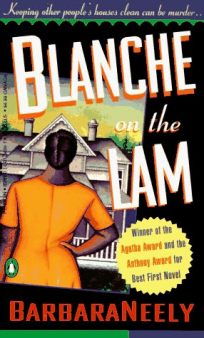
  Finally, after trying and not liking a few other hard-boiled / noir options for Pulp Fiction, I think I have settled on
  Another sabbatical project of a different kind was to come to terms with the essays I’ve written over the past few years about George Eliot, mostly for Open Letters Monthly but also for the Los Angeles Review of Books and Berfrois. What I mean by “come to terms with” is really “decide what to do about,” but the first phrase captures a bit more of the emotional baggage the essays have come to carry. I loved writing them, and on my 2015 sabbatical I worked mostly on more writing of the same kind, some of which I ultimately pitched unsuccessfully to a couple of publications that run similar pieces, such as The Hudson Review. I naively thought this was the kind of cross-over writing that would bolster my application for promotion–distilling, as it did, decades of academic expertise into publicly accessible forms. But it actually made no positive difference to my case at all (not peer reviewed, you see), as it turns out. Since then, the idea of a revised and expanded collection has also proved completely umarketable: the essays themselves don’t do anything with mass appeal and also–and this is something I honestly hadn’t thought enough about–their standing as previously published material works against them. Yes, there are plenty of essay collections out there that are mostly or even wholly republished material (some of them with not much more popular appeal, in subject and approach, than mine) but in those cases the authors’ famous names make the sale.
 So, six weeks into my sabbatical, that’s what I’ve done so far. Well, that and make most of a shawl that, over the past few days, I have had to completely unravel because I realized I had been doing one part of the pattern wrong almost since the beginning. As I ready myself to start re-doing it, it’s hard not to think of the process as a metaphor for my other work. Undoing crochet still leaves you with all the yarn, after all: you just have to make something else out of it. It’s very pretty yarn; that seems like grounds for optimism.
 Novel Readings