 From the Novel Readings Archives: I still find myself thinking a lot about the questions raised by Brian McCrea’s book Addison and Steele Are Dead, which I wrote about during my first year of blogging. Apparently I’m in something of a minority, or presumably I’d be able to find the actual cover image online somewhere! But rereading this post nearly a decade later, McCrea’s theory about the relationship between literature, professionalism, and teaching still seems well worth considering.
In parallel to my reading of ‘books about books’ aimed at non-specialist readers, I have been reading scholarly books that treat the development of English studies and/or academic criticism in historical as well as theoretical contexts. (Examples include John Gross’s The Rise and Fall of the Man of Letters, Morris Dickstein’s Double Agent: The Critic and Society, and Geoffrey Hartman’s Minor Prophecies: The Literary Essay in the Culture Wars. My notes on these have been largely maintained off-line, though my post on Denis Donoghue’s The Practice of Reading comes out of the same line of research.) All of these books (and many more like them, of course) make explicit that what now appear to be the “givens” of professional literary criticism and the discipline of English studies are highly contingent and far from exempt from scrutiny, evaluation, or (presumably) further development.
McCrea’s Addison and Steele Are Dead: The English Department, Its Canon, and the Professionalization of Literary Criticism (1990) is certainly among the more lively and provocative books in this collection. As his title suggests, McCrea frames his consideration of English departments as professional and institutional spaces with arguments about what features in the work of Addison and Steele “render it useless to critics housed in English departments”–not, as he is quick to add, that “their works are without value, but rather, that they are not amenable to certain procedures that English professors must perform.” The opening sections of the book look first at the express intentions of Addison and Steele as critics and men of letters, particularly at their desire to be popular, widely read, accessible, un-mysterious. The short version of his story is that professional critics require difficult, complex, ambiguous texts to do their jobs; the “techniques of simplicity” that characterize Addison and Steele propel them, as a result, out of the canon. (McCrea reports that the last PMLA essay on Addison or Steele appeared in 1957, and that Eighteenth-Century Studies, “the publication of choice for the best and brightest in the field,” published only two short pieces on them in 20 years.) (As an aside, I wonder if a similar argument could be made about Trollope, whose novels often seem difficult to handle using our usual critical tools.)
 As he develops his argument, McCrea offers an interesting overview of the 19th-century and then 20th-century critical reception of Addison and Steele. He explains the Victorians’ admiration for these 18th-century predecessors largely in terms of the different understanding that prevailed about the relationship of literature, and thus of the literary critic, to life. Rightly, I’d say (based on my own work on 19th-century literary criticism), he sees as a central Victorian critical premise that literature and criticism are public activities, that their worth is to be discussed in terms of effects on readers; hence the significance attached, he argues, to sincerity as well as affect. Especially key to McCrea’s larger argument is his observation that the 19th-century writers were not “academicians” or “specialists in a field”:
For Thackeray and his contemporaries, literature is a public matter, a matter to be lectured upon before large audiences, a matter to be given importance because of its impact upon morals and emotions. For the present-day academic critic, literature no longer is a public matter but rather is a professional matter, even more narrowly, a departmental matter. The study of literature has become a special and separate discipline–housed in colleges of arts and sciences along with other special and separate disciplines. The public has narrowed to a group of frequently recalcitrant students whose need for instruction in English composition–not in English literature–justifies the existence of the English department.
As McCrea tells the story (which in its basic outlines is pretty similar to that told in other histories of criticism) this decline in the critic’s public role has had both significant costs (among them, the critical ‘death’ of Addison and Steele) and significant benefits. At times the book has a nostalgic, even elegaic sound:
People who want to become English professors do so because, at one point in their lives, they found reading a story, poem, or play to be an emotionally rewarding experience. They somehow, someway were touched by what they read. Yet it is precisely this emotional response that the would-be professor must give up. Of course, the professor can and should have those feelings in private, but publicly, as a teacher or publisher, the professor must talk about the text in nonemotional, largely technical terms. No one ever won a National Endowment for the Humanities grant by weeping copiously for Little Nell, and no one will get tenure in a major department by sharing his powerful feelings about Housman’s Shropshire Lad with the full professors.
 While we can all share a shudder at the very idea, to me one strength of McCrea’s discussion is his admission that marginalizing affect, pleasure, and aesthetic response is, in a way, to be untrue to literature, and that the professional insistence on doing so also, as a result, marginalizes our conversation, alienating us, as McCrea says, “from our students, our counterparts in other academic departments, our families [unless, he allows, they include other professional critics–otherwise, as he points out, even they are unlikely to actually read our books and articles], and, ultimately, any larger public.” (In Democracy’s Children, John McGowan makes a similar point: “There remains a tension between the experience of reading literature and the paths followed in studying. . . . To give one’s allegiance to the academic forms through which literature is discussed and taught is to withdraw [at least partly] allegiance to literature itself”).
But why, McCrea goes on to consider, should we expect such cross-over between our work–our professional lives and discourse–and our personal lives? McCrea’s answer to this question (we shouldn’t) puts the professionalization of English studies into the context of professionalization more generally, which he argues (drawing on sociological studies) was a key feature of American society during the last half of the 20th century. Perhaps the most distinctive feature of McCrea’s book, in fact, seems to me to be his insistence that, in this respect at least, ‘professing English’ is (or has now become) just another job, and indeed that its success at establishing itself professionally at once accounts for and has depended on its investment in theory and metacommentary: “The ultimate step in the aggrandizement of any professional group is for its members to get paid to talk about how they do what they do rather than doing it.” If one result is isolation from and (perceived) irrelevance to the broader public, including the reading public, the gains for criticism and even for literature are also, McCrea argues, substantial:
Rotarians no longer look to us for uplift, future presidents no longer turn to us to increase their ‘stock of ideas,’ nor do ex-presidents attend our funerals, undergraduates no longer found alumni associations around us, family members can no longer read our books, and plain English has disappeared from our journals. But professionalization has liberated us from a cruel Darwinian system in which one white, Anglo-Saxon, Protestant male emerged at the top while others struggled at the bottom, grading papers in impoverished anonymity. It has liberated us from the harsh economic realities of eighteenth-century literature . . . while [today’s critics] might wish to share Steele’s influence, I doubt they would want to share his life. He practiced criticism in a world in which there was no tenure, a world devoid of university presses, National Endowments for the Humanities, and endowed university chairs in literature. . . .
In a society in which no one outside the classroom reads Pope, professors can earn handsome incomes by being Pope experts. The five top Pope experts compete with each other, but probably not with the Tennyson experts, and certainly not with the Chaucer experts. The quest for autonomy has cost us Addison and Steele, has cost us the ability to treat literature as a public, moral, emotional phenomenon. But it has left us with a part of literature, with a canon of works complicated in their technique and tone, and with a classroom in which we have a chance to teach those works, to keep them (and whatever value they hold) alive.
Provocative, as I said, not least in reversing the oft-heard line that (undergraduate) teaching is the price professors pay for the opportunity to do their research and as much as declaring that, to the contrary, academic criticism is the price they pay to preserve literature and its values.
Originally published in Novel Readings August 8, 2007.
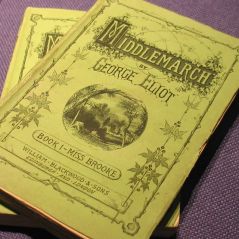 I’ve been feeling a bit downcast since Friday, because attendance absolutely plummeted in the tutorials for my Close Reading class and I can’t stop worrying about why — and wondering what to do about it.
 But that is a general pet peeve that’s probably never going to get resolved, while Friday’s collapse is a specific instance that I’d actually like to get to the bottom of. Is it because we’re spending so many weeks on Middlemarch that this first tutorial seemed expendable? (But why would anyone think that, given how much material we clearly have to work through? It isn’t as if we’re going to spend all those weeks on Book I.) Are a lot of students finding the novel difficult to engage with? (But wouldn’t that be an incentive to come to class and learn and talk more about it, rather than opt out — to increase the odds that you’ll enjoy the next 4 weeks?) Do some of them figure they’ve got this covered and don’t need to do the tutorial exercises? (But in that case, they could still come and help out their classmates with their insights, raising the quality of the experience for everyone — and maybe even learning a little something new themselves.) Is the pay-off from our tutorial work in general not clear enough, or actually less than I fondly imagine? On Friday we worked on tracking the movement of point of view in particular passages — but we also just talked about the themes and characters set up in the first section of the novel: both activities seemed pretty valuable to me, at least.
 There’s realism, and then there’s utterly, relentlessly, graphic and gruesome realism, which is very much the aesthetic principle of The North Water — McGuire offers not just a vision of the world warts and all, but of the world as warts only. I’ve also been reading Tessa Dare’s Do You Want to Start a Scandal? and the juxtaposition of the novels got me wondering about whether we have a label for McGuire’s style that would be the grim equivalent to the kind of (usually pejorative) terms used for romance writing — “flowery language,” “purple prose.” The implication of such labels is typically that the writing is excessive rather than expressive, that it’s artlessly out of control, rather than artfully serving its own purposes. (I still struggle with this reaction to some of it, but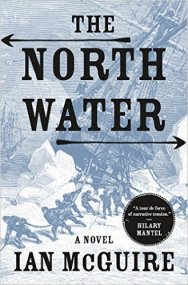
 The absence of meaning can, of course, itself be meaningful, but The North Water didn’t read to me like an investigation or revelation of existential vacancy, and certainly not like a purposeful response to the possibility that “there is no why.” Compare
  First of all, where did this past week even go? It feels like just yesterday I was writing my previous post, in a flush of enthusiasm about
  In Close Reading, we’ve just started Middlemarch — always a happy occasion for me, of course! Here’s hoping I can make it a good experience for the students as well. In a break from the usual rhythm of this course, I open with a fairly formal lecture to establish some biographical and philosophical context: as I explained to the class, with short texts it’s reasonable to expect them to be able to put specific details into the context of the whole right away, but with a text this long we can’t do meaningful close reading exercises without my providing some preliminary interpretive frameworks. I’ll do a bit more of that tomorrow, and then they’ll have some general concepts to guide their reading and analysis as we keep going. We’re only reading Book I this week: it’s always nice to move through it relatively slowly (we’ll take about two more weeks on it in Close Reading than I usually allow for it in my 19th-century fiction class).
 In my seminar on the Victorian ‘Woman Question,’ we started work last week on Elizabeth Barrett Browning’s 1856 verse-novel Aurora Leigh. It’s usually kind of hard going for the students: although it does have many of the familiar features of a Victorian marriage plot novel, it also includes (among quite a bit of more miscellaneous material) long meditations on, and also arguments about, the nature and purpose of poetry in the modern world — and its 9 books of blank verse add up to a total of approximately 15,000 lines of iambic pentameter, which, let’s face it, is not the easiest reading even when the verse itself is thrilling … which, frankly, for long stretches Aurora Leigh is not.

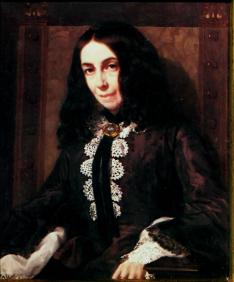 That Aurora Leigh has not lost its radicalism — that we are still fighting on some of the same fronts — was made unexpectedly clear to me this past weekend, as with so many others I watched the story of Donald Trump’s now-infamous bus tape break, and then one pontificating man after another denounce it in the name of his daughters (or his wife or his great aunt or whatever). For some men — too many men — women are still seen primarily as complementary, their value uncomfortably entangled with ownership (all those possessive pronouns!), their right to respect and dignity somehow contingent on their belonging to someone else (someone else male, of course). My
 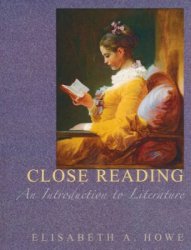 Over the past few weeks in Close Reading we have been working on disentangling specific elements of poetry and fiction in order to improve the precision of our analysis. We’ve focused, for instance, on tone and diction, on figurative language, on imagery, on symbolism, on rhythm, on point of view, on narrative voice, on characterization, and on setting. Often separating these elements is quite an artificial exercise, but there’s value in it nonetheless, as it helps us moves from impressionistic responses to focused observations that can be the foundation of critical conversation and analysis.
 The other day while idly browsing the ever-changing array of titles on ‘special’ at Kobo, I happened across Laura Kinsale’s Flowers from the Storm for only $1.99. Not long ago, the same thing happened with Loretta Chase’s Lord of Scoundrels. What serendipity — two of my favorite romances! The alacrity with which I snapped up both titles (hooray – no more waiting for library copies) was a reminder of how much has changed for me since my first forays into reading romance.
 I have read some things badly that I know I could learn to read better — Ford Madox Ford’s
  For me, romance is an interesting in-between case. I had no external obligation to get anywhere with it. But my curiosity was roused by following discussions about it among other readers who clearly enjoyed it and found interesting things to say about it. I think what stood out the most is how often they talked about reading romance in terms of pleasure — which is not to say the conversations didn’t get critical, or didn’t address complicated topics. But it seemed like for a lot of people reading romance (and talking about it together) was really fun, and that was enticing. Given that my early experiments in the genre were not very successful, I might not have tried again, FOMO notwithstanding, if it weren’t for those other readers both challenging and encouraging me — and finding, before I’d soured on the project, some romances that were easy for me to like. That line crossed, I pretty rapidly got better at reading in the genre. This is not to say I have any special insights about it: just that I have acquired a reasonable working awareness of important conventions and styles. Because I’ve also now done some reading about romance, and have followed and even contributed to a lot of informal and formal discussions about it, I also have a decent, if still somewhat superficial, understanding of the history of and cross-currents within the genre. I don’t like every romance novel I try any more than I like every mystery novel I pick up, but in both cases I feel equipped to read them, if that makes sense.
 Getting back to Lord of Scoundrels, the problem I had with it at first is that I thought it was ridiculous: melodramatic, overwritten, heavy-handed. I still think it is some of these things, some of the time — but I experience them quite differently: as playful, as tongue-in-cheek, as intertextual, as sexy. Now I enjoy the novel’s wit in a way I couldn’t before, because then I was too distracted by my initial negative reactions; now I appreciate its strong-minded heroine, not just on her own merits but because I have met more of her literary sisters. I can’t remember exactly the sequence that brought me back to Lord of Scoundrels in a more receptive frame of mind: my 2012 progress report notes that “I have yet to read a ‘historical’ that I really like” and mentions Heyer’s Sylvester in particular as a failure — and Sylvester, too, is now a favorite, though not nearly as much as Venetia or Devil’s Cub. (Jessica and Mary Challoner would get along just fine: they could compare notes on the beneficial effects of shooting alpha males in the shoulder — a link between the novels that I’m sure Chase makes quite deliberately.)
 Phonse Jessome’s grim, violent crime novel
  For readers who don’t know Halifax at all, Jessome provides not just vivid description but a lot of context about the city’s history. That it never feels like info-dumping is because much of it is provided by his protagonist, Detective Constable Cam Neville, a former army sniper and escaped POW, who in his new role as a cop struggles to overcome both PTSD and his past as a member of the biker’s club Satan’s Stallions. Cam views his home town with merciless clarity and an unhealthy dose of cynicism. “Halifax is a navy town,” he explains;
 We learn almost as much about Cam from these accounts as about Halifax, and, again like Rankin, Jessome also uses this contextual material to emphasize the relationship between social and historical conditions and the city’s distinctive patterns of crime and violence.
 My initial thought at this point is that overall, while I like Buffy the series better than Buffy the character, I like Angel the character more than Angel the series. I would happily watch another two or three (or more!) seasons about Angel, despite how dreadful Angel occasionally was, because I find him complicated and fascinating, whereas Buffy (though she does develop over the course of her series) always seems somewhat two-dimensional to me. I suppose this is a version of the age-old artistic problem that virtue is intrinsically less interesting than vice, except that of course with Angel we’ve got the best of both worlds: good and evil in unending tension, Angel and Angelus distinct but never entirely separable. Buffy, on the other hand, has a clear and singular role to play: while she sometimes rebels against it, when things turn bad she always, always, rises to the occasion — which is great and inspiring, because she’s strong and principled and brave and autonomous, but also somewhat predictable.
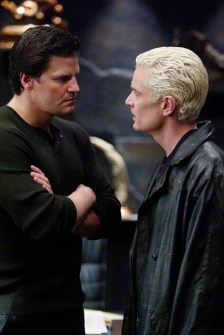
 I didn’t like the Angel ensemble as much as the Scoobies in Buffy, but another thing Angel and Buffy have in common is that they both show individual characters transforming in ways that leave them astonishingly far from where they started but that somehow happen in utterly believable ways. Other long-running shows I’m familiar with put fairly consistent characters into lots of new situations, but what happens with Spike in Buffy happens with both Cordelia and Wesley in Angel. If you’d told me while I was watching Buffy that one day Wesley would make me cry, I would not have believed you! As for Cordelia, I couldn’t possibly do better than
 Earlier this year there was a lot of buzz when a Princeton professor published a “
 I have been thinking about the question of failure in academia again since my promotion was denied. The appeal is ongoing, so I don’t yet know how the story will finally turn out, but no matter how it does, the fact will always remain that I was not successful in this process.** It has recently occurred to me that one reason last year was so difficult for me is that when things took a turn for the worse, one of my most intense reactions was humiliation. I felt profoundly embarrassed, because I had been held up for scrutiny and found wanting: I had not passed the test, and in this world, that feels not just like a professional evaluation but also like a very personal and all-too-public shaming. I know that this is not an entirely rational response, but I bet it also isn’t unusual for academics who fail in this way, especially when you add in
  What I have been thinking about more recently, though, is how much worse this cringing attitude made the whole experience for me, because it led me to be not just discreet but downright secretive about what was going on. I’m not saying that I should have made all aspects of the case public (and I don’t plan to now, either): I have some doubts about the advice on
  I don’t rule out that some of the intensity of my own reactions might be idiosyncratic: I myself was surprised that I took it all so hard, and that has been cause for some self-reflection. (Indeed, I have experienced fits of meta-failure in which I have been thoroughly unimpressed with myself for not handling everything better!) That’s what got me thinking again about the general context, though — about what failure means and how failure is treated in the academic world. And it also got me thinking about other failures in my own life, along the lines of the ‘CV of Failures.’ It isn’t, after all, as if this is the first time I have swung at something and missed. So in the spirit of Johannes Haushofer, here are a few more of my own failures. I’ll restrict the list to things that quantify more easily than, for instance, my general failure to thrive during my graduate coursework, and that are on a larger scale than, say, the many books I have failed to understand.
 Novel Readings