She watched the sky light up and flash. She watched the sparkling drops that burst into brilliant sprinkles and disappeared into the velvety sky. It was magical: that deep, echoing noise, that glowing tension, that unexpected, magnificent, beautiful release, like the unexpected joy that swept you away, like life itself.
Not much goes on in Laurie Colwin’s A Big Storm Knocked It Over: a marriage, a new baby. It’s a novel about life on a small scale, but that doesn’t mean it’s trivial: as Carol Shields said about Jane Austen’s fiction, it’s a novel that “demonstrates how large narratives can occupy small spaces.” I was reading Colwin’s earlier novel Family Happiness when I wrote about this topic before, and I reported not finding that book entirely satisfactory as an example of this genre: “it seems to me a small space filled by a small narrative . . . nice as it is, it feels trivial.” I don’t remember Family Happiness clearly enough to affirm or correct this impression of it, but I can say that A Big Storm Knocked It Over seemed to me to reach further, to gesture beyond its own immediate details. It still didn’t strike me as a particularly profound book: it didn’t seem resonant with new insights. What it does, which is also what other writers of this kind that I appreciate do (Carol Shields, Anne Tyler, Joanna Trollope at her best, Lynne Sharon Schwarz especially) is seize a moment and clarify it: they can bring something ordinary into the kind of focus that shows why it matters more than you thought before. Here’s a small example from A Big Storm Knocked It Over:
She and Teddy had simply merged their possessions and were now thinking about buying a sideboard. Jane Louise had never bought a piece of furniture with another person in her life. It seemed to her an act of almost exotic intimacy. After all, anyone can sleep with anyone, but few people not closely connected purchase furniture in common.
That little bit immediately got me thinking about the furniture in my own house, which in turn reminded me of Jane Smiley’s description of Trollope as “a great analyst of marriage as a series of decisions that turn into a relationship and then, as time goes by and the children grow up, into history and architecture.” Both comments articulate the way relationships, which can seem very abstract and psychological, also have concrete, tangible aspects that oddly merge the literal and the metaphorical.
 When Colwin comes up, people seem to talk a lot about her prose, and I can see why. The strength of A Big Storm Knocked It Over isn’t really its characters, though they are crisply delineated and believable (an achievement I certainly don’t mean to underestimate). Its plot, too, is well executed but minimal. It’s the voice of the novel that matters, which is often the voice of the protagonist, Jane Louise, since it is narrated in close third person with lots of free indirect discourse: wry, sharply observant, occasionally but self-consciously sentimental. There are lots of good epigrammatic moments (“Soon the holidays would be upon them like an oncoming train, loaded with complicated feelings”) but also, more rarely, passages that (like my epigraph) expand into something more and unexpectedly poetic.
I think that if I were in a different phase of my own life I might have reacted more strongly to Colwin’s depiction of early marriage and the transition into parenthood. Instead, I was most moved by the scene in which Jane Louise, her own child only five months old, happens across a father loading his college-age son’s possessions into the car:
It was nearing the end of the academic year. Everywhere she looked students were lugging boxes of books, clothes, and standing lamps out of their dorms. She stood on the sidewalk and watched a serious young boy haul two duffel bags into the trunk of his father’s car and dash into a building. His father, a gray-haired man with a wide chest and a linen sports jacket, was loading the trunk. Jane Louise stood perfectly still, blinded by the sunny glare. Hazy light poured down around her.
Someday Miranda would grow up and go to college. Day would follow day: She would lose her baby teeth. Her adult teeth would come in. She would go to school, learn to read, go to high school, have boyfriends, leave home. To her amazement, Jane Louise found herself in tears. Her throat got hot, and tears poured down her cheeks. She felt powerless to brush them away or to move.
“You must think I’m a nut,” she says ruefully to the man when he asks her if she’s okay. “When my kid went to sleep-away camp for the first time,” he replies, “I wanted to lie down in the driveway and eat dirt.” This moment of understanding fills Jane Louise with relief and happiness: “Thank you,” she says; “Oh, thank you.”
 Those are the kind of moments we (or I, anyway) read fiction like this for. It’s not simply the solipsistic pleasure of seeing something you’ve experienced reflected back at you, shaped into something more elegant than your own amorphous feelings and memories could create–though that is part of it. Right now my own children are almost gone: one basically moved out, the other, though still at home, less and less tethered to it and to us. My feelings about this are more complicated than I ever would have predicted during the years when the demands of parenthood seemed nearly overwhelming; more than once I have been caught in a wave of nostalgia as intense as what Jane Louise feels just anticipating the changes to come. The recognition I feel reading this scene also brings a comforting sense of connection, reassurance that there is a story to be told about these everyday pains and joys.

 This is definitely exciting stuff, as is the unusually explicit way in which Nell frames her choice between love and prosperity as a degrading and openly sexual kind of barter:
 The problem for me is that things don’t get this interesting until so far along in the novel. Up to that point, though the ground was certainly being laid, very little actually happened: the novel is almost all talk and no action. Why is that a bad thing, you might ask? Well, it isn’t, of course–not necessarily. Nell is an engaging narrator, and as Pamela Gilbert’s smart introduction to the Broadview edition convincingly argues, her unapologetic desire for Dick makes her an unusual and subversive one as well, as the contemporary reviewer I already quoted from indicates when protesting “the unmaidenly manner” in which she “dwells on her lover’s physical charms.” The relationship between Nell and Dolly is unconventionally fraught, and Dolly herself is an interesting twist as a woman who achieves villainy by her unrepentant pursuit of exactly what nice young woman are supposed to win, namely a “good” (wealthy) husband. Perhaps on a second read I would do better at appreciating these subtler effects. This time, however, I was bored by the lack of plot. A great deal more suspense and excitement might have made up for the long stretches of watery philosophizing like this:
 I thought Cometh Up As A Flower would be more in the Collins vein because it is cited as an example of sensation fiction. Gilbert’s introduction is good on the issue of genre. While acknowledging that the novel “is not heavily plotted” and has “little of the crime and madness characteristic” of other sensation novels, she notes that “Broughton gives us desiring heroines, women actuated by sexual desire.” She goes on to link Cometh Up As A Flower to novels of different kinds, including “the religious conversion narrative” and autobiographical fictions including Jane Eyre. I saved the introduction to read until after I’d finished the novel; thinking about it in those terms would probably have given me more patience with the first 250 pages. On the other hand, I was reading it in the first place because I’m shopping for an alternative to Braddon’s Aurora Floyd for my seminar on sensation fiction, which I’m offering again this coming winter term. (I have nothing against Aurora Floyd, but including two novels by the same author has always seemed a bit narrow.) I can see ways in which it would work very well with the other readings (The Woman in White, Lady Audley’s Secret, and East Lynne), both because there are some common themes and because it is so different in tone, style, and treatment. It’s just not as much fun as the others.
 I don’t suppose there’s anything wrong with Harris’s book on its own terms, though it turned out not to be the book I was looking for. It’s primarily about the challenge (as Harris sees it) of finding and coping with solitude in our hyper-connected technological age. As he tells it, nearly every activity that used to be solitary has become social. But while there’s no doubt that everything from reading to dating can now be carried on in a hyper-linked-up way, I thought he too hastily and completely conflated “using technology” with “not being alone.” Also, like many authors of this sort of book, he seemed to rush from his own habits and experience to universal proclamations. “Is there no middle road,” he asks,
 I must grow up, she thought. I must stop being so humble. I can make decisions and initiate actions like anyone else. I am not stupid. I am not poor. If I want to do something I do not have to wait for permission. I am old enough to make up my own mind. . . . But I must act, she thought. I am a total bore as I am. A nonentity. Not even a pawn in the game.
 Over the past week I read three novels. Only one, Michele Roberts’s
 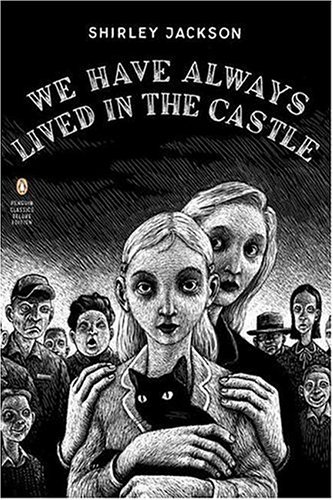 For my book club, I read Shirley Jackson’s We Have Always Lived in the Castle. What a treat that was. It’s like a perverse inside-out fairy tale. In our discussion of it, we got particularly interested in the way it destabilizes our sympathies. There’s the initial instinct to side with the narrator, which of course quickly turns out to be a mistake, except that she is being persecuted–though not unfairly, since after all, she is a murderer. Jackson evokes the horror of mob violence as well here as she does in “The Lottery”: the scene that begins with the fire chief throwing the first stone unfolds in an equally horrifying way–except that at least one of the targets is in no way an innocent victim, and later on, some of the villagers seem to be horrified, in their turn, at what they’ve done. We puzzled over Merricat’s motivation, or rather, over whether she has one, for killing her family. The suggestion seems to be that she didn’t much like being sent to her room without dinner, or in any way being thwarted or crossed. So the murders may be the act of a vengeful narcissist, a spoiled brat gone rogue. On the other hand, maybe there is no reason, which in its own way is even scarier. It’s a brilliantly written little book. I was hooked from the first paragraph, which is a perfect combination of whimsy and menace:
 I expected Sarah MacLean’s The Day of the Duchess to be a lot of fun too, but I really didn’t enjoy it and ended up skimming the last third or so of it just to get to the end. I have liked some of MacLean’s romances a lot, including The Rogue Not Taken, the first one in this series, but this book tilted too far towards the “feels” for me: it’s all angst and yearning, without any frolicking. I’m not necessarily saying it isn’t well done. It’s just that my own taste in romance tilts instead towards comedy. Also, more than I remember noticing in MacLean’s books before, The Day of the Duchess is full of the kind of writing that seems meant to force feelings on you, rather than allow you to arrive at your own reactions–lots of fragments, and lots of single line paragraphs, devices which to me almost always backfire: rather than increasing the impact of the line, they make it seem artificial, especially if the trick is used over and over again. I’ve been trying to think if there are any consistently serious romances that I really like. Laura Kinsale’s Flowers from the Storm is the only one I can come up with. Blame my inner cynic, which, as I’ve said before, makes me accept an HEA only if it doesn’t take itself too seriously.
 Though I don’t dispute Hogeland’s interpretation, I did notice that she seems aware she’s working a bit hard to make the case. She attributes the challenge to Hughes’s subtlety: for instance,
 Once again, you wouldn’t know it from this blog but I have been reading a lot! Quite a bit of it, though, has been for writing projects — including both reviews I know will be published elsewhere and essays I hope will find good homes. It’s not so much that I don’t want to “scoop” myself; it’s that I have some concerns about repeating myself, particularly if I say something here that I then wish I could put the exact same way somewhere else. Would it matter if I did? Probably not if it was just a phrase here and there, but it is still an inhibiting factor. If there’s just a bit of overlap, surely nobody would care, but it’s something that I do try to keep in mind.
 Today I finished reading Sarah Perry’s The Essex Serpent, which I will be writing up for the July issue of Open Letters Monthly. My initial impression is that it didn’t quite live up to my expectations, or to the hype, but I thought it had a lot of good ingredients — both stylistically and thematically — so my task over the next few days is to articulate what I think they added up to. Sometimes during this process my estimation of a book rises: it can take a little time to discover or understand the kind of whole the parts make. This was certainly my experience with Sarah Moss’s Signs for Lost Children, which I wrote about for
 Finally, last night, for no reason besides personal interest, I started reading Susan Bordo’s
  I’m trying to move on from
  Novel Readings