“Say you won’t leave us, Lolly.”
“I’m afraid I can’t do that.”
“But Lolly, what you want is absurd.”
“It’s only my own way, Henry.”
In many ways, Lolly Willowes is a familiar book. Like Villette or The Odd Women or The Crowded Street, it is the story of a woman whose life does not conform to the expected story of love, courtship, and marriage. Single women were both a social and a fictional (and thus a formal) problem from at least the mid-19th century on into the 20th. The statistical overabundance of women in the earlier period led to articles with titles like “Why Women are Redundant” and “What Shall We Do With Our Old Maids”; the terrible losses of World War I created a similar feeling of crisis, at least among those who saw marriage as the only natural and desirable aim for women’s lives. That was never everybody, of course, especially not all women, but it was an assumption that one way or another affected the horizon of expectation for most people.
Stylistically and tonally, Lolly Willowes is most like The Crowded Street, which makes sense, I suppose, as they are close together chronologically: Holtby’s novel was published in 1924, Townsend Warner’s in 1926. The world they depict is quite similar: for their heroines, it is one of stultifying limitations, well-meaning but hampering advice and attention, and near-debilitating mental suffocation. Lolly Willowes is brisker, though, and (for want of a better term) quirkier: Holtby plods along realistically with Muriel until finally she makes a little space for herself in the world — at last, most readers are likely to exclaim! — because the vicarious experience of her life is really very depressing.
Lolly Willowes feints in that realist direction. In fact, for most of the book you wouldn’t necessarily know it’s going to take a turn into the weird and wonderful unless you knew it already and so were watching (as I was) for signs — Lolly’s interest in herbs and potions, for instance, and the faintly uncanny way she has of not being altogether present in her immediate place and time. What’s so important and subversive about her story is that her cry for liberation — her demand to have her own way — arises from the most ordinary circumstances of her life. Nobody is intentionally cruel to her; she’s not abused or harassed or tormented … except by being an unmarried woman expected to find sufficient meaning for her life in being an accessory to other people’s plans and purposes. The complaint, in other words, is explicitly not personal but political, not individual but systemic: it’s an indictment of normalcy.
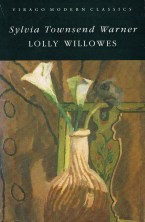 Once Lolly has removed herself from the benevolent tyranny of her family, establishing herself in the wonderfully-named town of Great Mop, she reflects on their disapproval:
There was no question of forgiving them. She had not, in any case, a forgiving nature; and the injury they had done her was not done by them. If she were to start forgiving she must needs forgive Society, the Law, the Church, the History of Europe, the Old Testament, great-great-aunt Salome and her prayerbook, the Bank of England, Prostitution, the Architect of Apsley Terrace, and half a dozen other useful props of civilization. All she could do was to go on forgetting them.
Lolly does find contentment when she has thrown off and (mostly) forgotten these “props of civilization,” but it turns out to be harder to shake them off than she’d hoped. I loved that it was her nephew Titus who followed her to Great Mop: again, precisely because he’s the one she likes best, the one who seems least threatening, the threat he does represent turns out to be most revealing. “Where are you off to, Aunt Lolly?” he cries cheerfully as she passes him; ” Wait a minute, and I’ll come too.” But Lolly doesn’t want him to come along; she doesn’t want him anywhere near her new life:
She walked up and down in despair and rebellion. She walked slowly, for she felt the weight of her chains. Once more they had been fastened upon her. She had worn them for many years, acquiescently, scarcely feeling their weight. Now she felt it. And, with their weight, she felt all their familiarity, and the familiarity was worst of all.
Happily for her, that familiarity turns eventually into a familiar, and Lolly is able to draw on forces outside “civilization” to break those chains once and for all. The turn is sly and mischievous and almost disturbingly gratifying: things turn against Titus (milk curdles, bees swarm) until he’s driven safely away. Lolly never seems overtly in control of these events: even as she feels a new power, her disperses. She’s certainly not innocent, though, as she openly and unrepentantly allies herself with Satan.
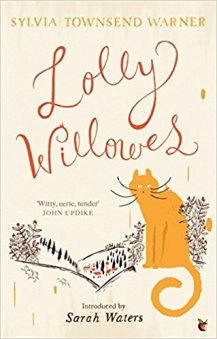 Lolly’s final dialogue with Satan (winningly in the guise of a common gardener) is the pay-off for the somewhat slow burn of the first two thirds or so of the novel. In fact, it’s mostly a monologue, in which Lolly makes a compelling case for Satan’s intervention. “It’s like this,” she explains:
When I think of witches, I seem to see all over England, all over Europe, women living and growing old, as common as blackberries, and as unregarded. . . . Well, there they were, there they are, child-rearing, house-keeping, hanging washed dishcloths on currant bushes; and for diversion each other’s silly conversation, and listening to men talking together in the way that men talk and women listen. Quite different to the way women talk, and men listen, if they listen at all. And all the time being thrust further down into dullness when the one thing all women hate is to be thought dull.
“Some may get religion,” she concedes, after more bitter musing about women’s wasted potential, “and then they’re all right, I expect. But for the others, for so many, what can there be but witchcraft?” It’s not about exercising malevolent power, or benevolent either, for that matter:
One doesn’t become a witch to run round being harmful, or to run round being helpful either, a district visitor on a broomstick. It’s to escape all that–to have a life of one’s own, not an existence doled out to you by others . . .
It’s the mordant genius of Lolly Willowes that this conclusion makes such perfect sense, in context–that Sylvia Townsend Warner has done such a good job bringing out the menace of the everyday that Lolly’s escape from it by such morally equivocal means is itself unequivocally something to celebrate, rather than fear or judge. She’s only trying to go her own way, after all: that should not be too much to ask.

 Only two chapters of The Optician of Lampedusa are about the rescue. The rest of it is about the context of the event, both personal (in the lives of the Optician, his wife, and their friends) and moral. The first chapters focus on normalcy: the everyday business of the Optician’s life, the nice dinner out before the boating trip, the pleasure of the time away from land and work. The chapters after show the same life stripped of its protective layer of willed ignorance. Once the Optician hears the roar on the other side of silence, he cannot go back to his previous wadding of stupidity. He can’t understand how he could have been so impervious to so much nearby suffering. He can’t understand why the catastrophes have continued for so long, why the response of governments and aid agencies and local people hasn’t been better, or done better. He can’t bear the memories of the people they couldn’t save; the only saving grace, for him and all those on the boat that day is the connection they maintain with the people the could save–and that doesn’t seem like much when so many were lost.
 As usual, the unusual stretch of radio silence here means that I have been writing: the good news is a proposal I sent in some months ago was unexpectedly accepted last week, but the challenge was they wanted it by today and I hadn’t really thought about it once the initial proposal had gone unanswered for a while. I have been focusing pretty hard since then–which was nice in a way, as I’ve been writing on Daphne Marlatt’s Ana Historic, a book that I have thought about a lot since I first read it and loved it when it was just out. As I have also found with the essay I’ve been writing on Dorothy Dunnett, though, loving and having a long relationship with a book can if anything make it harder to say something you’re pleased with, especially under tight space constraints!
 There were certainly things I liked, admired, and was interested in with The Trespasser. French is great at jump-starting her books with a strong sense of the narrator’s individuality (if you haven’t read them, though the books do connect, each of them is told by a different member of the Dublin Murder Squad). The strongest element in The Trespasser was the gradual undoing of its narrator’s own perspective–not on the case, but on her place in the squad. The whole book is about interpreting events, about considering competing stories and weighing them against both the fixed point of fact and one’s own sense of the teller’s character and of what, more generally, makes a plausible or significant story. Our narrator here, Antoinette Conway, operates under assumptions about the people around her that turn out to be both largely mistaken and debilitating; that “reveal” is more important, ultimately, than the unraveling of the crime itself.
 In his introduction to the Oxford World’s Classics edition of The Forsyte Saga, Geoffrey Harvey explains that we owe the saga in its completed form to Galsworthy’s goddaughter, Dorothy Ivens. The Man of Property had been published in 1906 but Galsworthy’s attention had moved on. Then in 1918, he published Indian Summer of a Forsyte as part of a volume of stories; when Dorothy read it, she urged the author to “give us more Forsytes!” In Chancery followed, in 1920, then To Let in 1921.
 The relationship between these two forlorn souls is delicately drawn. It’s unusual but not improper: Jolyon wants nothing more than to be in Irene’s company, and she seems to understand and to take comfort herself in sharing what remains of the old man’s time, in making this interlude more beautiful for him:



 This is the world these “maidens” know, and also the one they are each, in their own ways, trying to leave, or perhaps (though they haven’t quite seen it this way yet) to change. Gardam limns their individual characters effectively, along with the other people in their lives: Una’s flighty hairdresser mother; Hetty’s kindly father, returned from the trenches “unscathed in body but shattered to bits in mind” and reduced to eking out a living as a gravedigger; Hetty’s pious, meddling mother; the kind and principled Quakers who took Lieselotte in but cannot wholly comprehend what it means to have her experience of the world. It is a differently eventful summer for each of the girls; little happens of immediately visible moment, but by the end of the novel you can feel them all settling into firmer forms, asserting more clearly who they are and will be.
 I didn’t like the crow. I understand that it is the central conceit of the novel; it’s an effective metaphor and clever, probably more than I appreciate, as a way of figuring grief as something that has a real presence, that plays tricks, that demands attention, that even, in its own way, connects you to your loss. I think I would have liked it in a poem. Here I found it a distraction–too clever, with its multiple modes of discourse and its allusiveness. Is grief really so literary? so metatextual?
 My edition of The Sympathizer includes as appendices a New York Times opinion piece by Viet Thanh Nguyen called “Our Vietnam War Never Ended” and an interview with him by Paul Tran called “Anger in the Asian American Novel.” I read both of these through before I read the novel (cautiously at first, ready to turn away if there seemed to be significant spoilers). I did this because I thought I might not recognize important features of the novel given my own limited knowledge of the Vietnam War, or of other representations of it. I have never, for example, read Graham Greene’s The Quiet American or Denis Johnson’s Tree of Smoke (both discussed in these articles); I have never seen Apocalypse Now, and though I’ve seen Platoon, I have no particular memory of it. Growing up in Canada, the Vietnam War was never a big part of my historical mythology except insofar as it featured largely in American history, particularly (in my own intellectual experience, anyway) in the form of anti-war protests and draft dodgers.
 A friend recently mentioned that she’d been reading and enjoying Maggie O’Farrell’s novels, so the next time I was at the library I checked out two of them: Instructions for a Heat Wave and The Vanishing Act of Esme Lennox. Both are essentially family dramas; both turn on long-held secrets and their repercussions, though in Instructions for a Heat Wave the consequences are mostly moral and emotional, while by the end of Esme Lennox two people have paid (in very different ways) with their lives. Both are very good–well written, evocative, psychologically astute, and thematically layered — but it’s Esme Lennox (both the novel and the eponymous character) that’s really going to stick with me.
 Instructions for a Heat Wave ends on a faint note of optimism: the novel’s ultimate revelations may be initially devastating, but as people’s secrets come out, healing seems possible — no harm is ultimately irredeemable. The Vanishing Act of Esme Lennox, on the other hand, offers no such soothing hope: some wrongs, it suggests, can never be made right, at least not through forgiveness. The novel is a compelling blend of chilling and heartbreaking: as it takes us from Esme’s childhood to the present-day life of her grand-niece Iris, splicing in segments from the point of view of Esme’s sister Kitty, now suffering from Alzheimer’s, we gradually realize just how Esme came to spend 60 years confined to an asylum. One of O’Farrell’s sources is Elaine Showalter’s The Female Malady: Women, Madness and English Culture, 1830-1980; Esme’s story dramatizes the horrors of a society that conflates nonconformity with “hysteria” and madness, and punishes it accordingly. I was a bit disappointed in the novel’s ending, but it’s a haunting story, both poignant and gripping.
 Do any of you know the delightful children’s rhyming book The Piggy In the Puddle? For the last couple of days, as I sat at desk or table, staring at my computer screen and messing around with the pieces of what I hope will eventually be an essay on Dorothy Dunnett’s Lymond Chronicles, lines from it kept running through my head:
 Novel Readings