
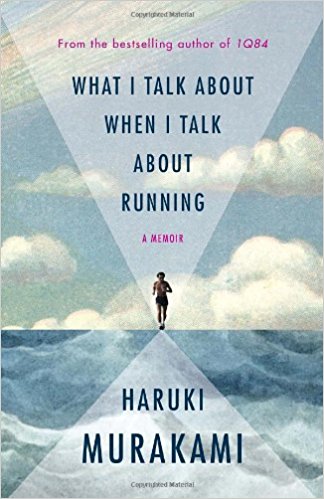
 It turns out I wasn’t entirely wrong to have avoided Haruki Murakami’s What I Talk About When I Talk About Running. A number of people recommended it to me after I posted last week about hoping that I can learn to approach my writing in the same spirit as I do my running: focused on my own goals and the intrinsic satisfaction of reaching them, without comparing myself to others, without feeling inadequate because I don’t run faster or further. I knew Murakami’s book was out there, but because I also knew that he ran marathons, I had figured it would probably provide just one more potentially demoralizing comparison of my own modest efforts to someone else’s much more impressive accomplishments.
To be honest, to some extent that was how I reacted to What I Talk About When I Talk About Running. The book made me feel a little bit defensive, a little bit apologetic, a little bit embarrassed not to be pushing myself harder and achieving more–not just as a runner, but as a writer. After all, it turns out Murakami doesn’t just run marathons: even when he’s not running in races, he runs for hours at a time, and in addition to marathons he also does triathlons. And, of course, he isn’t just an obscure writer puttering away, doing his best and trying to find satisfaction in that, but an internationally renowned, best-selling, prize-winning writer. Gee, thanks, everyone! As if my Salieri syndrome doesn’t flare up enough quite on its own.
That wasn’t the entirety of my response to Murakami’s book, though: there was also a lot about it that I liked. Above all there’s Murakami himself. I was amused and a bit touched by his remark that he thinks most people would not like his personality very much:
There might be a few–very few, I would imagine–who are impressed by it, but only rarely would anyone like it. Who in the world could possibly have warm feelings, or something like them, for a person who doesn’t compromise, who instead, whenever a problem crops up, locks himself away alone in a closet? . . . I just can’t picture someone liking me on a personal level. Being disliked by someone, hated and despised, somehow seems more natural.
Later in the book he describes his own “nature” as “individual, stubborn, uncooperative, often self-centered.” “I’ve carried this character around like an old suitcase,” he goes on,
down a long dusty path. I’m not carrying it because I like it. The contents are too heavy, and it looks crummy, fraying in spots. I’ve carried it with me because there was nothing else I was supposed to carry. Still, I guess I have grown attached to it. As you might expect.
Maybe it’s because I recognize something of myself in these descriptions that they didn’t alienate but rather charmed me. I also appreciated that his self-deprecation doesn’t come in the rather arch form that seems common in some kinds of personal essays these days but instead seemed (surprisingly, given his accomplishments) quite sincere. At one point he describes himself as a teenager staring at his naked body in a mirror and adding up all his (perceived) flaws. His evaluations of his own character here don’t seem immaturely judgmental, the way he now knows that earlier exercise was; it seems as if he has simply assessed himself as honestly and dispassionately as he can and learned to live with what he found.
 In a similar way, he talks about both his running and his writing without flourish or posturing. There’s no false modesty, but also no braggadocio. Further, though he does talk a lot about training and personal bests, he never seems competitive against anyone but himself. He certainly has a different relationship to running than I do, an interest in pushing himself and seeing (literally but also metaphorically) how far he can go as a runner, but he does it because it suits him: for him, it’s a way of expressing himself, not proving anything. In fact, sometimes what he seeks and finds in running is humility: when he feels he has been “criticized unjustly,” for example, he runs “for a little longer than usual”:
By running longer it’s like I can physically exhaust that portion of my discontent. It also makes me realize again how weak I am, how limited my abilities are.
He also believes that for him, running enables writing. Keeping it up has been worth it for him not just for its immediate benefits but because “I like the novels I’ve written . . . and if running helps me accomplish this, then I’m very grateful to running.”
What I Talk About When I Talk About Running is kind of a meandering book: it mixes some memoir with bits of travel writing, thoughts on music, a few practical notes on long-distance running, and some reflections on the writing process. One of the things I liked best about it is that just as I would be getting a bit impatient with details about training regiments or running shoes, Murakami would take a turn through some more metaphysical scenery. The insights he offers aren’t, I suppose, particularly profound or surprising, but he doesn’t present them as if they are: only as if he has thought about them, or they have become clearer to him, and so he’s sharing them. “Exerting yourself to the fullest within your individual limits,” he says, for instance: “that’s the essence of running, and a metaphor for life–and for me, for writing as well.” Or,
For me, running is both exercise and a metaphor. Running day after day, piling up the races, bit by bit I raise the bar, and by clearing each level I elevate myself. At least that’s why I’ve put in the effort day after day: to raise my own level. I’m no great runner, by any means. I’m at an ordinary–or perhaps more like mediocre–level. But that’s not the point. The point is whether or not I improved over yesterday.
 When he talks about writing more directly, he often emphasizes how difficult it is:
Writing itself is mental labor, but finishing an entire book is closer to manual labor. It doesn’t involve heavy lifting, running fast, or leaping high. Most people, though, only see the surface reality of writing and think of writers involved in quiet intellectual work done in their study. If you have the strength to lift a coffee cup, they figure, you can write a novel. But once you try your hand at it, you soon find that it isn’t as peaceful a job as it seems. The whole process–sitting at your desk, focusing your mind like a laser beam, imagining something out of a blank horizon, creating a story, selecting the right words, one by one, keeping the whole flow of the story on track–requires far more energy, over a long period, than most people realize. . . . Everybody uses their mind when they think. But a writer puts on an outfit called narrative and thinks with his entire being; and for the novelist that process requires putting into play all your physical reserve, often to the point of overexertion.
Implicit here is that he means this writer, this novelist, just as when he describes the routines he thinks are essential to success, such as “sit[ting] down every day at your desk and train[ing] yourself to focus on one point,” he means they worked for him. Your mileage may vary, he might have said, if he were offering this advice today! I don’t know if that’s how all novelists work, and since I’m no more likely to attempt a novel than I am a marathon (I think, anyway), I’ll probably never know if that’s what it would be like for me. What he describes is not totally different, though, from what it takes to do even the kind of writing I do, which also requires focus and effort, especially “selecting the right words, one by one.” His fundamental insight, too, is not so different from the one I arrived at in my own minor epiphany, though he seems to live it, while I still aspire to it:
What’s crucial is whether your writing attains the standards you’ve set for yourself. In this sense, writing novels and running full marathons are very much alike. Basically a writer has a quiet, inner motivation, and doesn’t seek validation in the outwardly visible.
 Adam Haslett’s Imagine Me Gone is painful, even tragic, and yet it is also just funny and acerbic enough to keep it (or its readers) from becoming unbearably sad. In fact, I thought there was something oddly bracing about it. That’s partly because I thought it was so well done, artistically and formally, but it’s also because the novel balances its devastating portrayal of depression and anxiety with its persistent faith in basic human kindness and, especially, family love. Haslett doesn’t oversimplify the challenge of severe mental illness — not just for the people living with it, but for the people living with them, whose lives are also inevitably changed by its presence. He also doesn’t romanticize it, or offer the faux consolation of silver linings: nobody is redeemed by it, it doesn’t bring anybody transcendence or special wisdom. It just is–for everyone involved.
 Michael’s illness cannot be willed away, stared down with stoicism, or held at bay by distractions or the pretense of normalcy — though even as he brings out the error, indeed the danger, of approaching it this way, Haslett is also very critical of medicalized approaches that consist largely of throwing more and more pills Michael’s way.
 Another thought-provoking aspect of Imagine Me Gone was the kinship Michael identifies between the family history of mental illness that so shapes his own individual story and the blight of slavery as foundational to America’s history. Michael is preoccupied with reparations, which for him represent a political and moral necessity that is impossible for him to separate entirely from his own tormenting belief that he is to blame for his father’s suicide. How can you right the wrongs of the past? How can you endure and survive your inheritance of suffering?
 I had a minor epiphany this morning: I should try to approach writing in the same spirit I approach running.
 My version of “otherwise” has
 I have also appreciated the way reviewing has expanded my reading, particularly when the books are suggested by other editors rather than hand-picked by me to suit my own known tastes and sensibilities. I would point, for example, to the increase in Canadian titles I have read since taking on some commissions for Quill & Quire and, more recently, Canadian Notes and Queries, though the best example of a writer I would probably never have discovered on my own but loved would be
 I am back from my trip to Vancouver, where in spite of the rain (even, in some ways, because of it) I had a lovely time visiting with family and friends and drinking in the always inspiring sight of the mountains rising above the city and the sea. It was a a welcome interlude between the end of a challenging term and the beginning of a summer of reflection and writing.
 I did get some travel reading done. I’m nervous on planes, so light or fast-paced books are good as my concentration isn’t always great. En route to Vancouver, I found Miranda Neville’s The Amorous Education of Celia Seaton an excellent diversion, and on the way home I alternated between Georgette Heyer’s Black Sheep (reliably amusing) and Adam Sternbergh’s The Blinds, which I’m reviewing for Quill & Quire. I plucked several promising titles off my mother’s well-stocked shelves, but the only one I read cover to cover was
  Though I didn’t manage a lot of good reading while I was away, I did bring back a nice stack of books to read here at home. One ritual my mother and I have on my visits is an expedition to
  Including The Blinds, then, which had been mailed to Vancouver so I could get started on it sooner rather than later, I came home with 8 more books than I left with. And yet wouldn’t you know it: the book I most want to read next turned out to be waiting for me when I got back to Halifax. It’s Marina Benjamin’s The Middlepause: On Life After Youth, a 50th birthday gift which seems like just the right book to help me think about where my own life is now and what I want to make of it next. That is likely, then, to be the next book I write about here.
 I haven’t disappeared or given up blogging! It’s just that as soon as my final grades went in, I had to buckle down and finish two reviews that have been haunting me — not because I didn’t want to write them, but because though I have had the books for some time and had even started reading them, it just hadn’t been possible for me to get the hard work of writing thoughtfully about them done. The result was that even though neither of them was technically late, I felt guilty for weeks! But one went in last week and the other today, and while I now have to wait and find out what the editors think, including what revisions they want, I’m out from under that shadow and ready to contemplate the rest of my summer.
 However! Rain is perfectly good weather for taking stock and making plans, and that’s the stage I’m at now. I actually feel as if I need some dedicated time for that, because I’m not really sure right now what my top priorities are. I spent a lot of the last two summers doing work related to
  Some of that was due to my specific teaching assignments this year. My fall term courses were both ones I have taught before and really enjoy. Since I first designed my version of Close Reading, I have tried to infuse its more technical aspects with both critical and moral purpose, and the result is that it generates some of the most interesting discussions and assignments I get. It was also balm to my soul to spend five weeks on Middlemarch for this class: that is not enough time, of course–what would be?–but still feels comparatively luxurious (when I teach Middlemarch in my standard 19th-century fiction class, we get three weeks). Finishing with The Remains of the Day is always marvelous, but Ishiguro’s novel felt
  One thing I realized as the term went by is that the big questions that, in my mind, really motivated the course–questions about the difference between “pulp” or “genre” fiction and “literary” fiction, for instance–were not of great interest (at least, as far as I could tell) to most of the students: they did not seem to be invested in either the distinction or arguments against it. My guess is that most of them had never thought much about genre categories or literary prestige before; certainly I got no sign that they believed themselves to be victims of or participants in any kind of “culture war” by virtue of having been assigned Elmore Leonard and Loretta Chase instead of Shakespeare and Jane Austen. It’s possible that some of them are now more interested in how and why we might draw these kinds of lines, but it was at once disorienting and refreshing to realize that they were not nearly as exercised about them as people often are in the media or in the world of literary criticism and book reviewing. In the end it was just another thing I was trying to teach them about.
 OK, I exaggerate slightly: I’ve also had some papers to grade. But the final exams for both of my winter term classes were this Tuesday. At 3 hours each, with set up and pack up time that meant over 7 hours straight in the dreary Dalplex fieldhouse, and I walked away with 120 exams which I will be working my way through until next Tuesday at least. Overall, it’s not exhilarating work: there are certainly bright spots (many of which so far have been in the essay answers from students in the 19th-century fiction class), but a lot of this marking is more or less drudgery. I do try to make the questions not just relevant but, where possible, interesting, for me as well as for the students, but as I’ve written about here before, the main value of exams for me is simply, and kind of sadly,
  I have been managing to get some reading done: some serious reading, with an eye to reviewing deadlines coming up, and some light reading. I just finished Julie James’s newest, The Thing About Love — and did not love it. It was entertaining enough, and she’s good at both plot and banter, but the awkwardness I always notice in her prose seemed particularly conspicuous this time. I can’t believe better editing couldn’t smooth a lot of it out: she has tics like explaining new names by adding “referring to etc. etc.” after them. I was diverted by the book, but also disappointed in it, especially as I like her previous novel, Suddenly Last Summer, a lot. I am really looking forward to doing some immersive reading that’s not for work (or for formal reviews, for that matter). I have some birthday gift cards I’m going to use to treat myself to some new books as soon as I file final grades! It will probably be pretty quiet around here until then.
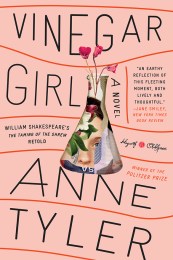 Vinegar Girl, Anne Tyler’s contribution to the
  As this line suggests, there’s not much taming in Tyler’s version, which I appreciated. Kate’s prickly personality instead is part of her appeal. Katherina’s famous closing speech becomes a rant from Katherine, not about how wives should lovingly obey their husband’s, but about how hard it is to be a man who always has to hide his feelings, while women “have been studying people’s feelings since they were toddlers.” “It’s like men and women are in two different countries,” she explains to Bunny, who accuses her of subordinating herself to Pyotr;
 Novel Readings