 Help me say what can’t be said, you ask me.
This would be the most extraordinary outcome. Managing to say out loud, dry-eyed, the things that can’t be said because no one knows where to put them, no one wants to hold them, because they burn. And you—when people ask about you—feel guilty because you are a red-hot ember that scorches anyone that touches it.
Concita De Gregorio’s The Missing Word is just barely fiction, by which I mean both that it tells a true story and that it tells its true story with exceptional lightness, almost delicacy, not of tone but of touch or glance, as if to help her readers hold Irina’s story in their minds without scorching.
What happened to Irina is this: she married Mathias; they had twins; she and her husband eventually separated but made amicable arrangements to share time with their daughters; one day he picked them up and they were never seen again. Mathias took his own life, leaving no traces or clues of the girls’ fate. Irina lives on, because “that’s what nature has decided: pain on its own doesn’t kill you.” Eventually she meets another man, Luis, and is happy with him, though she is also, always, grieving: “It’s a never-ending occupation. A constant battle. A siege, as you call it The presence of those who are absent besieges you.”
Some of the chapters of The Missing Word are told by the narrator (Concita, as I understand both the novel’s conceit and its fictionalized truth) addressing Irina with questions or observations about Irina’s story, or Irina’s desire to tell her about it:
You want to talk about you. About what you’re like now. You want to say, eyes wide with surprise, that it can happen, something that you never imagined possible has happened to you. Love is back, it never really left: it was hidden in a corner, crouching in fear with its hands over its head, but it was there . . . You talk and talk. You talk about changes. Memories. You wonder.
Other chapters are in Irina’s voice. She talks about about her family history, her marriage, her children, their disappearance, her memories, her mourning:
No. I don’t have a single picture with me. I don’t have one in my wallet. I don’t need to see them captured and immobilized in the past. I see them alive in the present, I don’t even need to close my eyes. I see them and hear them . . . There isn’t one image in particular that comes to mind. Every single one. All my memories are here: it’s not that they return, they never left. They haven’t been dislodged since the second they came into the world. Sometimes you’re surprised by the moment when they manifest themselves to you.
Other chapters are letters and documents: Irina writing to her friends, to her Nonna, to the girls’ teacher (begging, poignantly, for the school to release their stories and pictures to her), to judges or investigators (pressing for the investigation—which was inept, half-hearted, inconclusive—to continue). A couple of the chapters are lists: things Irina is angry about, things that make her happy, things she “mustn’t forget”—I made a list with that heading too, after Owen died.
 “It must be said,” Irina says to Concita, “that losing a child is the touchstone of grief, the gold standard of pain. The benchmark.” This is uncomfortable territory: it doesn’t seem right to weigh one grief against another. “Never would I compare my state with that of, say, a widow’s,” Denise Riley says in Time Lived, Without Its Flow”; “never would I lay claim to ‘the worst grief of all.'” Yet Riley, whose adult son died suddenly of a previously undetected heart defect, goes on to make other comparisons:
And, among my own kind, never would I compare my own infinitely lighter lot with that of the parent of a murdered or tortured child, or a suicidal child, or one killed in a stupid accident, or one very young, dying painfully slowly.
Irina does not know how or even whether Livia and Alessia died. She feels the impossibility of their survival, because surely there would have been some sign after so much time:
They’re very sensitive, Alessia and Livia. Highly intelligent. They understand, they hear everything. They would have found a way, in these years of absence, to let me know: we’re here. One person, a trick. Even if someone had said Mamma’s dead, or Mamma doesn’t want you anymore, she left. They would have come across something or someone, I think, able to capture a signal and transmit it. To be suspicious, feel sorry, understand.
But against the ninety-nine percent probability of their death, she sets the one percent chance that they are “somewhere in the world”: “all I can do is squeeze every fiber of my being into that infinitesimal space.” Maybe that would be worse, the not knowing for sure, the persistence of that tiny hope, although my mother’s heart says it might be better than what I know.
“There’s no specific noun for the parent of a dead child,” Riley remarks. That is the “missing word” of De Gregorio’s title. Maybe, both writers imply, there is no ready vocabulary because this is the loss (worst or not) that people, or parents anyway, least want to contemplate. It frustrates Riley when people say (as they have said to me too) “I can’t imagine what you are feeling”: “I’d like them to try to imagine,” she says, “it’s not so difficult.” I have thought the same, but I also understand the refusal; Riley calls it “a disavowal of the possibility of empathy,” but surely it is only self-preservation. Concita reflects on Irina’s reluctance to tell people the truth about her daughters:
People ask: Do you have children? You say nothing. Yes, two, you’d like to say. Because it’s true, you have two. They’re there all the time. You can’t free yourself of their absence . . . Then you should add: but they’re dead. Presumed dead, if you really want to be precise. But you don’t say it. You don’t say it spontaneously and then it’s too late, and you can’t find the courage to say it. Courage, yes, that’s the word. Because you’re ashamed to embarrass people . . . They truly didn’t want to know: they didn’t want to hear it.
“Well, do you know what would be amazing?” she goes on; “If people you speak to about yourself had the capacity to hold their peace, listen, and not feel duty-bound to put their two cents of horrified clichés in. To accept, and find a place for what you are saying.” That is what The Missing Word offers its readers as well as Irina: a place to listen, a story of love and loss to make up for the word we don’t have to give our grief a place—a story, too, of movement, which for Irina makes a new story and a new love possible, not replacing the old story or the old love but continuing them:
Searching, traveling, seeing, trying to understand what the bigger picture is. This is the only thing we can do. Not stopping ourselves, not suppressing our desire, ever. Another step. One meter further. Forgetting and remembering. Letting things out and then bringing them back into your heart.
I read The Missing Word on what would have been Owen’s 26th birthday. Another step.
 She thought of all the girls she had known—some too fat, some too thin, some plain and bespectacled like Nancy, some stupid, some dishonest, some mean, some cruel: all given, at times, to giggling, sniggering, sniffling, smelling of their under-arm smell—and yet, somehow, they were all transmuted by Tom’s admiration into unearthly creatures, silver-white doves, delicate, diaphanous, lovely as female gods.
 The novel is populated with many other women, young and old: that Ellie’s is not by any means the worst of their fates suggests the novel as a whole is grappling with the challenges faced by women in the 1950s, a time of rigid expectations but also some loosening constraints—a combination that brings a lot of risks, social as well as psychological. All around them are signs that it is now possible for women to rely on more than their looks for success and security, but women like Petta, the depressed wife of Ellie’s first, much older, lover, have not learned how—or maybe it is more accurate to say that they have not (or she has not, at any rate) learned to trust that they can get by on other terms. There’s a particularly poignant moment when Petta, feeling momentarily enlivened and confident, suddenly sees herself in a mirror among a crowd of younger women:
 Ellie could have been set up as a clear foil for Petta, but she isn’t sure enough of her own value (or values) to play that part. Again, Manning doesn’t set her up for success: her artistic ambitions are not matched (as far as anyone else thinks, anyway) by either talent or drive, and she spends a lot of the novel moping about. The real contrast turns out to be Petta’s daughter Flora, who appears only very briefly late in the novel. “I want to study medicine,” she calmly tells her long-absent mother, and Petta is struck with “acute envy”: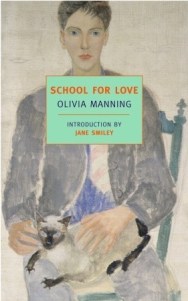
 There are moments in School for Love when it is possible to sympathize with Miss Bohun, mostly because we see her primarily through Felix’s eyes. Grieving, lonely, and naïve, he accepts Miss Bohun’s account of herself and others for a long time and enjoying his occasional role as her confidant. She does take people in, after all; she has taken him in when he was otherwise unwanted and at a loss, although the terms of her “kindness” (as we see much more clearly than Felix) are anything but generous. It is a sad part of Felix’s maturation that he has to give up believing the best about people, an attitude nurtured in him by his mother. He is helped along in this shift towards realism (or, perhaps, cynicism) by the arrival of the refreshingly frank widow Mrs. Ellis, who becomes the subject of his first intense crush and, through her resistance to Miss Bohun’s pretenses, an agent of his “developing attitude to life”: “Venturing into reality,” Felix thinks, “Mrs. Ellis was the guide for him. Almost every time he was with her some incident widened his understanding of life, or of himself.”
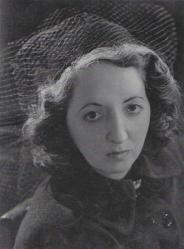 This is a gentler conclusion, both about Miss Bohun and for the novel, than I expected from
 There were definitely things about Drifts I did like. I liked learning about Rilke (I would have liked, better, a unified essay about Rilke); I enjoyed May Sarton’s scattered presence (I would have liked, better, an essay focused on Zambreno’s interest in Sarton). I liked the sense of what it might be like to be in Zambreno’s head—until I got tired of it, since it’s not a particularly restful or happy or illuminating place and being in my own head is hard enough these days, thank you very much. I got tired of the insistence on how hard it is to write, to be a writer, to write a novel. It started to seem unbearably self-absorbed, self-indulgent, solipsistic, all this moping around and lamenting and oversharing. “Think of Trollope!” I wanted to say. “Get out of your head and just tell us a story!” But of course that is not the kind of novel Zambreno is interested in.
 I’m just back from a long-awaited, oft-postponed visit to Vancouver. I came back with more books than I left with: no surprise there! A couple of them are ones I claimed from my mother’s ‘donate’ pile (one of my undertakings was to help her sort her many – many! – books so that the ones she wants most to read and reread are actually on shelves and the others eventually make their way into the hands of other readers); a couple of others were just too good to pass up when I spotted them on the bargain books shelves at the UBC bookstore; and one, Bach’s Sonic Tapestry, is by and inscribed by an old family friend.
 I have read a fair amount of poetry in my life, for pleasure and for work. One of my very oldest books is an illustrated edition of Robert Louis Stevenson’s A Child’s Garden of Verses, and I went through a phase as a tween where I thought reading Poe’s “The Raven” or Alfred Noyes’s “The Highwayman” aloud was the height of literary engagement; around the same time, I was given an anthology of Romantic poetry, which (read obsessively but selectively) confirmed my youthful predilection for angst and pathos. Mostly I read fiction, though, so it remains surprising to me that it was a poem—Robert Graves’s “The Cool Web,” specifically—that turned me into an English major (thank you again,
  Since I became an English professor myself, my research and teaching has primarily focused on fiction, but I actually consider poetry the highest form of literary art, and I always look forward to the chance to work through some examples with my students, something I rarely get to do except in first-year courses or when I teach our ‘theory and methods’ course on close reading. Once upon a time we had a full-year Victorian Literature course, which meant plenty of poetry and even (rarer still) some of the period’s great “sage” writing, and today sometimes I get to teach our survey course on British Literature from 1800 to the present: hooray, more opportunities for poetry! I also regularly assign as much of Aurora Leigh as I dare in my seminar on the Victorian ‘woman question.’ (If you’re curious about how I approach these courses,
  When I teach poetry, something I often remark is that even the most skeptical among us tacitly acknowledges its power and value on special occasions—weddings, for example, and funerals. There is something about poetry that we need, not just at those times but especially at those times. I knew this already in theory but only really understood its truth when Owen died. Lines of poetry that I had read many times before became new to me, in terrible but also beautiful ways; I reread them over and over, and also sought out (and was offered) more. Sometimes the words brought comfort, but more often they offered confirmation: yes, this, this is how I feel, this is what I would say myself, if I could. I have found some passages of prose that bring the same relief, but it is still poetry I turn to when the grief is hardest to bear. I copy passages into my journal and save screen shots, an ongoing commonplace book of sorrow. I don’t necessarily think that this is the best way, the best reason, to read poetry. It can feel solipsistic; I wouldn’t want it to be the only way I (or anyone) read poetry. I wouldn’t want these to be the only poems I read.
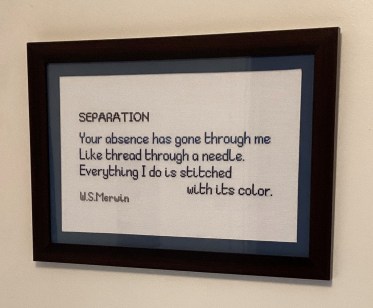 I would like to read more poetry, and to read more different kinds of poetry better. You’d think this would be easy, and of course the steps themselves are simple enough, but the feeling of not “getting” it (which I have, cumulatively, spent many hours trying to train my students out of) does get in the way of my good intentions. Lately, therefore, I’ve come up with a little game I call “Poetry Serendipity”: every time I go up into the stacks of the university library, I take different routes on my way to and from whatever section I am specifically visiting and, as I wander, I scan the shelves for names I recognize or (more random and risky, but also more fun) for those tell-tale slim volumes that you just know must be poetry collections. Sometimes I have a few names in mind, so that if I notice I’m in the (say) contemporary American section around names starting with M or P, I can look around for (say) W. S. Merwin, or Marge Piercy. I sign out a few books, bring them home, and browse them without purpose or pressure. If I like something, I pause and reread; if I don’t connect, I close the book and move on without shame or regret—sometimes from very famous poets! I haven’t had many big successes, but pretty often I find at least one poem I like enough to copy out. Along the way I think I am learning something about myself as a poetry reader. I like form, or the feeling of it; I like clarity, sometimes (though not always) simplicity; I like concrete details; I like ideas but not elusive abstractions; I like moments in time, poignant or reflective; I like calm, and melancholy, not exultation; I do not like religion (with rare exceptions). Yet somehow I also like many poems that meet none of these specifications.
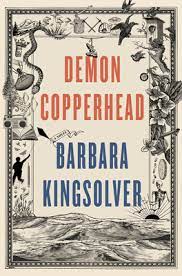 Practically from our first meeting, she’d been after me to write a recovery journal. I told her I don’t write, I draw. She said this would be for myself only. I could share it, but only if I chose to do so. The idea being to get clarity and process some of my traumas. On that particular ball of yarn I didn’t know where to start. She suggested pinpointing where my struggles had started with substance abuse, abandonment, and so forth . . . I’ve made any number of false starts with this mess. You think you know where your own troubles lies, only to stare down the page and realize, no. Not there. It started earlier. Like these wars going back to George Washington and whiskey. Or in my case, chapter 1. First, I got myself born. The worst of the job was up to me. Here we are.
 Kingsolver jumps right into the action, and really, it never stops, for the next 500+ pages. Demon Copperhead is a rush of narrative—a copious, colorful, fast-moving torrent of words. Although it is clear by the end of the novel that it is, like the original, retrospective, it has none of the layers of David Copperfield, which is complicated and enriched by foreshadowing and dramatic irony. It is perhaps surprising, given his reputation for exaggeration and hyperbole, that, on my reading anyway, Dickens is by far the more subtle and nuanced author of the two. Kingsolver (or, properly, her first-person protagonist Damon Fields) just keeps going and going and going, a kind of tireless Energizer Bunny of grim revelations about the hardships of life for a child born in poverty in Appalachia and growing up through the worst of the opioid crisis. At a time when the idea that fiction should have a purpose is (in elite circles, anyway) often dismissed as incompatible with real art, Demon Copperhead is, unapologetically, a fully committed ‘social problem’ novel: it has more in common, in that respect, with Mary Barton, or even with Bleak House, then with David Copperfield, which is, as its opening line tells us, a story about moral development—an individual story, a Bildungsroman. Its action is always, more than anything else, about David’s character, and especially about his tender, loving heart.
 It’s notable to me that the rest of her acknowledgments are to people who helped with expertise related to social problems (“foster care and child protective services . . . logistics and desperations of addiction and recovery, Appalachian history” etc.) – not to Dickens or David Copperfield. It isn’t that David Copperfield is
  ‘
‘ What I missed most of all in Demon Copperhead was the melancholy tenderness that suffuses David Copperfield, and the way Dickens shades David’s highs and lows with his profound understanding of both the necessity and the heartbreak of losing our childhood innocence. The David that worships Steerforth and adores Dora is so loving and lovable: he is wrong, of course, in both cases, but Dickens is so good at making us feel to our core the cost of outgrowing mistakes like these, of becoming someone too savvy and knowing and suspicious to follow our hearts without question.
 They belonged here. Of course. It was obvious. They belonged here and they should be here. Why not? Why on earth not? Why should she and Polly leave the Point to a land trust rather than to the people who had loved it the longest? Her heart pounded. It had taken her her whole life to see it, but now that she did, nothing could be as clear. The simple truths are always hidden in plain sight, only veiled by the complications of the human mind.
 Agnes, in contrast, has to get out of her own way, to stop guarding her secrets and make space in her life for love and forgiveness. This means reckoning with a traumatic incident from her past, which we learn about through the device of a long series of letters she wrote to her dead sister, which she eventually decides to share with the novel’s third protagonist, Maud Silver, an ambitious young editor eager to convince Agnes to write a full and frank memoir.
 It was a strange teaching term, at times hard, awkward, and demoralizing, but also at times invigorating, engaging, even restorative. This is true of every term, I suppose, but I really felt this emotional ebb and flow this time, probably because I am still grappling with what it means to carry on with my “normal” life after Owen’s death: I can’t really take any aspect of it for granted, and the more normal things seem in the moment the more
  I have always worried that students who attend irregularly are missing out on that broader learning experience, and also that sporadic attendance can become a self-fulfilling prophecy because if you just show up occasionally, you might not recognize the value of what we are doing or know how to join in to get the most out of it. The most obvious policy response is to require attendance, and I do believe in a version of “if you build it, they will come”—if you mandate it, they will (maybe, eventually, hopefully!) start to see the value of it. Mandatory attendance creates its own problems, though, from the administrative burden of recording it (especially with large classes) to the difficulty of having and applying fair policies that take accessibility and other issues into account and don’t lead to constant wrangling over what counts as a “legitimate” absence. For many years now I have not required or graded attendance, though I do always take attendance, so that I have some sense of who is or isn’t showing up and can reach out to anyone who seems like they might be in trouble. Before COVID, I also experimented with a range of different in-class exercises for credit, using them both for low-stakes practice at key course objectives and to “incentivize” being present. I think this is the approach I will go back to next year.
 Another reason to return to more in-class work is the relentless encroachment of AI. Other people have written well about what it means for those of us whose life’s work is helping students learn to read, think, and write better, and about what we can and can’t, should and shouldn’t, do in response. (See
 Actually, I kind of love the idea that the novel’s narrator “would rather have tea than everything else in the world” (me too!)—but of course this is absolutely not a passage from the novel; it’s just a jumble of nonsense. Students are already willing to put in a remarkable (to me) amount of effort “hiding” or “fixing” material they have copied from other sources, to conceal their reliance on it, but I doubt most of them are up to the task of getting crap like this into passable form. Mind you, to know it’s crap, they would need at least some familiarity with the novel: what shocked me with the ChatGPT cases I had this term was that they included quotations that were simply not in the actual assigned text, and the students didn’t even notice. As students get more familiar with the bot’s limitations, they may (may!) find it is actually less work (and less risk) to just do the reading and assignment themselves.
 Next term: what a thought. A year ago the very idea of being back in the classroom was completely overwhelming. It seemed impossible, unthinkable. “How do they do that?” I puzzled as I reflected on
 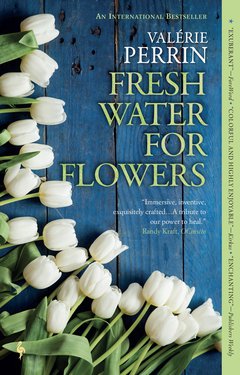 And then, just like the cemetery cats, the sun reached as far as my room, reached under my sheets. I opened the curtains, and then the windows. I went back downstairs to the kitchen, boiled the water for the tea, and aired the room. I finally returned to the garden. Finally gave fresh water to the flowers. I welcomed the families once again, served them something hot and strong to drink.
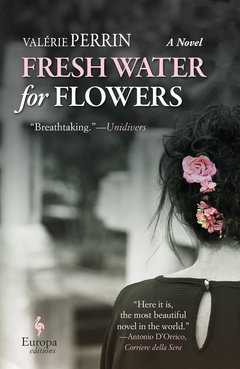 It isn’t that Violette isn’t warm or compassionate: reflecting on the demands of her strange job, which include assisting and often comforting those who come to bury or visit their loved ones in the cemetery she oversees, she says “for a woman like me, not feeling compassion would be like being an astronaut, a surgeon, a volcanologist, or a geneticist. Not part of my planet. Or my skill set.” She has been “destroyed,” though, and as a result has retreated into herself, leaving love and happiness to others—until things change and she resolves that “unhappiness has to stop someday,” even unhappiness stemming from a grief as intense as hers for her dead daughter Léonine.
 As a cemetery keeper, Violette is surrounded by other people’s death and mourning: a connoisseur of funerals, she believes you can understand and maybe even judge someone’s life by the send-off they get. She records every one in her notebook: the weather, the coffin, the flowers, the family and friends, the speeches. She knows her quiet neighbors’ birth and death dates and often much of the story of what came in between; she tends affectionately to their graves, watering, weeding, cleaning. Her work and thus the novel is a provocation to think about the many ways people live and then die. “Death,” as Violette observes
 It’s a long list, two pages, and even though it’s not Owen’s list, I couldn’t (can’t) stop crying as I read it, because it’s so true that part of what you are grieving is that future, the one you pour your hope, your effort, your time, your love, your heart into as a parent. Thankfully, Perrin avoids easy, inadequate clichés about consolation, the kind of implicit or explicit messages that hurt rather than help. There is no
 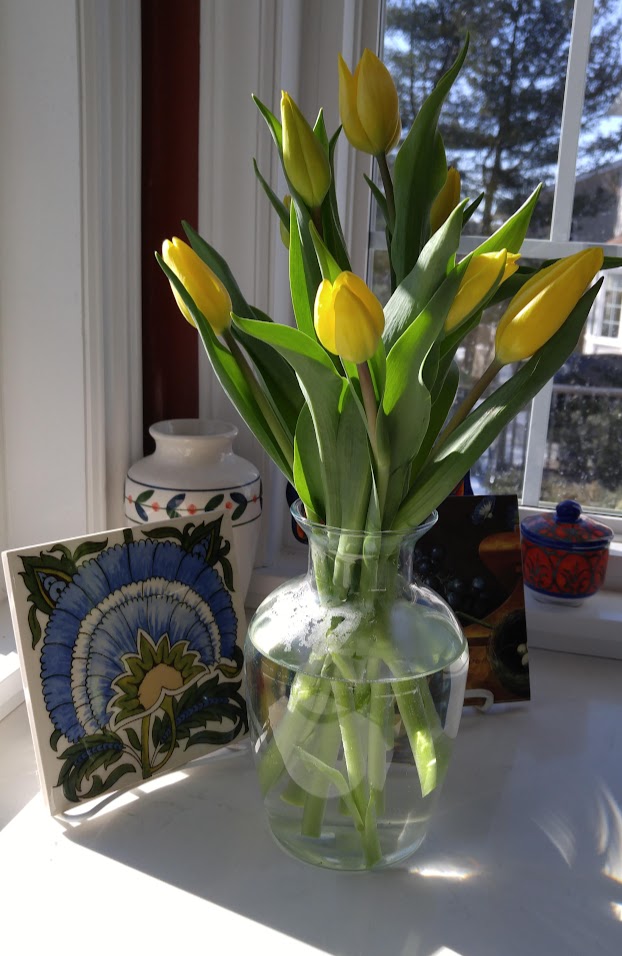 In fact, there’s quite a lot going on in Fresh Water for Flowers, and although overall I really enjoyed the novel, I did wonder sometimes if it needed quite so many elements. Violette seemed like enough to me, although I suppose it would be harder to appreciate the journey she makes from death back to life without the rich ambience the novel provides, in which life and love and loss and death and humor and tragedy and pain and beauty are constantly mingling and the sheer variety of human character and experience is a recurrent motif. Every chapter begins with what I saw as epigraphs, but which are referred to in the discussion questions at the end of the novel as “epitaphs,” which surprised me and then made perfect sense, even though many of them are not quite the kind of thing you’d actually carve on a tombstone. It’s a novel that immerses us in death, but in the spirit of inviting us to think about life. Violette’s specific path from the darkness back into the light felt a bit pat to me, a bit too easy and romantic, but maybe that’s what novels are for, at least some of the time. In the book of life, after all, as the epigraph / epitaph for Chapter 5 reminds us,
 Novel Readings