She wanted more than anything to be Dawnged to her mother now: a gift, a blessing. She was tired of striving, tired of the sideways look of those who did not trust her. She wanted to belong; to sit before the hearth and dip soup from the hanging bowl, or sit cross-legged before her mother who perched on a stool that she, her daughter, had made, to hear Elen use her name, Peretur . . .
I loved Nicola Griffith’s Hild, so I ordered Spear as soon as it was available last year and started reading it as soon as my copy arrived — only to find myself bogged down in, rather than entranced by, the language. Where Hild invited me to luxuriate in its vivid exposition and lured me through its sometimes bewildering complexity with its powerful characterization of Hild herself, Spear seemed mannered, even portentous, at first:
So it was that her mother, to keep the girl interested, taught her the language of books, and with great reluctance showed the girl her chest of scrolls. “These are tales of the world,” she told her. “All the adventure, all the different and new you need.” The tales of heroes and great deeds, and the riddles and tragic tales, did interest the girl, but many were stories of how to bind a wound and grow a garden, how to husband a flock and dress a fresh-killed fowl, and she already knew these things. And all the people in the stories had names, and she did not; and she would never find her name here in the cave.
I gave up on Spear last year, but I came back to it this weekend and it went much better, though I never quite lost the sense that there was too much artifice in its style, and also that it is as much the working out of a concept as the realization of a fiction with its own organic necessities.
The concept is explained in some detail in the Author’s Note at the end: it is Griffith’s contribution to Arthuriana, her own version of the story of Percival. Like Hild, Spear is thoroughly researched — not just the other versions of the Arthurian legend but also the “material culture” of the period in which Griffith places her story, the early 6th century. You can see the results in her description of Caer Leon, which has the same tactility as the more abundant exposition in Hild:
In the inner fort was the king’s hall and byre, lesser buildings for the Companions and their folk, for many had wives and, some few, children; there was a well, bread ovens, a granary, may small plots for fresh herbs, a still room, and food cellars dug deep in the dirt. A rooster crowed; a chicken, still half asleep, pecked; soon geese would waddle and the goats come pitter-pat to the midden to chew side by side, staring with their yellow, slot-centred eyes.
 Griffith brings the same dedication of detail to the fight scenes, which are brutal but also fluid in a way that reflects Peretur’s mystical connection to nature and especially to animals, including the horse she rides in a dramatic test bout with Lanza (better known to most of us as Sir Lancelot). And she brings a commitment to another kind of historical accuracy: inclusion. “This could not be a story of only straight, white, nondisabled men,” she explains;
Crips, queers, women and other genders, and people of colour are an integral part of the history of Britain — we are embedded at every level of society, present during every change, and part of every problem and its solution. We are here now; we were there then. So we are in this story.
This presence is embodied in Peretur herself, who passes as a man and fights as a knight but is a woman and loves women, especially Nimuë, the Lady of the Lake. Griffith also revises key conventions of the heroic quest plot: “her real goal is connection.”
There’s plenty of drama in Spear as Peretur faces antagonists from bandits to supernatural agents. Because it’s novella length, it moves very quickly through the action, and as a result the personal relationships meant to give it emotional depth — particularly with her mother but, in some ways more urgently, with Nimuë — felt underdeveloped, too thin to do the affective and thematic work they seemed meant to. And to the end I could not shake my slight dissatisfaction with the prose. I think Griffith may have been deliberately aiming for a cadence that would sound faintly archaic, to give us the feeling that we were dipping back into legend:
And so between them Nimuë and Myrddyn found the stone and the sword, and one day she looked deep into him and saw all that he had done, and would do with the power of the treasures of the Tuath.
Maybe this style is typical of fantasy, which is not a genre I typically read; I don’t much like it. But there were also moments of bright simple clarity:
The late afternoon sky over the lake this time was grey, but the water laughed and sparkled, reflecting the blue sky and summer sunshine of some other time and place. Peretur watched the flickers of light and thought perhaps her mother looked down from that place, giving her blessing.
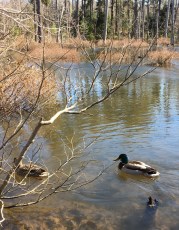 April comes and April goes, whether you want her to or not. In the teaching term, it is always a blur of a month—a bit out of control, like rolling down a hill. I used to welcome the feeling—the exhilaration of finishing up, the anticipation of summer—but this year it is just one more reminder of how relentlessly, and how strangely, time passes.
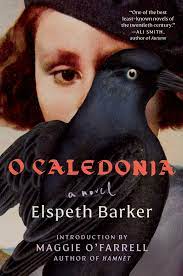 The other books I read all of in April (I’m assuming I won’t finish another one by Sunday) were Elspeth Barker’s O, Caledonia and Martin Riker’s The Guest Lecture. It’s hard to imagine two books with less in common! I enjoyed O, Caledonia a lot, although it is strange and wild and—I thought—a bit random, almost artless: as I read it, I was often surprised, even confused, by it, uncertain why this was what was happening or this particular detail was in it. Yet it felt unified, nonetheless: maybe that strangeness itself unifies it! Its fierce protagonist Janet takes the “not like other girls” trope to an extreme: she’s equal parts compelling and appalling. It has something of the flavor of We Have Always Lived in the Castle.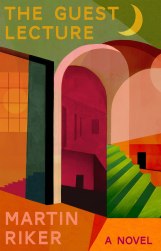
 March was a rough month. For one thing, I had more academic integrity hearings stemming from a single assignment than I’ve ever had in one term. It was an exceptionally disheartening experience, especially given the lengths I have gone to in my introductory class to reduce the risk for students of just trying to do the work for themselves: this is the class in which I’m using specifications grading, meaning there is really no risk involved. As I plaintively reminded the class as it became clear just how widespread the problem was, the class is designed to make it safe to be wrong, safe to be confused, safe to be learning. But if you don’t actually do your own writing, you strip the whole process of its meaning. Plus (as I pointed out to many students in the actual hearings), if your uncertainty leads you to copying other people’s writing, you will never build your own skills and your own confidence: you will never find out that you can in fact do the work, and get better at it.
 Easily the best novel I read in March was Claudia Piñeiro’s Elena Knows. This was recommended to me last year when I was (as I so often am) casting about for new ideas for my two mystery fiction courses. I started it then but had to abandon it, as a novel about suicide and a mother’s grief was not an experience I could bear. I kept it on my mental TBR, though, and I’m glad I tried again, because it really is exceptional: slight but fierce and complex, with its overlapping interests in disability, ageism, misogyny, and autonomy. I think it would be a really interesting book to read in my course on Women & Detective Fiction, even though in many ways it is not really a mystery. It is certainly about a crime – or, crimes, if you think socially and systemically – and there is an investigation, even if there isn’t a detective, or evidence, or any of the other conventional elements.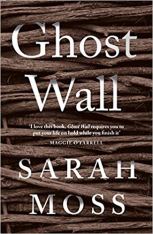
 It has been quiet around here. I’m not really sure why that is. I’ve been busy at work, but that has never stopped me before. When this term began, I intended to make posting about my teaching routine again. When I kept that up, in the old days, it didn’t matter if I felt I had something in particular to say when I started: eventually I would discover what I had to say, because (as I’ve been trying to convince my first-year students) that’s how writing works. My reading hasn’t been going very well, but I used to write about it anyway.


 After I finished Gwendoline Riley’s My Phantoms, I commented on Twitter that I was finding cold, meticulous novels wearing and asked for recommendations of good, recent warm-hearted fiction. Along with the understandable and spot-on nods to writers I already know well (such as Barbara Pym and Anne Tyler), I got a lot of good tips, which I am still working through. Here are the ones I have read so far. I have to say that while they have all been fine, none of them really got much traction with me: I don’t think it is necessarily the case that “warm-hearted” means lightweight, but that’s how these mostly felt. I don’t think I will remember much about them. The exception so far is
 Elizabeth McCracken, The Hero of This Book. I liked this one quite a lot except for the uneasiness it created in me about what kind of book it is, exactly. I realize that is one of the main points of the book, to destabilize assumptions about what constitutes a memoir or a novel or autofiction or whatever. I understood this because McCracken makes rather a lot of noise about it: “What’s the difference between a novel and a memoir?” she asks; “I couldn’t tell you. Permission to lie; permission to cast aside worries about plausibility.” “It’s not a made-up place,” she says about a trip she and her mother make to the theater (or do they?),
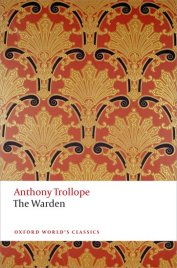 I’ve been ordering next year’s books — not because I’m that ahead of the game in general but because early ordering enables the bookstore to retain leftover copies from this year’s stock and students to get cash back at the end of term if they have books we’re using again. I’m teaching a couple of the same classes again in 2023-24 (my first-year writing class and Mystery & Detective Fiction) and so it isn’t too hard to get those orders sorted out. While I was at it, I thought I’d also make my mind up about which novels I’d assign for the Austen to Dickens course (this year I’m doing Dickens to Hardy — once upon a time I taught them both every year, but now I do them in alternate years) . . . and this has had me thinking about how my reading lists have changed over the past twenty years.
 When I came back to in-person teaching last term, I was wary about going back to pre-pandemic norms. Things in general didn’t really seem normal, after all. So once again I assigned just four novels. OK, one of them was Middlemarch! (But again, I used to assign Middlemarch routinely as one of five or even six.) My impression was that for many of the students, this reduced reading load was a lot — overwhelming, even, for some of them — and so I have ordered just four novels again for next year (although one of them is David Copperfield).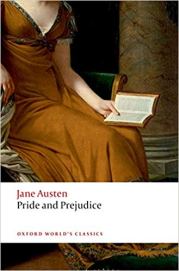
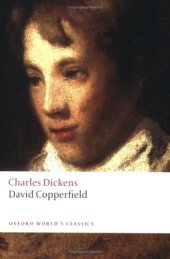 I could still add a fifth book to next year’s list if I want to. So far, I’m committed to Pride and Prejudice, Jane Eyre, David Copperfield, and The Warden. In 2017 I assigned Persuasion, Vanity Fair, Jane Eyre, North and South, and Great Expectations for the same course; in 2013 the list was Persuasion, Waverley, Jane Eyre, David Copperfield, and North and South (I remember that year distinctly, because it was the year of the
  The last train was in forty minutes. I pulled the sleeves of my jacket over my hands and wrapped my arms around myself as I sat on the bench to wait. Eventually, I got up and bought a bottle of sake from one of the vending machines. It was clear and cold, tasting at first of alcohol and something vaguely sweet, before evaporating into nothing. After a while, I was no longer cold, but only very tired. I had one vague, exhausted thought that perhaps it was all right not to understand all things, but simply to see and hold them.


 I read 8.5 new books this month and blogged about . . . none of them? Hmmm. I’m honestly not sure if the fault is mine or theirs. Not one of them lit me up, but that didn’t used to keep me from rambling on about a book! So maybe the problem is what I’m bringing to them as a reader these days—but if so, does that mean my reports on them are unreliable? Who knows? As always, all we can really talk about is our experience of a book.
 Kate Clayborn, Georgie All Along. The long-awaited (well, for at least a year anyway) new romance novel from my favorite contemporary romance author—that is, my favorite author of contemporary romances. I enjoyed it fine but it seemed too much like her other novels and not as good as the earliest ones. They are packed full (almost too full) of details, especially of the kind I learned to call “neepery” (whether it’s metallurgy or home restoration or photography, Clayborn is good at conveying the texture and fascination of people’s interests); they are also quite emotionally intense. This one included some of the same kind of stuff but in a less engrossing way; the characters also seemed too conspicuously constructed, like concepts that didn’t 100% come to life. But I might change my mind on rereading: I had a similar reaction to her previous one, Love At First, but liked it quite a bit more when I went back to it more recently.
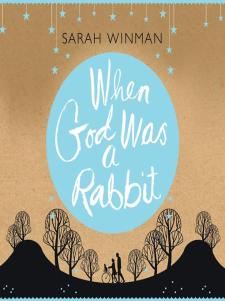 Sarah Winman, When God Was a Rabbit. I happened across this one at a thrift store and grabbed it because I liked Still Life so much. It is not as good as Still Life but it kept my interest from start to finish, which these days is saying something. The narrator’s voice in particular is effective, and I also appreciated the novel’s journey across key events in recent decades, landing on them as events in specific people’s lives. This includes 9/11; I learned from the author’s note that this was a controversial aspect of the novel, which didn’t really make any sense to me.
 Gwendoline Riley, My Phantoms. I didn’t enjoy this at all. I could tell it was “well written,” meaning it has crisp, often resonant sentences and is constructed with conspicuous care. The narrator is unpleasant; the relationship she has with her mother is worse than that. I wasn’t sure what the point of the exercise was supposed to be: it takes about 2 pages to get the gist of how uncomfortable it is all going to be and then it’s just discomfort and nastiness, with a bit of pathos thrown in, for another 150 pages. OK, I exaggerate slightly, but I want this post to serve as a cautionary tale for me: beware Twitter enthusiasm! I have learned not to rush off after whatever mid-century middle European novel from NYRB Classics is currently getting all the buzz, because it will probably just sit unread on my shelves along with Sybille Bedford’s A Legacy. For people who like these kinds of things, these kinds of things are great! (And it’s true that sometimes, a bit to my own surprise, I like them too.) But cold, clinical, forensically observant narrators are not my thing. Gorgeous cover on this edition, though!
 “Start where you are and see where it takes you” is
  There’s so much emptiness in my life now. It’s not just Owen’s death, although every day I confront the ongoing ache and mystery of his absence. Some of it is the ongoing isolation of our COVID-cautious lifestyle: especially as most of the rest of the world seems to be moving on, it feels worse than it did when we were all in it together. Being back on campus and teaching in person helps with that, but it’s not the same as it was: I’m in my office a lot, but mostly with the door closed, because masks are required in classrooms but not hallways and I like to take my own mask off while I work. It’s winter, so the outdoor visits that sustained me through summer and fall are less appealing, as are my long solo walks in the park, when I was alone but, somehow, never lonely. (I often think of Marianne Moore’s line “the cure for loneliness is solitude.”) I could be busier at / with work than I am. I will be, soon, as assignments start coming in, but even so I don’t expect to be even as busy with teaching as I was last term, just because of the nature of my classes this term, the easy familiarity of one and the high degree of automation in the other. There is other work I could be doing, even a writing commitment I should be doing. I can’t seem to summon up much urgency or energy for it, though, or for the book idea I still sort of believe is worth pursuing. I’m not even reading much. I can’t seem to concentrate on most books I try; I don’t seem to like many of them, and it bothers me, worrying that it’s me, not them, that’s the problem.
 Two things I did recently:
  Novel Readings