 In my year-end post last year I remarked that the final months of 2023 had been “frantic.” The reason, as I’ve since explained, is that near the end of that year my husband and I separated, one consequence of which was that we both moved out of the house we’d lived in for over 20 years—which in turn meant I dove headlong into “downsizing,” some of it as rapidly as we could manage together before he moved to North Carolina last December, and the rest on my own, before I moved into my new apartment in February. Yes, that’s a short timeline for changes this big!
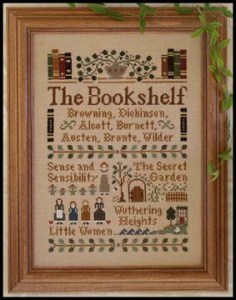
As a result of all of this, in 2024 my relationship to books and reading was unusual in a couple of ways. In the first place, as I moved into a 1-bedroom apartment, I had to confront a significant reduction in shelf and storage space, which meant, one way or another, getting rid of a lot of books. I know many folks online who are really dedicated book collectors—by which I don’t at all mean that they don’t also read their books, but they have extensive and cherished libraries. I have never had quite that relationship with books, more for practical reasons than principled ones, but I have always loved owning books and feel, as I know so many of us do, that my book shelves are in some ways an expression of my self. I also have many books that mean a lot to me for personal reasons, ones inscribed by my mother or my grandmother, for example, or ones that I picked out on my travels, or ones that I have reread so often I can’t imagine who I would be without them. Still, I always tried to be reasonable about how much room I actually had on my shelves (no teetering stacks on the floor for me!), and I regularly rounded up a bag or two to donate to the big book sale that raises money for the symphony, or some nice volumes to trade in at Agricola Street Books, both of which are great ways to maintain what I like to think of as the circle of (bookish) life.
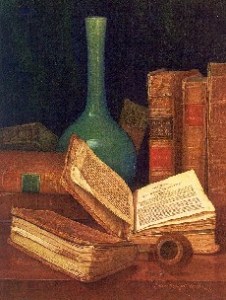 Still, this kind of incidental and largely voluntary pruning is nothing compared to the process I went through before I moved, which was often both logistically and emotionally overwhelming, especially at first. It got a lot easier as it went along, and in some ways it even started to feel good as the burden (literal and metaphorical) lifted. It involved admitting that there were books on my shelves I was never going to read again, and some I was never going to read at all, however good they might actually be (sorry, Europe Central, which took up the space of 2 or 3 other books for over a decade). It involved confronting the truth about dictionaries, desk encyclopedias, the Mayo Clinic Family Health Book, and the rest of our fine “reference” collection: nobody wants them anymore, including me, so their covers came off and their pages went into recycling. It meant carting bags of aging paperback mysteries to the Salvation Army and around 15 boxes of good quality fiction and non-fiction to the book sale depot. Hardest of all, it meant facing Owen’s books, which was particularly poignant for me because so many of them are ones I picked out for him over the years, for birthdays and Christmases. Most of his chess books went to the Dalhousie Chess Club, where he was a regular during his student years, though I kept Bobby Fischer Teaches Chess, his first and favorite book about the game. I kept all of his beloved Calvin and Hobbes collection, and many others that speak to me of the child he was and the young man he became—more than I needed to, maybe, but unlike my own books, his can never be replaced.
In the end I brought around 22 boxes of books with me to my apartment. I still sometimes look for a title only to realize I let it go, but mostly I think I did well: I cleared a lot of space mentally as well as physically. And in fact I cleared enough shelf space that I have room now for more books! I find pruning easier after all of this: my attachment to (most) books is just lighter. Sometimes I even put a book in the ‘donate’ pile as soon as I finish it! I don’t think of those purchases as wasted money. I want bookstores to thrive and authors to make money, after all. My wise sister pointed out once that a paperback is about the same price as a bottle of wine, and we don’t think we’ve wasted that money just because we can drink the bottle up in a single dinner party! And I still keep plenty: any that really hit hard, any that aren’t readily available, any that come with extra sentimental attachments, any that I think I’ll read again, or that I might want to write about.
 So I started 2024 by clearing out a lot of books. The other change since the separation has been to my reading time. I don’t quite understand why, but there seem to be a lot more hours in the day now that I live alone! I have wasted an awful lot of them watching TV, and many of them idly scrolling online, and plenty also just moping or mourning. I think (though this may be just making excuses) that I should not be too hard on myself about these bad habits, as the past few years have been pretty tough and we are all entitled to our coping strategies. I make intermittent resolutions to do better, to use my time better; I have made some of these for 2025. (Yes, blogging regularly again is one of them. We’ll see.) However! I have had more time for reading, and I have sometimes taken advantage of it. I have especially enjoyed taking time to read in the mornings. For many years—around two decades, really—mornings were my least favorite time of the day, what with all the kid stuff (breakfasts, lunches, getting dressed, remembering backpacks and permission slips and other forms, trying to get out the door on time) on top of bracing for my own work days, with the non-trivial (for me) anxiety of driving in winter weather adding a nice additional layer of stress from November through April. Things were simpler once the kids were older then out of the house, but I never felt like it was a good time for relaxing: I still had to get off to work, for one thing. Now, between habitually waking up early and living easy walking distance to work, even on weekdays I can afford to get in some peaceful reading while I have my tea and toast. We used to end most days in front of the TV; I still do that, especially on days when I’ve read a lot for work, but other days I can settle into my reading chair, put on some quiet music, and there’s nothing and nobody to interrupt me.
The combination of chaos and quiet time over this time of significant personal change has meant that overall 2024 was neither a particularly good or a particularly bad year for reading. I don’t think that in total I read a lot more books than usual, though I have never kept count, so I can’t be sure. I read a lot in some months and hardly anything in others. Since this post (which I realize is probably not of much interest—sorry!—I’m trying to recover my willingness to just sit down and write what’s on my mind) has already gone on long enough, I’ll do my usual year-end review of highlights and low points in my next one.
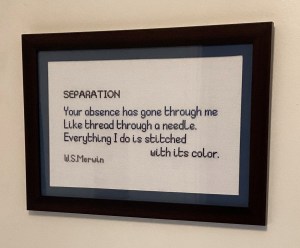
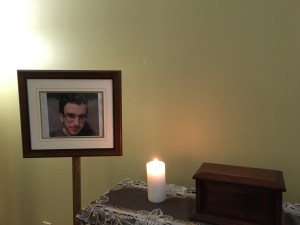 I also remember how angry it made me, in what I now know to call the “acute” phase of grief, to be told “it takes time.” Time for
  Like Riley, whose meditations on grief have been interwoven with my own since almost the beginning, after three years I have nearly stopped writing about it, at least publicly. As I realized long ago, there is a terrible
 She was surprised to find it more or less possible, most of the time, to follow her meal plan: it seemed that perhaps the battle was over, the endgame complete. She had followed the rules all the way to the end, until it was possible to go no further. She had met the experts’ standards until her heart and liver and kidneys failed in quantifiable and quantified ways, until other experts told her that it was time to stop and now, surely, there must be a period of grade, a little mercy.
 That instant, the memory of a long-lost word rises up in her, cut in half, and she tries to grab hold of it. She had learned that, in times past, there had been a word, a Hanja word . . . by which people had referred to the half-light just after the sun sets and just before it rises. A word that means having to call out in a loud voice, as the person approaching from a distance is too far away to be recognized, to ask who they are . . . This eternally incomplete, eternally unwhole word stirs deep within her, never reaching her throat.
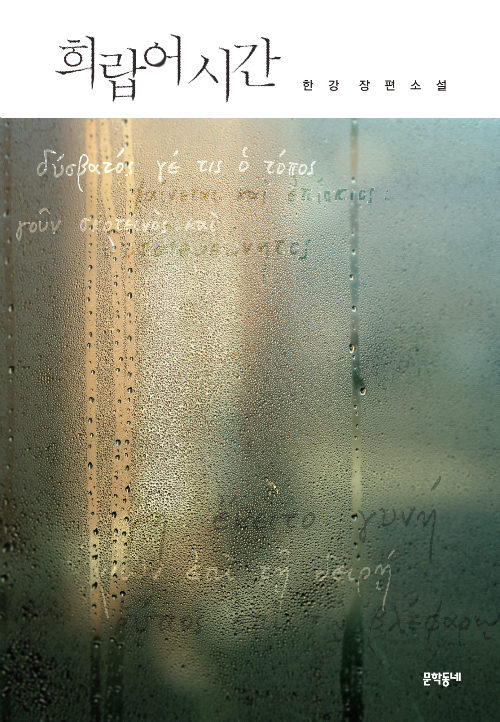 And yet overall I was captivated by Greek Lessons, not so much by its particulars as by the melancholy space it created. Ordinarily I prefer some forward momentum in a novel (both cause and effect of my specializing in the 19th-century novel for so long!). What Greek Lessons offers instead, or this is how it felt to me, is a kind of time out, from that fictional drive and also from the busy world that these days overwhelms us with “content” and noise. In the intimacy of the portrayal of these two people, both of whom are retreating from the world partly by choice but mostly from the cruelty of their circumstances, there is some recognition of how hard it is to be ourselves, to be authentic, to see each other. The quiet sparseness of Han Kang’s writing could be seen as an antidote to the pressure to perform who we are and to insist on making space for ourselves out there. (Pressured by her therapist to break her silence, the woman thinks, “she still did not wish to take up more space.”)
 November wasn’t a bad reading month, considering how busy things were at work—and considering that “work” also means reading a fair amount, this time around including most of both Lady Audley’s Secret and Tess of the d’Urbervilles for 19thC Fiction and an array of short fiction and poetry for my intro class. (I have not managed to get back into a routine of posting about my teaching, but I would like to, so we’ll see what happens next term.)
 I felt the need for something cheering in the wake of The Election and landed on Connie Willis’s To Say Nothing of the Dog: it was a great choice, genuinely comic and warm-hearted but also endlessly clever. I had a lot of LOL moments over its characterizations of the Victorian period, and it is chock full of literary allusions, many of which I’m sure I didn’t catch. A lot of them are to Agatha Christie and Dorothy L. Sayers: who know that Gaudy Night would be one of its main running references. I liked it enough that I’ve put The Doomsday Book on my Christmas wish list, even though I don’t ordinarily gravitate towards this genre.
 I knew I would read Noémi Kiss-Deáki’s Mary and the Rabbit Dream the first time I heard about it. It sounded like exactly my kind of thing: a fresh style of historical fiction, with a strange and subversive story to tell. It was published in the UK by Galley Beggar Press—and maybe that should have been a red flag for me, as they are the publishers and champions of Lucy Ellmann, whose Ducks, Newburyport I have begun three times, never making it more than 30 pages, but more significantly (because I still believe Ducks, Newburyport may be worth yet another try) whose Things Are Against Us I absolutely hated. On the other hand, I didn’t hate After Sappho, which they also published, and I do try, on principle, to push my own reading boundaries. So when Coach House Press here in Canada put out their edition of Mary and the Rabbit Dream, I promptly picked it up and happily began it.
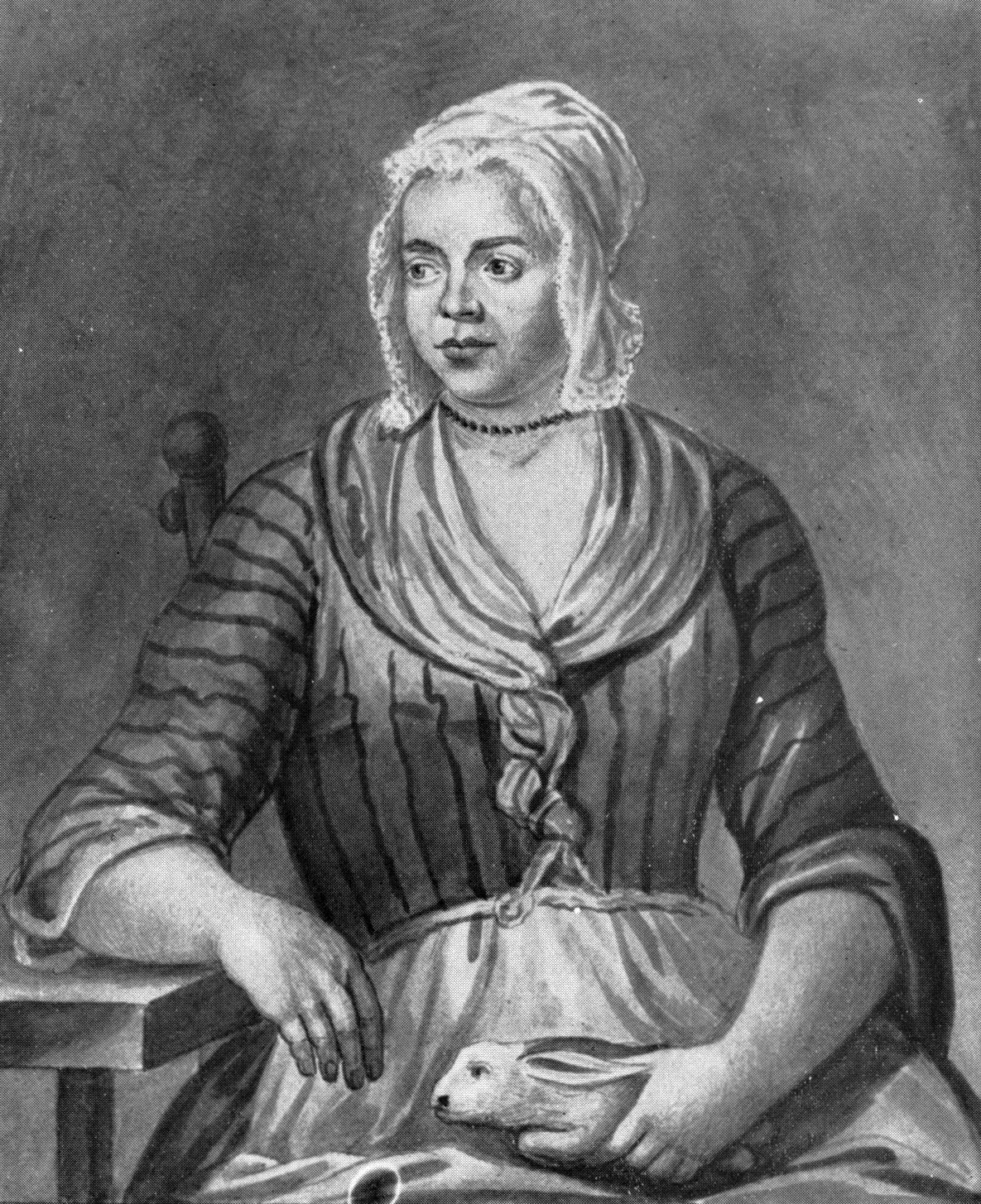 There is a lot that is good and interesting about this novel, especially the way that, while it centers sympathetically on Mary and her experience, it also uses her story as a device to expose the cruelty of misogyny and the punishing self-satisfaction of a certain species of scientific certitude. There is a particularly harrowing scene in which a powerful man, determined to break her and expose her as the fraud he is sure she is, threatens Mary with live vivisection, explaining to her with truly menacing “objectivity” that
 I might have tolerated the long stretches of this kind of stuff better if they hadn’t so often devolved into heavy-handed comments on what is perfectly obvious from the story itself, about how vile and prejudiced and uncaring the men are; or about how unfair the whole system is, especially to Mary (as happens in the example above); or about the symbolic meaning of what is going on. The worst such moment was this one, right after Mary, in excruciating pain and exhausted from relentless examinations, breaks down and begins screaming (“she slips down on the floor, she starts screaming, she screams and screams and screams”):
 Claudia Piñeiro’s Time of the Flies is, like the other novels of hers that I’ve read, a crime novel. Sort of. It is about a convicted murderer, Inés: she killed her husband’s lover, but at the time of the novel is out of prison and making her living running an environmentally friendly pest control business. Then she is approached by one of her clients to provide a deadly pesticide—so that she too can kill “a woman who wants to take my husband the same way yours was taken from you,” or so she tells Inés. Inés, who is not in general a murderous person and who also would very much like not to go back to prison, is tempted only because her friend Manca urgently needs treatment for breast cancer but can’t afford to pay to get it right away. The situation gets more complicated when a connection emerges between the client and the daughter Inés has not seen since her imprisonment.
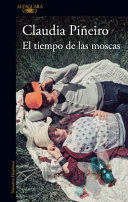 Clearly Piñeiro is doing something experimental here, creating a genre hybrid in a way that is actually reminiscent of Woolf’s The Pargiters, which I’ve been thinking about for some time because I’m fascinated by Woolf’s attempt to combine fiction and non-fiction, story and commentary. Woolf considered it an unsuccessful attempt and gave it up, turning her “novel-essay” into a novel (The Years) and an essay (Three Guineas). Maybe, I found myself thinking as I made my way to the end of Time of the Flies, Piñeiro should have done the same: if she didn’t trust her story to raise these questions for us, to stimulate those debates, she could have written a companion essay, or a different work altogether, leaving us the crime novel we expected when we picked the book up. It’s awkward, distracting, sometimes (to be honest) boring to have the plot, the suspense that Piñeiro is so good at building, constantly interrupted with these more abstract political sections, especially when they take such an uncertain form, voices themselves interrupting each other, offering competing arguments, incorporating references.
 That might be a good explanation for the hybrid nature of Time of the Flies, but it doesn’t necessarily make the book a success. I’d probably have to read it again (and again) to make up my mind about that, which I might do, given that I offer a course called “Women and Detective Fiction.” Last time around I almost assigned Elena Knows for it. Another title I’ve considered for the book list is Jo Baker’s The Body Lies, which is quite unlike Time of the Flies except that it too is a crime novel that turns out to be about crime novels, and especially about the roles and depiction of women in them, the voyeurism of violence against women, the prurient fixation on their wounded or dead bodies, the genre variations that both do and don’t reconfigure women’s relationship to the stories we tell about crime and violence. I thought Baker’s novel was excellent. I certainly didn’t have any trouble finishing it, in contrast to the concerted effort I made to get to the end of Time of the Flies. I really did want to know what happened! But I felt like I had to wade through a lot of other stuff to get there. If I do reread it, maybe that stuff will turn out to be the real substance of the book.
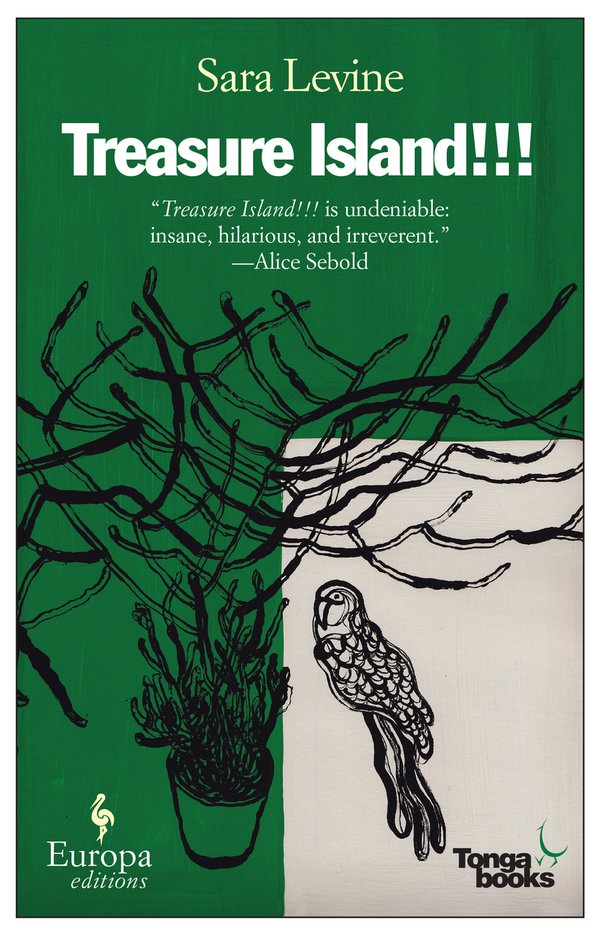 That said, I did quite enjoy Sara Levine’s Treasure Island!!!, which I picked up quite randomly at the library, mostly because it’s a Europa Edition but also because I vaguely recalled hearing good things about it online. It turned out to be a sharp and very funny send-up of the “great literature transformed my life” genre. Its narrator, whose life is in something of a shambles, reads Treasure Island and decides it offers her a template for turning things around. She adopts the novel’s “Core Values”—BOLDNESS, RESOLUTION, INDEPENDENCE, HORN-BLOWING—and applies them to her job (which, improbably and hilariously, is at a “pet hotel,” where clients sign out cats, dogs, rabbits, even goldfish), her boyfriend, and her family, with hilarious if also sometimes weirdly poignant results. I have such a love-hate relationship with books that purport to turn literature into self-help manuals that I relished the premise, but Levine uses it as a launching point for something much zanier than I could possibly have expected or can possibly summarize.