 Claudia Piñeiro’s Time of the Flies is, like the other novels of hers that I’ve read, a crime novel. Sort of. It is about a convicted murderer, Inés: she killed her husband’s lover, but at the time of the novel is out of prison and making her living running an environmentally friendly pest control business. Then she is approached by one of her clients to provide a deadly pesticide—so that she too can kill “a woman who wants to take my husband the same way yours was taken from you,” or so she tells Inés. Inés, who is not in general a murderous person and who also would very much like not to go back to prison, is tempted only because her friend Manca urgently needs treatment for breast cancer but can’t afford to pay to get it right away. The situation gets more complicated when a connection emerges between the client and the daughter Inés has not seen since her imprisonment.
Already, then, we are in what seems like a familiar mix for Piñeiro: women whose troubles and also whose transgressions are partly the result of individual characters and circumstances and partly symptoms of a world in which women are constrained, ideologically as well as socially and economically. What are the limits of justification for striking back against patriarchy, or against the men who embody, however unthinkingly, its privileges and advantages? What counts as a crime in a context that is itself systemically unjust? What do women owe each other, in the name of friendship, or motherhood, or solidarity?
This is promising stuff! But. By the end of the novel, its various strands, though cleverly plotted, did not cohere in a very satisfying way, I thought—but that isn’t what made Time of the Flies a struggle to read. Piñeiro is a good enough storyteller that the parts of the novel taking us through Inés’s decision and its consequences would have kept me engaged, and in fact those parts of the novel did. The challenge is that interspersed with Inés’s story there are long discursive sections made up of this kind of debate, or commentary, or polemic, or analysis: 
Let’s set the insects and fumigations aside for a moment and get to the bigger issue: one woman killing another woman. Are you talking about Bonar or Inés? Bonar wants to do it, Inés already did it. And is the woman being killed just because she’s a woman? No. Yes. Is she the husband’s lover ‘just because she’s a woman’? In a way. Really? Don’t be silly. What are you saying? That it’s not femicide. I don’t agree. Yes, the killer has to be a man. Can’t a woman kill another woman just because she’s a woman? It’s not that I want to pick on men. I just think that if we noticed that women are, on the whole, radically less violent, we might be able to theorise where violence comes from and what we can do about it a lot more productively.* There are violent women. That’s the exception, she said, ‘on the whole‘, didn’t you hear? Inés isn’t violent. But she committed a violent crime: she killed Charo. That’s different. Charo’s death wasn’t femicide. Yes it was. Let’s not get bogged down in a theoretical legal debate when we’re not even the jury. What are we? We’re the chorus. We’re an assembly.
*Rebecca Solnit, Men Explain Things To Me, Haymarket Boks, 2014, p. 24.
Another sample, from near the end of the novel, after the revelation that a key instigation for the client’s murderous intentions is actually her daughter’s transitioning to become a son:
Should we have a go at the issue or just stick to Inés and her poison? What issue? The issue of Timo-Tamara, Tamara-Timo. We address every issue. Not necessarily. But why wouldn’t we address this issue? Because it’s one of the most polarising issues in twenty-first century feminism. We should proceed with caution. We are not cowards. Let’s be careful. I’ll sit this one out. If it’s controversial, all the more reason to debate it. Is it controversial in Latin America, though? Less so, we understand marginality. It has nothing to do with where you are in the world. It would seem that it does at least somewhat. Feminism has to be committed to gender freedom, to radical equality, and to alliances with other minoritarian positions, sexual dissidents. Transphobic feminism is no feminism, that cannot happen.* Are there really people who want to leave trans people out of feminism? Incredible. I can’t believe it. Yes, that’s what they want to do. I think we should take some time to think about it a bit more.
*Judith Butler, from the ‘Pandemia, democracia y feminismo’, Lecture Series, Universidad de Chile.
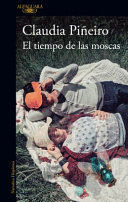 Clearly Piñeiro is doing something experimental here, creating a genre hybrid in a way that is actually reminiscent of Woolf’s The Pargiters, which I’ve been thinking about for some time because I’m fascinated by Woolf’s attempt to combine fiction and non-fiction, story and commentary. Woolf considered it an unsuccessful attempt and gave it up, turning her “novel-essay” into a novel (The Years) and an essay (Three Guineas). Maybe, I found myself thinking as I made my way to the end of Time of the Flies, Piñeiro should have done the same: if she didn’t trust her story to raise these questions for us, to stimulate those debates, she could have written a companion essay, or a different work altogether, leaving us the crime novel we expected when we picked the book up. It’s awkward, distracting, sometimes (to be honest) boring to have the plot, the suspense that Piñeiro is so good at building, constantly interrupted with these more abstract political sections, especially when they take such an uncertain form, voices themselves interrupting each other, offering competing arguments, incorporating references.
Until I copied out these samples, I hadn’t really thought about these as choric. I do find that a useful way to understand their role, and it also helps me appreciate that (I think) Piñeiro is trying to avoid didacticism by presenting topics precisely as debatable, though (as in the section on trans-inclusive feminism above) it is pretty clear that not every issue has, in her view, more than one legitimate side. Clarifying as the idea of a chorus is for the form of these sections, though, it doesn’t help me like them any better as part of my reading experience, which may e my own fault for resisting them as part of the book I thought I was reading. Hey, who spilled their feminist theory all over my mystery novel? But of course a lot of crime fiction has specifically feminist underpinnings, even before they got really explicit with the ‘feminist turn’ in the genre in the 1970s and 1980s. Piñeiro is just going much further, using her crime story as a provocation for feminist analysis.
 That might be a good explanation for the hybrid nature of Time of the Flies, but it doesn’t necessarily make the book a success. I’d probably have to read it again (and again) to make up my mind about that, which I might do, given that I offer a course called “Women and Detective Fiction.” Last time around I almost assigned Elena Knows for it. Another title I’ve considered for the book list is Jo Baker’s The Body Lies, which is quite unlike Time of the Flies except that it too is a crime novel that turns out to be about crime novels, and especially about the roles and depiction of women in them, the voyeurism of violence against women, the prurient fixation on their wounded or dead bodies, the genre variations that both do and don’t reconfigure women’s relationship to the stories we tell about crime and violence. I thought Baker’s novel was excellent. I certainly didn’t have any trouble finishing it, in contrast to the concerted effort I made to get to the end of Time of the Flies. I really did want to know what happened! But I felt like I had to wade through a lot of other stuff to get there. If I do reread it, maybe that stuff will turn out to be the real substance of the book.

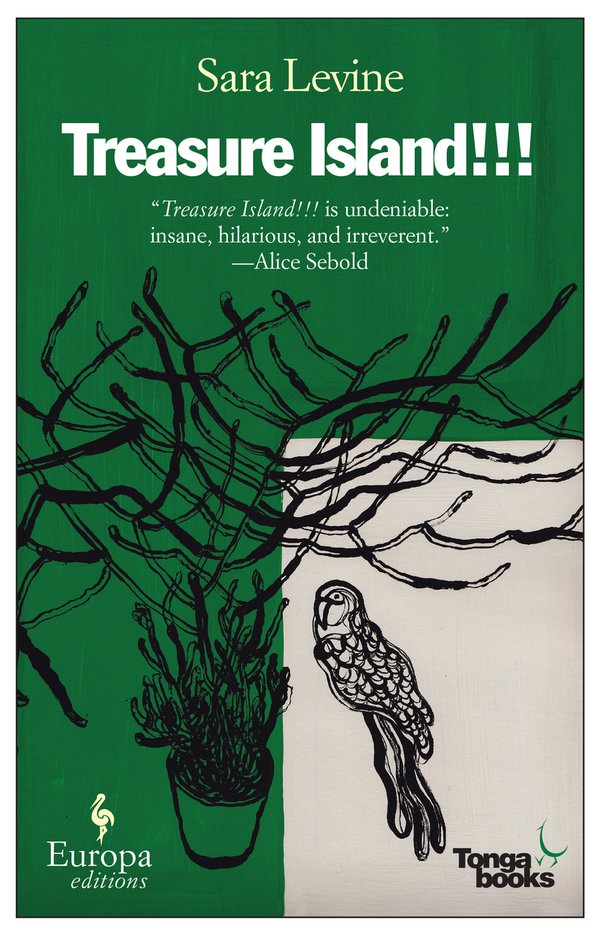 That said, I did quite enjoy Sara Levine’s Treasure Island!!!, which I picked up quite randomly at the library, mostly because it’s a Europa Edition but also because I vaguely recalled hearing good things about it online. It turned out to be a sharp and very funny send-up of the “great literature transformed my life” genre. Its narrator, whose life is in something of a shambles, reads Treasure Island and decides it offers her a template for turning things around. She adopts the novel’s “Core Values”—BOLDNESS, RESOLUTION, INDEPENDENCE, HORN-BLOWING—and applies them to her job (which, improbably and hilariously, is at a “pet hotel,” where clients sign out cats, dogs, rabbits, even goldfish), her boyfriend, and her family, with hilarious if also sometimes weirdly poignant results. I have such a love-hate relationship with books that purport to turn literature into self-help manuals that I relished the premise, but Levine uses it as a launching point for something much zanier than I could possibly have expected or can possibly summarize.
 Like Elena Knows, A Little Luck is a small book that packs a powerful punch. Now that the first impact of reading it has passed, I do find myself wondering: did it earn its effect? Is that even a fair question? But Elena Knows is
 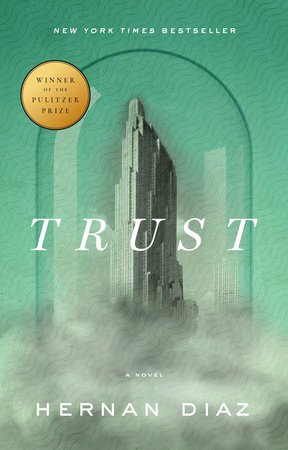 If you’re a friend of mine on social media, it won’t surprise you that Hernan Diaz’s Trust is the first one. It is an inarguably ingenious novel, but I thought (and the other members of my book club agreed) that the payoff for its ingenuity in the second half wasn’t enough to make up for the extraordinary, if self-conscious, dullness of the first half. Even a novel that can only really light up on a second reading can (and, arguably, should) generate some excitement the first time through. For me, a case in point would be
 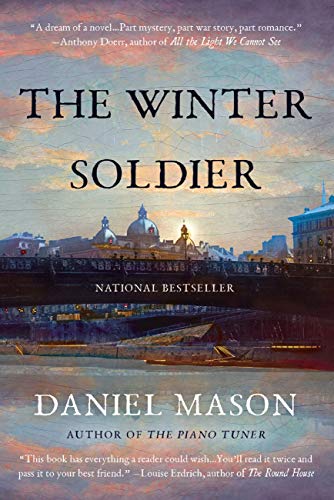 I picked up Daniel Mason’s The Winter Soldier because I’m writing up his latest novel, North Woods, for the TLS and it’s good enough that I wanted to read more by him. The Winter Soldier is quite unlike North Woods, mostly in ways that favor the newer novel—which suggests Mason is getting better at his craft! The Winter Soldier (2018) is a good old-fashioned historical novel. It is packed with concrete details that make the time and place of its action vivid in the way I want historical fiction to be vivid. It takes place mostly in a remote field hospital in the Carpathian mountains during WWI; its protagonist, Lucius Krzelewski, is a medical student rapidly converted to a doctor to serve the desperate needs of the Austro-Hungarian army. His time at the hospital is full of harrowing incidents; through them runs his growing interest in an illness that eludes physical diagnosis and treatment—what today we would call PTSD. There are chaotic battle scenes and idyllic interludes; there’s a love story as well. It’s good! It really immerses you in its world, and (unlike Trust!) makes you care about its characters. I ended it not really sure it was about anything more than that. Novels don’t need to be, of course, though the best ones are. Still, I liked it enough that I will probably also look up Mason’s other novels, starting with The Piano Tuner. North Woods is a lot smarter and more subtle, though. (I am not sure it’s entirely successful: in my review, I will say more about that, when I figure out how to!)
 And then there’s Claudia Piñeiro’s Betty Boo, which I found a really satisfying combination of smart plotting, thoughtful storytelling, and ideas that matter. In some ways it is less ambitious than the other two novels: it is structured more or less conventionally as a crime novel, and there aren’t really any narrative tricks to it, unless you count the sections that are ostensibly written by the protagonist, Nurit Iscar, about its central murder case. Iscar is a crime novelist who has had a professional setback (a crushing review of her foray into romantic fiction) and is currently getting by as a ghost writer. A contact at a major newspaper asks her to write some articles about a murder from a less journalistic and more contemplative perspective; in aid of this mission, she moves into the gated community where the victim lived and died. She ends up collaborating with the reporters on the crime beat as they investigate the death and discover that it is a part of a larger and more sinister operation—about which, of course, I will not give you any details here! Betty Boo is an unusual book: it doesn’t read quite like a “genre” mystery, as it is at least as interested in Nurit’s life and especially her relationships, with her close women friends and her lovers, as it is in its crime story. Also, Betty Boo is about crime, reporting, and fiction as themes, though its attention to these issues is integrated into the storytelling so that it never really feels metafictional—unlike Trust, which is all gimmick and so no substance, Betty Boo seems committed to the value and possibility of substance, even as Piñeiro provokes us to think about the obstacles we face in achieving it, in writing or in life, especially now that the news as a vehicle for both information and storytelling has become so degraded. I appreciated how original Betty Boo felt, and how genuinely interesting it was: I haven’t read another writer who does quite what Piñeiro does, in it or, for that matter, in Elena Knows. Of the three novels I read recently, this is the one I’m most likely to recommend to others, and I’m definitely going to read more of Piñeiro’s fiction, probably starting with A Little Luck, when I can get my hands on it.
 March was a rough month. For one thing, I had more academic integrity hearings stemming from a single assignment than I’ve ever had in one term. It was an exceptionally disheartening experience, especially given the lengths I have gone to in my introductory class to reduce the risk for students of just trying to do the work for themselves: this is the class in which I’m using specifications grading, meaning there is really no risk involved. As I plaintively reminded the class as it became clear just how widespread the problem was, the class is designed to make it safe to be wrong, safe to be confused, safe to be learning. But if you don’t actually do your own writing, you strip the whole process of its meaning. Plus (as I pointed out to many students in the actual hearings), if your uncertainty leads you to copying other people’s writing, you will never build your own skills and your own confidence: you will never find out that you can in fact do the work, and get better at it.
 Easily the best novel I read in March was Claudia Piñeiro’s Elena Knows. This was recommended to me last year when I was (as I so often am) casting about for new ideas for my two mystery fiction courses. I started it then but had to abandon it, as a novel about suicide and a mother’s grief was not an experience I could bear. I kept it on my mental TBR, though, and I’m glad I tried again, because it really is exceptional: slight but fierce and complex, with its overlapping interests in disability, ageism, misogyny, and autonomy. I think it would be a really interesting book to read in my course on Women & Detective Fiction, even though in many ways it is not really a mystery. It is certainly about a crime – or, crimes, if you think socially and systemically – and there is an investigation, even if there isn’t a detective, or evidence, or any of the other conventional elements.
 Novel Readings