
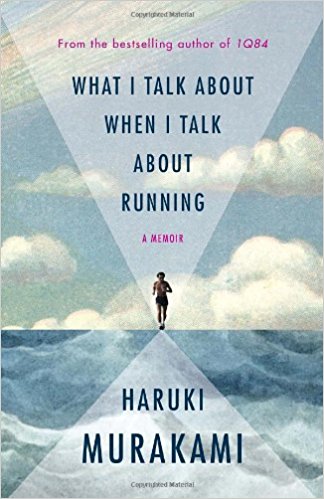
 It turns out I wasn’t entirely wrong to have avoided Haruki Murakami’s What I Talk About When I Talk About Running. A number of people recommended it to me after I posted last week about hoping that I can learn to approach my writing in the same spirit as I do my running: focused on my own goals and the intrinsic satisfaction of reaching them, without comparing myself to others, without feeling inadequate because I don’t run faster or further. I knew Murakami’s book was out there, but because I also knew that he ran marathons, I had figured it would probably provide just one more potentially demoralizing comparison of my own modest efforts to someone else’s much more impressive accomplishments.
To be honest, to some extent that was how I reacted to What I Talk About When I Talk About Running. The book made me feel a little bit defensive, a little bit apologetic, a little bit embarrassed not to be pushing myself harder and achieving more–not just as a runner, but as a writer. After all, it turns out Murakami doesn’t just run marathons: even when he’s not running in races, he runs for hours at a time, and in addition to marathons he also does triathlons. And, of course, he isn’t just an obscure writer puttering away, doing his best and trying to find satisfaction in that, but an internationally renowned, best-selling, prize-winning writer. Gee, thanks, everyone! As if my Salieri syndrome doesn’t flare up enough quite on its own.
That wasn’t the entirety of my response to Murakami’s book, though: there was also a lot about it that I liked. Above all there’s Murakami himself. I was amused and a bit touched by his remark that he thinks most people would not like his personality very much:
There might be a few–very few, I would imagine–who are impressed by it, but only rarely would anyone like it. Who in the world could possibly have warm feelings, or something like them, for a person who doesn’t compromise, who instead, whenever a problem crops up, locks himself away alone in a closet? . . . I just can’t picture someone liking me on a personal level. Being disliked by someone, hated and despised, somehow seems more natural.
Later in the book he describes his own “nature” as “individual, stubborn, uncooperative, often self-centered.” “I’ve carried this character around like an old suitcase,” he goes on,
down a long dusty path. I’m not carrying it because I like it. The contents are too heavy, and it looks crummy, fraying in spots. I’ve carried it with me because there was nothing else I was supposed to carry. Still, I guess I have grown attached to it. As you might expect.
Maybe it’s because I recognize something of myself in these descriptions that they didn’t alienate but rather charmed me. I also appreciated that his self-deprecation doesn’t come in the rather arch form that seems common in some kinds of personal essays these days but instead seemed (surprisingly, given his accomplishments) quite sincere. At one point he describes himself as a teenager staring at his naked body in a mirror and adding up all his (perceived) flaws. His evaluations of his own character here don’t seem immaturely judgmental, the way he now knows that earlier exercise was; it seems as if he has simply assessed himself as honestly and dispassionately as he can and learned to live with what he found.
 In a similar way, he talks about both his running and his writing without flourish or posturing. There’s no false modesty, but also no braggadocio. Further, though he does talk a lot about training and personal bests, he never seems competitive against anyone but himself. He certainly has a different relationship to running than I do, an interest in pushing himself and seeing (literally but also metaphorically) how far he can go as a runner, but he does it because it suits him: for him, it’s a way of expressing himself, not proving anything. In fact, sometimes what he seeks and finds in running is humility: when he feels he has been “criticized unjustly,” for example, he runs “for a little longer than usual”:
By running longer it’s like I can physically exhaust that portion of my discontent. It also makes me realize again how weak I am, how limited my abilities are.
He also believes that for him, running enables writing. Keeping it up has been worth it for him not just for its immediate benefits but because “I like the novels I’ve written . . . and if running helps me accomplish this, then I’m very grateful to running.”
What I Talk About When I Talk About Running is kind of a meandering book: it mixes some memoir with bits of travel writing, thoughts on music, a few practical notes on long-distance running, and some reflections on the writing process. One of the things I liked best about it is that just as I would be getting a bit impatient with details about training regiments or running shoes, Murakami would take a turn through some more metaphysical scenery. The insights he offers aren’t, I suppose, particularly profound or surprising, but he doesn’t present them as if they are: only as if he has thought about them, or they have become clearer to him, and so he’s sharing them. “Exerting yourself to the fullest within your individual limits,” he says, for instance: “that’s the essence of running, and a metaphor for life–and for me, for writing as well.” Or,
For me, running is both exercise and a metaphor. Running day after day, piling up the races, bit by bit I raise the bar, and by clearing each level I elevate myself. At least that’s why I’ve put in the effort day after day: to raise my own level. I’m no great runner, by any means. I’m at an ordinary–or perhaps more like mediocre–level. But that’s not the point. The point is whether or not I improved over yesterday.
 When he talks about writing more directly, he often emphasizes how difficult it is:
Writing itself is mental labor, but finishing an entire book is closer to manual labor. It doesn’t involve heavy lifting, running fast, or leaping high. Most people, though, only see the surface reality of writing and think of writers involved in quiet intellectual work done in their study. If you have the strength to lift a coffee cup, they figure, you can write a novel. But once you try your hand at it, you soon find that it isn’t as peaceful a job as it seems. The whole process–sitting at your desk, focusing your mind like a laser beam, imagining something out of a blank horizon, creating a story, selecting the right words, one by one, keeping the whole flow of the story on track–requires far more energy, over a long period, than most people realize. . . . Everybody uses their mind when they think. But a writer puts on an outfit called narrative and thinks with his entire being; and for the novelist that process requires putting into play all your physical reserve, often to the point of overexertion.
Implicit here is that he means this writer, this novelist, just as when he describes the routines he thinks are essential to success, such as “sit[ting] down every day at your desk and train[ing] yourself to focus on one point,” he means they worked for him. Your mileage may vary, he might have said, if he were offering this advice today! I don’t know if that’s how all novelists work, and since I’m no more likely to attempt a novel than I am a marathon (I think, anyway), I’ll probably never know if that’s what it would be like for me. What he describes is not totally different, though, from what it takes to do even the kind of writing I do, which also requires focus and effort, especially “selecting the right words, one by one.” His fundamental insight, too, is not so different from the one I arrived at in my own minor epiphany, though he seems to live it, while I still aspire to it:
What’s crucial is whether your writing attains the standards you’ve set for yourself. In this sense, writing novels and running full marathons are very much alike. Basically a writer has a quiet, inner motivation, and doesn’t seek validation in the outwardly visible.
 I have often but not always marked the occasion of a new issue of Open Letters Monthly here. The thing about publishing on the first of every month, regular as clockwork, is that it seemed predictable enough that people who cared shouldn’t have any trouble remembering the schedule and finding the new issues on their own! I feel as if I should not let the December 2017 issue go by without acknowledging it, however, because as some of you already know from our announcements on Facebook and Twitter, it will be the last one.
 On that note, I should add that I have no plans to give up Novel Readings, which actually predates my own association with Open Letters Monthly by a couple of years. I moved the blog from its original location to the OLM site in 2010. I always find change difficult, and I remember very clearly how anxious I felt when I made that decision. I feel a bit anxious now too, but as we all know, change is the only real constant! So as OLM winds down, so too will new posting at the OLM address, and this will become the only current home for Novel Readings.
 It’s still a slow and incremental process: I have more than once, in conversation, compared my efforts to build up my portfolio of work and thus my credibility in that role (for which my academic credentials mean relatively little) as being on a hamster wheel. I am very fortunate in that I do not need to depend on the results financially–but at the same time that also means I am doing this work alongside the other demands of my job. I’m increasingly happy with the results, though, especially now that they include a couple of pieces that reflect me more personally–that came out of my own strong interests and let me show a bit more of my own style and personality as a writer.
 In other words, a year after a fairly crushing blow to my career and (not incidentally) my self-esteem, I’m doing OK, even well. (Today was certainly an excellent day! There’s nothing like being included in
 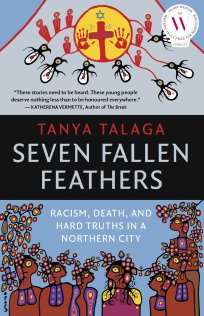 “To understand the stories of the seven lost students who are the subjects of this book,” Tanya Talaga begins her devastating, angry, and thought-provoking book Seven Fallen Feathers: Racism, Death, and Hard Truths in a Northern City,
 Seven Fallen Feathers left me with a lot to think about. Some of my lingering questions are historical or sociological; more reading, presumably, is the next step there. On a more personal level, the book prompted me to reflect uncomfortably on my own education in the B.C. public schools in the 1970s and early 1980s. If you’d asked me then, I would probably have said that we did pay attention to Indigenous history. Mostly, as far as I recall, this took the form of visiting museums with exhibits that included First Nations art, clothing, and tools — the kind of things always on display at the
  In retrospect, I still think some of this early experience was


 I’m trying to move on from
  I had a minor epiphany this morning: I should try to approach writing in the same spirit I approach running.
 I am back from my trip to Vancouver, where in spite of the rain (even, in some ways, because of it) I had a lovely time visiting with family and friends and drinking in the always inspiring sight of the mountains rising above the city and the sea. It was a a welcome interlude between the end of a challenging term and the beginning of a summer of reflection and writing.
 I did get some travel reading done. I’m nervous on planes, so light or fast-paced books are good as my concentration isn’t always great. En route to Vancouver, I found Miranda Neville’s The Amorous Education of Celia Seaton an excellent diversion, and on the way home I alternated between Georgette Heyer’s Black Sheep (reliably amusing) and Adam Sternbergh’s The Blinds, which I’m reviewing for Quill & Quire. I plucked several promising titles off my mother’s well-stocked shelves, but the only one I read cover to cover was
  Though I didn’t manage a lot of good reading while I was away, I did bring back a nice stack of books to read here at home. One ritual my mother and I have on my visits is an expedition to
  Including The Blinds, then, which had been mailed to Vancouver so I could get started on it sooner rather than later, I came home with 8 more books than I left with. And yet wouldn’t you know it: the book I most want to read next turned out to be waiting for me when I got back to Halifax. It’s Marina Benjamin’s The Middlepause: On Life After Youth, a 50th birthday gift which seems like just the right book to help me think about where my own life is now and what I want to make of it next. That is likely, then, to be the next book I write about here.



 ll of these activities and interests infused my listening life. I didn’t have any sense of disdain for whatever the top 100 might be; I just didn’t pay that music much attention. I knew and liked some older stuff: when Simon & Garfunkel did their reunion tour in 1983, for instance, I lined up overnight with a friend to get floor tickets, and enjoyed their B.C. Place concert from our spot maybe 3 yards back from the stage. I got to be good friends with Veda Hille (now
  But there really isn’t a list of 10 albums that for me made up a distinct soundtrack of those years, at least not one that really speaks to who I was. Instead, there are particular songs or albums that now have astonishing power to summon up different periods of my life. It’s remarkable how music can do that, isn’t it? A song comes on and suddenly there you are immersed in a whole set of feelings, as if you are being dunked into a vat of memory. These are often not songs that are personal favorites – what matters is that for some reason they became part of a moment in time for me. I was in the grocery store yesterday, for example, and Billy Joel’s “I’m Moving Out” came over their annoyingly loud sound system — and I was instantly back in the New Kent Hotel in London, where my sister and I stayed at both ends of our 6-month tour of Europe in 1986. (I just looked it up, and what do you know:
  Sarah McLachlans’s “
 Although I listen to music almost all the time now, there’s little that has the same emotional power over me: I have to go deeper into my past to get the same effect. I wonder if it’s just that the more immediate events and their associations haven’t yet distilled into part of my history. There is certainly some music that is fundamental to my life — that I have loved for so long, that has given me so much pleasure, that when I hear it it restores me to myself. At the top of that list would be Joan Sutherland’s 1962 recording of La Traviata: my parents gave me the highlights LP as a birthday gift in 1972 and I cherished it even before I had the honor of getting Sutherland’s autograph on the cover years later. (Richard Bonynge’s autograph is on the back: I still feel a bit embarrassed about how indifferent I was to his offer to sign it too, but I was 9 and Sutherland was my idol.) No piano music has ever displaced Chopin’s in my heart since I first tried to learn some of his easier waltzes as a student: practicing
