I found his scant entry in the ledger almost immediately–it was in my hands, as if I had manifested it, with no knowledge of what came before. The single page dedicated to his reign was now a mess, with marginalia and footnotes added over time as his story retrospectively evolved–was altered, challenged, embellished, struck through, left to rest as one great question mark by people who damned him.
It’s important to say the I cried, I wept, when I saw it. What a reduction of a life.
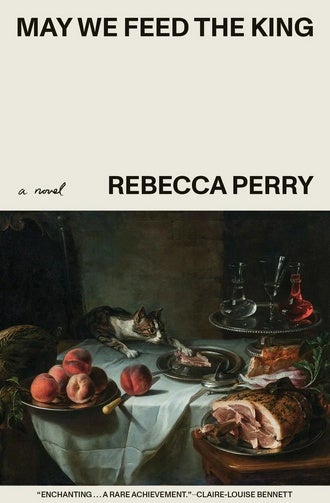
I enjoyed reading May We Feed the King. By the end, though, I was disappointed in it. I didn’t mind that it does not complete the intriguing mystery set up by its ‘historical fiction’ section, which gives us pieces of the life of an unnamed (and unwilling) king whose disappearance remains unexplained. Perry’s reconstruction, both of his story and then, through her present-day narrator, an unnamed curator, of the setting of his final day, allows us to imagine a range of possibilities for it, political, personal, supernatural. But the enigma is the point, as the curator explains to the visitors who come to see the exhibit they have created:
His great gift to us–or at least it has been a gift to me–is the very lack of an ending, that could drive a historian mad. What a great–pardon my language–“fuck you” to everyone who tries to manhandle ambiguity into order, to knock out the air. To the people that have since pinned him down so cruelly and unambiguously on this page. To the notion that one thing leads to another and then another and then done. To the idea that we owe anyone the answers that they seek–for they are theirs alone to find.
The problem I ultimately had is that this unknowability is such an obvious point to make about history, yet Perry seemed to feel she needed to make it this explicitly–even kind of ham-handedly, as when the curator leads the visitors through a painstaking round of questions designed to make the point that historical records reflect specific points of view or biases. I would have liked May We Feed the King better if Perry had let that point just silently underlie her own work: laying out her imagined series of moments and then her curator’s carefully staged reconstructions without the overt lesson. Historiographical metafiction is an old enough genre, a familiar enough concept, that surely readers would get it, and could just have enjoyed the gorgeous tactility of her details and the teasing suggestiveness of her anecdote–and been drawn with her curator completely into the lure of that alternative world, never losing awareness of its artifice–without the primer on the question “So, how do we know anything about history?”
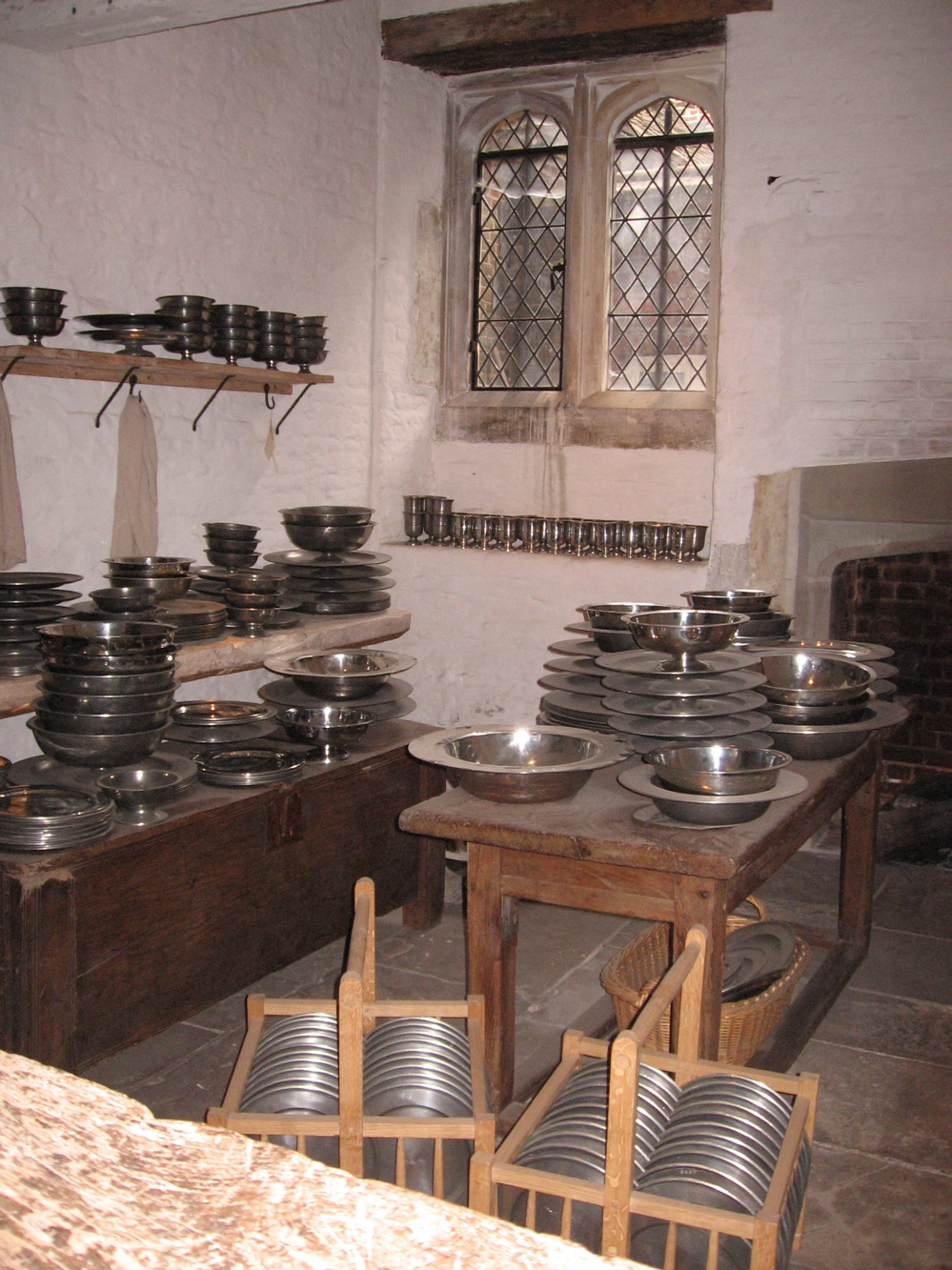
There’s no question that Perry’s way into this question has some specifically interesting features. Who has ever thought much about how those scenes in historical houses and castles are created, where the fake hams and imitation period cooking pots and whatnot come from, what makes one such scene hum with life and another look, well, fake? I have always loved the period rooms in museums; as a child I was thrilled by the section in the Royal British Columbia Museum, now apparently called the “Human History Galleries,” where you could peer into store fronts and smell apple pie baking. The last time I visited Hampton Court, one of my favourite spots was the vast kitchen, with its stacks of pewter dishes. “For me, of all the rooms,” says Perry’s curator, “[the kitchen] is the easiest to animate,” and that makes sense to me.
Though the king’s story is engrossing, by far the most evocative writing in May We Feed the King comes at the end, with the descriptions of the rooms the curator has set up that capture what they imagine it was like on the day of his disappearance, when “a sense of quiet panic is starting to spread through the court, along with many theories about what has happened.” In the Queen’s Parlor, for example, there are two chairs with a small table between them on which “rests an unfinished embroidery,” the blue thread disappearing over the table’s edge:
On closer inspection, the thread is weighted down by the needle, still threaded, which hangs a few centimetres from the floor, occasionally rocked by an otherwise imperceptible movement the air.
From an angle only afforded by standing by the largest window, which looks out over an expansive stretch of lawn bordered by mulberry trees, four screwed-up paper balls of parchment can be seen lying discarded beneath the shadow of the bed, as if thrown.
At a small desk, a quill sits broken in the inkwell, the tip submerged. On a blank sheet of parchment has been placed the dry stem and flower of a lavender plant.
As they send the visitors off to see their meticulously designed exhibit, the curator instructs them to “Listen for everything and, above all, pay attention.” This felt like a direction to the reader as well, and it is impossible, I think, not to approach the rooms as if each carefully chosen and placed element is a clue that will lead us, if we are attentive enough, to the truth about what happened to the king–or, at any rate, to the story the curator has decided to tell. Is this what Perry has done? Is there a hidden truth, revealed but concealed in the manner of a whodunnit, a pay-off for the sufficiently insightful investigator? I came across a review that raised the same question (though now I can’t seem to find it again–if I do I will come back and add a link to it), which made me feel better about being unsure. If there is a “true story” implied in the dioramas, I was not smart enough to detect it. But though I stand ready to be corrected, I don’t think that is the game, if only because it would undermine the novel’s delight in the elusiveness of the past. Rather, I think the game is precisely to tempt us to try to interpret the clues in a definitive way, to turn us into would-be historians naive enough to think there is a true story just waiting for us if we can stare hard enough at the evidence we have. The quest for access to the past can be obsessive, romantic, transporting, even revelatory (for the curator, it is all of these things), but what we come up with will always be a kind of mirage or deception, the imposition of narrative on the disorder of remnants.
This brings me back to my dissatisfaction, which may be unreasonable, but isn’t unfounded. I read The Daughter of Time in sixth grade, after all; I wrote my Honours essay under the influence of Hayden White and Louis O. Mink; I’ve read The French Lieutenant’s Woman and Possession and Ana Historic. I didn’t find May We Feed the King very original, at the level of ideas about history and fiction, or historical fiction, or (again) as historiographical metafiction. I couldn’t help but puzzle over the rave reviews that seemed so stunned by its whole concept. But I did find its approach to that concept by way of wax fruit and imitation chicken legs original and its execution (except for that surprisingly banal lecture interlude) impeccable, even at times poetic. And I did really want to know what happened to the king! In that sense, the novel perfectly enacts the very illusion it so artfully exposes.


I’ve borrowed this from the library so I’ll read your review later. But I will say that though I found Death of an Ordinary Man to be a wise and thoughtful book, I was not impressed by Melmoth so I’m not expecting much.
LikeLike
Different Perry. 🙂
LikeLike
Oops. *chuckle* So I may be pleasantly surprised!
LikeLike