 Claudia Piñeiro’s Time of the Flies is, like the other novels of hers that I’ve read, a crime novel. Sort of. It is about a convicted murderer, Inés: she killed her husband’s lover, but at the time of the novel is out of prison and making her living running an environmentally friendly pest control business. Then she is approached by one of her clients to provide a deadly pesticide—so that she too can kill “a woman who wants to take my husband the same way yours was taken from you,” or so she tells Inés. Inés, who is not in general a murderous person and who also would very much like not to go back to prison, is tempted only because her friend Manca urgently needs treatment for breast cancer but can’t afford to pay to get it right away. The situation gets more complicated when a connection emerges between the client and the daughter Inés has not seen since her imprisonment.
Already, then, we are in what seems like a familiar mix for Piñeiro: women whose troubles and also whose transgressions are partly the result of individual characters and circumstances and partly symptoms of a world in which women are constrained, ideologically as well as socially and economically. What are the limits of justification for striking back against patriarchy, or against the men who embody, however unthinkingly, its privileges and advantages? What counts as a crime in a context that is itself systemically unjust? What do women owe each other, in the name of friendship, or motherhood, or solidarity?
This is promising stuff! But. By the end of the novel, its various strands, though cleverly plotted, did not cohere in a very satisfying way, I thought—but that isn’t what made Time of the Flies a struggle to read. Piñeiro is a good enough storyteller that the parts of the novel taking us through Inés’s decision and its consequences would have kept me engaged, and in fact those parts of the novel did. The challenge is that interspersed with Inés’s story there are long discursive sections made up of this kind of debate, or commentary, or polemic, or analysis: 
Let’s set the insects and fumigations aside for a moment and get to the bigger issue: one woman killing another woman. Are you talking about Bonar or Inés? Bonar wants to do it, Inés already did it. And is the woman being killed just because she’s a woman? No. Yes. Is she the husband’s lover ‘just because she’s a woman’? In a way. Really? Don’t be silly. What are you saying? That it’s not femicide. I don’t agree. Yes, the killer has to be a man. Can’t a woman kill another woman just because she’s a woman? It’s not that I want to pick on men. I just think that if we noticed that women are, on the whole, radically less violent, we might be able to theorise where violence comes from and what we can do about it a lot more productively.* There are violent women. That’s the exception, she said, ‘on the whole‘, didn’t you hear? Inés isn’t violent. But she committed a violent crime: she killed Charo. That’s different. Charo’s death wasn’t femicide. Yes it was. Let’s not get bogged down in a theoretical legal debate when we’re not even the jury. What are we? We’re the chorus. We’re an assembly.
*Rebecca Solnit, Men Explain Things To Me, Haymarket Boks, 2014, p. 24.
Another sample, from near the end of the novel, after the revelation that a key instigation for the client’s murderous intentions is actually her daughter’s transitioning to become a son:
Should we have a go at the issue or just stick to Inés and her poison? What issue? The issue of Timo-Tamara, Tamara-Timo. We address every issue. Not necessarily. But why wouldn’t we address this issue? Because it’s one of the most polarising issues in twenty-first century feminism. We should proceed with caution. We are not cowards. Let’s be careful. I’ll sit this one out. If it’s controversial, all the more reason to debate it. Is it controversial in Latin America, though? Less so, we understand marginality. It has nothing to do with where you are in the world. It would seem that it does at least somewhat. Feminism has to be committed to gender freedom, to radical equality, and to alliances with other minoritarian positions, sexual dissidents. Transphobic feminism is no feminism, that cannot happen.* Are there really people who want to leave trans people out of feminism? Incredible. I can’t believe it. Yes, that’s what they want to do. I think we should take some time to think about it a bit more.
*Judith Butler, from the ‘Pandemia, democracia y feminismo’, Lecture Series, Universidad de Chile.
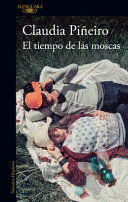 Clearly Piñeiro is doing something experimental here, creating a genre hybrid in a way that is actually reminiscent of Woolf’s The Pargiters, which I’ve been thinking about for some time because I’m fascinated by Woolf’s attempt to combine fiction and non-fiction, story and commentary. Woolf considered it an unsuccessful attempt and gave it up, turning her “novel-essay” into a novel (The Years) and an essay (Three Guineas). Maybe, I found myself thinking as I made my way to the end of Time of the Flies, Piñeiro should have done the same: if she didn’t trust her story to raise these questions for us, to stimulate those debates, she could have written a companion essay, or a different work altogether, leaving us the crime novel we expected when we picked the book up. It’s awkward, distracting, sometimes (to be honest) boring to have the plot, the suspense that Piñeiro is so good at building, constantly interrupted with these more abstract political sections, especially when they take such an uncertain form, voices themselves interrupting each other, offering competing arguments, incorporating references.
Until I copied out these samples, I hadn’t really thought about these as choric. I do find that a useful way to understand their role, and it also helps me appreciate that (I think) Piñeiro is trying to avoid didacticism by presenting topics precisely as debatable, though (as in the section on trans-inclusive feminism above) it is pretty clear that not every issue has, in her view, more than one legitimate side. Clarifying as the idea of a chorus is for the form of these sections, though, it doesn’t help me like them any better as part of my reading experience, which may e my own fault for resisting them as part of the book I thought I was reading. Hey, who spilled their feminist theory all over my mystery novel? But of course a lot of crime fiction has specifically feminist underpinnings, even before they got really explicit with the ‘feminist turn’ in the genre in the 1970s and 1980s. Piñeiro is just going much further, using her crime story as a provocation for feminist analysis.
 That might be a good explanation for the hybrid nature of Time of the Flies, but it doesn’t necessarily make the book a success. I’d probably have to read it again (and again) to make up my mind about that, which I might do, given that I offer a course called “Women and Detective Fiction.” Last time around I almost assigned Elena Knows for it. Another title I’ve considered for the book list is Jo Baker’s The Body Lies, which is quite unlike Time of the Flies except that it too is a crime novel that turns out to be about crime novels, and especially about the roles and depiction of women in them, the voyeurism of violence against women, the prurient fixation on their wounded or dead bodies, the genre variations that both do and don’t reconfigure women’s relationship to the stories we tell about crime and violence. I thought Baker’s novel was excellent. I certainly didn’t have any trouble finishing it, in contrast to the concerted effort I made to get to the end of Time of the Flies. I really did want to know what happened! But I felt like I had to wade through a lot of other stuff to get there. If I do reread it, maybe that stuff will turn out to be the real substance of the book.
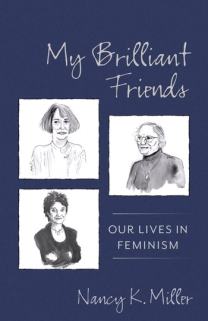
 A lot of things about My Brilliant Friends really interested me. The friendships Miller is reflecting on were with Carolyn Heilbrun, Naomi Schor, and Diane Middlebrook: all four of them are big names, renowned scholars of the generation that basically pioneered feminist literary scholarship in the American academy in the later 20th century—and thus the generation that laid the groundwork for my own education as a feminist critic. I’ve written here before about the influence of Heilbrun
  At its heart, though, My Brilliant Friends is really about more personal things than that (again, I think Miller might reply that the personal and the academic are not really so separable, or shouldn’t be). I found I wasn’t always able to be as interested as I wanted to be in the details. The Heilbrun section was the easiest one for me to engage with, because I have a relationship of my own, however indirect, with its subject. Miller’s thoughts on her friendship with Naomi Schor (a relationship which was long, complex, and of intense interest and significance to her) left me mostly unmoved, a detached spectator to the emotional intricacies of its ebb and flow. Of her three main subjects, I knew the least about Diane Middlebrook when I started the book; for some reason she came more vividly to life for me than Schor did, through both Miller’s recollections and her own letters. She sounds wonderful: she possessed, Miller says, “the art of making her friends feel loved and appreciated.” Theirs was a friendship formed relatively late in life, and I found Miller’s reflections on the different bases on which such belated bonds are formed really thought-provoking, especially as I have spent so many years distant from the very dear friends I made in my younger years.
 Death is the occasion for the book. Middlebrook died of liposarcoma, which she was diagnosed with not long after she and Miller met; Schor suffered a cerebral hemorrhage at only 58, which, Miller remarks, “while not a tragically young age, is young enough to feel untimely.” Heilbrun, of course, committed suicide: though a relatively small part of the book as a whole, the other women’s reactions to her choice are among the most thought-provoking moments, because they are tied up with their deepest convictions about autonomy, especially for women, as well as with their thoughts about living, aging, and dying. Miller quotes from an exchange about Heilbrun’s death between Middlebrook and Elaine Showalter (another accomplished and very influential feminist scholar of this generation, of course, and another whose work has played a large part in my own scholarly life—her book A Literature of Their Own was the first book of literary criticism I ever bought for myself, when I was just starting down this academic path). Middlebrook argues that the suicide was an act “taken on behalf of what she valued in herself, which was her independence,” while Miller sides with Showalter, at least emotionally, that while the death itself may have been a legitimate choice, it was regrettable that leading up to it Heilbrun had (as Showalter put it) withdrawn herself “from life, from the trivial, quotidian treats that gave pleasure, and from the tasks and obligations that give pleasure to others.” (As a side note, I looked up the rest of the Showalter-Middlebrook exchange because it is also a discussion about retirement, something that, while most likely a decade or more away for me, has begun to pose itself to me as a question: not just when, but what. My attention was especially caught by Showalter’s reference to a book that makes the case for “people reinventing themselves after 55. She believes,” Showalter says, “that it is actually necessary to make major life changes at this point, or fade away.” Hmm. That gives me just over two years!)
 It’s not just her friends’ deaths that prompt and shape Miller’s writing: early in her work on the book, she herself was diagnosed with lung cancer. “You discover that your position, secured among the living, is unstable, unsure,” she observes; “You may have imagined yourself safely on the side of the living, and then suddenly … you are on the verge, possibly, of disappearing yourself.” This increases her desire to be “the subject”—”to be in charge of the story even if it seemed I had lost control of the narrative.”
 It’s an aesthetic effect that, when it works, perfectly suits the kind of man Spenser is: a man whose actions, as he says to Susan in Promised Land, speak for themselves. This doesn’t mean he isn’t introspective or capable of nuanced insight. He’d just rather act on what he discerns than spell it out. It’s primarily Susan who encourages him to articulate his life, which I’ve always thought was her primary role in the series — that and providing psychological and emotional support to people caught up in Spenser’s cases who aren’t well served, or sufficiently served, by his decisive but often unconsoling minimalism.
 The case Spenser is involved with here involves a woman, Pamela Sheppard, who leaves her husband for no stronger reason than general dissatisfaction with her marriage. (There turns out to be more awry with her husband than that he doesn’t really see her for who she is, but that’s where she starts.) She ends up falling in with a group of women keen to start a revolution against the patriarchy, and as a result she ends up an unwilling participant in a bank robbery that goes horribly wrong. Spenser is entirely unmoved by her distress:
 On university campuses we hear a lot about innovation these days, from hype about the latest ed-tech fad to proclamations by institutions like my own about fostering a “culture of innovation.” This has got me reflecting on how we define or recognize innovation — something that is not as obvious, I think, as its champions, or as those who insist on it as a measure of academic success, typically seem to assume. In some fields, of course, it’s easy enough to tell when something is new, if it shifts or breaks a paradigm. But in others, context makes all the difference, as my own chequered career as a “thought leader” demonstrates.
 Today, of course, an interdisciplinary degree is wholly unremarkable; Dalhousie even has an entire
  But when I got to Cornell, I discovered that far from being a radical, I was actually a conservative! It turned out that there were some kinds of questions you couldn’t safely ask there, arguments you couldn’t seriously entertain, without undermining your feminist credentials. My first big mistake was giving a seminar paper called “The Madwoman in the Closet”: it queried some then-dominant trends in feminist criticism, particularly in 19th-century studies, and tried (perhaps crudely, but I was a beginner at all of this — and frankly, my somewhat old-fashioned training at UBC had not prepared me well for it) to figure out how politics and aesthetics were getting balanced (unbalanced, I thought, maybe, possibly) in the debates. My professor was keen to have these discussions, but said to me quite frankly that he felt that as a male professor, he couldn’t raise these questions. So I blundered in, and paid the price. I also wrote a more or less positive review of Christina Hoff Sommers’
  Exhibit C: my critical writing. There are many possible angles to consider here, but I’ll focus on my recent work outside of academic publishing, because its status has been much on my mind lately. In a way, the kind of criticism I’ve been doing recently — from book reviews to literary essays — is not innovative at all: it’s the same kind of work everyone else is doing who also writes for newspapers and magazines and literary journals. But from an academic perspective, to be writing for those venues instead of for academic journals is itself innovative: it’s the kind of thing that gets called “knowledge mobilization” or “knowledge dissemination” or “public humanities.” Except that some of these publishing ventures resemble (in style, not necessarily in content) an older kind of literary criticism — a kind some might call belles lettres — which is now considered passé in academic circles. So my recent work could be considered retrograde, not innovative. Except that to break from the conventions of academic writing and try to replicate the best qualities of belles lettres (fine, smart, accessible writing, with its own literary elegance) while still doing criticism informed by decades of academic scholarship … couldn’t that combination of new insights and old forms itself be innovative? Then, what about the content of the reviews and essays? Every new interpretation of a literary text is a critical innovation, isn’t it? So every review of a new book, representing a new intellectual encounter, is intrinsically ground-breaking, even if book reviewing as a form is the oldest kind of literary criticism. What if you make a new critical argument, based on original research, but in an essay outside the norms of academic publishing — if that argument falls in the forest, can anybody hear the innovation? Or what if the argument of an essay is new to one audience but not to another? What is going on then?? Am I doing original work or not???



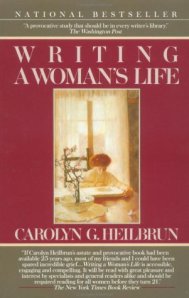 Some time ago one of my most thoughtful readers (hi, Tom!) suggested I write about “a teacher/scholar whose work has had a significant influence on you.” I really liked this idea because, as I said in

 Novel Readings