Sara Paretsky Admires EBB

Here’s a heartfelt, if somewhat unexpected, tribute from one writer to another:

Victorian writers tackled the Angel more creatively. A number, including Elizabeth Barrett Browning and Isabella Bird, took to their beds, but it was Barrett Browning who also first confronted the Angel head on in her 1856 poem, Aurora Leigh. Women may be educated, Aurora scornfully says, “As long as they keep quiet by the fire /. . . their angelic reach / Of virtue, chiefly used to sit and darn”.

A few cantos later, her cousin proposes marriage, telling her to give up her dreams of poetry and support him in his work. Aurora turns him down. Like Aurora, Barrett Browning dedicated her life to her art, but she also had a passion for social justice. When Robert Browning convinced her of his love, she finally rose from her sickbed and ran off with him to Italy, where she devoted the remaining 12 years of her life to her art, to writing and working on behalf of Italian independence and an end to slavery in America — and to her lover.

Perhaps if I’d known of Barrett Browning’s life and work when I was young, I might have pushed aside the Angel’s wings more easily. Like her, I’ve been fortunate in love, but in her courage, her poetry and her dedication to social justice, she sets the bar for me.

I agree that EBB sets a remarkable example, though I have often thought that Aurora Leigh is more equivocal about ‘having it all’ than is often acknowledged: “Art is much but love is more,” Aurora says at one point, though she does go on to love and write.Aurora Leigh is an odd, boring, thrilling, pedantic, erotic poem (yes, all at once) and doesn’t seem to have much in common with Paretsky’s contemporary private eye novels–but on further reflection, both writers are accutely aware that patriarchy (if you’ll forgive an old-fashioned polemical term) is not an individual problem alone but also a systemic one, and both emphasize the need for women to form allegiances with each other (“come with me, sweetest sister,” as Aurora says to Marian Erle). So maybe it’s not that unlikely a pairing after all!

E-Reading Tolstoy

A while back I was wishing I could be reading Tolstoy: Amateur Reading was reporting on Childhood, Boyhood, Youth, while at The Millions, Kevin Hartnett wrote about his experience reading War and Peace:

The night I finished reading about Borodino, it was plainly obvious that I had just read something great.  Yet here I was sitting in a corner of my couch, just the same as I had been an hour before.  I thought about the question with which I opened—what is it that greatness does?  An encounter with greatness, I would say, is like a bright light fixed in time, a marker that defines memory and makes it clearer than it otherwise might have been, that we were here.

I did put my copy of War and Peace out as a promise of good reading to come, but the end of term seemed so far away (seems, as I stare down about 20 more essays and 125 incoming exams)–I couldn’t bear to defer Tolstoy altogether, so I turned to The Death of Ivan Ilych, which I had stored away on my Sony Reader. There’s been a lot of kerfuffle lately about e-readers. I’m not really interested at getting in on that action. I like books, but I don’t consider them all equally collectible, and there are some texts I’m interested in reading that are long out of print. It’s not hard to find Ivan Ilych, but a lot of the other books I’ve put on my reader from Project Gutenberg aren’t so easily found, and if I could find them, they’d weigh a lot more than the Reader–which also has other cool features for academic types. I still love the feel and smell and look of a well-designed book, or a book with a history, but the fundamental reason I pick up a book is to read the words in it. It’s perhaps a little disorienting at first, when you make the shift to e-ink, but once you’re reading, you’re just, well, reading, and it doesn’t get much better than reading this:

Ivan Ilych saw that he was dying, and he was in continual despair.

In the depth of his heart he knew he was dying, but not only was he not accustomed to the thought, he simply did not and could not grasp it.

The syllogism he had learnt from Kiesewetter’s Logic: “Caius is a man, men are mortal, therefore Caius is mortal,” had always seemed to him correct as applied to Caius, but certainly not as applied to himself. That Caius – man in the abstract – was mortal, was perfectly correct, but he was not Caius, not an abstract man, but a creature quite, quite separate from all others. He had been little Vanya, with a mamma and a papa, with Mitya and Volodya, with the toys, a coachman and a nurse, afterwards with Katenka and with all the joys, griefs, and delights of childhood, boyhood, and youth. What did Caius know of the smell of that striped leather ball Vanya had been so fond of? Had Caius kissed his mother’s hand like that, and did the silk of her dress rustle so for Caius? Had he rioted like that at school when the pastry was bad? Had Caius been in love like that>  Could Caius preside at a session as he did? “Caius really was mortal, and it was right for him to die; but for me, little Vanya, Ivan Ilych, with all my thoughts and emotions, it’s altogether a different matter. It cannot be that I ought to die. That would be too terrible.”

Such was his feeling.

Yes, isn’t that just the feeling: “When the commonplace ‘We must all  die’ becomes ‘I must die – and soon,’ then death grapples us, and his fingers are cruel.”

There’s a gristly quality, a toughness, to the story of Ivan’s life (“most simple and most ordinary and therefore most terrible”) and death (“He drew in a breath, stopped in the midst of a sigh, stretched out, and died”). There’s no romance, no sentimentality, and yet in the harsh light Tolstoy shines on this man who lived his life “all wrong,” we also see ourselves and thus, I think, arrive at compassion.

The night I finished reading about Borodino, it was plainly obvious that I had just read something great.  Yet here I was sitting in a corner of my couch, just the same as I had been an hour before.  I thought about the question with which I opened—what is it that greatness does?  An encounter with greatness, I would say, is like a bright light fixed in time, a marker that defines memory and makes it clearer than it otherwise might have been, that we were here.

Speaking of The French Revolution…

…It’s as if the TLS just knew Novel Readings would be talking about Carlyle this week. They’ve posted a lively piece on his French Revolution by Ruth Scurr, described as “an edited version of the introduction to a selection from Carlyle’s French Revolution, published by Continuum later this month.” Like me, Scurr considers Carlyle’s “the most exciting account of the Revolution there has ever been.” An excerpt from the essay:

He has brilliant visual sense, cutting for example, from the flow of blood outside the prison walls to the great Bastille clock in its inner court, ticking at its ease “as if nothing special, for it or the world, were passing!” After the action is all over, he pauses to consider “what precisely these two words, French Revolution, shall mean; for, strictly considered, they may have as many meanings as there are speakers of them”. Carlyle’s answer to this question is revealing of his narrative purpose:

“For ourselves we answer that French Revolution means here the open violent Rebellion, and Victory, of disimprisoned Anarchy against corrupt worn-out Authority: how Anarchy breaks prison; bursts up from the infinite Deep, and rages uncontrollable, immeasurable, enveloping a world; in phasis after phasis of fever-frenzy; – ’till the frenzy burning itself out, and what elements of new Order it held (since all Force holds such) developing themselves, the Uncontrollable be got, if not reimprisoned, yet harnessed, and its mad forces made to work towards their object as sane regulated ones.”

You can read the whole piece here, if you want, but because, inevitably, the best bits are the quotations from Carlyle himself, your best bet for a wild reading experience is really just to go and read The French Revolution.

Imaginative Power: Hilary Mantel, A Place of Greater Safety

safetyGeorge Eliot considered the writing of historical fiction “a task which can only be justified by the rarest concurrence of acquirement with genius,” requiring “a form of imaginative power [which] must always be among the very rarest, because it demands as much accurate and minute knowledge as creative vigour.” Novels of “the modern antique school have a ponderous, a leaden kind of fatuity,” she complained, “under which we groan.” The extraordinary difficulty of the genre is testified to by her own attempt “to reanimate the past” in Romola, the only one of her novels set back more than a couple of generations. She began writing Romola as a young woman and ended it an old one, she said herself, and having worked through the novel recently in my graduate seminar, I know that the effort it demands can make it feel as if it is having the same effect on its readers. To be sure, Romola does have its thrilling moments, and it certainly demonstrates both “accurate and minute knowledge” and “creative vigour”–just not always at the same time, or always in harmony with each other. And there’s the whole “cheese to the macaroni” moment…but I digress from my main point, which is that really good historical fiction is really hard to write, and thus really rare to read.

This brings me, of course, to Hilary Mantel. Like so many others, I admired Wolf Hall a great deal, not least because it was so unlike what I have come to expect of run-of-the-mill contemporary historical fiction. Unsentimental in its approach, economical in its prose, uncannily sideways in its perspective, Wolf Hall evoked the ‘difference’ of the past without condescending to us with faux antiquities or excessive explanation. Its momentum was achieved by Mantel’s gift for the evocative moment or detail, and by her tacit confidence that her reading audience could handle complexity without handholding. Rather than yoking her narrative to one of the reliable moneymakers of the period, she chose a man of  some principle but also much ambition, who not only loves and hates but befriends, alienates, and outmaneuvers. Then she had the courage to portray him as neither the hero nor the attendant lord, but as a man at work and at home, a man being, simply, himself–or, rather, never simply himself but always intensely himself, and thus, in many specific ways, not Everyman, and not us. Mantel’s Cromwell is (in the spirit of, say, Scott’s Fergus MacIvor) a man of his time, shaped and motivated by currents of ideas, by situations, by contexts and opportunities, by values and beliefs, that are not universal. The slight but persistent sense of disorientation created by the odd point of view Mantel adopts for the novel, putting us at Cromwell’s shoulder, in his mind but not of it, helps to keep us at an appropriate distance from that other time towards which we can, after all, only reach out imaginatively but never truly enter. But by not providing elaborate passages of exposition, Mantel also allows us to take that other place for granted, as a reality we can, provisionally, inhabit. We aren’t told about historical trends or events–the shift, for instance, from sacred to secular power–but we are there as they are happening. It’s a risky strategy, a difficult balance: not enough information, after all, and we’d just be confused, but too much information and we might disengage.; not enough excitement or pathos, and we might cease caring, but tip into histrionics and the book’s literary integrity would be compromised. The critical and popular success of Wolf Hall (and sucha long book, too, as so many readers seem compelled to remark!) speaks to Mantel’s achievement.

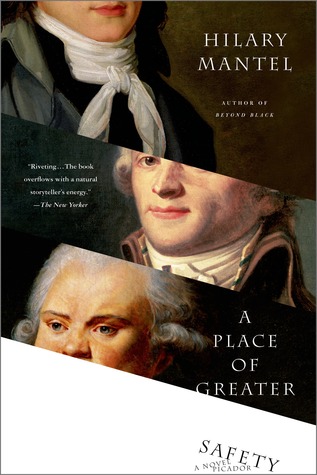
place-safetyMany of the same qualities and techniques are evident in Mantel’s earlier novel A Place of Greater Safety, particularly the lack of sentimentality and the sharpness of the writing, which is at once prolix and poignant, even uncomfortable–if, as I recently suggested, reading Ian McEwan’s prose is like getting acupuncture to your brain, I found reading A Place of Greater Safety akin to walking barefoot across a stretch of gravel towards a graveyard: you aren’t particularly enjoying the experience, but it has its own vividness and particularity, and there’s a morbid fascination in the direction you know you’re headed. (I seem to be finding my reading especially, if only metaphorically, tactile lately.) A Place of Greater Safety also, like Wolf Hall, builds momentum gradually by developing our relationship, with not just one complicated protagonist this time, but with three, the revolutionary triumverate of Georges-Jacques Danton, Camille Desmoulins, and Maximilien Robespierre. Again, there are neither heroes nor villains in this crowd, though each has his heroic, as well as his villainous, moments. (Desmoulins, beautiful, erratic, alternately effervescent and enervated, and writing, always writing, seemed to me a particularly brilliant characterization.) And just as Wolf Hall only incidentally informs its readers about the causes and contexts of the Reformation, A Place of Greater Safety eschews the potential pedagogical role of the historical novel. At the end of its 750 pages I really didn’t feel much better informed about the events or even the political and philosophical stakes of the French Revolution than I was already. Here again, Mantel adopts a slantwise approach: not altogether personal, not just the ‘human story’ of the men and women who lived it, but not abstract, theoretical, or fully contextualized either. Here’s a rare but characteristic ‘explanatory’ passage, terse and ominously proleptic:

Bread is the main thing to understand: the staple of speculation, the food for all theories about what happens next. Fifteen years from now, on the day the Bastille falls, the price of bread in Paris will be at its highest in sixty years. Twenty years from now (when it is all over), a woman of the capital will say: ‘Under Robespierre, blood flowed, but the people had bread. Perhaps in order to have bread, it is necessary to spill a little blood.’

There’s as little exposition here as in Wolf Hall, and the overall impression is one of a great deal going on that wasn’t well understood by, and certainly wasn’t under the control of, even the major participants. But Mantel only very rarely steps in to explain to us what they can’t know, or even, most of the time, what they do know: we get fragments of debates, pamphlets, laws, and contexts, in a kind of swirl of partial information and misinformation. I found this effect frustrating at times: I wanted to know just what the Girondins or the Cordelier Club stood for, what (if anything) was accomplished at and by the Tennis Court Oath or the storming of the Bastille. But it isn’t really a book about that. Though her people are intensely political, the novel is primarily personal, more so than Wolf Hall, with more emphasis on relationships, but without the sentimental premise that, for instance, home is the ‘place of greater safety’–or, if it is so, or if it feels so, that safety is temporary, or illusory. It’s a novel, then about the personal side of politics, or about political personalities, and above all it emphasizes the ways politics, especially revolutionary politics, are ultimately antithetical to personal loyalties. Principles have consequences to which even cherished friendships may ultimately need to be sacrificed. “From now on,” Louis Suleau tells Desmoulins, “personal loyalty will count for very little in people’s lives,” and we feel the inexorable truth of this statement as the Revolutionaries turn, eventually, on each other.
wolf-hallIt’s tribute to Mantel’s peculiar gifts and strategies as a storyteller that she assembles an even less attractive crew here than in Wolf Hall and yet what matters is not how appealing they are but how compelling they are, and how intensely themselves, so that by the final chapter, as the Revolution devours its children, I didn’t care who they were, really, only that they were going to die, after my having known them for so long. Mantel manages their end (known from the novel’s beginning because, after all, it is history) without any of the tumbril sentimentality the inevitable Dickens comparisons on the jacket blurb might lead us to anticipate. None of the characters comes across as heroic or noble, but they have such great vitality (even Robespierre, with his tedious incorruptibility), that their deaths felt like great losses–losses, quite simply, of life, of the energy and lust for life, for words, and for action, that characterized them all. Again, a sample of her terse, epigrammatic style:

There is a point beyond which–convention and imagination dictate–we cannot go; perhaps it’s here, when the carts decant onto the scaffold their freight, now living and breathing flesh, soon to be dead meat. Danton imagines that, as the greatest of the condemned, he will be left until last, with Camille beside him. He thinks less of eternity then of how to keep his friend’s body and soul together for the fifteen minutes before the National Razor separates them.

But of course it is not like that. Why should it be as you imagine?

And the famous final flourish:

He watches each death, until he is tutored to his own.

‘Hey, Sanson?’

‘Citizen Danton?’

‘Show my head to the people. It’s worth the trouble.’

In that predictable Dickens allusion, the Library Journal says he “did it first in A Tale of Two Cities.” But Dickens got his information from an earlier and far, far better, far more revolutionary, account of the Revolution: Thomas Carlyle’s 1837 The French Revolution. There’s no overt reference to Carlyle in A Place of Greater Safety, but I feel Mantel must have read it and learned from it that the only way to approach the reality of that wild, idealistic, turbulent, violent period was through story-telling that itself embraces confusion. Her book is far more orderly than Carlyle’s, of course: you couldn’t write The French Revolution today, I think, and indeed it was rightly felt and understood to be extraordinary in its own time. Just to give a sense of how crazy and yet compelling it is, here’s Carlyle’s version of Danton’s execution:

Danton carried a high look in the Death-cart. Not so Camille: it is but one week, and all is so topsyturvied; angel Wife left weeping; love, riches, Revolutionary fame, left all at the Prison-gate; carnivorous Rabble now howling round. Palpable and yet incredible; like a madman’s dream! Camille struggles and writhes; his shoulders shuffle the loose coat off them, which hangs knotted, the hands tied: ‘Calm, my friend’, said Danton; ‘heed not that vile canaille (laissez la cette vile canaille).’ At the foot of the Scaffold, Danton was heard to ejaculate: ‘O my Wife, my well-beloved. I shall never see thee more then!’–but, interrupting himself: ‘Danton, no weakness!’ He said to Herault-Sechelles stepping forward to embrace him: ‘Our heads will meet there‘, in the Headsman’s sack. His last words were to Samson the Headsman himself: ‘Thou wilt show my head to the people; it is worth showing.’

So passes, like a gigantic mass, of valour, ostentation, fury, affection, and wild revolutionary force and manhood, this Danton, to his unknown home. He was of Arcis-sur-Aube; born of ‘good farmer people’ there. He had many sins; but one worst sin he had not, that of Cant. No hollow Formalist, deceptive and self-deceptive, ghastly to the natural sense, was this; but a very Man: with all his dross he was a Man; fiery-real, from the great fire-bosom of Nature herself.

This is history as philosophy and prophecy, which is not Mantel’s history. Her theory of the revolution, as far as she offers one, is economic (“the price of bread”). But she too feels, or at least conveys, the urgency of understanding that whatever it means, if anything, history is lived (as Carlyle said in another context) “not by state-papers and abstractions of men” but by “very” men.

Bad Writers, Good Books

The invaluable Arts and Letters Daily alerted me to an essay by Sam Schulman at In Character (“A Journal of Everyday Virtues”–really?) on the topic “Good Writers. Bad Men. Does It Matter?” Schulman’s interest is in the relationship between our knowledge of a writer’s life and character, as revealed, for instance, through literary biography, and our estimation of their works:

What does it matter that Larkin sneered in his letters and conversation (fearfully and fretfully, it seems to me) about foreigners and women, that Naipaul made selfish use of people from the beginning of his life, and no doubt continues to do so now?  What does it matter that Dickens knew what it was like to be dependent and abandoned as a boy, but made sure that his wife would suffer the same fate?  It is this.  The weakness of character of Dickens, Larkin and Naipaul comes from the same source that drives their art (in contrast to Cheever’s alcoholism and priapism does not).   What drove the three writers to punish – to hurt quite a few people who were close to Dickens and (if French and Naipaul are right) virtually everyone who came within reach of Naipaul – drove them to their desk every day.  Without Naipaul’s ruthlessness about using others as means not ends, there would be no Naipaul.  And Dickens?  He gave an interview in 1862 to a young Russian journalist named Fyodor Dostoevsky which Slater guesses Dickens thought would never see the light of day:

“He told me that all the good simple people in his novels [like Little Nell] are what he wanted to have been, and his villains were what he was (or rather, what he found in himself), his cruelty, his attacks of causeless enmity towards those who were helpless and looked to him for comfort, his shrinking from those whom he ought to live, being used up in what he wrote.  There were two people in him, he told me: one who feels as he ought to feel and one who feels the opposite.  From the one who feels the opposite I make my evil characters, from the one who feels as a man ought to feel I try to live my life.”

This self-knowledge does not excuse Dickens – or Naipaul – for how they seem to have treated others.   But if we can’t be good – and it seems that we can’t – then it’s not a bad thing to try to make something out of what is missing in us, or at least to see how others do it.  And if we readers are complicitous – well, that’s not a bad thing either.  So I intend to read Naipaul’s “Mimic Men” next, as an exercise in shedding my own more superfluous illusions.

I don’t want to fall into a pattern of excessive self-quotation here, but this topic has been around the lit-blogosphere before, via shocked responses to Dickens’s genocidal response to the Indian Mutiny. I wrote at some (and somewhat rambling) length about the issues raised, in my post “Dickens and ‘The Limitations of Anguished Humanism.'” Here are the main parts of my own answer to Schulman’s question “Does it matter?”

There are a number of issues mingling in these discussions, probably the least interesting of which (from a literary standpoint) is the biographical question of Dickens’s racist / imperialist views. One question is how far admiration of writers’ work commits someone to admiration of the writers personally–or, coming at it from the other direction, whether distaste for a writer’s character (personality, values, politics, etc.) ought to affect our estimation of his or her work. (Do we also wonder whether whole-hearted endorsement of writers’ values or politics ought to motivate us to value their literary productions especially highly? I think we allow, in such cases, for plenty of “yes, but…” responses.) A further question is whether writers’ work inevitably (if not explicitly) reflects or reproduces their stated values, so that if we learn something distasteful about a writer, we should re-examine our understanding of their work expecting to find traces of that quality. If Dickens was racist, is it inevitable that his works are, in some way, also racist? Do we–must we–read them differently once this biographical aspect is known? Does an indictment of Dickens’s ideology lead us towards an indictment of his fiction? The initial Sharp Side post suggests that the answer is yes: that the stance of “anguished humanism” attributed to his novels is inevitably a flawed or inadequate attitude, as we should expect from someone who could express “genocidal” sentiments. So the biographical criticism is meant to affect our literary criticism (at least insofar as that criticism is political). . . .

. . .  I think it would be worth working through [these questions] more patiently with reference to some of the thoughtful contributions made by those working at the intersection of literature and ethics or moral philosophy. . . . In Philosophy and Literature a few years back, for instance, there was a piece by Richard Posner called “Against Ethical Criticism” (21:1, 1997); it was followed by responses from Wayne Booth and Martha Nussbaum, and then Posner’s reply (22:2, 1998). Among the topics they debated were the relevance of an “author’s moral qualities or opinions” to our “valuations of their works” (they basically agree that no, it should not . . . ). Here’s Booth, right on topic:

Should the moral qualities of the flesh-and-blood author affect our evaluation of any work? For example, should a brilliant story celebrating the triumph of compassion be dismissed when we discover that the author actually beats his wife? Should my judgment of the literary worth of the novels by the Marquis de Sade be determined by learning that he committed atrociously sadistic acts, or, in the opposite direction, that Sade could behave generously, however rarely?I hope we would all answer “no.” Moralistic criticism that answers “yes” is dangerous. Authors whose daily behavior is scandalous can compose stories of wondrous moral richness, sometimes actually realizing, as Samuel Johnson liked to insist, their own genuine ethical aspirations better than they ever do in “real life.” As he says, “a man writes much better than he lives.” I love living with the Tolstoy I meet in his novels. But I would certainly not want to live with the man that his mistreated wife had to live with. Does this view of the man change my judgments of War and Peace? Absolutely not. On the other hand, a perfect angel might write a tale exhibiting every conceivable fault, including a lot of ethical balderdash. (“Why Banning Ethical Criticism is a Serious Mistake”)

Readers who can’t reconcile their readerly experience of Dickens via his novels with revelations about his personal prejudices can be helped out with Booth’s idea of the “implied author”: “the full engagement is with the chooser, the molder, the shaper” of the story–”it is that chooser who constitutes the full ethos of any work” and Booth argues (persuasively, I think) that it is “that chooser” with whose ethics we must engage. Of course, the question of whether Dickens’s novels are morally admirable or objectionable begins, not ends, here. Both Booth and Nussbaum provide extensive examples of how we might pursue such an ethical inquiry through attentive reading of literary form, while Posner defends a version of aestheticism according to which “the moral content and consequences of a work of literature are irrelevant to its value as literature” (“Against Ethical Criticism”). (Interested readers will find Booth’s The Company We Keep: An Ethics of Fiction a particularly rich and engaging source of ideas and questions.)

Who Reads Scott Anymore? (A Reprise)

There’s an interesting piece at Standpoint on Scott and historical fiction, by Allan Massie:

I still meet people who read and appreciate Scott, and the splendid new Edinburgh edition of his works has led to a reawakening of academic interest. Yet Woolf was probably justified in saying that he had “entirely ceased to influence” other writers, even 80 or 90 years ago. Certainly, it is likely that none of the authors on the Man Booker list owed him anything, consciously or unconsciously. It was different in the 19th century. Dumas and Hugo in France, Manzoni in Italy, Fontane in Germany, Tolstoy in Russia, and Thackeray — in Henry Esmond certainly and Vanity Fair probably — were all in his debt, as were Stevenson and Buchan in their historical novels. Hugh Walpole, in his Herries chronicles, was one of the last novelists to regard himself as a disciple of Scott. But though he was Woolf’s friend, he knew, to his dismay, that she didn’t think much of his books. (read the rest here; HT 3QD)

He doesn’t mention George Eliot, who famously  wrote that she couldn’t bear to hear a disparaging word about Scott, and whose novels are infused with the same interest in people as embodiments of complex historical conditions. I don’t know if it makes sense to say that contemporary writers don’t owe Scott anything even unconsciously: the genre they work in was surely shaped and formed by him, even if (as does seem likely) they aren’t aware of it.Reading this piece, I was reminded of an earlier post I wrote calling attention to a wonderful essay by Brian Nellist at The Reader Online. Here’s the old post, and then the follow-up with links to the wonderful response at Wuthering Expectations, one of my favourite literary blogs.


I recently came across this article in “The Reader Online” by Brian Nellist, a long-time member of the English faculty at the University of Liverpool (and, among many other things, co-editor of the edition of Margaret Oliphant’s Hester that I recently used in my graduate seminar on Victorian Women Writers). Titled “People Don’t Read Scott Anymore,” the article pushes off from the scene of Mr. Ramsey reading Scott in Woolf’s To the Lighthouse, in which “Charles Tansley their intellectually arrogant house-guest has declared ‘People don’t read Scott any more’ and Mr Ramsey, who does, needs to confirm that what he admires is still alive on the page.” “The answer to Tansley’s taunt,” Nellist proposes,

is experto crede, not ‘Trust the professional’, heaven forbid, but ‘have faith in the man who’s tried it’ and that means because literature allows us all that privilege, ourselves reading.

He follows this up with a fascinating and detailed account of the experience of reading Scott, particularly The Antiquary, the novel Mr. Ramsey is reading in To the Lighthouse. Some samples:

Scott is a historical novelist not mainly because he is interested in inventing a new genre or likes picturesque effects but because the past provides a medium through which he establishes the difference, between himself and the reader together, from the characters (in the whole range of his moods there is no single character who can be identified directly with the novelist himself). This difference does not express the Modernist apprehension of the isolation of personality within its inevitably over-evolved identity but the opposite, a sense that we can after all in part understand lives inevitably beyond our own experience. Scott uses history and picture to maintain his balance between the warmth of knowing where the characters are coming from to admit their inevitable helplessness, and yet preserve a stoical silence over our incapacity to inhabit the same human space. . . .Scott requires of us not that Paterian aesthetic of intensity but a generous acknowledgement of permanent difference to which we are to bring heart and mind in understanding, the older idea of sympathy in fact. Sympathy makes rational objections, moral dissent, even though the text provides a basis for it, an irrelevance in the face of greater considerations: the ‘facts’ are more complex than any ideas we might have about them. . . . Sympathy is the bit of freedom given to the reader when we look at characters who seem, like Scott’s do, so gripped by the circumstances of their lives that their own freedom has been smothered by habit. What is for us the sharpness and individuality of his characters is often for them within the novel a painfully circumscribed identity: we laugh but often they don’t.

The article is well worth reading in its entirety.

And now here’s the question: Is it true that people don’t read Scott anymore? I admit I haven’t read The Antiquary, but I’ve read a modest number of Scott’s novels and until this year have persisted in including Waverley on the syllabus every time I teach the early 19th-century novel course here. My special affection for this smart, funny, poignant, satirical, self-conscious novel was begun and fostered by my studies with Harry Shaw at Cornell, and repeated re-readings and, especially, re-teachings have only enhanced the pleasure I take in it (though, sadly, I can’t be as confident about the pleasure my students have taken in it, though I have found that you can predict someone’s overall success in the course pretty well from whether they ‘get’ the humour in Waverley). My favourite exam “sight passage” (future students take note) is from the end of Chapter 16:

[Waverley] had now time to give himself up to the full romance of his situation. Here he sate on the banks of an unknown lake; under the guidance of a wild native, whose language was unknown to him, on a visit to the den of some renowned outlaw, a second Robin Hood perhaps, or Adam o’ Gordon, and that at deep midnight, through scenes of difficulty and toil, separated from his attendant, left by his guide. — What a variety of incidents for the exercise of a romantic imagination, and all enhanced by the solemn feeling of uncertainty, at least, if not of danger? The only circumstance which assorted ill with the rest, was the cause of his journey — the Baron’s milk-cows! This degrading incident he kept in the background.

Waverley and the excesses and errors of his “romantic imagination” obviously provide much of the comedy, at least for the first two-thirds or so of the novel (along with the Boring Baron of Bradwardine)–I always recommend to my students that they count the number of times “our hero” trips, falls down, or is carried injured or unconscious away from some potentially heroic situation. But the best scene for grasping what I take Nellist to be talking about, in terms of Scott’s engagement with the past, is Fergus’s trial, including Evan Dhu’s heart-stoppingly sincere offer of his life in exchange for his feudal master’s:

Evan Maccombich looked at him with great earnestness, and, rising up, seemed anxious to speak; but the confusion of the court, and the perplexity arising from thinking in a language different from that in which he was to express himself, kept him silent. There was a murmur of compassion among the spectators, from the idea that the poor fellow intended to plead the influence of his superior as an excuse for his crime. The Judge commanded silence, and encouraged Evan to proceed. ‘I was only ganging to say, my lord,’ said Evan, in what he meant to be an insinuating manner, ‘that if your excellent honour and the honourable Court would let Vich Ian Vohr go free just this once, and let him gae back to France, and no to trouble King George’s government again, that ony six o’ the very best of his clan will be willing to be justified in his stead; and if you’ll just let me gae down to Glennaquoich, I’ll fetch them up to ye mysell, to head or hang, and you may begin wi’ me the very first man.’

Notwithstanding the solemnity of the occasion, a sort of laugh was heard in the court at the extraordinary nature of the proposal. The Judge checked this indecency, and Evan, looking sternly around, when the murmur abated, ‘If the Saxon gentlemen are laughing,’ he said, ‘because a poor man, such as me, thinks my life, or the life of six of my degree, is worth that of Vich Ian Vohr, it’s like enough they may be very right; but if they laugh because they think I would not keep my word and come back to redeem him, I can tell them they ken neither the heart of a Hielandman nor the honour of a gentleman.’

There was no farther inclination to laugh among the audience, and a dead silence ensued.

(Haven’t read it? You really should! Here’s an etext, though you’ll probably want an edition with lots of notes.)

Let’s see: I’ve also read The Bride of Lammermoor, The Heart of Midlothian, The Talisman, Kenilworth, Old Mortality, Ivanhoe, and Redgauntlet (on which I actually published an article once). That’s not really very many, considering the man’s vast output, but I’d consider it a good sampling. I am also the owner of a battered copy of Quentin Durward inscribed to my grandfather as a Christmas gift in 1910, from the boys’ school he attended. (I’m guessing that he was more excited about Quentin Durward than he was the volume of Mrs. Hemans’s poems they gave him in 1912 “for good conduct”!)

So, what about it, dear readers (to use a very Victorian address)? Do people read Scott anymore? What Scott have you read, what are your favourites, and what would you say is special about the experience he offers us as readers?


My previous post inspired Amateur Reader to reflect on the joys and challenges of Scott, with engaging posts on The Heart of Midlothian, The Bride of Lammermoor, and Redgauntlet so far:

The word that Scott can’t escape is “slack”. Rarely is he in a hurry to get anywhere, so he requires patience, perhaps too much at times. The story of The Heart of Midlothian is not told with anything resembling efficiency.

But AR acknowledges the charms of Scott’s inefficiencies, giving due attention, for instance, to Madge Wildfire in Heart of Midlothian and Wandering Willie’s Tale in Redgauntlet. I think we agree that there’s more to life than “push[ing] the story forward.” (In a comment at AR‘s place, I tried to imagine Dickens being efficient. Sometimes perhaps writers should do things just because they can–Joe’s hat falling off the mantel in Great Expectations, or the head of Charles I in David Copperfield. Constrain that imagination and maybe you don’t get Krook’s spontaneous combustion, or Miss Havisham and her wedding cake….)

Another interesting comment: “Honor and loyalty – Scott returns to this theme repeatedly. Perhaps one reason we do not read Scott so much now is that our ideas about honor have changed too much since Scott’s time.” Scott isn’t afraid to showcase virtue, either: I’m thinking of Jeanie Deans in The Heart of Midlothian, almost certainly too steadfast to be the heroine of a novel by any other 19th-century novelist.

Still, the evidence of my very small sample (including those commenting at WutheringExpectations) is not overwhelming in Scott’s favour. No question, he’s not a crowd-pleaser, but I’m reminded of the annoying ads for local brewery Alexander Keith’s: “Those who like it, like it a lot!”


Do pitch in with your own thoughts on or experiences with reading Scott–and take note that, as part of the ‘Scottish Literature Reading Challenge’ that Wuthering Expectations is hosting, I’ve committed to reading The Antiquary this summer, because, after all, Viriginia Woolf considers it one of Scott’s best. I’ve also been thinking about The Heart of Midlothian as a candidate for this year’s Summer Reading Project at The Valve (following up on Adam Bede, in 2008, and Villette, last year). It does rather seem to be the Year of Historical Fiction.

This Week in My Classes: ‘Almost Over’ Edition

This is our last week of class meetings before the exam period begins. It seems I may be swimming against the tide in still trying to cover some actual content this week, as I finish up City of Glass in Mystery and Detective Fiction, Atonement in the Brit Lit Survey, and Daniel Deronda in my graduate seminar. But even I am nearly out of new material now and entering into the ‘review and conclusions’ phase. I actually like this phase, as I think it is good for us all to look back over what we have done, or tried to do, and see what sense we can make of it, so it frustrates me that attendance flags for review classes. Ornery to the end, I’m trying to counteract the apparently widespread conviction that the best approach to finishing a class is to stay away from it. I have many devious strategies: for instance, I now distribute the essay questions for the final exam at the review session, usually a list of two or three topics one of which will be the one they ultimately face on exam day. In addition to bringing more bodies into the room for my attempt to draw together the central ideas of the course and offer some kind of closing peroration, this tactic also benefits them, because it gives them structure for their studying and, I hope, reduces their anxiety about the exam (results are better if they are more in control, which I like as much as they do). The down side for me is that I have to think up the exam questions now, instead of two weeks from now when we reach the exam date–but then, overall it’s a zero sum game for me, and right now I’m not also marking papers.

Speaking of papers, one thing we did this week in the survey class was a peer editing session. Over the years my enthusiasm for this process has ebbed and flowed. Sometimes I worry that, no matter how much effort I put into planning the editing worksheet and other preparatory materials, it too often is just the blind leading the blind. And they’re so timid with each other: faced with a paper that has no discernible thesis, so often they politely praise the way it “flows” and tweak a comma here or a word choice there (again, no matter how precise the instructions that tell them, first, never to use the world ‘flow,’ which has no analytical value at all when applied to an argument, and second, that editing is not the same as proofreading). On the other hand, even if the actual editing is not always as stringent and rigorous as would be ideal, it is valuable to expose your work to another reader and get at least some response, just as it is valuable to read another writer and realize how differently someone else may approach the same problem you have been working on. And, whatever else goes on–and these days this is the consideration that trumps all others when I schedule such a session–meeting the requirement that you turn up with a complete draft in hand several days before the deadline means that you do, in fact, have a complete draft several days before the deadline. If you use the great gift you have now been given, namely, time to rethink, reconsider, review, and revise, then it’s all worth it. I know, because my students frankly admit this over and over, that the vast majority of them typically begin writing an essay less than a week before the deadline, maybe even just a day or two. Most of the time, it shows. For instance, if I had a loonie for every time I wrote in my comments that the strongest statement of their argument was at the end of their essay rather than in its introduction, I could, well, not retire, but maybe buy an iPad (if I wanted to, that is). That’s a symptom of the time crunch they are usually in: they haven’t really figured out their argument when they begin writing–which is typical, of course, because writing and thinking go on together–but they haven’t got time, once they’ve figured it out, to rewrite and restructure. Write, print, submit: that’s the usual process.  To be sure, some of those who brought their drafts to Monday’s workshop still won’t care enough to revise before Friday’s deadline. But I’ve had enough students tell me how glad they were not to have handed in that first ‘finished’ version that I think it’s a class hour well spent.

Having confessed last time that I don’t like City of Glass, I should say that I enjoyed Monday’s discussion much more than I expected. Perhaps because I was unfettered by strong commitments to the novel, I roamed a bit wildly around in the questions I put to the class, though I think I did keep us thinking and talking about central issues in the novel, such as identity and naming, or the difference between doing something and pretending to do something. The novel is playful (a bit tediously so, but again, that’s just my taste) about the possibility that identity is, if not wholly arbitrary, at the very least malleable, or interchangeable. Who are we really? What kind of a question is that, anyway? Auster literalizes some of the paradoxical conclusions of post-structuralist theory or post-humanist perspectives, and taken as an intellectual game, it has its entertaining side. The games he plays with the expectations of detective fiction are amusing too, in our context–the expectation that information is relevant, for instance, and can be assembled into meaningful patterns. Many detective novels in fact ironize, or at least thematize, the will-to-order enacted by their form, but they also cater to it by giving us, not (just) random bits of trash but clues, urging us to distinguish red herrings from the real thing and so on, and then offering up the big ‘reveal’ at the end, the promise, as Auster says, of plenitude. So his faux-detective obsessively collects information and finds meaning in it, though the further he goes in his quest the more fragmented, elusive, and ultimately unreliable and meaningless the whole process becomes. In the end, of course, there’s only writing.

The last meeting of the George Eliot graduate seminar was mostly used for discussion of Daniel Deronda, but I asked them also to reflect on the pros and cons of our single-author focus (pros, the consensus seemed to be, included the satisfaction of feeling you really knew a lot and could notice, appreciate, and investigate connections and relationships across the oeuvre; cons included some repetitiousness, as her thematic concerns do have a certain consistency, and also some difficulty appreciating her by contrast, through seeing what other 19th-century novelists did, either with similar themes or plot structures, or with the form of the novel–all fair concerns). It is striking, when you read so many of the novels all in a row, how much they have in common, despite also being so different one from the other (The Mill on the Floss and Daniel Deronda, for instance, don’t sound at all the same, except perhaps in some passages of narrative commentary, and even there, not as much as you might expect). The interplay of egotism and altruism, and the secularization of sacred feelings, seemed to me the strongest continuities. We had some good discussion specifically of the tension some of us felt between the ‘sympathy project’ GE is so palpably and overtly engaged in through the earlier novels and the turn to a more essentialist kind of identification, and to nationalism, in Deronda. Perhaps, as some critics have argued, the Jewish nationalism of Derondashe sh should not be taken too literally but should be understood as an almost metaphorical antedote to the spiritual vacuity of the upper-class English world that makes up the ‘other’ half of this famously dis-unified (or is it?) novel. But that reading is difficult to sustain given the specificity with which Mordecai and then Daniel’s dream of a Jewish homeland is articulated. Of course we had to take some time for Daniel’s mother, too, the singer Alcharisi, whose uncompromising rejection of both Judaism and conventional female roles is at once heroic and tragic, and ultimately, we felt, undermined by the novel, which celebrates all the kinds of feelings she lacks (submission, loyalty, love, faith, altruism). So Gwendolen is chastened, and Alcharisi is like an object lesson (as if we needed one by this time) of the damage GE so insistently suggests is done by those who pursue their own selfish desires. But…(and that’s a frequent turn in working through this novel) she also has lived for art, and the nobility of that vocation is surely one of the novel’s interests. But, again, Mirah is idealized and sings beautifully, not on stage, but in homes. Often in the course we have struggled with the ways GE acknowledges women’s struggles for self-realization but then cuts them off, usually in the interests of realism. Something else seems at stake, though, with Alcharisi: that she should be the character to rail against ‘the slavery of being a girl’ makes such a feminist critique seem not just unattractive but dangerous. I had a terrific group of students in this seminar: smart, engaged, articulate, sincere. In this case at least, I’m looking forward to reading their term papers. I’ve asked them if they would mind my lifting the password protection on our class blog now that they’ve finished their ‘official’ contributions. I think the discussions were consistently lively and interesting, and might therefore be of some interest to other people–who might even be tempted to join in with a comment or two. I don’t know what they’ll conclude about this. Like most academics, they’re a bit shy. Whatever they decide, I think I’m pleased with having required them to maintain a blog rather than, say, to give formal class presentations. Our class discussions were more productive because of it, and they also now have an archive of ideas-in-progress to consult as they work on their essays. The give-and-take of blogging, too, is something I like better than the often stilted experience of presentations, in which one person has thought a lot and the rest of the group tries to catch up and think of something to say. They may disagree, of course: I won’t know until I see their course evaluations!

Saturday Afternoon at the Opera

Joan-Sutherland-005I’ve been an opera lover at least since I was five years old, when I received this LP of highlights from the Sutherland-Bergonzi La Traviata as a birthday present. Of course, I must have been primed for this gift by hearing opera around the house: both of my parents are also opera lovers, and my father in particular cherished the Metropolitan Opera’s Saturday afternoon broadcasts. One of my first school writing projects was a guide to Lucia di Lammermoor (below); see my pithy summary of Act III? 🙂

A major life highlight was going backstage at the Vancouver Opera to meet La Stupenda in person–hence the personalized autograph on the record cover, which is one of the items I would probably take risks for in the event of a fire. I was nine at the time and so overwhelmed by the event that I completely blew off Richard Bonynge, who very courteously hailed me as we progressed down the corridor and offered his autograph as well. “OK, if you want,” was my careless reply–but I suppose he was accustomed to being Mr. Joan Sutherland by then. (Clearly recognizing his place in my pantheon, he signed the back of the record.)LuciaActIII

Predictably, as a teenager I did rebel for a while, not so much against opera, as against other people’s interest in it: I remember sulking about the need to tip-toe around on Saturday afternoons and being obstreperous about being put in charge of recording the occasional broadcast when my parents had to be out. But I (we!) got through that phase, and then I started working part-time at a classical music store, where my operatic know-how was actually an asset (mandatory brush-with-celebrity anecdote: when Goldie Hawn came in the shop–she and Mel Gibson were in town filming Bird on a Wire–I helped her pick out the Bjoerling-de los Angeles La Boheme when she said she was looking for something gorgeous). Initially I was ‘hired’ to do inventory for specific record labels, for which I was ‘paid’ in store credits. My parents are currently storing the archive of LP box sets I accumulated before I was promoted to minimum wage and starting saving money instead.

When, as a university student, I moved into my own apartment, one thing that came with me was the Saturday afternoon ritual. I still have, as a matter of fact, a stash of cassette tapes of broadcasts from that period, including a superb Rigoletto with June Anderson as Gilda. But I reached the pinnacle of my opera-loving career when, as a graduate student at Cornell, I had season tickets to the Met, for the Saturday afternoon performances, no less. I was able to do this because my sister was living in Mamaroneck (you NY types will know just where that is on the Northern Line), so I could take the long bus trip across the Catskills (coming from BC, I didn’t recognize them as mountains the first time) and stay with her for the weekend. I’m not sure there’s a better feeling than coming out of Grand Central Station knowing that you have all morning to roam the city and all afternoon to spend at Lincoln Center–even if it was about $10 to get a coffee at intermission.

Now I live in a city without a full-scale opera company, though our music department puts on some small-scale productions, and now we too are the beneficiaries of the brilliant live broadcasts from the Met. I haven’t been to one here yet, though: apparently the demand is so strong you have to show up at least a couple of hours in advance, and Saturdays are typically busy enough for working parents. Having children of my own, in fact, has changed my understanding of what those broadcasts must have meant to my parents: like reading, listening (at least in any serious way) becomes a rare thing when your children are small. That said, our children too are growing up with opera. We used to soothe–or at least distract–our son after baths (which for some reason he found very traumatic as an infant) by getting out my beloved books of opera songs for voice and piano and going through our favorites as loudly as we could, and my daughter has already sat by and comforted me as I sob my way through the Zeffirelli film of La Traviata. Sometimes it’s best, though, when everyone else is out and I can revert to my childish self. Today, as the spring sunshine streamed in the windows, I took The Art of the Prima Donna from the cabinet and spent my own Saturday afternoon happily at the opera.

I know operatic voices are profoundly personal and not everyone loves Sutherland’s rich tone or joyous facility. They are wrong of course, but that’s OK: some of my best friends (my grandmother, even) have been Callas fans. But to my ear, nurtured on her voice from childhood, there’s just nobody else, at least for certain repertoire. (For Puccini, I’m a Price fan, except when I’m a Caballe fan.) Also, I’m not altogether satisfied with this choice of clip, which doesn’t altogether convey the magic. Still, from me to you, through the magic of YouTube, enjoy.

New at Open Letters Monthly

It occurs to me that the title of this post works in two directions. My original intention was to call attention to the April issue of Open Letters Monthly, which went live this morning and looks, as their new issues always do, full of readerly goodies: John G. Rodwan writes on “Carson McCullers and Her Crowd,” Irma Heldman adds to her series “It’s a Mystery” with a write-up of Erin Hart’s False Mermaid, Ingrid Norton offers a compelling reading of George Eliot’s little-known Gothic novella “The Lifted Veil,” Krista Ingebretson explores some of the complexities of translation as a practice and a genre by way of Edith Grossman’s Why Translation Matters and a recent volume of poetry from the Center for the Art of Translation…and these are only the ones I’ve had a longer look at so far from the typically tempting menu. Also, as always, the cover photograph is stunning. If you haven’t already, click over and have a look around.

But I realized that for those who come by to read Open Letters anyway, Novel Readings itself may also be new. We set moving day for the blog a bit early to get the transition taken care of before the work of preparing the new issue became too intense, so I’ve been part of the OLM blog “family” for a little while now. If you haven’t happened over here before, though, you can look here for my explanation of who I am and what kind of a blog this is.

This Week in My Classes: Eliot, Auster, McEwan

There’s a lot of variety in my classes this week. After a short stint with Tony Hillerman in Mystery and Detective Fiction, we’re starting Paul Auster’s City of Glass on Wednesday. I really enjoy the Hillerman story we discussed, “Chee’s Witch”; it presents, in microcosm, some of the larger themes Hillerman takes up in his novels, about competing systems of evidence and explanation, for one thing–does Chee actually believe there might be a witch? We’ve talked a lot this term about detective fiction as a genre that rules out supernatural explanations (the various rules drawn out in the Golden Age explicitly bar them), but Hillerman plays with this conventional expectation, undermining the classic emphasis on ratiocination but keeping it just ambiguous enough, in the story, that we can believe, if we want to, that Chee never really entertains the witch theory–though he studies to be a medicine man later on, so why should we believe that? What’s at stake? That last question makes for an interesting discussion, anyway, especially when “Chee’s Witch” turns on racist stereotypes. City of Glass also undermines or plays with conventions and expectations of the mystery genre, which is why I include it on the syllabus, though I don’t particularly like it, myself.

In British Literature Since 1800, we’re moving further into Atonement. I thought Monday’s class went really well. I began with some pretty open-ended questions about Briony as a character; participation was strong, more than usual, including students who haven’t typically jumped in, and we moved from collecting impressions of her (young, immature, neat, a writer) into questions about her perceptions of what she sees, especially Robbie and Cecilia at the fountain, then in the library, and then of Lola’s assault. Because we’ve been talking a lot about (mis)perception as a central issue in the movement from Victorian fiction into modern fiction, they were primed to see her misinterpretations in relation to the interest in psychology emphasized, for instance, by Woolf in “Modern Fiction,” and to see how McEwan’s presentation of alternative points of view on those key scenes acts as a kind of critique of the potential solipsism of that preoccupation. We got into quite an interesting discussion about how far we can or should judge or blame her for imposing her story on what she sees–a conversation that of course we get to continue, with complications, when they have read to the end of the novel and realize that they are being set up for exactly that struggle between understanding and forgiveness. We also talked about sex, of course: it wouldn’t be an English class if we didn’t, right? But there’s Robbie’s letter, for one thing, forcing the subject into explicitness, breaking through the layers of propriety and repression that characterize so much of the action in that section of the novel (and in so many other novels, of course, as we are insistently reminded). Is his letter obscene, shocking, or threatening, I asked? Of course, being modern young people, they denied its shock value (“maybe in those days” seemed to be the consensus view). Maybe–they did acknowledge that even today, context would matter (“if just some guy sent it to you,” as one of them rightly remarked, “that would be creepy”). I found myself thinking of the scene in The Mill on the Floss in which Stephen Guest kisses Maggie’s inner arm. Again, context matters: it’s a startling and intensely erotic moment not just because ‘in those days’ you didn’t just kiss your fiancee’s cousin’s arm all of a sudden, but because that action is so transgressive and speaks of the strength of the forces social taboos and rituals work to control and organize. (This was one reason contemporary reviewers found The Mill on the Floss so shocking, just by the way–because it conceded so much to the strength of “physiological law.”) There was a lot of intelligent engagement on display, and I left feeling very pleased at my choice of Atonement as our capstone reading for the course. (It’s not easy choosing just one novel to represent ‘contemporary fiction’!) Tomorrow we will be talking about the war section. Again, I’m hoping to keep things open and lively, not least because they are writing papers on the novel and I don’t like to do too much of the organization for them, or leave them feeling they are just reiterating arguments I’ve made. At the same time, I do have some topics I want to focus on, particularly the effect (formally and thematically) of juxtaposing the account of Robbie’s wartime experiences and the almost surreal horror of the Dunkirk scenes against the much more cerebral and aestheticized first part. Is the second section somehow more realistic, or more important? What are the connections, besides the obvious one of plot? Later in the novel Cyril Connolly will tell Briony that artists have no obligation to write about war–but of course, she has, and so have many other writers we’ve read. I had thought of showing the famous 5-minute shot of Dunkirk from the adaptation, but I think time will be too short, because tomorrow will also be course evaluation day–I need all our time next week for peer editing and then (gasp) conclusions and review.

Last but never least, we’re still on Daniel Deronda in the George Eliot graduate seminar. Today we talked quite a bit about the developing contest of wills between Gwendolen and Grandcourt, her fixation on Daniel as priest and confessor, and his increasing involvement with Mirah and Mordecai. Like most readers and critics of the novel, we are struggling with the idealization of Daniel (I wondered aloud today if what we resist is hearing a character say the kinds of things usually reserved for GE’s narrators) and the relationship, whatever it is, between his spiritual yearning and discovery and Gwendolen’s more earth-bound struggles. That part of our discussion will certainly continue next week, when we will have read all the way to the end. And we talked about music, authenticity, national identity, family loyalty, adoption, boa constrictors, and little Jacob’s pocket knife!