Fall 2010 Course Outlines

In the comments to my previous post, a couple of people said they’d be interested in seeing my course outlines for this fall, so I’ve prepared short versions of them (trimmed of the boilerplate stuff about attendance policies, late papers, academic integrity, accommodations for students with disabilities and so forth). Of course, if you’re particularly keen to know what my policies are on attendance or late papers, I can explain them too. There is not one right way to design or run a course; I use readings and assignments (and policies) that have seemed to me to work well over the years, and that suit the kind of teacher and person I am. (Like parenting, teaching is an activity in which I think you can only really flourish if you are yourself in it, playing to your strengths and acknowledging and, as much as possible, guarding against your weaknesses.) That said, I also learn and borrow from colleagues on campus or online: the wiki assignment I’m using in English 2002, for example, is a version of one Jason B. Jones designed and explained at the very helpful blog ProfHacker. Questions or suggestions welcome–there’s always a next time!

English 2002 Syllabus Short Version

English 4205 Syllabus Short Version


This Week in My Classes: Let the Wild Rumpus Start!

Well, it won’t be wild today, I don’t expect, but my teaching term does begin, with the first meeting of my seminar on Women and Detective Fiction. I’ve always really enjoyed teaching this seminar in the past: it usually attracts a good group of students, the readings are varied and, I think, productively juxtaposed, and the discussion as a result tends to be lively and interesting. Plus who wouldn’t like a reason to read Gaudy Night and call it working? Today is just administrative stuff, mostly, though I’ll make a few remarks about my choice of readings and some of the themes that I expect we’ll concentrate as we go forward. Then we’ll discuss the course requirements and expectations, and then sign everyone up for question sets and seminar presentations. Looking at my incredibly detailed syllabus, I am amused to remember the one page mimeographed sheets that served this purpose when I was an undergraduate. Now, if it’s not in the syllabus, good luck insisting on it! Today, students expect a very literal and precise explanation of what they are supposed to do and how they will be evaluated for their efforts. There are some good reasons for this, including transparency (it seems only fair that they should know what they are supposed to do and how they will be evaluated for it!) but at the same time the trend towards hand-holding does rather sap the student experience of what I guess I’d consider adult expectations. I worry, too, that my detailed handouts (and Blackboard sites) sometimes backfire, in that students don’t even try to infer anything or figure anything out for themselves (looking up regulations, for instance)–and then there are the students who blithely ignore all the support materials and email or corner you with tediously repetitious questions about when things are due, what the policy is on late papers, and so forth. I no longer answer these questions, except with a smiling “You’ll find all that information and more in your syllabus.” It’s that whole teach a man to fish philosophy (imagine, then, how it peeved me to see on one of my course evaluations a year or so ago, “She’s not very helpful: whenever I asked her anything, she just said “look in the syllabus”…).

Anyway, these petty annoyances aside, I’m glad to be heading into the classroom, and I expect to post regularly about it as I have been doing since Fall 2007! I still find the expectation (mine, not anybody else’s) that I’ll keep up the series a helpful kind of discipline, and I’m still frequently surprised at what I discover I have to say about the class meetings, even if it’s only some idea about what not to do next time when I cover the same material. This term is all repeat teaching, actually, except that I always tinker a little with the reading lists from year to year. In the British Literature Since 1800 survey course, for instance, I’ve put in Gaskell’s Mary Barton instead of Great Expectations, which mixes things up a bit. Much as I love Great Expectations, brilliant as it is, and sorry as I am not to be doing any Dickens, as a result, in the course–I just couldn’t go through it one more time quite so soon! And Mary Barton, while not nearly as brilliant, is in lots of ways just as interesting and representative of important things about Victorian literature. Plus it has a boat chase. I love the boat chase. In Women and Detective Fiction I didn’t succeed in really revamping the list, but then I’ve always been mostly very happy with it. But I did eventually add in Nancy Drew. And did I mention that I get to reread Gaudy Night? To my annoyance, Death in a Tenured Position (which nicely rounds out the academic focus of Gaudy Night and An Unsuitable Job for a Woman with a more contemporary perspective on feminism and universities) went out of print right after I placed my book order, but happily our bookstore has been able to round up nearly enough copies for everyone, and if the students can show a little extra initiative, they will be able to find more themselves. I didn’t want to let this book go, not just because of the academic angle (and the importance of poetry in it, which makes another interesting link to Gaudy Night) but because I definitely wanted to talk about Carolyn Heilbrun (who has also written some of the best essays around on women and detective fiction). I could have picked a different one of her novels, of course, and next time I might have to, but I’m fond of this one–and sometimes, with so many to choose from, that’s as good a reason as any!

So, off I go to class, and then this afternoon we all ‘meet and greet’ our incoming graduate students, and then we’re well underway for the year.

Summer Reading Wrap-Up: Mitchell, Genova, Paretsky, Nordstrom

September 12 is the last day for counting books towards our goals for the public library’s summer reading club. Maddie and I were aiming for 25 each. I’m not sure I’m going to get four more titles in by Sunday, what with classes starting and all. There’s hope: I’m currently reading the latest (and I guess the last, since it’s posthumous) in Robert B. Parker’s Jesse Stone series, and Parker’s books have very few words in them. I’m also about half way through a couple of others, including Reginald Hill’s latest and Isabel Coleman’s Paradise Beneath Her Feet. Actually, I suppose there’s no reason I can’t count More All-of-a-Kind Family, which I reread a couple of days ago–so if I finish all three I have already started, I’ll make my quota!

I haven’t written detailed posts about all the books on my summer tally, so I thought I’d at least put a few thoughts together about some of them, if for no other reason than that I find I remember books much more clearly once I’ve written about them (plus, of course, if my memory dims, I can amble through the archives and perk it up).

One book that I read with interest and, for a while, some real enthusiasm is David Mitchell’s Cloud Atlas. But as I mentioned before, I hit first ‘An Orison of Somni-451’ and then ‘Sloosha’s Crossin’ an’ Ev’rythin’ After,’ and my reading never recovered its momentum. Mitchell is clearly a brilliant and virtuosic writer, but after a while I found I was more aware of  his virtuosity and the ingenuity of the nesting narratives than I was actually engaged in them. The multiple genre trick is a risky one, I think, because after all, not all of us enjoy quite such a range of genres or styles, and this book rather insistently refuses to care about that. That kind of challenge to our reading habits may be good, and in fact for the first third of the book I found it invigorating to be wrenched out of one story into another, to adapt to the new style, and to puzzle over how the parts would ultimately interrelate. I’m fairly sure they do, but by the time I was finishing the book up, I wasn’t excited enough about it to figure out how or why.

I read Lisa Genova’s Still Alice on a friend’s recommendation (you know who you are, you lurker!) and while I can’t really say I enjoyed it, since it was extremely depressing, it was certainly moving and probably important, too. I thought it read a bit too much like a case study, or a novelized reenactment, especially through the first few chapters in which a number of fairly technical issues of symptoms, diagnoses, and medications need to be covered. But as Alice’s disease progresses, the tactic of recounting the story from her point of view became increasingly effective and is handled with wise understatement. After I finished it, I was pretty anxious every time I couldn’t remember something! My excuses, after all, are always the same as Alice’s: I’m busy, I’m distracted, I’m juggling multiple demands and tasks most of the time…and I’m too young to be demented–aren’t I?

I read Sara Paretsky’s next-t0-latest V. I. Warshawski novel, Hardball, with interest (her most recent, Body Work, has just come out). I liked it quite a bit. A while back I wrote a bit pettishly that I wasn’t sure my interest in this series could be sustained any further, mostly because I found it too predictable that the villains are always corporate leaders or businessmen, or corrupt politicians. Though this continues to be the case, within variations, in Hardball, I’m inclined more favorably to Paretsky’s overtly political worldview these days. One factor is just the sheer amount of time I’ve spent on my mystery and detective fiction courses, and in prowling around looking for interesting books to assign for them. I appreciate that Paretsky has a worldview, that she uses her novels quite deliberately to explore it: an awful lot of mystery novels are formulaic but without the compensations of actual ideas. I hadn’t taught Paretsky in my lecture course until this past year, when I substituted Indemnity Only for Sue Grafton’s ‘A’ is for Alibi as an example of feminist revisions of hardboiled conventions. (In my ‘Women and Detective Fiction” seminar, I’ve always done both, which allows from some productive comparative discussions.) Grafton’s book is much wittier, but Indemnity Only seems to me to have aged better in some important ways. For instance, Grafton’s detective, Kinsey Millhone, embodies a certain kind of liberal feminism that Grafton called ‘playing hardball with the boys’ (hey–I just noticed the correlation with Paretsky’s title–but I don’t think there’s any deliberate interplay there). Kinsey is strongly male-identified; she refuses to dress up (her indestructible black dress that she keeps balled up in the back of her car for emergency girlishness is a running gag in the series); she takes pleasure in pumping her own gas; and so on. I like her tomboyish character, her refusal to play nice–and in ‘A’ is for Alibi and many of the other books in the series, I think Grafton does a lot of smart things with Kinsey’s struggles to maintain her autonomy, especially in romantic relationships. But the books are only implicitly political, and then only at the individual level: Kinsey won’t put up with shit, from men or anyone else. Paretsky’s idea of feminism seems to me a more complicated one; she pays a lot of attention to systemic problems, connecting women’s efforts to achieve or use power to social structures that also disadvantage people because of race or class. She puts a lot of emphasis on women’s relationships as potentially empowering allegiances, but she also seems more positive about the potential for equity in romance, though she doesn’t pretend it comes easily. The crimes of her novels are always intricately related to this nexus of issues: in Indemnity Only, for instance, the central mystery turns on fraud and corruption among powerful men, but the climactic confrontation at the end is nearly fatal for Vic and her love interest, Ralph, because he has not been able to take her work seriously. Though Vic is very tough, she is also very feminine in some conventional ways: we had some lively discussions in my class in the winter about her emphasis on what she’s wearing, the overt pleasure she takes in nice clothes and in looking good, and about the relationship of this interest (which Kinsey Millhone vehemently rejects) to different ideas about feminism and femininity. I was a little peeved to learn V. I.’s cup size in Hardball: it figures (so to speak) that she’d be a 36C. So as far as that goes, she still conforms to certain standards of female beauty–but that’s OK, some of my best friends are curvy.

The last book I wanted to say something about is Dear Genius: The Collected Letters of Ursula Nordstrom. But you know what? It was such a great read, and has so many delicious quotable bits, that I think I’ll put that off for its own post (also, I really should be prepping class notes by now…).

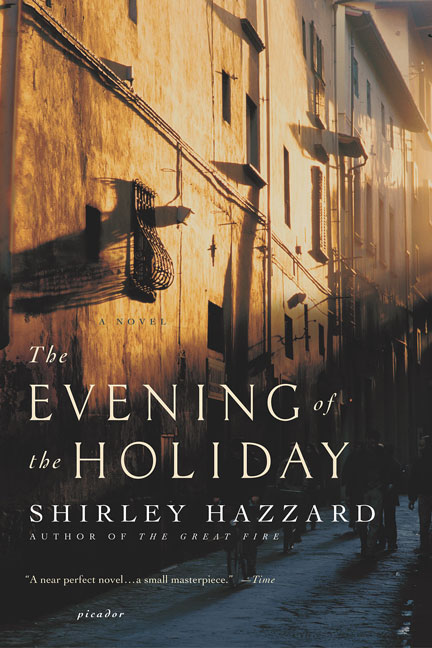
Shirley Hazzard, The Evening of the Holiday

The Evening of the Holiday tells the story of a love affair between the English Sophie and Tancredi, an Italian Sophie meets during a trip to Italy to visit her relatives. Sophie and Tancredi begin their affair on the night of a holiday celebration, but the novella’s title also anticipates the inevitable end of their holiday romance, and the ending of the holiday from reality that their affair itself represents. Both accept, temporarily, the fantasy that they needn’t ask any questions about the future, but the unspoken but deeply felt knowledge that their relationship is temporary gives it greater intensity, as if the emotional investment of a lifetime must be compressed into an interval of weeks. But that knowledge cannot be suppressed forever:

He was about to speak; or so he told himself, as he sat there silent. Exchanging in his mind one pretext for delay after the other, he was like someone who, at the close of a beautiful day, constantly shifts his chair to enjoy the last of the light.

She said, “Don’t be anxious to find a reason.”

He had forgotten what they were saying. She saw that, and added, “To come to the end of this.”

He smiled at her vaguely, as if it were all a joke.

In the same patient voice, she continued: “Since there’s no need. Since we don’t have much time left together.”

The astonishment Tancredi felt at being thus relieved in an instant of any necessity to describe their position had nothing to do with a sense of deliverance – for by demolishing his belief in her unawareness of their dilemma she automatically brought into focus the dilemma itself, and he was faced not with the discussion of the thing but with the thing itself.

This excerpt actually shows off nicely both the qualities that impressed and captivated me about the book and the qualities that made it less than satisfying for me. I really appreciated the intelligent precision of Hazzard’s language, and the deftness with which she identifies the significance of a particular detail or moment. How nicely her simile of the person shifting his chair, for instance, captures the mood of this moment for the lovers, still enjoying the pleasures of the day but now with some effort, not simply basking in them. The simile also, of course, echoes the title, and so we feel the readerly pleasure of our author’s artful control of her ideas. But Hazzard’s prose is extraordinarily restrained: it has a flat affect, as if, knowing the risk of falling into sentimentality in telling a love story, Hazzard decided to leave passion off the page entirely, leaving us to infer it, to trust that it’s there. I felt as if I was watching the drama play out through a window, with each detail clearly defined but distanced. Here’s another excerpt, this one from just before Sophie leaves. She and Tancredi go for a drive and take a detour near an abandoned villa, its ruins, again, artfully suggestive of the impending ruin of their affair:

The rough surface was comforting after the urgent efficiency of the highway; among its dents and ridges they slowed to a walking pace. On either side grass grew high against the twisted trunks of the trees. When they had gone about fifty yards along the avenue, Tancredi parked the car at a place where the roadway widened slightly and where another car might pass. But nothing approached them in the driveway or from the road behind. Under the hospitable arch of green, sheltered from the light of these last curious days, they were silent in one another’s arms.

Insects and birds resumed their interrupted life outside the car. A leaf or two fell on the windshield, and they heard the flourish of some small animal in the grass. All around them, across the countryside, men and women went about their work or sat down to their lunch, talked and laughed – or wept, as they wept now. Even in that luminous green she persevered, trying to fit this love into some immense, annihilating context of human experience, assailing it with her sense of proportion.

Tancredi, who knew more about proportion, lifted his head from hers. “What could be worse than this?” he asked. “What could be worse?”

Not long ago he had thought it logical that she should leave him. In the face of this pain, it now seemed meaningless, an action deliberately performed against the only life they could be sure of, their prsent existence, in the name of a future that might never come, and that in any case must contain inapprehensible elements.

It’s beautiful writing, evocative, descriptive, and intelligent about their emotions–but where is the emotion in the writing? Do passionate love affairs really end so discursively? I found myself wishing for something to break the glass, something like Dorothea’s outburst when she sees Will Ladislaw leaving, again: “Oh, I cannot bear it – my heart will break!” Call it melodrama if you like, but my own experience suggests it’s closer to the truth, even for (perhaps especially for) love defined by the certainty that it’s only a holiday.

Joe Meno, “People are Becoming Clouds”

“People are Becoming Clouds,” the seventh story in Joe Meno‘s well-received collection Demons in the Spring,  is equal parts wistful and whimsical. “People are becoming clouds nowadays,” it opens, with a quiet certitude that belies its disorienting premise that in fact, literally, people are becoming clouds–people like Eleanor, John’s wife, who “turns into a puff of soft white vapor” whenever her husband tries to kiss her:

The vapor is quite odorless and can assume various sizes and shapes. It can still understand when it is being spoken to, the vapor. . . . A partial list of the strange shapes Eleanor has taken as a cloud of vapor: a dove with enormous wings blowing a large trumpet, an intricate snowflake with castles for feet, a swan with an impossibly long neck sewing a blanket, a fairly accurage representation of an angel with rings of spoons for a halo, and a gigantic apple being swallowed by a ghostly white tiger.

I admit, my first reaction was impatience at this liberal sprinkling of the dust of magic realism over a pair of otherwise quite commonplace characters. At the very least, surely a far-fetched premise of this sort needs to be decked out in more fanciful prose. But the story won me over, in part because it remained in such a low key that a gentle poignancy gradually takes over its “what if” scenario. “Couples go through these kinds of things,” poor John thinks, and while of course he’s wrong in the real world, where people are don’t turn into clouds, he’s right that couples go through all kinds of things, sometimes difficult and even hurtful things, and often they do keep trying, as John and Eleanor keep trying, to maintain themselves or to recover what they’ve lost.

What John and Eleanor have lost is intimacy. There’s a comical aspect to their attempts to recover it once Eleanor has vaporized, but that light mood drifts easily into grief:

He will reach his hands up to grab her but he will be unable to. He will try to breather her in, to take her into his lungs, but his face will only become red until, finally, he gives in. He will turn on his stomach and want to cry into the pillow but he will not. He will be too embarrassed to cry.

The story also allows a note of deeper inquiry to creep in. Eleanor claims her transformations are beyond her control, but John always hears her laughing just before. She also never transformed before their marriage. Is Eleanor escaping or eluding John when she becomes a cloud? Is she an oddly literalized version of the many literary heroines who tease their lovers by remaining just out of reach, a temptress or siren? Or perhaps she’s a perversely successful version of the other literary heroines who find it difficult to reconcile married love and autonomy? Or are these questions too weighty–do they try to hard to bring the clouds down to earth, to give them definite shape? When asked by their “weather/relationship specialist” which cloud shape she prefers, Eleanor says, “I like just being a general kind of cloud the best.” Perhaps she just appreciates embodying possibilities, rather than actualities. And how bad is it, really, for one partner in a  marriage to turn into a cloud? While John suffers and pines for his tangible wife, even he wonders, “Would I still love my wife so badly if she wasn’t so impossible to claim? Would I still want her if I could have her whenever I wanted?” “People are Become Clouds” invites us to think about dreams and desires and the shifting shapes they take, but it does so with delicacy and humor.

The collection’s original design was meant to assert the appeal and value of books as tangible, aesthetic objects, “celebrating this archaic archaic form,” as Meno puts it. In support of this idea, each story is illustrated by a different artist. The illustrations for “People are becoming clouds” are by Nick Butcher.

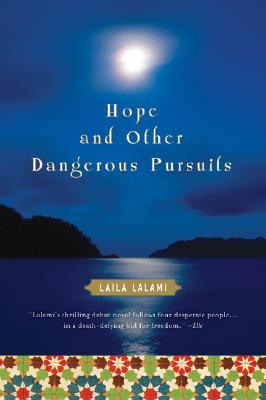
Laila Lalami, Hope and Other Dangerous Pursuits

The author of Hope and Other Dangerous Pursuits, Laila Lalami, is a long-time blogger at the site originally known as Moorish Girl. I have followed her writing there for some time and have been looking for the novel locally for a while; I was very pleased, therefore, to come across it on my recent expedition to The Strand.

It doesn’t seem entirely apt to say that I enjoyed reading Hope and Other Dangerous Pursuits. It’s elegantly written, spare but not unnecessarily elliptical, suggestive and yet surprisingly detailed for a novel that’s less than 200 pages. This artistic care (and it does, somehow, strike me as a careful book, by which I mean painstaking, not cautious) is dedicated to such a quietly harrowing account of hopes turned back and diminished, though, that pleasure seems an uncomfortably voyeuristic response.

Lalami explains on her website that the novel was inspired by stories she read about Moroccans attempting illegal crossings of the Strait of Gibraltar, hoping to begin a new life in Spain. The novel is artfully constructed, beginning with the crossing itself, introducing us to each of the four protagonists huddled with 25 other people in a 6-meter Zodiac. The pilot refuses to take them all the way to land; they are all tipped into the water and make their desperate way across the last stretch of water to the beach as best they can, only to face the unwelcoming realities that await them on shore. As we backtrack in the next part of the novel to learn how our four came to be in the boat, their watery struggle takes on retrospective symbolic significance: they have left home in the first place to avoid drowning of one kind or another. In tracing the very different lives of the four main characters up to the crossing and then picking them up again after the attempt, Lalami finds an effective formal device for conveying the variety and the human complexity of circumstances that drive people to such dangerously optimistic decisions. At the same time, in concentrating on just four stories she puts a human face on the pursuit too easily abstracted under terms like “illegal immigrants.” And though each of her stories is highly particular, both to the character she has imagined and to the social and historical context that is her focus, the hopes her people cherish–for opportunity, for freedom, for the dignity that comes with prosperity and independence–resonate because they are universal. Without belittling the families or the cultures they are choosing to leave behind, Lalami moves us to sympathize with her people because they look across the water and imagine something better. The saddest part of the novel, I thought, was its quiet concession to the elusiveness of that dream: hope is a dangerous pursuit, not just because of the risks of the pursuit itself, but because sometimes the chance you take brings you only further away from what you really wanted.

“The Story of an Eye”: Lynne Sharon Schwartz, Leaving Brooklyn

lsschwartz-210-exp-Leaving_brooklyLeaving Brooklyn is hands down my favourite reading of the summer, maybe even of the year so far. It’s also the only book I’ve read in a while that has sent me, immediately on finishing it, straight to the computer because I wanted to blog about it. Having said that, I realize that immediately after finishing a book is not necessarily the best time to write about it, as it allows no time for reflection. But Leaving Brooklyn excited the reader in me, and that’s a great feeling.

It’s an especially good feeling because I’ve been feeling a kind of mild, prickly annoyance at the whole conversation buzzing about the literary / lit-blogging / book-tweeting arena to do with men’s writing and women’s writing prompted by the fuss about Jonathan Franzen’s new novel. There was the shallow piece at the Atlantic, for instance, in which the writer realized he didn’t read books by women and set himself the noble project of “consciously trying to read at least one piece of fiction by a woman for every one I read by a man.” “This sounds stupid, I know,” he continues–yes, it does, because “fiction by a woman” is not a genre, and while it’s all very nice and inclusive to advocate reading “books outside of the reader’s direct experience as a way of understanding the world,” the very way the problem and its putative solution are framed here is impossibly reductive. Plus, of course, it’s impossible to imagine a woman reader seeking out a “piece of fiction by a man” as if that’s a coherent and potentially illuminating category–which of course proves the problem that men’s writing is more easily taken as universal, including by women–who have centuries of experience accommodating themselves, provisionally, to a more-or-less masculine point of view in order to enter into fictional worlds. I sympathize, though not entirely, with the reaction of Linda Holmes at NPR’s ‘Monkey See’ blog, who noted that the discussion would be improved by abandoning the term ‘chick lit,’ which is now far too casually flung around as if it embraces all “books that are understood to be aimed at women, written by women, and not important” (that “not important,” of course, is not Holmes’s view of books aimed at, written by, or about women). I’ve intemperately expressed my own impatience with what I take to be exemplary chick lit titles here a couple of times, and I’m not nearly as impressed with Jennifer Weiner as Holmes is, though I certainly consider Weiner’s books (including In Her Shoes) a big step up from, say, Confessions of a Shopaholic. But I do think that there’s something to the complaint that assumptions about literary significance still skew towards the masculine.

Anyway, I don’t want to set Leaving Brooklyn up as a case study in the gendering of literary standards, but it struck me so forceably as being a breathtakingly good novel that I am puzzled about why it’s not (to put it bluntly) more famous than it is. Why, just for instance, is The Catcher in the Rye a modern classic, and not this wonderfully pungent, self-reflective, intelligently emotional and erotic story? Now, to be fair, I’m not an expert on contemporary American fiction, and perhaps Leaving Brooklyn is considered precisely a modern classic. Or perhaps, as it was published only in 1989, it will grow into that status. Or perhaps it will shrink into the somewhat more marginal status hinted at by the odd qualifier in Russell Banks’s cover blurb: “The blend of lyricism and history, of memory and the imagination–all shot through with the female erotic–is wonderful,” he writes (my emphasis). Well, it is wonderful, and it is shot through with eroticism, sort of. But just as courses I teach with ‘Woman’ in the title consistently attract very few male students, how likely is it that this particular endorsement of the novel will be taken as indicating that it’s one of those books “aimed at women, written by women, and not important”?

But never mind all that, really, because the reason that whole discussion annoys me is precisely that it directs our attention to the writer and not the book. There’s a reason Charlotte Bronte and Marian Evans chose to publish under pseudonyms. Gender makes a difference, to be sure, but it’s when that difference becomes the measure that writers want to evade it.

Leaving Brooklyn is a novel that is intensely about a particular place and time: Brooklyn, obviously, in the post-war years. Street names, subway stops, card parties, news stories all evoke that era and the peculiar aura it has, especially for the protagonist, Audrey. “The air was suspended on a discrepancy,” she recalls:

something like the discrepancy between my mother’s use of the words ‘To thine own self be true’ and their true meaning. It was a presumption of state-of-nature innocence, an imaginative amnesia, and a disregard of evidence such as photographs of skeletal figures in striped pyjamas clawing at barbed wire, of mushroom clouds and skinned bodies groping in ashes.

The disjuncture between what is known and what is said is given oddly literal metaphoric form in the opposition between Audrey’s two eyes (“This is the story of an eye,” the novel enticingly, obliquely, begins, “and how it came into its own”)–one, her left, is perfect, but her right eye wanders, due (or so her mother believes) to an unspecified injury just after Audrey’s birth. So Audrey sees straight on, with perfect clarity, but also sees everything askew. She can see around corners, or so she feels; she can see through the discrepancies, the surfaces and half-truths. How is it possible–is it even desirable–to unite these perspectives? Not then, or at least not in Brooklyn, Audrey realizes. Brooklyn demands an end to wandering, as represented by the hard contact lens Audrey is prescribed to control the errant movements of her eye: “Conscientious parents pursued standardization as Calvinists performed good works,” she reflects. Difference was not to be borne but confronted.

But of course Audrey never does see as everyone else does. She learns to compensate for her lack of binary vision (just incidentally, so apparently did I, before an eye operation in my early childhood that repaired a problem with my depth perception): she navigates stairs and corridors, street crossings and subway stations, with precision and accuracy. She also learns to navigate the intangible complexities revealed by her intelligence and imagination, those qualities fed by her imperfect physical sight. She’s a reader and a thinker, sharp, unsentimental, feeling Brooklyn as a constricting force she must leave emotionally as well as literally. She can’t leave, of course, because Brooklyn is her past, part of her identity, who she was before she became who she is: “no matter how much I leave, it doesn’t leave me.”

Leaving Brooklyn is not just about leaving Brooklyn, though. It’s about, among other things, precisely that inextricable tie we have to our past and our early selves, but also about how we reconstruct that self, looking back and trying to recognize ourselves in the child we once were.  “I am confused about who I was,” she reflects:

why else would I need to tell this story about my eye? The confusion is that I seem to have grown up into someone who could not have been me as a child. Yet in the telling the girl grows to sound more and more like the woman I became. The voice overcomes her. The real girl with her layers concealing me becomes more elusive the more I tell. She has been superseded, but I am sure she existed. As I try to find her in me, I keep finding me in her.

At one point she feels the convergence of her selves:

She was me, at that moment. She already knew what I know. This is so startling to come upon that I have to stop and contemplate it. And her. Oh yes, I see myself plainly, right there, bearing the seeds of all I would come to know.

This is metafiction without pretense or flamboyance; Schwartz integrates crucial insights about the inevitable inauthenticity of memoir as a genre with the dramatic urgency of personal discovery.

It’s not accidental that this moment of identification occurs while Audrey is having sex with the Park Avenue eye doctor who prescribed the contact lens. Their affair is not, initially, revelatory to Audrey, but as its erotic possibilities unfold for her, her perception of the world around her becomes less bifurcated: her mind and her body begin to feel equally present to her, though what she sees in Brooklyn is that a woman “could choose the life of the mind or the life of the body, but she could not have both.” Though the doctor eventually expresses his somewhat pathetic (and certainly inappropriate) passion for her, he’s a catalyst for her development: he’s its occasion, not its object. The affair prompts her to see that there might be “another way to live,”

some free and unhampered way I could recover from those years before I stood waiting in the ration lines gripping my mother’s hand, before I began school and was assigned a place in the ranks.

It’s not desire that liberates her, not erotic freedom that she seeks. It’s not love, either–it’s the risk of “caving in” to the doctor’s love that scares her away, the risk of having to be true to him, or to them, rather than to herself. It’s something more like space–mental space, room to decide for herself, to identify herself. Walking through Manhattan after ending the affair, she experiments with an eye patch she has taken from the doctor’s office. But which should she cover, the good eye or the bad? She covers the left eye first, and the world becomes “a huge amorphous mass, its fine points and articulations lost in blur and darkness.” That’s not right: “I needed to find my life, not lose it.” Heading home from the subway, in Brooklyn again, she covers her right eye and “saw clearly the usual sights,” then switches it again. But that’s no real test, she thinks, as she knows the route “so well I could have walked it blindfold.” And yet as she goes along, everything around her indistinct, she is filled with “limitless buoyancy”:

It seemed I might leave the earth and sail up unimpeded, as the snow around me was sailing down, and float right over Brooklyn up to where the stars drifted. . . I didn’t want to float away, though; I was so enraptured that I wanted to remain here on earth, or maybe just a few inches above, and dance. Everything seemed perfect and right; the world, glistening and abundant, unfurled its rightness and perfection–how come I hadn’t noticed it before? Of course I would have everything I wanted, my life would be all I dreamed.

Her ecstasy is inexplicable: “it came from nothing that had happened to me today or ever, beyond circumstance, out of nowhere, a gift that wouldn’t last.” But what she feels is the spaciousness of human possibility, liberated momentarily from the specificities of history. Of course it can’t last, but at that moment she feels that her “entire past barely existed, could be rolled up into a mote in the eye and winked away.” Eventually her own life will begin, she thinks, and then “oh how freely I would float.” It’s the bad eye, the wandering eye, that sees her home that night, and with it she looks through and then past Brooklyn with the hopeful, naive, ambitious exaltation of youth. It’s an intensely personal but also profoundly commonplace experience, movingly represented in a book by a woman, about a woman, that I think deserves to be called “important.”

A Word to Canada: We are not dismayed.

Colleen of the always engaging blog Bookphilia is clearing out stock at her bookstore (side note: check out the website or, if you’re in Toronto, just show up, and you will find some great deals). In the process she came across a little gem which she sent along for my Daphne du Maurier collection. It’s called Come Wind, Come Weather; first published in Britain 1940, this collection of “true stories” is intended to “bring courage and strength” to the British in the face of impending invasion by the Germans. My copy is the Canadian edition. I haven’t read the stories yet, though their titles are perfectly enticing (“The Admiralty Regrets,” “A Nation’s Strength,” “Spitfire Megan” [that might have to be first], “Mrs. Hill and the Soldiers”…). But I have read the preface, “A Word to Canada,” which is–well, rather than describe it, I’ll just quote from it:

The book was published on the 15th of August, 1940, the famous date of threatened invasion when every man, woman, and child in the Kingdom stood waiting tense and expectant for the blow to fall. Since then we in this island have experienced the full horrors of war in the air. Many have faced death itself, others are homeless–parents without children, children without parents.

In spite of these things we are standing firm. We are not dismayed. The spirit of the British people is rising triumphant. The old lazy go-as-you-please, every-man-for-himself attitude is becoming a thing of the past, and out of this testing time of tribulation we shall arise, please God, worthy descendants of those ancestors of ours who first sailed the Seven Seas and laughed at danger.

You men and women of Canada are helping us in the European struggle. Many of your sons are with us now, showing great gallantry and courage in the face of danger, and their coming has strengthened even more, if it were possible, the link that binds our two countries together.

We believe that side by side with this war in Europe we are fighting another battle–the battle against human selfishness. We can only win the first if we are victorious in the second.

You people of Canada are fighting this battle too. We are allies in this war, just as we are allies in the war in Europe. Political differences, class struggle, financial wrangles, racial jealousies, these are all problems that must be solved before the new world can be born. Peace will not come nor unity be achieved among the nations of the world, unless we can first sow peace and unity ourselves. It is in the workshops, in the farms, in the factories, in the fields, and above all in the homes that you men and women of Canada can lay the foundation stone. You have inherited a splended past from your British and French ancestors; but you will bequeath a far greater future to your Canadian descendants, if you can hand down to them, side by side with equality and freedom, the new spirit of selflessness, cooperation, and goodwill.

There are so many odd things about this little period piece that I hardly know where to begin. For one thing, I have no idea if this call to selflessness is actually typical of the war-time rhetoric, but that’s not where I thought she was going when she started. It’s also really interesting how she places the responsibility for the Utopian future right in the domestic sphere. I’m curious to see how the “true stories” that follow reflect that idea. But certainly my favourite moment is the brilliantly understated remark “We are not dismayed.” Take that, Hitler!

Normal Programming will Resume…

I’ve just returned from my trip to New York for the launch of the Open Letters Monthly Anthology. It was a great night for everyone on the Open Letters team, I think, and once we recover from the festivities, we’ll all enter with renewed vigor into getting the September issue ready for its eager public. I also hope to be back to a more regular blogging routine. One important part of that will be getting back into the habit of more frequent but shorter posts. Starting a new teaching term will help with that, as I will suddenly be too busy with the hectic miscellany of lectures and tutorials and assignments and wiki projects to linger over other things. On the other hand, I will also look forward to blogging more once it becomes, again, more of a rarity to have time and attention for things I choose to read.

And speaking of choosing things to read, naturally a great highlight of my trip to New York was my visit to The Strand bookstore (sadly, I didn’t really have any time to browse at Housing Works, where we held our reading, but just knowing that its secret sub-basement exists will be spiritual nourishment for me). I didn’t have enough time to explore all the layers and recesses of The Strand either, but I did find a couple of titles I’ve had on my ‘most wanted’ list for a while, plus a couple of others that were just too enticing to pass up at those prices. Here’s my haul:

Laila Lalami, Hope and Other Dangerous Pursuits. I have followed Laila Lalami’s blog for some time and I’m really looking forward to reading her novel, which I hadn’t been able to find around here.

Lynne Sharon Schwartz, Leaving Brooklyn. I’ve mentioned Schwartz’s Disturbances in the Field as one of the ‘books of my life’; though sometimes when I really love a particular book I don’t necessarily even want to read others by the same author, in this case I’m keen–and I already like the first sentence: “This is the story of an eye, and how it came into its own.”

Penelope Lively, Family Album. Moon Tiger is another of those books I’ve loved for many years, though in this case I have followed up with several others by Lively–who has never disappointed me so far.

Anita Brookner, Strangers. They had a lot of titles by Brookner and I had a hard time choosing one. I’ve only read Hotel du Lac, which I really enjoyed. This is a very recent one. I admit: I chose it from the many options there partly because I liked the cover.

Shirley Hazzard, The Evening of the Holiday. I also picked up The Transit of Venus recently, so I guess I’m about to go on a very small scale Hazzard binge. So far the only one of hers I’ve read is The Great Fire. I loved the writing but didn’t love the book–this is not a common response for me. In fact, I think usually I would deny that the writing can be separated from ‘the book.’

Henry James, English Hours (introduction by Leon Edel). This was out on one of those $1 tables that line the outside of the store. The first sentences are, well, Jamesian: “There is a certain evening that I count as virtually a first impression–the end of a wet, black Sunday, twenty years ago, about the first of March. There had been an earlier vision, but it had turned to gray, like faded ink, and the occasion I speak of was a fresh beginning.” Now really: could you have resisted this book, for $1, if only to find out what the heck he is going on about in such lovely, nuanced, but oblique language?

Just as an aside, on my visit to The Strand, I happened to be wearing one of my favorite (and oldest) scarves: it’s kind of purple/green/black strips, with a bit of shimmery thread running through the weave. On my way in, the greeter (I don’t know his actual job, but he seemed to be saying ‘hello’ to everyone who came in) said “Hello. I like your scarf. It’s very distracting.” Distracting from what, I had to wonder?

These aren’t the only books I brought back with me, either. I have SD to thank for yet another two, The Art Book (which I only regret not having had in hand at MoMA, where as is actually quite predictable, I bumbled around quite a bit wondering where the actual art was hidden–though I did enjoy the Matisse exhibit) and a review copy, stories by Joe Meno. I’ve promised to write up at least one here at Novel Readings, so more about that eventually.

And at the Metropolitan Museum gift shop, there on the sale table, just as if they knew I was coming, I found this beautiful book on ‘Embroiderers, Knitters, Lacemakers, and Weavers in Art.’ I did come to regret its heft as I lugged it along while walking all the way back down through Central Park, but it promises hours of browsing pleasure, and perhaps some encouragement for the little needlework project mentioned in an earlier post–which I have begun.

But before I can finish any needlework, much less any blogging or other actual intellectual task, I have to recover from several days of poor sleep (sirens, car horns, and garbage trucks not being altogether lullabies to my small-town ears) and really early rising (note to me: it’s all very well to prefer early flights because “then you have the whole day ahead of you when you get there,” but you aren’t as young as you once were and it will cost you).

Open Letters Monthly Reading and Book Launch!

It’s almost here: the day you’ve all been waiting for!

Friday is the Open Letters Monthly Reading and Book Launch at the Housing Works Bookstore and Cafe. The line-up of readers (including Nathan Schneider, Lianne Habinek, Sam Starkweather, Jared White, Lisa Peet, Steve Donoghue,  John Cotter, and me!) reflects the  range in both styles and subjects that makes OLM such a great reading experience every month. Here’s hoping for good weather and a good turnout! I think that, for our part, we can promise you a good time.