Emsley, The Jane Austen Playgroup

I’m deep into a rather quixotic essay project and thus stalled in my other reading and writing, including blogging. But this is no loss to you, as I’m going to fill in the gap with a lovely little piece of writing by someone else. Here’s an excerpt from a charming children’s story called The Jane Austen Playgroup.

In February Laura and her mom invite us to their house for a Valentine’s party. We watch Mr. Darcy propose to Elizabeth in the Pride and Prejudice movie. Then we make valentines to give each other. My Mom says we’re wasting gold paper, the way the rich sisters Maria and Julia do in Mansfield Park. She likes it, though, when I give her a big valentine and a kiss. Zachary’s mom gives Sophie’s mom a pretty card that says, “I admire and love you, love, Mr. Darcy.” Sophie’s mom laughs and says “Thank you,” but she looks kind of sad.

Pending appropriate interest from a publisher, the story is available in full on the author’s website. The photos are placeholders until there’s a full set of artist’s illustrations, but I think they work very well.

Full disclosure: the author, Sarah Emsley, is a friend and former Ph.D. student of mine. I’d like to take some credit for this particular project but all I’ve contributed is my enthusiasm. Sarah has also written about Jane Austen for grownups, and she edited the Broadview edition of Edith Wharton’s  The Custom of the Country.

Recent Reading: Johnson, Mitchell, Sage, and Mitchell

Somehow that post title ends up sounding like a law firm! Its somewhat miscellaneous character matches my recent reading experiences well, though.

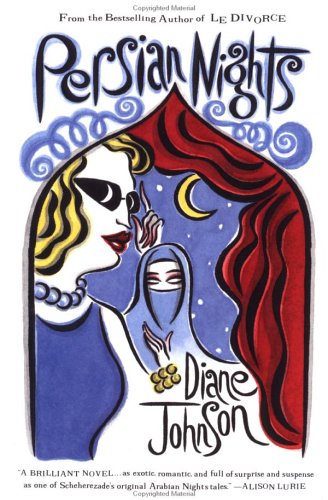
Diane Johnson’s Persian Nights is the first book on my blogging catch-up list. I picked it up on a recent trip to Doull’s because I’ve been spending a fair amount of reading time in Iran lately and also remembered having read Ahdaf Soueif’s review of Persian Nights in her collection Mezzaterra, so it just seemed like a good book for me to try. Soueif seems to have liked it better than I did: she found it ” a serious tale, a tale of altered perceptions and of moral responsibility.” I’m quite prepared to believe that she is a better reader of this book than I was, but I was disappointed precisly by the lack of seriousness and by the sideways, slightly satirical way it touched on issues of moral responsibility. The book clings closely to the point of view of Chloe Fowler, an American doctor’s wife who ends up spending alone what was meant to be ‘together’ time for them in Iran. I felt that her limitations became the novel’s limitations, that the opportunity for a complex narrative about cultural misunderstandings and crosspurposes was handled instead as a rather sour comedy of manners. I agree with Soueif that Persian Nights “is a story about the limits of change — and, finally, its impossibility,” but I would press a little on that, or add in that it is about the limits of change that are possible for someone like Chloe.

The first ‘Mitchell’ on the list is for David Mitchell: I’m reading Cloud Atlas. Notice that I say “reading”: it’s a work in progress. I was doing really well until “An Orison of Sonmi-451.” I’m not a science fiction reader, largely because I find the elaborate artifice of ‘world-making’ tedious, and while I accept intellectually that the genre at its best works as an indirect way of exploring themes or problems in our actual world (though of course I’m sure it doesn’t always, or have to, do this)–still, there’s a machinery to it that I don’t read well. Still, I persevered with Sommi 451 and eventually became adept enough at the futuristic dialect to feel a pulse of readerly excitement as it came to its (interim) conclusion. But then Mitchell hit me with “Sloosha’s Crossin’ an’ Ev’rythin’ After” and ground to a halt. Egad. It’s like reading “Caliban Upon Setebos” but for 100 pages. Still, the novel as a whole is clearly genius, and I know my expectations and reading habits are just being tested. I’m going to return to it and just read, even skim, if I have to, until I feel that pulse again, because I’m quite keen to return to all the other narratives, each of which caused a terrible hiccup of interrupted attention as I began it the first time–like grinding gears!–but each of which also had drawn me right in within a few pages. I enjoyed seeing the threads of connection gently laid down for us, too, and I’m pretty confident that the experience of following them back out of the labyrinth of stories will be quite thrilling. I just have to get past “Sloosha.”

‘Sage’ here is for Lorna Sage, whose memoir Bad Blood I’m also stalled in the middle of. I’m not sure why, except that the atmosphere of the book was depressing and I have been discovering, also, a strain of resistance in myself to memoirs as a genre.

And the second ‘Mitchell’ here is for Margaret Mitchell: I’ve just finished reading Gone with the Wind for (and I’m not making this up) the 32nd time. I know this exact number because GWTW was a favourite of mine in my misspent youth and I used to note each rereading on the inside cover (the copy I now have takes me from 23 to 32). I have many thoughts about how this book looks to me today–but I’m saving those for what I hope will become an essay for Open Letters on just that experience of rereading something in a different way, from a different time–almost, as a different person. I’m thinking of drawing (not too heavily, I hope) on Wayne Booth’s discussions of books as friends in The Company We Keep: An Ethics of Fiction. In this case, not to spoil the ending of my future essay or anything, I have to say that this friendship right now is under a lot of strain, but I think, despite myself,  its longevity may sustain it. Don’t we all, after all, have a friend (or a relative) we still love, warts and all, in spite of everything that’s wrong with them? We’ll see.

In the meantime, because clearly I don’t have enough unfinished projects on the go, I’m about to start work on this nice bookish sampler from Little House Needleworks. I’m going to try and sneak “George Eliot” in instead of “Wilder”–not that I didn’t read and love all the Little House books as a girl, but really, if it’s going to hang in my office when it’s finished, she just has to be there. There’s some nice lurking irony in this project, given how many of these writers felt about needlework! Canadian readers with a crafty tendency may want to know that I ordered my copy of the pattern from the Button & Needlework Boutique in Victoria. You Yankees are on your own.

Help Wanted: “novelists and poets published in the last sixty years”

In a comment on my ‘About’ page, Bruce Cooper makes the following request:

I have no academic qualification and, to a very large extent, have relied on the works of FR Leavis to guide my reading of poetry and fiction. The reliance has not, I believe, been without merit and I am indebted to him for my deep and ongoing enjoyment of English literature. But, sadly, I’ve had no such guidance for novelists and poets published in the last sixty years and my age (65), and the limited time I have to spend on this most cherished pursuit, press upon me to seek from those better informed a literary canon for the period as well as the names of good literary critics who might assist in finding, to some degree at least, what I’m looking for.

I’d be most grateful if you’d be willing to have a shot at this.

Bruce, I don’t consider myself to have deep expertise in recent poetry and fiction: my own primary field for teaching and research is Victorian literature. However, I do read outside that field, of course, and I also have had to get a lot smarter about more contemporary literature in order to teach our survey course in ‘British Literature After 1800.’ In that effort, I have found the Cambridge Companion series extraordinarily rich and helpful. There’s a volume on almost any subject you can think of, including, say, Contemporary Irish Poetry, Literature of World War II, Malcolm X, Modern British Women Playwrights, Twentieth-Century English Poetry, and Postmodernism.

I also spent some time with some general introductions to contemporary fiction, all of which I found clear and lively. One was the Blackwell Companion to The British and Irish Novel 1945-2000, edited by Brian Shaffer. In this volume, a range of experts address both general issues in the history and theory of the novel in this period and more than two dozen particular novelists from George Orwell to A. S. Byatt. Shaffer also has written a guide to Reading the Novel in English 1950-2000, also from Blackwell. And the essay collection Contemporary British Fiction, edited by Richard Lane, Rod Mengham, and Philip Tew, from Polity Press, also contains a lot of very interesting material.

I think it is possible to derive from these works (and from standard teaching texts such as the Norton Anthology) a pretty good sense of the ‘canon’ for this period, though just how long that list would become would depend on what, if any, limits you set. Even if you stick to “literature written in English,” setting aside work in translation, you’d have a lot to cover, taking into account works from many countries. The reading list for our Ph.D. comprehensive exams in modern British literature is several pages long, and we have separate exams for Canadian, American, and postcolonial literature–though to be sure, these lists are aimed at producing specialists, not well-informed general readers.

But let me throw this question open, as I know I have readers who are more knowledgeable than I about contemporary literature. Recommendations, anyone? How should Bruce proceed? What critical guides or voices would you recommend? Where would you look (or, for that matter, not look) for help in compiling a manageable reading list for novelists and poets published in the last sixty years?

P.S. I have thought of making a kind of regular ‘ask the professor’ feature here. I get questions all the time, from students but also from friends, family, and colleagues, from “Why do we call George Eliot ‘George Eliot’ when we don’t call Charlotte Bronte ‘Currer Bell’?” to “What would you recommend for my first attempt at reading Dickens?” or “What’s so great about Finnegan’s Wake if nobody can understand what it says?” I don’t always have a good answer, but I often know someone I can ask. Do you think that would be fun? What would you ask? What has someone asked you that you couldn’t answer? Maybe this could even be a bit of a column in Open Letters (“Open Questions”?), if there’s enough interest. (I should probably ask this general question in a more prominent place eventually, but this seemed a good time to at least air it in a preliminary way!)

August in Open Letters

The August issue of Open Letters is up and full of the usual wide range of readerly goodies. I’m especially pleased to call attention to my Valve colleague Amardeep Singh’s “The Original Wasn’t Better,” which presents arguments against the literary purist’s “fixation on ‘fidelity'” in film adaptations. I admit, I count myself among those for whom Mira Nair’s revised ending to Vanity Fair was “a step too far,” but Amardeep helps me think about my resistance to it, and about the general issues involved in adaptation, in a more complicated way. The issue also includes a complete “fitt” of Adam Golaski’s new translation of Sir Gawain and the Green Knight, Amelia Glaser on Peter Stein’s adaptation of Dostoevsky’s The Demons, Megan Kearns on veganism and ‘carnism,’ Max Ross on Alberto Manguel’s A Reader on Reading, Steve Donoghue on a new biography of Edward II, Garrett Handley on the Shakespeare authorship controversy, Ingrid Norton on Margaret Atwood’s Surfacing–and that’s not all. Come on over and see for yourself!

The Stars Look Down is an actual book!

OK, this is admittedly a very trivial discovery, and one I could have made easily enough long ago, if it had ever occurred to me to inquire. No doubt I’m just revealing yet another embarrassing gap in my reading knowledge in pointing to it as a book I’d never heard of. Still, I felt a little amused thrill yesterday as I was browsing  in J. W. Doull’s and happened across a battered copy of a novel called The Stars Look Down. I instantly recognized the title because it is mentioned several times in the opening section of one of my long-time favourite books, Dorothy Sayers’s Busman’s Honeymoon. Peter’s mother is reading it as the drama of Peter and Harriet’s engagement and marriage unfolds: “Was reading The Stars Look Down (Mem. very depressing, and not what I expected from the title–think I must have had a Christmas carol in mind, but remember now it has something to do with the Holy Sepulchre–must ask Peter and make sure) after ea, when Emily announced ‘Miss Vane,'”  reads the Dowager Duchess’s diary for 21 May. Then she loses track of it (“Must remember to ask Franklin what I have done with The Stars Look Down“). It turns up again in October (“Tried The Stars Look Down again, and found it full of most unpleasant people”) and then finally, on October 8, after the wedding (“H. looked very lovely, like a ship coming into harbour with everything shining and flags flying at wherever modern ships do fly flags…”), she puts it aside once more: “Find The Stars Look Down not quite soothing enough for a bed-book–will fall back on Through the Looking-Glass.” I’m pretty sure The Stars Look Down has no thematic relevance to Busman’s Honeymoon: Wikipedia tells me that the novel chronicles injustices in a mining town. I have no particular interest in reading it. It was just such a surprising start of recognition the minute I saw the title. I guess I may have read Busman’s Honeymoon a few too many times. A while back, a colleague gave a paper in the department on Sayers and the automobile, focusing particularly, of course, on Peter’s Daimler, and I was disconcertingly able to provide exact quotations for the examples she brought up in the Q&A session: “Not waking the baby, are we, Bunter?” “The vibration is at present negligible, my lord.” The mystery plot of the novel is absurd; it was always Peter and Harriet I loved, Harriet especially–though I admit, the Peter Wimsey of Gaudy Night and Busman’s Honeymoon is one of a tiny elite group of fictional crushes of mine. (And no, neither Heathcliff nor Mr Rochester is in the group.)

As a completely irrelevant aside, while I was browsing in Doull’s the staff received a phone call from a woman asking for ‘books that would look pretty on her shelves.’ I kid you not. The woman who took the call was remarkably patient (“No, you really would have to come in and take a look to see which books would suit your decor. No, we don’t offer special discounts on books sold “by the foot”; no, we won’t sell our books to you for 25 cents apiece if you buy over a certain quantity; yes, our books are all priced individually based on what they are worth.”) It reminded me of my own days in retail: it’s odd how customers are at once essential and the bane of your existence!

Daphne du Maurier, Frenchman’s Creek

A kind friend (thanks, SD!), on learning that I wanted to read some Daphne du Maurier besides Rebecca, sent me a wonderfully enticing stack of her novels, including the pictured 1959 edition of her 1941 novel Frenchman’s Creek. I was hooked from the moment I saw the cover (not just the picture, which you have to agree is delicious, but the caption, which begins “A memorable novel about a lady and a pirate”). Notice that it sold for the bargain price of 35¢ (inside is a tear-away card for a special promotional offer on a subscription to Time–27 weeks for $1.97). The volume itself is a wonderful period piece.

Frenchman’s Creek is a ridiculous novel. It features a bored 18th-century aristocratic lady impatient with the artifice of her pampered life and with “her fat and stupid husband” (to quote the back cover). She meets Jean-Benoit Aubery, a sexy Frenchman who shares her restless spirit–but in his case he has found an outlet for it, in piracy. Is there really any need for me to fill in the rest? The only surprise, really, in a quiet sort of way, is the ending…but of course I won’t give that away.

There is one other surprise, actually, something that shouldn’t have surprised me because, after all, I had already read Rebecca. Daphne du Maurier is a beautiful writer. I haven’t read any recent examples of this genre, which I would call a hybrid of historical fiction and romantic suspense, but I am skeptical that many writers today would either be able to or bother to surround their plots with the kind of detailed, luxurious, but never cheaply self-indulgent prose du Maurier lavishes (wastes, I’m tempted to say) on Lady Dona St. Columb and her piratical escapades. The opening of the novel, for example, is an evocative historical palimpsest, layering the homely present of Navron House and the nearby waters over the lingering traces of the past,  filling the dreams of a contemporary yachtsman: “as the tide surges gently about his ship and the moon shines on the quiet river, soft murmurs come to him, and the past becomes the present”:

All the whispers and echoes from a past that is gone teem into the sleeper’s brain, and he is with them, and part of them; part of the sea, the ship, the walls of Navron House, part of a carriage that rumbles and lurches in the rough roads of Cornwall, part even of that lost forgotten London, artificial, painted, where link-boys carried flares, and tipsy gallants laughed at the corner of a cobbled mud-splashed street. He sees Harry in his satin coat, his spaniels at his heels, blundering into Dona’s bedroom, as she places the rubies in her ears. He sees William with his button mouth, his small inscrutable face. And last he sees La Mouette at anchor in a narrow twisting stream, he sees the trees at the water’s edge, he hears the heron and the curlew cry, and lying on his back asleep he breathes and lives the lovely folly of that lost midsummer which first made the creek a refuge, and a symbol of escape.

Curlews, herons, and other wildlife figure largely in the novel, suggesting that du Maurier herself was, if not a birder, at least an avid naturalist; certainly her care to evoke the local fauna goes beyond what would be strictly necessary for a plot about running away to sea in borrowed britches and finding freedom and passion there. As for the sea, du Maurier is in her element there:

Slowly the ship gathered way, and the wind of the morning, coming across the hills, filled the great sails. She crept down the creek like a ghost upon the still water, now and again almost brushing the trees where the channel ran inshore, and all the while he stood beside the helmsman, giving the course, watching the curving banks of the creek. The wide parent river opened up before them, and now the wind came full and true from the west, sending a ripple on the surface, and as La Mouette met the strength of it she heeled slightly, her decks aslant, and a little whipping spray came over the bulwark. The dawn was breaking in the east, and the sky had a dull haze about it and a glow that promised fine weather. There was a salty tang in the air, a freshness that came from the open sea beyond the estuary, and as the ship entered the main channel of the river the sea-gulls rose in the air and followed them.

Even her melodrama is finely tuned. Here’s Lady Dona presiding over a dinner party for the fat stupid husband and his obnoxious cronies, who have gathered to plot the pirate’s capture:

She held her head high in the air, and there was a smile on her lips, but she saw nothing, not the blaze of the candles, nor the long table piled with dishes, nor Godolphin in his plum-coloured coat, nor Rashleigh with his grey wig, nor Eustick fingering his sword, not all the eyes of the men who stared at her and bowed low as she passed to her seat at the head of the table, but only one man, who stood on the deck of his ship in the silent creek, saying farewell to her in thought as he waited for the tide.

Lady Dona and her pirate may be, at best, lavishly presented cliches, and their adventures (though entertaining, I confess), ridiculous, but the long rhythmic sentences, the abundant details, even the vocabulary all give the novel a richness that makes reading it quite a paradoxical experience. Purple prose perhaps (as I was warned on the outside of the package)–but it’s royal purple, richest velvet. I can’t wait to work my way through the rest of the pile, which includes Mary Anne (a Regency novel), My Cousin Rachel (about the “enigmatic Countess Sangalletti”!), The Parasites (“They were the fabulous Delaneys–chasing love and luxury in a world they believed was strictly their own”!), and Kiss Me Again, Stranger, which may have the best cover of all:

Two Iranian Women’s Memoirs: Things I’ve Been Silent About and Iran Awakening

I read both Things I’ve Been Silent About and Iran Awakening a few weeks ago, inspired in part by the discussions with one of my students mentioned here–she also very kindly gave me her copy of Iran Awakening when I mentioned I had not been able to find it in stock locally. I’m not entirely sure why I have put off writing about them for so long! But until I do, I can’t put the books back on the shelf, so here I go.

I had a passing idea that I would, maybe should, reread Reading Lolita in Tehran before writing on Nafisi’s memoir, but I didn’t. Perhaps if I had, I would have more to say about Things I Have Been Silent About, which I didn’t actually find very engaging. It’s primarily about Nafisi’s relationship with her parents, which wasn’t what I wanted to know about. I also felt uncomfortable reading her account of them, particularly of her vexed relationship with her mother. Though she is self-conscious about her own failures to understand or sympathize with her mother, and works to contextualize her mother’s choices and values, she ultimately still comes across as both unsympathetic and resentful. I guess I’m just wary of the inevitable one-sidedness of such a personal account, and wince at exposure of family feelings in this way. Consider the tone of this passage:

Some families try to cover up their tensions in front of strangers, but for Mother, a woman otherwise so insistent on social etiquette, no such niceties existed. She gave in to her emotions regardless of where she was. I tried not to let her know about my interest in Mehran, but she had a hunter’s instinct, alert and sensitized to my secret hideaways. Her instinct was helped, in this instance, by daily intrusions into the most private corners of her children’s lives. She listened in on my phone conversations, read my letters and diaries, and walked in and out of my room whenever she felt like it. I could never be certain which I resented more, the fact that she read my diary and letters or that she never allowed me to feel indignant about her actions: she would use her new evidence as proof of my betrayals.

Sure, Mother sounds intrusive–any teenager would find her so. But Nafisi seems to be still caught up in the resentment she describes. She’s far more forgiving of her father’s infidelities than she is of her mother’s transgressions. In fact, she gets angry at her mother about them, as here, when her mother befriends one of Father’s mistresses:

It irritated me, the innocent and persistent way my mother had of being attentive toward this woman and her family. It made us all uncomfortable, since we all knew what was going on. . .

To some extent Things That I Have Been Silent About does trace a process of reconciliation for them, and the book ends, after the death of both parents, with some touching reflections on what–almost despite themselves, you get the impression–her parents have left her with, “a portable home that safeguards memory and is a constant resistance against the tyranny of man and of time.” But as I read the book, I wanted to get away from Nafisi’s own perspective on them–which of course is a desire that goes against the grain of a memoir.

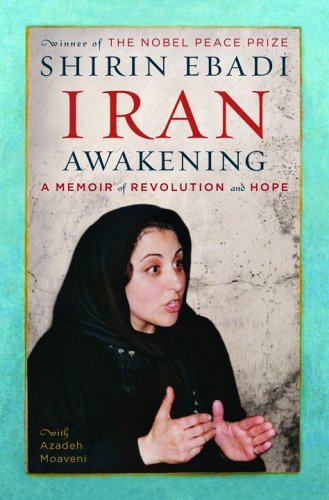
Shirin Ebadi’s story is intrinsically interesting, even inspiring. The oddity of Iran Awakening, for me, was that the book does not perform that inspiration. If anything, it consistently downplays the drama of Ebadi’s confrontations with the Islamic Republic. Individual chapters often open with appalling anecdotes of injustice and brutality against women and children, like the story of 11-year old Leila Fathi, raped, beaten, and discarded. Two of the three perpetrators are convicted and sentenced to death (a third hangs himself in prison).

In this instance, the judge ruled that the ‘blood money’ for the two men was worth more than the life of the murdered eleven-year-old girl, and he demanded that her family come up with thousands of dollars to finance their executions.

Leila’s father sold all of his worldly possessions, including the little clay hut where his family slept. Homeless but convinced that they would at least reclaim their honor, they offered the money to the court. It was not enough. The family took to sleeping at the shrine of Ayatollah Khomeini, a vast mausoleum on the road to Qom, while trying to raise the reminaing cash. First Leila’s father volunteered to sell a kidney, but his organ was rejected because of his past drug abuse. Next Leila’s brother offered his up, but the doctor refused because he was handicapped by polio. [Remember, they are doing this to raise money to pay for the legal sentence to be carried out on the men who raped and murdered their daughter!] ‘Why,’ asked the doctor, ‘are you two so insistent on selling your kidneys?’ Out poured the tale. They could not return to their village, they explained, stained by tthe shame of Leila’s rape. [their shame?!] Family honor rests on the virtue of women, and nothing less than the perpetrator’s execution could erase their shame.

As Ebadi remarks, this case is evidence that the ‘postrevolutionary legal system’ is not just flawed but ‘effectively pathological’; she agrees to represent the family. But things get worse, not better:

Over the course of the proceedings, the court acquitted both defendants [though there’s at least one eye-witness, Leila’s male cousin], overturned the acquittals, and then relaunched the investigation. The family’s grief slowly descended into madness. Leil’as mother took to sitting outside the courthouse in a white funeral shroud, holding a placard that described her daughter’s violation. During one trial, she threatened to set herself on fire, and began screaming profanities at the court. As though the whole proceeding was not dramatic enough, the judge held her in contempt of court and filed legal charges against her that took us weeks of mediation to settle.

The case, she tells us, “remains open to this day.” The whole scenario is so outrageous I found it difficult to sit still just reading about it, and along with Ebadi’s other examples, it more than makes her case about the “pathological” system. What I found disappointing was her understated treatment of her own courageous commitment to fighting for the rights of women and children. “While I was arguing Leila’s case,” she says, “the judge repeatedly accused me of speaking against Islam and its sacred laws.” She doesn’t detail either those accusations or her responses, either here or elsewhere by and large, though surely those exchanges exemplify the conflict between an evil state and those it oppresses, something more elaborate reconstruction of the debates would have dramatized. The prose of the book overall is just prosaic, even flat at times, considering the events it describes. But then, though Ebadi is clearly heroic, her heroism was always on behalf of other people, and of principles: if she spent the book grandstanding about herself, it would draw our attention to her performance rather than to the issues and people she fought for. The incidents and details she does provide, too, including her stay in Evin prison, are dramatic enough not to need a lot of heightened rhetoric.

Of particular interest to me were the sections discussing her decision to “draw on Islamic principles and precedents in Islamic law” in fighting her reformist battles. She is explicit and eloquent about her own conviction that the right and best option is a secular state: fundamentally,” she points out, “Islam, like any religion, is subject to interpretation,” and thus “there will never be a definitive resolution. . . . I am a lawyer by training, and know only too well the permanent limitations of trying to enshrine inalienable rights in sources that lack fixed terms and definitions.” She talks about ijtihad, the tradition within Islam of “intellectual interpretation and innovation” advocated by, among others, my own former UBC classmate Irshad Manji:

On the one hand, ijtihad imposes flexibility on Islamic law and creates an exciting space for adapting Islamic values and traditions to our lives in the modern world. But this flexibility is also precisely what makes ijtihad, and Islamic jurisprudence altogether, a tricky foundation on which to base inalienable, universal rights. Ijtihad frees us by removing the burden of definitiveness–we can interpret and reinterpret Koranic teachings forever; but it also means clerics can take the Universal Declaration of Human Rights home and argue about it richly for centuries. It means it is possible for everyone, always, to have a point. It means that patriarchal men and powerful authoritarian regimes who repress in the name of Islam can exploit ijtihad to interpret Islam in the regressive, unforgiving manner that suits their sensibilities and political agendas. As with the mullah who summoned his clerk and removed me from the floor of parliament, fighting for women’s rights in the Islamic Republic is often not a battle of wits or reason, nor is it always a fair fight. This does not mean that Islam and equal rights for women are incompatible; it means that invoking Islam in a theocracy refracts the religion through a kaleidoscope, with interpretations perpetually shifting and mingling and the vantage of the most powerful prevailing.

But she’s a pragmatist, and recognizing also the “permanent limitations” of her own position as a “citizen of the Islamic Republic,” she resolves to “advocate for female equality in an Islamic framework.” She has taken criticism from all sides for her decision:

I have been under attack most of my adult life for this approach, threatened by those in Iran who denounce me as an apostate for daring to suggest that Islam can look forward and denounced outside my country by secular critics of the Islamic Republic, whose attitudes are no less dogmatic. Over the years, I have endured all manner of slights and attacks, been told that I must not appreciate or grasp the real spirit of democracy if I can claim in the same breath that freedom and human rights are not perforce in conflict with Islam. When I heard the statement of the [Nobel] prize read aloud, heard my religion mentioned specifically alongside my work defending Iranians’ rights, I knew at that moment what was being recognized: the belief in a positive interpretation of Islam, and the power of that belief to aid Iranians who aspire to peacefully transform their country.

I admit, it was a problem for me to read about her arguments that, for example, male consent need not be given for divorce, not because of the inequities created by that requirement, but because the Shar-e Lomeh or Shia Textbook of Jurisprudence, does not explicitly require it. She works hard drafting a law to broaden women’s rights basing it “on the central texts taught in the holy city of Qom’s seminaries, showing that a basic right for women could be guaranteed within an Islamic framework of governance, provided [she concedes] those in government were inclined to interpret the faith in the spirit of equality.” My own view would be that women’s rights are not conditional on the inclinations of men or mullahs, and even as I am overwhelmed with admiration for Ebadi’s courage and accomplishments, it’s difficult for me to accept her strategic concessions precisely because, as she herself argues so elqouently, arguing for the compatibility of women’s rights “within an Islamic framework” is no guarantee at all because they can always be argued away again–really, arguing at all about the validity of women’s rights in the first place basically gives the game away. Though, as Ebadi’s memoir (like Nafisi’s) makes clear (as if it needed clarification), the Islamic Republic violates the human rights of all of its citizens, it’s women on whom the heavy hand of the state always falls the hardest– Ebadi remarks, “Reza Shah was the first, but not the last, Iranian ruler to act out a political agenda . . . on the frontier of women’s bodies.” The current case of Sakineh Mohammadi Ashtiani, currently under sentence of death by stoning for alleged adultery, is just one appalling recent example. (Both Nafisi and Ebadi are signatories on the petition to free Sakineh; if you aren’t already, follow the link and add your name.) As Ebadi would have to concede, Sakineh’s trial and sentence reflect an interpretation of Islam–just not the one that guarantees “a basic right for women,” thus proving her point about the need to base “inalienable rights” on a different foundation. But, of course, that’s easy for me to say. Nobody’s going to put me in prison for it.

Florence Nightingale, Letters from Egypt

Having cleared at least the semblance of a path through the draft thesis chapters that have taken up the bulk of my time since my summer class wrapped up at the end of June, I’m finally turning my attention back to my summer research project, which is to extend and perhaps even complete the essay on Ahdaf Soueif that I’ve posted about here and at The Valve before. Yes, that’s right, it’s not done yet. It got as far as a conference paper last year, and since then, in between other projects, I’ve been collecting references and sources for it and trying to conceptualize what it is I hope that the final essay will do, or be about and where exactly I might submit it. My basic idea is to fill in more details about In the Eye of the Sun and then develop a comparison between it and The Map of Love–which I’ve just finished re-re-reading. The Map of Love has a more complex form than In the Eye of the Sun, interweaving the story of two 20th-century women (Isabel, an American, and Amal, an Egyptian who turns out to be Isabel’s cousin) with the story of Lady Anna Winterbourne, an Edwardian Englishwoman who travels to–and eventually marries and lives in–Egypt. While my motivating interest is still the intertextual relationship between Soueif’s work and George Eliot’s, The Map of Love clearly has strong ties to other literary sources, particularly accounts of “lady travellers” in Egypt. Lucie Duff Gordon is probably the most famous, but I’ve also signed out of the library a lovely illustrated edition of Florence Nightingale’s Letters from Egypt: A Journey on the Nile 1849-50, which turns out to be quite entertaining. For instance, like me she wages war on biting insects:

I and the gnats have so many ways of outwitting each other. X and Mr B. look as if they had the small-pox; but I, who would sleep in an Indian rubber tub with a tallow candle in my mouth if it were suggested, shut my windows before sundown; and I hear those who are in, furling their wings and uttering little infernal cries of triumph. Then I set my door open, and put a light in the passage, and they think I’m there, and follow; but I’m not,–don’t tell them. Then, when night comes, I take out a large sheet of paper and begin to write, and they believe I’m not thinking of sleep. But I leave off in the middle of a word, run with all my might at the Levinge [an elaborate netted sleeping bag], where I insert myself by so small a hole that you would say a camel could get through the eye of a needle; and then I clap my hands, and sing a little ode in honour of Mercury, the god of theft, because I have stolen myself from the gnats. Meanwhile I hear their whistle of rage and disappointment, and I see their proboscises coming through the curtains, as if they would fly away with the whole concern.

In a more serious vein, she often reflects on what she perceives of “Mahometism.” Carefully fitted up in “Egyptian dress,” including a complete veil, for instance, she is able to step inside a mosque to observe:

That quarter of an hour seemed to reveal to one what it is to be a woman in these countries, where Christ has not been to raise us. God save them, for it is a hopeless life. . . . Still, the mosque struck me with a pleasant feeling; X was struck with its irreverence. Some were at their prayers; but one was making baskets, another was telling Arabian Night stories to a whole group of listeners, sitting round him–others were asleep. I am much more struck with the irreverence of a London church.

It is so pleasant to see a place where any man may go for a moment’s quiet, and there is none to find fault with him, nor make him afraid. Here the homeless finds a home, the weary repose, the busy leisure,–if I could have said where any woman may go for an hour’s rest, to me the feeling would have been perfect,–perfect at least compared with the streets of London and Edinburgh, where there is not a spot on earth a poor woman may call her own to find repose in. The mosque leaves the more religious impression of the two, it is the better place of worship,–not than St. Peter’s, perhaps, but better than St. Paul’s.

I don’t know why it surprised me, from the author of Cassandra, after all, but I was struck by how often her interest and enjoyment in the scenes she observes are undercut, or at least rendered more problematic, by her consciousness of her sex and the complications it brings:

We have had a delightful week at Cairo. I wish we were going to stay longer. It is the riding in the streets, above all, which is so delightful, of which one never wearies; the latticed windows meeting overhead, the pearls of Moorish architecture at every corner, the looking up to the blue sky and golden sunlight from the wells of streets and in the bazaars, the streets entirely roofed in; and as you stand bargaining for a pair of yellow slippers, you see the corner of a street with the spring of an arch covered with Moorish network, and the sunlight pouring through the square holes left in the roof which shuts in the street. . .

In riding home by moonlight, … there is not a corner which is not a picture; and no picture can give an idea of the colouring. But you don’t enjoy all this for nothing. A Christian female dog has two titles of dishonour here, and she cannot stir out without her ass, her running ass-driver, and at least one gentleman or a dragoman. A la langue this dependence becomes tiresome beyond what a European can conceive. It is not that one minds being spat at (which I have been) for a religion which one loves, but one is so afraid of the gentlemen of one’s party noticing any insult, as an Englishman’s complaint would bring a bastinado upon the poor wretch, which has often ended in death.

Like Soueif’s Lady Anna, she is particularly fascinated and spiritually moved by the desert. “The oftener you are astonished at it, the more like a stranger a mysterious power it seems,” she remarks;

While the earth in our country is rich and variegated with light, and crowded with animation, the sky above contrasts with its deadness. Here, on the other hand, the sky is radiant, the light is living, the golden light which seems to pour not only from the sun, but from all the points of the transparent blue heavens. One looks down, and the ungrateful earth lies there, hopeless and helpless, a dying, withered desert: one almost fancies one hears the Devil laughing as he dares even Almighty power to bring forth bread.

This is what gives one a supernatural, mysterious feeling in Egypt,–the looks naturally turn to the sky when the earth has no beauty that one should desire it, and the heavens have all beauty. The struggle between God and the Devil is perpetually visible before one’s thoughts, for the earth seems the abode of the Devil, the heavens of God; and you do not wonder at the Orientals being the mystical people they have become, nor at the Europeans, where all beauty is of the earth, and the thoughts turn to the earth, becoming a practical, active people.

Here’s an excerpt from Lady Anna’s (fictional) journal:

We rode on, and we stopped only twice. Once when we made camp for the night. The other earlier: when the sun set beyond the Gulf of Suez, making clear to me whence came the name the ‘Red’ Sea, for the setting sun brought out the red and black of the ore in the mountains and the sea reflected it all back. All the reds, and yellows and orange and purple, were in that wonderful landscape, and as it faded and the colours all round us melted more and more into gentleness, I thought there should be some act–some formal recognition of this daily magnificence. Even as the thought formed itself in my mind, we came to a halt as if by agreement. The animals knelt, the men dismounted and turned towards the South-East. One voice was lifted: ‘Allahu Akbar’, and they prayed silently together.

I might think that Soueif is delicately parodying the orientalizing English tendency to translate the Egyptian landscape into something exotically mystical, except that in her scene, Anna too is moved to prayer and to peace–and after all, isn’t there something spiritually uplifting about extraordinary natural beauty? For George Eliot, it’s the landscapes of one’s childhood that carry one towards “religious” peace and truth. What’s interesting in these examples (well, one among many interesting things) is the way an unfamiliar landscape opens up new spiritual ideas or possibilities.

Meg Federico, Welcome to the Departure Lounge

Well, here I am, right after making a big to-do about reviewing a book by an author I know–reviewing another book by an author I know! Who knew I knew so many authors–and, happily, such good ones, too! In the interests of full disclosure, then, Meg Federico is my near neighbor here in Halifax, and while I am still only looking forward to meeting John Cotter in person, I have chatted with Meg many times, and I thought it was about time I read her book. I’m glad I did: it’s both funny and touching.

Welcome to the Departure Lounge is a memoir about Meg’s mother’s decline into dementia. Depressing as that sounds (and depressing, of course, as it actually was), the book itself is not, actually, depressing but rather finds and exploits a fine line between hilarity and pathos as Meg takes us through the chaos that descends on her family as a result of her mother’s illness. “The Departure Lounge” is the nickname she and her brother give to the house where her mother, Addie, lives with her second husband, Walter–whose Alzheimer’s is also steadily advancing. Addie’s doctor won’t declare her incompetent (“Oh, right, competence,” he says to Meg. “Like anyone is ever competent”), so she and Walter are left nominally in charge of their increasingly haphazard home, cared for by a rotating roster of caregivers overseen, as far as possible, by their children, most of whom, like Meg, live many miles away. The mounting confusion is worsened by Addie and Walter’s fondness for booze. Together, they are a defiantly loopy team:

Ornella often answered the front door to find a deliveryman with a TV set and a case of scotch. Mom couldn’t see well enough to dial the phone, but Walter could. Together, they called liquor stores and placed large orders. The stores were only too happy to oblige and took credit cards over the phone. There were fifty liquor stores in a twenty-mile radius. I called as many as I could and asked them not to take Walter’s orders. But I couldn’t get them all. If it wasn’t booze, it was TV sets. Walter was having trouble working the remote, so he thought the set was broken. And unfortunately, he couldn’t remember that he’d already placed an order, so more TV sets kept showing up. That made him very angry. “Who thinks they can send us these things?” he said. The UPS man and the FedEx lady became regulars at the house. “There’s two more TVs. What do you want me to do with them?” Ornella asked me, a million miles away in Canada. I added “Return Unusual Purchases to my list”.

That list of things for Meg and the other offspring to deal with is ever-growing, and the stress and chaos spill over into Meg’s regular life as a “soccer mom” up in Halifax.  She gets phone calls incessantly about one crisis or another, sometimes with her mother and step-father, sometimes among the staff. “Astrid is putting voodoo on us at night, in your mother’s bedroom,” Addie’s helper Ornella phones to report; later on, the cook, Cassandra, calls to say “Those people are robbing your mother blind”–the supplies she lays in Friday night are gone by Monday morning, and Meg also discovers that her mother’s jewelry box has been emptied. There are falls, and worse. Through the fog of his Alzheimer’s, Walter clings to a protective instinct for his “Bride”–but because he rarely understands what is going on around him, this leads to its own catastrophes as he lashes out in what he thinks is her defense:

Walter started out the following day with his usual round of breakfast gin and tonics. Mother fell. As Ornella lifted her, Walter launched a two-fisted frontal assault. Ornella managed to duck the first punch, but the left hook caught her on the jaw. Edward [Walter’s helper] was nowhere to be found. Ornella called the police, who called me in Halifax. Walter, Edward and Ornella were shouting at one another in the background, punctuated by Mom yelling, “Stop it!” at the top of her lungs.

“Okay, buddy, calm down,” a male voice said, presumably to Walter. “Mrs. Federico? This is very confusing here.”

I heard the other police officer saying, “No more drinking. I am a policeman and you are not going to drink anymore!”

. . . The officer on the phone said to me, “Look, I don’t think you want me to arrest your father.”

I resisted the impulse to say, That would be ideal.

The police are called again later, when Meg and the staff intervene to protect Addie from Walter’s disinhibited lust. During one of Meg’s frequent visits, she gets the lock fixed on Addie’s door; later that night, Walter beats at it yelling “I want my Bride!” and eventually “take[s] a whack” at the worker trying to dissuade him. Someone calls 911, but then Addie refuses to file any charges.

In the course of these events, Walter and Mom had become united against the rest of us. “You want Walter to go to jail,” Mother said accusingly. “Why would you do a thing like that?” Walter had gone blank, as he sometimes did. Totally baffled, he followed Mother down the hall. “You better come and stay with me tonight, Walter,” she said, as they got to his bedroom door. “I’ll need help if the police come back.” “The police?” he asked. “Really?”

As Meg says, “the whole thing was absurd,” but as she’s also well aware, it has its dark, even frightening side always shadowing the comedy. Further, as she interweaves stories about her family history into the narrative of her mother’s mental disintegration, she helps us get to know Addie enough that we feel the force of her former personality enough to appreciate her loss. Their relationship was never an easy one, and the book offers no idealized or sentimental picture of the past. At one point we learn, rather shockingly, that Addie tied little Meg to her bed at night for a while, to keep her on her strict bedtime schedule–much later, when Addie takes to launching herself deliberately and damagingly on to the floor, Meg notes that “the urge to tie her up was hard to resist.” An unhappy teenager suffering at boarding school, Meg runs off home, but when she shows up at the front door, her mother “looked out through the screen and said ‘Yes?’ as though I were a stranger”:

I went absolutely hollow. If I’d thought I might be welcome, I was mistaken. Mom kept me standing on the steps. She said through the screen that she had company, and they were just sitting down for dinner. “You have to understand that now you are a guest. You come home when you have an invitation,” she said. But it dawned on her that she could not really send me away, and she let me in.

But family feeling runs deep and it takes more than a vexed history to undo the longing for a mother’s love and approval. As Addie declines, things become simpler, but not easier, as in this poignant scene:

One morning when I arrived for my monthly shift, Mom scuttled towards me, rolling her walker. . . . Mother’s blank and dull face lit up like a sunflower. “Meggo, dear!” she said, with a huge toothy smile, lurching at me, hugging me, and ramming me with the walker. She was so glad to see me, pressing her face into my shoulder, gripping my arms. To share a moment of simple uncalculated love, my mother had had to become a dependent old lady with a dismantled intellect.

During long dreary days at the Departure Lounge, Meg comes to understand her mother better, seeing her “in a new light, one that illuminated the background.” Those moments of connection are intermittent, broken by Addie’s drifts back into confusion, but they help Meg think differently about her own role as both daughter and mother.

The story moves towards its inevitable conclusion. Even then, however, in what the book urges us to see as the paradox of real life, there’s no tidy separation between laughter and grief. Addie dies even as the caterer is arriving with the supplies she had ordered herself for her birthday party, and her passing is marked, not with dignity or heartfelt tears, but with a ridiculous struggle with the EMS team that arrives to “pronounce,” who will not recognize the DNR order as legitimate and hassle the family about liability as Meg holds off them and their defibrillator. At the wake, poor Walter is brought in to see Addie in her coffin and can’t grasp the situation: “Why is that woman asleep at this party?” he asks innocently. Like so many moments in Welcome to the Departure Lounge, this one makes you want to laugh and cry at once.