The Moral Continuum: Paul Scott, The Jewel in the Crown

Like The Once and Future KingThe Jewel in the Crown is something I have gotten around to very belatedly. I have known about it for ages and always meant to read it, but hadn’t, until now. I haven’t even seen the old BBC adaptation–at least, not all of it. (I think I saw some episodes when it first aired back in the 80s, at friends’ houses, as my family had no TV when I was growing up.)

Also like The Once and Future KingThe Jewel in the Crown is a book I thought I knew enough about not to be surprised on actually reading it. And in this case too, I was, after all, surprised. I knew the historical setting and, more or less, the plot, but  I wasn’t prepared for the form of the novel, which turns out to be where much of its interest lies and how many of its ideas are expressed. Though the obvious predecessor to compare it to is A Passage to India, The Jewel in the Crown reminded me insistently of both The Moonstone and The Ring and the Book, both multi-voiced crime narratives that show through telling and tell through showing — people expose themselves through speaking as themselves, and the accumulation of their voices gives us a  complexly layered whole that is far more, and far more interesting, than any single part. All of them are also about crime and guilt and innocence, and how tangled and twisted lives and motives and judgments can be. They all focus on what, in The Jewel in the Crown, are called “areas of dangerous fallibility.”

Nobody emerges truly innocent in The Moonstone, and no one character (except, arguably, the implied author) emerges as authoritative, but in both The Ring and the Book and The Jewel in the Crown there’s a certain status attached to the victimized woman whose story is at the center. As the telling and retelling by other characters roils around–as the possibility of ever seeing clearly, or acting on that clarity, eludes us–eventually it becomes clear that we must hear her speak. It’s interesting how they end up carrying so much moral weight. How do they earn it? In Daphne’s case, partly by being a woman and thus in a complicated relationship to British imperial power. This slight dislocation is not enough, though: not all English women in the novel see, much less act, as Daphne does. Once everything else is explained as fully as possible, there still always remains the mystery of human personality, after all. This, ultimately, is what the novel’s form emphasizes.

One question that inevitably arises reading The Jewel and the Crown is how far the trauma of the Bibighar Gardens can or should be read as a metaphor for other kinds of trauma, violence, and violation in the novel. It turns out that Daphne eventually addresses this question quite directly as she reflects on “the danger to [Hari] as a black man carrying [her] through a gateway that opened on to the world of white people”:

I look for similes, for something that explains it more clearly, but find nothing, because there is nothing. It is itself, an Indian carrying an English girl he has made love to and been forced to watch being assaulted — carrying her back to where she would be safe. It is its own simile. It says all that needs to be said, doesn’t it?

That’s true, but only because by the time we see the event as it happened–as it happened, that is, to her and to Hari–we have seen and heard so much that every word and movement of theirs is hopelessly fraught with everything else.

There’s no question but what The Jewel in the Crown is a novel about a very particular time and place, and that its central incidents mean what they do because of that specific context. At the same time, the diversity of voices in the novel means that, though specific, their experience is not narrow, not altogether foreign. “There are the action, the people, and the place,” as Scott says on the novel’s first page, “all of which are interrelated but in their totality incommunicable in isolation from the moral continuum of human affairs.”

This Week in My Class Prep: Sorting, Drafting, and Pondering

The beginning of classes is getting close enough that working on class prep no longer seems like just a way of avoiding more amorphous (and thus more stressful) tasks like research and writing. All summer, of course, I’ve been doing reading and thinking with my seminar on the Somerville novelists in mind, but now I’ve got a draft syllabus including a tentative assignment sequence. I’ve also been working on a prezi to accompany my opening remarks on the first day. At this point my plan is to sketch out the contexts that I think will be most relevant to our discussions of our four main texts: the history of women at Oxford, the suffrage movement, World War I, and modernism. As I work out details for the course requirements (still only provisionally decided) I am trying to balance a more open-ended attitude than is typical of even my upper-level courses with enough structure that everyone feels confident about expectations and standards.

Right now I’m feeling a bit panicky about this course, to be honest: I am personally very interested in the material, and I’m hopeful that the students will also find it interesting and have enough genuine curiosity and drive to make it work. But at the same time I worry that my expertise won’t be deep enough to support them if their interests take them too far afield, and that what seems enticingly open-ended to me will feel aimless or vague to them. Still, I’m glad not to be doing yet another round of one of my more familiar seminars: even though I could set up and run ‘The Victorian Woman Question’ or ‘Sensation Fiction’ or even ‘Women and Detective Fiction’ quite easily, as I’ve taught each of these seminars multiple times now, it is more exciting and intellectually challenging to be trying something new, and my being fresh has got to be beneficial to the students at some level. As I finalize the organizational details, I’ll keep reading background and critical sources to build up my confidence in the course content. This week I solicited advice on Twitter and got a great list of recommendations for books on World War I, most of which I was able to round up from the library. This week I’ll be adding to my collection of sources on women and modernism, and doing some reviewing of our four primary texts to help me decide on the reading installments for the schedule. And tidying up instructions for the wiki assignment. And … so many other things.

Because I won’t be changing much at all in this year’s version of the Mystery and Detective Fiction class (I shook up the reading list last year), my other main worry right now is my section of English 1000, Introduction to Literature. It hasn’t been that long since I taught an intro class, but most recently I’ve been doing one of our half-year versions, whereas in 2012-13 I’m doing a full-year section for the first time since 2000-2001! The half-year course I did was just “prose and fiction” (there’s a second course on poetry and drama that completes the intro requirement for students). The full-year version is supposed to address all of the major genres, so that’s one difference. The other difference, of course, is just having a lot more time with the same group, which is a great opportunity to develop both relationships and skills. Because book orders were due in the spring, that part of the course planning was already done (and there too I got very helpful input from people on Twitter, especially about choosing a contemporary novel to round out the syllabus). Now I’m sorting the readings into some kind of order and mapping out writing assignments, keeping in mind the various rules for the university’s Writing Requirements and our departmental policies on first-year courses.

The objectives for Introduction to Literature are quite broad and include both literary and composition skills. Aside from having to work on all the major genres, practice writing about literature, and give explicit attention to grammar, punctuation, and citations, what we do in Intro is pretty much up to us–which is nice, of course, but it also leaves every decision pretty wide open. So far I’ve decided to use the fall term for units on essays, short fiction, and poetry, drawing on the anthologies I’ve ordered, and to bundle the longer readings in the winter term. I’m pairing Night and The Road, and doing a poetry interval on grief, despair, and death to go along with them; and then I’m pairing Unless and A Room of One’s Own, with a women’s poetry cluster including Adrienne Rich, Sylvia Plath, and Margaret Atwood to set that up. We won’t be spending a lot of time on drama, but we’ll be reading one short play in the fall term. There’s time for me to add another one for the winter, but I’ve already discovered that once I set aside time for writing workshops, peer editing, and so forth, there’s not enough time to read all the poetry I’d like to cover, so I’m reluctant to crowd the schedule even more. I know some of my colleagues don’t assign any essays in their intro sections, so I figure I’m following the rules at least as well as they are! I really look forward to teaching poetry, which I don’t typically get much chance to do (last year, with English 3000, was another welcome opportunity). Students often mutter things about not “getting” poetry, or simply declare that they don’t like it–to which I typically reply that they should not, then, be English majors! Though novels are my first love as a reader, I do consider poetry the highest form of literary art.

At 30 students, my intro section this year will be the smallest first-year class I’ve ever taught at Dal: as part of a curriculum restructuring a couple of years ago, we introduced one extremely large section (largely with the aim of guaranteeing our TA allotment and thus funding for our graduate students) and (the silver lining) turned some of the remaining sections into these little baby ones. 30 isn’t really tiny, of course: at Cornell, I got to teach a writing seminar capped at 17, and that’s a size that makes serious one-on-one attention possible. Our sections of 30 will have no TA support, so it will be just me and them–all year long! Though with no TA I’ll have the same marking load as in the formerly-standard sections of 60, I will certainly be able to give them more personalized attention overall, especially during class discussion and workshops.

Demand for these small sections has been very strong: I think they all have waiting lists of at least 20. I hope that the students who get spaces in them appreciate that it is increasingly rare to be face to face with a (relatively senior!) professor like this for a full year. Inevitably I’ve been reflecting on all the hype around MOOCs as I plan my classes this year and trying to understand why it is so easy for some pundits to talk as if a teacher’s personal interaction with her students is an expendable part of the learning process. I know that many kinds of interaction are possible online (given my own range of online activities, I hardly need to be told that!), and for years I have supplemented my classroom time with a variety of technological options, from holding office hours in chat rooms to curating discussion boards or hosting class blogs and Twitter feeds. So much of the inspiration and motivation for students’ learning, though, comes from what happens between us when we look each other in the eye! And I don’t mean just for them: for me, too, it is often critical to be focused completely on the student, which often includes interpreting what they are trying to say, rather than what words are actually coming out. Moving towards understanding is a very fluid, dynamic, interactive process. And I do so much more with their writing than mark things right or wrong–and it takes so much time! With adequate resources, I suppose much of this could be done in some virtual way, but at some point, without that live classroom experience, this would cease to be a job I’d want to do. I guess I feel that way particularly at this point in the summer, when my own energy and motivation is flagging from sheer lack of human contact. When colleagues ask me how my summer’s going, they typically look shocked when I reply that it’s going slowly and I miss the energy of the teaching term (even though I do  rather dread the hectic pace of it!).  I had just this conversation again just yesterday, in fact. But it’s true!

At Last, and Maybe Least: The Final Patrick Melrose Novel

I find I have little to say about At Last. I think this is because I said quite a lot about the first four of Edward St. Aubyn’s Patrick Melrose novels, most of which applies equally well to the mixed experience I had reading this one. More awful people mostly being self-centered, self-deceiving, and self-indulgent. More self-consciously metaphorical writing  (occasionally so irritating that I wondered whether the praise lavished on the previous novels had inflated St. Aubyn’s sense of his own stylishness or just discouraged his editors’ interest in, well, editing). More barbed humor. More suspect precocity from young children, this time including one little fellow who can spontaneously pun on ‘Bin Laden’. A lot more popping in and out of different people’s points of views, which is appropriate in a series so interested in what defines identity and consciousness, and in memory and how it shapes or governs our characters.

If anything really struck me as interestingly different about At Last, it would lie in that question of memory. Most of the novel takes place at the memorial service for Patrick’s mother, so not only is this a good device for assembling everyone who remains from the dramatis personae of all the other books, but it also makes plausible a lot of flashbacks as they think back over their (mostly quite sordid and/or unhappy) lives. Ultimately for Patrick the question is how far the memory of his own appalling traumatic childhood defines him. His final meditation on this problem is by far the best part of the novel, but it didn’t seem really earned by what had come before it. At least, not by what had come before it in At Last: I can’t imagine how this novel would read on its own, but to the extent that the conclusion brings Patrick to something of an epiphany, it was the whole accumulation of what he’s been through (what he and the reader have been through!) that justifies it. I read the 250 or so pages before it with curiosity but no urgency, and that was disappointing given the intensity (sometimes quite unpleasant) of the other books.

So was my hope for a hopeful ending fulfilled? Ultimately, yes, though just barely. As the novel and the series ends, Patrick has found hope–just enough, anyway, to pick up the phone and have another try at living a life with “a margin of freedom.” Since it seems the freedom he longs for is from himself, though, it’s a thin thread. But it’s strengthened for him by compassion:

As the compassion expanded he saw himself on equal terms with his supposed persecutors, saw his parents, who appeared to be the cause of his suffering, as unhappy children with parents who appeared to be the cause of their suffering: there was no one to blame and everyone to help, and those who appeared to deserve the most blame needed the most help.

Perhaps, at last, this is the mercy he dreamed of, “a course that is neither bitter nor false, something that lies beyond argument.”

From the Archives: Who Cares Who Killed … Whoever It Was?

I’m reading Elizabeth George’s Believing the Lie, and I find I still feel pretty much as I did when I wrote this post in 2009: I’m more interested in the continuing characters than in the mystery plot they’re caught up in. Given the particular characters, I suppose it’s inevitable that a novel about them would involve some kind of crime story, and I appreciate what George is able to do with character development while still working in the procedural form. But I’m tempted to skim everything that’s not directly about Lynley and his immediate circle…


(Originally posted May 1, 2009)

I’ve just finished reading the latest releases by two of my favourite mystery novelists, P. D. James‘s The Private Patient and Elizabeth George‘s Careless in Red. (I know they’ve been out for a while; I was waiting for the paperback editions.) Both books are better than fine as examples of their type–though George is in fact American, both authors write what we could call highbrow British police procedurals, leisurely in pace, attentive to setting, driven by character more than plot. Both write well; James’s prose is more economical, while George’s would (IMHO) benefit from more stringent editing, but both offer their readers intelligent complexity of language and thought. The depth of character and theme both achieve justifies James’s repeated assertion that crime fiction provides a useful structure for the novelist without necessarily limiting the literary potential of her work.

Yet for all their virtues, I found myself unexpectedly dissatisfied with both of these novels, for reasons that are based in their form. Often in my course on mystery and detective fiction we talk about the limits working in this genre sets on certain literary elements, chief among them characterization. A mystery novelist can not afford to mine the depths of her characters as long as they are suspects in the case. This technical limitation is most apparent in writers of ‘puzzle mysteries,’ such as Agatha Christie, but even with writers who develop their people quite fully, as James and George do, an element of opacity is required, not just about their actions, but about their feelings and values, else we will know too quickly “whodunnit.” (There are exceptions, of course, as when some of the novel is openly from the point of view of the criminal, though often then we have inside knowledge without knowing the character’s outward identity.) The same limits do not, however, apply to the detectives–which is one reason, as historians and critics of the genre have pointed out, for the appeal of the mystery series. Across a series of novels, we can come to know the detectives very well, and a developmental arc much longer than that of any single case emerges. Though the case provides the occasion, after a while the real interest lies with the detective.

That, I think, is very much what has happened with both James’s Adam Dalgliesh and George’s Thomas Lynley. Every one of their books is populated by a new array of people, but they are the ones with whom we have longstanding relationships–remarkably longstanding, indeed, as James has been publishing Dalgliesh mysteries since Cover Her Face in 1962, and the first Lynley novel, A Great Deliverance, was published in 1988. And though Dalgliesh and Lynley have always been complex and interesting protagonists, in recent books so much of significance has happened in their lives that I turned to these latest instalments motivated far less by curiosity about the latest corpse than by the desire to know how things are going with them. While actually reading the books, I took a fairly perfunctory interest in the investigations but I was keenly interested in what came to seem the regrettably few sections focusing on, for instance, Dalgliesh’s relationship with Emma Lavenham (and not just because it’s a little victory for English professors everywhere). The real novelistic potential of The Private Patient emerges, I think, in the scene in which Emma confronts Dalgliesh in his professional capacity and we see, fleetingly, the difficulty that even these two extremely intelligent and independent people might have reconciling law and love, justice and humanity. But this material is not developed, and in fact the novel in which it does become the focus would have to leave the genre of detection quite far behind. (Gaudy Night is a rare example of a novel that I believe successfully balances human and literary interests with mystery elements, partly by integrating the case so thoroughly with the personal aspects of the story and making both the detection and the romance converge on the same themes.) Careless in Red spends more time on Lynley’s personal situation, but again his struggle to move forward after the tragedy of two novels ago (see how I’m avoiding spoilers, in case anyone hasn’t already read this excellent series?) is subordinated to the case at hand–though George does set the case up with thematic echoes of his tragedy.

I can hardly fault either author for the relative weight they give to the professional, rather than personal, business of their characters. That’s the kind of book they have undertaken to write. Also, as their protagonists are professional detectives, policing is integral not just to their work, but to their identities. But I do wonder if even James, the acknowledged Grande Dame of the genre, hasn’t finally shown us the end point (dare I say the dead end?) of a commitment to this genre. Just introducing the kind of story arcs they have given their protagonists recently suggests that James and George might be chafing at the constraints of detective fiction, wanting to write a straight novel of psychological and moral development, a novel in which incident is second to character, a novel squarely in the tradition James has always claimed as hers–that of Austen and George Eliot and Trollope. At any rate, that’s the kind of novel I find I wish they would write. Over the years they have succeeded in getting me quite emotionally involved in the lives of their main characters (and not just Dalgliesh and Lynley, either, but Kate Miskin, Barbara Havers, Simon and Deborah St. James…). The corpse and suspects, however, are never more than passing acquaintances.

On a somewhat tangential note, I was struck reading The Private Patient by the elegaic note on which it ends, in a passage which also echoes the wonderful ‘squirrel’s heartbeat’ passage from Chapter XX of Middlemarch:

She thought, The world is a beautiful and terrible place. Deeds of horror are committed every minute and in the end those we love die. If the screams of all the earth’s living creatures were one scream of pain, surely it would shake the stars. But we have love. It may seem a frail defense against the horrors of the world but we must hold fast and believe in it, for it is all we have.

Though of course I would not rush to assume that a character’s views are those of the author, it is hard not to read this final paragraph from a novelist who has spent nearly five decades telling us about “deeds of horror” as a reminder, even a consolation, that even in a murder mystery, death need not define life.

David Mitchell, Black Swan Green

Is it heretical to say that I appreciated Black Swan Green more than I did Cloud Atlas? Parts of Cloud Atlas completely captivated me, and there is no denying the Russian doll ingenuity of the overall construction, but I found it frustrating being jolted from one plot and genre to another, and as it went on I became distracted by the craft of the book and thus less and less able to get involved in its connecting themes and continuing stories. Mitchell is clearly a stylistic virtuoso, with a particular gift for inhabiting different voices. In Black Swan Green, though, we get to stay with one voice from start to finish, and though I suppose in some ways that makes it a more conservative or conventional novel, it also makes it a more immersive and, for me, more compelling read.
Continue reading

How to Read a Victorian Novel

a somewhat tongue-in-cheek contribution to the How-To Issue Tumblr

First of all, don’t listen to anyone who tells you not to. Middlemarch “kills book clubs”? Please! Unlike some highly-regarded classics, these novels were written to be read–by all of us.

But you do need to be properly equipped.

Bring both your head and your heart: these are books that want you thinking and feeling. While you’re at it, stock up on tissues. You may, like Oscar Wilde, consider yourself too sophisticated to cry at the sentimental bits, but you never know. It might be the tenderness of Silas Marner that gets you, or maybe silly Dora in David Copperfield will surprise you into sniffles–or maybe your downfall will be Mr Harding and his old friend the Bishop in Barchester Towers. If you think you’re immune, start with A Christmas Carol: Dickens has a name for people like you.

Don’t forget your social conscience, either–and maybe your checkbook. These are books that have designs on you, though in many cases they will be aiming at reforming you as much as (or more than) they aim at reforming society, so another useful accessory might be a mirror. If, at the end of the book, you can’t face yourself in it, I bet the book was Vanity Fair.

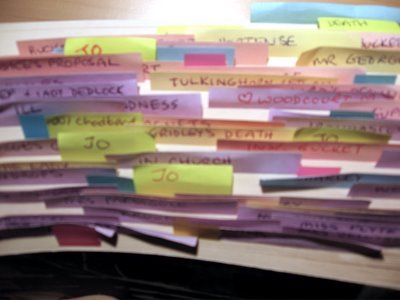
Post-Its are your friends. That passage that made you laugh or cry–the one you want to read to your friend, or copy into your commonplace book (or your Tumblr)–will rapidly be overwhelmed by all the other passages that make you laugh or cry: don’t lose track of any of them. A pen or pencil for jotting page numbers inside the back cover is handy too. You e-book users can take advantage of all the highlighting and bookmarking features your gadget provides.

Now that you’re properly equipped, your next challenge is time! You’re going to want to read, and read, and read–but modern life sometimes makes that difficult. What’s to be done?

Take the book with you everywhere, that’s what. Bank line-ups, buses, bathrooms, those precious 8 minutes while the pasta boils — you know what to do! A few pages here, a few pages there, and next thing you know, you’re 500 pages in, with only another 200 to go.

Then there’s all the time you’ll save by not watching television. Remember: the most highly-praised shows in recent years are always compared to … Victorian novels! Some of them are straight-up based on them! Just read the originals. They are always better.

When you’re actually reading, it will help to put aside modern(ist) assumptions about what novels should and shouldn’t do, such as “show, don’t tell.” Victorian novelists show plenty, but they are absolute masters of telling. They’re also kind of chatty–they like to talk to you. Yes, you, the reader. Don’t be rude. You’ll make a lot of new friends: though some of them may seem a little intrusive, and some tend to belabor the point, while still others make pretty silly jokes, well, I bet that’s true of your real-life friends too, and unlike your real-life friends, these ones will always be there when you need some intelligent, sympathetic company.

Do you assume Victorian novels are “realistic”? I do not think that word means what you think it means. Have you heard them called “traditional” a lot? Hardly! These folks were experimenting all the time. Frame narratives, multiple points of view, time-shifting, unreliable narrators, women with mustaches, people named ‘M’Choakumchild’ or, more slyly, ‘Slope’…there’s nothing they won’t try.

Have you heard that Victorian novels are loose and baggy? Not always (try Wuthering Heights), and besides, so what? That’s only a fault if you think a good novel has to be taut and linear. There are other kinds of unity. Think themes and variations for instance: Bleak House? Housekeeping. Or fog. Middlemarch? Webs. Vanity Fair? Vanity (of course). He Knew He Was Right? Husbands and wives. And so on.

Finally, try not to let Victorian novels spoil you for anything else. Sure, the work of hip contemporary novelists with promotional billboards may seem thin and reedy once you get used to the rich symphony of the great Victorians, and you’ll be forever comparing mystery novels unfavorably to The Moonstone and muttering “but he’s just not Mr. Thornton” at the end of every romance. But as Henry James (who, frankly, would have benefited from this how-to guide) pointed out, “the house of fiction has not one window, but a million.” There are other novels well worth reading.

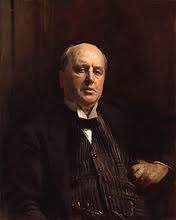
henry-james

But if, once you get started, you never want to stop, you probably won’t have to. You think Trollope was prolific, with his 47 door-stoppers? He was a piker compared to Margaret Oliphant, who published 98. And we haven’t even talked about Bulwer-Lytton yet. Well, maybe we shouldn’t, actually. I’m trying to help you to read Victorian novels, after all, not scare you away. And to be honest, Bulwer-Lytton is a Victorian novelist I’ve never read myself. If any of you want to tell me “How to Read and Enjoy a Novel by Bulwer-Lytton,” I’ll be right over to read all about it.

Happy reading!

The Quality of Mercy: Edward St. Aubyn, The Patrick Melrose Novels

melrose“If I could imagine a mercy that was purely human, and not one that rested on the Greatest Story Ever Told, I might extend it to my father for being so unhappy.” — Patrick Melrose
This is the point at which I almost stopped reading Never Mind, the first of the four Patrick Melrose novels included in this collection:

During lunch David felt that he had perhaps pushed his disdain for middle-class prudery a little too far. Even at the bar of the Cavalry and Guards Club one couldn’t boast about homosexual, paedophiliac incest with any confidence of a favourable reception.

The rape itself is told, with harrowing obliqueness, from the point of view of David’s victim, his five-year old son Patrick. Patrick doesn’t know exactly what is happening to him, and he certainly doesn’t know why. He endures it by dissociating himself from his body:

He could hear his father wheezing, and the bedhead bumping against the wall. From behind the curtains with the green birds, he saw a gecko emerge and cling motionlessly to the corner of the wall beside the open window. Patrick lanced himself towards it. Tightening his fists and concentrating until his concentration was like a telephone wire stretched between them, Patrick disappeared into the lizard’s body.

It’s a scene unbearable to contemplate, and St. Aubyn presents it with clinical precision, not buffering the horror with euphemism, or with narrative intrusions to ventriloquize our shock and outrage. David’s afterthoughts (and indeed the whole of the novel) are handled the same way, with pitiless detachment, but even though I understand perfectly well that it’s David, not the novelist, being ironic here at the expense of a raped child, it’s still a sickening moment of levity. I didn’t know if I could bear another 600 pages in this company–not David’s company, as I knew he would be dead by the beginning of the second novel (though thanks to flashbacks this doesn’t altogether spare us his presence on the page, and of course his influence is pervasive) as the company of the novelist who could dedicate his conspicuous writerly gifts to creating such a bitterly unpleasant world.

Continue reading

Fear of Flying: K. M. Peyton, The Edge of the Cloud

The Edge of the Cloud is the sequel to Flambards and picks up very tidily exactly where Flambards leaves off. It also, with equal elegance, concludes with a scene that mimics the ending of Flambards almost exactly, but, as one of the characters observes, “We’ve grown up since then.” That’s what The Edge of the Cloud is, then: a novel of transition.

Flambards is too, as I noted in my post on it. In The Edge of the Cloud, the historical shifts invoked in the earlier book become even more explicit, to the point that Christina herself perceives very clearly the widening schism between the past and the present:

[Aunt Grace] would never understand, in her hidebound Victorian way, that on the aerodrome everyone was taken for granted if they were interested in the machines. There was no distinction of class or underdog; the mechanics, the pilots, the pupils and the owners all mingled without status. Brought up in what Christina now thought of as the medieval atmosphere of Flambards with its forelock-touching subservience on the part of the servants … she looked on the way of life at Elm Park as the normal order of life. Aunt Grace would never understand this attitude.

Life for Christina and Will and their peers at the aerodrome has a Utopian quality to it despite the financial challenges and the enormous risks (which are brought home quite harshly in an awful accident near the end of the book). But it’s hard not to be aware that this period, with all the excitement and adventure of both social change and technological innovation, is an interlude, the lull before the storm of war that is on the horizon when the book begins and just breaking out as it ends: Will turns the joyous thrill ride of aviation to the service of his country by enlisting in the Royal Flying Corps. Christina’s love for Will is shadowed throughout the novel by her fear for his safety; this personal anxiety transforms into a broad national and generational fear: “She knew now that life was suddenly dangerous for very many more people than just Will.” Like Vera Brittain and her fiancé Roland Leighton, this young couple finds their youthful romance overwhelmed by a very different story, one in which they will be reduced to bit parts. The title evokes both the literal clouds that turn planes back towards the ground, then, and the looming disaster from which there will, tragically, be no turning back, no shelter.

Continue reading

My Somerville Summer Continues: Course Planning!

I continue to read both primary and secondary sources in preparation for my fall seminar on “The Somerville Novelists.” Most recently I’ve been going through Holtby’s Women and a Changing Civilization and Brittain’s Lady into Woman: A History of Women from Victoria to Elizabeth II, as well as reviewing some of their journalism: my idea at this point is to launch the course with some excerpts that will both give a sense of their voices and use their own work to set up some of the major themes and contexts, from the history of women at Oxford to the relationship between gender and literary form. Ideally, the bits and pieces I choose will show off their personalities and get the group excited to learn more about them. Then I think we’ll read a small sampling of some relevant critical writing, again to set up themes and contexts and to give us some frameworks for discussion going forward into our four common texts: Testament of YouthSouth RidingGaudy Night, and The Constant Nymph.

I often organize my upper-level seminars around group presentations, usually one for each major reading, with individual reading responses and final papers for the other assignments. This time I’m thinking that one major component will be a collaborative wiki: given the relative obscurity of our readings, I think it’s apt (and hope it will be motivating) if we think about the class as an opportunity for genuine knowledge creation, building what might actually be a resource for other people interested in our authors and topics. I’ve used wikis in a larger lecture class before (following very much the model used by Jason Jones, described here) but that was less about generating ideas (though I hoped there would be some of that, and there was) and more about recording and synthesizing. In this case, with a smaller group of more advanced students, I imagine deciding as a group, after we’ve been reading and talking for a while, what kinds of information and what kind of organization will best serve what we are thinking and talking about. I’ll have to frame it carefully to make sure we have a shared sense of what we hope to accomplish and how their contributions will be evaluated–that’s going to be the tricky part, balancing what I want to be more open-ended and creative participation with the pragmatic bottom line that I have to give them grades and my expectations thus need to be clear and specific.

Continue reading

K. M. Peyton, Flambards

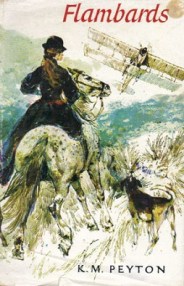
FlambardsProbably my favourite “YA” novels are K. M. Peyton’s Pennington novels, which I own in library discard copies and reread often. I’m sure I read Flambards in my youth too, but I had only a hazy memory of it, except that it involved a big house and horses. I was helping find books for my daughter at the library last week and, happening upon the handsome Oxford Children’s Classics edition of it on the shelf, grabbed it up for myself–and what a treat it was! It’s such an intelligent book, bringing together a range of historical changes all effectively dramatized through the clashes of personalities and values at Flambards, the house where young orphaned Christina is taken in by her bitter, violent uncle. His desire to hang on to a fading way of life is thwarted by his fallen fortunes as well as by his having been crippled in a fall so that he can no longer ride and hunt. His older son Mark is handsome, arrogant, and determined to follow in his father’s footsteps, a goal for which he will need Christina’s fortune, but it’s the younger son William, whose strengths are intellectual and who loves, not horses, but flying machines, who wins our sympathy as well as Christina–though not before she has a sort of romance with Dick the groom, thus bringing class, also, into the whole vexed business of personal lives that can’t help but reflect the conflicts of their times.

Peyton is a wonderful writer. I think Flambards actually lets her show off her descriptive talents more than the Pennington books do, and she’s very good with the landscapes especially. But she also captures the thrill of physical sensation as channeled for Christina through riding–along with its social themes, Flambards is very much about Christina’s maturation, including her coming to sexual awareness, and horseback riding is a time-honored way of displacing explicit discussion of those rising feelings in young women:

[Dick] grinned at her, and neither of them wanted to stop. It was too good, with the winter grass beneath them and the horses with their ears raked forward, their grey manes flying. Dick stood up in his stirrups and Woodpigeon started to gallop, Sweetbriar beside him, and this time Christina was confident, utterly trusting in her own ability, and in the infallibility of Dick. She looked across at him and laughed. Now it was right to be galloping: a great joy surged through her. And all the while the glory of it filled her with this new and incomparable happiness, she was conscious right at the back of her mind of a pity for William, and a little pit of contempt.

At this point William has yet to grow into the new model of masculinity he will embody, which will be marked by its own version of high daring and risk, but when his turn comes he will bring to it a scientific power that differentiates him from the more brutal passions of his father and brother, shown here as personally destructive and as part of a system of careless oppression: nobody but Christina is particularly concerned, for instance, when Dick is dismissed for helping her with a somewhat quixotic plan to rescue a lamed horse from being turned into dog meat. Christina becomes aware of social injustice even as she has to consider her own possible marriage to Mark and whether she will put her own resources into rebuilding Flambards or into the modern world that is making everything it represents obsolete.

It’s hard, reading Flambards today, not to see that it anticipates a lot of the themes and stories of Downton Abbey! It also fits aptly into my Summer of Somerville, at least in its historical setting. I’ve put a hold on the next volume in the series, The Edge of the Cloud, which takes us into WWI. I can’t remember it at all and am trying to avoid spoilers, but I don’t much like William’s chances if he goes into the war as a pilot…