 I’ve undertaken to write an essay on Dick Francis this summer, in preparation for which I am reading through all of his 40+ novels. His first, Dead Cert, was published in 1962, and he basically published one a year until his death in 2010 (the last few in partnership with his son Felix, who has now taken over the franchise). That’s a lot! I’ve been reading them off and on at least since the 1980s; I own about a dozen (which used to seem like quite a few, until I really took stock) and when things are busy at work I often pick a favorite to reread, as they are both brisk and smart enough to be a nice diversion without requiring a lot of attention.
It’s always interesting approaching as critical projects books or authors I have previously taken for granted or read “just” for pleasure. When I started teaching the Mystery & Detective Fiction course, I went through that with P. D. James, Ian Rankin, Sue Grafton, and Sara Paretsky (many of the other authors on the reading list are not ones I had read before, including Agatha Christie and Dashiell Hammett, so the effort there was always more academic). But what’s really different about this particular project is that I don’t typically read in bulk this way. Sure, when I find an author I like, I tend to follow up, but outside of genre fiction authors with 40 or more titles to their credit are rare, and I usually get restless after reading a few books in a genre series in a row. A good example would be Mary Balogh: when I discovered I could enjoy her books, I got a whole bunch from the library, but after racing through several, I just really wanted to read something different, and now I think of her as I had Francis, that is, as a safe option when I need some filler in my reading life. (A notable exception would be the Martin Beck novels: once I got hooked on them, I pretty much just kept reading. But there are only 10 of them anyway!)
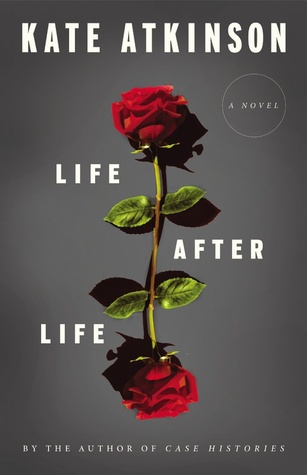
What strikes me about binge reading is the different kind of attention it requires compared to the intense close reading I’ve done for most of my recent writing — any of my George Eliot essays, for instance, or for reviews including my most recent one of Kate Atkinson’s Life After Life — or, for that matter, the reading I do for my teaching. For all of these purposes, poring over details is the essence. It’s not that I’m not reading each of these novels carefully and trying to hang on to the key details that differentiate one from another. There are plenty of these, and they matter, often substantially. But the novels do have a lot in common, and inevitably they blur together or form, in my mind, one larger whole. Since the essay I’m working on is intended as a kind of overview (though with a particular angle on women and gender roles), that’s appropriate: I’m reading all of them at once because I want to be able to generalize about them, to discuss patterns, or themes and variations, connecting threads, tropes, motifs, whatever. The individual novel is less important than the collection of novels. The more I read, the more each one I pick up reads like part of that collection, if that makes sense: the deeper into the catalog I go, the more rapidly I subordinate the particular to the general. My major challenge is not so much interpreting as keeping track: this is the first time I’ve ever used a spreadsheet as a writing tool!
And yet every novel is different. (I joked on Twitter that so far my lede is “The novels of Dick Francis are both alike and different” –ah, the bane of the undergraduate compare-and-contrast essay!) You could say that this oscillation between similarity and difference is the essence of genre fiction: its predictability is as much the appeal as the ability of a talented practitioner to surprise. I’m reminded of Josephine Tey’s sly, self-reflexive jab at formula fiction in The Daughter of Time:
Even in that, you knew what to expect on the next page. Did no one, any more, no one in all this wide world, change their record now and then? Was everyone nowadays thirled to a formula? Authors today wrote so much to a pattern that their public expected it. The public talked about “a new Silas Weekly” or “a new Lavinia Finch” exactly as they talked about “a new brick” or “a new hairbrush.” They never said “a new book by” whoever it might be. Their interest was not in the book but in its newness. They knew quite well what the book would be like.
I do notice that interchangeable widget quality as I read these books in relentless succession — and yet I always welcomed the appearance of “a new Dick Francis” precisely because I knew what it would be like but also knew that he was smart enough to mix it up, to really make it new.

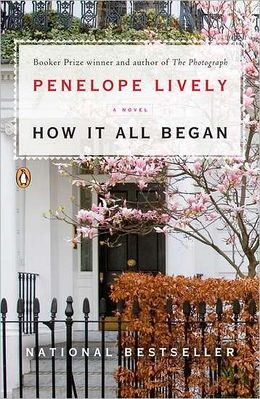 I could say very much the same things about How It All Began, which begins with a random event — here, the street mugging of retired English teacher Charlotte Rainsford — and then traces out the effects of this one moment in the lives of an array of interconnected characters. There’s a logic, or at least an intelligibility, to the way things unfold, but that is not the same as their being destined or fated, though at times the characters are tempted to interpret their experiences this way. Lively sets up the novel with a quotation about the “Butterfly Effect” from James Gleick’s Chaos, so we know that she is deliberately playing with the possibilities of this idea. The mugger (an unsavory butterfly!) couldn’t possibly have foreseen the personal and professional consequences of his own thoughtless action: “beyond him, unknown and of no interest, he had left Charlotte on her crutches, the embattled Daltons, Henry in his humiliation, Marion, Rose, Anton . . . ”


 Monday was my last day of class meetings, and now I’ve moved into the exams-and-essays phase of the term. I have mixed feelings about both final exams and final essays, but for different reasons. Final essays can be triumphant culminations of a term’s work, the products of significant reflection and practice. But they can also be perfunctory hoop-jumping or last-minute rush jobs, and because they are final, there’s no hope that you can turn them into learning opportunities. I still comment pretty thoroughly on them, but I bet we all have that disheartening file of uncollected papers stashed away in our offices: for some students, the recorded grade (which we often see as the least important part of our evaluations) is all that matters. (One of my favorite things about electronic submissions is that I can email them the marked papers, which at least puts the ball back in their courts — and doesn’t increase my clutter.) I often rethink how I approach or build up to a final essay assignment, but I never rethink including a final essay, or essay option, in my courses: organizing ideas about literature into well-supported analysis is just too fundamental to my goals for the courses, and indeed to my ideas about the discipline of literary studies.
 In my 19th-century novels class this term I tried what I hoped would be a more flexible and intrinsically valuable approach than the reading quiz: I required students to keep an online reading journal, using the journals tool in Blackboard. (I don’t like Blackboard in general, but this particular feature seemed unusually streamlined and user-friendly, so I took a chance on it.) The requirements were simple: three posts per novel minimum (no more than one per day for credit), at least 150 words and in full sentences. This way I figured they could keep track of their reading at their own pace, get regular small-scale practice writing (with the chance of regular quick feedback from me), and end up with a useful record of ideas and observations. After the first round, though, I realized that I had not been coercive enough: easily 75% of students did all three of their journals on the last three possible days, and often their posts suggested that they were way behind on the reading. What I hadn’t done, you see, is explicitly tie credit for the journals to the portions of the novels assigned for each class meeting, or insist that they stagger their work so that they were writing and thinking throughout our time on each novel. Silly me: I thought they would just be doing that anyway, and that self-interest and forethought would motivate them to do a journal here, a journal there — rather than piling them all on at the end. But apparently all that many of them wanted (and therefore got) out of the exercise was the credit for having done it. There were certainly some students who approached the whole exercise in exactly the spirit I hoped for, and kudos to them. My strong suspicion (and in some cases, my past experience) is that these are the students who don’t need coercion anyway: they’re just into it, and more power to them. But they are a minority.
 This month’s reading for the
  No Country for Old Men is stylistically enough like The Road that I feel retrospectively justified in having
  This week in my classes, which are traditional English classes rather than warm and fuzzy creative writing classes, I am burdening students with historical background, wrapping ideas in grad-school jargon, and generally obscuring the pleasures of reading and the power of literature. No, really!
 Novel Readings