This Week in My Classes: Setting the Tone

maskWelcome back to another season of “This Week in My Classes“! This will be the 8th year for this series. Sometimes I wish I’d given it a snappier title, but “This Week in My Classes” does have the advantage of being perfectly to the point. In case anyone forgets — or never knew — why I started writing these posts, there’s an explanation here, and in case anyone wonders why I keep on doing them, everything I said in this post still stands. You can track the posts through the years here. They range from very matter of fact updates about course content to broader pedagogical considerations or meditations on the meaning of it all.

One thing you’ll know if you’ve been reading these posts (or realize if you browse through the archive of them) is that I teach the same classes pretty regularly. Almost every year, for example, I teach Mystery and Detective Fiction, which sometimes strikes me as odd (because it’s not a “core” class in any way), but which serves my department well (because it’s a relatively large and consistently popular class). It’s also really fun, so I’m not complaining! Almost every year I also teach one or the other of our courses in Nineteenth-Century British Fiction, either the Austen-to-Dickens one or the Dickens-to-Hardy one. My other teaching duties routinely include sections of our introductory classes, one of our core survey classes (British Literature Since 1800), one of our core methods classes (Close Reading) and a range of upper-level or graduate seminars. All of these kinds of classes involve different problems and rewards. First-year classes are not always the most willing, for instance, though they can sometimes be the most surprising, and the most vigorous; surveys can feel like pulling intellectual teeth or like soaring over a fantastic imaginative landscape; advanced seminars can be either the most frustrating or the most electric experiences of your day.

The funny thing is, though, that not a lot of this has to do (in my experience, anyway) with the actual content of the classes. I’m not saying that it doesn’t matter what we teach, or that there aren’t some works that pose their own special challenges (Waverley, anyone?). But overriding everything else, I’ve come to think, is the relationship we establish with our students. If they trust and respect you — if they believe you are bringing your best self to the table — they will be willing to at least try almost anything, whether it’s scansion, peer-editing, building wikis, or close reading passages of Middlemarch. If they think you’re intimidating, that might help in some ways but hurt in others; if they think you’re a bit (who am I kidding – a lot!) eccentric, ditto; if they look at you with skepticism, resentment, indifference, or outright hostility, that can only be a bad thing for their classroom time and yours.

How can you set yourself up to succeed on these terms, though? I always brood about that as a new term approaches. It’s not a one-sided thing, of course: you can bring the best attitude and intentions to the room but if a student’s mind is already made up about you or the course, or if you accidentally or on purpose rub them the wrong way, that’s probably that (though we have all probably had the experience of seeing a student turn on to a course, or a reading, unexpectedly). You will never please all of the people all of the time (a reality we all lose track of when we obsess over the two most negative evaluations in a pile of otherwise perfectly fine ones). Still, if you don’t do everything you can to establish a good relationship from the start, you won’t be able to comfort yourself when things go sour by saying “well, at least I did everything I could.”

Is it an urban myth that students make up their minds about you in the first five minutes of the first class? I remember first hearing this frankly terrifying claim during one of the many thousands of angst-ridden conversations I’ve had with colleagues about course evaluations, as if had been established scientifically. Honestly, though, there’s really only so much you can do about how you come across in that first five minutes, which are often spent setting up recalcitrant technology or handing out pieces of paper. Or maybe I’m wrong about that: I guess I could do something more theatrical or innovative for five minutes and then get down to business? But no matter how hard you try, you will still look like you, and sound like you — and, not incidentally, think like you. “Behind the big mask and the speaking trumpet,” as George Eliot sagely observes, “there must always be our poor little eyes peeping as usual and our timorous lips more or less under anxious control.” It’s true that teaching is a kind of performance. But after all these years I’ve figured out that the only role I can really play is myself.

Well, it’s too late to worry any more about that for this term, since we are well past our first five minutes! I think (I hope) that the tone I’ve established so far is frank, friendly, and firm. I’m encouraged by seeing a lot of familiar faces, and by what seems like a general atmosphere of good will. We’re already deep into Villette in the 19th-century fiction class, and Friday we start on The Moonstone in Mystery & Detective Fiction: as Joe Gargery would say, “Wot larks!”

Summer 2014: A Reading and Writing Retrospective

IMG_1315We may have been basking in some gorgeous summer-like weather lately, but classes have begun and that means we are well and truly into fall. It had been very quiet around campus — though I find the hush kind of dreary sometimes, I’d gotten used to it, and I’ve been feeling kind of cranky at the return of loud, cheerful voices in the hallway, doors opening and closing all the time, and other people impeding my progress on the narrow stairs! But the renewed energy is welcome, as is (mostly) the return to a more active, immediately demanding routine.

It’s generally a bit quiet online over the summer too, so I thought I’d repeat last year’s idea and do a quick review of my summer activities, partly to bring people up to date who haven’t been around very much and partly to take stock myself.

Summer Reading

There were only a few real standouts in this summer’s reading. Chief among them is Dorothy Dunnett’s King Hereafter, which was a slow burn but became that most precious of reading experiences:  something satisfying and immersive on every level. I know Dunnett’s Lymond Chronicles so well that it was hard for me at first to adapt to the very different tone and pace of King Hereafter, but I can see why it is often referred to as her masterpiece. Reading it also prompted me to give Niccolo Rising another chance, and now I’m ready and eager to make my way through the rest of that series — though I doubt I’ll ever love it the way I love the Lymond books.

kinghereafterAnother highlight was Wallace Stegner’s Angle of Repose, a book ready-made for someone with my longstanding interest in women’s history and in intersections between fiction and historiography. A low point was Elena Ferrante’s Days of Abandonment. And another that I enjoyed reading but appreciated especially for the discussion my blog post prompted was Colum McCann’s Let the Great World Spin (I’m currently tracking down the Celine Dion book Tom recommended to help me think more about why we like or don’t like what we do or don’t.)

Some of the other rewarding reading I did was rereading with an eye to writing: Daniel Deronda, for instance, which I want to be the basis of an essay on George Eliot and marriage, and the Pennington novels by K. M. Peyton. But it seems as if many of this summer’s new books were in the OK-to-pretty good range (Finding Nouf or Burial Rites, for instance) or were fun enough without being much more than that (My Cousin Rachel or Friday’s Child).

Writing

I kept up my usual blogging over the summer, of course, with posts on my reading but also some reflections on teaching, including this reflection on facing my 20th academic year at Dalhousie. In as-yet-unpublished writing, I completed a prospectus of sorts for my George Eliot book — a conceptual sample, I would call it, something to clarify, if only for me, what kind of thinking and writing I want the book to represent. I also wrote a short piece that I submitted, experimentally, to a publication that has yet to get back to me about it (it has been 4 months and 10 days since I sent it in, but who’s counting?). At this point I’m mulling ideas about how to repurpose it, since rejection has always seemed the most likely outcome.

PenningtonI wrote three stand-alone pieces for Open Letters this summer. One was my version of our ongoing “Title Menu” feature (our attempt to take the popular form of the “listicle” and make it something more substantial and interesting than link-bait); my offering was “8 more George Eliot novels,” from Soueif’s The Map of Love to Cynthia Ozick’s The Puttermesser Papers. Then I wrote an essay about K. M. Peyton’s Pennington series, for no better reason (and really, is there a better reason?) than that they are longstanding cherished favorites of mine. I had started making notes for it before the bookish internet went berserk over a piece decrying the popularity of “Young Adult” fiction among old adult readers, and my thinking about that whole kerfuffle influenced the way I ended up framing my essay, which I thought might be received as a thoughtful contribution to the debate. I guess I should not have been surprised it didn’t get picked up at all by the people who were raging away about YA fiction just a short while before: everyone had moved on to the next thing, and also the essay is long, thoughtful (I hope) and avoids extreme declarations and hyperbole in favor of careful reading. That is not what you do if you want to play Internet Outrage! Which I don’t, really — imagine the collateral damage to one’s peace of mind! But it would be nice to be recognized a bit more widely as having something interesting and relevant to say.

My most recent piece is also for one of our ongoing regular features, “Peer Review,” in which we survey and comment on a book’s critical reception. Mine looks at the criticism to date of Elena Ferrante, whose Neapolitan novels in particular have attracted a lot of very positive (and, as I discovered, very uniform) attention. I found it a very interesting essay to work on, and now I’m watching the expected flood of coverage for her latest, Those Who Stay and Those Who Leave with much curiosity to see if anyone breaks the mould. The Wall Street Journal’s review calls it “startlingly frank,” which is right out of the usual playbook. Here too I found myself exploring territory — specifically, debates about women’s writing, anger, likable characters, and “chick lit” — that have been the subject of high profile, high stakes online exchanges. We’ll see if it sparks any discussion. It amused me to find myself doing a version of metacriticism again!

On a much smaller scale, I pitched in for our annual Summer Reading feature, and again for a Title Menu round-up of lesser-known works by major writers.

Other Projects

Two other projects provided some excitement in my summer. One was the Twitter Q&A I did in June with Stephen Burt as part of the Atlantic’s 1 Book 140 reading of Middlemarch. I was very gratified that my Middlemarch for Book Clubs site was highlighted as a resource for this, and Stephen and I had a lot of fun going back and forth about the novel. Indeed, we had so much to say to each other that we didn’t end up entertaining very many outside questions! But any time anyone wants to talk Middlemarch with me on Twitter, you know where to find me.

Then in July I worked with Matt Jakubowski on an interview for a series he’s beginning on critics and criticism. He sent me very thoughtful but also generously open-ended questions to answer by email and then patiently cut my long replies down into something manageable. I don’t usually think of myself as someone who has much visible presence as a critic (so many people review so many more books, so much faster, in much more prominent venues) — so I was flattered at Matt’s interest. I also found it useful, as well as motivating, to think about myself as a critic in the ways his questions presupposed: I do have a small but growing body of non-academic critical work to reflect on, now, and I think it is in fact underwritten by ideas about what criticism is or can be, as well as what kind of critic I want to be — or, what kind of critic I can be that might make my work distinctive.

photo

My personal accomplishments for the summer include two trips, one to Boston for an editorial summit (and, of course, some book shopping) — the other to Vancouver, for my parents’ 50th wedding anniversary festivities (and, of course, some book shopping!). I also got a tooth capped that has been broken since third grade, solved (I hope) an eye / contact lens problem that had had me looking weepy for about a year, and developed what turns out to be a “tendinosis” that put a stop to my plans to step up my running routine — that, too, I hope will be resolved soon, as I have been to see a physiotherapist at last and begun a healing regimen of exercises. None of this is exactly the kind of stuff that counts as being productive, but the store of books means more reading and writing to come, and self-care has its own value as well.

And now, it’s time to look forward! I’ll be keeping up my regular teaching posts: it will be the 8th year for “This Week in My Classes,” and while there’s bound to be some repetition in the themes and problems that come up, there’s always something new going on — this term, starting with teaching Villette in my 19th-century fiction class. I also have a sabbatical to look forward to in the winter term: my goal for this term is to keep up enough momentum on my writing that I can make the absolute most of that precious time. This may mean not writing as many smaller pieces — book reviews, for instance — that don’t serve my larger goals: I’m not someone who can crank out prose in a hurry, and “even” a review typically takes up a lot of mental space for me. On the other hand, sometimes being busier makes me more efficient, something I’m often aware of as I look back, as I have done here, at the results of my summer and find that I got as much if not more writing done in the midst of teaching!

Open Letters Monthly, September 2014 Edition

FerranteGraphicAnother new month, another new issue of Open Letters Monthly! As always, I hope you’ll check it out; I think almost anyone could find something of interest in it! Among my favorites this month are Laura Tanenbaum’s review of Julie Hayden’s The Lists of the Past, and Erin Wunker and Hannah McGregor’s essay on Joseph Boyden’s The Orenda. You’ll also find Steve Donoghue on 13 Days in September, Lawrence Wright’s new book on the Camp David negotiations; Justin Hickey on Nick Harkaway’s Tigerman; Robert Minto on a new book on the Hundred Years War; two new poems; and more! My own contribution this month is a ‘peer review’ feature on the critical reception of Elena Ferrante. The more of her reviews I read, the more I felt that something was going on that deserved some closer scrutiny. My conclusion? Well, you’ll have to pop over and read the piece, won’t you?

“The Melody in the Heart of the Universe”: Rose Tremain, Music & Silence

I have heard the melody in the heart of the universe and then lost it.

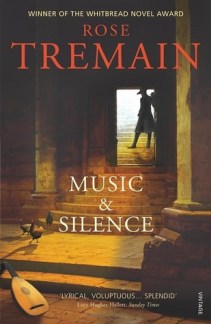
tremainLike Restoration, Rose Tremain’s Music & Silence confounds clichéd expectations about historical fiction. In its own way it has an epic sweep, but there’s nothing of the heroic saga about it. It’s drama under a blanket, a story of kings and queens and true love muffled by darkness and uncertainty. It has the extremity of fairy tales: Kirsten Munk, for instance, consort to King Christian and thus “Almost Queen” of Denmark, is a temperamentally oversized creature of voracious, noisy demands: her first-person portions of the narrative would be wholly comical if they weren’t also so sad, and if she weren’t also so destructive in her relentlessly selfish desires. Kirsten has a near counterpart in Magdalena, the wicked stepmother who forces  the Cinderella-like heroine Emilia out of the family and then, insatiably needy, seduces her step-sons.

In contrast to their hot, vociferous passions, there’s Emilia, quiet, grave, nurturing — and otherworldly, drawn, nearly out of life itself, to her dead mother’s memory. And there’s the beautiful Countess O’Fingal, beautiful, loving, but trapped by her husband’s tragedy, which is like an evil curse disguised as a blessing:

Johnnie O’Fingal had dreamed that he could compose music. In this miraculous reverie, he had gone down to the hall, where resided a pair of virginals . . . and had sat down in front of them and taken up a piece of my father’s cream paper and a newly cut quill. In frantic haste, he had ruled the lines of the treble and bass clef, and begun immediately upon a complicated musical notation, corresponding to sounds and harmonies that flowed effortlessly from his mind onto the page. And when he began to play the music he had written it was a lament of such grace and beauty that he did not think he had ever heard in his life anything to match it.

Urged by his wife to recapture the music of his dreams, he declares prophetically, “what we can achieve in our dreams seldom corresponds to what we are veritably capable of.” He does try, playing “a melody of strange and haunting sweetness,” but goes mad in grief and despair when he is never able to complete it. His desperate quest (and its painfully ironic ending) echoes that of King Christian, who has all the music he desires but is unable to bring order and prosperity to his kingdom, or to find lasting love and comfort for himself.

Yoking their stories together is the figure of Peter Claire, a lutenist so beautiful Christian calls him his angel. It seems as if Peter’s music should be the salvation both other men seek — throughout the novel music is at once the greatest mystery and the greatest joy anyone experiences. Christian tells Peter about a conversation he had with the great musician John Dowland:

He said that man spends days and nights and years of his life asking the question “How may I be brought to the divine?”, yet all musicians instinctively know the answer: they are brought to the divine through their music – for this is its sole purpose. Its sole purpose! What do you say to that, Mr Claire?

But though Peter cherishes the “rich and faultless harmony” he and the rest of King Christian’s orchestra create from their strange subterranean quarters — the King has contrived it so that the sound is carried up into the castle for the pleasure but also mystification of his guests, who cannot detect its source — his own “transcendent state of happiness” comes from his love for Emilia. The novel is in part the story of their romance, fragile, insubstantial, thwarted by Kirsten’s greed and Christian’s need. The interplay of these characters is much more complex than simple antagonism, though: Peter and Emilia are hampered by their kindness and empathy as much as by any external constraints. The price of goodness, in their world, is as likely to be loss as reward.

There are other characters and story-lines in the novel; I found their interweaving equal parts engaging and annoying, as the result is somewhat fragmented but also invites us — as literary juxtapositions always do  — to think about connections and comparisons, themes and variations. It isn’t entirely obvious to me what unifies the different elements. In the end I wonder if it’s primarily a mood or an attitude that we’re supposed to take away from our reading — a sense of what the world might be like rather than a coherent idea about what it is or should be like. The atmosphere of the book is slightly surreal, and the tone walks a fine line between being poetic and being portentous, or even pretentious. Tremain’s language falls into rhythmic cadences that shift us from the prosaic to the visionary:

Now, Emilia lies in her old bed in her old room and listens to the old familiar crying of the wind.

By her bed is the clock she found in the forest, with time stopped at ten minutes past seven.

She does not know why Magdalena was locked in the attic.

She does not know why Ingmar was sent to Copenhagen.

She cannot predict what world Marcus will enter now.

What she does know is that time itself has performed a loop and returned her to the one place she thought she had left for ever. It has stopped here and will not let her go. . . . She will grow old in the house of her childhood, without her mother, without her father’s love. She will die here and one of her brothers will bury her in the shadow of the church, and the strawberry plants, which creep further and wider each year, gobbling up the land, even to the church door, will one day cover everything that remains of her, including her name, Emilia.

 I wouldn’t want to read a lot of books written this way, or any at all written this way without the other qualities Tremain brings to it: intensely tactile historical specificity, for one thing, and an unswerving commitment to the flawed humanity of even her most grotesque characters. If Music & Silence is a fairy tale in style, I think it is, paradoxically, still a realist novel in spirit. If it has a message for us about music and silence, also, it is not that they are opposites but that (like imagination and reality) they are somehow inextricably linked, two aspects of the same attempt to express something important about life. This is something the characters are always experiencing, one way or another — that the actual sounds they can make do not quite convey the ideas and feelings they have, that their longings and loves and fears and hatreds shape their lives but are hard to give shape to in sound:

As they part, both men reflect on all that might have been said in this recent conversation and yet was not said; and this knowledge of what so often exists in the silences between words both haunts them and makes them marvel at the teasing complexity of all human discourse.

Next Week in My Classes: Beginning My 20th Year

IMG_1306I started teaching at Dalhousie in 1995-96, which means that 2014-15 will be my twentieth academic year at the university. What with maternity leaves and sabbaticals, that doesn’t mean 40 consecutive terms (though for many years I did also do summer teaching), but that’s still a long time to be in one place doing the same thing.

Or, at any rate, that’s how it felt to me when I did this calculation a few days ago. In fact, I was suddenly and unexpectedly swept with gloom as I walked across campus with the phrase “twenty years” echoing in my head. It was a beautiful sunny day, with just a hint of fall freshness in the air, but the buildings looked all too familiar, the coming routines felt all too predictable, the inevitable administrative hassles of the new term seemed almost too much to go through yet one more time. Even the prospect of teaching Middlemarch again after a two or three year hiatus wasn’t enough to cheer me up. It’s not that I don’t know how lucky I was to get this job (even in the mid-90s the market was tough, though not as devastatingly so as it has become) and it’s not that I haven’t liked — loved, even — a lot of things about it. I just couldn’t muster much pride or sense of accomplishment. What did I have to show for those 20 years?

You’ll be glad to know that this fit of depression has mostly passed, though not entirely. I think feelings like this are a hazard of what is otherwise a great blessing and comfort, namely the stability and security of my position. If it sometimes feels like a mixed blessing, because the down side to it is a high degree of immobility, it’s obviously still, overall, something to be appreciated and (not incidentally) made the most of, as with the kinds of experimenting I have been able to do with my writing and teaching. A lot of the changes that I have brought about in my working life are not immediately visible, after all. “You know where to find me,” I tell departing students, sometimes a bit ruefully or even wistfully, as they move on to the next stage of their own adventures, and it’s true I do still spend my time in the same literal spaces. But my mental life has moved on quite a bit, to the extent that sometimes I feel strangely detached from some of the preoccupations of my departmental colleagues. (Some of that detachment grew, self-protectively, out of the lack of interest in or support some of them — not, happily, all of them — have shown for my new projects, from blogging to writing for Open Letters: being defensive is not a good long-term strategy, I found, and being an advocate also gets tiring in its own way, so I have had to stop caring so much and measuring myself by their standards.) I’m much more aware than I was in 1995 that there’s life — literary life, even! — outside the academy, and that makes some of what we worry about seem much less interesting and important. Anyway, for better or worse, that’s one way in which I do feel I have not been stagnating but changing and even growing.IMG_1278

And it’s not as if I don’t have anything to show in other ways for my 20 year investment in Dalhousie. My academic research and publications certainly count as accomplishments, but when I am having a “save Tinkerbell moment” and need my belief restored, my surest remedy is a browse through the fat file folder I have of thank-you cards and messages from students. It’s enormously uplifting to know that the part I played in their lives mattered to them. Teachers at all levels can have this incalculably diffusive effect — I know my own life would be very different without the influence of my own teachers. I hope I told them how much difference they had made; I am certainly very grateful to the students who tell me, because knowing they cared helps me keep trying to bring my best self into the classroom every time. Even at a conservative estimate, twenty years’ worth is a lot of students: even if the majority move on and don’t remember my name, much less what we studied together, there are still plenty who carry something of me away with them — as I am cheeringly reminded every so often when one of them gets back in touch. “I saw someone reading Middlemarch in a restaurant awhile back and thought of how pleased you’d have been,” one former student recently emailed me, and I was pleased, not just that someone was reading Middlemarch (always a good thing!) but that she associated the book with me.

WP_20140827_005The other thing I have to show for my twenty years — something I benefit from every day I’m at work — is experience! It’s easy to forget, now, how new to all this I was in 1995-96. I was hired while still “ABD” (all but dissertation), and my hands-on teaching experience was limited to two of Cornell’s Freshman Writing Seminars (both capped — ah, luxury — at 17 students) and one stint as a TA (in a 19thC fiction class, too, because there were no first year writing classes big enough to use teaching assistants). The class on Browning’s “My Last Duchess” that I taught as part of my on-campus interview here was quite literally the first time I’d ever stood up in front of a room full of students (not to mention a back row of professors there to see how I did). So my first full-time term was really jumping into the deep end for me. I don’t recall any massive screw-ups beyond assigning way too much reading in my first section of Introduction to Literature and way too much writing in almost every class, because I had no idea how much time it would take to mark multiple papers for a class of 50 or 60. I had the time at first: I was keen to throw myself into a job I was excited about and knew I was lucky to have, and at first I had no children, either. But the hours and hours of marking … on top of having no files of teaching notes or materials to draw on, so absolutely every part of absolutely every class had to be prepared entirely from scratch. Good thing I was so young and energetic! (I was 28 when I came here, which means I was barely older than the first crop of graduate students I taught — in fact, now that I think back, I was actually younger than some of them.)

Now, on the other hand, I have a drawer full of notes, handouts, transparencies, and other materials, as well as acres of virtual storage devoted to more of the same. I don’t have everything covered, of course: every year I work in a new book or two somewhere, and I rarely use exactly the same notes or handouts twice. It is reassuring, though, to know that for a lot of texts I teach on a regular basis I have an archive to draw on for information and inspiration. I’m glad, too, that I haven’t recycled even the oldest paper materials, because I pull out treasures sometimes — such as, most recently, a cache of old student discussion questions for Villette including a set by Dorian Stuber, who was in one of the first Victorian novels classes I ever taught. Good questions about interesting books don’t go stale!

I also have found logistical systems that work well for me. I don’t think they are particularly original (when I mentioned them on Twitter, a number of people said they have similar strategies), but those of us who started teaching long before ProfHacker existed had to fumble our way into them. Since the second-most frequent comment on my student evaluations is “she’s really organized” (first is “she’s very enthusiastic”) I think they must be pretty good ones. One is very dull and basic: setting up spreadsheets to track all administrative aspects of every class, from attendance to essay submission to test scores. I don’t enjoy Excel, but  learning to use it reasonably well has shored up my record-keeping in important ways. A more fun thing I do to keep order is use color-coded folders for each course so that I can be sure I have the right ones when I’m gathering up my materials and heading out the door to teach. Red has become standard for detective fiction, and it’s usually green for 19th-century fiction, though this year I’m using some elegant William Morris folders (thanks, EB!). Other courses vary, but the key thing is that once I internalize a term’s colors I do a lot less scrambling at the last minute.

WP_20140827_004Another very simple thing I do is designate one shelf space for each course. Often coming back from class is a distracting time, with students tagging along for conferences or somewhere else to get to in a hurry, so I don’t have time to do fine sorting. Instead, I dump all the class material onto its shelf and organize it when I get my next chance — but in the meantime if I need to find a book or paper from it, my search is neatly delimited. Again, less scrambling! I have a pretty low tolerance for stress and confusion, so for me it’s well worth the little bit of forethought required. When I see offices with indistinguishable brown folders piled in heaps all over the place, I know that — while it must work for the office’s own occupant — I would be a nervous wreck by the end of a single day in there.
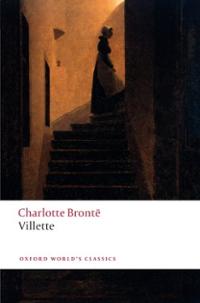
My only other crucial trick is using post-it notes — many hundreds of them, cumulatively — to mark important passages in the (yes, I admit it) very long books I teach so often. One of the treats of re-using a well-worn edition is taking advantage of the existing post-it notes, which often help me regain my footing in key interpretations and patterns as I go along; one of the treats of a brand-new copy (such as this year’s handsome Oxford World’s Classics Villette) is putting in a whole new set. (Yikes, how book-nerdy is that. But it is fun!) On Twitter, people mentioned colored pens, certain kinds of notebooks, and colored printer paper as other things that make their teaching days easier, more efficient, and also brighter. However much we use and now take for granted our electronic devices, there’s clearly still a special charm and a lot of use in old-fashioned school supplies.

So far I haven’t even mentioned the 20 years’ worth of increased knowledge I presumably have: when I consider how little I had read in 1995, and how much of that was not really very useful — well, I’m almost surprised they even let me teach! But they did, and here I still am. I’ve probably got another 20 years until I retire: just think how much more I will have read and learned and filed by then. I just have to keep my spirits up — so I don’t lose that third thing I’m often thanked for in my course evaluations: my sense of humor.

Sue Grafton: W is for Wasted [Time]

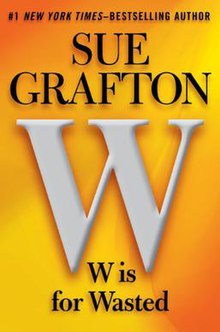
grafton-wIt’s actually a bit harsh to imply that reading W is for Wasted is a waste of time. Grafton is too good at her craft for that: the story is multifaceted and the elements unravel and then knit up together in a satisfying enough way. But it’s such a plodding book overall. First, Grafton seems to believe that she has to recap Kinsey’s history and living situation in detail every single time. Maybe she’s right about that strategically: not everyone reading W is for Wasted will have read A through V, after all, and she doesn’t want them to be confused or feel left out. That doesn’t make it any more interesting for those of us who already know all that. I’ve been trying to think how the other authors of long-running mystery series handle this continuity problem. That I can’t remember ever being bored or annoyed by, say, Robert B. Parker, or P. D. James, or Elizabeth George for the same reasons suggests that whatever they do about it, it’s somehow more artful. Grafton’s decision to keep Kinsey in the 80s also contributes to the boredom, I think: she and her life haven’t changed or progressed very far in the 30 years the series has been coming out.
Then there’s Grafton’s T. M. I. problem, which I’ve written about beforeW is for Wasted is just as lifelessly detailed as whichever one of her novels I was reading then. I’m not a fan of the silly “show, don’t tell” rule — but that doesn’t mean you have to tell us everything. There are examples of needless specifics on pretty much every page; here’s a representative bit from Kinsey’s arrival at a low-budget motel:

I unlocked the door and flipped on the light. The interior was dank. On the beige wall-to-wall carpet there was a ghostly foot path from the bed into the bathroom. A small secondary side road ran from the bed as far as the television set. I did a quick circuit. The heating and air-conditioning system, if you want to call it that, was a narrow unit installed just under the windowsill, with seven options in the way of temperature control. Heat: off or on. Cold: off or on. Fan: on, off, or auto. I tried to calculate the number of possible combinations, but it was way beyond my rudimentary math skills. The bathroom was clean enough and the motel had provided me two bars of soap, neatly sealed in paper. One was slightly larger than the other and was intended for the shower. I unwrapped the smaller one, standing at the sink. The chrome fixtures were pitted and the cold-water knob squeaked in protest when I paused to wash my hands. I felt a tap on my head and looked up to find water dripping slowly from a ceiling fixture. I unloaded my toiletries from the duffel — shampoo, conditioner, deodorant, toothbrush and toothpaste — and lined everything up on the vanity. True to form, there were no other amenities provided, so I was happy I’d brought my own. I tried the wall-mounted dryer and smelled burning hair.

I was getting a bit long in the tooth to stay in places like that.

 I’m getting long in the tooth waiting for you to get on with it! OK, I understand, you’re setting the scene, but (1) you really don’t have to, since Kinsey is going to spend exactly one night in this dive and nothing of significance will happen to her there and (2) even if for some reason you want us to be able to really picture it, you could pick some resonant details (the worn path on the carpet, for instance, and the smell of burning hair) and leave out the fan options, the number of bars of soap, and the list of her entirely predictable toiletries. The book is padded like this throughout, as if Grafton just can’t tell what to leave in and what to leave out:

I opened the bottom drawer and pulled out the telephone directory. I flipped to the Ss in the business listings and ran a finger down the page until I found “Santa Teresa Hospital.” There was a general number listed, a number for the emergency room, one for poison control, and then a few department numbers that could be dialed directly, including administration, billing, patient accounting, human resources, development, and public affairs.

Even setting aside the irrelevance of these details to the plot, who are the readers who need to be told this? She even makes sure to acknowledge the most mundane conversational moves:

Two rings, and he picked up.

“Is that you, Drew? This is Kinsey Millhone.”

“Hey, great! I can’t believe I’m actually talking to you.”

We spent a few minutes congratulating ourselves on finally managing to connect and then we moved on to the subject at hand.

We know how these things go, don’t we? We don’t need to be walked through them in what starts to seem like real time. I don’t see why a good editor wouldn’t point this kind of thing out. Maybe once you achieve best-selling status you don’t get interfered with by editors. Maybe I’m just too fussy. Maybe I just don’t like her style — except I don’t see this as a style but more as the complete refusal to be stylish. And one reason it frustrates me is that I think this labored method has smothered the fun of the series. I teach A is for Alibi often in my ‘Women and Detective Fiction’ seminar and it’s much more entertaining — brisk, tongue-in-cheek, and also innovative in its use of genre conventions. It’s also literally half the length of W is for Wasted. I often wish for more from the mysteries I read: more character development, more thematic richness, more interesting use of language. What I don’t want is just more words. I think I might not make it to the end of this alphabet.

Reading, Writing, Watching: Villette, Ferrante, Downton Abbey

villette-charlotte-bronte-paperback-cover-artYou wouldn’t know it from the lull here at Novel Readings, but it has been a busy few days. (Actually, you should know it from the lull, which is always a sign that things are busy elsewhere!) I haven’t made much progress yet with the book I chose to follow A Morbid Taste for Bones, which is Rose Tremain’s Music and Silence, but I hope to get back to it soon, as I was very impressed by Restoration when I read it last summer. I have been reading, though: yesterday I finished Villette, which I’m teaching in the fall for the first time in many years. It is a splendid novel in many ways: dark and twisty and, especially in its narration, full of tricks and surprises. Is it a better novel than Jane Eyre? I often stumble on evaluative questions like this, which (at least when both books involved are strong of their kind) demand so much further specification before they make any real sense. Better at what? On this read-through, Villette struck me as more prolix than Jane Eyre, particularly the religious arguments and disquisitions. The language is also more florid, though this can often be attributed to Lucy’s character, which is more morbidly introspective than Jane’s, but also, paradoxically, more theatrical. The novel as a whole is also more elaborately metaphorical, and the story it tells is more psycho-drama than Bildungsroman. There’s a wonderful fierce energy to Jane’s progress through her life. Lucy shares Jane’s determined independence, but not her flair for action or confrontation. Lucy’s yearning for love, and her attempt to (sometimes literally) bury her feelings, is very poignant. I expect we will talk a lot in class about her various doubles or foils in the novel and how (or whether) she herself ends up embodying anything like an ideal, as well as whether her final affair de coeur — or any of the marriages in the novel — is a model. I’ve always had my doubts about that tiny house with its “small round table,” its “little couch,” its “little chiffonniere”: it’s a bit too much like a doll’s house for me. We did a group read of Villette at The Valve a few years ago that was a lot of fun; I’ll have to mine those discussions for ideas.

I’ve also been writing my piece for the September issue of Open Letters Monthly. I’ve only just submitted it for editing by my colleagues, so I’m not sure how close I am to being done with it. I won’t say much about it here so it will still be fresh when it comes out, but the basic idea is that we do a semi-regular feature at OLM called “Peer Review,” in which we review the reviewers, and as I got quite interested in how people were talking about Elena Ferrante, I decided to try my hand at one of these focusing on her reception. Those of you who hang out with me on Twitter will have seen some of the choicer morsels there. I’m doing the usual editing for the new issue too, including on a couple of pieces for which I’m the “commissioning editor” (which means overseeing and collating all the input and working out revisions with the authors): I enjoy this work a lot, though it sometimes surprises me how challenging it is.

DowntonAbbeyFinally, my husband and I have been catching up on Downton Abbey. I watched the first season not long after it came out and opted not to continue, as it sort of bored me: I felt that, having seen much of Upstairs, Downstairs in the olden days and then watched Gosford Park and The Remains of the Day in the meantime, Downton didn’t offer me anything particularly new. I still think that’s true as far as the type of show it is, but once we started working our way through it we did get caught up in the personal dramas, and especially following the UK House of Cards the production and the acting in Downton are so luxuriously splendid. By the end of Season 4, we were laughing ruefully at the plot twists, which start to seem quite random, as well as rather tortuous (must Thomas always be so conniving? did we really need such an elaborate scheme to work out whether Bates would or would not be accused of murder … again?). It’s not actually a good choice for binge-watching, I think: it doesn’t give you the satisfaction of feeling you’ve watched something significant build up, the way The Wire or Deadwood does. It’s very good for doing crochet to, though! (If you want smarter commentary on Downton Abbey, you should read Joana Scutts’s two essays on it in Open Letters Monthly.)

I wish someone would take the energy and talent that goes into Downton Abbey and make a show about Somerville College before, during, and after the war! Imagine a series that looked, not at aristocrats and their servants in their country houses, but at the circles people like Vera Brittain and Winifred Holtby moved in: the writers and activists and reformers who were deliberately shaping the new England the Granthams are mostly just reacting passively to. You could have Bloomsbury subplots, since Woolf would be a good marketing tool, and tell stories based on people like Rebecca West and Dorothy L. Sayers, who were the real deal compared to Lady Edith and her magazine column and hidden shame. (Does anyone else think that Tom’s new friend Sarah Bunting is based on Sarah Burton from South Riding, by the way? An outspoken red-headed school teacher with progressive ideas, initials SB?)

“Aim at making everybody happy”: Ellis Peters, A Morbid Taste for Bones

Cadfael

“Aim, he thought, at making everybody happy, and if that’s within reach, why stir up any kind of unpleasantness?”

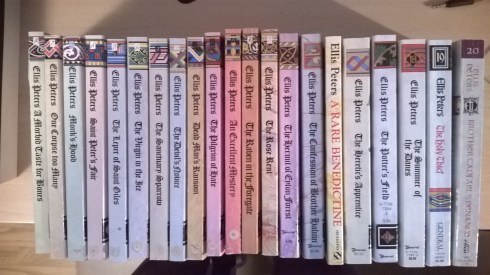
Thanks to the generosity of a retired colleague who is pruning her book collection, I recently came into possession of not one, not two, but all twenty-one of Ellis Peters’s Brother Cadfael mysteries. This series has long been on my radar, as it is beloved of many of my reading buddies including Colleen (formerly of Bookphilia, now of Jam and Idleness) and Steve (of Stevereads, of course!). I have made a couple of gestures towards it in the past, getting one or two from the library, but never actually read any. Who knows why: the timing just wasn’t right. But if this gift wasn’t a sign, I’m not a mediæval Welshman.

OK, so I’m not, but Cadfael is, and now that we’ve met at last I recognize his charm, and the charm, too, of the world and the style Peters creates for her readers. The cover describes A Morbid Taste for Bones as “a mediæval whodunnit,” and it is a lot closer to the puzzle form than the denser, more character-driven mysteries I typically choose for my own leisure reading (I never read Agatha Christie except for teaching, and I eschew the endless pageant of her “cozy” successors). I also don’t tend to like historical mysteries, which (like a lot of historical fiction generally) often strikes me, fairly or not, as either facile or encumbered with its research. (I accept George Eliot’s judgment that good historical fiction requires “the rarest concurrence of acquirement with genius.”) Peters deftly triumphed over my prejudices, though: the abundant research obviously required to present Cadfael’s world in such detail — from herbal remedies to weaponry to burial rites —  is deployed very naturally into elegant descriptions of setting and character, with more complex social or cultural contexts explained through natural devices such as Cadfael’s need, as a Welshman, to interpret or observe differences in custom between his countrymen and his Saxon colleagues.

Peters’s style tends a bit to the florid here (at one point Cadfael rushes into a room like the bolt from a crossbow and out again like a thunderbolt): I wonder, and even hope a bit, that as the series progresses she calms down enough to trust to her action to provide excitement, without insisting so much on it as the narrator. But that same instinct for rhetorical flourishes leads her into some nicely poetic moments:

The wood ridge on either hand ran in oblique folds, richly green, hiding the scattered house-steads. The fields were already planted, and here and there orchards flowered. Below them, where the woods drew back to leave an amphitheatre of green, there was a small stone church, whitewashed and shimmering, and a little wooden house beside it.

 Can’t you just picture it?

It bodes well for the rest of the series that I particularly liked Cadfael himself, especially his desire to work out a solution that satisfies justice without undue vengefulness and that also does as much good to as many people as possible. His benevolence doesn’t feel saccharine, because of his pragmatism and the ruthless wiliness of his schemes to uncover the evildoers. He’s also wry and uncompromising in his judgments of his fellow man, and I expect his dislike of men who use religion to serve their personal ends will be an ongoing theme.

I was particularly interested to see how Peters would deal with religion. All things supernatural are verboten in the puzzle mystery proper, of course. In their own ways, though, all the characters in A Morbid Taste for Bones are believers, and some of what they believe is explicitly supernatural (for instance, that the murder victim will bleed afresh if touched by his murderer). I thought Peters did a nice job conveying the centrality of her characters’ beliefs to their lives and to the ways they interpret the things that happen to them, even as she and Cadfael approach the crime itself as one committed by human hands for human reasons, and solvable by human reason and ingenuity. Brother Cadfael himself is quite prepared to believe in miracles, but it’s his intervention, not God’s, that reveals whodunit. At the same time, there’s just a hint that he and his collaborators may have been helped, or served, by the Saint whose bones are at issue in the plot. We don’t have to believe that, but it makes sense that Cadfael would be willing to, and so in that way Peters gets to have her mystical cake and eat it too.

I’m not going to binge read the rest of the series, since I have a lot of other books I’m keen to get to, but having sampled it at last, I’m happy knowing the rest of them are there waiting for me. Fall term is coming, and with it a lot of busy, stressful days when a little time with Cadfael will feel like a perfect time out.

Hero as Kitten: Georgette Heyer, Friday’s Child

fridayschildEarly in my Heyer adventures I was advised to stay away from the ingénue heroines. I’ve read about a dozen of Heyer’s novels now, and by and large I have followed that wise advice, seeking out and greatly appreciating the more mature, sensible, or knowing heroines of Venetia, Frederica, Devil’s Cub, or Black Sheep, for instance. Friday’s Child, however, features a heroine who is not just an ingénue but very nearly a child bride, an uncomfortable set-up indeed. Hero Wantage is just 16 when she is carried off to be married by special license to Lord Sherington, who is himself a bit anxious that he’s out of line. “Damme,” he exclaims as they hatch their scheme, “you’re nothing but a baby! . . . I don’t mind people calling me a libertine, but I’m damned if I’ll have them saying I took advantage of a chit not out of the schoolroom.”

He does marry her, however, though what he proposes and then establishes appears to be a marriage in name only: “you needn’t fear I shall be forcing my attentions on you,” he tells her at the outset, and there are no signs of passion or intimacy between them for nearly the entire novel. I wrote once before that I was finding Heyer’s novels “romantic but not sexy.” This reserve is a bit of a relief in this case, since Hero is so very young, not just in age but in outlook. She adores “Sherry” but follows him around craving his attention and approval in a manner more like a pet than a person — which makes it all the more cute but also irksome that he nicknames her “Kitten.” It would be creepy if he did sleep with her, or at least if he did so before they both grew up a bit.

I found it interesting that this very un-sexy relationship is at the heart of a novel that is actually quite sexually frank. Sherry is something of a libertine, known for his “bits of muslin” and his opera dancer. His associates are not much better, and one of them is such an unrepentant rake that there’s a pivotal scene involving a confrontation with his abandoned mistress and child. Hero’s marriage propels her, quite unprepared and without proper chaperonage, into the midst of this wholly unsuitable milieu. She is protected by her perfect innocence, but eventually even Sherry realizes that he isn’t doing at all right by his wife by exposing her to such habits and people. His friends, quickly won over by Hero’s good humor and guilelessness, become her allies and attempt to correct Sherry’s bad judgment. At the same time, though, his marriage clearly strikes them as odd, and one reason seems to be that they realize it is not a full marriage. The most explicit suggestion that to them, Sherry is wronging his wife by not consummating their relationship, comes from the Byronically handsome George Wrotham, who enrages Sherry by kissing Hero at a ball. It’s all just friendly (“There was nothing passionate in this embrace, and Hero had no hesitation in receiving it in the spirit in which it was clearly meant”), but it sure looks bad, and Sherry calls Wrotham out. Urged by his cronies to apologize, George bridles:

‘Sherry’s a dog in the manger!’ said George, his eye kindling. ‘Why don’t he kiss her himself? Tell me that!’

‘Nothing to do with the case,’ replied Mr. Ringwood. ‘What’s more, not your affair, George. I don’t say you’re wrong, but it don’t alter facts: you ought not to kiss her!’

Why should it be that Wrotham and Ringwood can see their precious Kitten in this different light but not her husband? As the novel tells it, the fault lies entirely with Sherry, whose maturation is brought about by his dawning awareness that being a good husband to Kitten means living more responsibly and, eventually, loving her entirely. It’s not so much Kitten who’s not ready, that is, despite her youth; it’s Sherry, who sees Kitten as so entirely separate from his own world of self-indulgent pleasures that it doesn’t seem to occur to him that she might have desires of her own beyond fun and bonnets.

If Kitten were a lot more than he thinks — if we knew what he doesn’t, namely that she is not a “chit” or a child but has strengths and resources and some adult perspective on the world — all would be well. But Kitten never does show herself as an adult. She’s forever getting into scrapes and being rescued; even the dénouement, which shows all Heyer’s unbeatable talent for bringing her various story lines together into a great comic finale, turns on other people’s planning, with Kitten never rising to the level of her real name. Her feelings for Sherry seem like a school girl crush from beginning to end, and when they do finally fall into a “passionate embrace” it doesn’t deter him from calling her a “brat” with his usual air of superiority. Add to that his tendency to bully her and box her ears — behavior that, to their credit, Ringwood and Sherry’s other friends find offensive (“he’s got no right to behave like a curst brute”) — and he’s far from my favorite Heyer hero, even if (like all good romance rakes) he does repent and reform.

And yet Friday’s Child serves up a lot of fun and laughs. It’s especially rich with Regency slang: I didn’t understand half of what Sherry’s “Tiger” Jason says (“Lor, you must have had a shove in the mouth too many, and I never suspicioned you was so lushy, so help me bob! Werry well you carries it, guv’nor! werry well, indeed! Gammoning me wot knows you you was sober as a judge, and all the time as leaky as a sieve!”), and the repartee among Sherry’s friends, if not exactly witty, is endlessly amusing. Also, the one truly nasty fellow gets his comeuppance just as he should. It’s just that to really enjoy these things that Heyer does so well, I had to fight off the faint queasiness induced by the other aspects of the novel.

Zoë Ferraris, Finding Nouf

noufFinding Nouf was one of my choices at Hager Books on my recent trip to Vancouver. I didn’t have any specific recollection of having heard about it before, but it turns out that a couple of people I know (well, know virtually, anyway) reviewed it when it was newly out, so perhaps that’s why the title caught my eye as I browsed the mystery section. I always have my eyes open for books that might bring a new twist on the genre to my detective fiction course — I’ve gotten more than a few good ideas from comments here and on Twitter over the years, including the Martin Beck books (now I routinely assign The Terrorists) and Walter Mosley (Devil in a Blue Dress is also now a staple). Inevitably in a course like this we talk a lot about common tropes and conventions; we work through some of the works that established the ones that are now central to the various subgenres of mystery fiction, and then we look at how those conventions can be used to explore a range of different issues that extend a single crime into a broader investigation — Sara Paretsky looks at systemic crimes like sexism and corporate corruption, for instance, Mosley at racism and structural inequities, Ian Rankin at the kind of social and political conflicts that have led some critics to call his Rebus books contemporary versions of the Victorian “condition of England” novel.

It looked like Finding Nouf might do something similar by using its specific crime (the murder of a daughter from a privileged family) to explore social and cultural issues in its own context, contemporary Saudi Arabia. To some extent it does exactly that: finding out what happened to Nouf involves exposing not just the nature of her very restricted life but her feelings about that life, and they are not happy ones. The story of her attempt to escape to a new life is not really as interesting, though, as the effect discovering her story has on Nayir, a friend of the family whose skills as a desert guide lead them to ask for his help while she is still missing, and who keeps on asking questions about her fate even after the family has asked him to stop. Though I didn’t find Nayir’s motivation convincing (at times, the machinery necessary to keep the investigation moving forward seemed pretty creaky), I thought his character protected Finding Nouf — which in some ways is very predictable — from some of the clichés that plague books about “life behind the veil” aimed at Western readers. If the only investigator were his accidental partner, Katya, the novel’s ideology would be a simpler one of resistance to the oppressions of being a woman in Saudi Arabia. But Nayir is profoundly pious — the sections told from his point of view are permeated with prayers and suras from the Quran — and conventional about women’s hidden lives and faces, and he is presented very sympathetically.

Katya, who both works and readily unveils, challenges his expectations and feeds his curiosity about women, while the revelations about Nouf help him sympathize with yearnings for something different. Their work together reflects the divisions of Saudi life (he has greater mobility and access to outside spaces, but only she can enter the women’s private spaces), but the fact of their working together defies it, which makes Nayir extremely uncomfortable at first but which comes to suggest (even to him) the benefits of freer interaction and greater equality between the sexes. It’s their story more than Nouf’s, then, which carries real thematic weight. To avoid spoilers, all I’ll say about Nouf’s case is that there’s a degree of misdirection that plays rather cleverly (or so I thought) on the likelihood that Western readers would expect the crime to confirm her status as a victim of women’s oppression, whereas the truth — while related to the context of women’s narrow lives — is more personal than political. (In this respect Ferraris’s plotting reminded me of Elizabeth George’s in Deception on His Mind). It’s a salutary reminder, if you like, not to take our categories of good and evil too simply for granted, a lesson Agatha Christie also teaches when she plays on, say, our trust in nice country doctors.

Finding Nouf had a lot of interesting aspects to it, then, but as a whole package it wasn’t entirely successful. There’s the creaky machinery, which I’ve already mentioned. Then the writing struck me as uneven: some of it is interesting and evocative, and there are many interesting “insider” details about life in Saudi Arabia that were vivid without being cheaply exoticizing (I particularly appreciated the cardamom-flavored Chiclets), but there were also soggy cliches and overwrought moments that didn’t do the work I think they were supposed to of ratcheting up the novel’s emotional intensity (“standing frozen in the hall, her heart split in half and lying on the ground”). The pacing seemed slow, the discoveries a bit protracted, though the novel itself is not that long. I have been wondering whether (as Mark Athitakis asks here) Ferraris would have done better to write a straight-up novel set in Saudi Arabia instead of  using the conventions of detective fiction, but on reflection I think it was a good instinct, given the potential of the genre to do the kind of exposé and critique Finding Nouf offers. It’s just harder than it looks to perfect the balance of form and substance, formula and novelty, that such a novel requires.

I can’t see myself assigning Finding Nouf in my class: it’s not interesting enough qua mystery novel for that. But I might try the second one in the series, just for myself, to see how Ferraris develops.