 All Quiet on the Western Front is as bleak and compelling a version of the “lost generation” narrative of World War I as I’ve read. In fact, Paul Bäumer, the novel’s narrator, comments explicitly, repeatedly, and bitterly on the chasm between the generation fighting in the trenches and the older generation far away from the front lines. “We agree that it’s the same for everyone,” Paul and his comrades conclude;
not only for us here, but everywhere, for everyone who is of our age; to some more, and to others less. It is the common fate of our generation.
Albert expresses it: “The war has ruined us for everything.”
Though the novel is replete with vivid vignettes, from the tedium of training to the camaraderie of trench life and the horrific chaos of bombardments, the most poignant moments arise when the young men (and they are so very young, most of them, just the age of so many of the first-year students I’m about to meet) reflect on the war’s catastrophic effect on normalcy:
To-day we would pass through the scenes of our youth like travellers. We are burnt up by hard facts; like tradesmen we understand distinctions, and like butchers, necessities. We are no longer untroubled–we are indifferent. We might exist there; but should we really live there?
We are forlorn like children, and experienced like old men, we are crude and sorrowful and superficial–I believe we are lost.
They can’t even imagine what they will do when it ends: even if they are lucky enough to survive at all, much less intact, what’s the value of a life from which all meaning has been stripped? The physical violence ultimately comes across as peripheral–collateral, even–to the other damage they endure:
The first bomb, the first explosion, burst in our hearts. We are cut off from activity, from striving, from progress. We believe in such things no longer. We believe in the war.
Battle is terrible, but it allows no time for reflection; Paul (and the reader) hurtles along, transformed from a thinking being to a “wild beast”:
We do not fight, we defend ourselves against annihilation. It is not against men that we fling our bombs, what do we know of men in this moment when Death is hunting us down–now, for the first time in three days we can see his face, now for the first time in three days we can oppose him; we feel a mad anger. No longer do we lie helpless, waiting on the scaffold, we can destroy and kill, to save ourselves, to save ourselves and to be revenged. . . . [C]rouching like cats we run on, overwhelmed by this wave that bears us along, that fills us with ferocity, turns us into thugs, into murderers, into God knows what devils; this wave that multiplies our strength with fear and madness and greed of life, seeking and fighting for nothing but our deliverance. If your own father came over with them you would not hesitate to fling a bomb at him.
It’s when you stop to think that the true madness of war overwhelms you, because of course it is against men that you fling your bombs, and only the decisions of other men far removed from the consequences have turned ordinary people into enemies. “Just you consider,” observes Paul’s mate Katczinsky,
“almost all of us are simple folk. And in France, too, the majority of men are just labourers, workmen, or poor clerks. Now why would a French blacksmith or a French shoemaker want to attack us? No, it is merely the rulers. I had never seen a Frenchman before I came here, and it will be just the same with the majority of Frenchman as regards us. They weren’t asked about it any more than we were.”
“Then what exactly is the war for?” asks Tjaden.
Kat shrugs his shoulders. “There must be some people to whom the war is useful.”
“Well, I’m not one of them,” grins Tjaden.
“Not you, nor anybody else here.”
But it is dangerous to think this way, or to think at all, as Paul discovers during a turn guarding a group of Russian prisoners. In the trenches, the enemy is abstract until he is upon you, and then your common humanity becomes irrelevant in the desperate struggle to survive. But face to face, what you perceive is “the suffering of the creature, the awful melancholy of life and the pitilessness of men”:
A word of command has made these silent figures our enemies; a word of command might transform them into our friends. At some table a document is signed by some persons whom non of us knows, and then for years together that very crime on which formerly the world’s condemnation and severest penalty fall, becomes our highest aim. But who can draw such a distinction when he looks at these quiet men with their childlike faces and apostles’ beards. Any non-commissioned officer is more of an enemy to a recruit, any schoolmaster to a pupil, than they are to us. And yet we would shoot at them again and they at us if they were free.
Paul pulls himself up short here: “I am frightened: I dare think this way no more. This way lies the abyss.” Yet he realizes, too, that he needs these thoughts: “I will not lose these thoughts, I will keep them, shut them away until the war is ended.” Though it is these thoughts that make the war unbearable, it is also these thoughts–these moments of recognition–that he hopes give him “the possibility of existence after this annihilation of all human feeling.”
Human feeling surfaces again when, hiding in a shell hole during an enemy attack (and how odd and salutary it is, just by the way, to be on the German side for once in my reading), Paul stabs a Frenchman who tumbles in on top of him. He had expected this moment, prepared for it (“If anyone jumps in here I will go for him … at once, stab him clean through the throat so that he cannot call out; that’s the only way”), but he is not, in fact, prepared (how could he be?) for this moment when killing becomes intimate. He strikes without thinking and feels “how the body suddenly convulses, then becomes limp, and collapses.” The man does not die, however–at least, not at once, and Paul is trapped in the shell hole with a man who now seems, not his enemy, but his victim. This way, indeed, lies the abyss:
These hours. . . . The gurgling starts again–but how slowly a man dies! For this I know–he cannot be saved, I have, indeed, tried to tell myself that he will be, but at noon this pretence breaks down and melts before his groans. . . . By noon I am groping on the outer limits of reason. . . . every gasp lays my heart bare. This dying man has time with him, he has an invisible dagger with which he stabs me: Time and my thoughts.
At last he dies: what a relief! “I breathe freely again. But only for a short time.” At least his dying was a distraction: “My state is getting worse, I can no longer control my thoughts.” Insanely, pathetically, beautifully, he tells his dead companion what he is thinking:
“Comrade, I did not want to kill you. If you jumped in here again, I would not do it, if you would be sensible too. But you were only an idea to me before, an abstraction that lived in my mind and called forth its appropriate response. It was that abstraction I stabbed. But now, for the first time, I see you are a man like me. I thought of your hand grenades, of your bayonet, of your rifle; now I see your wife and your face and our fellowship. Forgive me, comrade. We always see it too late. Why do they not tell us that you are poor devils like us, that your mothers are just as anxious as ours, and that we have the same fear of death, and the same dying and the same agony–Forgive me, comrade; how could you be my enemy? If we threw away these rifles and this uniform you could be my brother just like Kat and Albert. Take twenty years of my life, comrade, and stand up–take more, for I do not know what I can even attempt to do with it now.”
After he finally brings himself to leave the shell hole, Paul is restored to reason (or what passes for it during war) by Kat showing him the snipers gleefully picking off enemies. “What else could you have done?” ask his friends. “That is what you are here for.” “It was only because I had to lie there with him so long,” Paul says; “After all, war is war.”
That simple tautology says everything that is to be said, and at the same time it says nothing, offers no meaning, no consolation. There is nothing to be said, Paul thinks, as, recovering from a wound, he looks at the wreckage of young lives passing in a ceaseless stream through the hospital:
And this is only one hospital, one single station; there are hundreds of thousands in Germany, hundreds of thousands in France, hundreds of thousands in Russia. How senseless is everything that can ever be written, done, or thought, when such things are possible. It must be all lies and of no account when the culture of a thousand years could not prevent this stream of blood being poured out, these torture-chambers in their hundreds of thousands. A hospital alone shows what war is.
Paul’s testimony–Remarque’s novel–shows that too, with harrowing simplicity. For Paul (for Remarque) war is definitive. It is everything. Beyond it, for those who have experienced it, there is nothing:
And all men of my age, here and over there, throughout the whole world see these things; all my generation is experiencing these things with me. What would our fathers do if we suddenly stood up and came before them and proffered our account? What do they expect of us if a time ever comes when the war is over? Through the years our business has been killing;–it was our first calling in life. Our knowledge of life is limited to death. What will happen afterwards? And what shall come out of us?
I had been interested in reading All Quiet on the Western Front for many years; I finally read it as part of my preparation for my Somerville Novelists seminar. It is an example of what Testament of Youth is not: a soldier’s story, a first-hand (if fictionalized) account of fighting and survival and tactics and rations and brothers in arms. It is the masculine story of the war, and as many of the critics I’ve read point out, that’s the valorized story, the “authentic” one. Brittain knew these aspects of the war only second-hand, through the letters she received from the front and through her experience as a nurse. There are many points of convergence, though. Above all, both tell a story of lost innocence. And both focus almost exclusively on the personal, on individual disillusionment, devastation, and loss–but both lead us towards political conclusions by making it impossible to understand what cause could possibly be worth such a price. Outside their books, we might well feel there’s an argument to be had about that. Reading them, though, it’s hard to do anything but mourn.

From the Novel Readings archives (lightly updated). First published September 2, 2012.
Photo of field of poppies from Wikimedia Commons.
 I almost didn’t finish reading Mapp and Lucia. I’m glad now that I did, not because I take any uncompromising stand on whether one should or should not finish every book one starts, but because if I’d put it aside at the point I’d reached as of yesterday, I would never have known that the heroines get swept out to sea on a kitchen table. That was a surprise! And when they come back, thus thoroughly upsetting everyone who has (with oh, such difficulty!) come to terms with their loss, not to mention their homes and possessions and fortunes — OK, I admit it, it’s wonderfully done, with the perfect balance of malice and brio, which also perfectly describes Mapp and Lucia themselves. For people who like that sort of thing, Mapp and Lucia is definitely the kind of thing they’ll like.
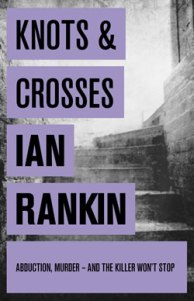 I spend a lot of time fretting about which books I assign in my Mystery and Detective Fiction course — because once you get past the few absolute “must haves” (something by Poe, some Sherlock Holmes, The Moonstone, something to represent the Golden Age, one of the hard-boiled essentials) there are many good reasons but no real imperatives to help me choose from the tens of thousands of possibilities. My guiding principles are coverage (of the major subgenres, such as the police procedural) and diversity (of voice or point of view), but that doesn’t really narrow things down that much. I’ve asked for suggestions quite a few times here, with great results: I have readers like Dorian to thank, for instance, for prodding me to read Sjöwall and Wahlöö, whose The Terrorists is currently a staple of my course reading list.
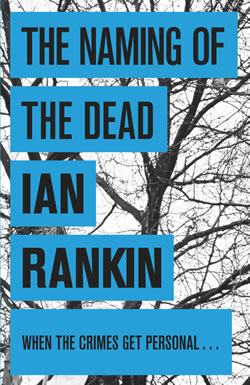 And yet … I am not convinced that I should replace Knots and Crosses after all! Much as I’m enjoying rereading it, I’m not sure it would be as teachable as Knots and Crosses, and my hesitation over this has had me wondering: what do I mean by “teachable”? It’s not something I ever really consider about Victorian novels when choosing among them for my 19th-century fiction classes, but when I’m scouting for mystery novels to assign — or contemplating assigning some new (or new to me) novel for an intro course — “How would this work in the classroom?” is always a concern. And for the majority of mystery novels I read, the (usually unarticulated) response to this question is “it wouldn’t”: I put most of them aside without seriously considering them for my syllabus, which strikes me as interesting. Why would that be? Might it (she says a little nervously) have something to do with the “literary” vs. “genre” fiction distinction? Or, to be more precise, with the ways that methods for “teaching” a novel (at least for me) align with qualities that are more likely to occur in “literary” fiction?
 Then there are other constraints on teachability: more pragmatic ones. Again, with Victorian novels I mostly don’t worry too much about these, though I am wise, or cautious, or jaded, enough never to assign two genuine door-stoppers in the same term (say, Bleak House and Middlemarch). Students who sign up for “The 19th-Century Novel from Dickens to Hardy” have to know what they are getting into! But the mystery class is a lower-level course that is purely an elective for everybody in it. I can barely get them all through The Moonstone (and in fact I am confident there are always some who never make it to the end) — and that’s a book that’s so interesting I can barely stop talking about it myself! It earns its two weeks of class time by being not just important but really complex and (for the class) quite challenging. This is actually where I fear The Naming of the Dead falls apart as an option (though I’m not 100% sure yet). Its nearly 500 pages are not nearly as dense as The Moonstone‘s, but in a way that’s just the problem: it goes on for almost as long a time without actually being as complex. It is broad, I might say, and it’s smart, but it’s not particularly deep. I’m not sure about this, because I haven’t tried to map out any lecture topics, but it would be a bad idea to assign 500 pages and then end up feeling like we were spinning our wheels in class.
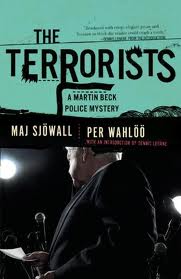 I think things are going reasonably well in both my classes right now. In Mystery and Detective Fiction we’ve just finished working through Sjöwall and Wahlöö’s The Terrorists, which provoked quite a lot of discussion this time around. As always, I’ve been meditating on how to change up the reading list for the course’s next incarnation; I think The Terrorists is a keeper, precisely because it gives us a lot to talk about. It is, arguably, somewhat tendentious — I’ve been wondering if I should hold the authors’ Marxism in reserve next time (rather than emphasizing it in my opening lecture) and let the novel’s politics reveal themselves inductively. I don’t find the novel too doctrinaire to be humanly interesting and dramatic, though: I think Sjöwall and Wahlöö successfully walk the line between the picture and the diagram, with Martin Beck himself especially standing between us and a narrow didacticism. Rhea may have a portrait of Mao on her wall, but Beck remains committed to (if ambivalent about) the flawed system he polices. Today we started Ian Rankin’s Knots and Crosses — time for my annual comment that I’d love to try one of his longer, richer novels, except that this one (like The Terrorists) is always really good for discussion, and always gets singled out in student evaluations as a general favorite.

 Udayan is beside him. They are walking together in Tollygunge, across the lowland, over the hyacinth leaves. They carry a putting iron, some golf balls in their hands.
 3. Jhumpa Lahiri, The Lowland. Like The Stonehenge Letters, The Lowland is one of my

 I’m sure you have all been wondering whether I have managed to get my
  Novel Readings