
In my last post I noted that I had been looking up passages in The Mill on the Floss for reasons I would say more about in another post. This is that other post! It’s about some exciting news–exciting for me at least.
Back in February, I got a surprise email from an editor at Routledge asking if I would be interested in providing the George Eliot volume for a series they publish with the general title Reading Literature Today. I looked pretty closely at the existing volumes before agreeing, because (as I also explained to the editor) my interest depended on what kind of book exactly they were looking for. They take a range of approaches, from fairly specialized edited collections to ones that are more clearly aimed at making their subjects accessible to non-academic audiences. It will not surprise anyone who has followed my work at all that it is the latter rather than the former kind of book that I said I would want to write, with a special interest in making ‘reading George Eliot’ a more inviting and rewarding experience for general readers, not just students. The editor was receptive–even enthusiastic–so I sent a proposal to her in June, received the feedback in August, and now have a signed contract to write Reading George Eliot: An Introduction by March 2028.
Honestly, I can’t think of a better project to be working on as I approach the end of my teaching career. (How soon will that be? Stay tuned for further updates!). There’s nothing I have worked harder at, enjoyed more, and felt more proud of than introducing new readers to George Eliot’s fiction, as a teacher and also as a modestly semi-public intellectual. While my way of doing that–from my ideas about Eliot as a thinker and novelist to my specific tactics in the classroom–is not everyone’s way (and some of the feedback on the proposal certainly made this point), well, I’m the one they asked, and like Lily Briscoe I can only pursue my own vision. (I admit I have wondered what made the editor reach out to me: somehow I feel sure they went to someone more eminent first and got turned down!)

The proposal they sent me as a model was the one for the Chaucer volume, and the full sample I got was Reading Milton: An Introduction. Both were extremely helpful as I began conceptualizing the kind of book that would best represent both why and how I would want to encourage people to read George Eliot today–or any day. My proposal eventually went in its own direction, of course, and no doubt once I am really writing, the project will continue to evolve. I actually had a lot of fun working on the proposal, which was encouraging. I tried hard not to second-guess myself (begone, imposter syndrome! be quiet, gremlins!) but just to think about the kind of book I really believed in and wanted to write, one that would reflect my own expertise as a scholar as well as my decades of experience working with students–and one that also conveyed my own enthusiasm, both for George Eliot’s novels and for the process of becoming a better reader. There’s really no point, this late in my career, of committing to anything else.
I’m sure I will post more about Reading George Eliot as it begins to take shape over the next year and half. For now I’ll just say that the distinctive feature of it, as I pitched it anyway, will be its emphasis on that first word, reading, with lots of time spend modelling the process, building outward from specific passages–hence my browsing in The Mill on the Floss looking for favourite moments that might work to launch sections of the book, or perhaps even the book as a whole! As the series is intended for potential adoption as classroom supplements, I want to keep my own commentary open-ended enough that it doesn’t preempt an instructor’s own ideas and plans; I want to frame my chapters with key questions and start down some paths for answering them, but not preclude students’ own analysis and interpretation. I especially want, though (and again this won’t surprise anyone who knows my work) to make the project of reading George Eliot better seem both fun and worthwhile to people outside college and university classrooms.
I’m excited about this: can you tell? It honestly seems like the book I have been preparing to write my whole career.
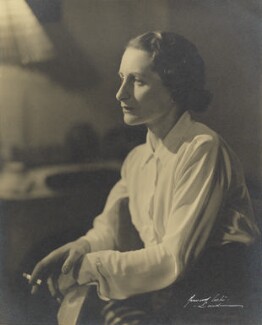 As part of my current research on issues related to gender, genre, and the ‘novel of purpose’ (about which more eventually, when it takes on a clearer shape!) I asked our indefatigable Document Delivery staff to bring in a copy of Vera Brittain’s On Becoming a Writer (1947). It turns out to be in large part advice for aspiring authors, and I’ve been amused, reading it, by how familiar a lot of it sounds as well as how practical and discouraging Brittain is. I thought you might be amused as well, so here’s her list of “nine widely-held illusions regarding the literary life,” in her own words, along with some of her blunt recommendations for overcoming these “phantasies.”
 Having cleared away these sad illusions, Brittain moves on in the next chapter (“First Essentials”) to offer some positive suggestions, though not without one more chastening reminder that your “desire for fame, wealth, and distinguished acquaintances does not in itself constitute a claim to literary success.” There really is something bracing about her Eeyore-like insistence that, while writing may well be worth the effort, it almost certainly won’t be fun, that it’s more likely than not that you aren’t very special or talented, and that the way forward is mostly drudgery. Would a book, not of this type (there are many such) but with this tone get published today? So far—I haven’t read to the end yet—it is certainly the antithesis of Elizabeth Gilbert’s irritating paean to half-assed creativity
  I wrote
  Since
Since 
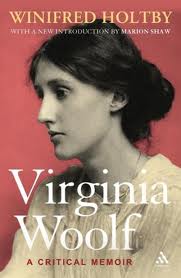
 I struggled with The Years, but I was also very interested in it, at least conceptually. I’ve been reading about it since then, especially about the splitting of the original project into two separate books. I’ve also been thinking about Holtby’s own fiction, especially South Riding, and her self-deprecating description of herself as a “publicist” (rather than an artist / aesthete), and about other novels that are like The Years in giving fictional form to social and political commentary but in very different ways, such as (surprise!) Middlemarch, but also North and South. I hadn’t planned to put any Victorian novels into my pile of relevant books this time, but there they are now, and that has got me thinking about things like periodization and genre and the ways we group or differentiate writers, especially women writers, which brings me back to Holtby’s critical approach, and I’m also interested in Holtby’s political journalism, which reminds me both of the anti-fascist arguments in Three Guineas and of the links between gender politics and fascism in Gaudy Night, which also includes reflections on fictional form and genre . . .
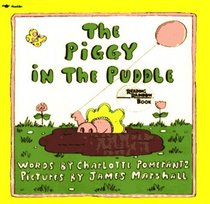 Do any of you know the delightful children’s rhyming book The Piggy In the Puddle? For the last couple of days, as I sat at desk or table, staring at my computer screen and messing around with the pieces of what I hope will eventually be an essay on Dorothy Dunnett’s Lymond Chronicles, lines from it kept running through my head:
