 I was about to open this post by saying “it has been a tough week” when I realized it’s only Monday! On the other hand, it has been a challenging week if we start it back at last Monday, and since I haven’t posted here since then, I think that’s fair enough.
It’s nothing in particular making things difficult: just the usual end-of-term craziness. I had four different assignments to grade last week. In 19th-Century Fiction, the students who’d opted to write their first paper on Jane Eyre had turned those in, while the students who’d opted to write theirs on North and South submitted their proposals; and most of the class also wrote our unit test on North and South. Then in Close Reading the students who had opted to do their second assignment on Middlemarch (which was most of them) turned those in. I’m pleased to say that as of this morning I had returned all of these assignments, meaning I’ve cleared the deck for the North and South papers coming in on Wednesday, after which nothing else is due until the Great Expectations test next week.
 I know I’m not the only one feeling a bit overwhelmed: my students are too. I’m doing what I can to keep up my own spirits and bring a lot of energy to class, but I admit I faltered today when all my efforts to spark discussion of Great Expectations seemed to dead end. I’ve never struggled to get people talking about Wemmick and his Aged Parent before! Things have been a bit quieter than I’m used to in 19th-Century Fiction for a while now, and today after class I was worrying that I’ve made it worse by talking more myself to compensate, and then by showing my frustration, which is always a bad move. I haven’t felt this stymied in class since the last time I taught Waverley–which was the time I decided to stage an “intervention” and see if we could bust out of our collective slump. It worked pretty well, and I think I need to try something similar on Wednesday, if probably less elaborate: we have only two sessions left on Great Expectations and it will be a real shame if they all go the way today’s did.
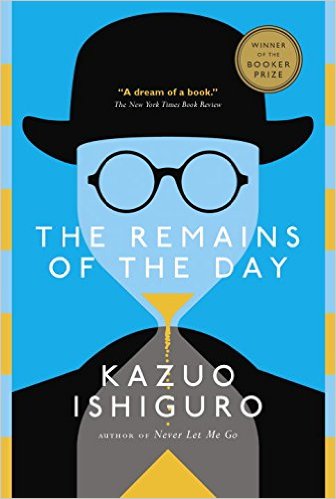 In Close Reading we are nearly finished with The Remains of the Day. Discussion is going better there: I always feel that I get a bit of a bump just because a lot of students are so relieved to be done with Middlemarch that Remains looks especially good to them! But of course it is a genuinely great novel and full of artful and important things to talk about. I should say, too, that although I felt at times that as a group we were struggling with Middlemarch, I did hear from a couple of students who appreciated the novel a lot, which I found very encouraging, as I did the excellent work a number of them did on their assignments. I do think it is worth giving students the opportunity to read it and think about it even if they don’t enjoy it: I try every trick I can think of to boost their pleasure in it, but ultimately a literature class is a place to learn, after all. I have resolved, however, that the next time I teach Middlemarch it will be in a 19th-century fiction class where nobody can reasonably express surprise or resentment at being assigned a very long book.
 It’s going to stay pretty busy for the next week, and then the pace changes as daily classes end and we move on to final essays and exams. I usually steal a little time for Christmas shopping before these last assignments come in, as once they do they have to be my top priority until grades are filed. I’ve also got an outstanding review to finish: I’ve read the books (two of them, on Golden Age crime fiction) but my notes and draft have been malingering because I’ve just been too tired to concentrate on writing after my other work is done. When my brain is otherwise too addled to use, I’ve been working on this website, especially on updating my blog indices so the links go to addresses on this domain. It occurred to me last night that this is barely half the battle, as so many of my posts have internal links as well…wish me luck! And if you know of any shortcuts to getting this stuff done, do tell.





 It’s still a slow and incremental process: I have more than once, in conversation, compared my efforts to build up my portfolio of work and thus my credibility in that role (for which my academic credentials mean relatively little) as being on a hamster wheel. I am very fortunate in that I do not need to depend on the results financially–but at the same time that also means I am doing this work alongside the other demands of my job. I’m increasingly happy with the results, though, especially now that they include a couple of pieces that reflect me more personally–that came out of my own strong interests and let me show a bit more of my own style and personality as a writer.
 In other words, a year after a fairly crushing blow to my career and (not incidentally) my self-esteem, I’m doing OK, even well. (Today was certainly an excellent day! There’s nothing like being included in
 That’s OK: it happens, especially around this time of term. It is startling to realize how far through the term we are, actually. We had an unusually warm October, and I think all the pleasant, sunny weather contributed to the sense that we were still in the opening phases. But here we are on November 1, and by the time we get back from our protracted study break (all of next week, plus the following Monday ‘in lieu of Remembrance Day’) we will be hurtling towards the end of it.
 So that class went better than expected, but then my afternoon class went a bit worse: participation was pretty minimal (though everything that was proffered was really useful) and there was a lot of that whole “look down intently at your book every time she asks a question” thing that clearly signals “don’t ask me! don’t even look at me!” Again, that’s fine–up to a point! Everyone’s busy and reading for my class can’t always be everyone’s top priority, even if it is North and South. I was disappointed, though, because usually it’s a class favorite and today’s was a good installment, taking us right through the strike to the remarkable scene on the steps of Marlborough Mill:
 There are lots of small interesting things along the way to Laura’s death, many of them spinning off from this attention to women’s relationships, but also comments about families and marriage and, of course, about dying. Sarton shows Laura gradually receding from the world around her. It’s not portrayed sentimentally or euphemistically, but for all the details about nausea and coughing up blood, it’s also not a catalog of medical horrors. Laura is very aware of her illness as a physical encroachment on her body, but Sarton gives us the story of her death primarily as a mental and emotional journey. “It seems as though a person dies when he is ready,” the caregiver Laura hires explains to her when Laura asks her to share what she knows about death. A Reckoning follows Laura as she readies herself. More touching and, I thought, more profound than the goodbyes to other people are the moments in the novel that are just about Laura taking a few last opportunities simply to be herself (an ongoing theme of Sarton’s writing), listening to the music she loves, drinking in the beauty of spring flowers:
 The moment when the dashing, exceedingly well-dressed, but annoyingly remote Earl of Worth declares “The game is up!” is the moment I finally understood fully that the reason I hadn’t liked him much throughout the rest of the novel is that he’s both the romantic lead and a detective hero–part Regency rake and part Sherlock Holmes.
 There are definitely charming aspects of their relationship. Their verbal sparring is often fun, though I didn’t often find it flat out funny, which was a disappointment: usually Heyer makes me laugh more. Overall, in fact, I’d say Regency Buck is one of the darker Heyers I’ve read, with more anger, violence, and threat, including, again, the overt sexual threats against Judith. It also had more, or at least more conspicuous, “period” detail in the form of both literary allusions and references to or parts played by actual people, including Byron, “Monk” Lewis, and the famous dandy Beau Brummell:
 But to get back to Lord Worth, he is in some ways a typical alpha hero. I was hoping his desire to dominate would be blown away by the end of the novel, but Judith is no Mary Challoner. For the reasons I’ve given, I didn’t find him a very satisfactory romance character, and I don’t think Regency Buck is likely to become a favorite of mine. But Worth is a pretty good detective, at least if you like the Sherlock Holmes “I’m much smarter than you and have everything well in hand” kind. The scene in which he finally confronts the villain is a classic “reveal” scene: Worth goes back over everything that has happened and explains what he knew or suspected and how he found it all out. As I said, the case is not particularly subtle, but Judith at least is wholly taken aback by his revelations, and then reassured by his Holmes-like promise that “there will be no scandal.” I just wish that he’d also promised there would be no beatings.
 In both of my classes this week we are focusing on young women making mistakes. It’s interesting for me (and I hope also for the students who are in both classes) to compare the very different ways their novels approach their rather different errors.
 Dorothea Brooke’s errors are easier to spot, because George Eliot gives us not just Dorothea’s perspective but that of everyone around her and, most important, of the narrator. It mystifies every person in the novel that Dorothea chooses to marry Mr. Casaubon: they all believe that it’s a terrible mistake. We understand why she marries him, though, because we know all about her, meaning not just her desire to lead a spiritually significant life but also her impetuous nature and her tendency to interpret things according to her own desires. Of course, that last bit is at once her greatest failing and the one thing we all have in common with her, as the narrator will take pains to teach us. We are given more information in Middlemarch, but we are also kept at more of an emotional distance–both formal choices that serve the novel’s larger purposes.
 Novel Readings