My annual series of posts on ‘This Week in My Classes‘ has come to an end, once again, with the end–not of term, since I won’t file my grades and move on until the 125 exams coming in later this week are marked–but of class meetings. So it’s time again to reflect on what it meant for me to write here about my teaching.
Not much has changed since I first wrote about the experience back in 2008. Then, I emphasized how my initial motivation, to make my work as an English professor more transparent to a skeptical public, had been replaced by a sense of the intrinsic value of being more self-conscious about one of the most important and time-consuming aspects of my job:
I found that taking this extra step each week not only helped me identify the purpose, or, if writing retrospectively, the result of each class, but it made each week more interesting by giving me an opportunity to make connections or articulate puzzles or just express pleasure and appreciation in ways that went beyond what I had time for in class. I pursued links between my teaching and my research projects, for example, as well as between my teaching and my other ‘non-professional’ interests and activities. I articulated ideas suggested by class discussions that otherwise would have sunk again below the surface of my distracted mind. Blogging my teaching enhanced my own experience of teaching. That in itself is a worthwhile goal.
I also noted the benefits of writing more, and more openly: “Though perhaps nobody will read your posts, somebody actually might! And once you realize that, you try to write better–just in case.” And I liked contributing what I hoped might be useful material to the vast reservoir of expertise and enthusiasm that is the ‘blogosphere.’ All of these things are still true, though as I cycle through my classes over the years I am finding that it seems pointless to reiterate what I’ve said before about the readings or themes. I do change up the book list almost every time I offer a course, but rarely by more than one or two books (or else I lose the hard-won benefits of having “prepped” most of the material before–which can be a huge and essential time-saver as I become more senior and take on more administrative responsibilities, and as class sizes, also, creep up, creating more paperwork and demand for my attention from students). Still, this year with the Mystery class in particular it felt a bit repetitive writing up the weekly reports. Yet I still find that when I sit down and make myself give it some thought, I pretty much always get caught up in writing about something that I find interesting. Indeed, my posts seemed to just keep getting longer!
The biggest teaching challenge for me this year was this term’s Brit Lit survey. I wrote often about the rapid pace of it and the disorienting experience of teaching a great deal of material well outside my comfort zone. Intellectually, though it was exhausting, it was also exhilirating, not least because of the treat of returning to writers I hadn’t paid much attention to since my own undergraduate survey class–though it was also interesting to note how the list of potential inclusions had expanded since those long-ago days (I’m quite sure, for instance, that we didn’t read any Elizabeth Barrett Browning back then, not even “How do I love thee?”). Although the day to day prep was intense for this course (the pay-off will be in the fall, when I get to do it all again), the hardest work I put in was before it started, when I researched and then committed to an assignment sequence involving having the tutorial groups build their own Study Guides using PBWiki. I’m in the middle of evaluating the finished projects now, and I am certainly glad I thought so hard about how to explain the assignment and the evaluation criteria. I was full of zeal and enthusiasm about the wikis when the course began, then I began to feel frustrated when I saw what my current review is confirming: most of the students did just fine on their assigned topic but very few entered with any spirit or creativity into the collaborative aspects of wiki-building. On the other hand, as I read through the final versions of all the pages, I’m satisfied that on the whole they put together a valuable resource–something I expect they are realizing now too, as they turn to them to study for their final exam. Some of them put in a lot of effort, too, and some of them, I think, had a little fun. They all learned something about using computers actively, rather than passively consuming content. These seem like good results to me. I don’t know what they thought about having to do this. I’m sure their course evaluations will tell me!
The other experiment I tried was having my graduate students maintain a course blog. Once they warmed up and got over their self-consciousness, they did a great job: they posted question sets and then followed up with comments, and every week there was a lot of lively online discussion that I thought made our classroom time more focused and energetic. I’m hoping they will post some retrospective thoughts about the pros and cons of incorporating that kind of writing into the seminar. I didn’t think it was that different from posting questions and responses to a discussion board, but several of them hadn’t done that for classes before either, and those that had seemed to find this form more exposed, even though the blog was (and so far, remains) password protected.
Writing this post, I realize that though blogging about my teaching has been interesting but not that revelatory this year, blogging has clearly affected my teaching, by giving me experience in new forms of writing and thinking that I think are worth using in pedagogical contexts and by exposing me to a community of innovative scholars like those at the very successful Profhacker site whose posts on using wikis in the classroom gave me courage (and know-how) to be a little bit innovative myself.
 George Eliot considered the writing of historical fiction “a task which can only be justified by the rarest concurrence of acquirement with genius,” requiring “a form of imaginative power [which] must always be among the very rarest, because it demands as much accurate and minute knowledge as creative vigour.” Novels of “the modern antique school have a ponderous, a leaden kind of fatuity,” she complained, “under which we groan.” The extraordinary difficulty of the genre is testified to by her own attempt “to reanimate the past” in Romola, the only one of her novels set back more than a couple of generations. She began writing Romola as a young woman and ended it an old one, she said herself, and having worked through the novel recently in my graduate seminar, I know that the effort it demands can make it feel as if it is having the same effect on its readers. To be sure, Romola does have its thrilling moments, and it certainly demonstrates both “accurate and minute knowledge” and “creative vigour”–just not always at the same time, or always in harmony with each other. And there’s the whole “cheese to the macaroni” moment…but I digress from my main point, which is that really good historical fiction is really hard to write, and thus really rare to read.
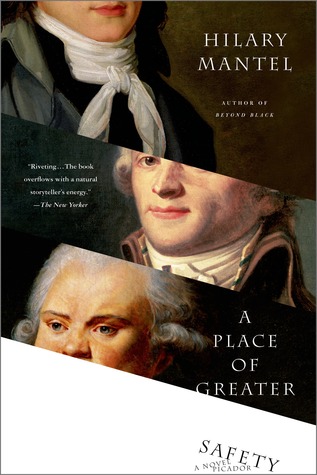
 Many of the same qualities and techniques are evident in Mantel’s earlier novel A Place of Greater Safety, particularly the lack of sentimentality and the sharpness of the writing, which is at once prolix and poignant, even uncomfortable–if, as I recently suggested, reading Ian McEwan’s prose is like getting acupuncture to your brain, I found reading A Place of Greater Safety akin to walking barefoot across a stretch of gravel towards a graveyard: you aren’t particularly enjoying the experience, but it has its own vividness and particularity, and there’s a morbid fascination in the direction you know you’re headed. (I seem to be finding my reading especially, if only metaphorically, tactile lately.) A Place of Greater Safety also, like Wolf Hall, builds momentum gradually by developing our relationship, with not just one complicated protagonist this time, but with three, the revolutionary triumverate of Georges-Jacques Danton, Camille Desmoulins, and Maximilien Robespierre. Again, there are neither heroes nor villains in this crowd, though each has his heroic, as well as his villainous, moments. (Desmoulins, beautiful, erratic, alternately effervescent and enervated, and writing, always writing, seemed to me a particularly brilliant characterization.) And just as Wolf Hall only incidentally informs its readers about the causes and contexts of the Reformation, A Place of Greater Safety eschews the potential pedagogical role of the historical novel. At the end of its 750 pages I really didn’t feel much better informed about the events or even the political and philosophical stakes of the French Revolution than I was already. Here again, Mantel adopts a slantwise approach: not altogether personal, not just the ‘human story’ of the men and women who lived it, but not abstract, theoretical, or fully contextualized either. Here’s a rare but characteristic ‘explanatory’ passage, terse and ominously proleptic:
 It’s tribute to Mantel’s peculiar gifts and strategies as a storyteller that she assembles an even less attractive crew here than in Wolf Hall and yet what matters is not how appealing they are but how compelling they are, and how intensely themselves, so that by the final chapter, as the Revolution devours its children, I didn’t care who they were, really, only that they were going to die, after my having known them for so long. Mantel manages their end (known from the novel’s beginning because, after all, it is history) without any of the tumbril sentimentality the inevitable Dickens comparisons on the jacket blurb might lead us to anticipate. None of the characters comes across as heroic or noble, but they have such great vitality (even Robespierre, with his tedious incorruptibility), that their deaths felt like great losses–losses, quite simply, of life, of the energy and lust for life, for words, and for action, that characterized them all. Again, a sample of her terse, epigrammatic style:
 I’ve been an opera lover at least since I was five years old, when I received this LP of highlights from the Sutherland-Bergonzi La Traviata as a birthday present. Of course, I must have been primed for this gift by hearing opera around the house: both of my parents are also opera lovers, and my father in particular cherished the Metropolitan Opera’s Saturday afternoon broadcasts. One of my first school writing projects was a guide to Lucia di Lammermoor (below); see my pithy summary of Act III? 🙂

