SATC2

sex_and_the_city_2_dvdThis weekend I finally watched Sex and the City 2. Though I have some book blogging to get around to, I’ve been thinking quite a bit about the movie, so I thought I’d puzzle over it a little here before returning to business as usual.

First, I should say that I like the series Sex and the City quite a lot. This was (still is, in a way) a surprise to me. It’s one of those cases, as with reading books by authors I don’t already know, in which serendipity played a part in winning me over: I stumbled on some reruns of Season 6 a couple of years ago and got caught up, partly in Carrie’s romance with Baryshnikov (a long-time crush! remember The Turning Point?)—and the conflict that develops between his emotional and professional needs and hers—but also in Miranda’s domestic struggles (including finding compassion for her increasingly senile mother-in-law), in  Samantha’s breast cancer, and in the saga of Charlotte’s adoption efforts. These were all storylines in which much more was at stake than I expected from my casual impression of the show. After that, I rented the earlier seasons and watched them all through—I’ve now seen the whole series a couple of times and I own a couple of seasons on DVD (and some episodes on iTunes)  so I can turn to them when I’m in the mood for that particular kind of diversion. Season 4 and Season 6 are my favorites, because I think they take the characters to the most interesting places (figuratively, not literally). If I’d seen Season 1 first, I don’t know that I would have kept watching, as I find it more superficial and deliberately provocative than the later seasons. Sure, there’s something refreshing about its frankness, but as the writers apparently realized, you need more than that to sustain a series, and characters (like people) need to grow up and move on.

Pink_Birkin_bagA lot gets made (often, in my experience, by people [mostly men] who don’t actually watch SATC) of the show’s emphasis on expensive clothes and shoes. Though I have never bought an expensive pair of shoes (and never any with heels higher than about two inches) and have very little interest in fashion, I actually enjoy watching the characters play dress-up—which is really how it strikes me, like a game of Disney Princess for grown-ups. In many ways, not just this one, the characters live in a fantasy world that has no relation to what I experience as real life, but the same is true of all kinds of shows and movies, and I’m perfectly capable of separating my own values and priorities from theirs: I feel no inadequacy over my lack of Christian Louboutin pumps or a Birkin bag, and if I ever had a great condo in New York (if only!), I’d fill it with books, not couture. That said, there are some aspects of SATC that (though unusually well accessorized) do bear significantly on real issues, such as the challenges of reconciling femininity with power and financial success, of dealing with success imbalances in relationships, or just of maintaining one’s own identity at work (or at play, really) given the pressure women feel to conform or please. Season 2’s “The Caste System” is sharp as well as funny about the pretense that there is no such thing as ‘class’ in contemporary America, while in Season 6, Carrie’s purchase of a Prada shirt for Berger (like Miranda’s earlier attempt to buy Steve a good suit) precipitates a romantic crisis based on his inability to accept something women have been expected or conditioned to accept for centuries, namely economic inferiority.

SATCBut by far the most important aspect of the series, its most potent fantasy, is its model of female friendship. More unrealistic even than Carrie’s affording a closet full of Dior and Manolo Blahniks on her freelancer’s income is the whole premise that four women who are such completely different types would be soulmates. Their acceptance of each other’s differences and their often explicit insistence that, though they may question or test them, they will always ultimately support each other’s choices—well, again, that’s a potent fantasy. To be sure, it’s not only women who feel pressure to apologize for who they are and what they want, but I think women experience this pressure more intensely, in more circumstances or situations, than most men. Carrie, Miranda, Charlotte, and Samantha feel it too, and to varying degrees all of them—except Samantha—struggle to persist with the way of being in the world that they think is right for them as individuals. How to do this and not be labelled, or to feel, simply selfish is a central problem of the series. That Samantha is miraculously unapologetic for her own independence, not to mention her sexual appetites, makes her at once the least familiar or likable character and the most radical, and I have sometimes thought it’s a shame that she expresses her defiance of convention so much through sex, which I think distracts from the political potential of her character and makes it easy to confuse her with the negative stereotype of the ‘slut.’ But from another angle, that’s precisely the point of the show: to present four very different women who have sex, like sex, pursue sex, talk about sex—and to refuse the moral judgments and double-standards that insist on dividing women into categories (good/bad, virgin/whore) based on their sexual conduct. SATC also, notoriously, reverses the gaze, turning men into objects for women’s voyeurism, something male actors who have been on the show have remarked as unsettling. Ethically that’s probably no improvement on the endless objectification of women in art, film, and advertising—but I don’t see that ending any time soon, and I think it does make a difference that in SATC this strategy is inevitably self-conscious and tinged with irony, just because it is far less familiar. And it is complemented by the sheer pleasure the women of SATC take in their own bodies, highlighted by the way they dress as well as by their active sex lives. Like any long-running show, SATC has better and worse episodes, but at its best I think it’s both intelligent and funny, and I appreciate the way it showcases strong, vocal women who, miraculously, love each other just the way they are.*

SATC-movieSo, about SATC2. Well, actually, first a few words about SATC1. It strikes some really unfortunate squirm-inducing notes (most of them during the ‘honeymoon’ getaway), but overall it does a good job, I think, of trying to imagine the next steps and crises for the four women. Many of the same issues of power, balance, and independence arise; friendships as well as relationships are tested. Some of the tricks that work well in a half-hour episode get too thin stretched to feature length, but there’s some genuine feeling—some real pathos—as well as some comedy. And most important it’s still about women and friendship and acceptance, about taking strength from differences and trying to see the way forward.  It’s not a great film—while I think the series has, or will have,  classic standing, the film does not do enough as a film to be really significant. Still, on balance I enjoyed it, and I’ve watched it more than once—and will probably, some day, watch it again.

I think SATC2, on the other hand, is a pretty bad film—and I also found it quite depressing. I don’t think it’s bad for the same reasons Roger Ebert (for one) said it was bad (and wow, is his review vitriolic); I agree with Opinioness Megan and the other critics she cites who think that the hate directed at the film reflects a double-standard by which women’s escapism is condemned while men’s is the stuff of putatively heroic legends. I think it’s a bad film because the pacing is awkward (not just slow but kind of staggering, lurching from scene to scene), the acting is forced, the storylines are thin, and the whole thing runs on an edge of desperation, as if the makers were under orders to Be Confrontational! Be Shocking! Be Funny! Have a Touching Moment! Sing Karaoke! For me, everything just kept not working, despite what seemed like painstaking efforts to check off all these elements. The most glaring example is Samantha’s declaration that “we are soulmates,” which ought to epitomize the emphasis on female bonding that makes the series so special, but which instead came across as unnatural (for Samantha—that’s not her vocabulary, surely!) and contrived, a case in which showing would have sufficed, in fact, without anyone needing to tell each other, or us, what we know perfectly well from years of watching the show.

I agree with Megan about the Eurocentrism of the film, and I would add that it falls into a sordid kind of Orientalism—but having said that, the idea of connecting the American women’s experiences of frustrated self-expression and autonomy (epitomized, without subtlety, in the silencing hand of Miranda’s boss) to veiling is not an altogether stupid one. (One clumsy moment in the development of this theme is Miranda’s observation on the woman eating french fries one at a time by slipping them discreetly under her veil–something to the effect of “that’s what men really want from us.”)  It just would have required much more care and nuance to develop the question of how or whether there are in fact parallels, or to what extent freedom and self-expression should be equated with the kinds of overt display and self-indulgence characteristic of SATC as a series. Along those lines, the scene in which “our” four bond with several veiled Muslim women who reveal fashionable couture outfits beneath their robes not only  proposes that there may be common interests across  cultural divides (ones that the film to that point has only crudely exploited)—it also suggests that there are many ways to inhabit, negotiate and subvert gendered rules and roles. SATC typically celebrates saying exactly what you think when you think it; imagine what a good film this might have been if instead of promoting that ideal it had taken the opportunity to explore its possible limits and liabilities. All the stupid falling-off-a-camel / getting-arrested-for-indecency stuff could have been overcome, or at least offset, by some intelligent use of the film’s “exotic” setting—but instead, we get mostly cheap fish-out-of-water gimmicks and some nice shots of the desert. And some pretty cool outfits, of course.

SATC-2So it’s not a good film. It tries, but it fails (or so I thought) to keep up the girls’-night-out energy of the series, and even the gaiety seemed forced. Still, I couldn’t help thinking, as I watched it, that there was something brave about it, because though it stumbles, it is stumbling around in the difficult territory of telling stories about women after the usual happily-ever-after moments of marriage and motherhood. And I think this is why I ultimately found it, not offensive, but depressing. Each of the women faces a fairly realistic mid-life problem, and the writers are not wrong to try to imagine their way out of these scenarios. Carrie seemed particularly whiney to me in this film, but the challenge she and Big face of how to design a marriage that isn’t so full of compromises that neither of them is happy—well, that’s a real challenge, and their solution (taking “days off”) is interesting because it breaks away from the current oppressive myth that two people can and should be completely happy with each other while being together 24/7. It struck me as appropriate that Carrie’s old apartment provides the means, not only for them to get a breather from togetherness, but also for Charlotte to get a little me-time away from her children. Throughout the series and on into the first movie, Carrie has never quite given up that apartment—it represents autonomy, her room of her own.

charlotteEbert is far too literal when he condemns Charlotte for the episode in which Lily puts red handprints on her vintage Valentino: of course it’s stupid to wear designer clothes while decorating cupcakes, but the real point in that scene is that being a parent is exhausting and, occasionally, demoralizing, not least because it keeps you from being the person you used to be—which is what that skirt represents to her. It’s impossible to anticipate, before you have children, the range of things you will give up for them and because of them. Of course, there are many much greater things you gain, but sometimes surely all parents have wondered where that other person, the one they used to be, has gone–along with that other life they used to lead! And I wouldn’t be surprised if most parents cling to some symbolic reminders, too, things they fret over and protect from the innocently destructive hands of their beloved offspring. (I certainly have some, though they aren’t items of clothing; I would be devastated, however irrationally, if they were destroyed.)  I actually thought the big red handprints on Charlotte’s (unrealistically tight!) butt in her (absurdly chosen!) white skirt were apt and pretty funny symbols, in this context.SATC-movie2

SATC2, then, deliberately debunks some popular myths of romantic bliss and maternal fulfilment. What’s sad is that it doesn’t really seem to know what to replace them with: what stories should it tell of its four protagonists? To have done a good job, maybe  it would have needed to break out of its genre  and embrace the complexities of mature women’s lives. It should have gone to work, not on vacation, with Miranda, for example. It should have followed through on the new model of marriage Carrie and Big propose, rather than reducing it to a fade-out at the end. It should have had Samantha prove her power, not reduced her to waving handfuls of condoms in the face of aghast Muslim men—or to a woman too lacking in self-awareness to agree that the dress she’s chosen is, in fact, “too young” for her. In SATC1, she decides—contrary to all romantic comedy rules–that she’d rather be alone than with her hot Hollywood-star boyfriend: “the most important relationship I have is with myself.” The Samantha of SATC2 shows no such self-respect.

Unlike Megan, then, I found this movie a lot less fun and escapist than the first one. It seemed permeated with Samantha’s fear of growing old, and it  focuses on women who dream  of escaping but who go home again without having learned or accomplished anything. I feel as if the movie let them down as well as me. Is it really so hard to carry forward  the irrepressible feistiness that characterizes the series? I’m not sorry I saw it, but I don’t expect I’ll watch it again. On the other hand, it might be time to go back through Season 4 . . .


*Remember the toast in Bridget Jones’s Diary,to Bridget just as she is? More evidence that acceptance is the real fantasy!

Course Evaluations Redux

A couple of years ago I noted that course evaluations do not necessarily help us understand our strengths and weaknesses as teachers because most of the time the responses are so contradictory. Last term’s batch, which just arrived in my mailbox, is no different. Some samples, from the Brit Lit survey:

One the one hand…

I really liked the collaborative wiki; it made for an engaging project that encouraged me to keep up with my readings.

The wiki pages worked well.

Her wikis are a great way to keep a class engaged and to help study for finals.

The wiki assignments are interesting and useful.

The wiki assignment is somewhat progressive and relevant.

but on the other hand,

I hated the wiki assignment!

The wiki was an unfair aspect of the course due to the amount of work it required … the wiki is a waste of time and effort for most of the students in the class.

Stop doing the wiki pages, just because we’ve moved into a technological era doesn’t mean we’re going to do something like this or want to.

On the one hand…

The material assigned helped the professor to be stimulating, and some lectures were inspiring.

Dr. Maitzen is brilliant and funny, and a pleasure to hear speak.

Dr. Maitzen made the course enjoyable and the lectures were easy to follow.

Maitzen is amazing at being informative and witty at the same time.

Maitzen did a great job being interesting with the material. The class moves along quickly but I was able to gain a good understanding of British literature.

but on the other hand,

Dr. Maitzen speaks too fast! … it is important for students to be able to follow.

The lectures were normally quite dry and boring.

I found it very difficult to stay interested in this class because of the teaching style.

On the one hand…

She also excelled in pushing her students to relate [to] course material with such a broad selection of writers.

The breadth of the material covered in this class was really nice.

but on the other hand,

Too much material to fit into one semester!

I think that Maitzen could have focused on fewer texts in a greater amount of detail.

The only thing I didn’t enjoy as much is the amount of poetry that we talked about. Poetry is not one of my favorite things to analyze.

I did not enjoy the amount of poetry, I would rather have more stories / novels.

Overall,

Professor Maitzen is very enthusiastic. She has a good influence on students to become excited about their studies. Also, she is able to relate to the various positions of students in order to maximize development.

The instructor led a superb class in which I learned quite a bit. I am very glad it was a required class as I gained valuable skills for my major.

One of the most engaging professors I’ve had so far at Dal, she’s brilliant but not in an intimidating way.

The instructor is interested in the students and makes sure they are engaged in the course, concerned with students’ academic success & cares about overall wellbeing of students.

Always willing to meet outside of class to help the student.

easy to approach!

She engaged the class in discussion often, making the class intellectually stimulating.

Although challenging at times, such difficult is necessary to learn.

She is approachable and lovely.

She was great! Really smart and interesting & I always left wishing class wasn’t over!

She is a wonderful prof who seems very interested in the material and in her students.

I appreciated how thoroughly Dr. Maitzen would prepare us for our assignments.

But then,

Professor Maitzen was an average instructor. She did what was necessary to get her point across.

Dr. Maitzen didn’t seem to care how we did in the course. By this I mean she only offered help when it was convenient for her and she offered no sympathy if you were busy with other school work.

A bit intimidating.

Not as bland as most instructors can be.

I found her classes very structured but not very stimulating.

I think she may have been a little too demanding in her assignment requirements.

Well, obviously you can’t please all of the people all of the time, and on balance the responses were actually more positive than I expected for this particular course. But what can I learn from these comments, going forward? Some of the reiterated complaints were predictable given the nature of the course. For instance, though I explained frequently that we would cover selected examples in class but that they should then be able to analyze the other assigned readings independently, using the information and models they learned, many of them objected to having been assigned readings that weren’t lectured on.  I can do better, perhaps, to clarify the relationship between class time and their own reading, though I know they will always (wrongly!) feel better served  if all the material has been “covered” by me explicitly.

There are some other fairly consistent comments across the set that I willcertainly keep in mind. One is that the course was very clearly organized–that I followed the schedule and syllabus closely, and so on (these comments always make me wonder what happens in their other classes!). It’s good to know that my efforts to be clear and consistent are appreciated. The other is that I talk too fast and they do not want to be responsible for putting their hands up and asking me to repeat things or slow down (as I always encourage them to do, if I start getting carried away). A couple of them felt it was easier for them to stay with me when I used PowerPoint slides; this is something I’ll think about, but mostly I need to keep reminding myself to slow down. My own perception often is that I am going slowly, doing a lot of repeating of key words and arguments, and so on, but enough of them felt harried by my pace that I should take their input seriously. Also, by and large they loved Atonement but not Mary Barton (but wait, here’s one who “particularly enjoyed Mary Barton“!). When (if!) I teach this survey course again, I’ll weigh my options again, but I think their lukewarm reaction to Mary Barton is as much a function of their unfamiliarity with long discursive novels in general (the most common specific complaint was about its length) as of Mary Barton in particular. Last year my exemplary Victorian novel was Great Expectations and the reaction was not that different. Also, though they were very enthusiastic about Atonement, their papers suggested a lot of them did not understand it very well! So as always, their preferences will not be the only, or even a major, influence on my book orders.

I must say, it’s easier to take in all this mixed and fairly personal feedback when I’m not going right back in the classroom. Although years of experience somewhat inures us all to the knowledge that we are being judged in this way, it’s still hard not to want to respond, sometimes quite sharply, to some of these comments (I did too care how you did in the course! And I held office hours every week that nobody came too, and I always invited students to set up appointments if those times weren’t convenient! And why are you an English major at all if you don’t like poetry? And I bet you didn’t think the wikis were a waste of time when you were using them to study for the final exam!). At the same time, the nice comments are a seduction that has its own dangers. You can’t teach well if you want too much to be liked. As one of the students says, with great (and rare) maturity, “difficulty is necessary to learn,” but difficulty is uncomfortable, and you may not realize until well after a particular course is over whether it was valuable to you or not–which is, surely, a more important issue than whether you enjoyed it in the moment.

Sabbatical!

Today is the first day of the rest of my sabbatical! Much as I love being in the classroom (usually, anyway), it’s a good feeling to confront a term in which my time will not be overwhelmed with teaching tasks and I can concentrate on the other parts of my job description–particularly, of course, research and writing–that tend to get crowded out the rest of the time. The sabbatical system is a wonderful and very valuable feature of academic life. It’s impossible to imagine sustaining the commitment, creativity, and intellectual integrity that’s necessary to do this job well without these intermittent opportunities to update my own knowledge and exercise my own skills as a researcher, scholar, and writer. We bring our whole selves to the classroom; the richer, more energetic, and more imaginative our own intellectual lives, the more worthwhile that teaching time will be for everyone involved, but especially for our students.

Not that my teaching life screeches to a halt, of course. For one thing, class descriptions and book orders for the fall term will be due before too long, which means I’ll have to make a number of important decisions about how to approach the three classes I’m slated for. It will be nice to make those decisions a bit more reflectively, and in fact one of my sabbatical projects is to refresh my ideas and knowledge about the course topics by reviewing recent critical work as well as work on effective assignments and teaching strategies. All three are courses I have taught repeatedly in recent years, so it would be easy just to do basically the same readings and course structures as before, and to some extent I am likely to rely on the materials I’ve already developed (it’s not as if I have any reason to think they are no good at all!). But it’s important not to fall into a rut, or to assume I don’t have anything more to learn myself about the texts and topics I teach. Yesterday I began compiling a list of recent books in my field that look interesting, and I even picked up a few of them from the library, so I’m ready to get started on them. Also continuing is my work with four Ph.D. students, all of whom are in the thesis-writing stage of their degrees. At this moment I have about 140 pages of their draft material waiting for my input, and I expect more to come in pretty steadily over the next few months, as at least a couple of them hope to wrap the whole thing up this year. This is another task that will be much more pleasant–not to mention efficient–without the pressing distractions of a regular teaching term, and without competition for my time from M.A. students (my most recent one successfully submitted her thesis just before the break–hooray!). Requests for reference letters continue to come in pretty steadily. Otherwise, however, this term is clear of a number of the usual ongoing chores and commitments. Least missed will be marking undergraduate essays, with attending committee meetings a close second!

So, in addition to refreshing my stock of information and ideas for teaching, what are my sabbatical plans?

First of all, I’m committed to finishing the full version of the essay I’ve been working on for a couple of years on Ahdaf  Souief and George Eliot. I had worked through a lot of what I wanted to do with In the Eye of the Sun, but I want to cover The Map of Love also and have not come to terms yet with how it complements or complicates the arguments I made about the earlier novel. And then I stalled as I tried to figure out how to balance all of the potentially relevant aspects of this project, which include theoretical issues in postcolonial criticism,  postcolonial critiques of Victorian literature including George Eliot’s novels, historical and theoretical questions about Arabic literature and the novel tradition in Egyptian literature, work on neo-Victorian novels and on travel writing and on imperialism and on women travellers, specific interpretive questions about both In the Eye of the Sun and The Map of Love… Well, clearly one essay can’t do everything, and I don’t need to know everything about all of these topics before I can write my essay. But I need to regroup, review the work I’ve already done, and then go back to the novels themselves and focus on explaining what interests me so much about them, how they work both formally and thematically to get us somewhere new in our understanding. In order to write the essay I also need a target publication venue or two in mind; the decisions I make about where, finally, to place the emphasis of the essay (particularly its theoretical framing) will determine (or be determined by) the kind of journal I hope might accept it. I have been thinking about Edebiyat, but the Journal of Postcolonial Writing seems like another possibility. (Other suggestions?)

My second research and writing commitment is to a series of review essays I want to do for Open Letters Monthly on some titles from the Virago Modern Classics back catalogue. Looking at these early 20th-century titles will take me outside my usual Victorian beat, but I’ve spent more time in the modern period since working up my British Literature survey lectures, and I’m very interested in learning more about these texts and writers. I have been dithering about where to start, and yesterday I finally decided that absent any overwhelming reason to do anyone in particular, I’d just have to choose, so I’ve chosen Margaret Kennedy as my first subject, because Together and Apart was the title in the very enticing pile of VMC’s Steve Donoghue recently sent me that for whatever reason piqued my curiosity the most. I don’t intend to do a complete survey of all of her work, but I got The Constant Nymph from the library yesterday (it seems, also, to be the only one still in print at Virago), and I hope to read that, Troy Chimneys, Together and Apart, and The Ladies of Lyndon. My second pick, I think, is Barbara Comyns, for the excellent reason thatI loved the first line of Our Spoons Came from Woolworths. But Antonia White (whose Frost in May was the first VMC published) is another possibility. The key here, though, is committing to whatever I’ve chosen, so Margaret Kennedy it is, a writer I’ve never read and indeed had never heard of until Steve’s parcel arrived in the fall. Though I will do some light research, into both Kennedy and Virago (I’ve already read a very interesting interview with Virago’s founder, Carmen Callil), I want to focus more on the reading experience here than on contextualizing or theorizing–all part of my project to gain confidence in my own critical voice and perspective. Happily, there isn’t nearly the weight of critical opinion on Kennedy as there is on George Eliot or Virginia Woolf anyway, so the whole anxiety of authority is somewhat allayed from the start.

I have a third writing project on the go, of at once narrower scope and grander ambition, based on my years of reading and loving George Eliot’s novels. But at this point I think it’s too soon to make pronouncements or declarations about how or when this will get done. And I’m also wondering if I can or should make anything more solid out of the fairly substantial archives here at Novel Readings. I was struck by the opening line of Zadie Smith’s Changing My Mind–that she didn’t realize she had written a book. Blog posts aren’t ‘literary essays,’ but they can be revised into them. But then, I’m not Zadie Smith (or James Wood or Michael Dirda or whoever) and who would want to read a collection of my reviews and essays? But it’s something to think about, anyway.  I’ve been writing this blog since January 2007: I started it at the outset of my last sabbatical, and in fact my very first post was a short one on none other than Zadie Smith! When I look back at just how much I’ve written, I’m not altogether happy to let it just fade into the distance, as blog posts inevitably do.

In addition to writing projects, I have many reading plans–too many to list, and more flexible, not so much commitments as ambitions and interests. For an English professor, time to read widely and curiously is enormously valuable. You never know what books you read ‘just’ for yourself will end up infiltrating your research and teaching life (many of the books I now teach regularly, such as Atonement or Fingersmith, I first read purely out of interest). But also, the more you read the richer your sense is of what literature can do, of how it can be beautiful or interesting or problematic or mediocre. I am convinced that I talk better about Victorian literature because of the contemporary literature I read, and that I teach with more commitment, and more hope of making connections with my students and their interests, because I read around and talk to them about books as things of pressing and immediate significance. So I’ll read a lot, I hope–and write about it here! Up soon are two books for reading groups: Graham Greene’s The Power and the Glory for the local in-person group, and Tove Jansson’s The Summer Book for the Slaves of Golconda.

And with that, I’d better get going–apparently it’s going to be a very busy term for me!

Why Criticism Matters

Is it just me or do the six “accomplished critics” writing on this topic for the New York Times go on and on without saying much of interest or substance? Most of the offerings exemplify the dangers of generalizing–whether about criticism, about literature, or about good writing. Indeed, some of their generalizations make me worry none of them read much, which surely can’t be true (for instance, “the serious contemporary novel withdraws from linearity”? so much for A. S. Byatt or Hilary Mantel, to name two obvious counter-examples;  but then “its focus [is] distributed across several characters”–which sounds not so much contemporary as Victorian to me). Then there’s the oddly facile pot-shot by Stephen Burn against English professors who abandon literature to become administrators (take note, Craig!): I guess he’d rather universities all be run by business professors? Well, that seems to be what most people want these days. By and large they all conflate criticism with book reviewing, they seem quite preoccupied with evaluation as the critic’s job, and there’s a lot of talk about good writing, but not much about good reading, by which I mean reading that comes from close, patient attention and expertise. The value of academic criticism is hardly acknowledged (the only one who admits it, indirectly at least, is Batuman, and then only through references to books she read in graduate school), and though there’s a nod or two to the possibility that some of the critical writing done by ‘amateurs’ on the internet might not be stupid or strident (they all assume that bloggers are amateurs, which is sort of funny, because there are a lot of bloggers whose professional credentials and accomplishments as critics are surely equal to those of this Big Six, if often in different venues), the general tone seems to be a defensive one, the mission to prove not so much why criticism matters as an activity but why their critical practices and habits matter. Still, there are some pretty good moments. I think Sam Anderson is close to the mark, for instance, when he notes that the “membrane between criticism and art has always been permeable”:

That’s one of the exciting things that books do: they talk to other books. The critic’s job is to help amplify that conversation. We make the whispered parts of it audible; we translate the coded parts into everyday language. But critics also participate actively in that conversation. We put authors who might never have spoken in touch with each other, thereby redefining both. We add our own idiosyncratic life experiences and opinions and modes of expression — and in doing so, fundamentally change the texts themselves.

Nobody asked me why criticism matters, but if they did, I think I would just say that criticism matters because literature matters. If I were then asked to expand on that response, I would say that serious criticism (a label which excludes plenty of what passes for book reviewing on the internet and in print) matters because it takes literature seriously enough to investigate, explain, contextualize, and challenge it. It may do so in myriad ways, from formalist or aesthetic or historical or political or even, per Batuman, Freudian perspectives. Good criticism, I would add, requires expertise as well as beautiful writing–indeed, I would say that the quest for beautiful sentences (though they are certainly requisite for truly great criticism) can also be a dangerous temptation, luring critics away from rigorous analysis. And though I think it’s fair to emphasize the importance of the critic’s voice, I don’t read criticism to learn about the critic but to enrich my understanding of, my thinking about, the work of literature under examination. If criticism accomplishes that, it matters.

Now, let me ask you, accomplished readers, critics, and bloggers: why do you think criticism matters–assuming you do, and it does?

Novel Readings 2010

My turn! Here’s my traditional look back at the highs and lows of my reading and blogging year.

Book of the Year:

Hands down, and entirely to my delighted surprise, since I had no particular expectations going into it, my favourite book of the year was Dear Genius: The Letters of Ursula Nordstrom. I raved about this book in my original post, and I’d like to emphatically repeat what I said there:

If you ever read a book, or were a child, or read a book to a child–if your childhood was shaped in any way by the books you read–then you should buy this book and read it immediately.

I don’t usually do this, but I feel strongly enough to provide a link straight to Amazon so you don’t waste any time getting your own copy. Mine was a gift, and for that, many, many thanks to the amazing Steve Donoghue of stevereads, book-giver extraordinaire.

More books I’m particularly glad I read:

After featuring it three times running on my ‘most looking forward to’ list and making at least one false start, I did finally read Vikram Seth’s A Suitable Boy (it took two posts to cover it, here and here). I enjoyed it thoroughly, proving my long-held theory that sometimes books simply have to ripen a while on the shelf before the reading experience can be perfectly tasty. “Would I read A Suitable Girl?” I asked, rhetorically, I thought; “You bet I would.” Imagine my pleasure in learning that just such a book is forthcoming!

Lynne Sharon Schwartz’sLeaving Brooklyn proved every bit as rich and satisfying a read as my long-time favourite Disturbances in the Field, though in quite a different style and register. It’s a coming-of-age story, “an intensely personal but also profoundly commonplace experience, movingly represented in a book by a woman, about a woman, that [I concluded my original review] I think deserves to be called ‘important.'” It would have been my ‘book of the year’ if it hadn’t been edged out by Dear Genius–but that’s OK, because Dear Genius is a book that advocates for all other books!

Hilary Mantel’s A Place of Greater Safety took longer to grip me than Wolf Hall, but once I was well into it, it really wouldn’t let me go, even though there was absolutely nobody in it to like or even (except sort of theoretically) to root for. A bit like A. S. Byatt, Mantel is resolutely severe, not only towards her characters, but also towards her readers, giving them little comfort or even encouragement as they press on:

if, as I recently suggested, reading Ian McEwan’s prose is like getting acupuncture to your brain, I found reading A Place of Greater Safety akin to walking barefoot across a stretch of gravel towards a graveyard: you aren’t particularly enjoying the experience, but it has its own vividness and particularity, and there’s a morbid fascination in the direction you know you’re headed.

Even at the end–the guillotine for pretty much everyone, as we know it will inevitably be–she avoids what I called “tumbril sentimentality” of the Tale of Two Cities variety (I can’t imagine Oprah ever assigning this novel to her followers). Impressed as I was by Wolf Hall, I read several other novels from Mantel’s back catalogue this year and was repeatedly startled by her range of styles and interests (not one, not even A Place of Greater Safety, really fits the marketing tag ‘by the author of Wolf Hall‘ as they are all simply too dissimilar). The other that resonated most deeply with me was The Giant, O’Brien. Fludd was under the tree for me this year, so there will be at least one more Mantel novel in 2011.

Penelope Fitzgerald, The Bookshop. I found this “a gem of a book: spare but revealing, quirky but unsentimental” (hmm, I’m noticing a trend away from sentimentality this year–even A Suitable Boy, though full of sentiment, does not ultimately cater to our more wistful or wishful emotions).  I’m glad finally to have begun my relationship with Fitzgerald; I’ve been meaning to read The Blue Flower for years and I look forward to doing so in 2011.

Elizabeth Hardwick, A View of My Own. When I grow up, I want to be Elizabeth Hardwick. Well, OK, not exactly, but I envy her the force and confidence of her critical voice. Even when I disagree with her, I really want to talk to her about what she says. I was particularly interested in her essay “George Eliot’s Husband,” which sets a high standard for biographical thinking not met at all by a particular more recent attempt to write about my favourite novelist–Hardwick says more worthwhile things in a few pages than that author comes up with in a couple hundred.

A. S. Byatt, The Children’s Book. Another tough-minded, unsentimental novel, as expansive in its own way as A Suitable Boy or A Place of Greater Safety. I called it “history as information management,” and I meant that as a tribute of a sort. Byatt is an accomplished novelist; while Seth’s abundance (though I loved it) occasionally seemed cluttered, Byatt’s somehow has a tautness to it. If Mantel writes historical fiction that defies conventional expectations of the genre, Byatt does the same with the ‘sweeping family saga.’

Laila Lalami, Hope and Other Dangerous Pursuits. I called this “a quietly harrowing account of hopes turned back and diminished,” and concluded that “hope is a dangerous pursuit, not just because of the risks of the pursuit itself, but because sometimes the chance you take brings you only further away from what you really wanted.”

Morley Callaghan, Such is My Beloved. This book, a classic of Canadian modernism, took me out of my comfort zone as a reader; talking about it with the new book group I belong to took me out of my comfort zone in other ways–but salutary ones! I ended up finding some kinship between Father Dowling and a couple of Victorian protagonists who founder, similarly, on the mismatch between their most strongly felt principles and the pragmatic realities of their world. But Callaghan’s setting, contexts, and language are not Victorian at all.

May Sarton, The Small Room. In the end I didn’t love this novel, but it interested me enormously, as did the conversation it generated on (and around) the Slaves of Golconda reading group. Its central themes certainly struck a chord with my ongoing anxieties about my professional work and the public discourse around higher education:

So much about the discourse of education today seems to disregard the value of that connection to the whole person–it’s all about outcomes and measures and productivity and, of course, jobs after graduation. Is that really what we want? We as teachers? or as parents? as students? If Lucy’s view seems dangerously personal, the current obsession with students as consumers seems dangerously limited and limiting. If we can’t ever hope to teach students as people, or to be people ourselves when we teach, who will ever, in the end, actually learn anything worth knowing?

Daphne du Maurier, Frenchman’s Creek. Dare I say that they don’t write pulp fiction like they used to? Purple prose, absolutely, but as I said in my original post, it’s ‘royal purple, richest velvet.’ I haven’t worked my way through the rest of the du Maurier collection on my shelf, but what’s a sabbatical for, if not to catch up on books you otherwise have no excuse at all for reading?

Books that disappointed, for one reason or another:

Happily, once again there weren’t very many of these. Leading the pack is certainly Brenda Maddox’s George Eliot in Love, which I reviewed for Open Letters Monthly. Here’s the money quote:

I wasn’t just disappointed in George Eliot in Love—by the time I finished it I was equal parts astonished and enraged. The book is not just George Eliot ‘lite’–it is superficial, prurient, and at times simply offensive. Maddox comes across as naively underqualified for her task: her good intentions are as painfully evident as the bad judgment and limited expertise she displays throughout. Focusing persistently on the pettiest details of Eliot’s biography, Maddox strips her of both dignity and intellectual substance and leaves us with an impoverished version that belies Elizabeth Hardwick’s confidence (expressed in her marvelous essay “George Eliot’s Husband”) that it was impossible to make this accomplished woman “look foolish and small.”

I was pleased (though hardly surprised!) that George Eliot in Love also won a spot in the ‘Worst Nonfiction, 2010‘ smackdown at stevereads: “Maddox should chronicle Paris Hilton next and leave the deep end of the pool to the grown-ups.” Ha! Between us we perhaps give the lie to the old saw about the only thing worse than not being talked about.

I was underwhelmed by Louis Menand’s The Marketplace of Ideas:

I really wish that, having grabbed people’s attention, Menand would have seized the opportunity, not to lob another petty grenade at his struggling colleagues but to insist that we not concede too much to either the rhetoric or the pressures of the marketplace. Surely an English professor who is also a public intellectual is uniquely positioned to make the case for, not against, the rest of us.

For quite different reasons, Tracy Chevalier’s Remarkable Creatures was also distinctly unremarkable: “The subject of the book is intrinsically interesting, but if a novelist can’t do any better than this, we might as well read non-fiction, or, better yet, poetry”–the salient example of the latter being, of course, In Memoriam A.H.H.

I think my expectations were just too high for David Mitchell’s Cloud Atlas. I really enjoyed reading some parts of it, but I don’t ordinarily seek out work in some of the genres he plays with (notably, science ficton) and I was frustrated by the way so many different kinds of storytelling were shoehorned into one book–even though Mitchell is dazzlingly smart (too conspicuously so, I sometimes thought) about the unifying threads. My conclusion after reading it was “after a while I found I was more aware of  his virtuosity and the ingenuity of the nesting narratives than I was actually engaged in them.”

The best of the not-entirely-satisfying collection is Ian McEwan’s Solar. I’d rather read an imperfect novel by Ian McEwan than any novel by probably the majority of other contemporary writers. I actually couldn’t quite decide which category to put Solar in, it’s so nearly excellent–but in the end, I decided McEwan set too high a standard for himself with Atonement and (for me, at least) Saturday, so for failing to live up to it, here he is down here.  A bit of my original post:

Of course it is not a universal prescription for excellence that a novel satisfy both heart and head, but that’s what I want, that’s what I think takes a novel from good to great, and Solar seems quite content to leave my heart untouched. I think this is a missed opportunity for a novelist with McEwan’s gifts. Why not set against the shabby opportunism of the protagonist (who is both brilliantly drawn and wholly unsympathetic) either some idealism not undermined by the general attitude of cynicism that permeates the novel–even if only to show it up as ineffectual against the absurd realities of political and scientific institutions–or some unembodied but evocative commitment to the beauties of the planet Michael Beard only pretends to cherish? Bleak House is an unforgettable critique of the stupidities of a system that serves, at most, only those who constitute it, because we see beyond it, unrealized, an idea of human flourishing, of love and justice, worth yearning for. Thus we find the yammering of innumerable lawyers both comic and tragic. Where is Miss Flite, or Lady Dedlock, never mind Jo the crossing sweeper, in McEwan’s universe?

Books I’m most looking forward to reading in 2011:

There are too many to enumerate, really, including all the treasures delivered for Christmas from my lovely family, but here are a few titles, if only to motivate me as the new year gets underway.

  1. Tolstoy, War and Peace. This is the new Suitable Boy: it will be on this TBR list until I get it read! Surely being on sabbatical, if only for half  the year, will remove most of the standard excuses.
  2. Flaubert, Madame Bovary. Yes, the new Lydia Davis translation. I’ve begun this, but it got pushed aside during the Great Cough and Cold of late 2010.
  3. Christina Stead, The Man Who Loved Children. I’ve been curious about this since reading about it in Hardwick’s A View of My Own.
  4. Sigrid Undset, Kristin Lavransdatter. This one is another object lesson in why you should never “purge” your book collection, no matter how often you move or how many times someone close to you mutters baleful warnings about running out of space. I owned this trilogy as a girl, never got around to reading it, purged it, and now–older and wiser–rejoice to have found a nice Penguin edition in a local bookstore.
  5. A delicious stack of old Virago Modern Classics, including novels by Margaret Kennedy, Antonia White, Rebecca West, and many others.
  6. Vikram Chandra’s Sacred Games. I’ve owned this for a couple of years without reading it–I think its time has come.
  7. Helen DeWitt, The Last Samurai. The discussion at Conversational Reading piqued my interest about this novel, which I’ve owned for many years without reading (note again the value of the ‘ripening on the shelf’ theory to justify these habits!).
  8. Graham Greene, The Power and the Glory. This is the next book up for the book group that read Such is My Beloved. I read it many years ago but Greene is an author I haven’t done anything with since turning ‘pro,’ and I’m finally, belatedly, interested.
  9. Colm Toibin, The Master and Brooklyn.
  10. Hermione Lee, Virginia Woolf. I’ve made some progress on this one, helped by an excursion into Woolf’s letters and diaries. I’d like to finish it in 2011!

I observe that not one of these is a work of literary history or criticism! There’s some chance that being on sabbatical will also give me a chance to recover some energy for that kind of reading! Certainly I will be doing some of it, as I am working (still!) on at least one academic paper which I hope to get into publishable form by the end of my leave.

Other Novel Readings highlights:

In 2008 I noted the invitation to contribute to The Valve as an important development in my blogging life. 2010 saw my farewell to The Valve, following on a resolution to “Get On With It!“–whatever, exactly, “it” is. The biggest development in 2010, congruent with this shift in emphasis, was the invitation from the fine folks at Open Letters Monthly, first to move Novel Readings to its new home, and then to join their editorial team. Both steps have been good ones for me, helping to sustain my blogging energy, bringing me into contact with all kinds of interesting writers and readers, even providing an excellent excuse for a trip to New York. Under the influence of these developments I increased my contributions to Open Letters, taking advantage of the flexibility and outstanding editorial input the magazine offers to write some more pieces on Victorian literature (Felix Holt and Vanity Fair), a couple of reviews (in addition to George Eliot in Love, I reviewed Claire Harman’s Jane’s Fame) and an essay on Gone with the Wind that took me a little outside my usual 19th-century ‘beat’ but reflected  my ongoing interest in ethical criticism–and my desire to write in a more personal voice. The Gone with the Wind essay earned me a link from Arts & Letters Daily, which helped me believe that I do have something interesting and even valuable to say as a critic–something that I have rarely felt in my almost 20 years as a practising academic critic. Looking ahead to 2011, I hope I can continue to build my confidence as a writer and critic, keep discovering what I have to say and saying it as well as I possibly can, in my own voice.

To everyone who reads and comments here at Novel Readings, and to all of you who keep up your own wonderfully thoughtful, diverse, and stimulating book blogs, thank you, and Happy New Year.

A Look Ahead

I’m not quite ready to do my annual year-end post as the year isn’t over and there’s more novel reading to be done! But I have been unwrapping all kinds of goodies which I will be reading and reviewing in 2011. A few years ago we decided that opening all the Christmas presents in one frenzied morning meant the individual presents were not fully appreciated and the let-down from the anticipation was unduly severe. So we started a brand new tradition (it’s important to launch these every so often!) of opening one present a day starting from the first day the kids are off school. I must say, I highly recommend this system! Everyone has something new to read or wear or watch or play with every day–and two, on Christmas day, plus stockings. It does mean, though, that I don’t yet know quite all the new books I’ve got (I can see some more distinctly book-shaped parcels still under the tree). So far, here’s my haul:

Miss Pettigrew Lives for a Day. I opened this one a bit early, as its card (accidentally?) said ‘Happy Birthday’–which was in March. I wrote about it already, here. I enjoyed it so much I thought I’d take another look at the film adaptation; I’ve rewatched about the first hour and I find myself often wondering why they didn’t stick closer to the book.

Hilary Mantel, Fludd. I was so impressed with Wolf Hall that I immediately began working through Mantel’s back catalogue, including A Place of Greater Safety, Beyond Black, and The Giant O’Brien. One of these will certainly feature on my ‘best reads of 2010’ list, but you’ll have to check back to see which one! Fludd looks enticing.

Kate Atkinson, Started Early, Took My Dog. I’ve started this one already. Atkinson is a great storyteller whose Jackson Brodie novels stretch, or evade, genre categories such as ‘detective fiction’ or ‘crime fiction.’ They are strongly character-driven, and they have a persistent interest in the ways people get tangled up in their own pasts, and their own erratic impulses.

Helen Simonson, Major Pettigrew’s Last Stand. Seriously, how likely is it that there would be two books featuring characters named ‘Pettigrew’ on my list? This one looks like just the kind of book I’ll enjoy. I wish the publishers didn’t feel the need to fill several entire pages at the beginning with endorsements from every conceivable source, though: it makes them look anxious! And the selection is so ‘something for everybody,’ from O magazine to the New York Times. I guess it’s perverse to find this kind of effusion offputting. Certainly it won’t actually put me off the book!

Christina Stead, The Man Who Loved Children. I first read about this in Elizabeth Hardwick’s A View of My Own, and since then I seem to have noticed a number of allusions to it elsewhere, all of which–but Hardwick’s essay especially–piqued my interest.

Zadie Smith, Changing My Mind. I thought White Teeth was OK–really good in parts, strained or excessive in others–and I disliked On Beauty intensely. On the other hand, I often really enjoy Zadie Smith’s essays, including one she wrote some time ago on Middlemarch, so I’m looking forward to reading this collection.

Winifred Watson, Miss Pettigrew Lives for a Day

misspettigrewThere’s a wonderful, if slightly painful, moment in Anita Brookner’s Hotel du Lac in which the central character, a romance novelist ironically named Edith Hope, explains the central myth of her books to her editor. That myth, which she calls “the most potent myth of all,” is the tortoise and the hare:
‘Now you will notice, Harold, that in my books it is the mouse-like unassuming girl who gets the hero, while the scornful temptress with whom he has had a stormy affair retreats baffled from the fray, never to return. The tortoise wins every time.’

‘This is a lie,’ she continues:

‘In real life, of course, it is the hare who wins. Every time. Look around you. And in any case it is my contention that Aesop was writing for the tortoise market. Axiomatically,’ she cries, her voice rising with enthusiasm,’ ‘Hares have no time to read. They are too busy winning the race. The propaganda goes all the other way, but only because it is the tortoise who is in need of consolation. Like the meek who are going to inherit the earth.’

Winifred Watson’s sweetly acerbic comedy Miss Pettigrew Lives for a Day is, precisely, written for the tortoise market. Indeed, it is a near-perfect tortoise fantasy: it offers complete, self-indulgent wish-fulfilment as its dowdy, marginalized, self-deprecatingly spinsterish heroine discovers herself to be, in fact, witty, powerful, and desirable. What’s missing, happily, from Watson’s version of the myth is competition: while we know perfectly well the novel is not for Delysia (who surely never reads novels), it is never against her either. Here, the hare–charmingly, implausibly, absurdly, generously–becomes mentor to the tortoise, who in turn helps her manage the disruptive and potentially degrading effects of her manifold attractions. There’s no room for jealousy, no purpose in revenge, as Delysia’s starry-eyed endorsement of Miss Pettigrew’s hitherto unknown genius (unknown even to herself) lifts Miss Pettigrew into a whole new life.

It’s true that the rewards Miss Pettigrew so surprisingly, and surprisedly, reaps do nothing to subvert conventional expectations or standards of feminine success. This is not Jane Eyre, despite some superficial similarities (imagine Blanche Ingram falling on Jane with anything like Delysia’s appreciation! but also, imagine Miss Pettigrew refusing her makeover, as Jane refuses Rochester’s silks and satins…). But it’s Miss Pettigrew’s presence of mind that begins her transformation from ugly duckling into swan, and her refurbished exterior reflects as much as it creates her increasing confidence. Still, Miss Pettigrew Lives for a Day would be little more than feel-good pablum if it weren’t for Watson’s shrewd presentation of Miss Pettigrew herself. With the exception of one brief moment near the end, we experience the entire day pretty much from her point of view; we share her rapid vacillations between shock and pleasure, horror and enthusiasm, pain and pleasure. Always, around the edges of her accumulating triumphs, we see the shadow of her fear and vulnerability; against the sparkling comedy of Delysia’s romantic misadventures and Miss Pettigrew’s (often accidentally) brilliant interventions, we see Miss Pettigrew struggling to accept the warmth and love and happiness she had thought could never be part of her life. We begin, after all, with this sad description:

Miss Pettigrew joined the throng, a middle-aged, rather angular lady, of medium height, thin through lack of good food, with a timid, defeated expression and terror quite discernible in her eyes, if any one cared to look. But there was no personal friend or relation in the whole world who know or cared whether Miss Pettigrew was alive or dead.

That’s a sober start to a comic novel, and the touching note of pathos continues through the novel, keeping it from floating quite away on a cloud of trivialities:

Miss LaFosse leaned forward eagerly.

‘Is everything all right?’

‘Absolutely,’ said Miss Pettigrew. ‘You can set your mind at rest.’

‘Oh, you darling!’ Miss LaFosse leaned forward and kissed her again, and there, right on Miss Pettigrew’s clasped hands, fell two drops of water and two more were trickling down her cheeks. Miss Pettigrew flushed a delicate pink.

‘I have not,’ said Miss Pettigrew in humble excuse, ‘had much affection in my life.’

‘Oh, you poor thing,’ said Miss LaFosse gently. ‘I’ve always had such a lot.’

‘I’m glad,’ said Miss Pettigrew simply.

After that they were friends, and Miss LaFosse, tactfully, ignored the tears.

As she gets drawn in, it’s not really the social whirl–the glitz and glamor–that lures her on so much as the unprecedented sensation of being wanted and valued:

She was thoroughly enjoying herself. She was in a state of spiritual intoxication. No one had ever talked to her like that. The very oddness of their conversation sent thrills of delight down her spine. Come to think of it, hardly anyone had ever troubled to talk to her about anything at all: not in a personal sense. But these people! They opened their hearts. They admitted her.  She was one of themselves. It was the amazing way they took her for granted that thrilled every nerve in her body. No surprise: they simply said ‘Hallo,’ and you were one of themselves. No worrying what your position and your family and your bank balance were. In all her lonely life Miss Pettigrew had never realized how lonely she had been until now, when, for one day she was lonely no longer.

For me, this dark thread among the gossamer made Miss Pettigrew Lives for a Day something more than what it undoubtedly also is, namely a witty, charming, deftly plotted Cinderella story. The novel made me laugh a lot, but it touched my heart too, probably because I’m a woman reader and thus (as Edith Hope understands) at least a little bit of a tortoise myself.

hashtag #gradingjail

Though classes have been over for about two weeks now, of course they aren’t really over until the grades are filed, which in turn can’t happen until the grading is all done. Last week was all about final essays, while this week will be all about the final exams my Brit Lit survey class wrote on Saturday morning–yes, that’s right, while other people were resting all snug in their beds, or bustling out to get an early start on their shopping the Saturday before Christmas, my students and I were stuck in a drafty classroom with really squeaky chairs from 8:30 to 11:30 a.m., counting down the minutes until we could be quite done with each other.

Invigilating exams is actually an oddly otherworldly experience. Because vigilance is, clearly, called for, you can’t just settle in for some serious work but have to alternate brief intervals of reading or writing with probing stares around the room or measured walks up and down the aisles (I use these strolls as opportunities not just to look out for students who have painstaking transcribed the whole of Mary Barton onto their inner arms or something but also to remind them all to double space their answers, offer additional exam booklets, and hand out extra Hershey’s Kisses). This particular room had steeply tiered seating, so I got some decent exercise every time I did this, or every time a student’s hand went up with a question about format or a lament for a dead pen (why anyone would show up for an essay exam carrying just one old ballpoint pen remains a mystery to me, but somehow every time, I hand out at least one spare). Otherwise, though, the atmosphere is one of anxious hush: the furrowed brows and deep sighs bring out all kinds of maternal feelings in me (these evaporate, more or less, once I start marking!). I always do bring some things to putter away at. Saturday I put a few keystrokes in on a writing project that’s in its very early stages, for instance, and I also read about half of Miss Pettigrew Lives for a Day, which turned out to be just right: smart enough to entertain but light enough to set aside as needed. More about that later, when I’ve read to the end!

Anyway, the booklets have all been collected, the candy wrappers are cleared away, and now I’m in the final week of what academics on Twitter discuss with the hashtag #gradingjail….and that is actually one of the things I have been thinking a lot about since classes ended and the complaining begin. Why is marking student work often not just unrewarding, but downright depressing, even disturbing? Why do people whose job it is to teach get in such a stew when they see the results of their, and their students’, term’s work? I can only think that something must be wrong–with us, with them, with the work, with the process–when we end up feeling entrapped, imprisoned, by what is, after all, a completely routine as well as absolutely essential part of our professional lives.

To be clear, not all marking is depressing. It’s always exciting to read a good piece of work, especially when you know you have had a hand in developing it. Thinking about the finished essays that gave me the most satisfaction to read this term, I realized that they were the ones in which the students had brought an idea or proposal to me, taken in my initial suggestions, come back after working on it some more, talked it over again, gone off to do more work based on our discussion, and eventually produced a thoughtful argument with which they were clearly engaged and which had flourished with my input and their effort. Now that’s teaching, right? So if that’s the gold standard, not just for results (and in fact, these aren’t all necessarily A+ papers when they are finished) but for the process, why is this not always the way things go? Why does it seem so often that the effort was perfunctory, the challenge was unwelcome, the requirements were simply ignored, the opportunities to learn and grow unappreciated?

There are a lot of answers, I think, and one of the things I hope to do on my upcoming sabbatical is address the ones that lie within my own power to address. I don’t think I can do a lot more than I already do, for instance, about students who just don’t care–and there are definitely some of those; it would be naïve to think there aren’t. There are doubtless a range of reasons why they don’t care, or can’t care right at the moment. But I can only do so much to reach them, if their interests or priorities or needs are somewhere else and they are just showing up (or not!) because that’s what they have to do. Mind you, I have to treat them all as if they do care, because it can be hard to know–that’s one reason marking is emotionally draining, I think: often you suspect you are pouring your effort in only for it to be ignored. (I like electronic grading because at least there are no uncollected papers serving as tangible evidence of their indifference.) But I’ve made the mistake once or twice of being rough on a student for not trying or caring, and it feels pretty bad to realize you were wrong about that.

So, if you start on principle from the assumption that most students do care, what gets in the way of their desire to engage with and develop their work as far as they possibly can, and what can I do to turn things around for them and keep myself out of #gradingjail–or at least make it one of those nice minimum security prisons? A few thoughts so far:

  1. Time is a major obstacle. Most of my students are taking five courses, many of them writing intensive, most with final essays due at the end of term. Even if they weren’t working part-time jobs (which most of them are) or juggling family responsibilities (which some of them certainly are), they’d have a hard time giving enough time to five final papers to get good results across the board. I have sometimes tried to take this into account by giving an option between a final paper and an exam. It’s true that this means those who write the papers do so in a much less perfunctory “because I have to” way, but those who write the exam do not make quite the same intellectual investment or get the same kind of intellectual reward.
  2. Class size is a problem. Except for graduate seminars, my smallest class is 20 students; I find it is just barely possible to do an assignment sequence involving rewriting with that many students while still moving through (and writing about) a reasonable amount of material. And even there, if every student came for the multiple visits (or exchanged the multiple emails) that lead to the kind of results I’ve described, I’d be swamped–not least because one seminar is not, of course, my only course per term. Still, ideally it would be nice to take everyone through proposals and drafts and revisions. I think for a seminar class I should be able to figure out how to do this–there’s a planning project, then, for my fall term seminar next year, to seek out advice and models for assignments that encourage long-term attention and rewriting, and that are manageable for a group that size. But what about groups of 40, 60, or (as I’m afraid we have recently resolved on for our first-year classes) well over 100? There aren’t enough hours in the day, for me or for whatever cadre of TAs is lined up for the really big classes, to give the kind of time and attention to their writing assignments that I believe is necessary for them to learn and improve. At Cornell, I taught in a writing program with classes capped at 17. We could do all kinds of things in a class that small, including lots of one-on-one work–and in fact that may be the last experience I can remember of feeling I was working with individual students, in detail, on ideas and lessons they could (and even would) use on their next attempt. I’ve heard people say you can teach writing just fine to large groups; in my gut, and from my experience so far, I believe that just isn’t true, but again, there’s a project for me, to figure out how people think this can be done, as I’m going to be expected to do it before too long.
  3. Preparation is a problem. I have had the feeling quite a lot recently that I am asking things of some of my students that have not been asked of them before, from ‘little’ technical things like correct spelling and writing in complete sentences to large scale things such as close attention to textual evidence or deep analysis of literary ideas instead of recapitulation of plots. Oh, and reading really long books! with footnotes! and characters that aren’t ‘relatable’! The gap between my expectations and their results is, of course, where much of the pain of grading originates, but if they just aren’t prepared to do what I’m asking, am I being fair to keep on asking it? How far should I dial back my expectations? Or, how can I use both classroom time and assignment sequences to move them into a position where they really can be expected to write the kind of essay I want from them? Again, here’s homework for me. Although I do build in components that I think and hope prepare them for larger assignments, perhaps I can do even more.

These are not observations with implications only for #gradingjail, of course, but that’s where I’ve been lately–and will be again tomorrow, and the next day, and probably the next day too–so that’s the context in which I am currently brooding about them. They apply mostly to essay writing, but I think a number of them are also relevant to exams: I’ve been tearing my hair and muttering “weren’t you paying attention?!” a lot, but time, class size, and preparation make a difference to attendance, diligence with class readings, and investment in the course material too, as does the sense that your professor knows who you are (or doesn’t) and has a specific interest in improving your understanding.

So: Those of you who also teach writing, and/or also spend time in #gradingjail, what do you think makes it such a hard place to be? What are your most positive grading experiences, and what do you think makes the difference?

Read Better!

I admit, I have some sympathy with Hillary Kelly’s lament about the whole Oprah Does Dickens thing. I don’t share, or like, Kelly’s condescending assumption that Oprah’s readers are incapable of appreciating the novels, that they will have to “scramble about to decipher Dickens’s obscure dialectical styling and his long-lost euphemisms” or that “with no real guidance: they will only “mimic their high-school selves with calls of, ‘It’s too hard!'” People have been reading Dickens “with no real guidance” for a pretty long time and lots of them have had great fun with his language, his stories, and, yes, his ideas. Of course, I wouldn’t be in the profession I’m in if I didn’t think “real guidance” could enhance people’s reading experience, especially (though not exclusively) for books that don’t yield as easily as others to the kind of self-revelatory or just lazy reading-for-what’s-relatable that Kelly rightly proposes is one of the main purposes of Oprah’s book club. A case in point actually comes from the putatively ‘high culture’ end of the media spectrum, the New Yorker‘s Book Bench, which this week included in their Year in Reading series the following commentary on George Eliot’s Romola:

Absolutely no one reads “Romola” these days, at least not for fun, and I hate to admit that I can see why: it’s desperately wearying. The heroine is a hopeless prig, unredeemed by anything even slightly compromising in her character, and the villain’s villainy isn’t very interesting: he’s uniformly awful to his father, his wife, and his mistress. Eliot was utterly diligent about ensuring the book was historically accurate: her diaries report that, in preparation for writing, she gathered “particulars, first, about Lorenzo de’Medici’s death; secondly, about the possible retardation of Easter; third, about Corpus Christi Day; fourthly, about Savonarola’s preaching in the Quaresima of 1492.” But as one of Eliot’s early critics, Leslie Stephen, put it: “The question will intrude, What would have become of ‘Ivanhoe’ if Scott had bothered himself about the possible retardation of Easter?”

Actually, this complacently closed-minded and anti-intellectual reading is much more annoying to me than Oprah’s Dickens fest because of its pretense of erudition. Dickens was a great populist, after all; he wrote to reach the hearts of the masses, and there’s a certain logic in an alliance between him and the forces of O. The really annoying thing about Oprah’s announcement, to me, was her gleeful admission that she’d never read any Dickens before  and the sheep-like enthusiasm with which her millions of viewers will now rush out and do what the diva says. (But hey, what corner of the book world is free from fads? It seems just a short while ago nearly every bluidy reviewer and blogger and tweeter I follow was talking about the same book … and wait, so was Oprah!)  The hot cocoa stuff is silly, too, as if every Dickens novel is a cozy holiday classic. Oprah ought to put on a better display of informed reading. It’s not hard to do–and she could just staff it out without losing a day of her royal tour of Australia. But with her resources, she may in fact bring in some really interesting people to talk about Dickens. Maybe, just maybe, some of the issues raised in this old debate about Dickens’s racism will even come up, though I sort of doubt it, since it would undermine the feel-good ethos of both the show and the book choice. For me, the bottom line is, Great Expectations and Tale of Two Cities (though, as Kelly and others have rightly noted, oddly mismatched) are books that are worth reading, whether it’s your mom, your grade 10 teacher, me, or Oprah who motivates you to read them. (I did do a double-take when I got my first look at the Penguin cover, though; I was relieved to learn that the back cover reverses the disproportion. Also, I hope Oprah’s web editors will stop putting a random apostrophe after Dickens; I already get endless assignments in about “Dicken’s” and I don’t need any more confusions introduced…)

But, to come back to Romola, if you’re going to set yourself the excellent project of reading through all of George Eliot’s fiction, and learn enough about Romola to know that it was extensively researched, you might also work on the assumption that novels that don’t immediately gratify your taste may be revealing some of your own limits, not just theirs. Sometimes, you’re asking the wrong questions, for instance. Here’s where ‘real guidance’ might come in handy, at least in training you as a reader to stop and think about why the book is as it is, what purposes its aesthetic and formal choices serve, what ideas shape it. You might not like it any better, but you would understand a lot more about it. These comments give the impression of a reader who really didn’t try very hard–in fact, who did just what Kelly worries Oprah’s readers will do. And seriously: any novel with the line in it “children may be strangled, but deeds never” surely deserves our close attention. Some of my ideas about Romola are here, from when we covered it in my recent graduate seminar; these excellent posts from Bookphilia also show how very far from “desperately wearying” the novel can be to a good reader.

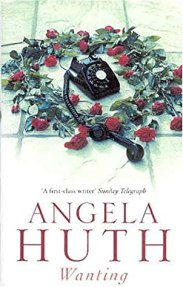
Angela Huth, Wanting

huthI thoroughly enjoyed the first Angela Huth novels I read, Easy Silence and Invitation to the Married Life, so I’m always on the lookout for her other novels. Last year I picked up Land Girls, which I also enjoyed, though it didn’t have quite the mordant wit that characterized Easy Silences especially. Last weekend, in honour of “Take Your Child to a Bookstore Day,” Maddie and I were in the Jade *W* (where I inevitably find two or three or four or [sigh] five books I can’t resist) and this time I happily discovered Wanting and Of Love and Slaughter, which means I now have about half of her oeuvre (at least of novels). In the morbid state of mind inevitably brought on by end of term chores (marking! calculating grades! invigilating exams!)–and made worse this year by the evil virus I have yet to shake off–I thought a little dark humour would be just right, so I chose Wanting for my leisure reading. I hoped it would cheer me up without being too cheerful.

It didn’t quite work out that way: Wanting turns out to be just as dark and twisty as Easy Silence but without the same charm. Somehow, the husband foolishly besotted with another woman in Easy Silence is much funnier trying to knock off his unsuspecting wife (“Over you go!”) than Harry Antlers is in pursuit of of the unwilling object of his affection. I would say that stalking just isn’t funny, and that’s the difference, except that of course murder is also completely serious. Perhaps it’s Harry’s own utter lack of charm: he’s just brutish and obsessive and repulsive, and when he menaces poor Viola with the jagged edge of a broken milk bottle, the absurdity of the situation seemed overwhelmed by its gruesome possibilities.

Maybe Huth wasn’t really trying to make us laugh this time, at least not with Harry. It’s true that among the array of other characters are some with winsome eccentricity. There’s Alfred Baxter, for instance, and his girls–about whom I won’t give be too specific, as they provide some of the more surreally delightful (if also depressing) moments in the novel. Their seaside picnic, for instance, is a lovely touch, though I have no idea whether it is meant to have any particular thematic resonance. I expected the girls to reappear somehow in the denouement; that they didn’t–that in fact there was not really any great coming together of the novel’s various strands–was part of my disappointment. Ian McEwan (who kept coming to mind, perhaps because this book is a gentle cousin to Enduring Love) would have made something more of those girls. I suppose they are the most elusive examples of unfulfilled love, literally representing something Alfred and his wife want but can’t have. Harry wants Viola, Viola wants Richard, who wanted the wrong woman; Gideon has to discover what he wants, Maisie finally gets what she wanted. Remarkably, Hannah wants Harry, at least for a while, and then he turns his wanting on her, and so it continues. Huth is an excellent storyteller. She has the knack of saying just enough–and having her characters say just enough:

She met his eye. Her corn-coloured hair, full of green shadows from the sky, clouded the contours of her innocent face. Harry rapidly sifted through the next lines that came to him: You are the most beautiful girl I’ve ever met, Viola Windrush, and I love you entirely. Come away with me now, for ever. Please just have dinner with me.

‘Bitch,’ he said.

The word hit Viola between the eyes, a well-aimed bullet.

You’re left with the impression that wanting of one sort or another drives most people, but not necessarily forward. Huth doesn’t seem interested in probing too deeply, though, into the mysteries of desire. In this novel at least, it seems erratic, irrational, sometimes invigorating, but more often haunting or threatening–not always literally, but that lurking possibility that love shades into mania gives Wanting (and Easy Silence, now that I think about it) its dark undercurrent.