2013: My Year in Writing

I still expect to get some reading done before the end of the calendar year (especially Black Lamb and Grey Falcon, which I have resolutely started over), but except for another blog post or two I have no great writing ambitions for the remainder of 2013, so I thought I’d start my annual year-end wrap-up with a look back at the essays and reviews I published in 2013.

Once again I did most of my writing for Open Letters Monthly, and once again I can only be grateful for the encouragement, support, and astute criticism I get from my co-editors. After only three years “on board,” I know I would be bereft without the freedom but also the challenges this platform offers me as a writer and thinker.

OxfordIn 2013 I wrote two more essays on George Eliot for Open Letters. I consider all of these essays part of a larger work in progress, the exact form and character of which I am still trying to figure out. In February I wrote about the ending of The Mill on the Floss, which I framed with some ideas about the concept of ‘spoilers’ but intended primarily as an investigation into how Eliot uses the trap and shock of the novel’s conclusion to provoke us into demanding alternatives. In March, I worked through some ideas about the beautiful but ruthless morality of Middlemarch; the thoughtful comments I received helped me see ways in which my argument is, not wrong, but incomplete. One thing’s clear to me when I think about a more sustained project on Eliot: these are the issues I want most to keep writing about. I wrote one more Victorian essay for Open Letters this year, a fun ‘Second Glance’ feature on Wilkie Collins’s The Moonstone.

I reviewed four books for Open Letters this year (that’s a long way from Steve’s nearly 200, but for me it’s not a bad total). In some ways the time spent on these reviews — or on three of the four — was time I ended up regretting a bit, as I’m not sure the books themselves were worth the effort. That said, generally you can’t be sure what a book is worth until after you read it carefully and think about it for a while — and write about it, too, which is always a learning experience. And if I’m going to review a book, I want to bring my best attention to bear on it, even if there’s a risk it will not hold up. This was true only of the most recent one, I think, which was Helen Fielding’s Bridget Jones: Mad About the Boy, which I reviewed for our December issue. It really isn’t a very good book even of its kind. But writing about it did give me another opportunity to air my grievance against the tediously persistent idea that incompetence is charming while brains are, well, not. (How pleased I was to find Rebecca West making the same complaint: “can anybody who cannot grasp that the angles at the base of an isosceles triangle are equal have charm?”) The other two novels I reviewed, Elizabeth Gilbert’s The Signature of All Things and Kate Atkinson’s Life After Life, were at least intelligent and ambitious books, and thus it was more interesting to grapple with just why I nonetheless found them unsatisfactory. I’m particularly proud of my review of Life After Life, which I think is both intellectually scrupulous and rhetorically ingenious. The other book I reviewed for Open Letters this year was Deirdre David’s biography of Olivia Manning. I have no regrets about the time spent on this book, which is smart, interesting, and thought-provoking — like Manning herself.

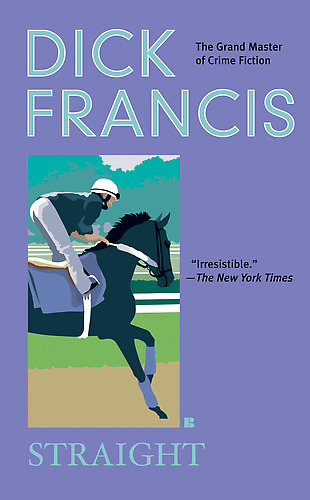
straightOutside of Open Letters, I successfully pitched another piece to the Los Angeles Review of Books, this time on the racing thrillers of Dick Francis (in previous years I have written for them on Sjowall and Wahloo’s ‘Story of Crime’ and on Silas Marner). I had a great time rereading the novels and thinking about how to place them in the context of debates about and revisions of gender roles in crime fiction. What should I pitch to them next summer, do you think? How about a similar Big Gulp piece on Robert B. Parker’s Spenser series?

Of course, the bulk of my writing has been here at Novel Readings. I have been feeling as if I was in a blogging slump this year, but looking back through my archives I don’t see much evidence for that, which is reassuring. Since I’m going to write another post on my year in reading, I’ll pick out here a few pieces that aren’t book reviews.

I wrote several more posts on blogging. My post on blogging and ‘intellectual curiosity’ led to some confessions about the limits of my own curiosity. l also considered how I would answer the question “should graduate students blog?” and I wrote yet another polemic on the place of blogging in criticism and scholarship (“Blogging: Accept No Substitute!“), which was rerun in a slightly abbreviated form at the LSE’s Impact blog. Also in a polemical spirit I responded to William Giraldi’s gratuitous grumblings about internet criticism: “Forget that blog is just one letter away from bog, or that the passel of burgeoning “literary” websites is largely a harvest of inanity with only the most tenuous hold on actual literature.”

As usual, I also did a lot of thinking out loud about my teaching: this year’s highlights include posts on teaching feminism, on ‘coercive pedagogy,’ on the difference between information and education, and on the challenge of emphasizing processes over products.

Finally, I wrote a lot on Twitter this year. 140 characters isn’t much at one time, but they add up. It’s a very different kind of writing than a blog, an essay, or a review, but the conversations Twitter enables and the communities it supports have become essential parts of my intellectual and social life.

“The sword in the hand of humanity”: Writings of Rebecca West 1911-1917

youngrebecca“Boldness is Rebecca West’s strength,” Jane Marcus says in  her edited collection The Young Rebecca: Writings of Rebecca West 1911-1917; “She polished the weapons of invective and denunciation into the tools of a fine art.” That combination of boldness and artfulness makes West irresistibly quotable: people who hang out with me on Twitter may have noticed that I, at least, couldn’t resist sharing some of her erudite zingers. As most of the essays and reviews in this volume are fairly short, it’s West herself that makes the biggest impression, though cumulatively her political and aesthetic commitments are clear: as Marcus outlines them, “the young Rebecca West stood for revolution, free love, equal pay, the working class, votes for women, and the most advanced ideas in literature.” Some samples — and keep in mind that between 1911 and 1917 West (b. 1892) was between 19 and 25:

On The Considine Luck by H. A. Hinkson, The Spinster by H. Wales, and The Trespasser by D. H. Lawrence.

The baldness and badness of popular novels is as touching as the ugliness of a cherished rag doll. What overflowing tenderness must be in the heart of the child who loves this monstrosity, we think. And so with the people who read these novels — what tireless imaginations they must have, to perceive joy in these bare chronicles! We superior persons are too feeble to go searching for beauty on our own like that. We wait idly until Thomas Hardy comes back from witnessing fierce wars between the flesh and the spirit, and Conrad sails home from the strangest and most distant tropic. But the common man picks up some artless work such as The Considine Luck by H. A. Hinkson and creates his own beauty. He takes the puppet heroine, Grace Smith, and paints her wooden cheeks with the flush of his sensuous dreams; he lights her eyes with the radiance he has seen in unattainable women in pictures or at theatres, till Grace Smith is more fair than his first love. In a sense he writes his own book. . . .

It is not unkind to say that the above two books need never have been written. Of course, one is glad that they have been written, just as one is glad that there are dog shows at the Horticultural Show, even though one never goes near the place oneself. One likes to think of all those jolly little puppies; and similarly one is glad that Mr. Wales feels up to his work, and quite certain that a lot of people will get ingenuous pleasure out of Mr. Hinkson’s book.

 On J. M. Kennedy’s English Literature, 1880-1905.

He misses the really high purpose which the Yellow Book school fulfilled. These young men of artistic ambition came into the world to find that style was held in contempt. Dickens had dragged the English language through the mud, Browning had thrown bricks at it, Trollope was sit on its chest and reading the lessons to it. The house of art was full of men who had magnificent messages, but nevertheless ate peas with their knives. This revolted Wilde, possibly because, coming from Ireland, he was accustomed to hear good, clean, English; but in any case he and his followers set about imposing style on English literature. That was the purpose of their existence, and they fulfilled it. There was no new philosophy in the air, so they had no new gospel to preach. But they improved our manners. It is thanks to them that we are as fastidious about words as we are about personal cleanliness.

 On The Carnival of Florence by Marjorie Bowen.

There are two kinds of historical novel: the dietetic and the dressy. In the first one cries ‘Tush!’ and calls for nut-brown ale and a pasty. In the second one sighs ‘Ah God, my lord!’ and wimples, when one does not stomacher. In both cases local colour is not the complexion of the story but an impediment in its speech, but the latter has attracted a higher type of intellect by the delicious opportunity it affords of spending the afternoon in museums, looking at pretty things in glass cases and pretending that one is doing a good day’s work. For the literary mind enjoys almost everything except its work. Chief among the students of upholstery of the past is Miss Marjorie Bowen, who brings to the research enormous romping vitality and a love for beauty of language in which one would believe more thoroughly if she did not so frequently split her infinitives neatly down the middle.

On The World of H. G. Wells, by Van Wyck Brooks.

 Mr Van Wyck Brooks is one of those young American writers who would have made excellent wives and mothers. He fails from sheer excess of the housewifely qualities. He is saving: just as in happier circumstances he would have put every scrap into the stockpot, so now he refuses to throw away the very driest bone of thought, and insists on boiling it up in his mental soup He is hospitable; the deadest idea does not get turned away from his doorstep. He is cleanly: his bleached, scentless style suggests that he hung out the English language on the line in the dry, pure breezes of Boston before he used it.

On Hatchways by E. Sidgwick.

With the possible exeption of Angela Carranza (condemned by the Inquisition of Lima in 1684), who claimed to have written her revelations with a quill from the wings of the Holy Ghost, Miss E. Sidgwick is the most pretentious woman writer who ever lived.

One more, on The Good Soldier, by Ford Maddox Ford (to show that she could praise as well as condemn).

 It is as impossible to miss the light of its extreme beauty and wisdom as it would be to miss the full moon on a clear night. Its first claim on the attention is the obvious loveliness of the colour and cadence of its language, and it is also clever as the novels of Mr Henry James are clever, with all sorts of acute discoveries about human nature; and at times it is radiantly witty. And behind these things there is the delight of a noble and ambitious design, and behind that again, there is the thing we call inspiration — a force of passion which so sustains the story in its flight that never once does it appear as the work of a man’s invention. It is because of that unison of inspiration and the finest technique that this story, this close and relentless recital of how the good soldier struggled from the mere clean innocence which was the most his class could expect of him to the knowledge of love, could bear up under the vastness of its subject. For the subject is, one realises when one has come to the end of this saddest story, much vaster than one had imagined that any story about well-bred people, who live in sunny houses with deer in the park, and play polo, and go to Nauheim for the cure, could possibly contain. . . . Indeed, this is a much, much better book than any of us deserve.

 Oh, OK, just one more, on The Lion’s Share, by Arnold Bennett (because it’s impossible not to think about Woolf’s much more famous essay “Mr Bennett and Mrs Brown” while reading this — though Woolf’s appears eight years later).

It is now the fashion in many intellectual circles to despise Mr Bennett, as it is the fashion to despise all authors who have performed the crude act of publishing anything. But it is interesting to notice that because has has worked so hard at the craft of writing, at the art of inventing the dreams of a not wild imagination with beauty, he cannot help but achieve good writing and beauty even in a book written without much devotion and with a light intention.

 Oh, and this one too, on Love and Lucy by Maurice Hewlett (because it takes up a pet theme of mine).

But Mr. Hewlett would probably object, the girl had charm. Yet can anybody who cannot grasp that the angles at the base of an isosceles triangle are equal have charm? Can anybody who cannot – to take a simple and revealing test of intelligence — fold up a deck-chair, have charm? Lucy, one feels, could not have passed either of these tests. Isn’t it a sign of commonness, like buying a watch with a handsome exterior and cheap works, to be able to regard such a person as charming? Isn’t intelligence not a separate inserted quality but a necessary condition of beauty, at once a manifestation of a subtle and healthy nervous system and a power which organizes mere physical perfection into beauty that stirs the soul?

 rwestAll of these reviews are, in their own ways, epigrammatically delightful. But they also have a quality of self-display that is in fact slightly wearing after a while: it is perhaps a symptom of West’s precocity, indicative of the youthful zest for being right, or of a critical sensibility compromised (as is so often the case today as well) by the journalistic need to be both pithy and memorable. To be quotable, that is, is not the same as to be impressive, and I find her reviews here more impressive when she tones things down and speaks less from her head and more from her heart. I quoted before from her essay on the death of Emily Davison, for instance; along with the suffering of the suffragettes, it’s the war about which she is most eloquent. Here are some excerpts from her review of May Sinclair’s  A Journal of Impressions in Belgium:

The contrast between the manner of Miss Sinclair’s genius and its achievements is difficult to define. It is as though the usual literary process had been reversed and a mouse had produced a mountain. She writes about life as though she were a little girl sitting on a tin trunk at a railway station and watching the people go by; she writes as though at the  most hopeful estimate she might be another Miss Mitford; and out of this piteousness and diffidence and round-eyed observation there amazingly comes a fierce, large vision of reality. It is entirely characteristic of Miss Sinclair that this record of seventeen days spent in Belgium, which is largely a record of humiliations, and is told with the extremest timidity and a trembling meticulosity about the lightest facts, should be one of the few books of permanent value produced by the war.

Partly it is because her meticulosity makes her describe what writers more accustomed to the battlefield leave one to take for granted. . . . And partly it is because she writes of such a company of heroes as never lived before: of girls of nineteen who trudge over turnip-fields among the bullets to look for the wounded, not in any sudden flame of courage, but as a daily occupation; of women who stayed in Antwerp at their posts till the red skies fell in on them. . . .

And against this background, which is a miracle of of dreadfulness, there moves the Ambulance Corps, which is a miracle of human splendour. It is merciful that, just as one discovers that the world is capable of being infinitely more noble. One perceives quite clearly that some members of this Ambulance Corps must have been intolerable as individuals: ‘practical’ women who use their common sense to rasp their neighbours’ shins and regard suavity as a part of incompetence. And yet, united by their collective purpose of courage, they become an organisation so magnificent in its fearlessness that one accepts as a real tragedy the personal grief which makes this book muted like words spoken by one who holds back the tears. No triumph of good work that may come to Miss Sinclair will ever make up to her for the discovery that the artist is unfit for the life of action. And yet every page of this gallant, humiliated book makes it plain that while it is glorious that England should have women who walk quietly under the rain of bullets it is glorious too that England should have women who grieve inconsolably because the face of danger has not been turned to them.

 Faced with that ‘miracle of dreadfulness,’ West is angrily impatient with wishful “emotional” solutions or simplistic pacifism, such as the proposal by Ellen Key’s Women, Peace and the Future that “mere femaleness is going to end the war”:

 Mere platitudinous assertions as to the niceness of peace and the nastiness of war are useless in such crises, and the ‘motherly’ advice of Miss Key that the belligerent nations should refrain from denouncing the sins of others and should turn their attention to their own defects, is actively mischievous.

If we refrain from regarding the invasion of Belgium as a crime, we foment a state of public opinion which would tolerate England’s commission of a similar crime if the occasion arose. It is alert and vigorous thinking about specific points, it is the very quality of intelligence which Miss Key belittles, which brings an end to war. The intellect is the sword in the hand of humanity, without which its tears and laughter are as impotent as the tears and laughter of children. That is why Miss Key’s feminism, this woman-worship that would have women cultivate laxness of mental tissue so that they shall dissolve into a hot emotional vapour that shall act as a Turkish bath to the Superman, is an offence not only against women but against the race.

Reading through this collection I was frequently reminded of Testament of a Generation: what years these were of passionate, uncompromising, yet humane writing in the service of both political and literary ideals! How well did West know Holtby and Brittain? Marcus’s introduction notes that to Brittain West was “the embodiment of the feminist cause, the twentieth-century successor to Mary Wollstonecraft.” The Berry / Bostridge biography mentions West’s friendly treatment of Brittain at a party in 1933 and there are scattered further references to letters and meetings. How stimulating it would have been to share in their conversations — and yet I’ve also been thinking, as I read West’s ruthless pronouncements, that this is not the kind of person I might like best in real life (West sounds difficult, if not quite as challenging a personality as Olivia Manning). Also, much as I appreciate West’s rhetorical flair, this is not the kind of writing I seek out in contemporary contexts, when I tend to find it tiresome. Though I certainly identify as a feminist, I let my Ms. subscription lapse in the mid 90s. I wonder why I enjoy polemics so much more at some historical distance. Or is it that these particular polemicists bring something to their work that isn’t there in the contemporary equivalents? Who would be the equivalents today of this “Fleet Street feminism” anyway? Jezebel? Feministing? What critics would you point to who combine strong political critique with a strong literary sensibility?

Holiday Traditions

Tree 2013

On Sunday, while the snow and sleet and freezing rain made a mess of things outside, we stayed cheerful inside as we carried on one of our favorite holiday traditions: decorating our Christmas tree while listening to Michael Bawtree’s recording of A Christmas Carol. There aren’t a lot of activities, holiday-related or otherwise, that all four of us are equally enthusiastic about, so one reason this is such a special time is that we really feel together during it — even though we all  participate in different ways (Maddie and I do the actual decorating, while the other two get cozy and just listen).

Rituals of one kind or another are of course fundamental to a sense of belonging, whether to a family or to a community, and one feature of academic life that I’ve written about here before is that because you rarely get to choose where you settle, you’re likely to be transplanted, and thus to be disconnected from the traditions that helped shape your identity. That’s not always a bad thing, I realize: when you are separated from your family it’s perfectly possible to idealize proximity! But rituals are something my own family was (is!) always very good at. Things weren’t absolutely the same every year (we used to joke about coming up with “brand new traditions”) but when I think back on my childhood I remember fondly (to give just one example) how we would “always” play charades until midnight on New Year’s Eve and then wait on the front porch until we heard the ships in the harbor before banging wildly on pots and pans to welcome in the new year. (We weren’t the only ones in the neighborhood who did this, so it didn’t make us pariahs…I don’t think!)

When my husband and I were first married, we usually traveled to stay with one or the other of our families at Christmas, but winter is not a good time for trips, especially if you’re teaching on both sides of the break. Then after we had children, the increasing costs and complications made our decision to stay home overdetermined. We’ve had the occasional visitor out here, if not for Christmas itself, at least for the lead-up to it (and one memorable year, because my brother was also living in Halifax, all the rest of my family came out!), but now by and large the four of us are on our own through the holidays, and we’ve gradually figured out what traditions work for us. The tree decorating is one. Another is an adaptation from my past: one of our traditions was “Advent Brunch,” a festive occasion usually on the first Sunday in December which marked (for our wholly secular family) the launch of the Christmas season. We broke out the holly-patterned china and the Santa decorations and the Christmas mugs and all the other paraphernalia that of course can’t have been, but seemed, eternal. We unpacked the Christmas records, too, and the books, and we got tiny presents (I especially remember, because I still have most of them, the new holiday pin tradition!).

Advent Treats

Something like this (though with a more modest menu and not quite so many trappings) has also become part of the Maitzen Family Christmas. We try to stick to the rule that there’s no (or very little) Christmas activity before then: though local stores had their Christmas stuff up before the Halloween decorations had quite come down, there were no carols or decorations in our house before December 1!  (I’m with Monica: “Rules help control the fun!”) The kids mock me about this rigidity sometimes, but I think they actually appreciate that special occasions stay special because they aren’t every day.

One ritual we came up with ourselves is our unusual strategy for gifts: we dole them out one per day once school gets out, keeping things relaxed and allowing time for appreciation and gratitude. We used to go on a Christmas lights drive around town on a suitably ice-free night; this tradition was cut short by a tragic car-sickness episode a couple of years ago … but we used to really enjoy it, so we are weighing the risks of trying again. Or maybe bundling up for a Christmas lights walk around our quiet neighborhood: that might make an excellent brand new tradition! Then there are the Christmas movies: we all love The Muppet Christmas Carol, so that’s another good time for togetherness, and then different combinations of us can be counted on to watch ScroogedWhite ChristmasA Miracle on 34th Street, National Lampoon’s Christmas Vacation and It’s a Wonderful Life at least once over the school break. All through December, we also enjoy our Advent calendar routine: we have one that has an (abridged) installment of A Christmas Carol for each day, so the kids take turns reading it — and, lately, acting it out (as of today we’re up to the Ghost of Christmas Yet to Come). This year we got another beautiful calendar that has an ornament in every window that then gets hung on the tree you can see as the centerpiece in the picture of our Advent Brunch table.

Holidays 2010 028

Because of our one-a-day present opening, Christmas Day itself is not the hyped-up occasion it is in many households, but we do keep up the tradition of putting out and filling Christmas stockings. I find it’s an excellent way to restock the kids with socks! I have a lot of fun picking out other little goodies for them too, and I keep up another of my family’s traditions by always topping the stockings off with a book. We have a traditional Christmas breakfast (pancakes) and dinner (roast pork with fixings), and dessert (apple crumble). The predictability adds to the pleasure: for one thing, it makes the preparation easier, and we all know we will enjoy the results. (Last year I actually made the radical decision to serve lamb instead. It turned out well, but it also turned out that Maddie doesn’t like lamb and we don’t like it a lot, or not as much as we like the pork — so this year we’re going back to the usual, though I have flirted with doing roast beef, which is what my grandmother “always” served us when we went over to her house for Christmas dinner.)

We’ve arrived at our family traditions through some trial and error. It was important to realize that we needed to find rituals that worked for us, with all our quirks and idiosyncrasies, rather than trying to relive our childhoods (or at least not entirely!) or live up to some imaginary ideal of what families should do on holidays. It turns out that we like things quiet: we’d rather see a few friends than have a big party (or go to one); we have no urge to stand outside in a crowd to cheer in the new year but prefer to watch a movie and turn in when we’re tired;  a holiday for us means time with fewer obligations and stresses, not more. Every so often it seems a bit too quiet to me, especially when I get reports from back home about everyone going to and fro and having all kinds of sociable fun. But we rush around a lot as it is, and so now, really, my favorite tradition of all is just taking my book and my Baileys and sitting to read where I can bask in the calming beauty of the tree.

Do you have holiday traditions you particularly enjoy? I know I’m not the only one who’s far from the people and places, and thus rituals, that I grew up with: what brand new traditions have you developed that work for you where you are now in your life? Do you embrace the quiet or relish the social whirl?

Weekend Miscellany: Bests and Worsts and Turgenev and Middlemarch and More!

As usual, the bloggers I follow have been putting up all kinds of good posts recently. Here’s a sampling!

At stevereads, the annual Best and Worst of the year extravaganza is in full flood. Lists already offered including Best History, Best Romance, Best Biography, Best Collected Letters, Best Reprints, Best Debut Fiction … and there’s more, and more to come. The range is extraordinary, the judgments vigorously pronounced, and the curmudgeonly digressions about the state of the (book) world today just add to the fun. Nobody I know or have ever known reads more, or more passionately, than Steve.

At Wuthering Expectations, Tom is reading Turgenev:

Turgenev may not have known what to do with the hero of Fathers and Sons once he created him, fleshed him out, and showed him from all sides.  So he killed him off, by disease.  Discerning critics have found this end unsatisfying in that it is arbitrary, too easy.  In a sense, yes.  But the next to last chapter, Bazarov’s death is so good that I do not care.

Vladimir Nabokov, judging by his notes in Lectures of Russian Literature, apparently taught this chapter simply by reading large parts of it aloud to his class.

The funny thing is that there is hardly a sentence in it that I would pull out as particularly good.  The quality is a question of urgency, of small movement, of the right amount of attention given to a scene before a quick cut to the next.  And of course the stakes are high.

There’s always a slightly sideways quality to Tom’s readings, by which I don’t mean they aren’t illuminating or interesting but rather the opposite. He finds his own way into every book he reads. I have never read Fathers and Sons or indeed most of the non-British literature he reads, so whatever he says about these books is inevitably fresh to me, but I always especially like it when he takes on Victorian novels or novelists that I think I already know well and makes me look and think again about how they do what they do.

At Tales from the Reading Room, litlove has a much more positive reaction to The Signature of All Things than I did:

This was altogether a much more convincing and and enjoyable riposte to the 19th century novel than Jeffrey Eugenides’ The Marriage Plot, and I think Elizabeth Gilbert has pulled off something quite special here.

I notice Gilbert’s novel made Steve’s 2013 ‘Honor Roll’ for fiction too. Geez, with friends like this … but in fact, this is all evidence that the real method of criticism is not finite declarations but coduction. In reading each other’s views, we test and reevaluate our own, and the goal cannot be some ultimate right reading, but only our most thoughtful, attentive, well-articulated ones.

At Shelf Love, Jenny has completed her posts on Galsworthy’s The Forsyte Saga. “Such enjoyable books,” she concludes; “If you’ve been considering these, do take them down from your shelf and join me in reading them!” I have indeed been considering them, and I have a handsome Oxford edition that I got for Christmas or perhaps a birthday not that long ago. They sound so good I did indeed take it off my shelf … but then I remembered that I’ve been vowing to finish Black Lamb and Grey Falcon, before the winter term begins if I possibly can, and I’m confident that I can’t do both. I think I will hold The Forsyte Saga in reserve for my February break!

At The Little Professor, Miriam writes on Charles Palliser’s Rustication. I’ve never read The Quincunx, but Danielle at A Work in Progress has just finished it and is ambivalent. I think Rustication might be more my style: Miriam describes it as in the tradition of the sensation novel. I stopped reading before she gave away the big plot twist, in case I do get around to it!

Ana at Things Mean A Lot has been doing year-end posts as well, and this one on Favourite Picture Books made me feel all happy and nostalgic. I really must get a copy of Frederick. One consequence of moving away from my family home is that my family doesn’t have any of our old children’s books!

Among many interesting recent posts at Thinking in Fragments, this one on Laura Wilson’s The Riot stands out because I too am always looking for good new crime writing. Alex writes so convincingly about it that I went immediately to see if I could get my hands on the first in the series … but no luck at the library or any of our local bookstores! I’ll have to order it in — or add it to my wish list.

At Read React Review, Jessica posted her thoughts about Georgette Heyer’s Sylvester, which was also one of the first of Heyer’s novels I read. I didn’t like it at all then, but I reread it after I’d learned to enjoy Heyer and liked it much better.

Finally, 2013 really does start to seem like the Year of Middlemarch. Of course the most spectacular event was the launch of Middlemarch for Book Clubs! OK, maybe not spectacular. But at least I did get it built, and some day they will come! (I’m still working on how to make that happen.) But at The Toast they are leadingMiddlemarch read-along in preparation for the launch of Rebecca Mead’s My Life in Middlemarch in the new year. Too Fond is also doing a read-along. And at The Millions, Adelle Waldmann highlights Middlemarch for their Year in Reading feature. (Weirdly (for me), I did not teach Middlemarch in any course in 2013. This is shocking! I’ve been thinking of assigning it for the Dickens to Hardy course in Fall 2014 … but right now I’m feeling anxious about students’ ability to keep up with the amount of reading I typically assign, and I’d hate to be dragging them through it. I’ll be thinking about this as book orders come due after Christmas.)


“He was my shadow, or I was his”: Daphne du Maurier, The Scapegoat

The Scapegoat is the third novel I’ve read recently with a plot that turns on stolen identities. It’s really interesting how differently they deal with the dangerous temptation to be someone else. In each case, the usurper is at least somewhat sympathetic because what he wants is so simple and recognizable: belonging, acceptance, communion. But while in Highsmith’s Tom Ripley this longing becomes an amoral readiness to betray or kill to protect his deception, and in Tey’s Brat Farrar it leads to unexpected heroism in defense of the people he intended to defraud, in du Maurier’s John it becomes something deeper still: in taking over the life of Jean de Gué, our protagonist is drawn not only into a history and a family steeped in their own secrets and lies, but into his own soul. What kind of man does he want to be — is he capable of being? How can his presence, as an undetected stranger in their midst, change the lives of the people Jean de Gué has damaged and now abandoned? In taking their pain and suffering into himself, can he free them somehow from the burdens of their past, even as he’d hoped that to be among them would liberate him from his own failures?

When the novel opens, John, a repressed English scholar and lecturer in French history, has been traveling in France. His pleasure in the sights has been haunted by his sense that for all his expertise, he remains an “alien” among the people whose language he speaks like a native:

Years of study, years of training, the fluency with which I spoke their language, taught their history, described their culture, had never brought me closer to the people themselves. . . . My knowledge was library knowledge, and my day-by-day experience no deeper than a tourist’s gleaning. The urge to know was with me, and the ache. The smell of the soil, the gleam of the wet roads, the faded paint of shutters masking windows through which I should never look, the grey faces of houses whose doors I should never enter, were to me an everlasting reproach, a reminder of distance, of nationality. Others could force an entrance and break the barrier down: not I. I should never be a Frenchman, never be one of them.

He longs to come out from the shadows of his “pale self,” to let loose “the man within” and discover “what urgings and longings he might possess.” Though his new identity is not freely chosen but thrust upon him, it is also the realization of his dream “to unlock the door”; no wonder that as he drives towards the chateau to take up Jean’s life, John finds himself rejoicing:

I drove faster still, overtaking the cars ahead of me, possessed by a reckless feeling I had never known before, the sensation that I myself did not matter any more. I was wearing another man’s clothes, driving another man’s car, and no one could call me to account for any action. For the first time I was free.

At first it’s just a lark to John, who can hardly believe nobody realizes he’s not really Monsieur le Comte. That’s a stretch for the reader’s credulity too, I have to say, but the dog at least growls at him (much to the family’s puzzlement), and we learn eventually that Jean’s mistress, too, was not taken in (“A woman would have to be a great fool not to distinguish between one man and another, making love”) — though she hasn’t turned him away either. Figuring out the puzzle that is Jean de Gué’s life is initially interesting and confusing but not terribly meaningful to John; his own missteps cause no deep feeling or alarm. Before long he realizes, though, that in moving into the chateau he has, however inadvertently, inserted himself into a complex and still unfolding story, and the shift from “library knowledge” to real life is fraught with dangers, the worst of them not physical but moral. To be “one of them” is to be called upon to act, even (as head of the family) to lead. But with what motive, and to what result?

Du Maurier brilliantly evokes the chateau’s brooding atmosphere, which we see, through the eyes of John the historian, as part of a broader national story of threat and struggle, of longing and destructive indifference:

The chateau, which had seemed a jewel in sunlight, was more forbidding at the approach of dusk. The roof and turrets that had blended against blue took on a sharpened tone against the changing sky. I thought how like a bastion it might have been when water filled the moat, before the eighteenth-century facade of the central portion linked the early Renaissance towers. Were they any more lonely, the silken ladies peering through those slits, than the Renée and the Françoise of today, with the clammy water damping the mouldering walls, and the forest, thick and shaggy, shrouding the very door? Did the wild boar, fiery-eyed, come rooting where the cattle wandered now, and the thin horn of the huntsman sound in early morning when the mist still clung about the trees? What drinking, roystering nobles of Anjou must have clattered forth over the drawbridge to hunt and fight and kill; what love-making by night, what long uneasy births, what sudden deaths? And now, in another time, how much of this was repeated, oddly, in a different way, with stifled emotions and hungers more obscure. Cruelty was of a deeper kind today, wounding the spirit, hurting the secret self, but then it was more openly brutal: only the tough survived, and the lonely Françoise or the frustrated Renée of that age went like blown candles into disease and death, lamented or forgotten by their lords, who, prototype of Jean de Gué, feasted and fought, shrugging a velvet shoulder.

It’s more recent events, of the kind that wound the spirit, that have set in motion the particular conflicts of Jean’s generation, and thus John’s new reality: the war-time occupation, and the subsequent brutal accounting between resistance fighters and collaborators, have set family and friends against each other, but also provided useful cover for other, more personal, reckonings. As John untangles the threads of Jean’s past actions and current relationships, he gradually feels himself becoming part of the history that he had previously only read about in books, and this in turn fills him with a powerful longing to do right by not just the people but the place:

I was no longer isolated, watching apart, numb with exhaustion, but one among many, part of St. Gilles. . . . I knew suddenly, with conviction, that it was not a stranger’s curiosity that drew me to them, a sentimental attachment to the picturesque, but something deeper, more intimate, a desire so intense for their wellbeing and their future that although akin to love it resembled pain. This longing, strongly felt, was yet somehow impersonal: it did not spring from a wish to stand well with them, and it embraced, in some curious fashion, not only the village people and those who now seemed part of me, sleeping within the chateau, but inanimate things beyond — the contour of a hill, a sloping sandy road, the vine clinging to the master’s house, the forest trees.

 Even before this point John has, rather bumblingly, been trying to act in the best interests of his strange, unhappy new family. He’s not overtly successful, but his good intentions are perhaps what Jean’s mistress acknowledges when she remarks, “you have something that he doesn’t possess . . . You may call it tendresse.” It may be, though, that his best course is not to live among them but to leave, taking with him everything he has learned, every burden or grief or sin he has shared while in Jean’s place. When the novel begins, John is contemplating a stay at the Abbaye de la Grand-Trappe: perhaps there among the monks, he had hoped, he would “discover what to do with failure.” “They might not give the answer,” he confides in Jean de Gué on the night of their fateful meeting, “but they could tell me where to look for it.” He ends up at the chateau instead: it is in action, not silence and solitude, that he finds his answer, and his belonging.

But is this success?  John believes it is just failure in another form: “[failure] merely became transformed. It turned into love for St. Gilles. So the problem remains the same.” After all, he doesn’t belong — not really — and as the novel ends he is once more on the road to the Abbaye, now with a different question that is somehow also the same one: “What do I do with love?” In seeking freedom, he found new obligations; in being someone else, he became, more than ever, himself.

This Week in My Classes: Term Limits and New Ideas

Arcimbolo LibrarianThis was the last week of fall term classes for us, which means concluding remarks and exam review and conferences about term papers — and then, beginning Monday, an influx of papers and exams to be marked, final grades to be calculated, and everything to be filed away and tidied up. I have an exam from 7-10 p.m. on the very last day of the exam period, which means I won’t be all done for quite a while yet.

It’s always bittersweet when the term ends. I put a lot of time and thought into preparing for each class hour, and a lot of energy goes into each actual meeting, which means I spend most of the term in a strange blend of panic and euphoria. When we’re done, I genuinely miss the buzz of meeting my students face to face and seeing what we can do with our material: even when a session doesn’t go particularly well, the challenge of it is definitely stimulating, and this year my mystery class especially was just a whole lot of fun. When a lot of smart students are really engaged and keeping me on my toes, it’s amazing how fast 50 minutes can go by! But I don’t miss the relentless pace of it all. What a relief it is to be home on a Friday night and be relaxing without the haunting awareness that by Sunday at the latest I have to be turning towards work again: the work I have to do for the next couple of weeks really can be managed in something more like regular office-job hours — unless I want to do a little puttering here and there evenings and weekends. I’m hoping that means I’ll be able to get some momentum on some reading and writing projects I’ve been deferring over the term. Ideally, I’ll get enough done that I can keep going on them when the winter term begins. This may mean not writing for the January issue Open Letters: much as I like to contribute, my recent pieces have not been entirely in line with my other writing priorities (especially the book on George Eliot I’m trying to conceptualize).

But as a wise woman once said, every limit is a beginning as well as an ending, and even as this term is winding down, things are heating up for the winter term, which starts exactly one month from today. Inquiries have been coming in about the waiting list for my intro section and about the readings for my 4th-year seminar; I’ve started roughing out my syllabi and I’ve got blank course spaces set up on Blackboard, with the goal of having materials ready for students well before the end of the month (in the spirit of ‘hit the ground running’).

And as if that isn’t enough, we’ve already had to organize our slate of classes for next year, and it won’t be long before we are asked to send in preliminary course descriptions and book lists, for promotional purposes. It usually makes me kind of cranky to be asked about next academic year when this one is still very much a work in progress, but on the other hand, the future is such a hopeful place to be! Drafting and redrafting possible book lists for the next incarnation of the Dickens-t0-Hardy course is pretty fun, and frustrations with this year’s assignments sequences are easier to handle when I think about them as learning experiences for next year’s New and Improved versions. (You can look forward to more posts about how I’m going to do everything different and better, especially the reading journals for the 19thC novels class.)

Looking even further ahead, I’ve been thinking more about the question of whether or what our students read outside of class and the perfectly reasonable point that we assign so dang much reading (ahem) that at least during the term it’s pretty challenging for them to be engaged in the book world more widely, even if that’s something they want. Of course, one reason I started this blog was because I was trying to figure out how to build some kind of relationship between my own academic reading and writing and that wider culture — and it has occurred to me that an obvious way to translate this impulse into pedagogy is to dream up a course that does something of the same thing, perhaps by combining assigned readings with readings students choose ‘from the field’ (books and reviews), and then requiring both standard essay assignments and different kinds of reports and reviews. It could be called “Books in the World” or something. Would this be a good first-year class? Or are the actual demands of any good book writing such that it would be better as a more advanced class, so that students will already have practised their writing skills and acquired some useful literary terminology and history?  In a recent interview, Daniel Mendelsohn proposes that students would be better off “reading Pauline Kael reviews in the New Yorker than Derrida” because when they begin “they literally have no idea, at first, what the point of being critical is.” I would be motivated by a somewhat similar impulse, I think: that they should have a sense of what (and where) the critical conversations are, because (as I do already say frequently in class) literature is not in fact written for the classroom but for the world.

This is still a very new idea for me, but maybe it’s actually a common approach and I’ve just been stuck (as we all so often are) in my own ‘how things are usually done’ rut. I’d be happy to know about any classes that are run along these lines, and also to know what anyone’s first impression is about this possibility.

“That promise will not be kept”: Rebecca West, This Real Night

westrealnightEvery time we left our pianos the age gave us such assurances that there was to be a new and final establishment of pleasure upon earth. True that when we were at our pianos we knew that this was not true. There is something in the great music that we played which told us that promise will not be kept . . .

This Real Night is the sequel to Rebecca West’s The Fountain Overflows. It was published about thirty years later, and apparently there was to be a third volume completing the series. This Real Night was published posthumously, and the publisher’s note to my edition suggests she hadn’t entirely finished working on it when she died. That might explain the odd tempo of the novel, which is extraordinarily dense — almost tediously so at times — through the first two thirds or three quarters and then concludes with a rush of emotional intensity. It feels compressed more than incomplete, though, and perhaps that sensation of lopsidedness is not a defect but a strategy to make the ending strike the reader, as it does the characters, as a transition from a long, complex, but unified and meaningful past into a future tragically unmoored from it. “I am writing all this down,” Rose says at one point,

in full knowledge that it will not now seem important, for the reason that that is just what marks off that past from our present. Everything was then of importance. Everything was of equal value. In life we were not divided. Life itself was not divided.

This Real Night picks up the story of the Aubrey family, now without their mercurial burden of a father and relatively prosperous thanks to their mother’s cleverly having preserved some valuable paintings as insurance against his fecklessness. The musical daughters, Mary and Rose, have progressed to studying in musical academies in London; the unmusical daughter Cordelia, who had so distressed the rest of her family by her insistence on playing the violin, pursues conventionality with the same single-mindedness and self-assurance that they bring to their art. In this novel West continues her ruthless cultural elitism: there’s a particularly painful scene in which Cordelia’s former mentor Miss Beevor (“the poor, poor idot”) is accidentally shown how little the musical Aubreys think of her when their mother tries (tactfully) to get out of taking Miss Beevor to a concert that’s beyond her musical reach:

“If it is not to be the St Matthew Passion,” said Miss Beevor, implacably, “let it be this young woman you have been talking about.”

“No, no,” said Mamma, “do not think of her either. Let us leave such things to the young, we will go to the Queen’s Hall.”

“I do not want to go to the Queen’s Hall,” said Miss Beevor. “I have been to the Queen’s Hall. On several occasions. I know that I am not a gifted musician. Nor a highly trained one. But surely it need not be taken that I am quite without musical taste.”

 That night Rose finds “Mamma sitting there among the shadows, the gas not lit,” in tears. “Why are you crying,” she asks. “I was awful to Miss Beevor,” is the reply. She is remorseful about Miss Beevor’s hurt feelings, but she has no second thoughts about her judgment of Miss Beevor as someone who is beneath a great performance of the St Matthew Passion or a performance by Wanda Landowska. Great art requires just such ruthlessness. Cordelia has already suffered for it, and in This Real Night Rose too has a brush with it, thanks to her new teacher Mr. Harper:

I was fairly certain that if I had played to Mamma and Mr Kirsch as I was playing to Mr Harper I would have rated the compliment of denunciation . . . Their scorn would have meant that I was walking with them in the procession that would gloriously never arrive at its destination; but Mr Harper’s embarrassed indifference implied that so far as he was concerned I had never joined it.

It turns out, though, that Mr. Harper just wants Rose to learn to play as herself, not as an imitation of her mother: “She’s taught you to play as if you were her, and you’re not , by a long chalk.” So Rose sets out to relearn how to play, and it’s hard, hard work: “it was animal warfare, such as a mongoose might wage against a snake.”

I find West’s treatment of the artistic life fascinating because it is at once so utterly committed and so unsentimental: no Aeolian harps here! There’s much more sweat and tears than inspiration. Mr. Harper gets particularly exercised over a picture showing people “woozy” over music: “and it was Beethoven, Beethoven, of all composers, who was supposed to have put them into that state. Music was something you had to do sober as a judge. Hard, you had to be.” But it turns out that this novel is not about Rose and Mary maturing into the musicians they are meant to be, or capable of being. Rather, it’s the story of the lesson the music teaches them: that the promise of pleasure on earth will not be kept. Because while they are practising and, eventually, performing, and becoming gold medallists, and playing at the Proms, and waltzing in the moonlight in this “age of success” — while all this rich living is going on, a cataclysm is in the making. When the novel begins, everyone knows “there were to be no more wars,” but when it ends it is 1914 and their golden age is over, though the extent of the catastrophe is not immediately apparent:

Our careers for some time continued. The First World War did not suddenly turn on civil life and strangle it as the Second did. Simply we saw a fungoid bloom of ruin slowly creep across the familiar objects among which we had been reared.

The greatest threat, inevitably, is to their cherished brother Richard Quin, who is caught on the very threshold of adulthood, who instead of going to Oxford goes to war, and to death. His leaving is protracted in the novel: it takes up many long pages of memory and anticipation and repressed dread. When they finally take him to the station, it’s music that provides a fantasy of evasion:

Under his breath he sang the aria from The Marriage of Figaro which Figaro sings when Cherubino is going to war, and weaved talk through it. There was no difference between the youth of Cherubino and the youth of Richard Quin, and it was delightful to pretend that we were in an opera, that Richard Quin would go to the war again and again for hundreds of years and never get there.

But the moment of real parting inexorably comes: “He said, “I want to swim. And lie in the sun.'” They are together for a few more moments and then “he was not there.” It seems as if everyone including Richard Quin knows he will not come back; it was only my own optimism that kept me hoping, even as I ran out of pages, that the book would end but Richard Quin would not. “I saw the life of those days as a flagon of grey glass, filled with salt water, with collected tears” Rose says;

The occasion of our grief was classically decorous, our brother had died for his country. But our grief was useless. Salt water, spilled on the ground, does not feed what grows there, but kills it.

 There will be more tears, this time for their mother, whose death follows closely on Richard Quin’s. “We had known her to be ill for a long time, all people die,” Rose reflects, “yet we felt as if she were the first person to die, and we the first people to suffer a beloved’s death.” They tend her “with the extremest gentleness” to the painful end, as if to prove the truth of her own despairing cry: “Yet what is useful except love?”

Open Letters Monthly: The December Issue (With Bonus Crochet)

brattle

Once again we mark the beginning of a new month with a bright shiny new issue of Open Letters! And once again it shows off the range of readers and writers involved with the site.

We lead off this time with our annual Year in Reading feature (Part I, Part II). My contribution won’t surprise any regular readers of this blog, but there’s lots else to interest you: Colleen of Jam and Idleness (and now of Open Letters! hooray!) reports on reading time happily spent in 19th-century France; Steve Donoghue reminds us that for sheer physical pleasure, print books still beat out digital; John Cotter has been reading short stories that blew his socks off; Lisa Peet has been in a Jane Gardam phase; and that’s only for starters. Other pieces address Chagall’s Christian iconography, Doris Kearns Godwin’s The Bully Pulpit (that’s Steve again!), Michael Johnson’s extraordinary search for Solzhenitsyn, John Ford’s ‘Tis Pity She’s a Whore (that’s Colleen again!), Helen Fielding’s new Bridget Jones novel (me again!), the life and writings of Giacomo Leopardi, and more that you’ll have to click on over to find for yourself.

I was proud of myself for getting a review done during this fairly busy month. It became conspicous to me towards the end of the month that the real casualty is actually this blog: if I’m working on a review, it takes up a lot of the time I have for non-work-related reading and writing. So on the one hand, it’s a good thing to be turning out more polished pieces more often and building up experience writing more ‘on demand’ and less on my whim — but on the other hand, especially since it has been a while since I reviewed a book I was really enthusiastic about, it makes me feel a bit stifled.

Crochet
Look what I made!

In unrelated news, when I’m not reading, writing, or working (or reading and writing for work!) I’ve been trying my hand at crochet. I got it into my head to learn crochet a couple of months ago, on the theory that it might be something I could do better than I knit (I like knitting but have no head for patterns or fancy stitches, and after a while ribbed scarves aren’t that fun to make). I like doing cross-stitch but it’s fussy and hard to do when I’m very tired (which is when I stop reading / writing / working) or while watching old episodes of ER* (which is how I currently recuperate from too much reading / writing / working). I think I was right that crochet will suit! I had a rocky — or perhaps I should say a tangled — start, but I have more or less got the knack of the basic stitches now, and a couple of weeks ago I successfully completed a basic “granny square.” It probably says something about the ways in which other aspects of my life are fraught with intangible frustrations and deferred outcomes that I am so very pleased with learning how to make something I can quite literally hold on to – even if by serious crochet standards my technique probably has a long way to go. I’ve gotten very ambitious and started stockpiling coordinated squares for an afghan, to give my father as a Christmas present. I’ve warned him, however, that at my current rate of production it may be just a little late.

deptmtgcrochet
Afghan-in-progress!

*Speaking of ER, I’m realizing all over again what a good show it was — much better than Gray’s Anatomy. Are there other ER fans out there?

(Flickr photo of the Brattle Bookshop courtyard.)


This Week: I’m Still Reading, In Spite of It All!

mosleyIt’s a crazy week, with midterms and proposals and assignments piling up on top of the routine business of class meetings — which isn’t entirely routine at the end of term because I always prepare practice exams and review handouts and everything needs to be printed and copied and sorted and ready on time and yet there are still class notes to be prepared and readings to do and … well, you get the picture. Add in that the next issue of Open Letters is in production, which means writing and editing in every ‘spare’ minute and you’ll understand that I’ve been feeling kind of frazzled.

And yet, there are books. Some are assigned ones, and happily they are really good ones this week. It’s a bit funny that I say that, as one of them is a book I really disliked the first time I read it – Walter Mosley’s Devil in a Blue Dress. The more time I spend on it the more I appreciate it: for me, this kind of experience is always a good cautionary tale about taking first impressions as final ones. They also help me (I hope) with my teaching, as I honestly do understand what it’s like to read something and not really get it, but to stick with it and learn what mental lenses bring out its most interest aspects. Even more to the pedagogical point, I know that I don’t have to like something — it doesn’t have to conform to my personal taste — for me to know it’s worth engaging with. I persisted with this one because I knew it would bring a valuable new dimension to my mystery class, which it does, and in working on how to explain it, I ended up making friends with it. Mind you, I still haven’t read any other Easy Rawlins novels, but my excuse is that I’ve been trawling for the next great addition to my syllabus. Then it’s North and South in the 19th-century novels class, which is an old favourite of mine.

I have managed to do some reading outside of class too. Last week I reread (very briskly! skimming!) both of the first two Bridget Jones novels in preparation for reviewing the new one, which I also read (and spent much of the weekend writing about – stay tuned for the new issue, to see what I thought). Over the weekend I also read Georgette Heyer’s A Civil Contract, which was the most subdued Heyer I’ve met so far. It was bittersweet enough to make me almost sad at times, even at what should have been the happy ending.

With all that light reading going on, I needed the occasional bracing tonic, so I have been dipping into The Young Rebecca: Writings of Rebecca West 1911-1917. It’s an astonishing volume: she is fiercer and smarter at 20 than most of us will ever be, whether she’s writing on socialism or feminism or Jane Austen or some hapless lesser novelist whose book “need never have been written.” One of the most memorable pieces so far is her essay on “The Life of Emily Davison” — Davison was the suffragette who threw herself in front of the king’s horse and subsequently died of her injuries, though West is if anything more vehement about the pain and cruelty of the force-feedings she had endured:

But for her last triumph, when in one moment she, by leaving us, became the governor of our thoughts, she led a very ordinary life for a woman of her type and times. She was imprisoned eight times; she hunger-struck seven times; she was forcibly fed forty-nine times. This is the kind of life to which we dedicate our best and kindest and wittiest women; we take it for granted that they shall spend their kindness and their wits in ugly scuffles in dark cells. And now in the constant contemplation of their pain we have become insensible. When enlightened by her violent death, we try to reckon up the price that Emily Davison paid for wearing a fine character in a mean world, we realise that her whole life since she joined the Women’s Social and Political Union in 1906 was a tragedy which we ought not to have permitted. For if, when we walked behind her bier on Saturday, we thought of ourselves as doing a dead comrade honour, we were wrong. We were making a march of penitence behind a victim we allowed the Government to do to death.

As soon as the dust clears / the new issue has gone to ‘press’ / I can, I want to read the rest of this collection as well as the two other of her novels I have in my Virago collection: This Real Night (the sequel to The Fountain Overflows), and The Judge. And then I’m turning to Black Lamb and Grey Falcon and I’m reading it ALL. I’m sick of spending time reviewing brand new novels that aren’t really worth the effort it takes to write about them well. (OK, I guess that’s a spoiler for my upcoming review of Mad About the Boy!)

baloghsummerFinally, as I’ve temporarily run out of Georgette Heyers, I’m revisiting Mary Balogh’s A Summer to Remember for something soothing to read with my morning tea and when everything else is done at the end of the day. Now that I’ve read several more Heyers, the differences are more conspicuous, chief among them that Balogh (as far as I’ve seen, anyway) is absolutely never funny! She is much more sentimental than Heyer — and also much sexier, which is not better or worse but just different. A Summer to Remember  is a nice one, though Lauren is a bit too perfect (my favourite Balogh is Simply Perfect, probably because I identify with the prickly schoolteacher heroine!).

Looking ahead, I have more treats in store besides West, as both of my book clubs have chosen Daphne du Maurier titles: my local group meets in mid-December to discuss The Scapegoat, and the Slaves of Golconda group chose Jamaica Inn (all welcome, to post or just join in the comments). Now, if I can just make it through the incoming deluge of papers and exams — and the meetings!

This Week In My Classes: Pressing On

northandsouthEvery year my rate of posting (never particularly frequent or steady anyway) falls off at this time of year thanks to the rising pressure of other reading and writing — much of it kind of mind-numbing (midterms, for instance) and thus sloth-inducing when it’s done. That’s about where I am this week, with two sets of midterms in (one now marked – hooray!) and various proposals and papers imminent. Still, when I reflect how much I had going on this time last year, especially with the all-new and very labor-intensive Somerville seminar, I can’t really complain: overall, this is a much less hectic term. That’s what makes it possible for me to be at least contemplating getting another review done for Open Letters this month — though my attempts to write it have been going badly so far.

In Mystery and Detective Fiction we wrapped up Knots and Crosses before the latest midterm and we’ve just started on Indemnity Only. In my usual mental game of musical chairs for this course, I’ve starting thinking it’s time to rotate Paretsky out in favor of ‘A’ is for Alibi next time around, just for some variety, but I always enjoy teaching Indemnity Only. As with Rankin, Paretsky has later novels that are richer qua novels, but in both cases these series starters do a lot of useful setting-up work and are more self-consciously messing about with genre conventions, which works well in a survey course. I rattled off way too many ‘opening questions’ in a hurry in yesterday’s class and felt bad about it afterwards: tomorrow I will be sure to slow down, filter the key ones for our particular attention, and allow for a lot more discussion. I think defensiveness about working on an overtly feminist text had something to do with my feeling that the framing issues needed to be addressed so fully, but it’s a mistake to let hypothetical carpers set my agenda. At the same time, though, I think it makes sense to anticipate some potential misunderstandings or knee-jerk responses, and to do some basic things like point out that “feminism” is a word that does not have a single fixed meaning. When we were discussing Knots and Crosses this year I tried to emphasize more than usual that Rankin explores ways in which crime is gendered; we also always discuss the novel’s interest in masculine identity and the cost of living up to certain ideals of “manly” strength, as exemplified by Rebus’s SAS training. I hoped that would make Paretsky’s (and V. I.’s) commitment to challenging gender norms ‘belong.’ But I’m sure there will be some of the usual irritated comments, and that’s fine: we come to discuss the book, not to share its values.

In 19th-Century Fiction we have wrapped up our time on David Copperfield and begun reading North and South. It has been a couple of years since I’ve assigned North and South, and I’m coming back to it with pleasure: it’s always one of my favorites, and happily it is often popular with the students too, as they find Margaret a strong and interesting character (she should be especially welcome after the insufferable Dora and the almost as tedious Agnes!) and appreciate the explicitly political drama. Besides thinking about Gaskell, I’ve been thinking a lot about the assignment sequence I’ve used this term and in last term’s Dickens-to-Hardy class. Some aspects of it do just what I had hoped they would, but the reading journals in particular continue to be a mixed success — successful, that is, only for the students who don’t need special prodding to do them regularly and thoughtfully. I’ve been thinking that I may have to set questions for them that would require them to be up to date with the reading to answer, and that would quite deliberately target issues and scenes I plan to discuss in class — which might increase the participation rate. But while that sounds efficient in those ways, it also stifles creativity and independent thinking about the books, which I do value and want to encourage and even see more of. How to find the right balance between coercion and liberty? Well, that’s an appropriate enough question to be pondering while reading this particular novel, I suppose.

And on that note, back to rereading it for tomorrow’s session.