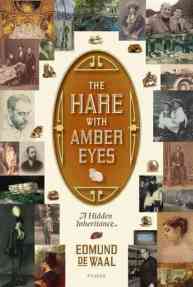
“A life entirely through objects”: Edmund de Waal, The Hare with Amber Eyes

hare-coverIt is not just things that carry stories with them. Stories are a kind of thing, too. Stories and objects share something, a patina. I thought I had this clear, two years before I started, but I am no longer sure how this works. Perhaps patina is a process of rubbing back so that the essential is revealed, the way that a striated stone tumbled in a river feels irreducible, the way that this netsuke of a fox has become little more than a memory of a nose and a tail. But it also seems additive, in the way that a piece of oak furniture gains over years and years of polishing, and the way the leaves of my medlar shine.

“I really don’t want to get into the sepia saga business,” Edmund de Waal says in the Prologue to The Hare with Amber Eyes, “writing up some elegaic Mitteleuropa narrative of loss.” This self-consciousness about the kind of story he will, or can, or should, tell is one of the most interesting elements of the saga he eventually does write up. It is, inevitably, a narrative of loss — and why, really, should it not be elegaic? It’s nostalgia he wants to avoid, “about all that lost wealth and glamour from a century ago” — but why? Where, how, do we draw a line between treacly nostalgia and heartfelt lamentation? Or is it only what he would be nostalgic for that gives him pause? Is “lost wealth and glamour” not something to mourn? What about the art, the beauty, such wealth enables?

It is certainly not more tragic to lose everything when you have so much than it is to have nothing to lose. But The Hare with Amber Eyes prompts difficult questions about value and loss. Should the privilege of the Ephrussi family inhibit our sympathy for them when their luxurious world of beautiful objects is shattered? In Vienna after the Anschluss in 1938, the Palais Ephrussi is swarmed by men finally given license to act without restraint on their vindictive anti-Semitism:

They take the silver candlesticks held up by slightly drunken fauns from the dining-room, small animals in malachite from mantelpieces, silver cigarette boxes, money held in a clip from a desk in Viktor’s study. A small Russian clock, pink enamel and gold, that rang the hours in the salon. And the large clock from the library with its gold dome held up by columns.

They have walked past this house for years, glimpsed faces at windows, seen into the courtyard as the doorman holds the gate open while the fiacre trots in. They are inside now, at last. This is how the Jews live, how the Jews used our money — room after room stacked with stuff, opulence. These are a few souvenirs, a bit of redistribution. It is a start. . . .

They push Emmy and Viktor and Rudolf against the wall, and three of them heave the desk and send it crashing over the handrail until, with a sound of splintering wood and gilt and marquetry, it hits the stone flags of the courtyard below.

 The enumeration of the Ephrussis’ beautiful objects seems designed to make us feel their excess, and also to feel, as the desk hits the ground, “You can spare this — it is not the worst loss you could suffer.” After all, they themselves are spared, and what’s a desk, or a candlestick, or a clock, to their lives? I know that I feared, at this moment in the story, that much worse was to follow for Emmy and Viktor and Rudolf.

There is worse. Of course there is: for them, and for many, many others — unspeakably many, unspeakably worse. In the context of the Holocaust it’s absurd to mourn splintering wood, and equally foolish to celebrate the survival of the netsuke, overlooked in their cabinet beside the ornate desk and then preserved by the faithful servant Anna as the rest of the Ephrussis’ treasures are methodically plundered. As de Waal learns the fates of more and more of those who have made part of the history he’s painstakingly constructed, he feels “wrong-footed”:

The survival of the netsuke in Anna’s pocket, in her mattress, is an affront. I cannot bear for it to slip into symbolism. Why should they have got through this war in a hiding-place, when so many hidden people did not? I can’t make people and places and things fit together any more. These stories unravel me.

What sense does any of it make — what or who is lost, what or who is saved? De Waal is right to be squeamish about the “slip into symbolism,” and right not to make more sense of it than he does: all he can do is tell the story, up to the limits of what he can find out.

hare-amberBut the story he’s telling is a story of objects, and for all that we feel the impropriety of caring about the recovery of 264 tiny carvings when “65,459 Austrian Jews had been killed,” de Waal also emphasizes, across the book as a whole, that things routinely outlive their owners, are passed along, given away, inherited. Objects do last; art could perhaps be defined as objects that are meant to last. Every object that endures has a story longer than the story of any individual owners. That doesn’t make objects more important than people, but it creates an interesting counterpoint of caring, and raises many thought-provoking questions about how we understand what matters. It’s not as simple, de Waal’s book asserts, as choosing life over art, people over things — or, it seems simple until you try to explain why. The destruction of the beautiful desk, for instance, seems so gratuitous, until we recognize that the heave over the handrail is not really about gilt or marquetry but about power and anger and hatred: in its own way, that act is as disrespectful of life, of humanity, as any of the physical cruelties the Ephrussi family suffers — or it is, at any rate, part of the same spectrum of horror. To refuse to mourn that loss is to capitulate, at least a little, to the logic of the looters, who see around them only expensive “stuff” to which the watching family has no right. But the Nazis do value the art they loot, in a way: this chilling episode is followed by a very different, methodical pillaging that benefited museums all over the Reich. What they don’t care about is the kind of story de Waal is telling, the intertwining of objects and people. Or maybe they understand it only too well and know that by breaking up collections they are furthering their work of erasing identities, like the official stamps (“‘Israel’ for the men, ‘Sara’ for the women”) that finally make de Waal cry.

For me, de Waal’s book — though it is about other things too — was most thought-provoking and powerful when it dealt with this intersection between people and their things. It’s too easy to take the attitude that possessions are only material goods. Sure, we can do without many of the things we have, if we are fortunate enough to have many things that are, strictly speaking, excessive to our needs. Once those minimal needs are met, though, things we accumulate can play many different roles and can carry a great deal of meaning. I was reminded of The Mill on the Floss and “Mrs Tulliver’s Teraphim“: George Eliot understood, too, how our possessions can be tangible aspects of our lives and characters — not symbols, but actual pieces of our lives.

The Hare with Amber Eyes explores these meanings for the netsuke by embedding their story in a range of contexts: personal, political, literary, historical, art-historical, aesthetic. I was fascinated by the worlds de Waal evokes: 1880s Paris, fin de siècle Vienna, post-war Japan. De Waal has an artist’s eye: his descriptions are specific, tactile, admiring but always also inquiring, so that we look around, as he does, with curiosity rather than reverence. Here is his description of the Palais Ephrussi in Vienna, for example:

For rooms covered in gold, it is very, very dark. The walls are divided into panels, each delineated by ribbons of gilding. The fireplaces are massive events of marble. The floors are intricate parquet. All the ceilings are divided into networks of lozenges and ovals and triangular panels by heavy gilded mouldings, raised and coffered into intricate scrolls of neoclassical froth. Wreaths and acanthus top the heady mixture. All the panels are painted by Christian Griepenkerl, the acclaimed decorator of the ceilings of the auditorium of the Opera. Each room takes a classical theme: in the billiard room, we have a series of Zeus’s conquests — Leda, Antiope, Danaë and Europa — each undraped girl held up by putti and velvet draping. The music-room has allegories of the muses; in the salon, miscellaneous goddesses sprinkle flowers; the smaller salon has random putti. The dining-room, achingly obvious, has nymphs pouring wine, draped with grapes or slung with game. There are more putti, for no good reason, sitting on doorway lintels.

PalaisEphrussi“For no good reason” — and then, a bit later, still marveling at the lavishness of decoration, he wonders, “What was Ignace trying to do? Smother his critics?” It’s too much for de Waal, this cold marble opulence: he finds it unpleasantly slippery, with “nothing to grip onto.” This kind of display seems decadent, overwrought, excessive. What is the use of such splendour, in a family home? Or anywhere? Should the splendor of the Palais impress us, make us envious, or spur us to revolutionary zeal? Can we be both repelled (“I run my hands along the walls,” de Waal says, “and they feel slightly clammy”) and delighted — because this kind of wealth has prompted, supported, or preserved so much beauty for the rest of us? I was reminded, as I puzzled over this, of Trollope’s The Warden:

Who would not feel charity for a prebendary when walking the quiet length of that long aisle at Winchester, looking at those decent houses, that trim grass-plat, and feeling, as one must, the solemn, orderly comfort of the spot! Who could be hard upon a dean while wandering round the sweet close of Hereford, and owning that in that precinct, tone and colour, design and form, solemn tower and storied window, are all in unison, and all perfect! Who could lie basking in the cloisters of Salisbury, and gaze on Jewel’s library and that unequalled spire, without feeling that bishops should sometimes be rich!

Maybe it’s because the netsuke themselves are so small, so unassuming, that they carry us through this difficulty so well. Though they are worth a lot of money, they aren’t out of our reach — anyone’s reach — the way allegorical paintings and putti are. They are an intimate art form, and the story that de  Waal tells is also an intimate one, of parents and children and cousins, of friends as well as patrons, lovers as well as great artists.

As the fortunes of the Ephrussi decline, the world of the netsuke contracts and becomes less elite, more domestic: from Charles Ephrussi’s elegant Paris house, where they share the honors of display with paintings by Renoir and Degas and Monet, to the marble Palais Ephrussi on the Ringstrasse in Vienna, to a house in Tunbridge Wells and then to Japan, where we have first seen them in the cabinet in the Tokyo home of de Waal’s great-uncle Iggie. Finally, they take up residence in a vitrine de Waal salvaged from the Victoria and Albert Museum, “in [his] Edwardian house in a pleasant London street.” Is this a come down or a coming home? If de Waal had written the kind of story he feared, a “sepia saga,” we might see the netsuke as remnants of a lost golden age. But that would never have really been their story, which did not, after all, begin when Charles Ephrussi bought them as “a complete and spectacular collection from Sichel.” There’s so much that we still don’t know about them, such as how they came to be together in that collection. Through The Hare with Amber Eyes we’ve also never lost sight of what the title immediately emphasizes: their particularity. They are not 264 of the same thing but 264 different, highly individual, carvings. If I were to risk a “slip into symbolism” of my own, I might say that they represent the proliferating individuality of the people who have surrounded them — bought them, displayed them, but above all, handled them. Although the book ends, their story is not over: “the netsuke begin again,” de Waal concludes. From their perspective, he is only their latest custodian.

For a book that is rich with both human love and human tragedy, then, The Hare with Amber Eyes ends by making all that activity seem eerily fleeting: these tiny objects remind us to question our own self-importance, or perhaps to measure it by how we serve them, the objects that make up our lives.

I’ve worried how I would construct a life entirely through objects.

You take an object from your pocket and put it down in front of you and you start. You begin to tell a story.

Facing the Sunshine: E. M. Forster, A Room with a View

room

We cast a shadow on something wherever we stand, and it is no good moving from place to place to save things; because the shadow always follows. Choose a place where you won’t do harm — yes, choose a place where you won’t do very much harm, and stand in it for all you are worth, facing the sunshine.

The pleasure I took in reading and thinking and talking about  Howards End was one reason I decided it was time to reread A Room with a View. Another was that I felt in need of cheering up, in a general kind of way, and A Room with a View is a novel that doesn’t just make me laugh but also fills me with a glow of what I can only call delight. Comedy alone (as I recently found with Mapp and Lucia) isn’t necessarily uplifting: too acid an undertone can compromise the pleasure and make you (or me, at any rate) feel a little smaller for having partaken. A Room with a View, however, is so humane, so forgiving — even in its satire — of the muddles we all make of our lives, that it always makes me feel better, bigger, more hopeful.

Zadie Smith quotes Forster calling A Room with a View “bright and merry,” and it is, but it never ignores shadows, darkness, or trouble. I was thinking, reading it this time, that its brightness really relies on its constant reminders that the light is always embattled, that its characters’ small struggles — to be, to do, to love, what is right and beautiful — are part of a wider struggle, the same one Dorothea invokes in Middlemarch when explaining her guiding belief to Will:

That by desiring what is perfectly good, even when we don’t quite know what it is and cannot do what we would, we are part of the divine power against evil — widening the skirts of light and making the struggle with darkness narrower.

Though her struggles are longer and more painful than Lucy’s, Dorothea is more consistent in her pursuit of the light — less prone to deceive herself, or to lie to others. Wrong as she so often is, she at least sees more clearly through the stifling inadequacies of petty convention. Lucy, on the other hand, is constrained and inhibited by convention to the point that she is almost unable (and certainly unwilling) to recognize love and truth when they offer themselves. As a result, as Forster’s wonderful chapter titles itemize for us, she lies — to George, to Cecil, to Mr. Beebe, to Mrs. Honeychurch, to Freddy, to Mr. Emerson, but worst of all, to herself. Her lies put her among “the vast armies of the benighted, who follow neither the heart nor the brain, and march to their destiny by catch-words. . . . The night received her,” Forster intones solemnly. “I have been into the dark,” George tells her urgently, “and I am going back into it, unless you will try to understand.” “It is again the darkness creeping in,” exclaims Mr. Emerson, despairing; “it is hell.”

It is,” as the narrator says, “the old, old battle of the room with the view,” and the joy of the novel is that even as we feel the horror of violence and death and the lesser but equally inexorable horror of everything Lucy must overcome, we see the view open up, we see the light and the violets and the sunshine, we heed the driver’s cry of “Courage and love!”

It’s easier, in a way, to scorn a joyful ending, to belittle as unserious a novel that champions happiness, than to admire novels that rend our hearts with “all the troubles of all people on the face of the earth.” But just as Will cautions Dorothea against the “fanaticism of sympathy,” we shouldn’t shut joy out of literature even when – maybe, especially when – we are all too aware that the world is full of troubles. Sometimes it’s important to stand facing the sunshine.

Last Week In My Classes: Exams and What’s Next

The final exams for my classes were last Friday and Saturday, both at 8:30 a.m., both in Dalplex, our main athletics facility, which is converted during the exam period into, well, this:

dalplex

Looks depressing, doesn’t it? And it is, but it is also efficient: a cadre of assistant invigilators patrols the aisles, helping to bring extra exam booklets or escort students to the washroom, while an appointed Chief Invigilator works out the seating plan, makes announcements, and keeps track of the time. Though in some ways I prefer being in a smaller room alone with “my” students, the impersonality of this set-up is not all bad. And I always put out candy (toffees, this year), which I hope is at least very mildly cheering. (I was always too nervous to eat before exams, which meant my blood sugar would crash in the first half hour or so: a toffee or two would have really helped me out, which is why I do this. That, and because despite any rumors to the contrary, I’m a friendly person!)

Anyway, the consequence of having both exams back to back like this and quite late in the exam period is that I went from being completely caught up on work the previous Thursday night to having approximately 120 exams to mark. I decided not to start on them until Monday — I’m trying to reclaim my weekends, which is rarely possible during the term when you have a Monday morning class, but it seems like a good principle as far as work-life balance goes. So Monday morning I settled in, and Friday around mid-day I filed the second set of final grades.

It was not a pleasant week, and as usual it raised all kinds of questions for me about final exams. This is such familiar territory on this blog now that I’m reluctant to rehash the arguments for and against them. I wish I could do without them altogether, but experience teaches me that I can’t, at least not in classes that aren’t as self-selecting as 4th-year seminars (where I have never given exams). I’m almost as tired of fretting about exams as I am of marking them! The solution that seems most reasonable to me at this point — since the chief purpose of them in lower-level classes is to motivate work and attention during the term — is to change the kind of exams I give to make them less laborious for me to mark. I’ll be thinking more about that when I work out the assignment sequences for my next classes … which won’t be for months, because I’m on sabbatical as of the end of December!

Yes, that’s right, I have made it through to another teaching-free term. I was on sabbatical when I first started this blog, in 2007, then again in 2011. I got a lot done both times, but in somewhat miscellaneous ways. This time I am determined to be more deliberate about how I use my time, to get less distracted by small projects (essays and reviews that aren’t really part of anything, even if individually I’m proud of them). It has been very intellectually stimulating paying more attention to “that tempting range of relevancies called the universe,” but this sabbatical is about my “particular web” — which, yes, means that George Eliot book I keep talking about but not actually writing.

Actually, that’s not quite fair, since in the summer I wrote a kind of prospectus for the book — and since the five essays I’ve written on George Eliot (for Open Letters and the Los Angeles Review of Books) are all, in a way, trial runs at the kind of criticism I want the book to represent. That’s a long way from producing something longer and more unified, though, and I have been realizing how long it has been since I really thought on a larger scale than “essay” or “article.” I haven’t really worked at anything book-length since I turned my thesis into my first book; my second book was an edited collection, for which I did a great deal of work and wrote an introduction, but that’s not at all the same thing! The first challenges for me, then, are both conceptual and logistical. The prospectus really helped me with the former; now I have to face up to the latter by breaking down a large and still fairly vague plan into manageable first steps. And I have to make sure that I don’t let myself get too tempted away from this still frighteningly open-ended project to more concrete things I can finish up now. The short-term sense of accomplishment is like psychological toffee, really: you get a useful little sugar rush from it, but it won’t serve you well in the long term.

And that’s one reason I’m going to block off further thoughts, meditations, plans, and preparations for next fall’s classes. I love drafting syllabi! Choosing reading lists is fun! Even building Blackboard sites has its satisfactions, because it involves many discrete tasks that can be neatly itemized and checked off — but they really do not need to be done now. If you catch me working on them before July 1, when my sabbatical ends, rap my virtual knuckles, please! (Well, I will have to submit course descriptions and book orders in March or April, I think, but anything beyond that is not allowed!) I think this blog shows how seriously I take my teaching and how much time I put into it, but the point of a sabbatical is that you focus on the other things you’re supposed to be doing as a scholar.

Something I think may help me maintain a different kind of focus next term is spending less time in my office. We’ll see: it can be a very quiet, productive space for me. But it has been an emotionally very up-and-down term for me, especially where thinking about work is concerned, and there have also been a lot of specific work-related stresses. As a result, I’ve been feeling a strong desire to put a little distance between myself and the campus. I had been imagining I might take my laptop to our new library, which has finally opened to the public. But although it does seem to be a very exciting, vibrant space, my two visits so far have been discouraging about it as a potential workplace for me. We live close to the Atlantic School of Theology, which has a library with a pretty nice view; my guess is that it’s pretty quiet, so I might give it a try. Even just fixing on a different campus location for writing might be enough to break the mental cycle of weariness and discouragement.

The other thing I’m committed to is signing up for Jo VanEvery’s “Meeting With Your Writing” — for which, it occurs to me, I’d best be in my campus office, so I have a landline, but that’ll be fine for such a specific purpose.

So! That’s this term put to bed and next term planned out — in theory, at least. But now I’m taking a break to read, bake, and generally unwind and enjoy our quiet holiday traditions.Inspired by Howards End, I’m rereading A Room with a View, which I love as much as always; I’ve got a mental TBR list yards long; and I see several book-shaped parcels under the tree, which is always exciting. I’ll also be putting up a couple of year-end round-up posts here soon (here are last year’s).

Jo Walton, Ha’Penny: My Two Cents’ Worth

waltonI didn’t love Jo Walton’s Farthing: in my brief review at GoodReads I admired the ingenuity of the premise and the “nice economy” of Walton’s development of her alternative history, but I thought the mystery itself wasn’t very interesting, and that it lined up too neatly with the predictions you would readily make about a crime story set in a Britain that has made peace with Hitler. But I know a lot of people who are big fans of Walton’s work, and “not loving” is not at all the same as “not liking at all,” so I thought I’d have a go at Ha’Penny, the second in the “Small Change” series.

And, again, I find myself a bit let down. It too is neatly executed, but again it felt obvious — not so much in the details of the plot, but in the larger story it’s telling us about the creeping moral paralysis of appeasement and the evils of tyranny. It is certainly possible in theory to introduce moral complexity into a novel about a plan to blow up Hitler, but I didn’t find any here, except, I guess, for the structural irony Inspector Carmichael recognizes at the end — that by doing his job as an officer of the law, he has preserved the very devil’s bargain under which so many (himself included) are suffering. But that’s not particularly subtle, and neither are the lessons our narrator Viola gets from the man fondly coercing her into violent resistance. “I don’t know if you’ll understand,” he says, with condescension that, unhappily, Viola deserves,

 but there’s a thing it’s hard to give a name. It’s what we fought for in Ireland when you wouldn’t give it to us, and it’s what’s been lost on the Continent — I could call it freedom, or self-determination, but that’s too abstract. It’s the idea that one man’s as good as the next, before the law, whoever he is. It’s the idea behind the French Revolution, but it’s lost now in France, where old Petain licks Hitler’s boots. It’s the idea that built America, but they’re too frightened over there now even to elect old Joe Kennedy instead of Lindbergh with his talk of keeping down the Jews and the blacks.

“This isn’t going in, is it, love?” he asks Viola, who replies, “I don’t know . . . I do care about individual liberty. . . . But I don’t think liberty is something you get by blowing people up.” This is all hardly breathtaking, either for the sophistication of the dialogue itself or for the depth of the moral and political insights on either side — and that’s how I felt about the book as a whole too. Tyranny bad, liberty good, appeasement corrupting: we get it!

To be fair, I think some of this simple-mindedness comes from Viola, who is another of the ingenue narrators Walton alternates with her third-person account of Carmichael’s investigation. Carmichael himself is a sympathetically rendered character whose personal situation nicely encapsulates the insidiously encroaching pressures of dictatorship. As Ha’Penny ends, for instance, he has resigned himself to running an English equivalent of the Gestapo — to be called, with nice historical resonance, “The Watch” — partly because he has little choice and partly because he hopes he might have “the chance to do some good — to turn judicious blind eyes, and to make it better than it might have been.” It’s obviously a deal with the devil (did I mention that the bad guys in these novels are Nazis, or near enough?) and the road to hell is paved with good intentions … and the temptation to lapse into cliches when explaining what’s up is symptomatic of the problem I have with these novels.

It’s not that Walton is wrong about tyranny or Nazism or appeasement, or that her vision of this alternative future isn’t both plausible and a kind of cautionary tale for our present — but she hardly needed to create an alternative history to demonstrate any of her points, and the scenarios she comes up with are much less interesting than so many stories of actual people who cooperated with the Nazis in different ways and for various good purposes, stories that swamp us with the kind of moral complexity that I think these two books have notably lacked.

“It feels ours”: E. M. Forster, Howards End

MAO.7375.cvr compI know of things they can’t know of, and so do you. We know that there’s poetry. We know that there’s death. They can only take them on hearsay. We know this is our house, because it feels ours. Oh, they may take the title-deeds and the doorkeys, but for one night we are at home.

I have been in a real reading slump lately. For a while nothing I’ve started and stopped (or even the few that I’ve started and finished) has felt very satisfying, and one reason has been that they’ve felt too slight — that essential quality that (thanks to a friend who studied library science) I’ve come to call “aboutness” has been elusive, simplistic, or (as far as I’ve been able to tell) just missing. This is one way, I suppose, that my quest for novels that are “teachable” lines up with my quest for novels that really excite me as a reader: my ideal novel satisfies both head and heart, appeals to both the aesthete and the ethical explorer in me, gives me language and stories but also ideas that engage me.

I think Howards End is one of those ideal books for me. I hesitate only because I’ve just read it for the first time — astonishing, I know — and so I’m still thinking it over, and not feeling entirely up to the task. (I don’t think Howards End is a novel for beginners,* exactly, though it certainly offered some immediate readerly pleasures.) Until now I didn’t even really know what the novel was about, though I had miscellaneous tidbits stored away from having heard about it so often — “Only connect,” of course, and something about Schlegels and Wilcoxes, and a house that obviously stood for something more than a nice place to live. I probably knew a bit more about it than that, in some minimal sense of “knew,” because I’ve read and admired Zadie Smith’s essay on Forster in Changing My Mind and also researched Forster a bit myself when teaching A Room With a View (long one of my favorite novels). But unless I’m reading really purposefully, not much sticks with me when I read about a novel I don’t know myself. It’s a kind of self-protective selective amnesia, perhaps, so that I remain open-minded when I finally get around to it.

So I started Howards End with a lack of specific expectations that was at once liberating and, ultimately, somewhat disabling. It’s nice to read along and feel you are discovering for yourself what a book is about (notations on the back page of my edition include “politics,” “Beethoven!” “Monet vs. the umbrella,” “odd narrator,” “house = a spirit,” “Schlegels vs. Wilcoxes,” “men don’t know” / “his superiority,” and “only connect!”). But it’s also frustrating — if provoking, in a good way — to reach the end and know there has been more going on than you knew to keep track of from the beginning, and so this reading is, even more than usual, only a preliminary one.

Reading is always a work in progress, though, right? And you have to start somewhere. I’ll start with those notations, then, as they indicate the issues that revealed themselves to me during this first reading. It wasn’t hard to identify as the (or, perhaps, a) central conflict the difference between the world as the Schlegels see and experience it and the world of the Wilcoxes. “The truth is,” Margaret says to her sister, with a combination of surprise and confusion,

that there is a great outer life that you and I have never touched — a life in which telegrams and anger count. Personal relations, that we think supreme, are not supreme there. There love means marriage, settlements, death, death duties. So far I’m clear. But here my difficulty. This outer life, though obviously horrid, often seems the real one — there’s grit in it. It does breed character. Do personal relations lead to sloppiness in the end?

They do, in fact, and that sloppiness is one thing the novel makes (paradoxically) perfectly clear. I think this is part of what Zadie Smith means when she talks about Forster’s “infamous muddle,” that personal things (feelings, relationships, needs, demands, desires, love, jealousy, betrayal, even the passivity of indifference) don’t line up in organized ways, or lead to elegant solutions, no matter how good our intentions, or the novelist’s. It’s the outer life that has form and structure, and the interplay between these forces of order and disorder is the sum of life — though not of any individual life, since for Forster those mostly seem to fall on one side or the other.

I saw, then, though I’m sure didn’t entirely understand, this aspect of Howards End: the opposition between that Wilcox life of “telegrams and anger” and control, and the Schlegel life of art and ideas and impulses. What I didn’t see until fairly far along was that Howards End is a ‘condition of England’ novel: this didn’t occur to me until people in the novel starting talking very explicitly about England — its past, its future, its empire. The version of this question that I’m familiar with, from novelists like Dickens and Gaskell, is a much more literal one than Forster’s, at least in its framing. His questions seem more abstract or theoretical than material, though they do have practical dimensions (as shown by the elaborate game of “how should the millionaire leave his money,” or the eventual distribution of resources among the characters). The Wilcox / Schlegel antagonism embodies this social and political question, which is about which values will come to define “the way we live now.” It may be an extension of the Dickens – Gaskell version, actually, because they are also worrying about the attitudes and feelings that lead to social and political conditions and reforms. But I’m not used to Forster’s way of posing the question: there’s a good starting point for my next reading.

howardsendLeonard Bast seems like a key (if a cryptic one) to Forster’s “condition of England” question. Not that he’s the answer to it: far from it! He seemed utterly pathetic to me for some time, and then I recoiled from my own snobbery and, as a result, also from the Schlegels, who really treat him very oddly from beginning to end. Leonard makes sure that we don’t oversimplify the Wilcox – Schlegel conflict — by assuming, for instance, that, in contrast to the Schlegels’ free-spirited life of the mind, the Wilcoxes are the unequivocal villains of the piece. Again, far from it, which is something even Margaret acknowledges when she observes that the privileges she and her sister enjoy have been won and protected for them by Wilcoxes who have “worked and died in England for thousands of years.” I thought it would be Margaret and Henry’s son who became heir to Howards End, because that would neatly balance their two worlds. But it turns out it’s Helen and Leonard’s, and I’m not really sure what to make of that. I can’t see what Leonard brings to the future, to be honest! Another place, then, for further reflection.

I was interested that Forster’s critique of the Wilcoxes was so gendered. Clearly Margaret and Helen are liberated from some specific constraints of sex (is either of them a ‘New Woman‘?), and there are moments of direct feminist assertion (“A new feeling came over her; she was fighting for women against men.”). And Mr. Wilcox’s inability to “connect” (“you cannot connect,” Margaret exclaims in her wonderful denunciation) seems tied to the particular kind of masculinity he embodies: strong, decisive, pragmatic, but also unreflective, controlling, possessive (as literalized in the way he overrides his wife’s attempt to will Howards End to Margaret). We seem to be in Three Guineas territory here, with the intertwining of manliness, despotism, capitalism, and imperialism.

I seem to have said a lot already for someone who admits to being a novice with this famous novel! The last thing I’ll comment further on for now, then, is that scribbled notation “odd narrator.” There is something very casual, almost artless, about the way the story is told, from the shoulder-shrugging opening line (“One may as well begin with Helen’s letters to her sister”) through the many equally haphazard intrusions, but also the apparent uncertainty of the narrator about what even happens (“The friendship between Margaret and Mrs. Wilcox … may perhaps have had its beginning at Speyer” — what, don’t you know? What kind of narrator are you?). The pacing is odd too: the plot moves ahead in fits and starts, building momentum then slowing for meticulous detail then jumping across crucial events with no explanation or transition (Mrs. Wilcox walks out of Chapter X just fine, only to turn up as the corpse at the funeral that opens Chapter XI). By the end, though, the novel turns out not to have been random or careless at all but to have a strong and quite balanced structure: what could be neater than that long-delayed revelation about Mrs. Wilcox’s thwarted will and the discovery by the Schlegel sisters that the house they have (from the Wilcox point of view) invaded and colonized, was always already, in some moral sense, theirs — not to mention always theirs in spirit? What’s at stake in Forster’s denial of the control he obviously has? What could be less muddled than the sense he gives us of being in a muddle? If, as Zadie Smith suggests, this is art in service of an ethical vision, it’s a far different one (I’m pretty sure) than Stephen Blackpool’s “‘Tis a muddle.'”

And with that, off I go to reread Zadie Smith, who seems to have sorted a lot of this out. Imperfect as my own understanding of Howards End is, I’m really glad I’ve finally read the novel for myself so that (with her help and others’ – including many of yours, I expect) I can begin the process of figuring out what it means.

*Update: It has been brought to my attention that this phrasing seems to suggest that I think you need to be some kind of expert to read Howards End — that only, perhaps, “superior” readers should attempt it at all. That is not what I meant (I hope readers who know me at all would not have thought so, either!), but I can see that my wording was inept. I meant that it struck me as a novel that, for first-time readers of it (beginners) like me, is hard to make sense of and maybe even, as a result, to take unqualified pleasure in. Other novels (A Room with a View, to pick another Forster example) seem to me much more immediately intelligible on a first reading. Obviously, with any novel YMMV, and no doubt there are readers who appreciated Howards End unreservedly on a first reading. I am not among them, as I often felt mildly thwarted by my own ignorance or uncertainty about what was going on. I was trying to articulate both what that experience felt like and what I thought its causes were. “I think Howards End is not a novel that’s very welcoming to newcomers” would perhaps have been a better way to put it.

Open Letters Monthly and Other December Reading

Books

It’s up: another new issue, and this one is as wide-ranging but also as deep as any we’ve published in a while. A small sampling:

Sam Sacks on James Wood and the Fall of Man:

But Wood’s story works brilliantly if it is taken as just that, a story—if it is read conditionally and gleaned for the truths of a work of fiction. Wood personifies the novel; he sets it on a quest, as in a Bildungsroman. He puts it through a crisis of faith and then follows it past obstacles and blind alleys, through low periods of stasis, and into the fugitive joys of innovation and discovery. Most powerfully, he animates the novel with a very human desire: like Thomas Bunting, and like Wood himself, it seeks freedom—from the outdated customs of its upbringing and the fear of public disapproval. Most of all it looks to throw off the chains of self-consciousness, or, to borrow a description from his collection The Fun Stuff, to get away from “the overbearing presence of the self, the insistent internal volume of the self, the dunning inescapability of being who one is.”

Alice Brittan on Colm Tóibìn’s Nora Webster:

Like the painters he admires, Tóibín is devoted to revealing the interior life of the individual, the emotions and thoughts that people hide even from themselves and that you can only see by looking closely and for a very long time. He writes the calmest prose I know. There is nothing showy or grabby about his sentences, and his narrative structures are fairly straightforward. Yet no living writer seems wiser. Few are as moving. “You want plot, read the newspaper!” he said in a recent interview. Tóibín is more interested in the moment when the action stops, and in people who look forward to getting home, shutting the front door, and quietly thinking it all over.

Steve Donoghue on yet another biography of that ‘pestiferous little Corsican,’ Napoleon Bonaparte:

veteran biographer Andrew Roberts this book season has produced an 800-page biography of Napoleon Bonaparte, and the mere thought of such a thing, let alone the brick-solid reality of it, is an extravagant, almost insulting imposition on the carefully-rationed spare time of his readers. Bonaparte is one of the most exhaustively-studied people in history; in less than a decade, we’ve had gigantic one-volume biographies, gigantic two-volume biographiesgigantic reprints of earlier biographies, studies of the Russian campaignthe Egyptian campaign and dozens of other studies large and small. Bonaparte’s every move has been scrutinized, his every utterance parsed, his locks of hair CT-scanned as often as any Egyptian mummy; no matter how galling it might be for professional historians to admit, there are no substantial secrets remaining in his life.

Greg Waldmann on Leon Panetta’s unworthy Worthy Fights:

Just as Panetta writes himself as a cliché, many of the people he writes about become clichés, and most of his ideas are clichés, too. Political memoirs are often badly written, so in a sense this is no surprise. The genre, however, is a deformed species of apologetic literature, and the way in which these former leaders go about justifying themselves is usually revealing in other ways. George W. Bush’s Decision Points was like its author: Manichean and self-righteous, yet fundamentally insecure. Dick Cheney’s memoirs were contemptuous and not a little sinister. Donald Rumsfeld’s were combative and condescending, quarreling in end notes about semantic minutiae. Worthy Fights, like its author, is stultifyingly conventional, cozy in its Washington milieu, grinding on for page after page of received wisdom and unexamined assumptions about people and the role of American power in the world.

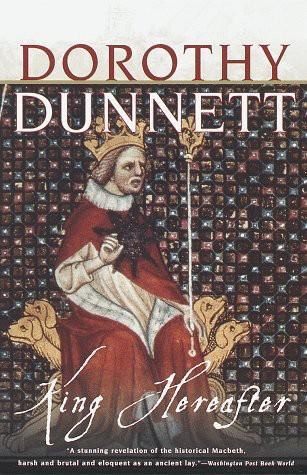
There’s much more equally interesting and worthy of your attention, on topics from Norman Mailer’s letters to contemporary Serbian fiction, from new poetry to the collected stories of Frank Herbert: I hope you’ll head over and explore for yourself. I’m represented this month only through my behind the scenes editing work and my contribution to our annual Year in Reading feature, where my comments about discovering that there’s Dorothy Dunnett beyond Lymond won’t surprise any regular readers of this blog.

kinghereafterI am, however, represented in a couple of other publications this month — one of which is actually Whispering Gallery, the journal of the Dorothy Dunnett Society, where my essay on King Hereafter is being reprinted. Whispering Gallery is available in hard copy only, to members of the Society. I’ve never been much of a joiner (I don’t even belong to the George Eliot Fellowship! and I’m just a little bit scared of the enthusiasm manifested by the members of the Jane Austen Society of North America …) but Whispering Gallery looks like it’s a lot of fun. The last issue included an article called “Jerott Blyth: Dashing Hero or Dumb Idealist?  Part 2,” for instance, which certainly got me thinking, not just about how I’d answer this question (“a bit of both,” maybe?) but also about how great it is that Dunnett has readers who care enough to make this a 2-part feature. (Lymond was just voted “Scotland’s favourite literary character,” by the way, which is as it should be.)

And you’ll also find my byline on an essay in 3:AM Magazine this month: “Sex, Style, and Sewage Farms: Winifred Holtby and Virginia Woolf.”

Woolf, of course, dominates our picture of early twentieth-century women writers: Holtby paid a price in prestige for her commitment to the kind of social realism Woolf eloquently dismissed in essays such as “Modern Fiction” or “Mr Bennett and Mrs Brown.” Holtby’s novels offer us not the “luminous halo” of consciousness, but the materiality Woolf rejected as lifeless; to Woolf’s rhetorical question “Must novels be like this?” Holtby implicitly replies that at any rate they can be like this and still convey something important, that the “series of gig lamps symmetrically arranged” may reveal social patterns of genuine significance — not just artistically but politically.

It’s exciting to contribute to another great online journal, and also gratifying to see all that work I did on Brittain, Holtby, and the Somerville novelists bearing new fruit. I’m actually working on another short piece on Brittain for another site, so more about that when it goes live early in the New Year.

“Too Tarsome”: E. F. Benson, Mapp and Lucia

mappandluciaI almost didn’t finish reading Mapp and Lucia. I’m glad now that I did, not because I take any uncompromising stand on whether one should or should not finish every book one starts, but because if I’d put it aside at the point I’d reached as of yesterday, I would never have known that the heroines get swept out to sea on a kitchen table. That was a surprise! And when they come back, thus thoroughly upsetting everyone who has (with oh, such difficulty!) come to terms with their loss, not to mention their homes and possessions and fortunes — OK, I admit it, it’s wonderfully done, with the perfect balance of malice and brio, which also perfectly describes Mapp and Lucia themselves. For people who like that sort of thing, Mapp and Lucia is definitely the kind of thing they’ll like.

I don’t really like it, though, which is why I was tempted to give it up half way through. It’s not just that there’s nobody in the novel who is worth anything. That’s true of Vanity Fair too, after all, and Vanity Fair is a novel I greatly admire. But then Vanity Fair is an impassioned indictment of the greed, selfishness, and hypocrisy of the world its characters have created. Mapp and Lucia is too much fun to be read as social criticism or satire; it takes too much pleasure — or allows us to take too much pleasure — in the machinations and lies, the pretense and double-dealing. Who will play Elizabeth I in the fête? Will Lucia’s complete ignorance of Italian be exposed? Will Mapp get away with the recipe for Lobster à la Riseholme? Will Mapp’s strategems for keeping Georgie and Lucia’s pictures out of the exhibit be successful? These are the pressing questions of the novel, but the answers to them are for our entertainment only. They don’t mean anything. Nothing in the story matters, except as a move in the absurd, competitive, hilarious game of snakes and ladders Mapp and Lucia are playing with each other’s lives.

It’s not that there isn’t amusement to be had. Benson is very clever, and both heroines are memorable. When they might be dead, it’s not just life in the village but the novel itself that deflates. As Georgie reflects,

There was nothing to look forward to, and he realized how completely Lucia and her manoeuvres and her indomitable vitality and her deceptions and her greatnesses had supplied the salt to life. He had never been in the least in love with her, but somehow she had been as absorbing as any wayward and entrancing mistress. ‘It will be too dull for anything,’ thought he, ‘and there won’t be a single day in which I shan’t miss her most dreadfully.’

But when she does come back, it’s just more of the same. It’s smart and witty, but a bit nasty: it’s what Pride and Prejudice would be stripped of everyone but the Bingleys, or Persuasion with only Sir Walter Elliot and Mrs. Clay — or Vanity Fair without the narrator. I seem to prefer my social comedy served up with a hint of conscience, or even of pathos. At first Mapp and Lucia was good for a laugh, or at least a chortle, but after a time I found it (as Georgee would say) “too tarsome.”

This Week In My Classes: Counting Down

todolistActual classroom hours left this term: 6
Essays still to grade this week: 17
In-class tests incoming: 42
Reading Responses incoming: 84
Reading Journals incoming: 60-ish
Final essays and exams looming: 130
Reference letters in the queue: 24
Early morning hours that will be spent in Dalplex in the limbo of exam invigilation: 7
Weeks until I’m officially on sabbatical: 6
Department meetings before then: 1

That Which We Call A Blog By Any Other Name …

LastRose2013… would be the same thing it always was, which is also the point about the rose in the original line, of course. Names are (more or less) arbitrary labels, sure, no problem. But they have connotations as well as denotations, effects and associations as well as literal referents.  And lately I’ve been wondering: how much does the label “blog” (still) influence people’s assumptions about the substance and value of online writing?

This is not a new question, of course. Remember Princeton professor Jeff Nunokawa, who staunchly refused to call his series of Facebook “essays” a “blog”? As he explained in an interview, this is because

“I hate that particular syllable,” but also, more importantly, because “it doesn’t catch what I’m really trying to do, whether successfully or not. These are essays. When I think of a blog — and maybe I’m being unfair to bloggers because I don’t spend much time in the blogosphere — my sense of blogs is that that they’re written very quickly. This is stuff that I compose and recompose, and then recompose and recompose and recompose. It’s very written.”

There’s much that could be said about this self-consciously ignorant generalization (I said some of it in my JVC essay on blogging, and I’ve said lots more on related topics in numerous other posts here on blogging.) The assumption that somehow by definition blog posts aren’t “very written” is particularly annoying. But for today let’s focus on his comment “I hate that particular syllable.” I don’t much like it either, insofar as it is not particularly euphonious, but disdaining it on those grounds has something of a “Wragg is in custody” feeling about it (“Higginbottom, Stiggins, Bugg!”). A “hideous name” is not, of course, actually a symptom of any particular coarseness — but is it possible that the ugly syllable “blog” has created for many people an Arnoldian disdain, as if it signals “an original short-coming in the more delicate spiritual perceptions” of literary form, such as those of the more mellifluous “essay”?

I have been thinking about this again because I had a good session recently with a colleague who wanted some tips on using WordPress. While we poked around my various sites, he commented that he’d been reading around in my blog archives. “There’s lots of good stuff here!” he said, a generous remark which I sincerely appreciated. I think there is too! But I couldn’t help but notice the faintly astonished tone in which he said it, as if he hadn’t expected to find much “good stuff” but had been pleasantly surprised. That’s all good, of course — better that way around than the other way, for sure! But what had set his expectations low in the first place? Could it be assumptions stemming from “that particular syllable”?

Now, it’s entirely possible that I heard something that wasn’t there, and more than anything I was genuinely happy (almost absurdly so!) to be conferring with someone who was taking an interest in what I’ve been doing and learning online all this time. If I projected my own lingering anxieties on him, though, it’s precisely because  so few of my colleagues have shown any similar interest. Some, in fact, have been openly derisive about the whole concept of blogging. A precious few have been engaged and supportive, but most have simply been indifferent (as far as I’ve ever been able to tell). It’s not that I expect everyone I work with to drop what they’re doing and read everything I write! But I’ve wondered why the perception that blogs are not worth reading persists to the extent that when I asked a couple of colleagues once if they read any at all (never mind mine), they both laughed before they said no. How much of that has to do with the word “blog” itself, do you suppose, and what they take it to signify? If we talked about “essays on our websites” instead of “posts on our blogs,” would that sound different enough that it might bring more people across the threshold who might then stay long enough to discover that, indeed, there is “good stuff” to be found?

Why does “blogging” have such negative connotations, anyway? When Paul started his blog on “The Big C” and couldn’t stop talking about it, I admit I was filled with self-conscious horror at how annoying and narcissistic it seemed: what if I sound that way when I mention my blog? (Which isn’t that often, honest! At least, I don’t think it is…) Even I turned against him! But all shared writing is, in its own way, a demand for attention, a claim that your voice is worth hearing. Blogging is just a form: why, in this case, do a lot of people still assume the form defines the content? Was Nunokawa right, not about blogs themselves, but about avoiding the label if he wanted his short pieces to be read differently — or at all?

I think most of us actual bloggers have made our peace with the admittedly ugly vocabulary associated with the online writing and discussions we have (though I bet most of us would happily vote to ban “blogosphere”). But do you think that a lot of non-bloggers (we need a term for them, the way wizards have “muggles” — maybe “Higginbottoms”?) still hear the word “blog” and think “shallow, hasty, and self-promoting”? I don’t suppose it really matters, not for us, anyway, since we’re doing what we want, whatever it’s called, but the prejudice against it continues to puzzle and sometimes provoke me.

And that, speaking of ugly vocabulary, is quite enough meta-blogging! Next up, I hope, will be a post  essay  review  column  discussion excursus  disquisition  confabulation on an actual book. I’m still reading The Stonehenge Letters; I’ve just started Mapp and Lucia; and I’ve downloaded The Duchess War — we’ll see which one I finish first.

This Week In My Classes: What Makes a “Teachable” Novel?

This week I decided to call my own bluff.

knots_crossesI spend a lot of time fretting about which books I assign in my Mystery and Detective Fiction course — because once you get past the few absolute “must haves” (something by Poe, some Sherlock Holmes, The Moonstone, something to represent the Golden Age, one of the hard-boiled essentials) there are many good reasons but no real imperatives to help me choose from the tens of thousands of possibilities. My guiding principles are coverage (of the major subgenres, such as the police procedural) and diversity (of voice or point of view), but that doesn’t really narrow things down that much. I’ve asked for suggestions quite a few times here, with great results: I have readers like Dorian to thank, for instance, for prodding me to read Sjöwall and Wahlöö, whose The Terrorists is currently a staple of my course reading list.

I tweak that list pretty regularly, and I’m always turning over alternatives in my mind. One of the books I’ve assigned the most is Ian Rankin’s Knots and Crosses, which is his first Rebus novel. As often the case with the first books in a series, it is in some ways his most self-conscious, and it doesn’t assume any prior knowledge of Rebus on our part, which is useful for classroom purposes. It’s also a nifty little book in its own way, neatly constructed, with lots of clever twists; its deliberate invocations of the Scottish gothic tradition make it nicely literary and its inquiry into masculine identity, military “bonding,” and repression usually spark good discussion. It’s not the best Rebus novel, though (I know Rankin doesn’t think so either): the others, especially the more recent ones, have a broader social and political reach and do more as police procedurals, while Knots and Crosses (which was not intended as a “crime novel” to begin with) is really more of a psychological thriller. Every time I teach Knots and Crosses, then, I mutter to myself (and sometimes remark to the class) that to really see what Rankin and Rebus can do, we should read something else. Yet I have never acted on that conviction.

This week, then, I decided I should reread one of the others that has long been in my mind as an alternative: 2006’s The Naming of the Dead. Set in Edinburgh during the 2005 G8 meeting, it balances its murder investigations against political crimes and misdemeanors of all kinds. Siobhan Clarke is on the case too, but involved personally as well as professionally, and Rebus’s old antagonist, “Big Ger” Cafferty, becomes an uneasy ally. My recollection of the book is that it explored lots of themes we’re always interested in in this class, especially gray areas between crime and detection, or tensions between the law and real justice. Rereading it, this impression has been confirmed, as has my sense that its political context gives Rankin the opportunity to do something similar to what Sjöwall and Wahlöö do, that is, extend particular criminal investigations to larger critiques of systems of power. Rankin’s novels have been acknowledged as contemporary versions of the Victorian ‘condition of England’ novel: with Knots and Crosses, you can’t see why, but with The Naming of the Dead, the genealogy works and would, I think, be really interesting to discuss.

namingofthedeadAnd yet … I am not convinced that I should replace Knots and Crosses after all! Much as I’m enjoying rereading it, I’m not sure it would be as teachable as Knots and Crosses, and my hesitation over this has had me wondering: what do I mean by “teachable”? It’s not something I ever really consider about Victorian novels when choosing among them for my 19th-century fiction classes, but when I’m scouting for mystery novels to assign — or contemplating assigning some new (or new to me) novel for an intro course — “How would this work in the classroom?” is always a concern. And for the majority of mystery novels I read, the (usually unarticulated) response to this question is “it wouldn’t”: I put most of them aside without seriously considering them for my syllabus, which strikes me as interesting. Why would that be? Might it (she says a little nervously) have something to do with the “literary” vs. “genre” fiction distinction? Or, to be more precise, with the ways that methods for “teaching” a novel (at least for me) align with qualities that are more likely to occur in “literary” fiction?

What qualities am I looking for in a novel I assign? I suppose the fundamental requirement is that there be something in it for us to talk about — not just for a few minutes, but for enough classroom hours that we can spread our work on the novel across whatever seems like a reasonable amount of time for the students to read the whole thing. The formula for this will vary depending on the level and nature of the class, of course, but anything that will take up a week or more of class time has to be of a certain complexity — and not just of plot, because just rehearsing what happened is not particularly valuable or interesting. It might sound foolish to put it this way, but to teach a book there also has to be something about it that needs explaining, as well as something that rewards discussion. Not all of this has to be generated by the intrinsic qualities of the book: a book might get some of its interest from external contexts — (literary) historical, for instance, or theoretical. But you don’t (well, I don’t) want to spend a lot of time on stuff around the book and only point to the book itself in passing: you want to dig in and really get to know it!

One way of labeling the process I’m most used to, pedagogically, would be “deep reading,” or “close reading.” Not all books reward that particular kind of reading equally. An alternative is “horizontal reading,” where the individual text is seen as part of a broad array of related and perhaps even quite similar material. Its interest arises at least in part, in that case, by comparison: among things of this kind, how is this particular one different or interesting? In Mystery and Detective Fiction we actually do a combination of the two. I spend a fair amount of time describing a broad horizon of comparison (because we don’t have time to read lots and lots of examples to establish it on our own) and then we consider how our specific example fits into or revises common conventions and tropes. Mystery fiction really is strongly governed by recognizable patterns which in their least interesting versions seem simply formulaic — which is not to say that there aren’t tropes and conventions and formulas in “literary” fiction too, and one reason I’m using scare-quotes is that I am very aware that the distinction I’m invoking is a vexed and imperfect one. But it seems silly to pretend there aren’t books that are very clearly of a kind, perhaps even repetitively or predictably so, and that whatever the pleasures they afford many readers, they don’t individually hold up under the kind of scrutiny I am inclined to give them in class. Or, in another variation on the problem, they don’t do something new and thought-provoking enough to those tropes and conventions that they jump out as examples we need to consider. I’m not judging these books in any absolute way, of course. I’m just measuring them by what I perceive as my pedagogical goals.

moonstone-oupThen there are other constraints on teachability: more pragmatic ones. Again, with Victorian novels I mostly don’t worry too much about these, though I am wise, or cautious, or jaded, enough never to assign two genuine door-stoppers in the same term  (say, Bleak House and Middlemarch). Students who sign up for “The 19th-Century Novel from Dickens to Hardy” have to know what they are getting into! But the mystery class is a lower-level course that is purely an elective for everybody in it. I can barely get them all through The Moonstone (and in fact I am confident there are always some who never make it to the end) — and that’s a book that’s so interesting I can barely stop talking about it myself! It earns its two weeks of class time by being not just important but really complex and (for the class) quite challenging. This is actually where I fear The Naming of the Dead  falls apart as an option (though I’m not 100% sure yet). Its nearly 500 pages are not nearly as dense as The Moonstone‘s, but in a way that’s just the problem: it goes on for almost as long a time without actually being as complex. It is broad, I might say, and it’s smart, but it’s not particularly deep. I’m not sure about this, because I haven’t tried to map out any lecture topics, but it would be a bad idea to assign 500 pages and then end up feeling like we were spinning our wheels in class.

It’s true that you can find something to say about almost anything, and that there is no one uniform approach that works for teaching all novels. The Naming of the Dead seems to me an in-between case: I’m ruling it out (I think) because it requires too big an investment for the likely payoff in this particular course. It also matters to me that Knots and Crosses — which is both short and suspenseful — is always very popular with students: it is often singled out in course evaluations as a favorite, for instance, and class discussions about it tend to be pretty lively. (This year The Terrorists has been our most-discussed book so far, though.) Maybe it will inspire students to go on and read more of Rankin’s (better) novels on their own; I’m guessing that the number who are inspired to read more Wilkie Collins is very small! I suppose I could swap it out for a different example of the police procedural. I’ve tried that before, actually: one year we read Ed McBain’s Cop Hater, which earned its spot on the list because the 87th Precinct series was ground-breaking of its kind. But for all that is interesting about it, Cop Hater is a really badly written novel, or so we ended up thinking by the time we’d talked it through. In that case, being teachable turned out not to be enough to teach it again!

If you’re curious about which books I’ve chosen over the years, in Mystery and Detective Fiction or in my other classes, you can get a good sense of the range by scanning the On Teaching page of this blog.