His tone, he felt, was at once too obvious and too personal; somehow it brought to his mind the questions he had failed to resolve all his life. His head was full of so many things, and somehow he had failed to realise any of them on the page. So many things, so many names, so many dead, and yet one name he could not write. He had sketched at the beginning of his foreword a description of Guy Hendricks and something of an outline of the events of the day he died, including the story of Darky Gardiner.
But of that day’s most important detail he had written nothing. He looked at his foreword … with the simple, if guilty, hope that in the abyss that lay between his dreams and his failure there might be something worth reading in which the truth could be felt.
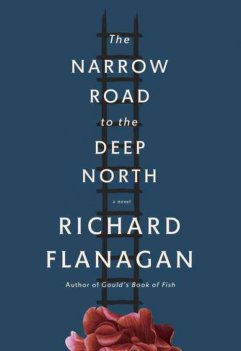
How far do the hopes of Dorrigo Evans, the protagonist (perhaps the hero) of The Narrow Road to the Deep North, reflect Richard Flanagan’s for his novel? The Narrow Road to the Deep North is an ambitious book, almost palpably so, in its subject as well as in its form and style: it tries to give a meaningful shape to experiences that hardly bear thinking about, and perhaps to discover in them something like truth, even something like beauty—not in the violence itself (not like, for instance, Cormac McCarthy) but in what it reveals. Flanagan throws every literary tool he’s got at this problem: romance, heroism, brutality, camaraderie among the characters, metaphor, symbolism, allusion in the language. The novel is often grim but sometimes lyrical; dramatic, but also introspective. What can Dorrigo—what can we—learn from this story of “the Line” and the POWs who built it at such horrendous cost? Is that quest for meaning itself an effort as pointless, in its own way, as the construction of the Death Railway?
Flanagan never entirely resolves that question. Dorrigo himself has some revelations during his time on the Line that he believes (in the moment, at least) stand as “the truth of a terrifying world”:
It was as if man existed only to transmit violence to ensure its domain is eternal. For the world did not change, this violence had always existed and would never be eradicated, men would die under the boot and fists and horror of other men until the end of time, and all human history was a history of violence.
It’s no wonder this feels true to him as he watches “three hundred men watching three men destroying a man whom they knew.” That beating—one among many but also unique among them—is a defining moment for Dorrigo and also, in some ways for the novel, which keeps bringing us back to it, as if violence is the only reality that matters. Yet after the war Dorrigo feels his entire existence is “bogus”; the falseness of it arises from the pretense that there is life outside of horror and crime:
He thought of how the world organises its affairs so that civilisation every day commits crimes for which any invidual would be imprisoned for life. And how people accept this either by ignoring it and calling it current affairs or politics or wars, or by making a space that has nothing to do with civilisation and calling that space their private life. And the more in that private life they break with civilisation, the more that private life becomes a secret life, the freer they feel. But it is not so. You are never free of the world; to share life is to share guilt.
Is this hard-won insight, knowledge freed from sentiment? Or is Dorrigo’s condemnation of private life as artifice a war wound, a scar on his perception? When he reaches the end of his life we’re told that he already “no longer lived,” as if in giving up hope and love he has cut himself off, not from civilisation, but from humanity.
 The Narrow Road to the Deep North does gesture towards the value of the private life that Dorrigo has lost faith in. But of all its many parts, the novel’s romance seemed to me the weakest: the story of star-crossed lovers doomed to separation because of a petty deception felt forced, too overt a gesture of the novelist himself, as if he thought we needed that kind of idyllic star to follow through his otherwise unrelentingly dismal narrative. I’m not sure the love story works this way in any case: there’s a suggestion at the very end of the novel that the beauty of love is a “small miracle” worth cherishing even “in the midst of the overwhelming darkness,” but is this the real truth of the novel, or is it an illusion that is beautiful but unsustainable? It isn’t love that sustains Dorrigo in the camp but his own characteristic determination to “charge the windmill”: not to turn back or be daunted by the next hard task, or the next, or the next. What good are dreams of love when you are literally wading through shit? Or, what is the point of wading through shit, unless you believe in love?
This inconclusiveness is the source of some of my reservations about The Narrow Road to the Deep North. Another problem for me is the representation of the Japanese officers and guards, who seem for at least the first two-thirds of the novel to be little more than caricatures, embodiments of every negative stereotype imaginable: they callously starve, beat, and dehumanize the POWs, with occasional time-outs from the action to meditate on their service to the emperor. Whereas Dorrigo’s fixation on Tennyson’s “Ulysses” is set up as a symptom of his yearning humanity, the reverence of the Japanese officers for Issa and Basho is deployed ironically, at their expense, to highlight their failures of humanity along with their self-deception:
They recited to each other more of their favourite haiku, and they were deeply moved not so much by the poetry as by their sensitivity to the poetry; not so much by the genius of the poem as by their wisdom in understanding the poem; not in knowing the poem but in knowing the poem demonstrated the higher side of themselves and of the Japanese spirit—that Japanese spirit that was soon to daily travel along their railway all the way to Burma, the Japanese spirit that from Burma would find its way to India, the Japanese spirit that would from there conquer the world.
In this way, thought Nakamura, the Japanese spirit is now itself the railway, and the railway the Japanese spirit, our narrow road to the deep north, helping to take the beauty and wisdom of Basho to the larger world.
That their implacable cruelty makes perfect sense to them only demonizes them here. But later in the novel Flanagan starts providing back stories, contexts that elaborate on (though they don’t necessarily justify) their indifference to the suffering around them. Why, I wonder, didn’t Flanagan structure the book differently so that we knew who these men were before we saw them at their worst—or, doing their worst? It seems like a missed opportunity. The Narrow Road to the Deep North could have started from both sides and then brought together the full range of people we come to know so that their time together in the camp stood as a fateful convergence, a clash of opposing ideas about authority, valor, heroism, self, and survival. The cruelty of the camp, it is belatedly suggested, is in many ways an extension of a culture in which (at least for these men) violence is inconsequential and expected. And, as Nakamura points out to Dorrigo, the Japanese by no means have a monopoly on coercion: “Your British Empire . . . You think it did not need non-freedom, Colonel? It was built sleeper by sleeper of non-freedom, bridge by bridge of non-freedom.” In a novel that also includes the bombing of Hiroshima, what means justify what ends? How do we stand in judgment: is victory the only measure that ultimately counts? Flanagan’s novel raises these questions, but its treatment of them seems indecisive, or unfocused, as if Flanagan could summon up marvelous parts but not quite orchestrate the whole.
And I did think that, in parts, The Narrow Road to the Deep North was pretty marvelous. I was certainly engrossed from the beginning—which is not, of course, a definitive measure of merit, but it’s also inarguable as a starting point. I was particularly gripped by the saga of the men on the Line, who were not idealized but individualized as the absolutes of their characters were bit by bit exposed by the extremity of their ordeal. Dorrigo himself, too, seemed to me a powerful creation, strong without false heroics, thoughtful but only reaching for, not achieving, wisdom. I’m not convinced the book is the “masterpiece” it’s called on the cover of my edition: if it were in a Tournament of Books match against The Orphan Master’s Son, which has some similar elements and aspirations, Johnson’s novel would win handily; so too, though for different reasons, would In Sunlight and In Shadow, which is closer to it in style and tone. I can’t disagree with those who have pointed out weak spots in Flanagan’s prose, but overall I didn’t find it affected or manipulative. It struck me, again, as ambitious, and that’s not a bad thing — “a man’s reach must exceed his grasp” etc., and one result of that reaching higher is writing that I sometimes found really evocative and even beautiful:
Around him, behind him, beyond him were people, moving every which way. Wild flying particles in the light, lost long ago, as he knew everything now was lost, in the steel and the stone, in the sea and the sun and the heat rising and falling in the cloudless blue sky, lost in the ochre cranes and the thundering expressway.
Ecstatic blurbish hyperbole or hysterical hatchet jobs aside—and don’t most books actually deserve something in between?—I think The Narrow Road to the Deep North is at a minimum “something worth reading.” That’s not everything—but it’s quite a lot.