 It starts to feel as if I have written a lot of these ‘start of the term’ posts: I’ve used up every variation I can think of for titles! It’s in the nature of academic work to be cyclical, though, and on the bright side, this term I am doing one all-new course, so at least you can look forward to some novelty in my teaching posts!
‘This Week In My Classes‘ was one of the first regular series I started up on Novel Readings. The very first was ‘Books About Books‘ – and there aren’t really any others, except, sort of, my book club updates. Otherwise, as I’ve observed before, for better or for worse I pretty much just write about whatever I’m reading, or whatever else is on my mind about either literary or academic / professional topics. It’s interesting (to me at least) that reading and teaching so quickly took on equal importance here: that’s actually what I was thinking about as I contemplated this post, more than any specifics about this week’s class meetings (though I’ll say a bit about those in a bit). I didn’t know anything about blogging when I began doing it, so I didn’t know there was such a thing as “academic blogging” or “book blogging” — or “mommy blogging” or anything else. As a result, I really didn’t have a plan, except to post some updates about reading I could share with friends and family when they asked what I’d been reading lately and if I had any recommendations. (I’ve written at some length about the transformation in my reading, writing, and scholarly life that ensued: if you’re reading this post, you probably don’t need to hear any more about it anyway! I’ll probably make a few remarks around my anniversary, though.)
 I’ve sometimes wondered if I should have had a plan, or developed one, in order to give Novel Readings a more definite identity. In the decade since I launched this blog, I’ve seen quite a lot of articles or posts giving advice on blogging, and the key to success is apparently having a mission, or filling a specific niche — along with posting on a regular (and frequent) schedule, and keeping your posts under 1000 words. (Hey, I’m 0 for 3!) I do think the hybrid identity of Novel Readings — which is not really, or at least not just, a book blog, and not really, or not altogether, an academic blog — has probably limited its appeal, because for some bookish people there’s no doubt too much academic stuff here, while for some academics, there’s too much book talk (or, too much book talk that’s not sufficiently academic).
But because I didn’t have a plan, or a purpose, Novel Readings evolved based only on what I wanted to write about. That I still want to write it is, for me, the surest sign that on my terms, it has been successful. I think this is true of all of the bloggers I follow, in fact: we blog because we like the activity itself (including both the writing and the community and conversations we’ve found through the comments). After my very first year of blogging about my teaching, I wrote about how valuable I’d found the experience. If I didn’t like doing it, I could have just stopped: my blog, my terms! And that could still happen — but it hasn’t yet.
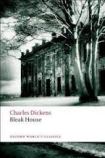 So: what’s up for this winter term? Something old and something new. I’m doing another iteration of 19th-Century British Fiction (Dickens to Hardy), beginning, this week, with Bleak House, which I haven’t taught (or read) since 2013. I was so sad to read Hilary Mantel identifying Dickens as the most overrated author: “The sentimentality, the self-indulgence, the vast oozing self-satisfaction, the playing to the gallery.” Them’s fightin’ words, even from a writer I admire as much as Mantel. I’ve never written anything more formal than a blog post about Dickens: 2017 might be the year that changes.
My other course this term (and how lucky I feel, to have just two!) is my new intro class, Pulp Fiction. So far we’ve just been warming up, but next week we start our unit on Westerns, which means I have been busy putting my miscellaneous notes in order for an introductory lecture, after which we read some short stories and then launch into Valdez is Coming. I just read through the first batch of reading journals (about Lawrence Block’s twisty little crime story “How Would You Like It?”) and it looks like a good group.
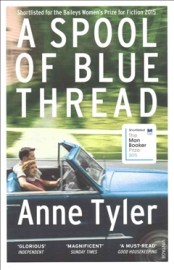
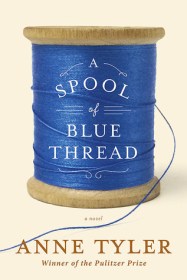 A Spool of Blue Thread is chronologically wider-ranging than some of Tyler’s novels, which means it has a wider range of characters and some sense of being not just a personal story but also an American story — not as overtly as Smiley’s Some Luck and its sequels, with their relentless chronological march through American history, but still, we get a sense of people shaped by different eras, from the Depression through the Sixties and into the 21st century. I liked the novel’s structure, reaching back into the past and then back yet again, so that we first meet the characters and then learn more about how they came to be who they are, or to be with who they’re with (a process that turns out, in some cases, to be much more fraught than the cherished family stories reveal).
 I think that’s what, for me, makes Tyler an author whose new books I always seek out, in spite of (or maybe because of) the strong family resemblances between them. They are all books about people coming to terms with life, which is, after all, what most of us are doing ourselves, most of the time — and the wry, resigned tenderness of her storytelling seems to me a model for how we ought to approach both ourselves and others: with honesty, but also with kindness and humor.
 We don’t stay up until midnight on New Year’s Eve anymore. I can’t remember when we gave up on this tradition, exactly. The last New Year’s Eve I specifically remember was 1999-2000: remember the Y2K panic? We didn’t really expect a dramatic catastrophe on the stroke of midnight, but it was hard not to wonder just what would go wrong. I think we rang in the New Year a few times after that, but there came a point at which it was just too obvious that nothing significantly changed with a new date, and also while the children were small, staying up late on purpose when we were already tired all the time didn’t make much sense. This is one way in which I have broken with my upbringing: to this day my intrepid parents and whoever’s celebrating with them stand out on their front porch in Vancouver and listen for the ships in the harbor to tell them when it’s officially midnight, then bang enthusiastically on pots and pans — a ritual I participated in with glee for many years. (To my knowledge, none of our neighbors ever complained.) I don’t think they still have Pêches Flambées for dessert, though: that used to be the showy finale to our elaborate New Year’s Eve dinner.
 Anyway, here we are now, writing 2017 instead of 2016 but otherwise puttering along more or less as usual. For me, that means getting things in order for my winter term classes, which begin on Monday — a week later than is typical, which has been a real boon. The campus itself, including the administrative offices, opened up this week, so I’ve been able to get handouts printed and copied and all kinds of other preparatory business done, including a trek across campus to scout out the room where I’ll be teaching ‘Pulp Fiction,’ which is in an unfamiliar building. Will that preemptive action ward off anxiety dreams about getting lost en route? Here’s hoping.
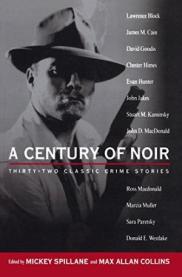 The very first reading we’re doing, though, is a nifty little short story by Lawrence Block called “How Would You Like It?” I often begin the fiction unit in an introductory class with Kate Chopin’s “The Story of an Hour”: it’s really short, but also full of things to talk about, so it makes a great warm-up exercise. It didn’t really fit ‘Pulp Fiction,’ though, so I hunted through my anthologies looking for something else equally brief that would help us get some key literary terms on the table right away while also (hopefully) catching people’s interest. I found the Block story in an excellent anthology called A Century of Noir; though it actually isn’t exemplary of noir, I liked that it was twisty as well as short, so I thought I’d try it out. One of the topics I always address early on is point of view, along with the different options for narrators; the story will work well for that, and it also provocatively introduces questions about vigilante justice that we will be discussing with both our Westerns and our mystery readings.
 My other course this term is 19th-Century British Fiction from Dickens to Hardy. As regular readers will know, I do this class (or its prequel, 19th-Century British Fiction from Austen to Dickens)


 2016 has been a somewhat unusual reading year for me because quite a few of the books I read were ‘assigned’ for reviews — or else were books I chose not entirely because I wanted to read them but because they looked like books I could pitch for reviews. Although at times I ended up feeling a bit stifled as a result, because it felt as if reading obligations were crowding out reading pleasures, at other times it meant a thrill of discovery, as a book or author I wouldn’t otherwise have read turned out to be wonderful. This was also a sign that as a writer I was being pushed in new directions and, as a result, learning new skills and finding (I hope) new strengths — about which, more in my next post on my year in writing!
 Book of the Year:
  Inspired in part by The Portrait of a Lady, I finally read Colm Tóibín’s
  Another author I discovered thanks to a prompt from someone else was David Constantine: Scott Esposito asked me to review
  Finally, Gerald Durrell’s
  I finished my first full viewing of both

 Lovely as Durrell’s scenery is, he’s at his best (as you’d expect) with animals:
 Perhaps, then, the child’s point of view (though of course the sophistication of the writing subtly belies it) is one reason children have loved this book. Another would be its humor: when things do happen, they are usually very funny. There’s some high drama, as well: the epic battle, for example, between the gecko Geronimo and the giant mantid Cicely:
 In case you were wondering why it has been so quiet here at Novel Readings, I’ve been grading papers industriously, trying to get through them as efficiently as I could consistent with still paying really close attention. I did well at sticking with it, partly thanks to my students, many of whom wrote really good essays! Not only does that speed things up, but it makes the whole process more enjoyable.
 Before I put this term completely behind me, though, one question lingers after hours spent poring over student writing: what’s up with apostrophes? Actually, I have two questions, because my follow-up to that one is, should I care about apostrophes?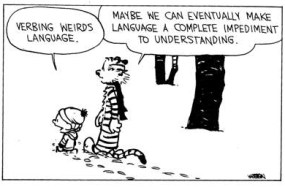
 I’ve just finished two Scottish-themed romance novels — Sarah MacLean’s A Scot in the Dark and Tessa Dare’s When a Scot Ties the Knot — and they have enough similarities that the juxtaposition has provoked me to figure out why I enjoyed one so much more than the other, a question that quickly expanded, in my mind, to the more general question of why some romance novels work for me and others just don’t, including novels by the same authors. Of these two, for instance, I much preferred Dare’s, though I really enjoyed The Rogue Not Taken, the previous novel in MacLean’s “Scandal & Scoundrel” series, and I liked but didn’t love Dare’s most recent novel, Do You Want to Start a Scandal.
 For instance, I have mentioned before that I don’t always read right to the end of the HEA. This is partly because while I can enjoy the development of a romantic relationship, especially when it involves witty sparring and plenty of sexual tension, I don’t find unmitigated happiness (which is where, of course, romance novels always end up, sooner or later) that dramatically interesting. But it’s also because I don’t really believe marriage itself is necessarily a particularly blissful state. For both of these reasons, the rosier things get for the protagonists, the more disengaged I become from their novel. Thus I usually prefer romances that defer the protagonists’ happiness until the end of the novel, or very nearly. In a lot of Georgette Heyer’s novels, for example, hero and heroine don’t come joyfully together until pretty much the last page. That keeps things interesting! Our attention then is also less on how delightful they find each other and more on their learning about each other, and / or on wondering how they will ever discover how delightful they are to each other, or on how they will overcome the personal or social obstacles keeping them apart.
 I also often find with more recent romances that the protagonists get intimately sexy too soon and too often for my taste. I don’t think this means I’m prudish! No doubt it’s partly the result of many years spent reading Victorian novels, which are full of erotic undercurrents but have vanishingly few explicitly sexual moments. When feelings (and body parts) are usually kept covered, it’s that much more exciting when you finally get a glimpse! As well, I don’t think lust and love are the same thing, and sometimes — including in A Scot in the Dark — they get too quickly conflated. I suppose this is a variation on my preference for deferring their happiness, and it’s also about the sacrifice of tension involved. (I think there may also be some problems with realism — but I’m really not an expert on sexual mores during the Regency, so I may be quite wrong about what well bred men and young, “respectable,” unmarried women would get up to in their carriages without anxiety, shame, or repercussions.)
 A specific romance-reading preference of mine that I know is about me more than about the novels is that I have a fondness for bluestocking heroines, or at least ones with an intellectual passion, who have a lot more on their minds than romance. I love Dare’s A Week to be Wicked and Courtney Milan’s The Countess Conspiracy for this reason, and of course my favorite romance of all — so far — is Loretta Chase’s Mr. Impossible. Madeline in When a Scot Ties the Knot, with her passion for illustrating natural history, is a good addition to this collection. I also prefer more mature heroines, and I have a fondness for prickly ones, like Claudia Martin in Mary Balogh’s Simply Perfect. I find ingenues annoying and get bored easily by heroines who are too nice. It’s not hard to see that I appreciate romance novels that show women at least somewhat like me as lovable!
 Novel Readings