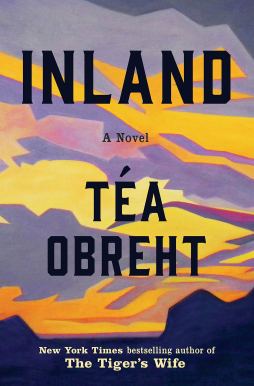
 Something might seem missing by the novel’s end, and that’s a clear sense of what larger narrative Obreht offers us about the genre she is at once using and revising. What story is Inland ultimately telling us about the American West, or about the tropes and limitations of the Western?
“Camel. Camel. How could anyone have guessed?” thinks Nora Lark, one of the two main characters in Téa Obreht’s Inland. I certainly couldn’t, at first: there’s nothing in the way Lurie, the novel’s other protagonist, speaks to his companion Burke that gives it away; there’s nothing in the conventions of the genre to which Inland more or less belongs, the Western, that prepares us for it. Inland has another surprise for us too, something about Lurie himself that we learn only after his story and Nora’s have finally intersected. In both cases, shock quickly gives way to understanding, and to appreciation of Obreht’s ingenuity. While Inland includes many elements of the classic Western—there are outlaws and sheriffs, heists and hangings, settlers and “Indians”—Obreht persistently subverts our expectations of the stories to be told about them. The result is a panoramic saga at once familiar and strange.
The action of Inland unfolds through two contrasting storylines. In both of them, as in her widely-praised debut novel The Tiger’s Wife, Obreht pushes the boundaries of realism: in her worlds, the lines between fact and fancy, and between the living and the dead, are wavery ones. Lurie’s first-person narrative recounts his misadventures on the rough edges of nineteenth-century American society. His immigrant father Hadziosman Djurić was “mistaken for a Turk so often” he disowned both his name (becoming “Hodgeman Drury” and then “Hodge Lurie”) and his faith. Orphaned as a small boy, Lurie ends up working with a man known as the Coachman, who trades in corpses—some stolen fresh from the graveyard. It is while doing this grim work that Lurie first experiences a “strange feeling at the edges of myself”: from his contact with the dead he takes away a “whorling hunger” to satisfy their unfulfilled desires. “It’s not as cold as you would expect, the touch of the dead,” he later reflects: 
The skin prickles like a dreaming limb. It’s not the strangeness of the feeling that terrifies you—it’s their want. It blows you open.
When Lurie and the Coachman are caught, Lurie is sentenced to work as a “hireling” alongside brothers Hobb and Donovan Mattie. When Hobb dies of typhoid, he passes on his “itch for pickpocketing” and Lurie and Donovan turn outlaw, robbing stagecoaches, waystations, and pack trains. One night during a heist Lurie seizes “an overbold New York kid” and beats him to death, and this begins the cat and mouse game between Lurie and Marshal John Berger, who becomes his dogged antagonist.
Hobb’s “want” is also what leads Lurie to Burke. One day in the spring of 1856, while heading down the Texas coast to elude Berger’s pursuit, he climbs aboard a ship docked at Indianola. Scouring the ship trying to appease Hobb’s craving, Lurie comes upon “a crude barn” erected near the stern. There he makes a discovery that changes his life forever:
And there of course—sightless, blundering into a fog of stink and breath, terrified suddenly beyond reason—what should I find but you?
The ship is the U.S.S. Supply and Lurie has chanced upon the Camel Corps, a real but little known military venture overseen by “a brooding, handsome, steadfast Syrian Turk” named Hadji Ali but called—through the same distorting process that rechristened Lurie’s father—Hi Jolly, Jolly for short. Jolly’s charges—“roaring, jostling, belching incredibly, dust-rolling, butting necks along wild laterals”—have been brought thousands of miles to “serve as pack animals for the cavalry” in territory where their legendary ability to cross long distances without water will make them invaluable.
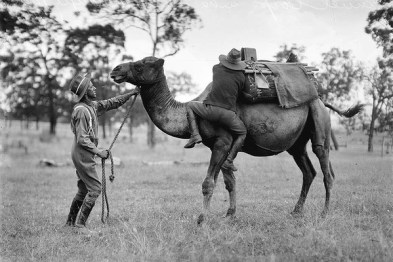
At first just an enthralled observer, Lurie eventually becomes a full-time member of the cameleering troop. He finds himself at home among the men: for once, looking like a “Levantine” lets him blend in rather than stand out. And the camels, with their “profound intolerance and incredible strength,” win his unstinting admiration. “Camels are not for the faint of heart,” he tells us:
They are faster than one might expect, and twice as rattletrap. They are frowzy and irate. Their fur sloughs off and drifts, filling the air with a sweet, malty stench that frenzies mules and horses, who scatter to outrun their own terror.
“Their hearts belong to their riders,” he adds, and thus is born the powerful bond between Lurie and Burke that holds both them and the two strands of Inland together.
Lurie and Burke travel widely, first carrying out military missions with the Camel Corps and then, when Marshal Berger’s proximity once again puts Lurie on the run, serving in timber camps and on mining expeditions. In an elegiac mood, Lurie reminds Burke of the wonders they have seen:
You have stood on the shores of the mighty Platte, where Red Cloud’s Sioux, gathered for the parley that would be their ruin, had grazed a horseherd two thousand strong, balding the prairie all the way back to the tree line. You have seen the hunchback yuccas pick up their spiny skirts to flee an oncoming duststorm. … You have stood on bluffs planted up with scorched saplings where the ground was pocked with exhalations, with ruts belching white gobs of mud. You have walked the rim of a jaundiced gulch, veined high and low with bands of ore, through which the whitecaps of a nameless river went roaring.
Everywhere they go, the camels arouse wonder, fascination, and fear. “We saw curiously few Indians,” Lurie recalls; “word had got around, as it always did, that we were traveling with monsters.”
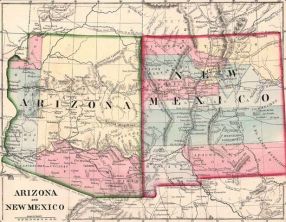
In contrast to Lurie’s wide-ranging tale, Nora’s story takes us through just a single eventful day in 1893 on and around her homestead in the Arizona Territory. She lives there with her husband Emmett, once a teacher, now a newspaper man; with her three sons Rob, Dolan, and Toby; with Emmett’s mother Harriet, “immobilized two years ago by a stroke”; and with Josie, “the daughter of Emmett’s cousin Martha,” who unlike Nora has yet to “harden” to their arduous frontier life. It’s not just that Josie is too soft for the work—”ordinary ranch implements confounded her”—but that she is awash in useless and often debilitating beliefs:
Churning around in Josie’s mind was an almanac of tincture remedies, Oriental magic, occult notions, absurd natural histories—especially those detailing the monstrous lizards unearthed by Cope and Marsh—all of which she talked ceaselessly about.
Above all, Josie is plagued by the dead, who, “according to Josie, were everywhere”: “They announced themselves to her in town; on the road; at church. Their sentiments were revealed to her abruptly and ferociously.”
Nora scorns Josie’s “unwelcome eccentricity,” which distracts Josie from the more literal threats that preoccupy Nora, such as, on this key day, their dwindling water supply. But Nora herself has a hidden relationship that also defies reason: she carries on constant silent conversations with the ghost of her baby daughter Evelyn. Evelyn’s death is part of what has transformed Nora from a hopeful, loving woman into a “tough, opinionated, rangy, sweating mule of a thing”: not just the tragedy itself, but Nora’s own role in it, which is one of the threads Obreht unspools for us as this difficult day drags on. It’s a day driven by thirst—for water, but also for information. Emmett has been missing for three days, and now Rob and Dolan too are not to be found. Meanwhile, Josie and sensitive young Toby are overwrought from fear of “the beast” Josie insists she has seen—“a ruffle-boned skeleton with great, folded wings on its back.” “You think I’m telling tales,” Toby complains when Nora is unconvinced by the signs he shows her of its menacing presence. “Mama don’t think the tracks are cloven,” he reports petulantly to Josie when they come back in from their investigation; “They don’t strike her as tracks at all.”
 Thanks to Lurie’s tale, readers will guess the beast’s identity well before Nora does. Before that moment of revelation, however, much has yet to transpire, as Nora’s question for her missing husband and sons brings back memories and leads to encounters with her neighbors, the sheriff, and local ‘Cattle King’ Merrion Crace, all of whom are entangled in a controversy over a proposal to move the county seat from Amargo, where Nora and Emmett have settled, to nearby Ash River. Crace wants to shut down the opposition to the move for which Emmett’s paper has provided a forum; his leverage includes what he knows about Evelyn’s death and what he and the Sheriff tell Nora about Emmett’s fate, and about what Rob and Dolan have been up to since they rode off in the night.
While Lurie is a man in constant motion, Nora is a woman seeking to stay put. After their marriage, the Larks had “followed railroad and rumor” for two years trying to establish a life for themselves on the frontier: “No sooner had Nora warmed to the curtains and mattresses of whatever place boarded them than they were off again.” Finally, in Amargo, bit by painful bit they build a home and a life for themselves and their growing family. “Should the county seat be lost to Ash River,” Nora knows, “all this would have been for nothing.” The pressure of change is inexorable, though, even in remote Amargo:
Hardly a day went by, it seemed, without the newspapers touting some remarkable discovery that had altered the truth or convenience of living … From Atlantic state palaces of learning, educational revues were making their way slowly inland to share the latest scientific advancements: anatomical marvels and wonders of automation. Put together, these all had the effect of drawing things closer to one another, of illuminating that grainy twilight beyond which lay the landscape of a new and truer world.
Emmett (if he ever returned) would, she knows, have no qualms about moving on yet again: “All difficulties in Emmett’s view could be solved by pulling up stakes.” But all Nora can think about is what they might leave behind with this house where “every beam, every mirror, every corner … breathed with the immutable spirit of her daughter. “If I leave here,” she says plaintively to the Evelyn only she can perceive, “will you come with me? Or will you have to stay?”
The strength of the bond between the living and the dead shapes both Lurie’s and Nora’s stories. The novel’s many ghosts might seem to push Inland out of history towards fantasy. As Nora eventually concludes, however, truth is already proving stranger than fiction:
If electromagnetic pulses could fly through the air; if giants with shinbones the length of her entire body had once roamed ancient seas; if the world was plagued by living creatures so miniscule that no living eye could see them, but so vicious that they could lay waste to entire cities—was it not also possible that Josie’s claims … might hold some truth? Might the dead truly inhabit the world alongside the living: laughing, thriving, growing and occupying themselves with the myriad mundanities of afterlife, invisible merely because the mechanism of seeing them had yet to be invented?
Lurie’s story in particular, it turns out, depends on answering “yes” to these rhetorical questions, but Inland as a whole plays with their implications, building a world on “what if” premises that, as Nora’s equivocal skepticism shows, are sometimes easier to dismiss in theory than in practice. More even than Obreht’s nineteenth-century characters, after all, we have learned to live with belief in what we cannot see.
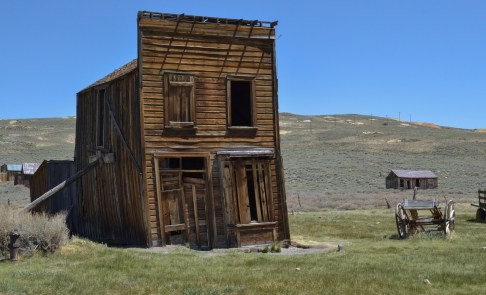
Obreht vividly evokes the sights, sounds, and moods of her frontier setting: Inland conveys both what it is like to travel, fight, and forage across the miles with Lurie and Burke and how it feels to scrabble and fret with Nora and her family on the precarious margins of the modernizing world. For all the pleasures of Obreht’s prose and the originality of her intertwined plots, though, something might seem missing by the novel’s end, and that’s a clear sense of what larger narrative Obreht offers us about the genre she is at once using and revising. What story is Inland ultimately telling us about the American West, or about the tropes and limitations of the Western? Hers is certainly an unconventionally populated saga: both camels and Muslims, though present in reality, are missing in nation-building myth. Inland reminds us that if they seem alien in the landscape she draws it is only because we have not seen it clearly before. The underlying logic of the frontier, however, with its commitment to settler colonialism, is never challenged. While clinging to her home in Amargo, Nora never questions her right to the land; to her, its original inhabitants are the aliens, their proximity filling her with “a plunging dread.”
Yet in the shadows of Nora’s anxious racism, which turns out to have had devastating consequences, we can perhaps glimpse the critique Obreht refrains from spelling out explicitly. One hot day, carrying Evelyn on her front, Nora sees “a dark rider on a spotted horse” on the horizon: “she thought Apache because the word had been growing in her like an illness all her life.” Panicked, she hides in the field for hours, with Evelyn pressed between her body and the ground. It is this act of fear and suspicion that brings on the heatstroke that leads to Evelyn’s death. “There were Indians,” Nora insists ever after; “Five of them. Apaches.” But it wasn’t Indians: it was her neighbor Armando Cortez—“a dark man,” yes, but no more a threat than the Navajo woman (or is she Apache? Nora, revealingly, cannot tell) whose inscrutable visits have exacerbated Nora’s self-destructive paranoia.

Lurie and Nora, then, are linked not just by Burke or by ghosts but also by white Americans’ pervasive fear of “dark” others, though Lurie is a victim of this bias while Nora is one of its perpetrators. Lurie finds unlikely fellowship among the cameleers, his kinship with them symbolized in the glass bead he steals from the ship where he also finds Burke—“deepwater blue, painted up with a dizziness of receding circles … something very like the nazar my father had kept in his pocket.” Much later, the nazar turns up in Nora’s barn, a tangible reminder of the interconnectedness of even the most apparently dissimilar lives. While for Lurie strangeness becomes his freedom, even his happiness, Nora’s fear of it has hemmed her in. By the end of the novel she can at least picture something different, a life more fluid and various. Obreht, in her turn, makes the Western strange to her readers, offering us an account not of how the West was won but of how its real diversity could be reimagined.
This was not how he had imagined it, the truth-telling time. It was as if his secrets had altered in the keeping, had grown like living things, so that he did not quite know them any more. Or that they were not entirely his, not the private stash or black treasure he had imagined. And once more it came to him, the thought that had touched him several times since coming back from Spain, that we are not private beings and cannot hide things inside ourselves. Everything is present, everything in view for those who know how to look.
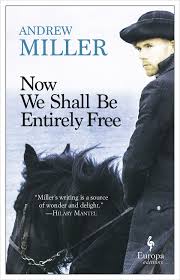 I won’t give more specifics about the plot; I’ll just note that it sets up a structure that is at once simple and increasingly suspenseful. Miller makes good use of the common trope of a geographical voyage also being a voyage of personal discovery, so that the cat and mouse game over time becomes something at once subtler and more complex. Though the plotting is very precise, even the moment when hunter and quarry coincidentally and unwittingly cross paths didn’t feel contrived: it just added to the evidence (shared eventually by at least one of Lacroix’s pursuers) that they are not really seeking a legible or reasonable form of justice but are carrying out a more arbitrary exercise of power, playing their parts in a game none of them can ever really win because those who made the rules don’t care who they really are–or who they could be, if they were free to choose.
 Last Wednesday, because of the disruption from Hurricane Dorian it felt as if we were starting the term all over again. A week later, it finally feels as if we are getting into something like a routine–even though the add-drop (a.k.a. “shopping”) period is only just ending, so the list of registered students for Pulp Fiction has been changing literally every day. Still, the majority of students in the class have been coming since September 4, and the general air of uncertainty and anxiety is fading into the usual combination of commitment and resignation. Because it’s a 4th-year seminar, Women & Detective Fiction has been a more focused group from the beginning, but there too we are past the getting-to-know-you period and are (I think) comfortably embarked on what promises to be a really good term’s discussion.
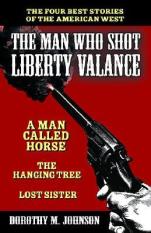 What have we done so far? Well, in Pulp Fiction we have done a bit less reading than usual by this point, but we’ve gone through all of the warm-up texts, starting with Lawrence Block’s “How Would You Like It?” and then, to set up our unit on Westerns, Sherman Alexie’s “My Heroes Have Never Been Cowboys.” If I am assigned this course again for next year, I would like to replace the Block story with something a bit more on point for the course themes. Alexie’s poem, on the other hand, has proved to be a really good opener for Westerns because it clarifies right from the beginning that this is a genre that both invites and deserves significant pushback. Our reading for Friday, for instance, is Louis L’Amour’s “The Gift of Cochise,” which I think is the worst of our Western readings in terms of flattening and dehumanizing its Apache characters. (I actually think L’Amour is trying to do better by them but does so through a version of the “noble savage” stereotype that doesn’t end up helping at all.) “My Heroes Have Never Been Cowboys” has primed us to see this as (among other things) a problem of point of view, one with both specifically literary and broader and still urgent social and political consequences. We read Dorothy Johnson’s “The Man Who Shot Liberty Valance” for today, which is a good story for challenging just what kind of cowboy really counts as a hero: as we discussed, the self-effacing Bert Barricune may be the best shot, but he’s a hero for a different reason–because he lets someone else take the credit and the girl. Next week we start Valdez Is Coming, which has not really gone over that well in previous years. Maybe third time’s the charm!
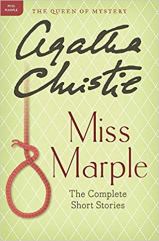
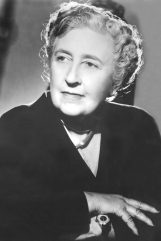 In Women & Detective Fiction we have just wrapped up three classes on Agatha Christie. Going over my notes from the last time I taught this seminar reminded me that we were struggling a bit, that year, to find enough to talk about–enough that, though I had forgotten about this until it was too late to make the change, I had resolved to assign a novel instead of the stories next time around. Happily, even sticking with the short stories, we had no such trouble this year! The class time has seemed to fly by: not only is it a keen group with plenty to say but the things they are noticing are often things I haven’t really focused on before. We talked a lot, for example, about role playing as a motif across the stories, from the overtly theatrical Jane Helier (an “actual” actress) to Miss Marple herself and the perhaps insoluble puzzle of how far her performance of self-deprecating femininity is a deliberate feint or strategy that enables her detective prowess and how far it is a way for Christie to sincerely re-value the qualities Miss Marple displays. Today was student presentation day and in addition to some useful discussion of her life and works we did an exercise in crime solving ourselves based on her mysterious 11-day disappearance. Next up in this class: Nancy Drew–and one of my students turns out to be an avid Nancy Drew fan and collector, so she is going to bring in some of her early editions to show us. I’m excited: if everyone stays this lively and engaged, it’s going to be a great term.
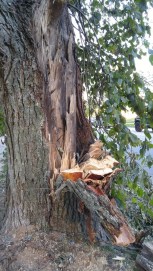 It hasn’t been stormy in my classes so far–in fact, we have barely had a chance to meet because of the literal storm that passed over Halifax this weekend. Hurricane Dorian churned up the east coast of the United States, and unlike most of the other big storms that head towards us it neither cooled off into an unpleasant but basically harmless rainstorm nor turned out to sea.
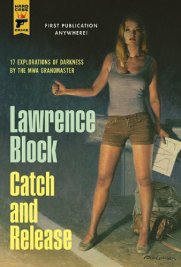 I decided to bump the scheduled classes along a day in Pulp Fiction and make up for it later, so today we picked up right where we left off last Wednesday, with the idea of “pulp fiction” and assumptions about differences between genre fiction and literary fiction. Then we turned to our first reading, Lawrence Block’s creepy little story “How Would You Like It?” It’s a story that doesn’t quite fit into any of the genres we’re actually studying–I suppose it is a kind of crime story, but it isn’t a detective story. It’s an attention-getting story, though, or at least I hope it is, and it’s useful for starting conversations about point of view, tone, and varieties of narrators, including unreliable ones. I wasn’t sure students would be willing to talk in class, given its relatively large size (120) and the rather formal lecture hall, but a lot of hands seemed to be going up, so I’m encouraged. I wonder if my using a microphone helps keep people involved because everyone can hear what’s happening: I am trying to be scrupulous about repeating students’ questions before I answer them, and also since it is wireless I can move around the room, including going up the stairs.
 In Women & Detective Fiction, I decided we would stay on schedule: Monday’s class was supposed to be spent discussion a cluster of ‘classic’ detective stories to provide touchstones for our often subversive takes on classic tropes: I’d assigned “The Purloined Letter,” “A Scandal in Bohemia,” and Hammett’s “Death & Company,” one of his Continental Op stories. I think we can hit the main points about these quickly at the start of today’s class, and then return to them through comparisons with today’s assigned readings: Baroness Orczy’s “The Woman in the Big Hat” (one of her Lady Molly of Scotland Yard stories) and Susan Glaspell’s “A Jury of Her Peers.” Both of these stories begin our term’s work of highlighting the ways gender matters to fundamental questions in detective fiction, including who has the expertise and authority to solve the crime and what “justice” means in a context where women’s experiences in particular and a broader context of sexism mean that the law may not provide it.
 Tomorrow I kick of my 25th year of teaching at Dalhousie and my 13th year of
  It wouldn’t make much of a post to say that five years later, nothing has changed! And yet in most respects that’s true. (Certainly my office looks more or less the same.) I think, or at least I hope, that the consistency in my priorities and methods is a sign of success, not stagnation. I still take class preparation seriously and regularly look for ways to change things up, whether it’s
  There won’t be big changes in my pedagogy this year, then: just the usual tweaks to see if I can get an exercise or an assignment or a reading to go a bit more smoothly or get better results. That doesn’t mean there won’t be surprises or challenges, though. That’s the thing about teaching! Every time you do the “same” thing–discuss the same book, assign the same essay topic, ask the same exam question, whatever–you are doing it with a different group of people and in a different context, not just of your own changing ideas but of theirs, which are shaped by the other courses they are taking and readings they are doing and experiences they are having–and by your life in the moment and their lives too. One of the scary, exhausting, and stimulating things about teaching is that no matter how carefully you have prepared, you never know what exactly is going to happen in the classroom that day. You just show up, bring what you’ve got, and try your best to shape, steer, listen, and respond in a way that serves the goals that you have for the course. In my case, though there are more specific objectives that vary from class to class, my fundamental goal is simply to help my students have as good a conversation about our readings as possible (meaning one that is well-informed and attentive to both text and contexts) so that they will carry away with them a sense of both how to do that and why it’s worth doing. We talk a lot these days about “transferable skills,” and those certainly matter, but the reason I teach English instead of something else is that I consider that specific work well worth doing
  On that motivational note, the two courses on my teaching schedule for this fall term are Pulp Fiction (a large introductory-level class) and Women and Detective Fiction (a small upper-year seminar). I’ve spent a lot of time over the last several weeks getting things in order for them; although I’m a bit anxious, as always at the start of term, at this point I’m eager just to get going. Once again, I will be writing about them here. Though sometimes over the years I have wondered if I’ll find anything new to say in this blog series, the exercise itself always proves that I do, and it also always proves valuable in the same ways I explained
 It’s not mannered or ornate, but its rhythms are varied and its vocabulary and word placement are full of small surprises.
 The wolves’ story is entwined with the story of Rachel’s pregnancy, the birth of her child, and the evolution of her relationships with her brother, from whom she has long been alienated. Without setting up overt or heavy-handed parallels, Hall creates a sense of common rhythms to the two stories: Merle and Ra grow in confidence, expanding their domain and skills and, eventually, their own family, as Rachel in her turn is easing the tight control she has always kept over herself, allowing other people into her space and finding there is room in it for feelings she had always thought were antithetical to her independence. As the wolves grow wilder, she becomes more domestic–but that is too pat a way to put either unfolding story. Rachel’s experience in particular shows there are risks and challenges at home too: different needs and desires to be held in what is sometimes a precarious balance. Then alongside this personal drama there’s also a political dimension, one that didn’t really come into focus for me until fairly late in the novel, though it’s clear from early on that Hall is interested in the artifice of human barriers (fences, walls, borders) and the tension they create with nature, which does not understand or respect them. One thing Rachel and her team cannot do is let the wolves run truly wild, for example, but as long as they are enclosed, no matter how generous the space allotted, they must be managed, their natural proclivities shaped to fit man-made limitations. What would it mean for them (or us) to override these boundaries?
 To return to my Sarah Moss comparison, I found The Wolf Border not just well-written and engrossing but consistently interesting in the same way that I did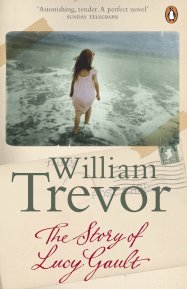
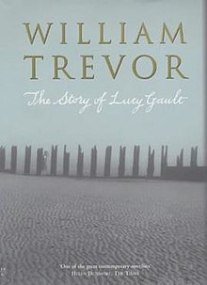 There’s an almost stately simplicity to the novel’s unfolding after this precipitating crisis, which launches its characters into a strange state of limbo. Lucy’s parents, unaware of developments back in Lahardane, roam Europe, exiled from home and happiness by their grief and guilt; Lucy, shamed by what she has done, pays penance for it with a life of near total isolation, even refusing love, when it is offered, as something she cannot accept “until she felt forgiven.” When a reunion finally comes, it is almost too late to repair the damage they have collectively wrought or to make up for the time spent apart, mourning and waiting. There is redemption in the story, though, and it comes from what the nuns who visit Lucy late in her life call her “gift of mercy.” Lucy herself sees nothing extraordinary in what she has done, nothing that needs the kind of explanation others wish they could command: “for what does it matter, really, why people visit one another or walk behind a coffin, only that they do?”
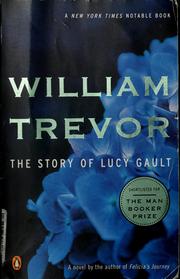 Is the story of Lucy Gault a tragic one? I don’t think so. It is a sad one, certainly, but for all its heartbreak the novel conveys the same sense of peace that draws the visiting nuns to Lucy’s home:
 “We had a limit known as the Whipple line, below which we would not sink. Dorothy Whipple was a popular novelist of the 1930s and 1940s whose prose and content absolutely defeated us. A considerable body of women novelists, who wrote like the very devil, bit the Virago dust when Alexandra, Lynn and I exchanged books and reports, on which I would scrawl a brief rejection: ‘Below the Whipple line.'” —
 But. It really doesn’t do more than tell this story. There aren’t any layers to it. The characters are fairly two dimensional, especially the French temptress Louise, who to me was the novel’s weakest element. She’s a selfish narcissist who takes what she wants for her own gratification. The whole catastrophe, in fact, is the result of her resentment at an old lover in her home town in France, himself blithely ignorant “that he, at such a distance, could have had anything to do with the breaking up of that family” or with the rift that opens up between Louise and her own parents. Her unmitigated nastiness sapped the novel of any chance of a real moral or emotional dilemma at its center: Avery is wrong to get involved with her and that’s that. Whipple plays out the moves on the board she has set up, but there’s nothing in it for us to think about: we just follow it all through to the end. And that is just not a terribly interesting exercise: Ellen is a bit of a limp noodle, and the solution that unfolds to her problem of finding her own place in the world is too pat, too easy.
 I did enjoy Someone At A Distance in the moment, but I also found myself comparing it unfavorably to another much better book (in my opinion) about an affair, Joanna Trollope’s Marrying the Mistress. In Trollope’s novel the “mistress” is a genuinely sympathetic character; the relationship that develops creates a genuine tension for the husband and then, eventually, for his children, who can’t help but like his new partner in spite of their loyalty to their mother; and the marriage that ends, while not a bad one, has weak spots that made it vulnerable—indeed, that maybe even made its end, while painful, a change worth bringing about. Yet even though her mistress is not an evil temptress, Trollope is less sentimental about love, and less blandly optimistic about fixing what has been broken. Someone At A Distance ends with the promise of restoration, but why? Knowing what she now knows about her husband, what is that promise worth to Ellen? I didn’t really care, though: by that point I was ready to be finished with her.
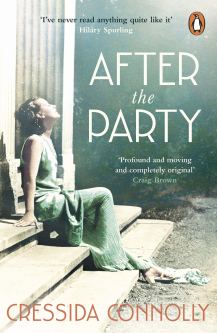 We all have our crosses to bear, our own personal sorrows. Mine is that the people who should be dearest to me, my own children, my sisters, consider me a bad woman. The grandchildren have been taught to be wary. I think I’m a disgrace to them, really. After the war when the newsreel film was shown of what had gone on in Germany and Poland, those places, the horrors . . . It all got tangled up in their minds, as if we’d stood for such barbarism.
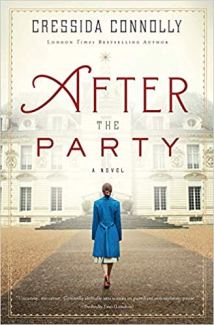 Even after her long imprisonment Phyllis remains indignant that her commitment to Mosley’s cause has cost her anything at all and especially that it has led to people concluding she is not a good person. It would be at once pathetic and laughable if it weren’t also plausible and unhappily timely: Phyllis insists that she and her fascist friends were very fine people. The novel approaches them with sly delicacy, never presenting them as outright villains but allowing the us to experience their moral corruption through the lens of Phyllis’s own self-justifications. It also focuses on the personal relationships that naturalize and sanitize the fascist cause for those directly involved, keeping the political context just vague enough that the reader almost has to shake herself to remember that what they stand for is not acceptable, that fascism isn’t just one reasonable choice among many no matter how elegantly its proponents are dressed or how preoccupied they are with their families, lovers, and friends.
 My
My 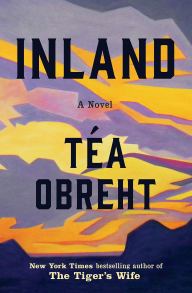 I thought it might help to write for some places that do run longer pieces, so I wrote a review “on spec” for one such venue but they didn’t want it–in the end it maybe wasn’t a great fit with the place I sent it, although the book I chose (
 This is why I keep returning to class prep! It’s so straightforward, and after all, it does have to get done. Maybe I should think of it this way: the better prepared I am for the term, the more likely it is that I can keep working on some kind of writing project even after classes start. My colleagues and I often talk about the way teaching expands to fill however much time you can (or are willing to) give it: this is something we advise TAs and junior colleagues to guard against. Good, detailed course planning is part of a strategy for achieving better balance between my various professional obligations; it’s not just a diversionary tactic when your other commitments are getting you down. Right? RIGHT?!
 Novel Readings