 As a member of Jo VanEvery’s Academic Writing Studio (which I highly recommend, by the way, if you need a bit of structure, encouragement, and/or advice), I receive her helpful weekly newsletter by email. Last week’s had the timely subject heading “It’s June! You Are Not Behind,” and included the calming observation that “you may not be where you thought you’d be or where you wanted to be on the 1st of June. But you are where you are.” I thought I’d use this post to follow her advice and take stock of where I am and where I should be going next.
Jo’s not wrong when she says “June may have snuck up on you.” One reason June’s arrival can feel sudden and thus disconcerting for me is that it follows immediately on May–which is obvious, of course, but here’s the thing: every year it seems as if May should be the real start of the summer writing season, but every year I realize, as if for the first time, that May is actually the end of the previous academic term, and the transition to the summer. Exams finished here in late April, and though my only exam was relatively early, the practical result was not that I could get my marking done sooner but that the 90 exams came in while I was also receiving final papers in both courses. April was nearly over by the time I had filed my grades. Then there is always a flurry of committee meetings. In the English Department, they usually culminate in our annual May Marks Meeting, which requires a lot of preparation from the Undergraduate Committee, which I am on. The work is mostly done by its chair (not me right now, happily), but in consultation with the other members. Because our department underwent a review this year (an institutional requirement involving both internal and external reviewers), and because of the wave of retirements we are experiencing, we also held a full-day “retreat” to talk about the kinds of stress our program (and faculty) are under and how we might respond.
 For me personally, the “retreat” (how I hate that term, which falsely suggests there’s something soothing about being closeted for hours with my colleagues and having to talk about fraught topics about which in some cases we profoundly disagree) was extremely stressful and undid some of the progress I’d made, post-promotion-debacle, towards restoring my trust in our collective operations and feeling once more like I have some kind of intellectual home here. I know it was undertaken with the best of intentions, but my experience of the day was that the event, which was pitched as an opportunity for “open” discussion, ended up feeling uncomfortably like an occasion to push us in a pretty specific direction–one much more aligned with the “skills” argument than with the actual content (for want of a better word) of what most of us study and teach. We’ll see how this plays out, and I may also be reacting to the loudest and most persistent voices rather than to any genuine underlying consensus that this is how we should seek to define ourselves–but I certainly left in a hurry and in a funk at the end of the day, and it has taken a while for the bitter aftertaste to wear off.
 Anyway, Jo recommends taking stock of what we did accomplish in May, and dealing with meetings and administrative tasks was a big part of that. I also completed the final draft of a report: I was part of the Faculty of Graduate Studies’ internal review committee for the King’s MFA in Creative Nonfiction (spoiler: overall, it’s a great program). I returned comments on a Ph.D. thesis chapter. I’ve written a couple of reference letters. I submitted three writing assignments, all relatively short but each posing its own kinds of challenges: an “In Brief” review for the TLS, a review for Quill & Quire, and a guest post for Sarah Emsley’s series “Youth and Experience: Northanger Abbey and Persuasion” (it will be up on her blog later this month). My post for Sarah is pretty personal, which actually made it harder to write, for reasons that are explained, at least by implication, in the post itself.
 One of the things I’d intended to do in May is work out a definite plan for some larger writing projects to focus on over the summer. For some reason I have found this very difficult to do: I have sketched out and even done scraps of writing for a lot of possibilities but I have struggled to commit to any one of them. I have continued to explore places to pitch pieces that aren’t book reviews, and I have some ideas I like, as well as a firm commitment to doing a piece for The Reader, a publication I have long admired for its combination of sophistication and accessibility. I really want to get back to writing about George Eliot; I think what I may need is to stop focusing on venues for a while and just write, the way I could when I always had the option of running something in Open Letters Monthly. Trying to think of the pitch first becomes an exercise in self-defeating second-guessing. Getting going on this–whatever it turns out to be–is a top priority for me this month.
 These are all work things, and of course that’s never everything that’s going on. Maddie had her wisdom teeth out on May 18th, for example, and that meant a week or so of disruption (and a lot of smoothies) while she recovered, but she is basically better now. As previously mentioned, I’ve been taking a drawing class; I’ve been feeling much better about it since I learned it was okay to copy pictures, which removes a lot of the frustration of trying to get proportion and perspective right on my own. I’ve been enjoying my practice sessions a lot more, as a result, and that in turn is building up my confidence–I even sat on our back deck on the one really hot day we’ve had so far and tried to draw the trunk of our big elm tree (not bad) and our small stone wall (not so good). After my initial discontent, I am now definitely glad I decided to try this. In addition to the intrinsic satisfaction of creating something (not that copying is that creative, but it’s a step towards it!), I often spend a lot of time alone, especially in the summer, and being able to bring along my sketch pad and pencils to someplace like Point Pleasant Park or the Public Gardens will be a nice substitute for company.
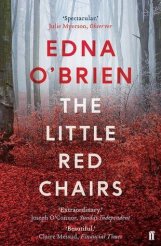 Last but not least, Edna O’Brien’s The Little Red Chairs ended my reading slump; I picked up Kamila Shamsie’s Home Fire and Ottessa Moshfegh’s Eileen on the weekend and feel excited to start both of them–though right now I’m actually reading Ann Cleeves’ Thin Air, to see if I like the books Shetland is based on as much as I liked the series. (So far, I don’t.) I’ve realized that getting out of the reading doldrums is not just important for me personally: I rely on my underlying enthusiasm about reading to keep me motivated about my writing projects, most of which now are done not because of any external demand but because I want to do them, because I think they matter in some way. When I feel myself getting bored or disillusioned or disconnected from the current literary conversation, it gets much harder to see why or how I should contribute to it.

So: that was May. Jo is right: it’s useful to reflect. Though there were long spells last month when I felt extremely grim and unproductive, it turns out I still got quite a lot done, which is reassuring, but that there are also things I really want to do next, which is bracing.
 Classes have been over for a while now, but the business of the teaching term isn’t quite over. I mentioned before that one unfortunate feature of marking season is academic integrity hearings: I had more this year than I’ve ever had before, which has taken up a lot of my time and also given me a lot to think about. Individual cases are confidential, of course, but at some point I plan to write a separate post about some trends I’ve noticed around plagiarism and some ideas I have about how to address both its causes and its consequences. Some of what I’ve been dealing with and thinking about is addressed in
  Since classes ended, I’ve been thinking a lot about what seemed to work and what didn’t this term. It’s always hard to know what are actual lessons about pedagogy that you can carry forward and what are idiosyncratic reactions or developments based on the specific and unpredictable population of a particular class. For instance, I thought that overall Pulp Fiction went much better this year than last. What did I do differently? Not much logistically: I used the same readings and course structure, and more or less the same assignments. Class participation was way up, though, and most of the time the atmosphere felt happier: is that because (anxious to avoid whatever went wrong last year) I tried even harder than usual to be positive, friendly, and encouraging? Did we all benefit from my having broken in this material last year and so being more adept with it this time? Or did I just get lucky and have a larger proportion of reasonably talkative students who softened the atmosphere for others to join in and thus helped increase overall engagement?
 I have also concluded that Valdez Is Coming is not a good choice for my representative Western. When I read it on my own,
  As for Victorian Sensations, I thought it was quite a successful seminar. Participation levels were consistently high and (as important) were of high quality; as I told the class at the end of term, I genuinely looked forward to showing up and talking with them about our readings. The only novel I hadn’t taught before was Cometh Up As A Flower; we found it provocative and sometimes puzzling, and quite a few students chose to include it in their term paper, which is a sign that they were engaged with it. It might be fun to include it in one of my standard Victorian fiction class, where it would fit well with other novels in which passion and duty collide (The Mill on the Floss, for instance), or in which the ‘romance’ of marrying for money is overtly stripped away. One slight surprise for me was that discussion flagged a bit for Fingersmith. Everyone seemed to really enjoy reading it, but it was conspicuously harder to get them to talk about it. This might have been (a bit paradoxically) because they found it fun to read and so their critical faculties shut down in ways they really can’t with a novel like East Lynne (which is pretty hard work to slog through, honestly); it might also have been that we read Fingersmith last, and by the final weeks of term everyone’s tired and overwhelmed with work.
 Less of a surprise, but still a challenge, was how difficult it was to generate discussion on the classes I’d set aside for “critical approaches” to our novels. After the first of these sessions I realized that I needed to approach them differently, so I ran those classes more overtly than I usually do in a seminar class, adding some contextual information about the history of literary criticism and devising a set of “metacritical” discussion questions to supplement students’ questions on the specific readings. Even so, discussion was halting. I think the main reason was actually closely related to my goals for these readings. In my experience, when students read criticism they are often mining it for usable quotations, which they then drop into their own arguments as if the fact that somebody else said it proves their claim. I wanted to get them to engage with other scholars in a more equal and conversational way, learning how to see what kind of criticism they are reading (by considering its original date of publication, the venue it was published in, the kinds of questions it asks, and the kinds of evidence it considers) and then if they use it in their own work, signaling how and why in a different way. Just saying “As Critic Smartypants argues” instead of “Critic Smartypants argues” is an improvement: it implies “I’ve thought about this and agree,” not “Smartypants said it, so it’s true.”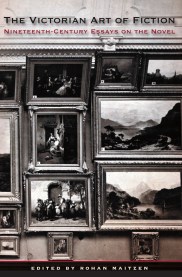
 Last week and this week, actually. That’s not quite all I’ve been doing since classes wrapped up on April 10: there has been a spate of committee work, and also (one of the less pleasant features of this time of term) some academic integrity hearings, which take up a fair amount of time. Then on the home front, Maddie was in her high school’s production of The Drowsy Chaperone, which had its four-performance run April 19-21, so in addition to ferrying her to and from rehearsals and doing what I could to mitigate the stress on her schedule in other ways, I’ve also been to two performances–which, on the bright side, was the most fun I’ve had in ages. (In case you know the musical, she played Mrs. Tottendale, with great comic flair. The whole cast was great, actually, as was the production, especially the costumes.)
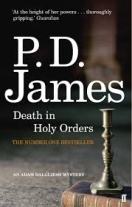 I’ve been too busy and distracted to settle in for any intense reading, though I did join a few Twitter friends in reading The Warden last weekend. Then I had to take all the books off my mystery bookcase (we needed to move it out of the way temporarily, to do a household project) and in the process of sorting them I was reminded how long it has been since I read most of my P. D. James collection. I’ve put An Unsuitable Job for a Woman back on the reading list for Mystery & Detective Fiction in the fall, so it seemed like a good time to revisit one or two. As a result, I’m happily rereading Death in Holy Orders, which turns out to follow very well on The Warden as it has a number of explicit references in it to Barchester Towers. James herself said she saw the 19th-century novelists as her predecessors more than the Golden Age mystery writers, and in a book like this, that genealogy is clear. There are plenty of murderous moments in Trollope but his world is (mostly) too genial a place, his morality too committed to shades of grey, to allow for outright irremediable violence. (There are exceptions, of course). Like Trollope, James is very good at depicting institutions, with all their intricate politics and emotional dynamics. She’s also exceptionally good at setting, something I emphasize when we discuss Unsuitable Job (where the beauty of Cambridge makes a poignant contrast to the horrors of the novel’s central crime). After reading several hastier or lazier stylists in this genre recently, I am appreciating the leisurely pace of her descriptions, along with the meticulous depth of her characterizations. I don’t like all of her novels equally, but when she is good, she’s very very good.
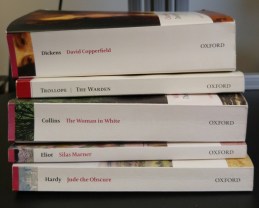 As if things in this term’s classes aren’t busy enough (and about to get busier, as next week I get in both sets of term papers and give the final exam for Pulp Fiction) but book orders for next fall were also due. It’s not a set-in-stone deadline, and quite reasonably a lot of my colleagues put it off until the summer, but I’ve actually been playing around with possible book lists for my Dickens to Hardy class since Austen to Dickens wrapped up last term, so I figured I could at least get that one settled.
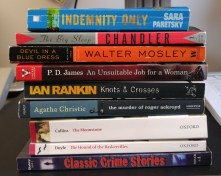 In the end I also submitted my book order for Mystery and Detective Fiction today. If I’d waited I might have made more changes to what has become my ‘standard’ book list for the course, but though I have been considering some more recent Canadian books for inclusion, I wasn’t completely convinced either of them would work well in class (
 Those are my only two courses for the fall and then I’ve got a half-year sabbatical next winter, so that’s it: my book orders for next year are done! For the first time in a long time I’m not teaching a first-year class in 2018-19. I’m glad, not because I don’t enjoy teaching introductory classes but because I want to think carefully about which one I’ll teach next, and especially about whether I’ll put in for Pulp Fiction again. We recently revised
 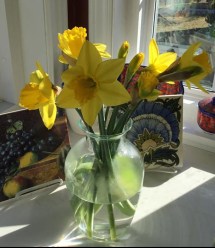 The good news isn’t specifically about what’s happening in my classes this week (although I hope there is some connection): it’s good news about my teaching more generally. This week I learned that I am this year’s recipient of the Faculty of Arts and Social Sciences Award for Excellence in Teaching.
 Given the role that Novel Readings has played in my teaching life–as a vehicle for reflection and a place where I have both shared and received ideas and encouragement about teaching–it is gratifying to know that my blogging was part of the case made on my behalf, and that my success at generating “conversations both within the university and in wider circles” was cited by the committee that selected me to receive the award this year. I started blogging about pedagogy when this kind of outward-facing work was still relatively uncommon for academics and was (as it still largely remains) not entirely congruent with the university’s standard operating procedures. I have found it intrinsically valuable, for the process itself and for the conversations and communities it has brought me into. For that reason alone I would keep it up in any case, but I admit it is nice to have some institutional recognition that it contributes to our core mission.
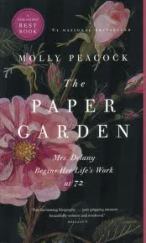 And it has felt even better sharing my good news and basking in people’s happiness on my behalf. I got a lot of help from my friends, both online and off, when things went badly for me; now everyone has been wonderfully supportive about this good news. Social media certainly has its down sides (as we are only too well aware at this point), but there’s also something magical about the way it creates a vast web of connections–intangible perhaps, but still very real–between so many people across such distances. I hesitated before putting my good news out there in case it seemed self-aggrandizing, but I’m so glad I did. Why should we be afraid to invite a bit of cheering for our accomplishments, after all? I was reminded of one of my favorite points from Molly Peacock’s wonderful and inspiring book
 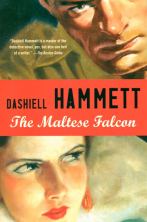 But good things happen in the second part of term too. For one thing, students have got their bearings in the course materials and expectations, so I can spend less time on logistics and reminders and saying “it’s in the syllabus.” And for another, the reading and discussion continues and sometimes even gets better because we’ve all warmed up. In Pulp Fiction last week, I thought there was a noticeable improvement in the students’ Reading Journals, as if they “get” The Maltese Falcon better than they did Valdez Is Coming–which, I’ve belatedly realized, is a more subtle novel than I thought, hard to get an interpretive grip on if you aren’t used to reading that way. Though the actual plot of The Maltese Falcon is plenty bewildering as it unfolds, the prose and the issues and the characters give us more to grab on to. The class is writing their papers on it now: we’ve got an editing workshop for their drafts on Friday, then they turn in revised versions next week and we start our unit on romance, which I’m quite looking forward to. I hope they are too!
 In Victorian Sensations we’ve started Rhoda Broughton’s Cometh Up as a Flower. When I first read it I wasn’t convinced of its merits, but it turns out the magic trick is to read it right after you finish reading East Lynne! What a relief to turn from Wood’s dreary moralizing and Isabel’s unrelenting gloom and repentance and the whole tawdry, disorganized assortment of subplots to a sassy young heroine who hates her sister, canoodles with a handsome soldier in the garden and finds it blissful, not shameful, and just adores her dear old dad! Not much actually happens in Broughton’s novel, but in the context of our discussions of other sensation novels, that in itself has provoked some discussion, as has figuring out what made Broughton’s very different work equally scandalous–mostly, Nell herself. In general, the consensus in the class seems to be that Nell is refreshing, if not altogether likable; there will be lamentations, I’m sure, about the turn her story is about to take as well as the shift in her tone from defiant to repentant by the end. I’m so impressed with this group of students: often on the way to class I’m wondering a bit anxiously if we’ll find enough to talk about, and I always end up surprised that we’ve run out of time and I have to shut down discussion. One factor is that there are always two students charged with bringing in talking points to get us started, and of course I bring notes and materials myself–but basically, they’ve got this, which is great.
 In Pulp Fiction, this is our second and final week on The Maltese Falcon (no, it does not seem like enough time, but we have other work to do too!). Leading up to our discussions of the novel I made a big deal about Raymond Chandler’s claim that the novel “demonstrated that the detective story can be important writing. The Maltese Falcon may or may not be a work of genius,” he says in “The Simple Art of Murder,” “but an art which is capable of it is not ‘by hypothesis’ incapable of anything.”
 Two of the questions I asked my students to think about for class discussion this week were what the falcon ultimately stands for–to individual characters and, perhaps not the same thing, in the book as a whole; and how they viewed Brigid O’Shaughnessy by the end–as a femme fatale or a woman fighting for survival in a man’s world. Today we also considered what it means that the actual statuette the characters have been chasing (and have killed and died for) in the novel turns out to be a fake. It’s one thing to imagine what it might mean to actually get whatever it is that you most want: what if it isn’t worth it after all, or it is but now you don’t know what to do next? But what if you think you’ve got it and it isn’t real? Gutman recovers quickly and proposes they keep looking: after all, the real one is still out there, isn’t it? Isn’t it the quest itself that really matters? Or in chasing their dream are they missing their chance to actually live?
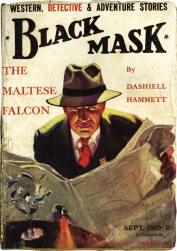 It seems pretty clear that Sam is missing some kind of chance by following his dream, except that his is a dream of justice for his murdered partner. One of my favorite things about this novel–which in many ways I find deeply unpleasant–is how shadowed Sam’s choices are by their consequences. In the end he chooses justice over love, which is (as Effie comments) the right thing to do; Sam himself gives a long list (literally numbered) of reasons why he should turn Brigid in, against which there is only “the fact that maybe you love me, and maybe I love you.” “It isn’t always easy to know what to do,” he tells Brigid when she first comes to see him pretending to be the innocent and vulnerable “Miss Wonderly.” He may in fact know exactly what to do, but the ending to the novel shows that that, too, isn’t easy: he may live up to his principles, but he also has to live without love, without trust, and probably without happiness. In a different novel, the alternatives might not be so stark, but Sam lives in world where “if they hang you, I’ll always remember you” really does, I think, count as romantic. While Effie may agree with him in principle, though, she also recoils from him, a judgment I share.
 In Victorian Sensations we finished up East Lynne this week–with some relief, I think, though I was glad to hear some students saying they did enjoy it: curiosity about what would happen next helped them keep going, even though it dragged a bit at times. One of the reasons I think this novel falls short of being “important writing” is its ineptness, artistically speaking: a lot of it seems quite haphazard or just plain incoherent, and our well-trained desire to find patterns and unities was frequently frustrated. That’s not to see it doesn’t contain many interesting elements, but I don’t really think that, through them, Wood is saying something worth really thinking about. She does have plenty to say, but it’s the very heavy-handedness of her overt message that becomes tedious. I said before that the novel reads very clearly like a cautionary tale–but so, of course, is Vanity Fair, which has a similar moral lesson for us: live well so you have no regrets on your deathbed. “Oh, Barbara,” says the tediously honorable Mr. Carlyle after presiding over the pathetic deathbed of his first wife:

 Not only is February a short month already but it includes two of the winter term’s time-outs (times-out?): Munro Day and Reading Week. Because February is often one of our most difficult months weather-wise, it’s usually a big relief to have the pressure ease up at work a bit, even if there’s always still plenty to do. This year, the February weather actually hasn’t been that bad, but the change of pace is welcome just the same.
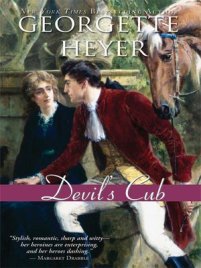 I haven’t started a new book since I finished Tinker, Tailor, Soldier, Spy, though I did reread Georgette Heyer’s Devil’s Cub last week after recommending it to a Twitter friend looking for a Valentine’s Day present for his wife. I hope she liked it! Sometimes I reread just the final third but this time I started from the beginning. It does take a little while for all the pieces of Heyer’s plot to get lined up, but once they’re in place it’s comedy gold, I think, and also pretty romantic–though YMMV depending on your tolerance for bad boy heroes. (But Mary is so having none of his self-indulgent nonsense!) It’s also good preparation for teaching Lord of Scoundrels, which will be up in Pulp Fiction in just a few weeks!

 Novel Readings