The sheen is definitely off the new term now: we are in the thick of it, and the challenge of juggling its many demands has not been helped by (and probably contributed to) the cold-y flu-y virus I’ve been struggling with for about ten days. It was at its worst this past Friday,when in a rare moment of weakness I even let one of my morning classes go early! They looked so tired themselves, and they weren’t really rising to the bait of my discussion questions–but the bait itself was kind of limp with no fight left in it, not the fresh wiggly kind you need to … well, whatever. Probably best for us all that I stay away from fishing metaphors. Anyway, I was tired and slightly foggy at that point and suddenly just couldn’t keep the song and dance routine going. Some quiet working time in my office and some hot tea perked me up enough to get through the last class of that day, and by Monday I was more or less healthy, but it sure has felt like a slog. It’s good to feel better, but the work is still piled up, more than it would be if I hadn’t been sick last week, and that’s despite how much I did over the weekend and routinely do at night as well. This is the time of term when it’s particularly galling that all the mainstream media coverage of higher ed so often seems focused on what a bad job we are doing teaching undergraduates because we are either lazy tenured slackers or self-important research kingpins who can’t be bothered to spend time in the classroom.
So. Where are we now? Well, in Mystery and Detective Fiction we have just wrapped up our discussion of The Maltese Falcon, which I continue to find a particularly depressing novel, and tomorrow we turn to Ed McBain’s first 87th Precinct novel, Cop Hater. This is one of the books I read during my sabbatical quest to refresh the reading list for this course. When I wrote up my first impressions, I noted,
What seems really different about Cop Hater compared to earlier detective novels is its attention to the specific procedures of the police investigation, even including reproductions of gun licenses and rap sheets, but also detailed explanations of forensic measures (such as fingerprinting) and lab work. These features, along with the spread of the novel’s attention across several detectives (though Carella is clearly the main character) help us see the police as a system, as part of a bureaucratic organization operating within a network of other supporting (or, sometimes, hindering) systems. The case is not solved by the ingenuity of Poirot or the ratiocination of Dupin or Holmes but by the persistence of men who just keep looking and asking until they find something out.
This is one of the things I want to talk about tomorrow, though I think we’ll start with some attention to the setting, especially since we’ve talked quite a bit about the whole “mean streets” idea in Chandler and Hammett. Rereading the McBain, I was struck again by some of the stylistic tics I found annoying the first time, but I’m more interested in the dynamic of the squad room. I’m curious to see how the class reacts to this one. It is quite a good group: there’s a core of keen participants, and as far as I can tell most of the rest of them are reasonably engaged, with the exception of a couple of them who sit at the back and pretty obviously scrawl notes to each other and smirk. The room has tiered seating and isn’t that deep, so they are quite visible to me. Pretty soon I may actually say something to them, as it does occasionally throw me off my mental track wondering what they’re writing…
In 19th-Century Fiction (where, actually, there are also a few scribblers / whisperers and smirkers, and it’s a much smaller room, so again, it gets distracting!) we are working our way through The Tenant of Wildfell Hall. Happily for me, given how much else I’m trying to stay on top of, I just did this novel in The Victorian ‘Woman Question,’ so it’s pretty fresh in my mind, though I’m still rereading pretty much all of each instalment. It is interestingly different doing a book in a seminar and a lecture class. I don’t just lecture, of course, but even when we’re working through points together I’m steering things more than in the seminar. The participation level is definitely better with Tenant than with Vanity Fair. It helps that some of the students, too, just read the novel for my other class! But it helps even more, I think, that the novel is simply more straightforward, in some ways more familiar, and definitely shorter. I’m a big admirer of Tenant, which is a really artfully constructed novel as well as a compellingly told one. For some time I have been meaning to do another Victorian ‘Second Glance’ piece for Open Letters (which I haven’t done since I wrote on Vanity Fair in the summer of 2010) and Tenant is at the top of my list. Another one that would be fun is Ellen Wood’s East Lynne … but no time to think about that now!
And in The Victorian ‘Woman Question’ we wrapped up Aurora Leigh last week. I thought our discussions of it went well–better than I expected, frankly! They did not find its blank verse bulk nearly as off-putting as I had anticipated, and we had some good lively sessions on it. This week we’re doing more poetry: yesterday was D. G. Rossetti’s “Jenny” and Augusta Webster’s “A Castaway,” both complex and fascinating dramatic monologues focusing on ‘fallen women,’ and tomorrow and Friday it’s Goblin Market.
Behind the scenes, I marked the first set of Mystery midterms last week and this week I’m trying hard to get through the Vanity Fair papers for the novels class. On the weekend I wrote up my final evaluation of an honours thesis I’d agreed to examine for the University of Western Sydney and sent it off. The letters for the three tenure and promotion cases I was involved in have been submitted, and I don’t think there’s any major committee business looming again for a while–so that’s a relief, because there’s a Ph.D. thesis chapter languishing in my inbox that I’d like to get to before another week goes by, and it’s starting to seem possible that I will manage it!


 Well, OK, that puts it a bit strongly — but I find I don’t flourish in the summer, despite being happy (who could not be?) to have some warmth and sunshine. I find the relative formlessness of the days difficult: I do better with more of a routine, including a routine that gets me out of the house and into my office on a regular schedule. I have an office space at home, but for years now my “real” workplace has been on campus, and though I use my home office for lots of things, from marking to blogging, still, there’s something psychologically useful to me about being “at work” rather than at home. That includes the absence of domestic distractions: being at work in a predictable way really helps me feel less torn when I am at home between wanting to appreciate being with my family and give my children the time and attention they deserve, and trying to get work-related chores and projects cleared away.
 The other work project I’m puttering away at is my presentation for the conference in Birmingham, which suddenly does not seem far off at all! I leave in just over a month. I’ve been learning
 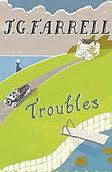 I’m reading, too–right now, Troubles, by J. G. Farrell, which won the “lost” Booker a while back. I am loving it: it is brilliantly, mordantly, funny, with a current of uneasy violence running through its main storyline that is perfectly suited to the novel’s historical context, the Irish “troubles.” It’s yet another book (like Old Filth or Major Pettigrew’s Last Stand) featuring a retired servant of the empire — though in this case Major Archer is retired from active service but still a young man — yet it does not give me the same uneasy feeling that I’ve been through these moves before. We’ll see if I still feel that way at the end of the book. When day is done and I can’t even putter any more, I am watching Downton Abbey. This does seem familiar (wasn’t it called ‘Upstairs, Downstairs’ the last time?), but it is also very well done. I’ve just finished watching the Emma Thompson / Kenneth Branagh adaptation of
