 It has been kind of a stuttering week for me. My “Meeting With Your Writing” session on Monday helped me work up some positive energy about the next part of the George Eliot project I want to work on — this was good, as I had been getting kind of fed up with the other piece I’ve been working on since January. That piece is at about 18,000 words right now and it’s definitely still a messy early draft, which is one reason I’d become frustrated with it. But I realized that trying to “finish” it, or even polish it, when I’m not quite sure about my overall direction would be unproductive, so starting the next section made both practical and psychological sense.
Soon after, though, I found myself in the writing doldrums, mostly because the new bit seemed so disconnected from the first part and that started a whole mental chain reaction of questions about what exactly I was trying to do. This kind of metacriticism of my own work-in-progress is something I’ve been deliberately avoiding this term: my plan was just to write as much as I could while I have the time to dedicate to it, and then contemplate the results in July, when my sabbatical is officially over. Who knows, by that point, I might have accidentally provided myself with answers about what exactly I was trying to do! And I wouldn’t any longer be trying to answer questions about it in the abstract — what kind of thing might this be? what would it look like? what would it say? — but would know, and could revise and reconsider and repackage from there.
Because I am prone to both brooding and self-doubt (they go together so awfully well, don’t they?), this plan was basically a good one. It has proved harder to follow than I’d hoped, though. I am steeped in self-consciousness by both nature and training, after all; falling off the wagon as I did this week was probably an inevitability. I got myself back together by Thursday, partly by doing an extra session of MWYW during which (in service of the writing, I promise!) I got to spend a lot of time surfing around in Middlemarch choosing examples to discuss. That was truly restorative! Jo always advises us to start, if we can, with an aspect of the writing project that we really want to do — something that we think will be fun. I’ve made a note to remind myself that when I feel stuck, I should go back — if only for a little while — to one of the novels and just read for a bit. After all, they are the reason I’m doing any of this in the first place!
I’m back on track now, ready for a better, steadier time next week. I don’t think the time I spent in the doldrums was necessarily wasted, though. Though Jo rightly pointed out to me on Twitter that I don’t need to decide this question now, what I found myself mostly brooding about was whether I was wrong to be thinking about this project as a book (recall the trigger, that the two sections didn’t seem connected, except by method) — or, to approach it from the other direction, why I wasn’t satisfied thinking about it as related but distinct essay projects. I’ve honestly never been sure I had a sufficiently motivating and unifying book-sized idea, so in fact the book plan (as far as it has gotten at this point) has always been for a carefully framed and integrated series of essay-like chapters that remain primarily exercises in expansive close reading — I know, I know, not a marketable idea, at least for a literary nobody — don’t knock me off the wagon again! But any book is a struggle to get published, and Tom isn’t the only person who has pointed me to venues like the Hudson Review that already do publish literary pieces of the sort I have been writing (and of which my current material is really just a larger and messier version).
Obviously, I can’t simply assume my work would be accepted at places like that, but what if essay-writing actually suited me and my work best — what would be wrong with making that kind of publishing my ambition? After all, even the critical books I’ve liked best in recent years have in fact been made up of … you guessed it, essays (I’m thinking of Zadie Smith’s Changing My Mind, for instance, or James Wood’s The Broken Estate). Why, then, have I become fixated on somehow producing a book?
During my brooding period, I finally admitted to myself that, in part at least, it’s for the wrong reasons, that is, it’s not because I have something to say that can’t be said properly in any other format but because I imagine it would bring me (in addition to what I hope would be some genuine personal and intellectual satisfactions) some professional validation. “Look!” I could say (to the kind of person, for example, who waved a dismissive hand at my list of essays and reviews and said they didn’t “add up to anything in particular”). “It’s not quite your kind of book, but it is at least a book, the kind of thing you can display at your book fairs!” That’s not the only reason, but recognizing that it was definitely one reason was at first depressing, and then strangely liberating. I routinely give presentations in which I bring up the MLA’s proposal that we “decenter” the monograph: I strongly believe that books (as I also discuss here) aren’t always the best form, though they have become the professionally essential form. Loving books as I do, it’s not surprising that I love the idea of producing (another) one, and I’m not 100% sure that what I’m working on now won’t eventually prove to be a book. But the next time I get fretful, I’m going to remind myself that (by principles I myself have argued for repeatedly), it’s okay if it doesn’t.
So that’s where I end up another week of my sabbatical! In the moment, it didn’t feel like a very productive week, but in retrospect I think both the writing and the brooding I’ve done actually were productive in their own ways.





 I spend a lot of time fretting about which books I assign in my Mystery and Detective Fiction course — because once you get past the few absolute “must haves” (something by Poe, some Sherlock Holmes, The Moonstone, something to represent the Golden Age, one of the hard-boiled essentials) there are many good reasons but no real imperatives to help me choose from the tens of thousands of possibilities. My guiding principles are coverage (of the major subgenres, such as the police procedural) and diversity (of voice or point of view), but that doesn’t really narrow things down that much. I’ve asked for suggestions quite a few times here, with great results: I have readers like Dorian to thank, for instance, for prodding me to read Sjöwall and Wahlöö, whose The Terrorists is currently a staple of my course reading list.
 And yet … I am not convinced that I should replace Knots and Crosses after all! Much as I’m enjoying rereading it, I’m not sure it would be as teachable as Knots and Crosses, and my hesitation over this has had me wondering: what do I mean by “teachable”? It’s not something I ever really consider about Victorian novels when choosing among them for my 19th-century fiction classes, but when I’m scouting for mystery novels to assign — or contemplating assigning some new (or new to me) novel for an intro course — “How would this work in the classroom?” is always a concern. And for the majority of mystery novels I read, the (usually unarticulated) response to this question is “it wouldn’t”: I put most of them aside without seriously considering them for my syllabus, which strikes me as interesting. Why would that be? Might it (she says a little nervously) have something to do with the “literary” vs. “genre” fiction distinction? Or, to be more precise, with the ways that methods for “teaching” a novel (at least for me) align with qualities that are more likely to occur in “literary” fiction?
 Then there are other constraints on teachability: more pragmatic ones. Again, with Victorian novels I mostly don’t worry too much about these, though I am wise, or cautious, or jaded, enough never to assign two genuine door-stoppers in the same term (say, Bleak House and Middlemarch). Students who sign up for “The 19th-Century Novel from Dickens to Hardy” have to know what they are getting into! But the mystery class is a lower-level course that is purely an elective for everybody in it. I can barely get them all through The Moonstone (and in fact I am confident there are always some who never make it to the end) — and that’s a book that’s so interesting I can barely stop talking about it myself! It earns its two weeks of class time by being not just important but really complex and (for the class) quite challenging. This is actually where I fear The Naming of the Dead falls apart as an option (though I’m not 100% sure yet). Its nearly 500 pages are not nearly as dense as The Moonstone‘s, but in a way that’s just the problem: it goes on for almost as long a time without actually being as complex. It is broad, I might say, and it’s smart, but it’s not particularly deep. I’m not sure about this, because I haven’t tried to map out any lecture topics, but it would be a bad idea to assign 500 pages and then end up feeling like we were spinning our wheels in class.
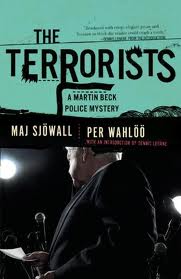 I think things are going reasonably well in both my classes right now. In Mystery and Detective Fiction we’ve just finished working through Sjöwall and Wahlöö’s The Terrorists, which provoked quite a lot of discussion this time around. As always, I’ve been meditating on how to change up the reading list for the course’s next incarnation; I think The Terrorists is a keeper, precisely because it gives us a lot to talk about. It is, arguably, somewhat tendentious — I’ve been wondering if I should hold the authors’ Marxism in reserve next time (rather than emphasizing it in my opening lecture) and let the novel’s politics reveal themselves inductively. I don’t find the novel too doctrinaire to be humanly interesting and dramatic, though: I think Sjöwall and Wahlöö successfully walk the line between the picture and the diagram, with Martin Beck himself especially standing between us and a narrow didacticism. Rhea may have a portrait of Mao on her wall, but Beck remains committed to (if ambivalent about) the flawed system he polices. Today we started Ian Rankin’s Knots and Crosses — time for my annual comment that I’d love to try one of his longer, richer novels, except that this one (like The Terrorists) is always really good for discussion, and always gets singled out in student evaluations as a general favorite.

 I’m sure you have all been wondering whether I have managed to get my
 Novel Readings