We set our clocks back an hour on the weekend. Whle I concede that it’ss nice to have it lighter in the morning, I never feel that makes up for how dark it gets in the afternoon, which tends to be my low energy time anyway. In any case, this plus our first flurries of the season makes it impossible for me to keep pretending winter isn’t setting in. I can hardly express what a drag this is on my spirits. Winter increases my stress levels exponentially — mostly because I hate driving in snow and ice. In fact, if I could configure my life so that I never had to get behind the wheel of a car between December and April, I might not mind winter at all. Well, OK, I would still not be a fan of the freezing-rain-sleet-snow mix Halifax specializes in, but it would not fray my nerves or ruin my plans in the same way. On the bright side, I do have a sabbatical next term, which somewhat relieves the pressure, and at this point the worst still lies ahead. In the meantime, we’re not done with the fall term yet.
 I think things are going reasonably well in both my classes right now. In Mystery and Detective Fiction we’ve just finished working through Sjöwall and Wahlöö’s The Terrorists, which provoked quite a lot of discussion this time around. As always, I’ve been meditating on how to change up the reading list for the course’s next incarnation; I think The Terrorists is a keeper, precisely because it gives us a lot to talk about. It is, arguably, somewhat tendentious — I’ve been wondering if I should hold the authors’ Marxism in reserve next time (rather than emphasizing it in my opening lecture) and let the novel’s politics reveal themselves inductively. I don’t find the novel too doctrinaire to be humanly interesting and dramatic, though: I think Sjöwall and Wahlöö successfully walk the line between the picture and the diagram, with Martin Beck himself especially standing between us and a narrow didacticism. Rhea may have a portrait of Mao on her wall, but Beck remains committed to (if ambivalent about) the flawed system he polices. Today we started Ian Rankin’s Knots and Crosses — time for my annual comment that I’d love to try one of his longer, richer novels, except that this one (like The Terrorists) is always really good for discussion, and always gets singled out in student evaluations as a general favorite.
In 19th-Century Fiction we’ve moved on to Jude the Obscure. Jude is usually the last novel I cover in the Dickens-to-Hardy class, so it feels odd that it isn’t this time: we’re following it up with The Odd Women. I made room for Gissing by skipping sensation fiction for the first time I can remember in this course. I kind of miss it, because it’s a lot of fun (I usually assign either Lady Audley’s Secret or The Woman in White), but I’m anticipating a good response to The Odd Women. Jude seems to have perked people up, too, which might seem perverse, considering how grim it is, but depression has its own agonistic charms, and the novel also moves much more quickly, and is expressed much more bluntly, than Middlemarch (which, to my delight, thrilled a handful of students but also clearly daunted or deterred a fair number of them). One of the things we talked about today was Hardy’s emphasis on buildings and architecture. The novel is so intensely tactile and visual that I thought it might be nice to put some pictures in our minds’ eyes, so I put together a simple slide show, including these photos from my own one and only (so far) visit to Oxford.


The pulpit at St. Mary’s isn’t, strictly speaking, a Jude landmark, but Newman is one of the ghostly presences Jude communes with on his first night in the city, and I was surprised how moved I was to see where he had preached. The Martyrs’ Cross, of course, is where Sue and Jude first meet — or, more precisely, where Jude first suggests they meet, only to have Sue call out, as they approach it, “I am not going to meet you just there, for the first time in my life!” Jude is definitely not one of my favorite novels, but it is a favorite of mine to teach, because however heavy-handed I find it (and however annoying I find Sue), it is also passionate and occasionally profound, including in the challenge it issues to the more conventional morality of our other readings. Reading it right after Middlemarch also really brings out continuities: they share interests in aspiration and vocation, in hopes crushed, in loves that press against convention, in learning and religion and compassion for flawed, suffering humanity. Middlemarch may seem melancholy in its treatment of these themes, but put Jude up against it and suddenly Eliot’s meliorism seems downright buoyant!
Even though Jude is not our last book, it’s astonishing to realize how close we already are to the end of term: it seems to be rushing past. At the same time, it has felt like a particularly effortful term to me. I can’t remember ever feeling quite so tired after each class meeting: I come back to my office and have to just sit still for a while before I can gather up the energy for my next task. Am I getting old? Well, yes, of course I am … but I hope that the real culprit is the tendinitis that has kept me from my running routine for months now. I am just gradually getting back into a modified exercise program. One reason I have to sit down after class, though, is that standing and pacing (as I inevitably do during lecture and discussion) seems to be about the worst thing for my aches and pains! I’ve been very frustrated that even after diligently following all my physiotherapist’s instructions I am not significantly better and more mobile! I’m cautiously optimistic at this point. I never ran very far or very fast at the best of times, but I would like to get back at least to where I was. I miss the psychological benefits as much as the physical ones. Here’s hoping!
 I’m sure you have all been wondering whether I have managed to get my

 In 19th-Century Fiction we’ve finished our first two novels, Villette and Great Expectations. Although Villette is a fascinating novel, I had more fun (rather to my surprise) rereading Great Expectations. I’ve read and taught it so often that my own expectations were kind of low as we started it up, but I fell right into it, especially the climactic confrontation between Pip, Estella, and Miss Havisham after Pip’s world has been up-ended:
 In Mystery and Detective Fiction we’ve wrapped up not only The Moonstone but Sherlock Holmes and a sampler of other great detectives as well (we read one story each by G. K Chesterton, R. Austen Freeman, and Jacques Futrelle). Today we started our discussion of Agatha Christie’s The Murder of Roger Ackroyd. I enjoy using Christie to spark discussion about canonicity: I point out that despite being possibly the best-selling novelist of all time, she has no literary standing compared to her contemporaries Henry James, Virginia Woolf or James Joyce, which gives me a chance to suggest that modernism set a lot of the terms for discussions of literary merit that we now often take for granted. This means talking about things like linguistic or syntactical difficulty, which on the face of it, Christie is having none of: her prose is remarkably lucid. Next time, though, when all is known, we’ll go over just how tricky she actually is — telling us everything while keeping everything from us. Is this its own kind of difficulty, or is it just trickery, and if so, is that somehow a lower order of skill? To some extent I am playing devil’s advocate in asking why she should be taken any less seriously than Woolf: for me, conversation about Christie flags pretty quickly once the game is played out, and for my money there are other mystery novelists who are a lot more interesting to think about. But she’s excellent of her kind, and I think it’s worth provoking a conversation about whether it makes sense to value some kinds more than others. This is the “genre fiction” version of the YA debates, of course.
 Over the last week or so we’ve done our first small assignments in both classes: an in-class writing response in Mystery & Detective Fiction, paper proposals and then a “mini-midterm” in 19th-Century Fiction. Also, since the start of term students in the 19th-Century Fiction class have been keeping reading journals. These assignments have all been developed as parts of my attempt to shift the emphasis from
 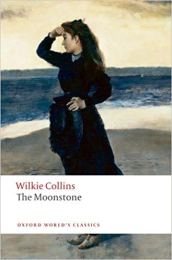 I have yet to get tired of teaching The Moonstone, which has been a staple of the detective class since I introduced it to our curriculum in 2003 and also an occasional offering in the Dickens-to-Hardy class. At this point I actually think I know it better than any other text I teach, with the exception of Middlemarch. What this means in practice is that I feel very relaxed during class discussion: though I do have a pretty clear agenda overall, I don’t need a careful script to make sure I don’t miss any aspects of it the way I do with books I’m still learning my way around. Today was Miss Clack Day, which is one of my favorites days. Here are two of the quotations I brought in to use as starting points:
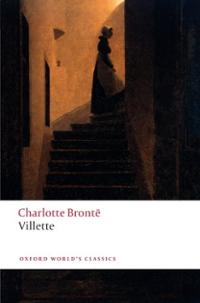 On quitting Bretton, which I did a few weeks after Paulina’s departure — little thinking then I was never again to visit it; never more to tread its calm old streets — I betook myself home, having been absent six months. It will be conjectured that I was of course glad to return to the bosom of my kindred. Well! the amiable conjecture does no harm, and may therefore be safely left uncontradicted. Far from saying nay, indeed, I will permit the reader to picture me, for the next eight years, as a bark slumbering through halcyon weather, in a harbour still as glass — the steersman stretched on the little deck, his face up to heaven, his eyes closed: buried, if you will, in a long prayer. A great many women and girls are supposed to pass their lives something in that fashion; why not I with the rest?
 Welcome back to another season of “
 I started teaching at Dalhousie in 1995-96, which means that 2014-15 will be my twentieth academic year at the university. What with maternity leaves and sabbaticals, that doesn’t mean 40 consecutive terms (though for many years I did also do summer teaching), but that’s still a long time to be in one place doing the same thing.
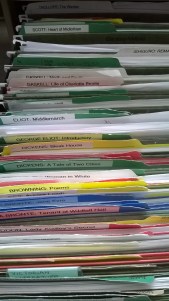 The other thing I have to show for my twenty years — something I benefit from every day I’m at work — is experience! It’s easy to forget, now, how new to all this I was in 1995-96. I was hired while still “ABD” (all but dissertation), and my hands-on teaching experience was limited to two of Cornell’s Freshman Writing Seminars (both capped — ah, luxury — at 17 students) and one stint as a TA (in a 19thC fiction class, too, because there were no first year writing classes big enough to use teaching assistants). The class on Browning’s “My Last Duchess” that I taught as part of my on-campus interview here was quite literally the first time I’d ever stood up in front of a room full of students (not to mention a back row of professors there to see how I did). So my first full-time term was really jumping into the deep end for me. I don’t recall any massive screw-ups beyond assigning way too much reading in my first section of Introduction to Literature and way too much writing in almost every class, because I had no idea how much time it would take to mark multiple papers for a class of 50 or 60. I had the time at first: I was keen to throw myself into a job I was excited about and knew I was lucky to have, and at first I had no children, either. But the hours and hours of marking … on top of having no files of teaching notes or materials to draw on, so absolutely every part of absolutely every class had to be prepared entirely from scratch. Good thing I was so young and energetic! (I was 28 when I came here, which means I was barely older than the first crop of graduate students I taught — in fact, now that I think back, I was actually younger than some of them.)
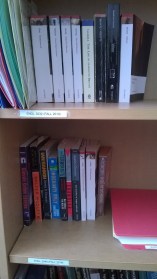 Another very simple thing I do is designate one shelf space for each course. Often coming back from class is a distracting time, with students tagging along for conferences or somewhere else to get to in a hurry, so I don’t have time to do fine sorting. Instead, I dump all the class material onto its shelf and organize it when I get my next chance — but in the meantime if I need to find a book or paper from it, my search is neatly delimited. Again, less scrambling! I have a pretty low tolerance for stress and confusion, so for me it’s well worth the little bit of forethought required. When I see offices with indistinguishable brown folders piled in heaps all over the place, I know that — while it must work for the office’s own occupant — I would be a nervous wreck by the end of a single day in there.

