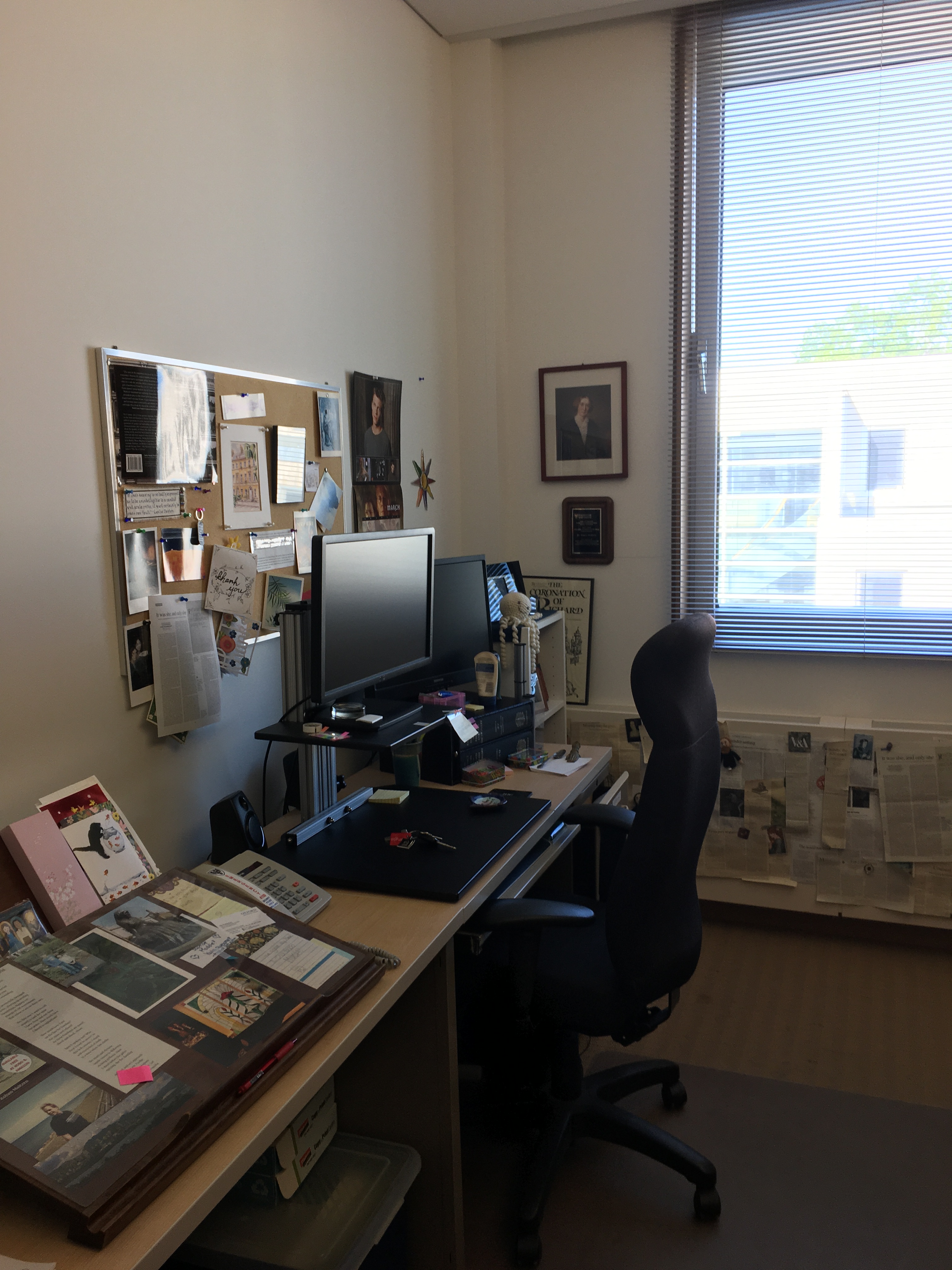
 I’m in the little lull between the end of routine class work and the arrival of final essays and exams. Pre-COVID, this was a time for two ritual activities: cleaning my office and going Christmas shopping. Since I’m still working almost entirely at home, the first of these is mostly, if not entirely, beside the point: my current workspace, set up in what was once my son’s bedroom (and still furnished for that purpose, including his 20-year-old mate’s bed), could use a bit of tidying, but because online teaching means there’s a lot less physical debris from the term’s work, it’s not particularly chaotic. I’ll take the teaching-related books and folders to campus for storage when my courses are well and truly wrapped up – and bring home more books related to my sabbatical projects – but there won’t be any major housekeeping to do here until I return to working full-time there.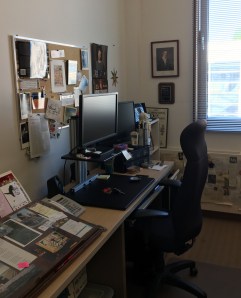
As for Christmas shopping, I’ve done a very little bit in person, in quiet local shops, and some online, but I’m not comfortable going back to the mall yet. I’m actually sad about that: I know a lot of people abhor malls, but I enjoy their cheerfully hectic impersonality. In the before times, I often headed out to the Halifax Shopping Center, ostensibly to do an errand or two, but also to get a little break from the relative isolation of my typical weekends. Much as I cherish quiet ‘alone time,’ sometimes it is (was) also good to be surrounded by the buzz of other people – people who have no expectations of and are placing no demands on me. A leisurely browse in Coles, a bemused poke around in Sephora, feeling old while idly rifling through the racks at H&M: honestly, I miss it, but not enough to do it while masked (and so overheated) and anxious about distancing, especially not now with an outbreak making our case counts spike and omicron on the rampage across the globe.
 So what have I been doing instead of cleaning and shopping? Honestly, I’m not entirely sure where the “extra” time has gone. One factor, I think, is that online teaching actually doesn’t end neatly the way in-person classes do, or at least my classes haven’t: there has been a fair amount of tidying-up stuff to do, especially record-keeping and wrangling problems of one kind or another. One thing I suppose I didn’t have to do but considered worthwhile was an audit of students’ course bundles for English 1015 (where I am, again, using specifications grading). I would have had to do this eventually to determine their grades, but doing it now has given me a chance to identify a few students who, for whatever reason, were just one component short of a particular bundle, and then to see if there was a bonus exercise they hadn’t already completed that they could do to make it up, rather than ending up with a lower grade for lack of, say, a single discussion post. Of course the students themselves were supposed to be tracking their completed components, but I know that for some of them this was an unfamiliar and/or difficult expectation to meet: there were a lot of moving parts. One thing I like about specifications grading is that you can plug holes in this way, without creating different rules or requirements for different students (which I am always really reluctant to do). Overall, this process went much better this year than last year, when I ended up revising the bundles because so many students had (much to my mystification!) completed such a random assortment of components that an awful lot of them could not have passed the course at all if I hadn’t. I think my new slide presentation using a shopping metaphor to explain how specifications grading works really helped!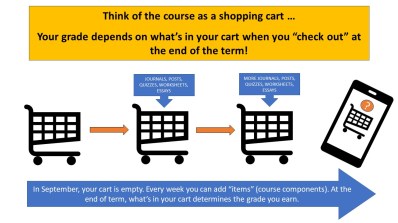
I have also been preparing my final exams, including not just making up the questions but building them in Brightspace, a boringly complicated process with many opportunities to set a switch wrong and create problems, for them or for me. I have now ‘previewed’ and reviewed the settings for both exams multiple times! I also wrote up detailed announcements with information and instructions for the students about everything from the timing of the exam to where to get technical support while writing it. One of the most stressful things about online teaching turns out to be the pressure of putting absolutely everything in writing! Say the wrong thing, put the wrong date, explain something with inadequate clarity – or in too much detail – and there’s endless follow-up work to clean up the mess. There are definitely advantages, of course, over making announcements in person, exactly because the information is there, in writing, available 24/7. I think that weekly Brightspace announcements may be one of the elements of online teaching that I carry over into my in-person classes when I return to them next fall.
 Next fall! Yes, because much to my immense relief and gratitude I am on sabbatical this winter term. This means – although nothing seems absolutely certain about the future anymore – that this term may have been my last term of online teaching. Please let that be true! This is not to say that I’ve hated everything about it. There are some aspects of it I have grown to like, and others that I have learned the value of, whether I like them or not. I will probably never give an in-person quiz or exam again: the simplicity of arranging make-up tests is a gift, for one thing, and especially valuable as we are likely (I hope and expect) to be much more aware from now on of the importance of letting students stay home when they are sick. I also like online reading journals: I had used them in the past as a way of encouraging students to keep up with the reading and getting them to practice expressing ideas about it with low stakes, but then ‘upgrades’ to our LMS took away the journal function I had used and I gave it up. Now that I know how to set up one-on-one discussion boards in Brightspace, I can see keeping up some version of these, especially because Brightspace makes it pretty easy to keep the records.
 What else has been good about online teaching? Well, while I still greatly prefer the energy, intellectual stimulation, and good cheer of class discussions, I have been impressed at the level of commentary on the discussion boards, especially, this term, in my 19th-century fiction class. I was frustrated all term at how much of it went on at the very end of each module, which meant only rarely was there substantial back-and-forth among the students, but that logistical griping tended to subside when I read through the posts that had come in. I am certain that I “heard” from more students this way than I would have in the classroom: I have pretty good participation rates, and I work hard to make space for students who are shy or just slower to know what they want to say (by, for instance, requiring everyone to put their hand up and wait to be called on), but even so it is typically a minority of students present who actually contribute. As was much discussed last year, when so many of us were new to online teaching, discussion boards proved to be fraught requirements, mostly because their demands felt really burdensome to students – particularly, perhaps, those who were used to coasting a bit by showing up to class and just listening, without (in some cases, not all, of course) doing the reading. The past 18 months of trial and error around online forums has given me a lot to think about in terms of how or whether I will build them into in-person classes.
I haven’t thought through yet how or whether I will incorporate recorded lectures into in-person courses. Happily, my sabbatical buys me time to brood about that! I am teaching English 1015 in person for the first time in Fall 2022; it is the first course I have designed from the start as an online offering, so it’s the one that will require the most reconsideration as with my other courses I can revert pretty easily to my old ways if I want to. For the upper-level courses I’ve created online versions of, my aim was to use the recorded lectures to replace my “front of room” work: some straight lecturing of the “here are the facts, here are the frameworks” kind, but then prompts for discussion, ideas to think through, and passages to focus on, with the work of talking these things through handled through the forums. They were never, that is, designed to give the whole story about our readings, which is also not a goal of mine in the classroom. If I’m (we’re) back in the classroom engaging in these conversations together, I am not sure there’s much point in laboring over slide shows even as supplements, and I would welcome the freedom to follow discussions where the students take them, too, rather than steering students down pre-ordained PowerPoint paths. That said, I have thought and learned a lot about accessibility since COVID struck – more than I ever had before, to my shame.
 The single thing I have missed the most in my online classes has been laughter. You can do a lot of things asynchronously, and honestly I’m proud of the courses I offered. But asynchronicity is incompatible with spontaneity, which in turn is essential to the kind of fun we so often have in my classroom. The two best qualities I have as a teacher, according to generations of students, are that I am very organized and that I am very enthusiastic. The former has definitely helped me as an online professor: I feel confident that my students always knew exactly what was happening in every module; they knew exactly what was expected of them, and they could count on me to have prepared what they needed for it. I tried hard to convey my enthusiasm, through the tone of my announcements and lectures and through my own participation in the online discussions. I also tried to give some idea of my sense of humor in my slides, replacing what one student fondly (?) called my “demented stick figures” drawn on the whiteboard with the finest graphic design PowerPoint makes possible.

I know, because they have been generous enough to tell me, that some of my students over the past three terms have felt engaged and connected and motivated by my online teaching, and I’m proud of that! I am definitely eager, though, to be back working with students in person. I think none of us will ever take that experience for granted again.
 I fell out of the habit of writing teaching posts last year, partly because I was doing so much else on my computer that blogging about it felt like a bridge too far, but also, and more so, because of the flattening effect of teaching asynchronously, as I discussed in
  Last year we were pretty much all online, in my department and across the university. This year, almost everybody else is back to teaching in person. Early in the planning process I had committed to doing my first-year course online. One reason was that it was such a big job planning and building it that I wanted to get more return on that investment. But it was also was the course that I least missed teaching in person. If our first-year classes were smaller, I might have felt differently, but teaching 120 students in a big auditorium, wearing a microphone, relying on PowerPoint, and knowing (and sometimes seeing) perfectly well that a lot of students in the room are only there because someone told them they had to be – that’s not a great experience, to be honest. I have always considered first-year teaching really important and I love engaging with the students who get excited about the material and the work – the ones who really show up for class (not just physically in class). It is especially gratifying when students taking intro primarily for their writing requirement discover a passion for analyzing literature and come back for more. Sometimes they even change their majors! But I don’t think lecture classes of 120 or more (however diligently you try to make them interactive, as of course I have always tried to do) are the right way to teach either literature or writing, and the crowd control aspects of it are always particularly disheartening. I also thought my online course went pretty well, all things considered. So why not do it that way again?
 The harder question, as we headed into the summer, was what to do about 19th-Century Fiction. These courses are my absolute favorites to teach, and I did really miss the energy of in-class discussions last year, even though I thought the online version went quite well (again, all things considered). Offering this year’s version in-person seemed reasonable, even likely, back when our second dose dates got moved up and it looked like widespread vaccination was going to turn everything around. Then came Delta, and with it a lot of renewed confusion and uncertainty about what an in-person fall term would actually be like, along with slower than ideal vaccination uptake among the main student demographics. I remembered only too well how much work it was creating the materials for last year’s Dickens to Hardy course online and I knew I would not be able to do a good job on Austen to Dickens (there’s no overlap in the readings) if I put off the decision to the last minute, so I set August 1 as my deadline to make the call, and when things still looked too precarious for my liking, I committed to moving it online as well and got started right away on setting up the Brightspace site and creating materials.
 A couple of weeks later, Dalhousie did finally implement a vaccination requirement, along with mandatory masking for at least the month of September (neither of which was in place when I made up my mind to go online). I really hope that these measures and a generally high level of diligence help make it a safe and positive term for everyone now back on campus! For myself, though, while I do have regrets (anyone who has followed this blog knows how much I love being in the classroom), I appreciate the clarity of my situation and the continuity I can be sure of providing to my students. I don’t need to have multiple contingency plans – or to lecture masked or to dodge crowds in the hallways, or to work in my overheated office where at the moment I am not allowed to open the window. I do also feel that I am serving a need: there are students who themselves could not get back to Halifax, or who aren’t confident about returning to in-person classes, and I honestly think we should have tried harder to make sure they had more and less haphazard options given the predictable complications of this in-between phase, especially for international students.
 Classes began here yesterday, and the discussion boards in my courses are now filling up with students introducing themselves and checking out how things are going to work. It’s not the same as meeting them face to face, but those of us who are online a lot one way or another know that you can communicate a lot about yourself through virtual interactions, and also that it is possible to create, sustain, and cherish real communities that way. I think the most important things I learned last year, which did involve a lot of trial and error, was that simpler is better and personal is best of all – not personal in the sense of over-sharing personal information, but personal meaning you bring yourself to the work, you show yourself in the work, and treat everybody involved as if they are people too. I’ve been trying to welcome each student individually to the class as they make their introductions: I don’t know if I’ll be able to keep this up as the pace of their contributions increases (there are 150 students all told across my two courses) but I want to make my presence felt from the beginning.
 As for course content, well, the first week of Literature: How It Works focuses on the idea and practice of close reading, with an emphasis on word choices. This is how I always begin my introductory courses, so the only difference is delivery. Across the next few modules we just keep adding things to pay attention to (“stocking our critical toolbox”!) – all the while trying out our ideas through low-stakes writing. I’m using specifications grading again, simplified and clarified (I hope) from last year’s version. In Austen to Dickens we warm up (again, as always) with a bit of background on the history of the novel: nothing fancy, just a rough sketch to give some context for our actual readings. Next week we start on Persuasion. My favorite part of class prep last year was devising slide presentations in which I tried to capture not just the main talking points of what would have been our classroom discussions, but the spirit of them. I actually found – find – this work quite creative! I don’t do anything fancy, but I do try to have a kind of unfolding narrative, illustrated by apt graphics (and sometimes silly graphics, because I miss drawing stupid stick figures on the whiteboard). This year I’m going to be more explicit about the limitations of the lecture components, which are never (in person or online) meant to “cover” everything or answer every question. Last year some students expressed frustration that I raised questions in my lectures but didn’t go on to answer them: realizing that they had this expectation surprised me a bit, because my in-person lectures also can’t possibly answer every question that comes up, but I think the recorded delivery seems like it should maybe be more definitive or complete.
 I miss writing my regular updates about what we’re doing in my classes. Given that I am still teaching, and covering much the same material as usual, I have been puzzling over why it nonetheless feels nearly impossible to talk about it right now–not the process or the logistics of it, which I have written about several times now, but the substance of it. So much is the same, even though we’re online, after all: as I’ve pointed out more than once to my students, we always read the books outside of the classroom, and we always did at least some of our work on them in writing, including sometimes reading journals or discussion boards much like what I’ve asked them to do for the online versions. Why is it that without the actual classroom time, I can’t figure out what to say about the weekly experience of my classes?
 In contrast, our online class discussions, even though we cover the same kinds of topics, are diffuse. Lots of good replies get posted to questions; lots of good comments get made on passages. But these things happen really sporadically, on the students’ own schedules. The earlier someone posts, the more likely another student will specifically reply and so the more conversation-like it feels, but (especially since this term I have relaxed my earlier attempts to micromanage this process) it’s haphazard and unpredictable, and you can never be sure if the original poster will look at the replies or that other students, writing in other threads, will check in to see what is unfolding elsewhere. As a result, there is no common ‘discussion’ for me to write about here: I can’t say “today we focused on X” or “after today’s discussion I realized that the thing I really need to bring up is Y.” Even for me–and of course I’m trying diligently to be as attentive as I can across every thread–it is hard to gather up the various pieces into a story about what, collectively, has gone on. One of my original plans for my own role in online discussions was exactly that: I was going to mostly hover, during the week, and then post something synthesizing the main lines and insights and gaps. It proved much harder than I thought it would, though, and in the spirit of giving myself a break too, I stopped trying.
 The other thing that muddles me up about reporting on ‘this week’ is that most weeks I am actually focused on next week in my classes, as I need to get the lectures composed and recorded, the discussion prompts up (when they are my job), the quizzes made up and created in the tedious quiz tool with its endless drop-down menus — everything needs to be ready to go ahead of time, so that when the module begins they actually can do it at their own pace, as the asynchronous model promises. Again, this is very different from a regular term, in which preparations for lectures, assessments, and activities are often done close to (sometimes too close to!) the specific hour in which I’m going to use them. This lets me shape them to our current discussions, and it keeps me mentally right in the moment. Today, though, as an example of what’s different, for Mystery and Detective Fiction I will be creating a lecture about “Chasing Meaning in The Maltese Falcon,” while my students work through materials on The Murder of Roger Ackroyd – which I completed almost two weeks ago. (Notice I say “for” this class, not “in” this class, and that’s the key to the difference!) For The Victorian ‘Woman Question’ I just made my slides for next week, our last week on The Tenant of Wildfell Hall, and I already made my slides introducing The Mill on the Floss for the week after that. My mind is all over the place, not here, now, in this week.
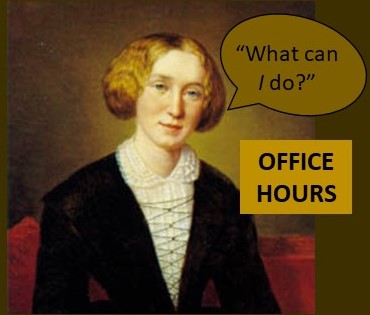
 I will spend two hours this week with my students, if not in my classes: Thursday mornings I meet for an online but real-time discussion with the students who are taking The Victorian ‘Woman Question’ cross-listed as a graduate seminar, talking about the novel and also about some secondary readings. Then Thursday afternoon I’m having a drop-in office hour, which I’m pitching as a chance to ask questions about the courses or just to come and hang out for a while. I floated the idea of having some actual real-time class discussion, but scheduling presented a lot of obstacles and students’ reluctance to be recorded (so as not to disadvantage those who couldn’t attend) also proved, understandably, another disincentive. So we won’t dig into questions about our reading except, perhaps, incidentally, but at least we can see each other’s faces and infuse a little shared time into the otherwise radically dispersed experience of this online semester–hopefully, possibly, maybe our last one. Also, maybe, hopefully, possibly, we’ll get nice enough weather in April, before this term is over, that we can try holding that drop-in office hour somewhere outside, near enough to see each other’s faces if still distant enough not to put each other at risk.


 It hasn’t been all bad, though.
  So what have I learned? In addition to the technical stuff – Brightspace and Panopto and Collaborate, oh my! – I have learned, as a lot of other people have too, that the best advice and methods for online teaching
  That said, I’m still going to ask for online discussions in my winter term courses! Expressing your ideas about what you’ve read in words is the fundamental task and method of literary studies, after all. I lessened the requirements in one of my classes this term, once we started to hear reports of students being overwhelmed, and for next term I have (I think!) made the requirements more streamlined, and also explained better what the terms and expectations are. In retrospect I should perhaps have scaled things back in my first-year course, where I was (still am!) doing my first experiment with specifications grading – but I honestly didn’t expect that so many of them would fix on and stay fixed on fulfilling the most demanding bundle. I expected a much larger number to decide that level of effort was a bit much just to cross off their writing requirement: instead, knowing it was achievable with enough persistence seems to have motivated a significant portion of the class to do a lot of regular writing. They will have worked very hard on a whole range of tasks, so I certainly don’t begrudge them their As, though this is something I will think more about when (if) I do specifications grading again – which will have to be the subject of its own post when the term is really and truly over and I have a more complete sense of whether or how the experiment succeeded or failed.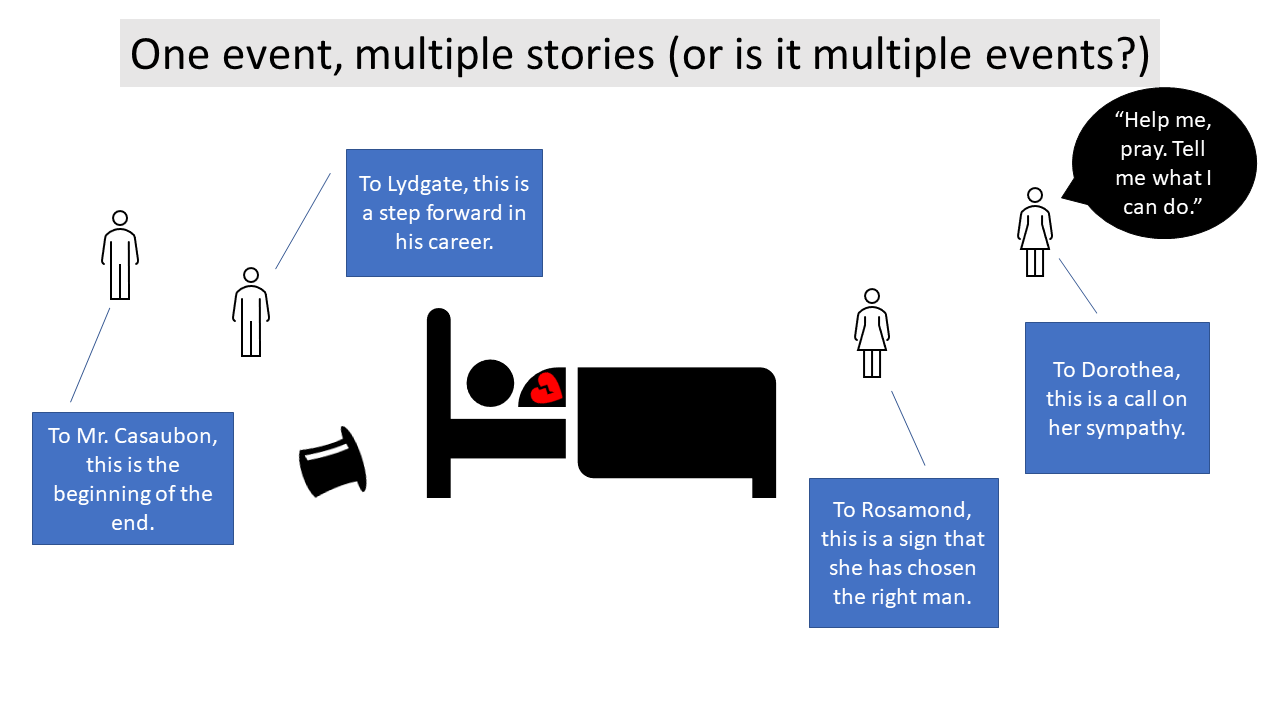
 If you’d asked me on March 13 of this year (the last “regular” day before we were all locked down!) whether I ordinarily spent a lot of time working at my computer, I would have said “Yes!” without hesitation. It turns out, however, that I used to greatly underestimate the amount of time I spent away from my computer–at least, relative to the balance (or, rather, imbalance) between these two options in my pandemic life. While preparing for class always involved at least some time typing up notes and preparing handouts, worksheets, slides, and other materials, for example, going to class meant gathering up actual books and papers and markers–and sometimes
 But here I am now, ready once again to take stock of how things are going in my classes. And the disconcerting truth is that a third of the way through this strange term, I still don’t really know, because I have no base line for comparison, no past experience to check this one against. I’m working pretty incessantly on one teaching task or another, but I get very little feedback compared to the ongoing opportunity, in face-to-face teaching, to “read the room”–which could, of course, be discouraging if you could tell they weren’t with you, but at least there was some immediacy to that input and enough flexibility to the whole operation to let you change things up, on the fly or more deliberately. One of the most disorienting things about online teaching so far, in fact, is the time lapse: because a lot of materials need to be ready ahead of time, I’m usually working on next week’s lectures and handouts while the students are working on this week’s. (Yes, that gets very confusing sometimes!) If I sense that something isn’t clicking this week, it can be pretty hard to figure out where or how to adapt.
 Certainly some parts of this feel easier now than they did at first. The start of term is always chaotic, and this year it was worse than ever before because communicating by writing is just less efficient than talking to people or showing them things directly. (That said, at least when everything is written down there is less chance of details just getting lost or forgotten: the documents are always there for reference! The sheer quantity of written materials becomes its own kind of burden, but there’s still something to be said for having what amounts to a detailed instruction manual for the entire course.) By and large my classes seem to have settled into a rhythm now, though, and as a result the stress has gone down on both sides and the quality of actual work has gone up. It’s clear that the online model is harder for some students who would almost certainly be better off with more external structure and tangible support–but there are also students who find the move away from in-person pressures congenial. At this point I personally feel that, given the option, I would never teach online again: I have not had the transformative experience I’ve heard about from other instructors who ended up wholly converted to this mode of instruction. But it’s early yet, I suppose, and of course right now I don’t have a choice–and in spite of everything, I’m glad about that, as it’s not as if being in the classroom under current circumstances would be a return to the kind of work I loved. I’m also very grateful to have the job security I do, and that, along with my real desire to do the best I can for my students, keeps me pretty motivated and determined to keep trying to do this as well as I can.
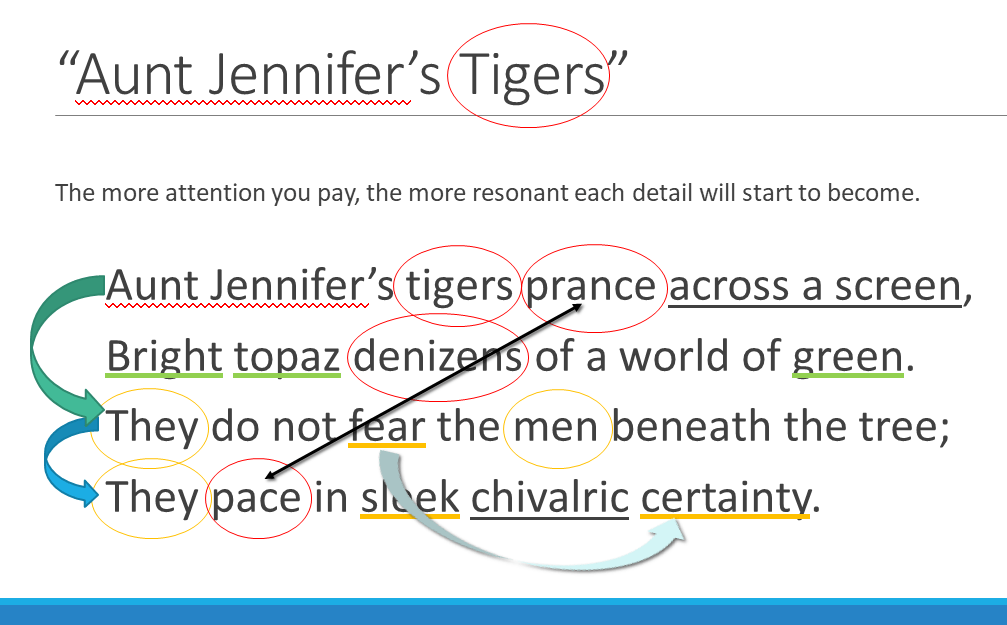
 The best thing I can say about my courses right now is that I do finally feel as if I am paying more attention to content than to logistics–which means that when I post about them, I might start talking more about what we’re actually studying in them, like I used to! A trial run: In my intro class (“Literature: How It Works” – a dull title but a pragmatic focus that actually suits my usual approach to first-year classes) we are wrapping up our work on poetry. This week students get to choose a ‘cluster’ of related poems to discuss, hopefully showing off what they have learned about literary devices and poetic form and interpretation so far; then next week we will turn our attention to short stories. I expect a lot of them will like that change of focus; I just hope I can coach them to keep paying attention to details and form and not relax into plot summary.
 In 19th-Century Fiction we start Middlemarch this week! I, at least, am very excited about this! (Honestly, though: isn’t the cover of the new OWC edition dreadful? They could hardly have made the novel look less fun and inviting. Dorothea is supposed to be blooming, not gloomy!) Rereading the novel and working on my slide presentations to launch our discussions of it has been pretty fun, and also very intellectually challenging, because I have had to make a lot of decisions about how to package the concepts and examples and approaches I would usually lay out over the first few class meetings. While I would certainly do some lecturing in a face-to-face course, I always prefer to draw students towards ideas about how the novel works and what it means through discussion, using a lot of open-ended questions and brainstorming on the white board (where I draw lots of what one of my students [hi, Bea!] recently described as “demented stick figures” 😊). This is hard to reproduce asynchronously!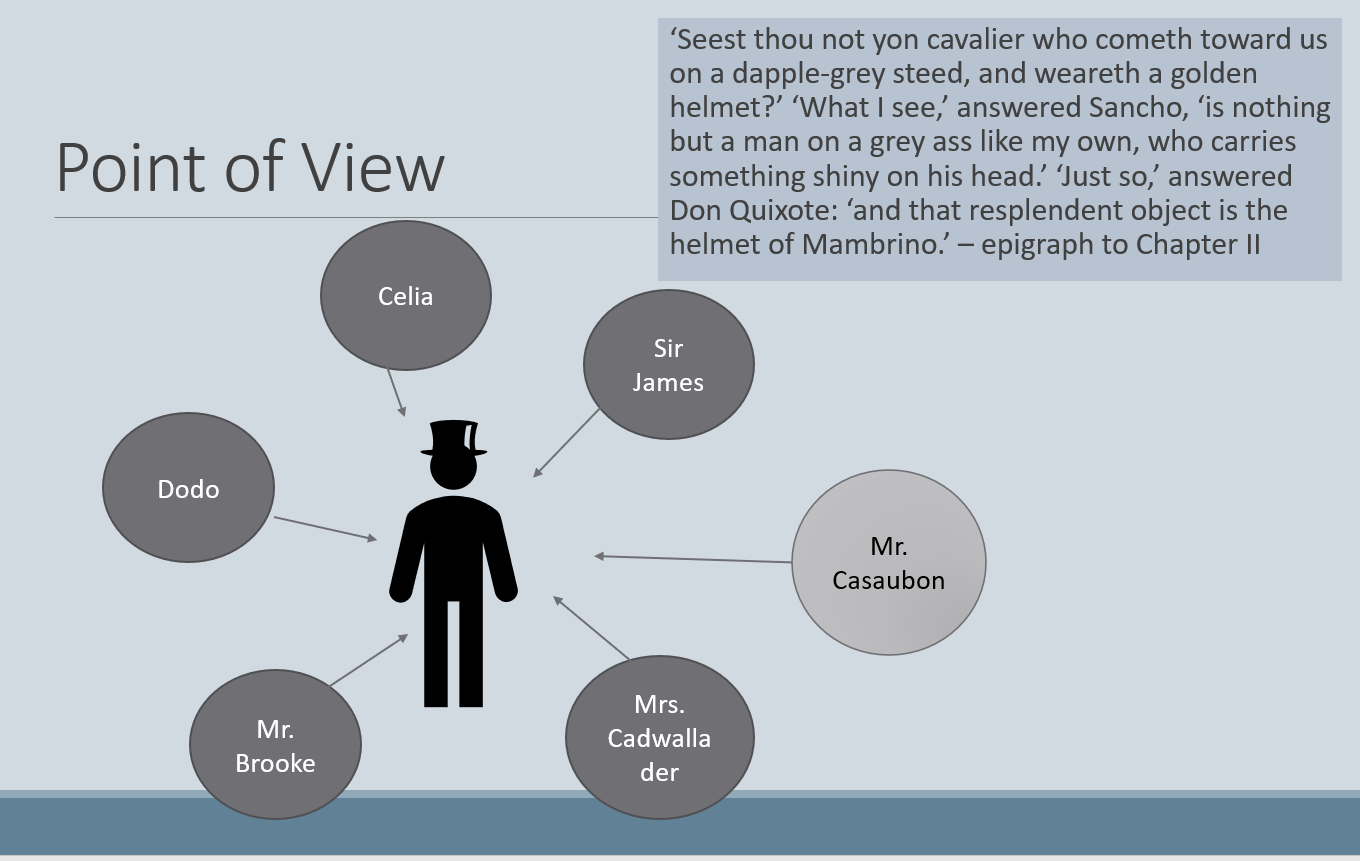
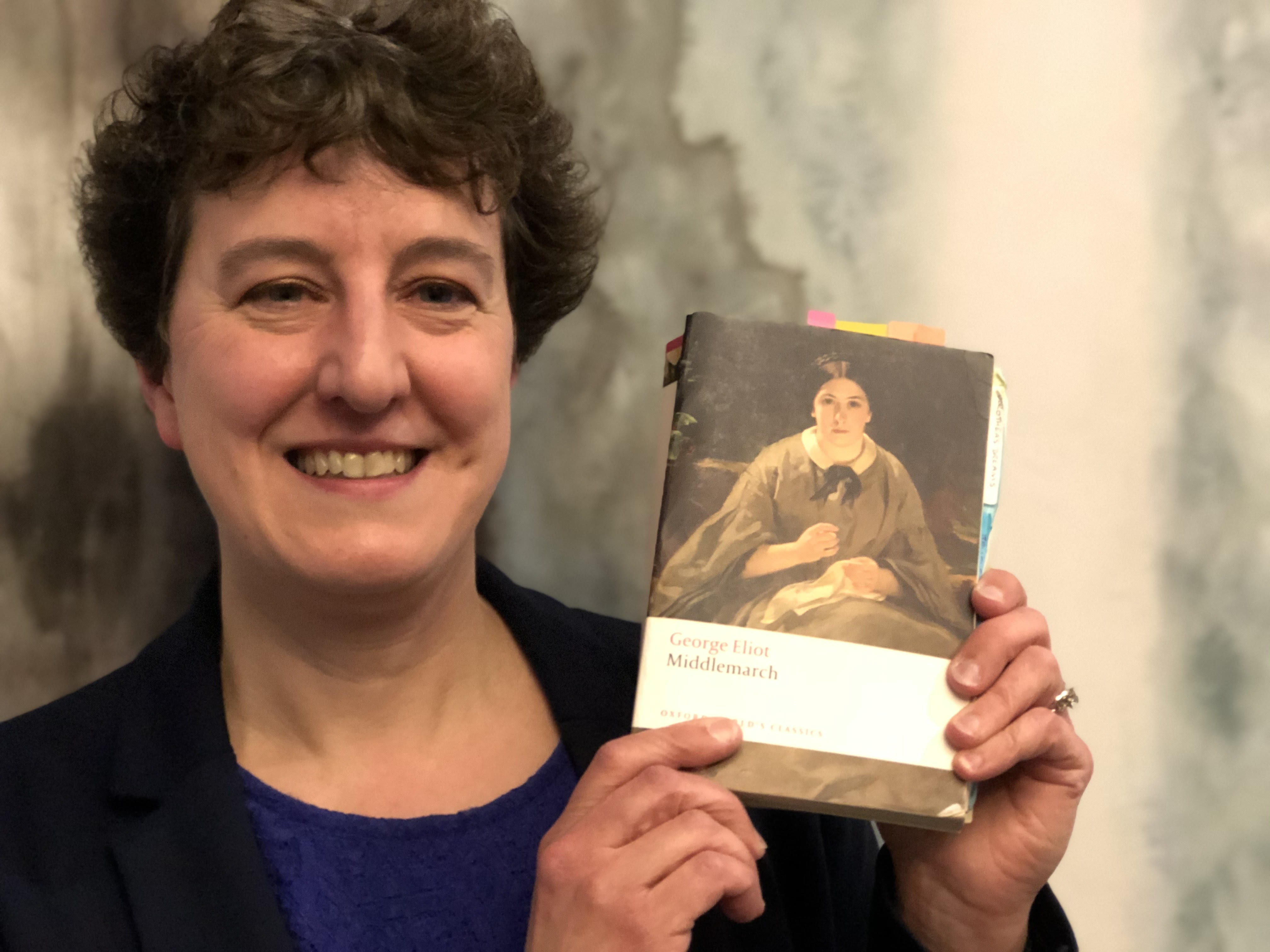 I do expect a bit of stuttering as we get going on Middlemarch: my experience of teaching it in the classroom, where I can play ‘cheerleader-in-chief,’ has been that even with me absolutely radiating enthusiasm for it, it can be a hard sell at first, and though I am trying to be as enthusiastic as I can this time too, I have to communicate so much more indirectly that I can’t be sure it will come across, much less be contagious! The stumbling block is usually the amount of exposition, which requires a different kind of attention and patience and can muffle, on a first reading, the sharpness and comedy of the dialogue as well as of the narrator herself. I’m also often surprised by how little students like Dorothea: is idealism so out of fashion these days? But there are always some students who love the book, at first or eventually, and of course my job is not to make them like our readings but to help them learn about them.
 It has been two weeks since my last post. That sounds almost confessional: forgive me, gentle readers; it has been fourteen days since
 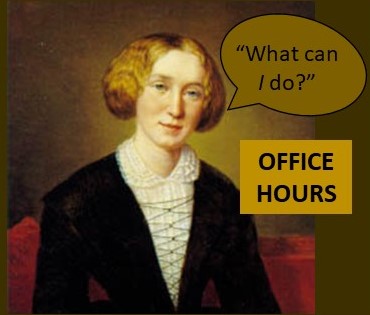 I think my overwhelming impression at this point (and it may get better as we all get more and more used to doing things this way) is that I am spending a lot more time managing logistics and a lot less time engaging robustly with my classes about our readings. I can understand how online structures of the sort we were encouraged to develop would work pretty well for more mechanical subjects, and I think, too, that there is some good cross-talk going on between the students that does accomplish some of the goals of classroom time. That I feel a bit left out does not mean it isn’t valuable: this is what the experts mean, I guess, when they tell us online teaching “decenters” the teacher. But I don’t think I have so far found the strategy that makes an asynchronous course feel like what a face to face class (at its best) feels like. I don’t see where the energy comes from this way: even if I admit that the best classroom discussion doesn’t actually generate that energy for everyone, it still does it for some of us, and I just really miss that.
 I expressed cautious optimism when the term began and I do still feel some of that, even if at times over the past couple of weeks it has been challenged by fatigue and frustration and sadness. The students are there and most of them are really trying; in my turn, I am doing my level best to demonstrate “instructor presence” and make them feel that I care and am paying attention, not just tracking submissions. I’ve already made a few adjustments to the requirements, too, to reflect what we are all learning about how long all of this takes. Also, although preparing recorded segments is not my favorite thing to do, I find devising topics and shaping them into what seem (to me at least) like engaging little packages intellectually stimulating and even fun sometimes.
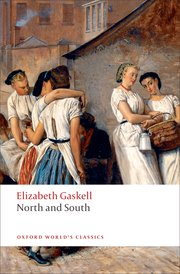
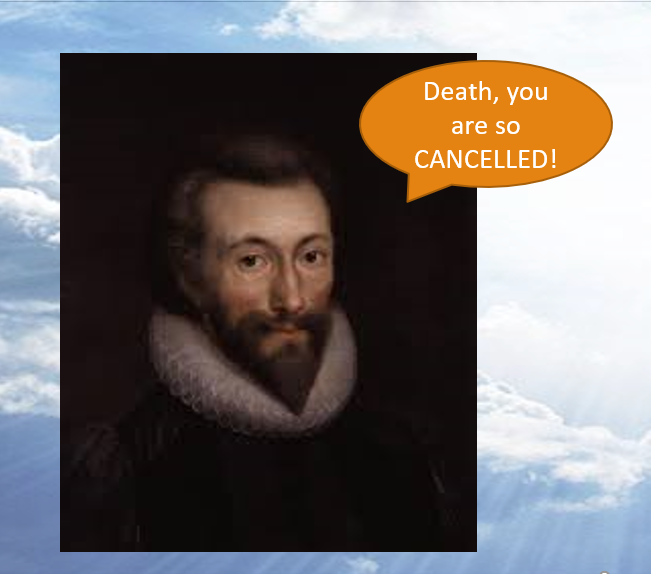
  The readings, too, are as good as they always are, and when I have time to linger over them, that really boosts my morale. I reread the first half of North and South this week (a bit hastily, but still all through) and got excited about the many ways it provokes comparisons with Hard Times, which we are just wrapping up. And in my intro class we are doing Woolf’s “The Death of the Moth,” which was also a tonic to revisit. It’s so beautiful and so sad and so oddly uplifting, in its contemplation of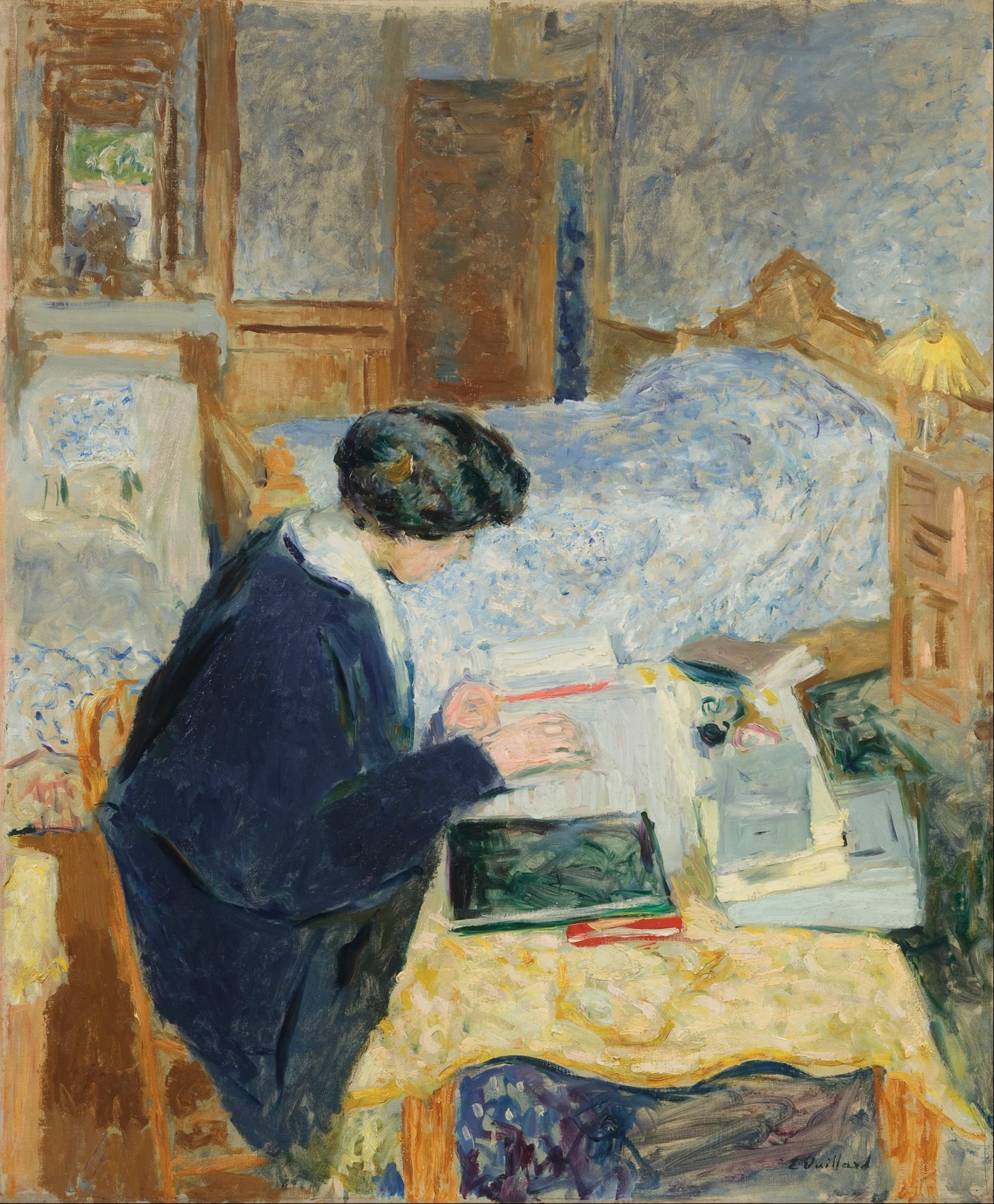
 Then, instead of having three distinct conversations about the reading on three separate days (which, again, has always allowed me to pace us, and to model sorting out specific interpretive elements rather than facing everything that’s going on in the novel all at once), we’ll have discussion boards. Presumably, the topics will reflect the same questions I usually set in class, but I’m not sure if I should try to move us through these topics in some kind of sequence across the week, as I would in person, or think of the module as weighted towards reading at the beginning of the week and discussion at the end of the week. Probably the latter–though they might miss getting input and ideas from each other (and from me) earlier in their reading. I don’t want to be micromanaging participation on the discussion boards too much: I’m imagining how strange this all might feel to them, and ideally I’d like it to feel both easy and sort of natural to contribute. Super-rigid requirements (post once by Wednesday, reply once on Thursday, post again on Friday–whatever) really work against that and give me a lot to keep track of.
 I think the next step for me is actually to back away from the overwhelming amount of information and advice I’ve been contemplating about online teaching and go back to my actual teaching notes. Looking at the topics I usually cover with a modular redesign in mind will probably help me realize ways in which these bundles would actually work and think in more concrete ways about just how different the online experience needs or doesn’t need to be. Precisely because I’ve been teaching 19th-century fiction in such a similar way for so long, it is the one that feels the strangest to mess with, but it’s also the one where I have the simplest overall goal–to have the best conversations we can about our readings–and the most faith in the books themselves to get us talking, one way or another. Even if I don’t get everything right on my first attempt to do all this online, at least we’ll still be working our way through Middlemarch!
 Novel Readings