Sjöwall and Wahlöö, The Terrorists

I’ve just finished reading three more of the Martin Beck books by Maj Sjöwall and Per Wahlöö: The Abominable Man, Cop Killer, and The Terrorists, which are, respectively, numbers 7, 9, and 10 in the series. There are now only two I haven’t read (The Man on the Balcony and The Locked Room)–not by design but because they haven’t turned up in the library or at any of the used bookstores I haunt. I think that the eight I’ve read have given me a very good idea of the series as a whole, and my interest in and respect for what Sjöwall and Wahlöö do in it has only increased as I’ve read along. By the end of the final book the scope and intensity of their critique of contemporary Swedish society has finally become explicit. It is even, finally, articulated at length, rather than gestured at through repeated jabs by the characters and in the narration or through the accumulating examples of incompetence, hypocrisy, and stupidity we got in book after book. It’s interesting that it’s a relatively peripheral character who finally voices the most sustained piece of social criticism in the series. It is carefully prepared for, in The Terrorists, by the juxtaposition of an “actual” terrorist cell that engineers two political assassinations (one of which is ultimately unsuccessful) with a very different kind of attack by someone who, as her lawyer argues, may have committed murder but is best understood as a victim. The terrorists’ attacks are not glorified: in fact, we get a rare close-up of brutality from one of the main characters when two of them are finally cornered (I’m trying to avoid really explicit spoilers, as it is quite a suspenseful story!):

He felt the hatred welling up inside him, a wild, uncontrollable hatred against these people who killed for money without caring who they killed and why. . . . [he] proceeded to smash his opponent’s face and chest repeatedly against the wall. On the last two occasions, [the man] was already unconscious, his clothes soaked with blood, but [he] kept his grip and raised the large limp body, ready to strike again.

“That’s enough now,” says Martin Beck, but there’s no sign that anyone, including Beck, is surprised or moved in any way by the violence shown. In contrast, the alt-assassin is treated sympathetically–during her initial interrogation (which even seems the wrong term to use) Beck offers her food, proposes that they resume after she’s had a rest, and generally gives her every consideration. There’s no question that her action is political, in the broadest sense of the word. She aims (pun intended!) at the head of a state that has shown her only indifference or hostility through its pervasive but ineffective bureaucracies. Nobody in particular has done her any harm: the problems and injustices she faces are systemic. What recourse does one individual have, in such a situation?  “She realized,” her lawyer explains, “that someone must bear the responsibility”–and so she has acted, with a slightly pathetic naïveté. ‘It does seem a bit pointless,” one policeman remarks; “They’ll find another one just like him inside half an hour.”  But her lawyer suggests, that “she is wiser and more right-thinking than most of us.” It’s almost a call to revolution, except that it’s so carefully embedded within the particularities of the case and of the wind-bag lawyer that its risk is contained. Still, it’s out there, as an idea, and the direction of our sympathies towards someone who has basically turned political terrorist because of the repeated small ways she has, in her own private life, been terrorized, is consistent with the overall message of the series that violence generates violence, and that we should not be too quick to equate legality with justice.

There is quite a lot of violence in The Terrorists, some of it quite gruesome. The tone is never sensational, though, only dispiritedly matter-of-fact, even when a head decapitated by an explosion strikes an officer in the chest. The grim potential of these moments is also leavened by Sjöwall and Wahlöö’s characteristic dry humor, which perfectly conveys the attitude of rueful stoicism shown by most of the police officers. The one who is struck in the chest, for instance, is immediately upset about his nice suit. Later the head of a decapitated dog is displayed as evidence and the annoyingly smarmy and incompetent Superintendent, Stig Malm, “at once threw up on the floor,” a moment which gave me more gratification than it probably should have because his bad police work has cost a lot of lives across the series. The cynicism that drives the series is also on full display, as when the proceedings against the apprehended terrorists are described as “among the most farcical that had even been enacted in any Stockholm courtroom.” If we had any lingering idealism about the system that has failed the first accused assassin, it’s dispelled here. After the case and the evidence against the men has been presented, we get this:

“I oppose the arraignment,” said the defense counsel.

“Why?” asked the judge, a flash of genuine surprise in his voice.

The defense counsel sat in silence for a moment, then said, “I don’t really know.”

With this brilliant remark, the proceedings collapsed…

We end the book, and the series, on an ambivalent note. On the one hand, we settle down for a pleasant evening with four of our main characters,

just the kind of evening everyone hopes for more of.  When everyone is relaxed and in tune with themselves and the world around them. When everyone has eaten and drunk well and knows they are free the next day, as long as nothing too special or horrible or unexpected happens.

If by “everyone” we mean a very small group of humankind.

Four people, to be exact.

The restoration of order and domestic harmony promised by the form of the detective novel is offered but promptly rejected or subverted. Even if that harmony is achieved, it is only for the fortunate few, and even they enjoy it only precariously, only until it is broken once again. In the Martin Beck books, such happy moments actually happen often, but it seems to be a law that the more comfortable you are with your aquavit and your book, or your lover, the more likely it is that the phone will ring and pull you back into the corrupt world. What hope does one individual have against all the wrongs, all the injustices, all the stupidity? The one person who has taken a stand in this book has been labelled insane and locked away, destroyed, not helped. Martin Beck’s long-time partner, Lennart Kollberg, offers his friend some consoling perspective: “Violence has rushed like an avalanche throughout the whole of the Western world over the last ten years. You can’t stop or steer that avalanche on your own. It just increases. That’s not your fault.” “Isn’t it?” asks Beck. “Kollberg … looked at Martin Beck and said, “The trouble with you, Martin, is just that you’ve got the wrong job. At the wrong time. In the wrong part of the world. In the wrong system.” “Is that all?” Becky drily responds.

The final word of the series goes to Kollberg, and, as has been widely noted, is “Marx.” Certainly there’s plenty of disgust expressed for capitalism, by characters but also through theplots of the  novels and their typical allocation of guilt and innocence. The Terrorists even has a long screed against Christmas, which “had changed from a fine traditional family festival into something that might be called economic cheapjackery or commercial insanity.” The defense lawyer’s statement explicitly condemns the way “large and powerful nations within the capitalist bloc have been ruled by people …  who from a lust for power and financial gain have led their peoples into an abyss of egoism, self-indulgence and a view of life based entirely on materialism and ruthlessness toward their fellow human beings.”

Clearly these are books with a political agenda, and moments like these are didactic, riskily so. I think they are dramatically effective, however, because they are rare, and because the series shows no crusading or utopian zeal. In its world, systems are necessary. Bureaucracies are imperfect but essential. Some good police work is better than none; trying to find a just outcome is better than not trying. Change is slow. Work is hard. Patience is a virtue. Life is bleak, but there are small pleasures, like dinner with friends. Martin Beck has no illusions, but he still shows up every day and does his job. It’s an unimpressive but ultimately quite moving form of moral heroism.

I think I may choose The Terrorists for my class in the fall. Usually when approaching a series I assign the first one, as it often makes most obvious what is going to be different, how this author will bend and reshape the conventions of the genre. That also gets me out of the awkward backstory problem (teaching Gaudy Night, I’m always tempted to [and often do] interject with context from the previous books). But here, though I think all the ones I’ve read are outstanding, and Roseanna would be a really interesting book to read right after studying hard-boiled detective fiction and then Ed McBain, I think this one makes the political work Sjöwall and Wahlöö are doing most evident, and that is something that really does make their series distinct. It shows a conviction (one often echoed by today’s practitioners of the genre, such as Ian Rankin) that the detective novel really be both artistically effective and ideologically significant, and not just as a means for celebrating and protecting the status quo. That doesn’t mean Sjöwall and Wahlöö are necessarily successful or persuasive in every aspect of their project, but I think it will give us a lot to talk about.

ö

Walter Mosley, Devil in a Blue Dress

I was a bit disappointed when I finished reading Devil in a Blue Dress last night. Easy Rawlins is a great character, no doubt, and there are some very interesting aspects of the book. One of them is its post-war context, specifically as felt and explained by Easy himself as a black man who fought in what some saw as a white man’s war, his experiences of tension but also solidarity in the army, his frustrations on returning to an America where despite being a veteran he found himself still an outsider, still vulnerable to the degradation of police harassment and abuse. Mosley manages to make Easy’s social commentary and criticism seem natural to his first-person narration, moments of articulated reflection rather than didactic exposition. Easy’s narration itself is also very interesting, particularly when juxtaposed against the speaking voice he uses in conversation–or speaking voices, I should say, as he shifts deftly between registers to suit his purposes, or to meet or surprise his audience.

What I found less interesting was the book’s take on its adopted genre. The deliberate throw-back to hard-boiled detection has its provocative features, as discussed, for instance, in Daylanne English’s essay “The Modern in the Postmodern: Walter Mosley, Barbara Neely, and the Politics of Contemporary African-American Detective Fiction,” which I read after finishing the book. English disputes other critics, who emphasize the difference it makes that Mosley’s hard-boiled private eye is black, and instead argues for the significance of the similarities between Mosley and his predecessors: “Mosley’s…return to a quintessentially modern and quintessentially cynical genre now is to argue that we have not yet earned the ‘post’ in postmodernity.” That is, if I follow her correctly, Mosley’s close imitation of a form with its origins in a particular moment in the American past, rooted in particular critiques of that moment, is his way of saying not much has changed:

He chooses to return in the 1990s and early 2000s to a genre born of 1930s discontent in order to write novels set in the 1940s-60s, thereby enacting a complex process of literary anachronism that describes and inscribes present-day injustice and discontent.

The familiarity of Easy Rawlins’s situation as a black man in America, even the ready-to-hand recent parallels between real events and things that happen in the series (such as the Rodney King beating) tell us that the past is not as past as we like to imagine–“at least some things are liable to stay the same, across time, for poor and working-class black men in Los Angeles.” I find this a plausible reading of the effect of this ‘literary anachronism,’ though at the same time that seems a potentially ineffective, because fairly oblique, way to offer social critique aimed at present problems. It has to occur to the reader to make the modern-day comparisons–not that they are terribly remote, but there are ways they could be made immediate in the novel itself (for instance, by placing Rawlins’s narrative specifically in the present so that he could incorporate some retrospective comparisons? he is speaking from the future, as he does make some ‘the way things were back then’ remarks, but I don’t think we know exactly when he is telling the story from). Still, this is one of the ways I would probably approach the novel if I taught it, asking not only what difference it makes to the genre of hard-boiled detection when the protagonist is black (as, with Paretsky’s Indemnity Only, we ask what difference it makes when the investigator is a woman), but what it means to recreate not just the style but the period, as Mosley does so well.

But it’s that very close imitation of an earlier form, good as it is, that leaves me reluctant to use the novel. For me, it didn’t seem different enough. It recreates the things that worry and weary me about hard-boiled detective fiction: it portrays a grim, violent world and the violence is quite sensationalized; the men are tough, callous even, and the women are peripheral, victims or (as in the case of the eponymous ‘devil’) vamps. The case itself turns primarily on money and power–and it’s every bit as tangled in its details as its hard-boiled models, meaning by the end I wasn’t even really trying to keep all the deals and double-crosses straight. It didn’t seem to me, either (though I haven’t thought this through all the way yet) that race played a key thematic, rather than contextual, role. Maybe there are other books later in the series that let go of, or interrogate more forcefully, the problematic features of this particular kind of detective novel. I have time to do some more reading and thinking, and I should, as I would like my reading list to represent better the diversity of voices working in the genre. English’s essay makes me think that in addition to more of Mosley’s, I should look up Neely’s books; I also have Gar Haywood and Grace Edwards on my list. Any other suggestions?

“Sheer misery”: Mankell and Scandinavian Noir

Henning Mankell’s most recent (and, as I understand, also his final) Wallander novel, The Troubled Man, is being released in its English translation this week. I’m still enjoying a break from my immersion in Scandinavian crime fiction, though I picked up another of the Martin Beck mysteries during my most recent excursion to Doull’s (The Abominable Man)–now that I’ve decided to assign one for my fall mystery course, I have to figure out which one, so I’ll be back reading them again in a bit. I won’t be rushing out to buy The Troubled Man right away, as I still need to catch up on the rest of the series (I’ve read only Faceless Killers and The Fifth Woman so far). Now that I’ve been thinking more about the characteristics of these books myself, though, the coverage of Mankell’s latest is interesting in itself. I must say that I particularly enjoyed the parodic opening of the review in the Guardian:

The flat, affectless sentences went on. Like rape out of season they stretched to the horizon in grey fields. Wallander found he was in another book. There was no reason for this. There could be no reason except money, but it would take 300 pages for him to work this out. It always did. Later, he would think about this often, but he could not reach any conclusions. Perhaps it was drink. Perhaps it was senility. Perhaps it was just the conventions of a Swedish crime novel. He wondered if any of this mattered.

Another page turned. His daughter rang. She disturbed him. This might be because she was the only human character in the entire book. She tells him he is a self-pitying bore but she loves him anyway. After she has gone he will spend some time looking out of the window and feeling regret while he remembers incidents from other books. Later, she has a baby, but to show she belongs in the book she will refuse to name it for three months. This is a joke that worked better in Doonesbury where the author was aware that people might find it funny.

An old girlfriend turns up. She is dying of cancer. Soon, she will kill herself, although it may have been an accident. Wallander is unhappy for some weeks, and then he decides he will always be unhappy. Life continues.

Spot on! And yet as you know, I have been brought round somewhat by the thoughtful arguments some of you made in response to my criticisms of Faceless Killers, to accept that the surface tedium of this style has its own literary antecedents and justification. (Thanks very much to @Liz_Mc2 for sending me this link via Twitter!)

There’s a longer piece in the Financial Times that is prompted by a recent BBC production, a “Danish-made Copenhagen set” drama called The Killers. The article opens with The Troubled Man (“the first page of the first chapter of Henning Mankell’s … The Troubled Man is sheer misery”) and then moves into a more general inquiry into the current popularity of Scandinavian crime fiction:

Crime fiction has long depended on a sense of dark forces lurking below calm surfaces and it is not unusual for it to have a reformist, critical edge. Critics have pointed to US noir novels and films as an allegory for fears of subversion and communism in the 1940s and 50s. English country-house crime of the Mousetrap genre depended on an assumption that, behind the tennis and the gin, bestial passions waited their time.

But in Scandinavian noir this is frequently married to a revolutionary intent. Most of these writers are militantly left-wing. It is a tradition started by Maj Sjöwall and Per Wahlöö, a couple of Swedish journalists who, between 1965 and 1975 (when Wahlöö died in his late 40s) wrote the 10-novel Martin Beck series. Beck, a Stockholm police inspector who resembles the later Wallander, stoically solves crimes that are often rooted in upper-class chicanery or lower-class desperation.

It’s not obvious why fiction of this kind (novels “from Marxists who write of people beset with misery who either commit or must deal with acts of extreme sadistic violence”) would have any market appeal today. Sex and violence always sell, as some of the interviewees note, and many of the most successful novels (the Stieg Larsson ones especially) are hyper-modern: “the trappings of contemporary technology are much in evidence.” But there’s also the variation these works provide on the consistent preoccupation of crime fiction: the ongoing contest between order and disorder. The Scandinavian countries have long exemplified a certain kind of contemporary social order: “their “model” – one of high taxation funding comprehensive welfare and education, coupled with world-beating corporations – has roused envy and emulation, as have the orderliness of their civic life and the fluency of much of their population in foreign languages.” Such control inevitably (or so the novels persistently suggest) comes at a cost, and has its own dark side:

Rigidity in maintaining surface order, the mark of the Scandinavian social democracies, needs to be breached violently by those who are, ultimately, on the side of order – otherwise it will be breached by the violence of those who would destroy it.

The piece ends with some comments from mystery novelist Joan Smith; I was interested that she describes the Wallander novels as “very old-fashioned,” and points to “Larsson, Arnaldur Indridason in Iceland, Jo Nesbø in Norway” as  doing something much more interesting.”

Maj Sjöwall & Per Wahlöö: The Martin Beck Mysteries

My education in Scandinavian crime fiction continues! After I expressed my doubts about Henning Mankell’s Faceless Killers, I received some very helpful advice in the comments thread. In particular, Litlove suggested the Wallander books participate in a peculiarly European mood of melancholia (about which, she rightly inferred, I am largely ignorant) and a literary tradition of what she, um, invitingly described as “ugly, grinding prose, empty, bleak, futile.” And Dorian, who added the nice term “effaced personality” to our conversation about how Wallander is characterized, noted that Mankell’s series has an important antecedent in the Martin Beck mysteries by Maj Sjöwall and Per Wahlöö. If I had been reading Mankell solely for pleasure, I might not have felt obligated to do the extra work of adjusting my reading framework to take these contexts into account, even though in principle I agree that good reading requires situating the book appropriately. I was reading Mankell in part as a professional, though, so I felt I did need to try a little harder to understand what he was up to–and boy, am I glad I did, not just as a teacher/scholar but as a reader. Three books into the Martin Beck series, I am thoroughly enjoying them, and I’m already feeling as if I will read Mankell much better (more aptly, more appreciatively) when I turn to The Fifth Woman, which is waiting here on my desk.

Why am I liking the Sjöwall and Wahlöö books so much better than Faceless Killers? One likely answer is that I’ve already fine-tuned my expectations, so that the features they share with Mankell’s first Wallander novel are more familiar and comfortable. Among these I would include the bleak (grinding, empty, futile) atmosphere–including both the literal atmosphere of cold, wet, miserable winter (as Jonathan Franzen says in his introduction to The Laughing Policeman, the “weather inevitably sucks”) but also the moral and emotional atmosphere, which is grim in a resigned, routine way. There’s also the one-damn-thing-after-another plotting characteristic of a police procedural, where every lead has to be laboriously pursued, every interview methodically conducted. No snazzy locked-room mysteries, these, no death-by-icicle or orangutang, no brilliant ratiocination leading up to a triumphant revelation scene. In these books, crime is a sordid business, no matter which side of the law you are on. No wonder everyone drinks so much–or tries to (in the Beck books at least, the more you are looking forward to your aquavit, the more likely it is the phone will ring and tear you away from it).

To some extent, I would say too that the prose in the Sjöwall and Wahlöö books has the same somewhat clunky quality I objected to Faceless Killers. Those of us who know no Swedish (I’m guessing that covers all readers of this blog!) can’t know how far this is an effect of translation, of trying to capture the cadence of another language in English. There are some tics in the Beck books that do suggest that there’s something deliberate about it, something purposefully exotic, if you like. One small detail that stands out for me is the recurrent reference to ‘Martin Beck’ where I would expect the surname alone, e.g. “Martin Beck looked disbelievingly at Kollberg,” 200 pages in. That’s just the tiniest little bit jarring, as you read along; it lets you know you aren’t quite on your home turf. But more generally, I found Faceless Killers flat, whereas I am finding the Beck books dry–in a good way. They are almost as tersely declarative, but there’s a momentum to the language that I enjoy, and also there’s a wonderful streak of humor, sometimes sardonic, other times more flat-out comical (as with the two beat cops Kvant and Kristiansson–“Ask a policeman,” they helpfully tell a confused woman who asks them for directions).

I haven’t yet seen quite the scope of social criticism attributed to Sjöwall and Wahlöö in the prefaces provided to my editions–one by Mankell himself, another by Val McDermid, another, as I mentioned, by Franzen. Franzen calls the series “a ten-volume portrait of a corrupt modern society; Mankell says “the authors had a radical purpose in mind … to use crime and criminal investigations as a mirror of Swedish society.” I have seen enough, though, to believe that the critique already apparent accumulates over the remaining seven books–and especially in The Laughing Policeman (with its anti-Vietnam rallies and its complacently self-interested corporate villain) I can anticipate how it might proceed. Mankell writes that the authors never intended “to write crime stories as entertainment” and he points to Ed McBain as an inspiration for them, someone who showed how to use “crime novels to form the framework for stories containing social criticism.” McDermid highlights the difference between the Beck books and the “golden age” procedurals of the 1930s, set in a world in which “a bent cop is almost unthinkable; an incompetent one only a little less so.” I was actually surprised that none of these discussions mentioned the possible influence of hard-boiled detective novels: to be sure, one point of these is that their protagonist is not part of the official law enforcement system, but someone like Sam Spade moves precisely in a world of near-universal corruption (or, sometimes worse, incompetence) which very much includes the police. I mentioned the noir atmosphere of McBain’s Cop Hater, and I think there’s something of the same perspective–though illuminated by the flickering flourescent lights of bureaucracy, rather than the foggy fitfulness of street lights–in these bleak cop novels.

As for the cases, well, I didn’t like the graphic violence and sensational bursts of action in Faceless Killers. Two of the Beck novels I’ve read so far also turn on quite violent crimes, and particularly in Roseanna, the details are unrelentingly specific. Having read McBain’s comments about facing up to violence while still trying not to be “salacious” about it, I can see a similar principle at work in the Beck books, though I think the authors flirt with danger in the way they linger over the details of the sexual crimes and, especially, seem preoccupied with women’s sexual histories, or with women who are “too” sexually assertive or demanding. There are only rare cases of women who are something other than nagging/disappointed wives at home, or ‘whores’ shading into victims: here too, perhaps, some fruitful consideration might be given to the influence of hard-boiled novels, or perhaps this is just another reflection of the hyper-masculine world of the police. The standout exception is the woman police officer who helps entrap Roseanna’s murderer…but she too ultimately must play the vamp and then becomes a victim, only to be rescued. That the belatedness of the rescuers’ arrival is caused by the same kind of stupid screw-ups that typify the world of the novels more generally adds only a little painful irony to an exploitive situation.

These remain first impressions, but I feel like I’m making progress. I’ve talked fairly often about blogging as a way of thinking in public; it’s also, wonderfully, a way of learning in public. Thanks for your help so far–feel free to  keep correcting and supplementing my attempts to come to terms with this material!

Ed McBain, Cop Hater

I took a break from the grim world of cop fiction after Faceless Killers and spent a little time with Rosy Thornton in the Cévennes (I’ll write a little about The Tapestry of Love later, I hope). What a nice interlude that was! But then I got right back on the horse with Ed McBain’s Cop Hater, which I had requested as an exam copy because it seemed a strong contender for the Mystery & Detective Fiction survey. Having read it, I think that was a pretty good call, though I can’t say I enjoyed the McBain any more than I enjoyed the Mankell. (I have also added Sjowall and Wahloo’s Roseanna to my Kobo collection and taken Mankell’s The Fifth Woman out of the library, so I’ll be improving my Mankell skills soon.) Cop Hater does seem to exemplify a certain definition and style of police procedural. McBain’s own introduction notes that his 87th Precinct novels were innovative in making the operations of a squad, rather than an individual detective, their focus; this comment made me think of the Dell Shannon series I remember my parents reading steadily many years ago (and I just this very minute, googling the name, learned that is one of the pseudonyms of novelist Elizabeth Linington). Her Luis Mendoza series premiered in 1960, so a few years after McBain published Cop Hater (1956).

I’d read only some 87th Precinct stories before; Cop Hater is my first full-length McBain. I imagine these books, too, get better as the writer becomes more sure of his territory and characters. I found this one a bit cheesy at times, with coy little writing tricks for effect, especially at the ends of chapters:

There was only one thing the investigators could bank on.

The heat.

Some of the writing is much better than this, though; McBain effectively conjures up the sights and, especially, the smells, of urban life in a heat wave:

The smell inside a tenement is the smell of life.

It is the smell of every function of life, the sweating, the cooking, the elimination, the breeding. It is all these smells, and they are wedded into one gigantic smell which hits the nostrils the moment you enter the downstairs doorway. For the smell has been inside the building for decades. It has seeped through the floorboards and permeated the walls. It clings to the banister and the linoleum-covered steps. It crouches in corners and it hovers about the naked light bulbs on each landing. The smell is always there, day and night. It is the stench of living, and it never sees the light of day, and it never sees the crisp brittleness of starlight.

McBain (not knowing, perhaps, quite how his own new subgenre should sound or would develop) sometimes seems to be aiming for a noir-ish atmosphere, and striving for the verbal panache of his hard-boiled predecessors. The results are occasionally awful: “He shook his head sadly, a man trapped in the labial folds of a society structure.” In fact, Cop Hater is most hard-boiled in its claustrophobic masculinity, in its unease with and about women (“trapped in the labial folds” indeed!), in the voyeuristic gaze it directs on all of its female characters, and especially in the femme fatale who turns out to behind the cop killings. I don’t really know what to do about Carella’s girlfriend being deaf and mute: on the one hand, there’s something fitting about that being the novel’s ideal woman, but then, she acts courageously and saves Carella’s life in the novel’s thrilling denouement, which is a refreshing change in a novel in which the women (including her) seem to spend all their time in stuffy apartments just waiting for their men to come home. As our villainess says, “What kind of life is that for a woman?” But I don’t see any room here for seeing, much less adopting, her point of view (despite her hopes, even the men on the jury don’t like her enough to save her), while in The Maltese Falcon Brigid is (arguably) not really worse than anyone else.

What seems really different about Cop Hater compared to earlier detective novels is its attention to the specific procedures of the police investigation, even including reproductions of gun licenses and rap sheets, but also detailed explanations of forensic measures (such as fingerprinting) and lab work. These features, along with the spread of the novel’s attention across several detectives (though Carella is clearly the main character) help us see the police as a system, as part of a bureaucratic organization operating within a network of other supporting (or, sometimes, hindering) systems. The case is not solved by the ingenuity of Poirot or the ratiocination of Dupin or Holmes but by the persistence of men who just keep looking and asking until they find something out.

The other thing that I found striking about Cop Hater is how completely unglamorous it is (setting aside the lacy lingerie bits). There are some quotations from McBain at the end including this one about violence in his books:

I am unflinching about the violence…If someone is getting killed, that person is getting killed and you know it, and it hurts, and it results in a torn body lying on the sidewalk. It’s not pretty…it’s horrible. But there’s a way of doing violence that’s salacious. And that’s wrong…I have never, ever, ever in my books tried to make violence appealing. I’ve made it frightening and I’ve made it ugly, but never appealing.

I respect that, and though the lead-up to violence in Cop Hater is almost always manipulatively suspenseful, the violence itself is as he describes it: blunt, horrible, not appealing. I’d like to discuss his dead bodies with my class in comparison to Roger Ackroyd’s bloodless corpse. And I think Cop Hater would make a good stop in between Hammett or Chandler and Paretsky, and not just because of the timing (right now my book list jumps pretty much right from 1930 to 1982). Perhaps it would also be a good step on the way to a later example of the police procedural–not an alternative to Rankin or Mankell, but a supplement. I think the students would probably like it: it’s short, it moves fast…but it’s also $21, which seems a lot for an edition that seems to be just a reproduction of an earlier version but on larger pages (there are oddly wide margins, especially at the top). I think there is also a page out of order: near the beginning of the book is a title page for Alice in Jeopardy, “now available in hardcover” etc., and it says “turn the page for a preview,” but next is the title page of Cop Hater. Then after Cop Hater ends (happily ever after!), we go right to a new Chapter 1, otherwise unidentified–which I assume is from Alice in Jeopardy. For $21, readers might like Simon and Schuster to make a nicer book.

And now, I need another break from the death and dirt and darkness, so I’ve started May Sarton’s The Education of Harriet Hatfield.

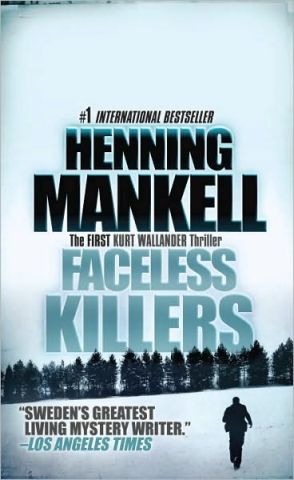
Henning Mankell, Faceless Killers

mankellMy copy of Faceless Killers is littered with snippets of praise, both for Mankell in general and for the book in particular. “Sweden’s greatest living mystery writer!” (Los Angeles Times). “An especially satisfying crime novel” (Wall Street Journal). “A thriller of the very best kind.” (The Times [London]). “Beautifully constructed plots.” (New York Post). “An excellent thriller…A terrific novel.” (The Independent [London]).

Hmm.

I’m not in a position to generalize about Mankell, or Wallander, after reading just one novel in this series. But I honestly can’t see why this book, or its author, would stimulate such enthusiasm. The style is almost unbearably plodding–not quite as dreary as the Stieg Larsson books (or the 1.5 of them I managed to wade through), but close. Maybe the fault lies with the translators, but there is no elegance, no rhythm, no color to the prose at all: it’s just one statement after another. Its starkness does seem suited, after a while, to the bleak landscape–both literal and emotional–of the novel, but that didn’t rescue it from seeming perfunctory, as writing, rather than artistic or literary: it often seemed as if Mankell was just working his way down a checklist of things to include or describe:

At 4 p.m. that afternoon Wallander discoverd that he was hungry. He hadn’t had a chance to eat lunch. After the case meeting in the morning he had spent his time organising the hunt for the murderers in Lunnarp. He found himself thinking about them in the plural.

or,

For the next three days nothing happened. Naslund came back to work and succeeded in solving the problem of the stolen car. A man and a woman went on a robbery spree and then left the car in Halmstad. On the night of the murder they had been staying in a boarding house in Bastad. The owner vouched for their alibi.

He gets the job done, but do reviewers really have such low expectations for crime fiction qua fiction that something so flat gets so much praise?

Perhaps the “very best kind” of “terrific” thriller doesn’t need great prose, just an interesting and well-constructed plot (a double-standard, of course, as if genre fiction should not be expected to be well written in every respect). How good is Faceless Killers by this measure? It’s fine, I guess. By the end the necessary information has been gathered and the pieces fitted together. Because it’s a procedural, solving the case is a matter of following along as the police do their job, which necessarily makes us more passive as readers–we have to wait for their discoveries to be delivered to us. Lots of very good crime novelists use the procedural form–as P. D. James has pointed out, nowadays it’s really the only way to write realistic mysteries, after all. A procedural can become rich and interesting if the contexts and the characters are developed enough and the police’s discoveries aren’t all strictly literal. Cases can be devised that draw both detectives and readers into new territory–social, political, intellectual, even philosophical. And the detectives themselves can be made multifaceted, and have plot lines of their own, so that the case under investigation becomes a device for personal exposure or exploration as well. James, of course, does all this brilliantly (think of A Taste for Death, for instance), as does Ian Rankin (whose last three Rebus novels in particular deserve to be called ‘condition of England’ novels), and sometimes Elizabeth George (Deception on His Mind, I think, is one of her most interesting). Faceless Killers reads like a thin version of, say, Rankin’s Fleshmarket Close. Wallander is a close cousin of Rebus (and not too distant from Peter Robinson’s Inspector Banks)–which is not to say that Wallander is derivative (if I have the chronology right, they are basically contemporaries), just that with his divorce and his drinking and his depression, he seemed formulaic, another in an already well-populated group. Over the later books in the series, perhaps, he distinguishes himself in some way besides his fondness for opera.

The crime is very violent, and described very graphically, and there are some intense action sequences in the novel. I suppose this is why some of the reviewers call it a “thriller” rather than a “mystery.” I don’t enjoy that kind of reading very much: I’d rather be drawn in intellectually than manipulated through fear and suspense. This, I recognize, is basically a matter of taste, though I think that it is worth asking if different kinds of preferred experiences might in fact be more or less valuable, or whether we ought to seek out or encourage preferences that pander to our baser nature rather than our higher! (Look, for example, at Wayne Booth’s comments on Jaws in The Company We Keep, and ask yourself “who am I being, what am I desiring, as I go along with this kind of story?”) Here I think Mankell’s dull style is actually a good thing, because though grim, his violence is not really sensational–it’s just there, and then we move on to the next thing. The case does touch on some broader issues, particularly xenophobia and tensions over immigration. Again, though, the treatment seems perfunctory: we don’t spend time among the asylum seekers in the camps, and the central crime turns out to be connected only incidentally to the racial tensions it stokes. Probably the most distinctive feature of the book, for me, was its atmosphere, a relentless cold heaviness. Things just always get worse, and then there’s more sleet and snow. Who wouldn’t want to spend hours immersed in that?

I read Faceless Killers for a couple of reasons–first, because Mankell is such a big name now that I figured I should have some first-hand experience, and then because I would like to broaden my course reading list by adding some ‘international’ authors and Scandinavian crime fiction is very hot right now. If he bumped anyone from my usual list, it would be Ian Rankin. Right now, though, Rankin wins: he’s just a better writer. The question is, should I (must I?!) read more Henning Mankell to be sure. Suppose I read one more, to see how much better he gets: any recommendations?

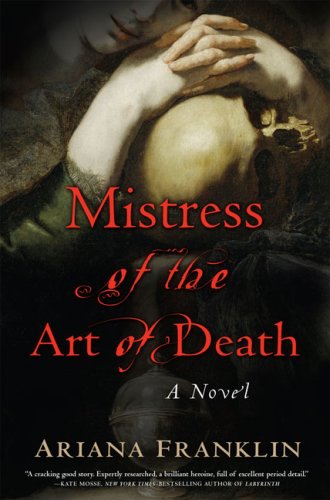
Ariana Franklin, Mistress of the Art of Death

I’m coming belatedly to this series of medieval mysteries featuring Vesuvia Adelia Rachel Ortese Aguilar–mercifully, just ‘Adelia’ most of the time–who is the eponymous ‘mistress of the art of death,’ which was launched in 2008. I’m generally wary of historical mysteries. Actually, I’m wary of most mysteries, though people often assume (because I teach courses in mystery and detective fiction) that I must read them avidly. Too many of them are too formulaic for my taste (though the issue of how we value [or label] formulaic vs. ‘original’ fiction is an issue we discuss at some length in my classes), and I’m not particularly interested in solving puzzles as I read. So when I read mysteries for pleasure, I gravitate to authors who emphasize character development and social context (P. D. James, Elizabeth George, Peter Robinson, and Ian Rankin, for instance). I’m also a faithful fan of Robert B. Parker and Dick Francis (both of whom, sadly, died recently): their books are among my most frequent re-reads, actually. I’ve followed both Sara Paretsky and Sue Grafton for many years now and will keep doing so, though Grafton with far less enthusiasm. And there are other books and authors in this genre that I love (Gaudy Night, The Daughter of Time) or find consistently interesting (Amanda Cross). But outside this group, which is pretty small considering just how vast the possibilities are, I can’t seem to get very excited, despite having sampled quite a lot of suggestions each time I’ve put out a ‘bleg‘ for teaching ideas. (Of course, books I get excited about reading for myself are not necessarily the same as books I get excited about using in my classes–Paul Auster’s City of Glass being a perfect example.)

Anyway, though I could ramble on about other mystery writers I’ve tried and liked or not liked recently (Denise Mina–liked! Inger Ash Wolf–not liked!), this post is supposed to be about Mistress of the Art of Death…which I liked. And then didn’t like. And then liked again.  I have a personal distaste for crime novels focusing on murdered children: I find it troubling to treat such grim possibilities as entertainment. So I had some difficulties initially with the set up of the crimes, which seemed sensationalistic, even manipulative. This distaste receded for much of the novel as I saw how stylishly Franklin proceeded with her historical context as well as with establishing her main characters and relationships. I’m no kind of expert on the 12th century, but in the Q&A at the end Franklin discusses her research as well as her (very endearing) nerdish enthusiasm for the many period details she mastered to write the book. I have to take her expertise on trust, but I can say that she made it all seem very convincing, and in general she dealt with it very naturally, not weighing down her narrative unduly with exposition and certainly not falling into any of the annoying faux Olde-Englishe stuff that makes a lot of historical fiction seem so artificial. She’s frank, in fact, about introducing anachronisms (including calling Cambridge ‘Cambridge’ instead of its medieval names) to make the story ‘comprehensible,’ and her dialogue especially is for the most part briskly contemporary.  She succeeds in making her chosen historical moment seem fraught with interesting tensions and possibilities, especially because of the religious and racial tensions that she uses effectively to frame the killings. And Adelia is a good character: smart, prickly, intense.

But…with all that going for it, I wish the crime had not turned out to be a medieval version of a fairly conventional psycho-killer plot: I thought towards the end  it collapsed into lurid melodrama, turning away from a compelling forensic investigation into a violent thriller in which the suspense comes not from wondering our way through clues and personalities but from waiting for the villain to take off his mask (literally!). And the revelation is a surprise, yes–but not one that particularly satisfies any story arc we’ve been following. With so much going right in the book to that point, I was surprised that it got so cheap so fast. Then there’s the romance subplot, which I found the least convincing aspect of the novel.

But…just when I thought I had the measure of the book–good start, bad finish–she brought in Henry II and made everything interesting again. So I’ll definitely search out the next one in the series. Next up, though, is Henning Mankell’s Faceless Killers–long a front-runner to replace Ian Rankin’s Knots and Crosses as my example of the ‘grim contemporary’ police procedural in my class (not because I don’t like the Rankin, but because I would like a change, and also because the ‘internationalization’ of the crime novel in English seems to me the biggest recent development in the genre). I’ve tried Mankell before and gotten stumped by the bleakness of the atmosphere and what seemed a flatness in the style (or the translation). February seems the right month to try again, doesn’t it? I mean, who expects anything cheering in February?

Recent Reading: Mina and Mantel

In my previous post about summer reading plans I forgot to mention that my daughter and I have committed once again to our local library’s summer reading club. (As an aside, let’s hear it for public libraries, perhaps the greatest public institutions we have!)  This year her pledge (for me to match) is 25 books over July and August. I’ve managed to read four titles since she signed up, but I haven’t blogged about any of them yet, so I have some catching up to do.

First up, I finally read Denise Mina’s Field of Blood, which was highly recommended when I put out my ‘bleg’ for ideas for my seminar on women and detective fiction. Unlike many of the titles I read as I worked on my book list, it’s very good! What makes it stand out from the others? The simplest answer is that it suits my own reading tastes better. It’s rich in context and characterization, but it’s not overwritten, pedantic, or (like the awful Stieg Larsson books) just one damned thing after another with intermittent pornography (I know, I know, Salander is a great character, but…). Paddy Meehan is flawed and conflicted, but not melodramatically so; her family and co-workers are effectively and efficiently specified so that we rapidly get a sense of the community she moves in, which is an interestingly complicated one. It’s not really a detective novel, and in fact one reason I think I couldn’t have fit it into my course very well is that the crime itself is almost peripheral to Paddy’s own story. I thought there were a few missteps: there’s a ‘killing-due-to-mistaken-identity’ episode that I found did cross over into cliche in the writing, for instance. I was most interested in the push-and-pull for Paddy herself between her family’s expectations and her ambitions. Paddy is also a good example of the type I now think of (thanks to Anita Brookner) as the tortoise: she’s plain, underappreciated intellectually, overlooked romantically–in short, she’s every socially awkward, ill-at-ease bookish young girl who can therefore read in her eventual success validation of their own painful experience as misfits. As Brookner points out (in Hotel du Lac), books are written for the tortoise market because in reality the hares are off winning the race (or the guy).

I did read one other mystery, though I finished it in June so I can’t count it towards my summer total: Katherine V. Forrest’s Murder at the Nightwood Bar. If I had read this sooner, I might have included it on the syllabus, though I would have had some misgivings. I had hoped to find a teachable example of lesbian detective fiction, which is a thriving subgenre now. Forrest was one of the earliest writers to establish herself in it: Amateur City, the first in the Kate Delafield series, was published originally in 1984, soon after Sue Grafton and Sara Paretsky had launched their female private eyes. Murder at the Nightwood Bar is far more overtly political than the Laurie King and Sandra Scoppetone ones I read earlier, and the crime is set up to resonate with those political interests and to stand as exemplary of a larger social problem, giving the book the kind of unified effect that lends itself to the kind of work we would do in a seminar discussion. On the other hand, it is perhaps a bit too obviously set up in this way: I like a little nuance with my social consciousness raising. Forrest is another competent but unspectacular stylist; nothing in the book seemed as literarily fine as, say, P. D. James’s An Unsuitable Job for a Woman. At any rate, the book didn’t make it on the list for this fall (though Nancy Drew ultimately did–we’ll see how that goes!) but I’ll revisit it next time around.

My other summer book for this post is totally unlike these two: I continued my trip through Hilary Mantel’s back catalogue with The Giant O’Brien. Once again, it was a surprise: like Beyond Black, it gives no sign of being by the same author as Wolf Hall, for instance, except in being strangely conceived but ultimately quite compelling. It follows the experience of a Giant who has travelled from Ireland to London in the 1780s, escaping poverty and famine at the cost, ultimately, of his self-respect, his integrity, his humanity, and even his life, though we realize from early on that all of these aspects have been compromised for him from the start simply by his being a giant, a freak, a spectacle. Juxtaposed against his story is that of the anatomist John Hunter. They are set up to embody a number of oppositions, not just scientist and potential experiment or subject, but also the man of facts, of physicality, and the man of imagination–ironically, in an extraordinary physical frame, but living the life that really matters to him in his mind alone, and through the stories he tells. They are also England and Ireland, I think, and to some extent, also winner and loser. There’s pathos, but Mantel downplays it, going instead for a combination of quirky and grotesque that, inevitably but rightly, one of the critics in the blurbs identifies with Hogarth’s famous prints of 18th-century London. The prose is beautifully styled, moving between short epigrammatic conversations, terse sections of exposition, brutal graphic detail, and passages of great lyricism without any hint of sentimentality:

The poet has his memorial in repetition, and the statesman in stone and bronze. The scholar’s hand lies always on his book, and the thinker’s eyes on canvas travel the room to rest on each human face; the rebel has his ballad and his cross, his bigot’s garland, his wreath of rope. But for the poor man and the giant there is the scrubbed wooden slab and the slop bucket, there is the cauldron and the boiling pot, and the dunghill for his lights; so he is a stench in the nose for a day or a week, so he is a no-name, so he is oblivion. Stories cannot save him. When human memory runs out, there is the memory of animals; behind that, the memory of the plants, and behind that the memory of the rocks. But the wind and the sea wear the rocks away; and the cell-line runs to its limit, where meaning falls away from it, and it loses knowledge of its own nature. Unless we plead on our knees with history, we are done for, we are lost. We must step sideways, into that country where space plaits and knots, where time folds and twists: where the years pass in a day.

Some of the most haunting passages in the novel are those in which the giant pacifies his motley associates with tales told in the resonant tenor voice that belies the monstrosity of his frame. The transcendence of his voice, his ability to take both himself and his listeners outside themselves, outside the ugly and inescapable realities of their literal lives and their physical selves, beautifully captures the promise of story-telling itself.

TMI

I’m still exploring options for my upcoming seminar on ‘women and detective fiction.’ Frankly, right now I’m feeling tired of the whole project and wouldn’t mind not reading any more mystery novels for a long time: after a while, the machinery just seems so creaky. Start with a prologue introducing the crime or the criminal. Sound an ominous note to create suspense (from the book nearest to hand, for instance, “If they’re the ones who killed Mary Claire, why wouldn’t they kill me?”). Introduce the detective, more or less alienated from work or partner or family or society. Start investigating. End lots of chapters with ominous notes, of the “little did she know how things would turn out” variety (“Things seldom went this swimmingly for me, which should have been a clue”). Reach putatively thrilling denouement. Fade out.  Repeat as necessary. I know, I know. The good ones are not like this, or do it well. Still, genre fiction is, inevitably, formulaic. A particular phenomenon I’ve been struck by lately, though, that actually bothers me more than the essential predictability of the form (which is, as P. D. James has argued, in some ways a strength of the genre as it establishes a firm structure within which the author is free to explore themes and characters as desired): there seems to be a trend towards overwriting, providing lots of unnecessary literal detail that contributes little to either plot or atmosphere but is just there. Now, I’m a Victorianist, and I like details: I’m not one to argue in favor of brevity for its own sake. But I like the details to be somehow resonant, whether with thematic or symbolic significance or with literary interest or pleasure. Dickens’s details, for instance, hum with life. But I don’t feel any life in this kind of writing:

I dropped my shoulder bag near the copy machine and crossed to the shelves where the yearbooks were lined up. The 1967 edition was there and I toted it with me, riffling through pages while I activated the On button and waited for the machine to warm up. The first twenty-five-plus pages were devoted to the graduating seniors, half-page color head shots with a column beside each photograph, indicating countless awards, honors, offices, interests. The juniors occupied the next fifteen pages, smaller photographs in blocks of four.

I flipped over to the last few pages, where I found the lower school, which included kindergarten through fourth grade. There were three sections for each grade, fifteen students per section. The little girls wore soft red-and-gray plaid jumpers over white shirts. The boys wore dark pants and white shirts with red sweater vests. By the time these kids reached the upper school, the uniforms would be gone, but the wholesome look would remain.

I turned the pages until I found the kindergartners. I checked the names listed in small print under each photograph. Michael Sutton was in the third grouping, front row, second from the right.

I’m no best-selling author, but I can’t see why a reader needs to know most of this. We’ve seen yearbooks, after all. The uniforms are, I suppose, period details and class markers, but the number of pages, or rows, or photographs per row, seems tediously irrelevant. How about this, instead:

I dropped my shoulder bag near the copy machine and crossed to the shelves where the yearbooks were lined up. I found Michael Sutton’s kindergarten picture in the 1967 edition . . .

The whole book is padded with this kind of excessive, and excessively literal, description of mundane objects and activities:

As long as I was downtown, I covered the seven blocks to Chapel, where I hung a left and drove eight blocks up, then crossed State Street and took a right onto Anaconda. Half a block later, I turned into the entrance of the parking facility adjacent to the public library. I waited by the machine until the time-stamped parking voucher slid into my hand and then cruised up three levels until I found a slot. The elevator was too slow to bother with so I crossed to the stairwell and walked down. I emerged from the parking structure, crossed the entrance lane, and went into the library.

I’m sure you’ll be interested to know that once she is actually in the library and has spent a couple of paragraphs explaining about the directories she’ll consult, she reaches into her bag and “remove[s] a notebook and a ballpoint pen.” The blow-by-blow description slows down the action without developing anything else–not atmosphere, character, or theme. In other ways, this particular book is well built: Grafton is clearly interested in experimenting with form beyond the journal-like first-person narration she has used in most of her novels, and here she varies her point of view and alternates between past and present events in a fairly effective way. Still, the novel  could have been much shorter and not lost anything valuable if someone had edited it more strenuously. I’m reading The Girl who Played with Fire and feel very much the same way about it: it just goes on and on and on.

‘Not many girls would have used their wits the way you did’: Nancy Drew

There’s one obvious candidate for inclusion in my seminar on women and detective fiction that I hadn’t thought seriously about before today. But if exemplarity and influence matter, surely Nancy Drew is right up there with Miss Marple–more important, perhaps, if you consider the number of high profile contemporary women, now role models themselves, who say they took some of their own inspiration from her. Students have asked about her before, but I hadn’t really followed up, mostly on the grounds that the books are ‘young adult’ fiction and thus unlikely to be of much literary interest. But once you’ve made the move into genre fiction in the first place, you’ve acknowledged the significance of other factors, alongside or, sometimes, instead of, more strictly literary ones–and these days it’s not obvious how you define the ‘literary’ anyway. So I thought I’d poke around a bit, and though I haven’t had time to read any of it yet, I quickly became aware that there’s quite a bit of critical work on the girl sleuth, including by feminist writers like Carolyn Heilbrun, and by other mystery writers, including  Sara Paretsky. She’s looked at as a feminist exemplar, a break-out figure in the genre of detection fiction, a “WASP” super-girl, and a “ballbuster.” There’s discussion of the novels in the context of other series fiction for young readers, and in a range of historical and political contexts. The series has a complex history (the current editions of the “original” mysteries, for instance, are in fact revisions of the 1930s versions which were revised starting in the 1950s because of their racist attitudes) and of course the figure of Nancy herself has a cultural currency that is probably about equivalent to that of Sherlock Holmes. I started thinking that maybe I should make room for Nancy on the syllabus! It seems as if we would have plenty to talk about.

So I borrowed my daughter’s copy of The Secret of the Old Clock and gave it a quick read–after all, it has been more than 30 years, probably, since I myself was an avid reader, not just of the Nancy Drew books, but the Trixie Belden series as well as the Hardy Boys. I was right about the language not being particularly sophisticated or subtle, but Nancy herself is certainly a dynamo. In this book alone she saves a young girl from drowning, fixes a flat tire and an outboard motor, chases down a gang of unscrupulous thieves, stares down the town snobs, and recovers a lost will, with the result that both money and justice are effectively redistributed. Her independence at the wheel of her car anticipates V. I. Warshawsky’s confident navigation of the streets of Chicago (down these mean streets a woman can go, untarnished and unafraid, provided she has a reliable set of wheels)–and now that I think of it, like V. I. she’s also always well turned out (“looking very atttractive in a blue summer sweater suit,” “dressed in a simple green linen sports dress with a matching sweater,” “becomingly dressed in a tan cotton suit”–I suspect these details were added in the 1950s revisions). Motherless, she enjoys the apparently unqualified support of her father, who never discourages her risk-taking, though he’s touchingly pleased when her exploits end safely. (She drives him around, which I thought was an interesting detail.) She doesn’t meet any opposition or skepticism from the police, either. There is something sort of inspiring about the freedom and rectitude with which she rushes through the story. I’m not sure yet if I’ll put her on the syllabus–I do think it would be a case in which the apparatus we’d put around the book would be more interesting, in many ways, than the book itself. But at the moment, I’m tempted.