Binge Reading vs. Close Reading

dickfrancisI’ve undertaken to write an essay on Dick Francis this summer, in preparation for which I am reading through all of his 40+ novels. His first, Dead Cert, was published in 1962, and he basically published one a year until his death in 2010 (the last few in partnership with his son Felix, who has now taken over the franchise). That’s a lot! I’ve been reading them off and on at least since the 1980s; I own about a dozen (which used to seem like quite a few, until I really took stock) and when things are busy at work I often pick a favorite to reread, as they are both brisk and smart enough to be a nice diversion without requiring a lot of attention.

It’s always interesting approaching as critical projects books or authors I have previously taken for granted or read “just” for pleasure. When I started teaching the Mystery & Detective Fiction course, I went through that with P. D. James, Ian Rankin, Sue Grafton, and Sara Paretsky (many of the other authors on the reading list are not ones I had read before, including Agatha Christie and Dashiell Hammett, so the effort there was always more academic). But what’s really different about this particular project is that I don’t typically read in bulk this way. Sure, when I find an author I like, I tend to follow up, but outside of genre fiction authors with 40 or more titles to their credit are rare, and I usually get restless after reading a few books in a genre series in a row. A good example would be Mary Balogh: when I discovered I could enjoy her books, I got a whole bunch from the library, but after racing through several, I just really wanted to read something different, and now I think of her as I had Francis, that is, as a safe option when I need some filler in my reading life. (A notable exception would be the Martin Beck novels: once I got hooked on them, I pretty much just kept reading. But there are only 10 of them anyway!)

What strikes me about binge reading is the different kind of attention it requires compared to the intense close reading I’ve done for most of my recent writing — any of my George Eliot essays, for instance, or for reviews including my most recent one of Kate Atkinson’s Life After Life — or, for that matter, the reading I do for my teaching. For all of these purposes, poring over details is the essence. It’s not that I’m not reading each of these novels  carefully and trying to hang on to the key details that differentiate one from another. There are plenty of these, and they matter, often substantially. But the novels do have a lot in common, and inevitably they blur together or form, in my mind, one larger whole. Since the essay I’m working on is intended as a kind of overview (though with a particular angle on women and gender roles), that’s appropriate: I’m reading all of them at once because I want to be able to generalize about them, to discuss patterns, or themes and variations, connecting threads, tropes, motifs, whatever. The individual novel is less important than the collection of novels. The more I read, the more each one I pick up reads like part of that collection, if that makes sense: the deeper into the catalog I go, the more rapidly I subordinate the particular to the general. My major challenge is not so much interpreting as keeping track: this is the first time I’ve ever used a spreadsheet as a writing tool!

And yet every novel is different. (I joked on Twitter that so far my lede is “The novels of Dick Francis are both alike and different” –ah, the bane of the undergraduate compare-and-contrast essay!) You could say that this oscillation between similarity and difference is the essence of genre fiction: its predictability is as much the appeal as the ability of a talented practitioner to surprise. I’m reminded of Josephine Tey’s sly, self-reflexive jab at formula fiction in The Daughter of Time:

Even in that, you knew what to expect on the next page. Did no one, any more, no one in all this wide world, change their record now and then? Was everyone nowadays thirled to a formula? Authors today wrote so much to a pattern that their public expected it. The public talked about “a new Silas Weekly” or “a new Lavinia Finch” exactly as they talked about “a new brick” or “a new hairbrush.” They never said “a new book by” whoever it might be. Their interest was not in the book but in its newness. They knew quite well what the book would be like.

I do notice that interchangeable widget quality as I read these books in relentless succession — and yet I always welcomed the appearance of “a new Dick Francis” precisely because I knew what it would be like but also knew that he was smart enough to mix it up, to really make it new.

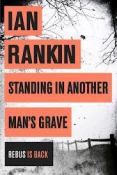
Rebus is Back: Ian Rankin, Standing in Another Man’s Grave

rankingraveYes, Rebus is back, and it’s good to see him again, the sodden old crank. The Malcolm Fox novels have been fine, but I don’t find Fox as interesting a character as Rebus–though that could be because I’ve known Rebus for so long. Also, I had hoped that Rankin would take up Siobhan Clarke as his protagonist when Rebus retired. She has quite a prominent role in Standing in Another Man’s Grave, so my hope of that is renewed!

Rebus is back — and that seemed to me the major feature of this new novel. It’s a solid, well-constructed procedural on its own merits — Rankin is an experienced pro at this, after all — but it’s as a novel of character that Standing in Another Man’s Grave is most interesting. It doesn’t have the ambitious scale or political reach of the late books in the initial Rebus series, particularly Fleshmarket Close (which is described on the cover as a “state of the nation novel”–surely a variation on what I talk about in the 19thC context as a “condition of England novel”) or The Naming of the Dead. Both of these work their particular crimes up as symptoms of much wider social evils. By contrast, the case in Standing in Another Man’s Grave is mostly an occasion for Rebus to revisit and rethink his identity as a detective as he contemplates a move from the cold case unit he moved to on retirement back into active service (something made possible as a plot twist by changes in regulations). The case itself seemed a little perfunctory, except that in linking together old cases with new, it continues the preoccupation of all of the Rebus novels with the complex relationship between past and present.

Here, it’s Rebus himself who often seems like a relic of the past, something Rankin can make the most of because this novel is itself a kind of throwback. While Rebus was out of our sight, our world and his was changing, and his ways of doing things — always borderline inappropriate — are now conspicuously “old-school,” as Malcolm Fox’s colleague Tony Kaye points out. Rankin set Fox up to be in many ways Rebus’s antithesis, and here we see Fox determined to put an end to Rebus’s tainted career. “I know a cop gone bad when I see one,” he tells Siobhan, warning her to cut ties if she values her own career advancement:

Rebus has spent so many years crossing the line, he’s managed to rub it out altogether. As far as he’s concerned, his way’s the right way, no matter how wrong the rest of us might know it to be.

“You don’t know him,” Siobhan replies, and that’s what long-time Rebus readers would say as well: Fox’s summary is pretty accurate, except for his conclusion that Rebus’s disregard for rules, protocols, and lines proves him to have “gone bad.” Rebus’s methods may be unorthodox, but the law and the right do not always completely coincide, and Fox’s determination to put Rebus on one side or the other of that line shows his own moral limitations, or at least his own moral rigidity.

Standing in Another Man’s Grave is in some ways an affirmation of Rebus’s approach. As Kaye tells Fox,

Rebus got results the old way, without seeming to earn them. He did that because he got close to some nasty people in a way that you couldn’t. . . . Rebus specialises in something a bit different — doesn’t necessarily make him the enemy.

Rebus gets results here too, through “old-school” contacts, hunches, and the weary, dogged persistence that has seen him through so many cases before.

Standing in Another Man’s Grave is not quite a triumphant return to form for Rebus, though. Rebus proves himself still up to the job, but just barely — not so much because he’s bemused by new methods and new media, such as Twitter (a bit of an inside joke from Rankin, who is a frequent and adept user of social media — you can follow him at @beathhigh if you’re interested) but because he’s just barely hanging in there physically, and no wonder, considering he smokes and drinks incessantly. Even if his application to be reinstated is accepted, how long before he’s in his own grave? His ancient Saab, also on its last legs (wheels?), becomes a metaphor for his debilitated condition. “And the Saab didn’t break down?” asks Siobhan after one of Rebus’s long trips to check out leads. “Not ready for the knacker’s yard just yet,” replies Rebus, and the same seems to be true of him. Maybe there’s one more Rebus novel left in him before Siobhan gets her chance at the lead role.

Elizabeth Speller, The Return of Captain John Emmett

I picked The Return of Captain John Emmett for my ‘light reading’ over the last couple of weeks because it seemed such a perfect fit: here I am reading and teaching both literature of the First World War and mystery fiction, and it’s a mystery set just after–and preoccupied with events during–WWI. In retrospect, maybe that was exactly the wrong reason to read it now: it couldn’t compete with Testament of Youth, or with my relatively fresh memory of All Quiet on the Western Front, as a book about the experience of the war, and it didn’t seem that effective to me as a mystery, either. I had trouble staying interested in it, and though by the end I was moderately caught up in the story it was untangling, overall I thought it was just OK. Perhaps if I’d read it last summer, or waited until next summer, it would have had more of a chance with me.

What didn’t I like about it? Oh, not much in particular. It’s literate and well-researched, and it didn’t have the ‘checking off boxes’ effect of clunkier period fiction, when you feel the details are being added on purpose rather than because they emerge naturally from the context. (That’s kind of how Season 1 of Downton Abbey struck me–Irish radical? check! suffrage? check! declining aristocrats? check! Maggie Smith? check!) The central case is interesting and it’s a good idea to make an investigation into one particular death a way of exposing the larger catastrophe of the war (something Jacqueline Winspear also does pretty well in Maisie Dobbs, as I recall). Culpability is a complicated thing in this scenario, and the novel’s somber tone aptly reflects the moral bleakness of its reflections on the wholesale slaughter that makes singling out individual killers seem at least redundant, if not necessarily pointless.

The process of the detective story was not particularly interesting, though: Laurence Bartram is not a terribly charismatic figure, and he doesn’t do any impressive detecting, more or less plodding from one person to another asking questions and receiving, in return, unbelievably long statements that masquerade as parts of actual conversations–it gets very speech-y, which is about the most literal form of too much ‘telling’ imaginable. It would have been more fun, and more suspenseful, if Bartram had displayed more ingenuity and done more ratiocination. There are a number of self-conscious references to mystery conventions (and several references to Agatha Christie), but Speller is clearly aiming for a more “literary” mystery, and her effort went into setting, backstory, and, to some extent, character development–but here again, we find things out about people more from long revelatory speeches than anything else.

As an aside, the front cover of my edition features a review proclaiming it’s “The new Birdsong — only better.” Is it just me, or is that kind of insulting to both books? What does The Return of Captain John Emmett really have in common with Birdsong besides the WWI context? Why deprive it of its own claims to originality? And that “only better” is surely a gratuitous dig at Birdsong? I don’t understand what marketing logic lies behind choosing this as the crucial sales pitch.

From the Archives: Who Cares Who Killed … Whoever It Was?

I’m reading Elizabeth George’s Believing the Lie, and I find I still feel pretty much as I did when I wrote this post in 2009: I’m more interested in the continuing characters than in the mystery plot they’re caught up in. Given the particular characters, I suppose it’s inevitable that a novel about them would involve some kind of crime story, and I appreciate what George is able to do with character development while still working in the procedural form. But I’m tempted to skim everything that’s not directly about Lynley and his immediate circle…


(Originally posted May 1, 2009)

I’ve just finished reading the latest releases by two of my favourite mystery novelists, P. D. James‘s The Private Patient and Elizabeth George‘s Careless in Red. (I know they’ve been out for a while; I was waiting for the paperback editions.) Both books are better than fine as examples of their type–though George is in fact American, both authors write what we could call highbrow British police procedurals, leisurely in pace, attentive to setting, driven by character more than plot. Both write well; James’s prose is more economical, while George’s would (IMHO) benefit from more stringent editing, but both offer their readers intelligent complexity of language and thought. The depth of character and theme both achieve justifies James’s repeated assertion that crime fiction provides a useful structure for the novelist without necessarily limiting the literary potential of her work.

Yet for all their virtues, I found myself unexpectedly dissatisfied with both of these novels, for reasons that are based in their form. Often in my course on mystery and detective fiction we talk about the limits working in this genre sets on certain literary elements, chief among them characterization. A mystery novelist can not afford to mine the depths of her characters as long as they are suspects in the case. This technical limitation is most apparent in writers of ‘puzzle mysteries,’ such as Agatha Christie, but even with writers who develop their people quite fully, as James and George do, an element of opacity is required, not just about their actions, but about their feelings and values, else we will know too quickly “whodunnit.” (There are exceptions, of course, as when some of the novel is openly from the point of view of the criminal, though often then we have inside knowledge without knowing the character’s outward identity.) The same limits do not, however, apply to the detectives–which is one reason, as historians and critics of the genre have pointed out, for the appeal of the mystery series. Across a series of novels, we can come to know the detectives very well, and a developmental arc much longer than that of any single case emerges. Though the case provides the occasion, after a while the real interest lies with the detective.

That, I think, is very much what has happened with both James’s Adam Dalgliesh and George’s Thomas Lynley. Every one of their books is populated by a new array of people, but they are the ones with whom we have longstanding relationships–remarkably longstanding, indeed, as James has been publishing Dalgliesh mysteries since Cover Her Face in 1962, and the first Lynley novel, A Great Deliverance, was published in 1988. And though Dalgliesh and Lynley have always been complex and interesting protagonists, in recent books so much of significance has happened in their lives that I turned to these latest instalments motivated far less by curiosity about the latest corpse than by the desire to know how things are going with them. While actually reading the books, I took a fairly perfunctory interest in the investigations but I was keenly interested in what came to seem the regrettably few sections focusing on, for instance, Dalgliesh’s relationship with Emma Lavenham (and not just because it’s a little victory for English professors everywhere). The real novelistic potential of The Private Patient emerges, I think, in the scene in which Emma confronts Dalgliesh in his professional capacity and we see, fleetingly, the difficulty that even these two extremely intelligent and independent people might have reconciling law and love, justice and humanity. But this material is not developed, and in fact the novel in which it does become the focus would have to leave the genre of detection quite far behind. (Gaudy Night is a rare example of a novel that I believe successfully balances human and literary interests with mystery elements, partly by integrating the case so thoroughly with the personal aspects of the story and making both the detection and the romance converge on the same themes.) Careless in Red spends more time on Lynley’s personal situation, but again his struggle to move forward after the tragedy of two novels ago (see how I’m avoiding spoilers, in case anyone hasn’t already read this excellent series?) is subordinated to the case at hand–though George does set the case up with thematic echoes of his tragedy.

I can hardly fault either author for the relative weight they give to the professional, rather than personal, business of their characters. That’s the kind of book they have undertaken to write. Also, as their protagonists are professional detectives, policing is integral not just to their work, but to their identities. But I do wonder if even James, the acknowledged Grande Dame of the genre, hasn’t finally shown us the end point (dare I say the dead end?) of a commitment to this genre. Just introducing the kind of story arcs they have given their protagonists recently suggests that James and George might be chafing at the constraints of detective fiction, wanting to write a straight novel of psychological and moral development, a novel in which incident is second to character, a novel squarely in the tradition James has always claimed as hers–that of Austen and George Eliot and Trollope. At any rate, that’s the kind of novel I find I wish they would write. Over the years they have succeeded in getting me quite emotionally involved in the lives of their main characters (and not just Dalgliesh and Lynley, either, but Kate Miskin, Barbara Havers, Simon and Deborah St. James…). The corpse and suspects, however, are never more than passing acquaintances.

On a somewhat tangential note, I was struck reading The Private Patient by the elegaic note on which it ends, in a passage which also echoes the wonderful ‘squirrel’s heartbeat’ passage from Chapter XX of Middlemarch:

She thought, The world is a beautiful and terrible place. Deeds of horror are committed every minute and in the end those we love die. If the screams of all the earth’s living creatures were one scream of pain, surely it would shake the stars. But we have love. It may seem a frail defense against the horrors of the world but we must hold fast and believe in it, for it is all we have.

Though of course I would not rush to assume that a character’s views are those of the author, it is hard not to read this final paragraph from a novelist who has spent nearly five decades telling us about “deeds of horror” as a reminder, even a consolation, that even in a murder mystery, death need not define life.

This Week in My Classes: Amidst the Mess, Three Mysterious Morsels

The past week or so has just felt crazy with tasks and details to keep on top of. When we’re planning courses, we (or maybe it’s just me?) tend to focus on big picture issues, like which books to assign and which assignment sequences to use. Once that’s all decided, there’s filling in the syllabus, usually a happy task full of dreams of lively discussion prompted by clever juxtapositions (like this week’s cluster of ‘poems by women poets about women poets’ right before we start Aurora Leigh!) and supported or solidified by informal and formal writing. What we (or maybe just I) tend not to prepare so well in advance are things like spreadsheets for record-keeping or evaluation forms for seminars, or attendance sheets–which it is nearly pointless to get to organized about anyway, at least until the add-drop period ends and the list has some stability! I’ve reached the point in all of my classes where I needed all these things firmly in place, as assignments have been coming in, quizzes have been written, students have given seminar presentations, and so on.  Luckily I do have templates for all these kinds of things, or at least a set of best (or usual) practices, so I’m not dreaming them up from nothing, but I am drawing them up or finessing them to suit this year’s particularities. And of course this administrative stuff (plus the marking of quizzes and evaluation of assignments and so on) has to happen in addition to the other aspects of class prep, so just when you are starting to think “see, the teaching term isn’t that busy after all–I’m getting all my readings and class notes ready in plenty of time!” you are reminded why the teaching term actually is quite intense.

Then as if this year’s classes aren’t enough to be worrying about, the deadlines for course proposals and timetabling for next year have been moved way up, and in fact we were asked to submit our teaching preferences for 2012-13 by last Friday. I’m reasonably certain that this deadline has nothing to do with program planning or pedagogy (heaven forbid we should think about next year once we have some kind of idea how this year is going) and everything to do with recruiting: Dal’s big fall Open House is October 14, and it probably helps to be able to point prospective students to at least tentative course listings. This process was further complicated for us this year by bad budget news in the faculty that had repercussions for our TA allocation and thus, potentially, for our graduate student funding–which meant rejigging much of our curriculum on the fly to ward off various worst-case scenarios. Once again, program planning and pedagogy were given short shrift because of external imperatives! This is not to trivialize the budget difficulties, but it’s a real shame the timetable for figuring out how to deal with them was not different. Book orders for the winter term also came due, though luckily I had made most of my decisions about that already. Still, I’ve been stymied by discovering, to my great surprise, that a book I had counted on assigning (Ishiguro’s The Remains of the Day) appears not to have a Canadian edition available at the moment. Seriously? The bookstore and I are working on this, but if we can’t find a workaround, I’m going to have to decide on something else in something of a hurry.

Add in the three tenure and promotion cases I’m involved in, the three Ph.D. students I’m supervising who persist (darn them!) in being industrious and thus giving me work to do, the two Honours students I’m now mentoring in preparation for our year-end Honours “conference,” the reference letters I’m already assembling documents for (and then writing, collating, addressing, and mailing), and the two other committees I’m on that persist in holding meetings or circulating materials for us to read (darn them too!)–and whew! My head has been buzzing, and my stress levels nasty, by the end of most days. The student union president who blithely commented in a recent Maclean’s story that “Professors have a pretty good gig . . . You put in some office hours, you teach for a few hours and then you end up with a decent paycheque” should maybe job-shadow a professor or two before concluding that it’s only reasonable for us to return all student emails within 12 hours. (Yes, that’s right: we were born knowing even the most recent developments in our field–amazing, eh?–and basically just sit around until it’s time to go pontificate. Assignments appear from nowhere, and magically reappear with comments and grades! Hmm: I just might contribute a little to that Facebook group mentioned in the article…)

Happily, at the center of all this you still do have those “few” hours in the classroom, and even more happily, it is often a treat getting ready for them because you are working on something you find genuinely interesting and exercising not just your expertise but your creativity in figuring out how to get your students equally involved in it. I’ve been teaching a lot of quite familiar material so far this term, but as always I’ve tweaked my syllabi here and there for variety and to keep me alert. One regular source for new material is whatever reader I’ve chosen for Mystery and Detective Fiction: it’s easier to change up smaller readings, and I’m often dissatisfied with an anthology for one reason or another so I have used quite a few over the years. This year, after much (much!) exploring, I settled on the inexpensive and perfectly suitable Dover collection Classic Crime Stories, and this week, much welcome relief from the other dull or worrisome things I’m taking care of comes from the three short stories we’re reading about “Great Detectives”: Jacques Futrelle’s “The Problem of Cell 13,” G. K. Chesterton’s “The Blue Cross,” and R. Austin Freeman’s “The Case of Oscar Brodski.” All of them are models of ingenuity in both the construction and the telling of the plot. All of them feature detectives who reason their way to solutions beyond the reach of us ordinary people, but each detective has a unique character and very particular gifts–and one of them, Father Brown, of course also has enormous endearing charm. Futrelle’s Thinking Machine is the least appealing of them, I think: his sheer arrogance is interestingly offset by the way his promise to think his way out of his solitary cell turns out to be, let’s say, misleading (of the three, he’s the one whose solution to his problem is ultimately most un-astonishing–though certainly surprising until explained–and relies the most on quite ordinary kinds of help from other people). The fellow-convict who believes his guilty conscience is driving him to confess provides another example of the Holmes-like trope of the seemingly unnatural element that has a perfectly natural explanation. Father Brown brings a new dimension to the uncomfortable proximity between the criminal and the crime-solver that we have been discussing from the beginning of the course: unlike many famous detectives, he manages to retain his innocence despite his deep understanding of guilt.  “The Case of Oscar Brodski” is the most formally interesting, with its first part (“The Mechanism of Crime”) telling us the crime going forwards, and its second part (“The Mechanism of Detection”) taking us backwards as each bit of evidence is traced to its source and the events are reconstructed. It is also the one with the most violent crime, and thus the one that most emphasizes another uncomfortable aspect of this kind of detective fiction, namely, the lack of human feeling so often displayed as the intellectual problem is given priority. Nobody is particularly upset by the decapitated corpse of poor Brodski! We’ll be spending a lot more time on this problem (if it is one) when we discuss The Murder of Roger Ackroyd starting Friday. Today, I have planned an in-class exercise designed to prompt the students to generate their own commentary on the stories: I asked them to read with an eye to “teachable” moments, explaining (as per my previous post) that they are supposed to be reading actively enough to get what’s interesting and relevant on their own. I’m going to put them in pairs and then larger groups and circulate transparencies for them to write up ‘lecture notes’ on, and then put them up on the overhead projector and see what they’ve come up with.


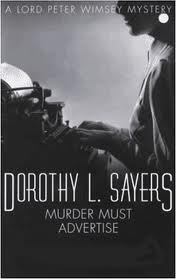
Not Quite Cricket: Dorothy Sayers, Murder Must Advertise

Murder Must Advertise is my fourth favourite Dorothy Sayers novel, after Gaudy Night (first, of course!), Busman’s Honeymoon, and Strong Poison and Have His Carcase (tied at third, because though neither of them is as good as I could wish, both do have Harriet Vane, and that’s such a lot for any novel to have). Harriet is around, in Murder Must Advertise, though never seen; she’s mentioned, very briefly, as Peter Wimsey heads off to “keep his date with the one young woman who showed no signs of yielding to him.” Though, as Sayers blithely remarks, “what he said or did on that occasion is in no way related to this story,” one reason Murder Must Advertise is as good as it is, is that Sayers wrote it after reinventing Peter as a character worthy of Harriet.*

Murder Must Advertise is a clever mystery, with plenty of clues and threads to amuse the devoted puzzle solvers among us. I’m not one of those, myself: I almost never try to figure out whodunit, which is probably why I am so comfortable with the police procedural as a form (no use trying to solve the crime before the police have collected all the evidence, after all), and the interest I do take in the crime and its solution is almost entirely the result of (or proportional to) the interest I take in the characters, setting, and situation of the novel — which is certainly why my preferred mystery writers are those who lavish care and detail on these elements: P. D. James, Elizabeth George, Ian Rankin. As I’ve often remarked here, I’m not really a fan of mystery novels as such. When I really like a mystery, I like it as a novel: I read it with the same attention and attitude as any other novel. The mystery just provides the skeleton, as a marriage plot provides the underlying structure of many other novels, or some version of the Bildungsroman the basic outline of yet more. In some cases, there’s too little flesh on the bone: when the generic framework is too exposed, covered in only the thinnest pretense of novelistic substance, I lose interest. At other times, I get frustrated when the mystery intrudes on the other aspects of the novel–or I wish the characters could escape for a while from their form and just get on with their lives! I love Gaudy Night because for me, it integrates its mystery perfectly – both structurally and thematically – with the other aspects of the novel. Sayers too thought it was something pretty special.

Murder Must Advertise is a very different book than Gaudy Night, much more satirical in tone and digressive (or, perhaps, experimental) in style. It seems to me to have its own thematic unities, though, arising from – or making apt – its setting in an advertising agency (a setting Sayers knew about first-hand). It’s a novel about money, I think, more than anything, and more specifically about the relationship between money and class, and between money and consumption, and how both of these are related, as means and motivators, to aspiration. It’s a satire on the folly of believing you can buy everything you want, from health to happiness, and it’s an exposé of the ruthlessness with which some people will feed and profit from that dream:

All over London the lights flickered in and out, calling on the public to save its body and purse: SOPO SAVES SCRUBBING – NUTRAX FOR NERVES – CRUNCHLETS ARE CRISPER – EAT PIPER PARRITCH – DRINK POMPAYNE – ONE WHOOSH AND IT’S CLEAN – OH, BOY! IT’S TOMBOY TOFFEE – NOURISH NERVES WITH NUTRAX – FARLEY’S FOOTWEAR TAKES YOU FURTHER – IT ISN’T DEAR, IT’S DARLING – DARLING’S FOR HOUSEHOLD APPLIANCES – MAKE ALL SAFE WITH SANFECT – WHIFFLETS FASCINATE. The presses thundering and growling, ground out the same appeals by the million: ASK YOUR GROCER – ASK YOUR DOCTOR – ASK THE MAN WHO’S TRIED IT – MOTHERS! GIVE IT TO YOUR CHILDREN – HOUSEWIVES! SAVE MONEY – HUSBANDS! INSURE YOUR LIVES – WOMEN! DO YOU REALISE? DON’T SAY SOAP, SAY SOPO! Whatever you’re doing, stop it and do something else! Whatever you’re buying, pause and buy something different. Be hectored into health and prosperity! Never let up! Never go to sleep! Never be satisfied. If once you are satisfied, all our wheels will run down. Keep going – and if you can’t  Try Nutrax for Nerves!

 The device of putting the über-aristocratic Peter Wimsey undercover at Pym’s Advertising Agency allows for some comic fish-out-of-water material in the early chapters, but the situation gets darker and more complicated as we see and feel – and Lord Peter sees and feels – the difference between his “ordinary” life and the realities of life for his colleagues at the office (and, just by the way, the novel is also an astute and sardonic portrait of office life and politics). It’s a harmless game to him at first, a pleasant charade laden with unthinking condescension:

‘So you have become one of the world’s workers, Peter,’ said Lady Mary.

‘Yes; I’m pulling down four solid quid a week. Amazin’ sensation. First time I’ve ever earned a cent. Every week when I get my pay-envelope, I glow with honest pride.’

Even Lord Peter seems surprised at how far he is transformed by his experience, which initially he is able to shrug off with ease:

In a taxi rolling south-west, Mr Bredon removed his spectacles, combed out his side-parting, stuck a monocle in his eye, and by the time he reached Piccadilly Circus was again Lord Peter Wimsey. With a vacant wonder he gazed upon the twinkling sky-signs, as though, ignorant astronomer, he knew nothing of the creative hands that had set these lesser lights to rule the night.

He is drawn into his new identity, however, by the simple necessity of having to do the job of writing advertising copy. It’s work for which, with his literary education and natural wit, he is actually well suited, despite being one of the people for whom (as he notes at one point to his brother-in-law Chief Inspector Parker) advertisement “does not exist,”people who are “not of the advertising sort”  – that is, he’s above either the lure of or the need for advertising by virtue of already having, or being able to afford, whatever he wants. He becomes fascinated by the cycle of yearning and imagining and manufacturing and advertising and selling and buying that sends money around and around in the modern world:

If this hell’s-dance of spending and saving were to stop for a moment, what would happen? If all the advertising in the world were to shut down tomorrow, would people still go on buying more soap, eating more apples, giving their children more vitamins, roughage, milk, olive oil, scooters and laxatives, learning more languages by gramophone, hearing more virtuosos by radio, re-decorating their houses, refreshing themselves with more non-alcoholic thirst-quenchers, cooking more new, appetising dishes, affording themselves that little extra touch which means so much? Or would the whole desperate whirligig slow down, and the exhausted public relapse upon plain grub and elbow grease? He did not know. Like all rich men, he had never before paid any attention to advertisements. He had never realised the enormous commercial importance of the comparatively poor. Not on the wealthy, who buy only what they want when they want it, was the vast superstructure of industry founded and built on, but on those who, aching for a luxury beyond their reach and for a leisure for ever denied them, could be bullied or wheedled into spending their few hardly won shillings on whatever might give them, if only for a moment, a leisured and luxurious illusion.

Far from bringing some kind of other-worldly values into play to challenge or even trip up this “vast superstructure,” he is drawn into it, ultimately initiating a great advertising “scheme” that anticipates today’s AirMiles-type points plans: “Whiffling Round Britain.” He has just hit upon the basic idea for this plan and “written the word ‘WHIFFLE’ in capital letters an inch high” on his scratch paper when a call comes from CI Parker asking him to call him at the Yard: “Lord Peter Wimsey was so intimately in the skin of Mr Death Bredon that he said ‘Damn!’ loudly and heartily.” He’s frustrated when a turn in the case makes it impossible for him to return to work: “But that won’t do. I’ve got to get that Whifflets campaign finished. Armstrong wants it particularly. And besides, I’ve got interested in the thing.”

But of course it’s a temp job for him, a fling; when it’s done, he understands something else about how the world turns, but it’s not until Gaudy Night that he is really forced to confront the limits of what his wealth can buy, and the challenge it poses to creating equal relationships. Harriet hates his wealth and the power it gives him. The mystery at Pym’s, in contrast, turns on the need for money, on the insidious way just the kinds of desires stoked by advertising can lead someone into debt, then erode their moral fiber as they struggle to conceal and protect their position. “You don’t know, Bredon – Wimsey – you don’t know what it is to be stuck for money,” the murderer says during his painful confession; “you marry and start paying for your house and furniture, and you must keep up the instalments…” His need for money made him vulnerable, and he became involved with a ruthless ring of drug smugglers, who connect the Pym’s storyline to another in a world at once remote and fundamentally similar, full of people whose yearning for amusement and distraction make them eager customers, with different but no less damaging results. Round and round it all goes, and there’s always someone there making a profit, turning someone else’s weakness or fantasy to their advantage. “We want to get women down to serious smoking,” kindly Mr Pym says as they prepare to launch the Whifflet campaign. “Too many of them play about with it. . . You can smoke a lot more [Whifflets] in the day without killing yourself. And they’re cheaper. If we increase women’s smokes by 500 per cent – there’s plenty of room for it – ”

Wimsey’s presence at Pym’s, then, lets Sayers go a little bit ‘Mork and Mindy’ on the advertising world, but also on the world it serves, both those who produce its goods and services and those who consume them. Wimsey’s class sets him outside this “desperate whirligig.” The novel does not seem to me to be interested in fiercely critiquing his position of privilege, but the juxtaposition of his pampered life with Bunter in the Piccadilly flat with the goings-on at Pym’s certainly exposes that privilege, and along with it, Wimsey’s casual superiority in pretty much every respect (looks, wit, education, clothing) as accidents of circumstance. “I could be a good woman if I had £5000 a year,” reflects Becky Sharp, and what special virtue can Wimsey claim for himself, never having faced the kind of petty catastrophes that come with being “stuck for money”? And yet if there is an underlying moral code at play in Murder Must Advertise, I think it is what might be called the “public school code,” something to do with fair play and honor, that’s central to Wimsey’s character and identity.  “I suppose that’s . . . the public school way out of it,” says the murderer, as he braces himself for what Wimsey presents as his best alternative, the only way he can extricate himself from the situation without leaving a legacy of scandal and shame for his wife and new baby. Their exchange refers us back to an earlier debate at the office about which schools really count as “public” schools, and whether it matters where someone was educated. There’s a painful self-consciousness on all sides about how schools act as class indicators, with those who went to Harrow and Eton (and perhaps Winchester, “a decentish sort of place . . . if you’re not too particular”) downplaying the significance of it all: “if only you people could get it out of your heads that these things matter a damn, you’d be a darn sight happier,” as “Mr Bredon” says. “I am quite aware,” Mr Smayle later says irately to Mr Tallboys,

that I never was at a public school, but that is no reason why I shouldn’t be treated with ordinary, common courtesy. And from those who have been to real public schools, I get it, what’s more. You may think a lot of Dumbleton, but it isn’t what I call a public school.

It’s all very well for Wimsey to take the signifiers of class so lightly, but only someone in his position can imagine that class doesn’t matter. Perhaps, also, only someone in his position can imagine that it shouldn’t matter. After all, he’s already in the class people like Smayle and Tallboys assume (correctly) has all the advantages. Lord Peter, though “not of the advertising sort” himself, is an advertising fantasy for everyone else: he embodies and lives their aspirations. He both is and has what they want.

This, I think, is where the cricket match becomes particularly interesting. I’ve been thinking about the relevance of the cricket match ever since a careless question about it at a recent Ph.D. exam I was involved in. Though I know next to nothing about cricket, I’ve always thoroughly enjoyed the cricket chapter in this novel. It’s brilliantly told, with lots of energetic detail; all the various Pym’s people play their part, and all the lurking tensions and resentments and all their hopes and fears give the actual cricket all kinds of human interest. The best part, though, is when Mr Death Bredon, who has planned to play an unobtrusive game that won’t give his own game away, that will give no sign of “the Peter Wimsey of twenty years back, making two centuries in successive innings for Oxford,” gets hit by a ball right on his funny-bone, at which point he “suddenly and regrettably forgot himself”: “He forgot his caution and his role, and Mr Miller’s braces, and saw only the green turf and the Oval on a sunny day and the squat majesty of the gasworks. The next ball was another of Simmonds’s murderous short-pitched bumpers, and Lord Peter Wimsey, opening up wrathful shoulders, strode out of his crease like the spirit of vengeance and whacked it to the wide.” What follows is pure sport, pure fun, and total exposure, as old Mr Brotherhood corners him: “Aren’t you Wimsey of Balliol? . . . You have a late cut which is exceedingly characteristic, and I could have taken my oath that the last time I saw you play it was at Lord’s in 1911, when you made 112.” An elaborate cover-up follows, but Wimsey’s double-life is over, the suspect is warned, and the sordid, unhappy conclusion follows soon after.

I suppose not everyone would necessarily enjoy the cricket match for its own sake the way I always have, but there’s no doubt that it plays a crucial role in the novel by bringing everything to this crisis point. But why do this through a cricket match? I actually think my colleague, in spite of himself, was asking a very important question about the central premises of Murder Must Advertise. One place to start with an answer is, again, with money and class, and also with national identity. Is there any game more English than cricket, for one thing? Or any sport more strongly associated, historically at least, with the British public schools like Eton and Harrow (which have held an annual match since 1805)? To play well (to show up in the right ‘flannels,’ even) is to stand up for something, or to stand out as something – something that seems, from the slipshod performance of most of the Pym’s players, to be out of date or out of reach. Cricket represents one form of aspiration for everyone involved, but it’s a backward-looking, nostalgic kind, a yearning for a certain vision of themselves, maybe even their country. Then there’s the more general idea of sports. “I can’t help feeling,” Mr Hankin remarks to Bredon, “that the cultivation of the team spirit would do this office good.” “Evidently, thought Bredon, Mr Hankin had realised that something was on the breaking point.” He too is struck by the uneasy contrast between the ideals Pym’s peddles (“EVERYONE EVERWHERE ALWAYS AGREES ON THE FLAVOUR AND VALUE OF TWENTYMAN’S TEAS”) and the realities:

In this place, where from morning till night a staff of over a hundred people hymned the praises of thrift, virtue, harmony, eupepsia and domestic contentment, the spiritual atmosphere was clamorous with financial storm, intrigue, dissension, indigestion, and marital infidelity. And with worse things – with murder wholesale and retail, of soul and body, murder by weapon and by poison. These things did not advertise, or if they did, they called themselves by other names.

At Pym’s, Wimsey goes around as something besides his best self. He plays at indifference, callousness, even crass commercialism – plays so well he finds himself becoming the man he pretends to be. Rapped on his funny-bone by a fast pitch, he breaks out of this adaptive inferiority, casting off “Mr Death Bredon” and appearing in his full glory as “Lord Peter Wimsey.” His class, in other words, re-asserts itself – and that, ultimately, is what begins the real process of restoring order and achieving justice. The revelation of Wimsey’s real identity brings the murderer to his flat; his moral authority sends the weaker, poorer man out to meet his dark but welcome fate: “We’ll show ’em that [we] can achieve the Eton touch. Why not?” It’s a grim and dubious responsibility Wimsey takes on here: who is he, after all, to play judge and, if indirectly, executioner? Or, to look at it from a different aspect, who is he to urge a murderer to circumvent the due process of law? It’s the time-honoured privilege of the amateur detective, though, to act on principle, and also to decide which principle to act on. (“When a man’s partner is killed, he’s supposed to do something about it,” Sam Spade intones in The Maltese Falcon.) “The first thing a principle does,” Lord Peter says in Gaudy Night, “is kill somebody,” and then later, “I admit the principle and the consequences must follow.” In that novel, the relevant – indeed, the central – principle is integrity of the mind. What principle holds the corresponding position in Murder Must Advertise? I’m tempted to say, cricket does. Cricket’s not a principle, you say? Well, it is when we use it metaphorically, as in “It’s not cricket,” which my trusty Brewer’s Dictionary of Phrase and Fable explains means “It’s not done in a fair and sportsmanlike way.” That, as I understand it, is what is meant by “the public school way” too, and that’s the principle that the various criminals and liars and cheaters in the novel have violated by playing on others’ weaknesses. How far is advertising implicated in the same creeping kind of villainy? Not completely, I think – as Miss Meteyard says, “if we didn’t do it, what would happen to the trade of this country?” But just because avarice and envy drive the economy forward doesn’t make them any less morally debilitating.

And yet there’s something uncomfortably high-handed about Wimsey’s role in this case, and something disingenuous at best about letting an aristocratic fantasy figure set the tone in a morality play about the dangers of social aspiration. “I’m damned sorry, old chap,” he says at the end, and to be sure, he is, but he’s not remorseful, and he’s not in any significant way reformed or transformed: his wealth makes him immune to the petty temptations that have done so much damage. I suppose it’s only fair to acknowledge that it opens up other temptations to him, including the sybaritic pleasures that prove pretty destructive to the characters in the other plotline, such as the languidly decadent Dian de Momerie. But here too he interferes playfully, and though his interference has fatal results, he remains essentially above it all. Unlike the people who really work at Pym’s, Wimsey can walk away from the whirligig, away from the lives lost or ruined or changed because of his field trip into the working world. Now that doesn’t seem quite cricket to me! On the bright side, though, Wimsey isn’t entirely happy with the way things worked out either. “Lovely,” he says, “with a spice of bitterness in his tone,” when Chief Inspector Parker calls to report that the case is nearly all cleared up. “I don’t feel quite like celebrating.” He’s pretty pleased with the results of his Whifflet idea, though: “with a few idle words on a sheet of paper he had touched the lives of millions.”

*When I next get to my office I will complete this post with a quotation from her essay on Gaudy Night, in which she writes eloquently about this point. Funny how odd, and rare, it is to be foiled in mid-post by wanting a text I have only in hard copy and only in one location!

Summer Reading Update: Some Hits, More Misses

I’m up to six books in my quest to reach thirty this summer. I can’t say I’m off to a very good start. Of these, two were awful, two mediocre, and two were very good. I’ll quickly survey them all here, but I plan to give the best two their own proper posts.

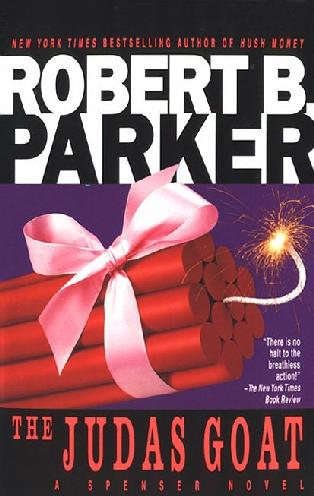
The two awful ones were Robert B. Parker’s The Judas Goat and Anne Easter Smith’s A Rose for the Crown. The Parker was a real and unpleasant surprise. I wrote recently about my long-standing fondness for this series and mentioned my interest in rereading some of the earlier ones. I don’t think I had ever read The Judas Goat before. If it had been the first time I ever met Spenser, our beautiful friendship would never have developed: I’m morally certain I would not have read another one in the series. I didn’t like the writing style, which seemed arch and insincere; I didn’t like Spenser, who seemed similarly arch and insincere, gratuitously violent, and also (to my surprise) sexist. To be sure, there are shades of the moral scrupulosity that I associate with him, but not enough. Most of all, I didn’t like Hawk–or, more accurately, I didn’t like the way Hawk is characterized here or the way he and Spenser interact. You can see a glimmer of the wry astute humor that infuses their zippy repartee in the later books, but I had the feeling that Parker hadn’t figured out how to do that yet. Plus Hawk kept on calling Spenser “babe,” which I found affected and annoying. The plot was not bad, and it is rare and therefore interesting to have Spenser abroad, but it was only loyalty that kept me reading to the end.

A Rose for the Crown was awful in different ways: it’s historical fiction of the thinnest variety, with tedious faux-antique dialogue, laborious exposition, and lots of forced emotion. I turned every page but by about half-way through I was skimming because I couldn’t bear to put in the effort to read every word. I figure I can count it as “read” for my summer tally because I also skimmed Reay Tannahill’s The Seventh Son, which was equally dreadful. Between them, calculating generously, you have something approximating the substance of a whole book. Honestly, I try to be open-minded in my reading, but I can’t understand the popularity of books of this type: who could not find the transparency of their efforts to be dramatic and affecting, not to mention the alternation between ploddingly pedestrian prose and a kind of loosely imagined old-fashioned idiom kind of insulting after a while? Compare something like The Children’s Book or Wolf Hall–or Waverley or The Heart of Midlothian or Romola: historical fiction can be so much more, and need not neglect originality of style or thought in order to tell a compelling story and animate our imaginings of the past. But I suppose they are no different from other fiction that has no aspiration to ideas, much less to art.

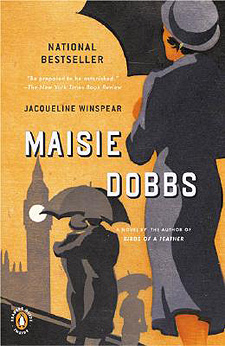
Maisie Dobbs is in the “mediocre” category. Perhaps it was a mistake to read it at a time when I have been reading a lot of much better writing about Britain during the wars. I would call it “Vera Brittain Lite, with a smattering of Dorothy Sayers (but absent her intellectual range).” How’s that for a cumbersome tag line? There’s nothing wrong with Winspear’s careful evocation of either WWI or its social and psychological after-effects, except that she is not a particularly good stylist (a lot of the novel seemed to be, again, striving after effects, rather than earning them) and so many of the notes she plays are so obvious if you already know anything about the context. Maisie is a reasonably interesting character, and reasonably well-drawn: one structural aspect of the book that surprised me was the amount of time spent going back over Maisie’s childhood and development. I wondered, in fact, if Winspear really wanted to write a “real” novel about someone growing up with these kinds of “Upstairs-Downstairs” issues, but thought it would be easier, either to write or to market, if this story were packaged as part of a detective novel. The detective plot is almost peripheral, and as the specific problem under investigation comes into focus, we are left sort of outside it, not knowing the steps Maisie has taken, for instance, to uncover it. I thought it was interesting that the case did connect the ostensible crime to the more complicated question of war and the damage it does–but there are far more original and compelling literary explorations of this (Pat Barker’s Regeneration trilogy, for instance). Maisie’s intense relationship with Maurice was not made compelling to me; it felt formulaic, perhaps because it reminded me too much of Cordelia’s relationship with Bernie in An Unsuitable Job for a Woman (which is a much better, more surprising, more literary mystery). So for me the book was just OK, but it had enough interesting aspects that I’m willing to read at least one more in the series, to see if they get better. I just hope Winspear got better editing later on. The book opens with a dangling modifier, for crying out loud (how does an editor at a major publishing house not flag and fix this?),  it is full of clichés (“Maisie felt a strong stab of emotion”), and it seems overwritten, as if the author doesn’t think we’ll get it, or if we do, that we won’t feel what she is anxious for us to feel (“a threat to the family of the woman she held most dear, the woman who had helped her achieve accomplishments that might otherwise have remained an unrealized dream”; “a feeling of anticipation and joy welled up inside her as she realized how very lonely it had been working without Maurice”; etc.).

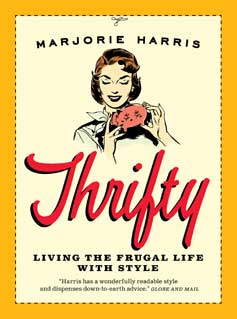
Finally, also mediocre was Marjorie Harris’s Thrifty: Living the Frugal Life with Style. I picked this up from the library because a friend recommended it to me enthusiastically, and I can see why she enjoyed the chatty style and the lifestyle advice, which is sensible and pleasantly concerned to differentiate “frugal” from “cheap.” Being thrifty, Harris argues, is about deciding what you really need, as opposed to what you merely want, and then focusing your efforts and controlling your finances so that these are the things you have. When I tell you that her list of “must-haves” is “delicious organic food, decent wine and candles,” you’ll understand that this is not in fact a book about things you really need in that you could not physically survive without them. That’s fine: we all understand that the real necessities include a roof over our heads, food on the table (organic or not), and so forth. Although there is some discussion in this book about how to understand and stretch your resources to make sure you can have these basics, it’s really more of an argument against foolish consumerism among those who have enough wealth to spend foolishly but might repent–by squandering it and ending up in debt, for instance. I like the idea of identifying priorities and being wary of the immediate but impermanent gratification of purchases that have no lasting value (not economic, again, as this is not really her focus, but value as in making your life better in the ways you really want it to be good). My own list would not include candles, but books, certainly, and music. So her advice for the “frugal fashionista” or the “frugal foodie” was not of much interest, but the general discussion of thrift was, as well as the repeated emphasis on putting your time and money where your heart is–including room for things you love and cherish for their beauty or other special qualities, for example, provided you do not do so at the expense of actual necessities. So far, fine, but the book is not really very well written (“she immediately turned [the fabric] into a suit for my brother and dresses for my baby sister and I” [emphasis ADDED]????–again, how is it that an editor did not flag and fix this?–and there’s trouble with modifiers again, here, too), it gets pretty repetitive, and some of the examples of “thrift” go a little too far towards justified self-indulgence. Great retro cover, though.

What a relief it was to turn to Testament of a Generation: The Journalism of Vera Brittain and Winifred Holtby, and to discover the gently painful delights of Jane Gardam’s Old Filth–about both of which, more later.

Decided! Books for ‘Mystery and Detective Fiction’

As you know, I’ve been tinkering for some time with the book list for this fall’s version of ‘Mystery and Detective Fiction.’ This course presents a special set of challenges for me because the range of options is so wide and because my patience for exploring the options runs out pretty fast.  I’ve also been asked to teach it so often since I first introduced it in 2003, and I’m always torn between the simplicity and efficiency of just using the same books as before and the desire for some change, not to mention the pricking of my conscience about trying to represent as many voices and styles in the genre as I can. After another round of suggestions, explorations, and cogitations, not to mention a very tedious search for a reader that included all of my ‘must have’ short fiction, here’s what I’ve settled on for Fall 2011. The order is in, so don’t you dare tell me what books would work better or what important writer I’m obviously missing. Actually, feel free to tell me. I’m sure I’ll be teaching the course again, probably as soon as 2012-13, and I might as well get the list started for the next round of ideas. Also, I emphasize in class that our list can’t even hope to be comprehensive even as a sampler: the stated goal of the course is to equip them with contexts, critical ideas, and reading strategies that will enhance their reading of any mysteries, so it doesn’t hurt to be able to mention other titles they should look at.

Classic Crime Stories: 13 Tales from Edgar Allan Poe to Lawrence Block, ed. James Daley

Wilkie Collins, The Moonstone (1868)

Arthur Conan Doyle, The Hound of the Baskervilles (1901-2)

Agatha Christie, The Murder of Roger Ackroyd (1926)

Dashiell Hammett, The Maltese Falcon (1930)

Ed McBain, Cop Hater (1956)

P. D. James, An Unsuitable Job for a Woman (1972)

Maj Sjowall and Per Wahloo, The Terrorists (1975)

Sara Paretsky, Indemnity Only (1982)

Walter Mosley,  Devil in a Blue Dress (1990)

McBain, Sjowall and Wahloo and Mosley will be brand new “preps” for me. I left An Unsuitable Job for a Woman off the list for this survey class last time, but it’s one of my own favorites and when I saw I could work the schedule to allow time for one more book, I decided to give it to myself as a treat as well as to the students as a striking contrast in theme and style to the greater minimalism (and testosterone) of McBain and the increase in hard-boiled tough stuff that comes with adding Mosley. This will be the first time I’ve offered the course without Ian Rankin’s Knots and Crosses, and I’ll miss that one for its blend of procedural conventions and literary material (it’s usually a student favorite, for the creepiness, too). And I’ve dropped Paul Auster’s City of Glass for now, with some regrets because it’s so darned clever–but that’s also the reason I won’t miss it. Looking at this list in chronological order I realize I’m not doing well at bringing it right up to date (1990 seems a lot more recent to me than it will to my students!). Oh well.

Robert B. Parker, The Godwulf Manuscript

It seemed appropriate to come back from Boston with a copy of Robert B. Parker’s first Spenser mystery, The Godwulf Manuscript. Though I’m sure I’ve read it before, it wasn’t in my own Spenser collection–which is actually pretty small, since I originally read them from my family’s copies back in Vancouver. The ones I own myself (and thus reread often) are all quite recent.

It was very interesting, therefore, to go right back to the beginning of the series. Right away, I was conscious of differences, particularly in the writing style. Over time Parker’s prose got more and more spare, especially his dialogue (I have joked that he seemed to be aiming for a book in which nobody actually has to talk at all, as they understand each other so well). The Godwulf Manuscript is downright verbose by comparison. There’s a lot more description of the setting and characters, with particular attention to what people are wearing:

Under one of the saplings a boy and girl sat close together. He was wearing black sneakers and brown socks, flared dungarees, a blue denim shirt and a fatigue jacket with staff sergeant’s stripes, a Seventh Division patch, and the name tag Gagliano. . . . The girl had on bib overalls and a quilted ski parka. On her feet were blue suede hiking boots with thick corrugated soles and silver lacing studs. . . .

A black kid in a Borsalino hat came out of the library across the quadrangle. He had on a red sleeveless jumpsuit, black shirt with bell sleeves, high-heeled black patent leather boots with black laces. A full-length black leather trench coat hung open.

There’s really no need for us to know any of this, unless it’s to establish how observant Spenser is. (Of course, for some of us, there’s a little nostalgic potential in this evocation of a college campus in the early 1970s–if it’s possible to feel nostalgic for flared jeans.) Spenser also talks to (and about) himself more, and he doesn’t act quite like the Spenser we know later on. He’s already a smartass and a good cook, but he’s more conventionally hard-boiled: a loner, a heavy drinker, and not too principled to sleep not only with the young student he’s supposed to be protecting but with her mother as well (to be fair, the mother comes on to him pretty aggressively, but the later Spenser would, I think, have resisted, and not just because of Susan). This is a bleaker Spenser, too, and now I’m curious about whether there’s any overt connection made between the ways he develops and his relationship with Susan–whom he meets in the second book, God Save the Child (which I now must find and reread as well).

Speaking of Susan, it was also interesting to note which of Spenser’s people are here right at the beginning: we meet Quirk and Belson right away, which I hadn’t remembered, but there’s no Hawk, for instance–is their meeting part of the plot of one of the early books, does anyone know, or is Hawk just there at some point? There’s no Rita Fiore yet, no Healy, no Farrell, no Vinnie. I think my favorite thing about the series is that it takes the lone cowboy model of its hardboiled predecessors and gives us instead a community of tough but righteous people who know by instinct what to do and are fearless about doing it. Spenser may go down the mean streets pretty much untarnished, but he’s not alone. Do you remember the original ads for ER, about these being the faces you’d want to see on the worst day of your life? That’s sort of what the Spenser group makes us feel, isn’t it, that if we were in some terrible, dangerous place, they are the ones we could trust to get us out alive, and then to see justice done? Their methods can be as ugly as their antagonists’ and there’s nothing particularly reassuring about a world in which this is the group you rely on, but they live by an unspoken code of honor that is always viscerally satisfying.

The Spenser-Susan relationship is my other favorite thing about the series. It’s as good an attempt as I know to imagine a fully adult relationship in which neither partner makes any compromises but instead each one consciously (if not always flawlessly) works to let the other be fully themselves, without apology. It’s true that it is, ultimately, Spenser’s series, and we follow Susan only in relation to him; there are also many occasions when she needs to be protected from physical harm by Spenser or, more often, by his associates (as he’s off solving the case, of course)–but then, there are also many occasions when her counsel is important to Spenser, and the strength of her psychological insight is often acknowledged and used. Their personal life is not the focus of the series (these are crime novels, after all), but Parker likes to mix it up a bit, as in Small Vices, which I recently reread, where Susan proposes that they have a child. Rather than using this as an opportunity for a dramatic change in either the characters or the basic commitments of the series, Parker makes it one more test of their commitment to letting each other be. That’s no small thing. In fact, in most relationships I know anything about, that’s one of the central challenges. I find it interesting that they keep their own homes. That means it is always a choice, an affirmation, when they are together; it also suggests that even romantic partnerships (and theirs is, undoubtedly, romantic!) need to have boundaries, and allow some time and space for complete autonomy.

I realize that it is possible, and not unjustified, to find this series repetitive. To some, its fidelity to its own formula even reaches the point of tedium–or worse. Recently at The Millions, for instance, Bill Morris gets pretty scathing:

the most rabid fans tend to insist that their favorite writers not only stick to their chosen genre but produce the same book over and over again.  That’s why we keep getting robotic, risk-averse re-writers like the late Robert B. Parker.

Predictably, as a fan (though not a rabid fan) I don’t think that’s entirely fair. The books are intensely similar but they are not the same, and the variations Parker plays on his themes show ingenuity and skill. Repetition also has its own significance: people do bad things for a narrow range of reasons, and setting things straight looks about the same every time. How could it not? One of the underlying points of all mystery series, too, is that a case may conclude, but crime never does. That said, I admit that one of the attractions of reading a new instalment in the series was always knowing basically what it would be like. It was like visiting old friends–and after all, do we expect our old friends to transform each time we meet them? One reason the late books could be so sparse and elliptical is precisely that we all knew each other so well: there was no need to explain. Why shouldn’t the successful establishment of that kind of trust and intimacy be counted a literary virtue as much as the ability of a writer to surprise us or subvert our expectations? Well, OK, I agree that it’s a greater achievement to do the latter, but it’s still no small achievement to do the former. No doubt it’s partly nostalgia that makes me defensive here: I’ve been reading the Spenser books for decades, after all–not quite since 1973, but since the 1980s for sure, and so it feels as if he and Hawk and Susan just belong in my life, somehow. But I wouldn’t have kept on reading and rereading the books if I didn’t think they were worth it, and I trust myself enough as a reader to believe that if they were no better than “robotic,” I would have noticed.

*Before some rabid fan points this out, let me say that I do know Spenser’s office is not at Berkeley and Boylston in The Godwulf Manuscript: he moves there later. I did not go so far as to tour all the Spenserian locations in Boston, though!

Sjöwall and Wahlöö, The Terrorists

I’ve just finished reading three more of the Martin Beck books by Maj Sjöwall and Per Wahlöö: The Abominable Man, Cop Killer, and The Terrorists, which are, respectively, numbers 7, 9, and 10 in the series. There are now only two I haven’t read (The Man on the Balcony and The Locked Room)–not by design but because they haven’t turned up in the library or at any of the used bookstores I haunt. I think that the eight I’ve read have given me a very good idea of the series as a whole, and my interest in and respect for what Sjöwall and Wahlöö do in it has only increased as I’ve read along. By the end of the final book the scope and intensity of their critique of contemporary Swedish society has finally become explicit. It is even, finally, articulated at length, rather than gestured at through repeated jabs by the characters and in the narration or through the accumulating examples of incompetence, hypocrisy, and stupidity we got in book after book. It’s interesting that it’s a relatively peripheral character who finally voices the most sustained piece of social criticism in the series. It is carefully prepared for, in The Terrorists, by the juxtaposition of an “actual” terrorist cell that engineers two political assassinations (one of which is ultimately unsuccessful) with a very different kind of attack by someone who, as her lawyer argues, may have committed murder but is best understood as a victim. The terrorists’ attacks are not glorified: in fact, we get a rare close-up of brutality from one of the main characters when two of them are finally cornered (I’m trying to avoid really explicit spoilers, as it is quite a suspenseful story!):

He felt the hatred welling up inside him, a wild, uncontrollable hatred against these people who killed for money without caring who they killed and why. . . . [he] proceeded to smash his opponent’s face and chest repeatedly against the wall. On the last two occasions, [the man] was already unconscious, his clothes soaked with blood, but [he] kept his grip and raised the large limp body, ready to strike again.

“That’s enough now,” says Martin Beck, but there’s no sign that anyone, including Beck, is surprised or moved in any way by the violence shown. In contrast, the alt-assassin is treated sympathetically–during her initial interrogation (which even seems the wrong term to use) Beck offers her food, proposes that they resume after she’s had a rest, and generally gives her every consideration. There’s no question that her action is political, in the broadest sense of the word. She aims (pun intended!) at the head of a state that has shown her only indifference or hostility through its pervasive but ineffective bureaucracies. Nobody in particular has done her any harm: the problems and injustices she faces are systemic. What recourse does one individual have, in such a situation?  “She realized,” her lawyer explains, “that someone must bear the responsibility”–and so she has acted, with a slightly pathetic naïveté. ‘It does seem a bit pointless,” one policeman remarks; “They’ll find another one just like him inside half an hour.”  But her lawyer suggests, that “she is wiser and more right-thinking than most of us.” It’s almost a call to revolution, except that it’s so carefully embedded within the particularities of the case and of the wind-bag lawyer that its risk is contained. Still, it’s out there, as an idea, and the direction of our sympathies towards someone who has basically turned political terrorist because of the repeated small ways she has, in her own private life, been terrorized, is consistent with the overall message of the series that violence generates violence, and that we should not be too quick to equate legality with justice.

There is quite a lot of violence in The Terrorists, some of it quite gruesome. The tone is never sensational, though, only dispiritedly matter-of-fact, even when a head decapitated by an explosion strikes an officer in the chest. The grim potential of these moments is also leavened by Sjöwall and Wahlöö’s characteristic dry humor, which perfectly conveys the attitude of rueful stoicism shown by most of the police officers. The one who is struck in the chest, for instance, is immediately upset about his nice suit. Later the head of a decapitated dog is displayed as evidence and the annoyingly smarmy and incompetent Superintendent, Stig Malm, “at once threw up on the floor,” a moment which gave me more gratification than it probably should have because his bad police work has cost a lot of lives across the series. The cynicism that drives the series is also on full display, as when the proceedings against the apprehended terrorists are described as “among the most farcical that had even been enacted in any Stockholm courtroom.” If we had any lingering idealism about the system that has failed the first accused assassin, it’s dispelled here. After the case and the evidence against the men has been presented, we get this:

“I oppose the arraignment,” said the defense counsel.

“Why?” asked the judge, a flash of genuine surprise in his voice.

The defense counsel sat in silence for a moment, then said, “I don’t really know.”

With this brilliant remark, the proceedings collapsed…

We end the book, and the series, on an ambivalent note. On the one hand, we settle down for a pleasant evening with four of our main characters,

just the kind of evening everyone hopes for more of.  When everyone is relaxed and in tune with themselves and the world around them. When everyone has eaten and drunk well and knows they are free the next day, as long as nothing too special or horrible or unexpected happens.

If by “everyone” we mean a very small group of humankind.

Four people, to be exact.

The restoration of order and domestic harmony promised by the form of the detective novel is offered but promptly rejected or subverted. Even if that harmony is achieved, it is only for the fortunate few, and even they enjoy it only precariously, only until it is broken once again. In the Martin Beck books, such happy moments actually happen often, but it seems to be a law that the more comfortable you are with your aquavit and your book, or your lover, the more likely it is that the phone will ring and pull you back into the corrupt world. What hope does one individual have against all the wrongs, all the injustices, all the stupidity? The one person who has taken a stand in this book has been labelled insane and locked away, destroyed, not helped. Martin Beck’s long-time partner, Lennart Kollberg, offers his friend some consoling perspective: “Violence has rushed like an avalanche throughout the whole of the Western world over the last ten years. You can’t stop or steer that avalanche on your own. It just increases. That’s not your fault.” “Isn’t it?” asks Beck. “Kollberg … looked at Martin Beck and said, “The trouble with you, Martin, is just that you’ve got the wrong job. At the wrong time. In the wrong part of the world. In the wrong system.” “Is that all?” Becky drily responds.

The final word of the series goes to Kollberg, and, as has been widely noted, is “Marx.” Certainly there’s plenty of disgust expressed for capitalism, by characters but also through theplots of the  novels and their typical allocation of guilt and innocence. The Terrorists even has a long screed against Christmas, which “had changed from a fine traditional family festival into something that might be called economic cheapjackery or commercial insanity.” The defense lawyer’s statement explicitly condemns the way “large and powerful nations within the capitalist bloc have been ruled by people …  who from a lust for power and financial gain have led their peoples into an abyss of egoism, self-indulgence and a view of life based entirely on materialism and ruthlessness toward their fellow human beings.”

Clearly these are books with a political agenda, and moments like these are didactic, riskily so. I think they are dramatically effective, however, because they are rare, and because the series shows no crusading or utopian zeal. In its world, systems are necessary. Bureaucracies are imperfect but essential. Some good police work is better than none; trying to find a just outcome is better than not trying. Change is slow. Work is hard. Patience is a virtue. Life is bleak, but there are small pleasures, like dinner with friends. Martin Beck has no illusions, but he still shows up every day and does his job. It’s an unimpressive but ultimately quite moving form of moral heroism.

I think I may choose The Terrorists for my class in the fall. Usually when approaching a series I assign the first one, as it often makes most obvious what is going to be different, how this author will bend and reshape the conventions of the genre. That also gets me out of the awkward backstory problem (teaching Gaudy Night, I’m always tempted to [and often do] interject with context from the previous books). But here, though I think all the ones I’ve read are outstanding, and Roseanna would be a really interesting book to read right after studying hard-boiled detective fiction and then Ed McBain, I think this one makes the political work Sjöwall and Wahlöö are doing most evident, and that is something that really does make their series distinct. It shows a conviction (one often echoed by today’s practitioners of the genre, such as Ian Rankin) that the detective novel really be both artistically effective and ideologically significant, and not just as a means for celebrating and protecting the status quo. That doesn’t mean Sjöwall and Wahlöö are necessarily successful or persuasive in every aspect of their project, but I think it will give us a lot to talk about.

ö