“Passion, plus craft”: Donald E. Westlake, The Getaway Car

getawaycarI’m glad I didn’t take Levi Stahl’s advice. If I had, I would have walked away from The Getaway Car, which is “the first book by Donald E. Westlake [I’ve] ever held in [my] hands.” Not that it seems like bad advice to get my hands on some of Westlake’s actual novels — indeed, reading The Getaway Car has made me quite enthusiastic about doing that! But a book in the hand is worth many dozens in the store (even if, as turns out not to be the case, my local bookstores had any Westlake on their shelves) or at the library (especially since my local branch is currently closed). So I blithely disregarded the advice to “stop right here” and read on.

And what a lot of fun I had! The Getaway Car is an anthology of Westlake’s miscellaneous nonfiction, and it is indeed miscellaneous: autobiographical fragments, letters, reviews, introductions (he wrote a lot of those). To me, as someone without his novels as a frame of reference or a set of touchstones, what struck me most was what a likable guy he seems to have been: even in what is the longest and probably the most conspicuously “expert” piece in the collection, his essay on “The Hardboiled Dicks” (originally a lecture at the Smithsonian), there’s not the slightest hint of pretension. Westlake’s letter to Howard Gotlieb of the Boston University Libraries, in response to a request to donate his papers, struck me as exemplary of his no-nonsense perspective on his own work. In the letter he expresses his “astonishment” that anyone would want to collect his papers, because he sees himself as a “writer,” not an “author”:

A writer, in my personal lexicon, is a commercial wordsmith, an active professional, a (if the word can be stripped of overtones) hack. An author, on the other hand, is an institution, a brand name, a reputation. John D. MacDonald is a writer. Saul Bellow began as a writer but has become an institution, an author. Arthur Miller has never been anything but an author. John Steinbeck, having resisted authordom, is a writer with an honorary author’s membership card.

 As for himself,

I’m a writer, with only the teeniest and most secret and ephemeral urgings towards authorhood. . . . all of the book-length writing I’ve done under my own name has been exclusively in a category of strictly entertainment writing, in which higher aspirations, even if they existed, are irrelevant.

There’s a cheerful pragmatism in this that’s refreshing in this era of heated (if largely manufactured) debates about “literary vs. genre fiction” — which is not to say that his comfortable assumption that there really are two kinds of writing, or at least two ways of approaching your writing, isn’t in its own way a potentially provocative contribution to just these debates.

Being a “hack” on his terms, though, certainly doesn’t mean being sloppy or careless. “In my opinion,” he says (or, at any rate, one of his personae says, in an entertaining “roundtable discussion” among them that he wrote up for Murder Ink) “the best writers are always people who don’t care about anything except telling you what’s in their heads, without boring you. Passion, plus craft.” A letter to David Ramus about the manuscript of that author’s first novel shows passion about craft:

Now I also think you need to do a little tweaking of story procedure, how you unfold it for us. Page 52 was way too late to introduce a flashback and then let the flashback wander. You say you’re going to tell us about the first time Ben met Dana, and then you tell us a bunch of other stuff for eight pages. I am very impatient during all of this. I don’t mind leaving prison to go to court, but if I’m leaving court, by this point in the story I want to get back to prison. . . .

Finally, I have one absolute objection. We do not overhear plot points. No no no. He just happens to be standing here when somebody over there says the stuff he needed to know. No. But if Ben wanted to know what was going on, and felt it was important, he could put himself at risk to deliberately eavesdrop. Almost get caught.

Don’t you feel you can trust a writer who has such a clear grasp of how the elements of fiction actually work? And then there’s his very endearing defense of the semicolon (my pet punctuation mark too):

I do want to rise to say a word or two for the semicolon. . . . My own rhythms tend to be long ones [mine too!], and I grant you that as a result I tend to over-use the semicolon, but some of them are right, and in most instances (in this book and others) the copyeditor’s alternative is less correct. . . .Why does everybody hate the poor semicolon? It’s nice; it’s useful; it’s even rather pretty.

 Equally endearing in its own way is that he has just the same tone when discussing the afterlife as when discussing plot points or punctuation:

Therefore, if I am to assume life after death, and if I am to further assume that the me over there would still be recognizably me, then I would like to meet O. Henry, Mark Twain, Ambrose Bierce and Dashiell Hammett, sit down with a bottle of beer — I won’t be on a diet then — and talk shop for a century or two.

The Getaway Car itself is full of “shop talk,” all of it brisk and opinionated without being overbearing. I took a special interest in the overview of the genre in his introduction to the anthology Murderous Schemes, because I’m always testing and refining the introductory framing lectures for my detective fiction course. (I think I got an exam copy of Murderous Schemes once, in fact, and ended up rejecting it as a course text because its taxonomy was a bit too different from the one I have settled on, though our generalizations converge easily enough.) And I paid special attention to his essay on hard-boiled detection, which I found useful as well as entertaining — and also thought-provoking. Talking about ways in which a genre can become exhausted if its form doesn’t undergo some kind of renewal, for instance, he holds out the ‘gothic romance’ as an example:

Several years ago [his essay is from 1982] there was a paperback fad for gothic romance, and an editor in the field told me one day about a book he was publishing — one of the four gothics from his house that month — that he was truly excited about because it was a bold breakthrough. “The girl isn’t a governess,” he said. “She’s the cook!”

There was no strength in those gothic romances beyond the ritual, so they soon withered and died. The Western had strength, and survived, and endured, and from time to time the very ritual itself leads to art.

Westlake comes across as a bit of a man’s man in these pieces (his final word on the afterlife is that, shop talk done, he’d “go off with Robert Benchley and look for girls”); if he ran with a different crowd, I wonder if he’d be so quick to see gothic romance as a form that had withered and died. Similarly, he ends the piece reflecting that the private eye novel has itself withered:

The brevity of the early Black Mask days is long gone. The relevance of those days is gone. The vitality of novelty is gone. The reflection of an underlying truth is gone. I’m not really sure what’s left.

Except the books and stories that started it all. Hammett reads as smoothly and honestly as he ever did. His contemporaries are just as lively, and not very much dated. Chandler retains his strength and his complexity. . . .

“The private eye novel may have become very strait-jacketed by ritual, but it’s certainly not dead,” he concludes. I wonder if he looked around and noticed that it was getting new life at that very moment from women writers like Sara Paretsky, Marcia Muller, and Sue Grafton. They brought a new vitality to the form because their perspective on it was novel, their underlying truth a somewhat different one. If Westlake were still around, I can imagine that it would be fun to sit down with a bottle of beer and talk this over with him.

Besides making me think Westlake is a guy I’d like to have met, The Getaway Car definitely made me think I’d like to read at least some of his books (he wrote an awful lot of them!) — I’m open to suggestions about where I should start. It also reminded me that I have yet to read any Ross Macdonald or any Rex Stout. I hadn’t heard of Peter Rabe before reading Westlake’s essay, but he made me curious (“Peter Rabe wrote the best books with the worst titles of anybody I can think of”). His “Ten Most Wanted” list is mostly books I haven’t read or hadn’t heard of, in fact, which is a bit discouraging considering how much time I spend reading, reading about, or talking about crime fiction. Also, why have I never read Thurber’s “The Man Who Knew Too Little”? I start my class every year now with “The Macbeth Murder Mystery,” but a little more Thurber can only be a good thing.

Just what I needed: more books to read! I’m glad I already read The Getaway Car, though, even if by some lights I should have deferred it. Many thanks to its editor Levi Stahl for my copy of it: congratulations on turning your obvious enthusiasm into something tangible that you can share with the rest of us.
Sue Grafton: W is for Wasted [Time]

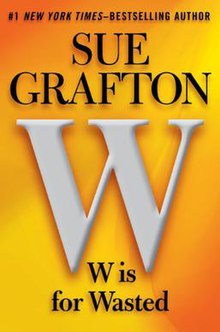
grafton-wIt’s actually a bit harsh to imply that reading W is for Wasted is a waste of time. Grafton is too good at her craft for that: the story is multifaceted and the elements unravel and then knit up together in a satisfying enough way. But it’s such a plodding book overall. First, Grafton seems to believe that she has to recap Kinsey’s history and living situation in detail every single time. Maybe she’s right about that strategically: not everyone reading W is for Wasted will have read A through V, after all, and she doesn’t want them to be confused or feel left out. That doesn’t make it any more interesting for those of us who already know all that. I’ve been trying to think how the other authors of long-running mystery series handle this continuity problem. That I can’t remember ever being bored or annoyed by, say, Robert B. Parker, or P. D. James, or Elizabeth George for the same reasons suggests that whatever they do about it, it’s somehow more artful. Grafton’s decision to keep Kinsey in the 80s also contributes to the boredom, I think: she and her life haven’t changed or progressed very far in the 30 years the series has been coming out.
Then there’s Grafton’s T. M. I. problem, which I’ve written about beforeW is for Wasted is just as lifelessly detailed as whichever one of her novels I was reading then. I’m not a fan of the silly “show, don’t tell” rule — but that doesn’t mean you have to tell us everything. There are examples of needless specifics on pretty much every page; here’s a representative bit from Kinsey’s arrival at a low-budget motel:

I unlocked the door and flipped on the light. The interior was dank. On the beige wall-to-wall carpet there was a ghostly foot path from the bed into the bathroom. A small secondary side road ran from the bed as far as the television set. I did a quick circuit. The heating and air-conditioning system, if you want to call it that, was a narrow unit installed just under the windowsill, with seven options in the way of temperature control. Heat: off or on. Cold: off or on. Fan: on, off, or auto. I tried to calculate the number of possible combinations, but it was way beyond my rudimentary math skills. The bathroom was clean enough and the motel had provided me two bars of soap, neatly sealed in paper. One was slightly larger than the other and was intended for the shower. I unwrapped the smaller one, standing at the sink. The chrome fixtures were pitted and the cold-water knob squeaked in protest when I paused to wash my hands. I felt a tap on my head and looked up to find water dripping slowly from a ceiling fixture. I unloaded my toiletries from the duffel — shampoo, conditioner, deodorant, toothbrush and toothpaste — and lined everything up on the vanity. True to form, there were no other amenities provided, so I was happy I’d brought my own. I tried the wall-mounted dryer and smelled burning hair.

I was getting a bit long in the tooth to stay in places like that.

 I’m getting long in the tooth waiting for you to get on with it! OK, I understand, you’re setting the scene, but (1) you really don’t have to, since Kinsey is going to spend exactly one night in this dive and nothing of significance will happen to her there and (2) even if for some reason you want us to be able to really picture it, you could pick some resonant details (the worn path on the carpet, for instance, and the smell of burning hair) and leave out the fan options, the number of bars of soap, and the list of her entirely predictable toiletries. The book is padded like this throughout, as if Grafton just can’t tell what to leave in and what to leave out:

I opened the bottom drawer and pulled out the telephone directory. I flipped to the Ss in the business listings and ran a finger down the page until I found “Santa Teresa Hospital.” There was a general number listed, a number for the emergency room, one for poison control, and then a few department numbers that could be dialed directly, including administration, billing, patient accounting, human resources, development, and public affairs.

Even setting aside the irrelevance of these details to the plot, who are the readers who need to be told this? She even makes sure to acknowledge the most mundane conversational moves:

Two rings, and he picked up.

“Is that you, Drew? This is Kinsey Millhone.”

“Hey, great! I can’t believe I’m actually talking to you.”

We spent a few minutes congratulating ourselves on finally managing to connect and then we moved on to the subject at hand.

We know how these things go, don’t we? We don’t need to be walked through them in what starts to seem like real time. I don’t see why a good editor wouldn’t point this kind of thing out. Maybe once you achieve best-selling status you don’t get interfered with by editors. Maybe I’m just too fussy. Maybe I just don’t like her style — except I don’t see this as a style but more as the complete refusal to be stylish. And one reason it frustrates me is that I think this labored method has smothered the fun of the series. I teach A is for Alibi often in my ‘Women and Detective Fiction’ seminar and it’s much more entertaining — brisk, tongue-in-cheek, and also innovative in its use of genre conventions. It’s also literally half the length of W is for Wasted. I often wish for more from the mysteries I read: more character development, more thematic richness, more interesting use of language. What I don’t want is just more words. I think I might not make it to the end of this alphabet.

“Aim at making everybody happy”: Ellis Peters, A Morbid Taste for Bones

Cadfael

“Aim, he thought, at making everybody happy, and if that’s within reach, why stir up any kind of unpleasantness?”

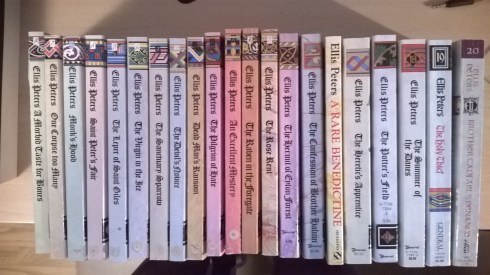
Thanks to the generosity of a retired colleague who is pruning her book collection, I recently came into possession of not one, not two, but all twenty-one of Ellis Peters’s Brother Cadfael mysteries. This series has long been on my radar, as it is beloved of many of my reading buddies including Colleen (formerly of Bookphilia, now of Jam and Idleness) and Steve (of Stevereads, of course!). I have made a couple of gestures towards it in the past, getting one or two from the library, but never actually read any. Who knows why: the timing just wasn’t right. But if this gift wasn’t a sign, I’m not a mediæval Welshman.

OK, so I’m not, but Cadfael is, and now that we’ve met at last I recognize his charm, and the charm, too, of the world and the style Peters creates for her readers. The cover describes A Morbid Taste for Bones as “a mediæval whodunnit,” and it is a lot closer to the puzzle form than the denser, more character-driven mysteries I typically choose for my own leisure reading (I never read Agatha Christie except for teaching, and I eschew the endless pageant of her “cozy” successors). I also don’t tend to like historical mysteries, which (like a lot of historical fiction generally) often strikes me, fairly or not, as either facile or encumbered with its research. (I accept George Eliot’s judgment that good historical fiction requires “the rarest concurrence of acquirement with genius.”) Peters deftly triumphed over my prejudices, though: the abundant research obviously required to present Cadfael’s world in such detail — from herbal remedies to weaponry to burial rites —  is deployed very naturally into elegant descriptions of setting and character, with more complex social or cultural contexts explained through natural devices such as Cadfael’s need, as a Welshman, to interpret or observe differences in custom between his countrymen and his Saxon colleagues.

Peters’s style tends a bit to the florid here (at one point Cadfael rushes into a room like the bolt from a crossbow and out again like a thunderbolt): I wonder, and even hope a bit, that as the series progresses she calms down enough to trust to her action to provide excitement, without insisting so much on it as the narrator. But that same instinct for rhetorical flourishes leads her into some nicely poetic moments:

The wood ridge on either hand ran in oblique folds, richly green, hiding the scattered house-steads. The fields were already planted, and here and there orchards flowered. Below them, where the woods drew back to leave an amphitheatre of green, there was a small stone church, whitewashed and shimmering, and a little wooden house beside it.

 Can’t you just picture it?

It bodes well for the rest of the series that I particularly liked Cadfael himself, especially his desire to work out a solution that satisfies justice without undue vengefulness and that also does as much good to as many people as possible. His benevolence doesn’t feel saccharine, because of his pragmatism and the ruthless wiliness of his schemes to uncover the evildoers. He’s also wry and uncompromising in his judgments of his fellow man, and I expect his dislike of men who use religion to serve their personal ends will be an ongoing theme.

I was particularly interested to see how Peters would deal with religion. All things supernatural are verboten in the puzzle mystery proper, of course. In their own ways, though, all the characters in A Morbid Taste for Bones are believers, and some of what they believe is explicitly supernatural (for instance, that the murder victim will bleed afresh if touched by his murderer). I thought Peters did a nice job conveying the centrality of her characters’ beliefs to their lives and to the ways they interpret the things that happen to them, even as she and Cadfael approach the crime itself as one committed by human hands for human reasons, and solvable by human reason and ingenuity. Brother Cadfael himself is quite prepared to believe in miracles, but it’s his intervention, not God’s, that reveals whodunit. At the same time, there’s just a hint that he and his collaborators may have been helped, or served, by the Saint whose bones are at issue in the plot. We don’t have to believe that, but it makes sense that Cadfael would be willing to, and so in that way Peters gets to have her mystical cake and eat it too.

I’m not going to binge read the rest of the series, since I have a lot of other books I’m keen to get to, but having sampled it at last, I’m happy knowing the rest of them are there waiting for me. Fall term is coming, and with it a lot of busy, stressful days when a little time with Cadfael will feel like a perfect time out.

Zoë Ferraris, Finding Nouf

noufFinding Nouf was one of my choices at Hager Books on my recent trip to Vancouver. I didn’t have any specific recollection of having heard about it before, but it turns out that a couple of people I know (well, know virtually, anyway) reviewed it when it was newly out, so perhaps that’s why the title caught my eye as I browsed the mystery section. I always have my eyes open for books that might bring a new twist on the genre to my detective fiction course — I’ve gotten more than a few good ideas from comments here and on Twitter over the years, including the Martin Beck books (now I routinely assign The Terrorists) and Walter Mosley (Devil in a Blue Dress is also now a staple). Inevitably in a course like this we talk a lot about common tropes and conventions; we work through some of the works that established the ones that are now central to the various subgenres of mystery fiction, and then we look at how those conventions can be used to explore a range of different issues that extend a single crime into a broader investigation — Sara Paretsky looks at systemic crimes like sexism and corporate corruption, for instance, Mosley at racism and structural inequities, Ian Rankin at the kind of social and political conflicts that have led some critics to call his Rebus books contemporary versions of the Victorian “condition of England” novel.

It looked like Finding Nouf might do something similar by using its specific crime (the murder of a daughter from a privileged family) to explore social and cultural issues in its own context, contemporary Saudi Arabia. To some extent it does exactly that: finding out what happened to Nouf involves exposing not just the nature of her very restricted life but her feelings about that life, and they are not happy ones. The story of her attempt to escape to a new life is not really as interesting, though, as the effect discovering her story has on Nayir, a friend of the family whose skills as a desert guide lead them to ask for his help while she is still missing, and who keeps on asking questions about her fate even after the family has asked him to stop. Though I didn’t find Nayir’s motivation convincing (at times, the machinery necessary to keep the investigation moving forward seemed pretty creaky), I thought his character protected Finding Nouf — which in some ways is very predictable — from some of the clichés that plague books about “life behind the veil” aimed at Western readers. If the only investigator were his accidental partner, Katya, the novel’s ideology would be a simpler one of resistance to the oppressions of being a woman in Saudi Arabia. But Nayir is profoundly pious — the sections told from his point of view are permeated with prayers and suras from the Quran — and conventional about women’s hidden lives and faces, and he is presented very sympathetically.

Katya, who both works and readily unveils, challenges his expectations and feeds his curiosity about women, while the revelations about Nouf help him sympathize with yearnings for something different. Their work together reflects the divisions of Saudi life (he has greater mobility and access to outside spaces, but only she can enter the women’s private spaces), but the fact of their working together defies it, which makes Nayir extremely uncomfortable at first but which comes to suggest (even to him) the benefits of freer interaction and greater equality between the sexes. It’s their story more than Nouf’s, then, which carries real thematic weight. To avoid spoilers, all I’ll say about Nouf’s case is that there’s a degree of misdirection that plays rather cleverly (or so I thought) on the likelihood that Western readers would expect the crime to confirm her status as a victim of women’s oppression, whereas the truth — while related to the context of women’s narrow lives — is more personal than political. (In this respect Ferraris’s plotting reminded me of Elizabeth George’s in Deception on His Mind). It’s a salutary reminder, if you like, not to take our categories of good and evil too simply for granted, a lesson Agatha Christie also teaches when she plays on, say, our trust in nice country doctors.

Finding Nouf had a lot of interesting aspects to it, then, but as a whole package it wasn’t entirely successful. There’s the creaky machinery, which I’ve already mentioned. Then the writing struck me as uneven: some of it is interesting and evocative, and there are many interesting “insider” details about life in Saudi Arabia that were vivid without being cheaply exoticizing (I particularly appreciated the cardamom-flavored Chiclets), but there were also soggy cliches and overwrought moments that didn’t do the work I think they were supposed to of ratcheting up the novel’s emotional intensity (“standing frozen in the hall, her heart split in half and lying on the ground”). The pacing seemed slow, the discoveries a bit protracted, though the novel itself is not that long. I have been wondering whether (as Mark Athitakis asks here) Ferraris would have done better to write a straight-up novel set in Saudi Arabia instead of  using the conventions of detective fiction, but on reflection I think it was a good instinct, given the potential of the genre to do the kind of exposé and critique Finding Nouf offers. It’s just harder than it looks to perfect the balance of form and substance, formula and novelty, that such a novel requires.

I can’t see myself assigning Finding Nouf in my class: it’s not interesting enough qua mystery novel for that. But I might try the second one in the series, just for myself, to see how Ferraris develops.

Elizabeth George, Just One Evil Act

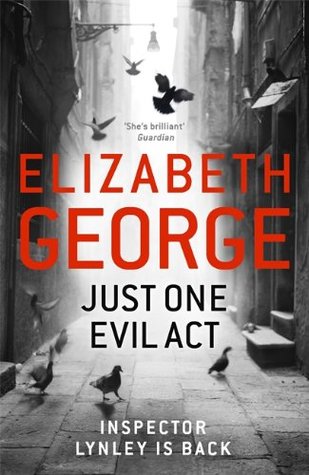
oneevilactThe last time I wrote about Elizabeth George here, after reading 2008’s Careless in Red, I said that “I turned to these latest instalments [in her series] motivated far less by curiosity about the latest corpse than by the desire to know how things are going” with her main characters: Thomas Lynley, Barbara Havers, Simon and Deborah St. James. I was tiring of the detective plots that ostensibly motivated the novels but that really just provided an excuse and an occasion for personal stories and character development. Then with 2012’s Believing the Lie I admitted that these private lives were also becoming a bit stuck for me: so much angst, and so many words (I have thought for a while that George’s books aren’t getting edited as stringently as I’d like). Still, she’s a writer I trust enough to keep trying — as I kept on going even after the disaster that was 2006’s What Came Before He Shot Her (a good enough idea, but, in my opinion, really unsuccessful in the execution). We’ve been in a reading relationship since 1988, after all: that’s a lot longer than I’ve known most of my actual friends, or my husband, for that matter.

This weekend I caught up on her latest, Just One Evil Act, and it made me glad I’ve stuck with her and this series, because I really enjoyed it. I think one reason it worked so well for me is that it combines case and characters: the crime story is a big tangled mess involving Barbara Havers’ friends and neighbors Taymullah Azhar and his (maybe a little too sweet?) daughter Haddiyah. The more Barbara in the case the better, usually (Deception on His Mind, in which Barbara operates solo, is one of the most interesting books in the series), and in this case her annoyingly endearing bulldog tendencies have a certain poignancy because she really has no other friends, so her attempt to find out what has really happened has an urgency that transcends professionalism. Not that Barbara usually toes the professional line, of course, but sometimes she just seems defensive and stubborn, whereas here she is defensive and stubborn and really vulnerable. An ongoing theme of the series is loyalty, too, and here it’s not just her devotion to her friends that drives the plot but Lynley’s to her that is tested (again) to the limit.

I also enjoyed following the action to Italy: much of it takes place in Lucca, which looks as lovely as George makes it sound. It was kind of a two-for-one deal, a Lynley novel plus a Donna Leon mystery, all in one! Lucca

I wonder if one reason I’m slow to pick up new mystery series these days is that I have been reading the same ones for so long — between Rebus and Kinsey and V.I. and Lynley and Dalgliesh (and, less faithfully, Banks, and Kincaid / James) I just don’t have room in my heart for many more! That’s not to say I haven’t read mysteries I’ve liked recently (I have Dorian and others to thank for putting me on to Tana French, and I’ll probably keep up with any new ones in Kate Atkinson’s Jackson Brodie series, for instance), but I have sampled a lot of others and just not felt inspired to go steady with them, even if they struck me as pretty good. It’s not altogether bad to know they are in reserve! I can have a big Maisie Dobbs phase later on, when some of my old standbys have retired.

A ‘Dark Love Letter to Iceland’: Hannah Kent, Burial Rites

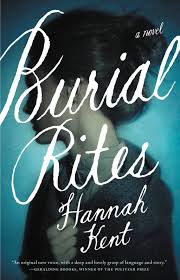
burialritesI’ve gotten pretty cynical about book blurbs, but when I see a cover adorned with high praise from not one but two of the smartest readers I know, how can I resist the temptation to read it for myself? (In fact, it’s probably because I’d seen Steve’s and Sam’s reviews in the fall that the title caught my eye in the first place, though they both write so darned many reviews that I didn’t specifically remember that Burial Rites was among them until I looked closer.) We don’t share all the same reading tastes, so it was still a bit of a gamble; I’m sure they will be relieved to know that I too thought Burial Rites was very good, so they retain their credibility! 🙂

Burial Rites is based on a real incident that took place in Iceland in 1828: a double-murder for which three people — a man and two women — were tried and condemned. One woman, Sigga, was pardoned; the other two, Agnes and Fridrik, were beheaded. Kent has researched the people, events, and locale extensively, but she has the gift of telling the story so that even though the documents from the case punctuate the narrative, it does not feel researched but lived. Agnes is her focus, and the novel begins when Agnes is moved from her primitive confinement to a farm where she is to be held in custody until her execution. The family charged with keeping her greets her with suspicion and hostility at first, but as they live and work together through a long hard winter, they come to see her as a woman with a story of her own, not just as a murderess.

Agnes tells that story herself (the novel alternates between her first-person narrative and the omniscient narrator). It’s a grim story of a lonely, love-starved life:

Oh, my foster-mother is dead and my own mother is gone. And I sit on the floor, my legs buckled with the pure, ripe grief of an orphan, and the wind cries for me because my tongue cannot. It screams and screams and I sit on the packed earth floor, hard with cold, and smell the fish-heads, sickening, lacing the bland scent of winter with their stench of salt and dried bone.

She asks to see a young priest, Tóti, who becomes the “final audience to her life’s lonely narrative.” He is told by the local administrator, Björn Blöndal, who is keen to make an example of Agnes, that “she has nothing that you need to hear unless it is a confession.” But Tóti believes he can serve her best by listening, and in doing so he brings her at least the comfort of having been heard — not just by him but, inevitably in the close quarters of the small farm house, by her custodians. In the end, in fact, it’s the farmer’s wife Margrét who hears her “confession,” or rather her account of what really happened the night of the murders.

It’s predictable that, incrementally, her audience (including us) comes to believe, not just that she’s human and thus deserving of our sympathy, but that she does not deserve the death she is not, in the end, to be spared. Kent strips her of any pathos, though: she may in some sense be innocent, but as Steve says, the revelations unfold with “an utter lack of sentiment.” Agnes herself is both reticent and fierce, with nothing of the damsel in distress about her. Accustomed to live without hope or comfort, she longs for her appointment with death:

I am sick with finality. It is like a punch in the heart, the fact of my sentence alongside the ordinariness of days at the farm. Perhaps it would have been better if they had left me at Stóra-Borg. I might have starved to death. I would be mud-slick, stuffed to the guts with cold and hopelessness, and my body might know it was doomed and give up on its own. That would be better than idly winding wool on a snowy day, waiting for someone to kill me.

But when it comes, it is not better than the waiting, and Agnes’s spiraling panic is wracking:

You will be lost. There is no final home, there is no burial, there is only a constant scattering, a thwarted journey that takes you everywhere without offering you a way home, for there is no home, there is only this cold island and your dark self spread thinly upon it until you take up the wind’s howl and mimic its loneliness you are not going home you are gone silence will claim you, suck your life down into its black waters and churn out stars that might remember you, but if they do not they will not say, they will not say, and if no one will say your name you are forgotten I am forgotten.

The jumps from third- to first-person narration are sometimes awkward, but it’s compelling to watch the gradual convergence of what we know of Agnes, from her own words, and what those living with her discover. As the execution approaches, there’s a different kind of drama as these perspectives grow apart again — having now shared her story, they can only stand by helplessly as she travels towards her fate.

In her acknowledgements, Kent says that she intended Burial Rites as a “dark love letter to Iceland,” and in that ambiguous goal I think she has succeeded: the novel reflects in its subject and its language the harsh, dramatic landscape it depicts. Iceland appears to be having something of a vogue (or maybe it just seems that way to me because I just read The Faraway Nearby), but this is hardly the language of tourist brochures:

Now comes the darkening sky and a cold wind that passes right through you, as though you are not there, it passes through you as if you do not care whether you are alive or dead, for you will be gone and the wind will still be there, licking the grass flat upon the ground, not caring whether the soil is at a freeze or thaw, for it will freeze and thaw again, and soon your bones, now hot with blood and thick-juicy with marrow, will be dry and brittle and flake and freeze and thaw with the weight of the dirt upon you, and the last moisture of your body will be drawn up to the surface by the grass, and the wind will come and knock it down and push you back against the rocks, or it will scrape you up under its nails and take you out to sea in a wild screaming of snow.

In this particular moment the description is infused with Agnes’s desperation in the face of death, and with the prospect of her own imminent reintegration into that frozen landscape, but there’s a bleakness to the whole novel, and to the whole account it gives of the struggle to live in such a cold, wild, unforgiving place. Agnes may be a prisoner of the law, but all of the characters are hostage to the climate, to the dark and wind and snow that makes the roads impassable and life barely supportable for so much of the year. Kent excels at scene setting so that we feel both the physical and the psychic stress of the characters: the warmth of a hearth seems like the possibility of love, while emotional deprivation brings a chill that the warmest blanket can’t ease.

For all the novel’s strengths, though (and once I got my bearings in it, I read it with rapt attention) I ended up wondering if, beyond its compelling account of who, what, and how, it was driven by much of a thematic why. The setting and characters are well developed, especially Agnes but also Margrét, but as the elements of the plot work themselves out, I couldn’t detect a strong layer of meaning behind them. What do we learn from Agnes’s story — about Icelandic society or history, for instance, or about issues of guilt, innocence, and morality? Burial Rites didn’t seem to me to be about an idea: it’s about a story, about making the most of it. “This novel has been written,” Kent says in her author’s note, “to supply a more ambiguous portrayal of this woman,” who has, she notes, been portrayed by many sources as “an inhumane witch, stirring up murder.” The scope of the novel seems limited, though, to providing that alternative version of an individual character: there are only gestures towards systemic issues about, for instance, class or gender. Agnes believes she is treated less sympathetically than Sigga (her co-accused who is pardoned) because she is older and seems more knowing than Sigga. Inquiring into the case, Tóti hears that “she was always fixed on bettering herself.” But there’s no consistent sense that Agnes is really being punished for transgressing, either as a woman or a servant. The case as she tells it is intensely personal, and limited to the passions and jealousies of the small circle involved. Though its materials are rich, and richly rendered, it’s not a book that does something with them besides dramatize them.

This Week In My Classes: Canons and Complications

unlessMy classes aren’t meeting at all today, thanks to the “weather bomb” we are currently enjoying. It is uncanny how many storms have come through on Wednesdays this winter! And it’s an unpleasant surprise to get a big one this late in the term. The bright side seems to be that it’s supposed to warm up significantly by the weekend, so we can hope that all this snow will just be a bad memory before too long.

What is it interrupting? Well, in Intro to Prose and Fiction we’ve moved on to Carol Shields’s Unless, a novel I appreciate more and more the more time I spend with it. It’s not an in-your-face kind of novel, but (appropriately, given its themes) its sharp edges can take you by surprise: a modest-seeming story about a woman writer rethinking her life and work because of a family crisis, it’s also a commentary on women’s writing and the literary canon, and on women writers and literary culture. Reta is seeking an explanation for her daughter Norah’s decision to drop out of ordinary life and sit speechless on the curb holding a sign that says only ‘GOODNESS.’ In a series of increasingly acerbic letters to intellectuals, writers, and critics (never actually sent) Reta connects Norah’s rejection of the world with the world’s indifference (or worse) to women. To the magazine that has run an advertisement for a series called “Great Minds of the Western Intellectual World,” for instance, Reta writes,

I have a nineteen-year old daughter who is going through a sort of soak of depression . . . which a friend of mine suspects is brought about by such offerings as your Great Minds of the WIW, not just your particular October ad, of course, but a long accumulation of shaded brown print and noble brows, reproduced year after year, all of it pressing down insidiously and expressing a callous lack of curiosity about great women’s minds, a complete unawareness, in fact. . . .

I realize I cannot influence your advertising policy. My only hope is that my daughter, her name is Norah, will not pick up a copy of this magazine, read this page, and understand, as I have for the first time, how casually and completely she is shut out of the universe. I have two other daughters too — Christine, Natalie — and I worry about them both. All the time.

To the author of an article on “The History of Dictionaries,” she observes “there is not a single woman mentioned in the whole body of your very long article (16 pages, double columns), not in any context, not once.” In wry anticipation of the VIDA counts (and their critics), she notes,

Bean counting is tiring, and tiresome, but your voice, Mr. Valkner, and your platform … carry great authority. You certainly understand that the women who fall even casually under your influence (mea culpa) are made to serve an apprenticeship in self-denigration.

 And later, addressing the author of a book review who calls women writers “the miniaturists of fiction,” she says,

It happens that I am the mother of a nineteen-year-old daughter who has been driven from the world by the suggestion that she is doomed to miniaturism. Her strategy  is self-sacrifice.

The letters punctuate the story of Reta’s reconsideration of her own writing: in particular, she is working on the sequel to her earlier work of light fiction, My Thyme is Up; in our class reading, we’ve just arrived at her conclusion that her new novel, “if it is to survive, must be redrafted,” so when we meet again on Friday I hope we’ll be able to have a good discussion about how and why Reta wants to write a different kind of book, with different kinds of options for her heroine, Alicia. Then next week we’ll consider her editor’s advice that she rework it to make it “one of those signal books of our time” — by making Alicia’s fiance, Roman, the central character:

‘I am talking about Roman being the moral centre of this book, and Alicia, for all her charms, is not capable of that role, surely you can see that. She writes fashion articles. She talks to her cat. She does yoga. She makes rice casseroles.’

‘It’s because she’s a woman.’

‘That’s not an issue at all. Surely you — ‘

‘But it is the issue.’

‘She is unable to make a claim to — She is undisciplined in her — She can’t focus the way Roman — She changes her mind about — She lacks — A reader, the serious reader that I have mind, would never accept her as the decisive fulcrum of a serious work of art that acts as a critique of our society while, at the same time, unrolling itself like a carpet of inevitability, narrativistically speaking.’

‘Because she’s a woman.’

‘Not at all, not at all.’

‘Because she’s a woman.’

Clipping these bits out on their own makes the novel sound more didactic than the experience of reading it actually is, partly because Shields plays around with the form of the novel, partly because the other anecdotes and memories Reta shares with us implicitly raise the questions these more pointed sections address explicitly, so that the book reads like an ongoing dialogue — internally, for Reta herself, and then with us — about what we look for in fiction, how we judge what we find, and how those questions are affected by gender. We’re reading it right after A Room of One’s Own, and many of the questions are the same: what (where) is the women’s literary tradition, what is the place or effect of anger in literature, how are our notions of literary greatness tied to ideas about scale? (Shields said “Jane Austen is important to me because she demonstrates how large narratives can occupy small spaces.”)

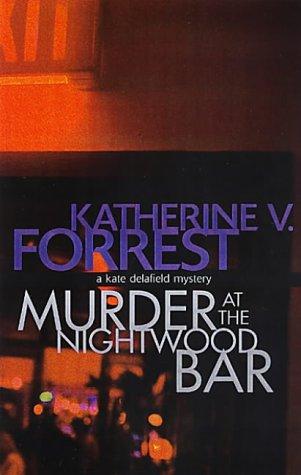
forrestIn Women & Detective Fiction, this week’s reading also raises questions about literary canons and standards, and how we decide what is worth reading and discussing, but in this case it does so more accidentally. I’m not someone who believes that we should assign only the books we believe to be The Greatest (even if we individually felt we could be confident about our standards). Universities are in the business of education, not adulation, and plenty of works that we might feel falter on some grounds are plenty interesting and significant (historically, theoretically, formally) on others. Courses vary in their purposes, too, and the best and most relevant conversations don’t always emerge from the most elegantly crafted narratives. Still, I do sometimes find my principles conflicting with my actual reading experience, and that’s how I’ve felt with Katherine V. Forrest’s Murder at the Nightwood Bar, which has been our class’s reading for the past week.

Murder at the Nightwood Bar is one in a series with inarguable significance (“First, first, first,” emphasizes Victoria Brownworth in her recent profile of Forrest), and it deals explicitly with questions of sexual identity and systemic discrimination both through its closeted detective (alienated, thus, both from her follow officers and from the lesbian community she engages with during the investigation) and through the crime itself. It sets up lots of good points of comparison with our other books, from the detective’s struggle over getting too personally involved with the case (or people involved in it) to the connections it makes between individual crimes and systemic injustices. As far as all that goes, I have no regrets about having added it to the syllabus this year. I just wish it were better written — yes, that awkward evaluative measure! Better at what, to what ends, as I’m always asking? In this case, I just mean “better at the words”: especially during the patient rereadings required for class prep, it has seemed stilted and inartistic, sometimes tediously so. I’ve felt no temptation to discuss anything that’s not literal about it: not its form or its style, not its voice, its attention to setting, none of those “literary” aspects. Mind you, it’s not the first of our readings to make that kind of reading seem beside the point: Agatha  Christie is also not particularly literary. But Christie’s prose has a clarity and economy that gives it its own (superficial?) elegance. That said, while Forrest may not be as good a stylist, her materials are more challenging — her agenda is more ambitious, and she gave us much more to talk about than Christie did, even though Christie is, of the two of them, the one who is obviously part of the ‘canon’ of detective fiction. Not every course can or should be a tour of “the best that has been thought and said” (as if we could be sure what those examples are — as Woolf says, “where books are concerned, it is notoriously difficult to fix labels of merit in such a way that they do not come off”). My goal is always to find the readings that are the best for my purposes, which in this case include considering a wide range of different examples of detective fiction by women as well as examples that are in fruitful conversation with each other when collected on the syllabus. My hope is that they will also reward close reading and rereading. At this point, then, I’m ambivalent about Murder at the Nightwood Bar, then, which certainly serves the first purpose but doesn’t quite fulfill my hopes for the second.

Josephine Tey, Brat Farrar: ‘Who are you?’ ‘Retribution.’

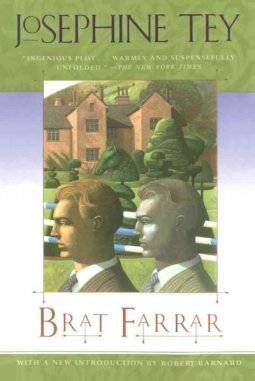
Brat Farrar

I’ve been rereading The Daughter of Time for decades, so it’s odd that until now I had never read another novel by Josephine Tey. Mind you, in some respects The Daughter of Time is sui generis. And indeed all Brat Farrar has in common with it is Tey’s refreshing prose and keen eye for character.

If I were writing one of those annoying sales blurbs for Brat Farrar, I’d describe it as “The Talented Mr. Ripley meets Flambards.” I’m reading it now, in fact, because it was one of two titles I came up with as follow-ups to my book club’s reading of Ripley: I went scouting for other books connected to it in some way (which is part of our selection process), and I discovered that there were two other classic suspense titles from around the same time featuring imposters and identity theft: Brat Farrar and Daphne du Maurier’s The Scapegoat. My book club voted for du Maurier, but I was too tempted by Brat Farrar not to order it as well.

Aside from the structural similarity of one man impersonating another, though, the two novels could hardly be more different, and of the two, much as I admired and enjoyed Highsmith’s deadpan sociopathy, it’s Brat Farrar that plays more to my personal tastes. For one thing, Brat — odd as he is — has a conscience, and so in this case a lot of the tension in the novel arises from his own discomfort with the fraud he’s perpetrating:

 He felt guilty and ill at east. Fooling [the lawyer] Mr. Sandal — with a K. C. sitting opposite you and gimletting holes in you with cynical Irish eyes — had been one thing. Fooling Mr. Sandal had been fun. But fooling Bee Ashby was another thing altogether.

Both protagonists are driven by a desire to belong, but in Brat’s case there’s a poignancy to his yearning:

He lay on the bed and thought about it. This sudden identification in an unbelonging life. He had a great desire to see this twin of his; this Ashby boy. Ashby. It was a nice name: a good English name. He would like to see the place too: this Latchetts, where his twin had grown up in belonging quiet while he had bucketed round the world, all the way from the orphanage to that moment in a London street, belonging nowhere.

 Later, when he’s well along in establishing his stolen identity, he is unexpectedly moved by a simple gesture from “his” Aunt Bee:

No one else had taken his hand in just that way. Casual but — no, not possessive. Quite a few had been possessive with him, and he had not been gratified in the least. Casual but — what? Belonging. It had something to do with belonging. The hand had taken him for granted because he belonged. It was the unthinking friendliness of a woman to one of her family. Was it because he had never “belonged” before that made that commonplace gesture into a benediction?

What Brat wants is not just to “belong” to a family but also to be part of the larger story Latchetts represents. Ashbys have lived there for generations: the estate — established but unpretentious, like its family (who will never change their traditional inn rooms for better ones when they attend the local agricultural fair) — represents the continuities and privileges of English country life. Brat is drawn into the scheme initially because he learns Latchetts is a stud farm and horses are his one love. This sets Tey up to include lots of horsiness in the novel, just for its own sake and for the fun of show-jumping and racing. But horses have histories, and thus they also embody that sense of lineage and tradition that Brat cherishes about Latchetts. He spends happy hours, in his new life as an Ashby, poring over the stud books: ironically, it’s his genuine passion for this part of the family lifestyle that makes him a better fit as master of Latchetts than Simon, the “brother” he displaced by showing up on the eve of Simon’s coming-of-age and bilking him of his inheritance.

Simon’s resentment at “Patrick’s” return from the dead is perfectly understandable, in the context of that displacement, and it stands to reason that as the one who loses the most by regaining his brother, he would be Brat’s chief antagonist — the chief skeptic about whether this young man who looks so much like him, and who knows so much about their family, their history, and their home, can actually be his long-lost brother. Surely it’s the heir who ought to represent and fight for the integrity of the line. That Simon’s resistance is both stronger and stranger than is completely accountable on those terms occurs, after a while, to Brat and to us, and thus the more sinister question arises: where was Simon when Patrick disappeared, presumably to his self-inflicted death? Could it be Simon himself who is the threat to the family and the estate? Is it possible that — what would it mean if — the interloper is a better Ashby than the one he supplants? How might Brat’s invasion become a tribute to the lost son of the house with whose life — and death — he increasingly identifies himself? “Out here in the open,” he reflects while riding the hills around Latchetts,

it had a reality that it had never had before. Up here, on that straggling path on the other side of the valley a boy had gone, so loaded with misery that this neat green English world had meant nothing to him. He had had horses like Timber, and friends and family, and a belonging-place, and it had all meant nothing to him.

For the first time in his detached existence Brat was personally aware of another’s tragedy.

“From being vaguely anti-Patrick,” he realizes, “he had become Patrick’s champion.” When he later confronts the man he holds responsible for Patrick’s death and is challenged to offer something “in return for my confidences,” he completes his transformation from invader to defender of the family:

“Who are you?”

Brat sat looking at him for a long time.

“Don’t you recognize me?” he said.

“No. Who are you?”

“Retribution,” said Brat.

But would exposure really be best — for the Ashby’s, for Latchetts, for his own hope of belonging? How can he prove his suspicions without revealing his own crime? And what’s to be done about the “sister” who arouses feelings in Brat that are not at all fraternal?

Some day the foundation of the life he was living here would give way; Simon would achieve the plan he was devising to undo him, or some incautious word of his own would bring the whole structure crashing down; and then there would be no more Eleanor.

It was not the least of his fears for the future.

Is there any hope that Brat can escape from the trap of his own making into a world where he really does belong and can be loved as himself? As Tey works her ingenious way through her story, the suspense of the crime plot becomes less interesting than the emotional and moral puzzle she’s created. And it’s beautifully fitting that the solution to that mystery, to “the problem of Brat,” turns on looking back through the records for connections and continuities that might turn a calculated deception into an unexpected restoration.

Holiday Reading

Happy Canadian Thanksgiving! It is a beautifully crisp sunny fall weekend here: I treated myself to an amble through the Public Gardens on Saturday, where the gold-tinged foliage provided a lovely backdrop for the remaining bright flowers. The Gardens are my favourite spot in the city, a perfect place for “a green thought in a green shade.”

PublicGardensOct13

LoneBloom

For one reason or another, I was feeling pretty grim by the end of last week, so I decided to treat the holiday weekend like actual time off from my day job. This means that although today I have had to turn my attention back to reading for work (The Big Sleep and Jane Eyre are up next week), I managed to get through two books just for fun. They are polar opposites, too, which made it just that much more entertaining to read them one after another.

venetiaThe first was Georgette Heyer’s Venetia, which a number of Heyer fans I know have identified as one of their favorites. It also came up in a discussion here in the summer about whether Heyer’s books ever get sexy, as opposed to romantic. I thoroughly enjoyed Venetia: it is brisk and witty, which is typical, but also full of lines of poetry (which is not quite so typical). It also has a more adult heroine,  and it does have more of that frisson that I was wondering about: “She had not enjoyed being so ruthlessly handled,” Venetia reflects after the first, quite improper, kiss,

but for one crazy instant she had known an impulse to respond, and through the haze of her own wrath she had caught a glimpse of what life might be. . . . if Edward [her dull suitor!] had ever kissed her thus! The thought drew a smile from her, for the vision of Edward swept out of his rigid propriety was improbable to the point of absurdity. Edward was sternly master of his passions; she wondered, for the first time, if these were very strong, or whether he was, in fact, rather cold-blooded.

Meeting her morally problematic mother, Venetia is struck by her lacy lingerie:

It was not at all the sort of garment one would have expected one’s mama to wear, for it was as improper as it was pretty. Venetia wondered whether Damerel would like the sight of his bride in just such a transparent cloud of gauze, and was strongly of the opinion that he would like it very much.

Well! Hardly the ruminations I’m used to from a Heyer heroine! And much later, when the usual convolutions of the plot have been managed, she “melts” into her rakish lover’s arms:

He held her in a crushing embrace, fiercely kissing her, uttering disjointedly: ‘My love — my heart — oh, my dear delight! It is you!’

It was a bit of a relief to be able to enjoy the courtship plot without any shadow of concern that the heroine seemed just a bit too young and naive to play her part in it. But it was Venetia’s smart independence that made the book particularly delightful for me: she doesn’t appreciate anyone making decisions or speaking for her, and she doesn’t hesitate to do what she thinks is best to orchestrate the outcome she desires.

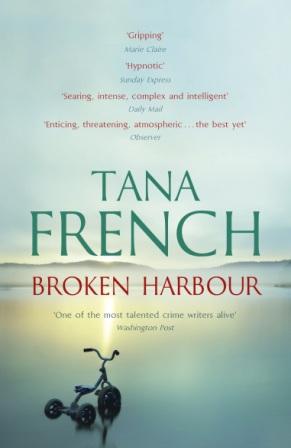
brokenMy other book was Tana French’s Broken Harbour. It seems odd to call it ‘fun,’ as it is just as dark and intense and frightening as the other books in her Dublin Murder Squad series. It’s also just as well and artfully written, with just as convincing and distinct a narrator and just as complex and psychologically fraught a plot. By the end, though, I found I was actually a little weary of the melodrama and the self-consciously brooding interiority, the heavy-handed revelations and insistent reminders of just how much the case resonated with (and screwed up) the detective. Rattling off my first impressions on GoodReads, I found myself wondering if my problem is related to the subgenre of crime fiction French is working in: I don’t usually read suspense novels or psychological thrillers, and Broken Harbour is as much of that kind as it is a detective  novel or police procedural. I found myself eventually skimming a bit through the confessions and backstories just to find out what had actually happened and what would come of it. This is my way of saying “it’s not you, it’s me,” I suppose! But the novel did seem too long (not unlike some of Elizabeth George’s more recent ones). There is an awful lot French does brilliantly though: setting, in particular, and the theme of people becoming desperate as they try to hang on to their dreams, or to reach the futures they yearn for — at whatever cost, it often turns out. French is definitely the best new crime writer I’ve tried in a long time — so thanks especially to Dorian for bringing her to my attention!

And now it’s back to work, though I will pick out something to read in the interstices. My book club has chosen The Talented Mr. Ripley for our next meeting, so it might be that, though I also recently picked up Beautiful Ruins (which looked like it might be refreshingly different).

What P. D. James Talks About When She Talks About Detective Fiction*

pdjamestalkingaboutI finally picked up P. D. James’s Talking About Detective Fiction, which I’ve been mildly interested in reading ever since it came out in 2009. I say ‘mildly’ because I’ve read all of James’s novels (some of them multiple times) as well as her autobiography and numerous interviews with her, not to mention essays, critical articles, and reviews about her work. I’ve also read quite a bit of historical and critical material on detective fiction more generally. So I didn’t expect any revelations from this little volume.

And there really aren’t any, although (because after all, James is both sharp and experienced!) her potted history of the genre is enriched by some interesting digressions on issues or writers of particular interest to her. She opens with a disclaimer — that she has “no wish to add to, and less to emulate, the many distinguished studies of the last two centuries,” aiming only at a “short personal account.” I actually wished her account had been more personal, as the survey material was so very familiar to me, whereas her commentary on, say, Ngaio Marsh, was more idiosyncratic and thus more thought-provoking:

Reading the best of Ngaio Marsh, I feel that there was always a dichotomy between her talent and the genre she chose. So why did she pursue it with such regularity, producing thirty-two novels in forty-eight years? . . . Marsh was a deeply reserved, indeed in some respects a private person, and she may well have felt that to extend the scope of her talent would be to betray aspects of her personality which she profoundly wished to remain secret.

 Her chapter on “four formidable women” of the Golden Age was in fact one of the most interesting parts of the book for me, along with her remark – made quite in passing – that if she’d begun her own series today “it is likely that I would choose a woman [detective]” as the main character. I find James somewhat evasive (here and elsewhere) on the gender politics of crime fiction. She says very little here about the woman detective she did create, Cordelia Gray (I think the only explicit reference to An Unsuitable Job for a Woman is in her discussion of setting), but I think it is widely agreed that in the second Cordelia Gray book she backed away from the feminist potential of the first, making Cordelia a much more conventional character and also much less effectual as an investigator. In the context of Kate Miskin, James has talked about the Met being a “very masculine organization,” though, and about the different experience women have of policing than men. In her chapter on the “four formidable women,” she emphasizes their work as “social history,” but also what they tell us of “the status of women in the years between the wars.” Then about Sara Paretsky (whom she calls “the most remarkable of the moderns”) she says,

No other female crime writer has so powerfully and effectively combined a well-crafted detective story with the novel of social realism and protest.

To me, James seems tempted towards a more explicitly feminist approach, but her Dalgleish novels, rich as they are as examples of social (and especially moral) exploration, have no air of “social protest.” It’s fun to imagine what kind of books — what kind of female protagonist — she would have given us if she had, as she imagines, started writing today!

But Talking About Detective Fiction is not the place to look for sustained analysis of either feminism and detection in general or of gender issues in James’s novels — or, indeed, of any aspect of detective fiction. Overall, the book is just an amiably brisk tour of the genre, and not even a very thorough one, as it spends a lot of its time on Golden Age figures, a bit on the hard-boiled turn, but none explicitly on, say, the police procedural (the subgenre to which most of James’s own novels belong). The discussion of recent developments in the genre has a haphazard quality because James draws her examples only from the writers she happens to have read –she makes the disarmingly honest comment that “new novels are being reviewed with respect, many of them by names unfamiliar to me.”

Still, if you didn’t know anything about detective fiction beyond the examples you yourself happened to have read, this would be a fine place to start, and it would give you lots of leads to follow up for further reading. (She completely convinced me that one Father Brown story is not enough.) And I admit that the absence of surprises or revelations was actually reassuring for me: it means I’m probably doing a decent job sorting things out for my Mystery & Detective Fiction class. As it happens, it turns out I’ve actually been using an excerpt from the book as the epigraph for my syllabus for many years — because I transcribed it from a lecture James gave in 1995 at the Smithsonian (once available online):

In his book Aspects of the Novel, E. M. Forster writes,

‘The king died, and then the queen died’ is a story. ‘The king died, and then the queen died of grief’ is a plot. . . . ‘The queen died, no one knew why, until it was discovered that it was through grief at the death of the king.’ This is a plot with a mystery in it, a form capable of high development.

To that I would add, ‘Everyone thought that the queen had died of grief until they discovered the puncture mark in her throat.’ That is a murder mystery, and it too is capable of high development.


*I feel as if I should apologize for reworking this tired titling trope. That the book really is called Talking About Detective Fiction made the temptation irresistible, but I promise not to do it again. Twice is enough! And, as my penance for being so unimaginative, I also promise never to title a post with any variation on the “Keep Calm and Carry On” meme either — fair enough?