
On Facebook there’s a meme going around of people posting a list of the albums that inspired or defined their teenage identities. One thing all the lists I’ve seen so far have in common is that they’re all pop music of one kind or another. I wonder if that’s because it’s a genuine rarity for a teenager to listen to classical music, or jazz, or folk, or opera — or because popular music is in some sense more personal, or speaks more immediately to mood and time and place.
My own teenage listening was a pretty odd mixture. I probably listen to more pop music now than I did in high school. I was an opera lover from a young age, and the music I heard at home was most often classical or folk: my parents deny ever being hippies, but their record collection certainly bore signs of their having lived in Berkeley for much of the 60s, with lots of Joan Baez, Bob Dylan, and Peter, Paul, & Mary. During my high school years, most of my family was quite involved in international folk dancing. My father and I, more specifically, were involved with a group called the “Philhellenic Dancers”: we met weekly to learn and practice dances from all regions of Greece, and a subset of the group, including the two of us, gave performances in restaurants and at festivals, including a few times at Greek Day. (As almost none of us were actually Greek, I have thought a lot about this group in light of current debates about cultural appropriate. But that would be — maybe will be — a separate post some day.) 
In Grade 11, I started working part-time at The Magic Flute, a classical record store that for many years was a Vancouver institution: this was a job that both reflected and supported my orientation towards classical music. My first gig there was doing inventory, for which I was paid in store credit. The fruits of that labor are now boxed up in my parents’ basement. With vinyl making a comeback, maybe I should finally get the boxes shipped out here for sorting. (I can’t find any photos of the store online, but I did find this clip of its graphic logo, which was on all our shopping bags and on the cover of the mail-order catalog that I assembled and edited for many years.)
A ll of these activities and interests infused my listening life. I didn’t have any sense of disdain for whatever the top 100 might be; I just didn’t pay that music much attention. I knew and liked some older stuff: when Simon & Garfunkel did their reunion tour in 1983, for instance, I lined up overnight with a friend to get floor tickets, and enjoyed their B.C. Place concert from our spot maybe 3 yards back from the stage. I got to be good friends with Veda Hille (now an original and successful musician in her own right) and she introduced me to the Beatles (imagine needing an introduction to the Beatles in the mid-80s, but I did), and then when we were co-editors of our high school year book, we listened to a lot of David Bowie while developing photos in the darkroom. Other people’s influence brought in other music: my boyfriend was a Eurythmics fan, for instance (I died my hair purple to go with him to their concert — though since my hair is naturally quite dark, the result was more like a purple aura than a bold statement). It was Vancouver in the 80s, so perhaps Bryan Adams fandom was inevitable, and when Born in the USA came out, my best friend and I put it on our Sony Walkmen and listened to it over and over. (That friend liked to get out and have some fun, so she is also the reason I saw Michael Jackson live when the Victory Tour came to Vancouver.)
 But there really isn’t a list of 10 albums that for me made up a distinct soundtrack of those years, at least not one that really speaks to who I was. Instead, there are particular songs or albums that now have astonishing power to summon up different periods of my life. It’s remarkable how music can do that, isn’t it? A song comes on and suddenly there you are immersed in a whole set of feelings, as if you are being dunked into a vat of memory. These are often not songs that are personal favorites – what matters is that for some reason they became part of a moment in time for me. I was in the grocery store yesterday, for example, and Billy Joel’s “I’m Moving Out” came over their annoyingly loud sound system — and I was instantly back in the New Kent Hotel in London, where my sister and I stayed at both ends of our 6-month tour of Europe in 1986. (I just looked it up, and what do you know: it’s still there.) It was really a kind of hostel, with a lot of long-term guests, many of them Australians on work visas, and the ones we roomed with played Billy Joel a lot. In the photo you can see the Bryan Adams poster my best friend gave me to take along, to remind me of my roots (I guess). I took photos of it on display in a lot of different hostels! The song brought it all back to me, perhaps because I don’t think I have ever played it myself in any other context: I remember all the excitement and anxiety of being on that big adventure.
 Sarah McLachlans’s “Building a Mystery” is another really evocative song for me. It’s on her album Surfacing, which came out the year Owen was born. I was up a lot at night nursing, and I used to play it softly as I rocked with him. It was a hot summer, and I was equal parts miserably exhausted and desperately in love with this new little person. If I hear songs from that album without warning — especially “I Love You” or “Angel” — I am liable to get teary, though I’m not sure why these memories are quite so poignant. Maybe it’s the sense of distance, the realization of just how much has changed, and how inexorably time keeps moving forward. Then there’s Enya’s “Caribbean Blue,” which my husband and I danced to at our wedding rehearsal dinner in 1992: an unlikely choice, perhaps, but it is a waltz and it had become one of “our” songs. One of our first joint activities (cliché alert!) during our daringly brief courtship was taking ballroom dance classes together, so we actually did a pretty good job of our dance, if I may say so myself! Of course I can’t hear that song now without remembering what a happy weekend that was, as our friends and family gathered around us to wish us well. We walked down the ‘aisle’ (we were married in a restaurant, so it was pretty informal — the plan had been to use their waterfront garden, but it rained) to one of Dvorak’s string serenades: this, along with my turquoise silk dress, helped make the ceremony itself seem less clichéd!
 Although I listen to music almost all the time now, there’s little that has the same emotional power over me: I have to go deeper into my past to get the same effect. I wonder if it’s just that the more immediate events and their associations haven’t yet distilled into part of my history. There is certainly some music that is fundamental to my life — that I have loved for so long, that has given me so much pleasure, that when I hear it it restores me to myself. At the top of that list would be Joan Sutherland’s 1962 recording of La Traviata: my parents gave me the highlights LP as a birthday gift in 1972 and I cherished it even before I had the honor of getting Sutherland’s autograph on the cover years later. (Richard Bonynge’s autograph is on the back: I still feel a bit embarrassed about how indifferent I was to his offer to sign it too, but I was 9 and Sutherland was my idol.) No piano music has ever displaced Chopin’s in my heart since I first tried to learn some of his easier waltzes as a student: practicing the A-major Polonaise in the little room I signed out in the music building helped me sustain myself emotionally during my terrible first year of graduate school at Cornell. And speaking of graduate school, The Proclaimers’ “I’m Gonna Be (500 Miles)” promptly delivers me back to my friend Bernie’s green pick-up truck and all the times we drove in it across the Catskills to my sister’s house in Mamaroneck…
I think my problem with the “10 albums” meme is not that there is no soundtrack to my teenage years but that my teenage years were just a few in a much longer musical history, an idiosyncratic collage of constant listening. What about you: are there songs or albums that invariably recall either high school or some other memorable moments in your life?
 It starts to feel as if I have written a lot of these ‘start of the term’ posts: I’ve used up every variation I can think of for titles! It’s in the nature of academic work to be cyclical, though, and on the bright side, this term I am doing one all-new course, so at least you can look forward to some novelty in my teaching posts!
 I’ve sometimes wondered if I should have had a plan, or developed one, in order to give Novel Readings a more definite identity. In the decade since I launched this blog, I’ve seen quite a lot of articles or posts giving advice on blogging, and the key to success is apparently having a mission, or filling a specific niche — along with posting on a regular (and frequent) schedule, and keeping your posts under 1000 words. (Hey, I’m 0 for 3!) I do think the hybrid identity of Novel Readings — which is not really, or at least not just, a book blog, and not really, or not altogether, an academic blog — has probably limited its appeal, because for some bookish people there’s no doubt too much academic stuff here, while for some academics, there’s too much book talk (or, too much book talk that’s not sufficiently academic).
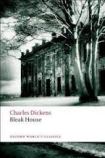 So: what’s up for this winter term? Something old and something new. I’m doing another iteration of 19th-Century British Fiction (Dickens to Hardy), beginning, this week, with Bleak House, which I haven’t taught (or read) since 2013. I was so sad to read Hilary Mantel identifying Dickens as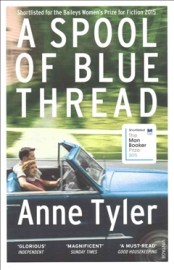
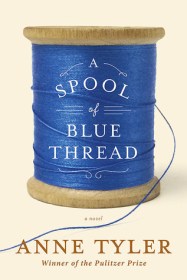 A Spool of Blue Thread is chronologically wider-ranging than some of Tyler’s novels, which means it has a wider range of characters and some sense of being not just a personal story but also an American story — not as overtly as Smiley’s Some Luck and its sequels, with their relentless chronological march through American history, but still, we get a sense of people shaped by different eras, from the Depression through the Sixties and into the 21st century. I liked the novel’s structure, reaching back into the past and then back yet again, so that we first meet the characters and then learn more about how they came to be who they are, or to be with who they’re with (a process that turns out, in some cases, to be much more fraught than the cherished family stories reveal).
 I think that’s what, for me, makes Tyler an author whose new books I always seek out, in spite of (or maybe because of) the strong family resemblances between them. They are all books about people coming to terms with life, which is, after all, what most of us are doing ourselves, most of the time — and the wry, resigned tenderness of her storytelling seems to me a model for how we ought to approach both ourselves and others: with honesty, but also with kindness and humor.
 We don’t stay up until midnight on New Year’s Eve anymore. I can’t remember when we gave up on this tradition, exactly. The last New Year’s Eve I specifically remember was 1999-2000: remember the Y2K panic? We didn’t really expect a dramatic catastrophe on the stroke of midnight, but it was hard not to wonder just what would go wrong. I think we rang in the New Year a few times after that, but there came a point at which it was just too obvious that nothing significantly changed with a new date, and also while the children were small, staying up late on purpose when we were already tired all the time didn’t make much sense. This is one way in which I have broken with my upbringing: to this day my intrepid parents and whoever’s celebrating with them stand out on their front porch in Vancouver and listen for the ships in the harbor to tell them when it’s officially midnight, then bang enthusiastically on pots and pans — a ritual I participated in with glee for many years. (To my knowledge, none of our neighbors ever complained.) I don’t think they still have Pêches Flambées for dessert, though: that used to be the showy finale to our elaborate New Year’s Eve dinner.
 Anyway, here we are now, writing 2017 instead of 2016 but otherwise puttering along more or less as usual. For me, that means getting things in order for my winter term classes, which begin on Monday — a week later than is typical, which has been a real boon. The campus itself, including the administrative offices, opened up this week, so I’ve been able to get handouts printed and copied and all kinds of other preparatory business done, including a trek across campus to scout out the room where I’ll be teaching ‘Pulp Fiction,’ which is in an unfamiliar building. Will that preemptive action ward off anxiety dreams about getting lost en route? Here’s hoping.
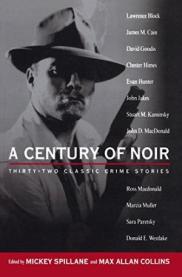 The very first reading we’re doing, though, is a nifty little short story by Lawrence Block called “How Would You Like It?” I often begin the fiction unit in an introductory class with Kate Chopin’s “The Story of an Hour”: it’s really short, but also full of things to talk about, so it makes a great warm-up exercise. It didn’t really fit ‘Pulp Fiction,’ though, so I hunted through my anthologies looking for something else equally brief that would help us get some key literary terms on the table right away while also (hopefully) catching people’s interest. I found the Block story in an excellent anthology called A Century of Noir; though it actually isn’t exemplary of noir, I liked that it was twisty as well as short, so I thought I’d try it out. One of the topics I always address early on is point of view, along with the different options for narrators; the story will work well for that, and it also provocatively introduces questions about vigilante justice that we will be discussing with both our Westerns and our mystery readings.
 My other course this term is 19th-Century British Fiction from Dickens to Hardy. As regular readers will know, I do this class (or its prequel, 19th-Century British Fiction from Austen to Dickens)


 2016 has been a somewhat unusual reading year for me because quite a few of the books I read were ‘assigned’ for reviews — or else were books I chose not entirely because I wanted to read them but because they looked like books I could pitch for reviews. Although at times I ended up feeling a bit stifled as a result, because it felt as if reading obligations were crowding out reading pleasures, at other times it meant a thrill of discovery, as a book or author I wouldn’t otherwise have read turned out to be wonderful. This was also a sign that as a writer I was being pushed in new directions and, as a result, learning new skills and finding (I hope) new strengths — about which, more in my next post on my year in writing!
 Book of the Year:
  Inspired in part by The Portrait of a Lady, I finally read Colm Tóibín’s
  Another author I discovered thanks to a prompt from someone else was David Constantine: Scott Esposito asked me to review
  Finally, Gerald Durrell’s
  I finished my first full viewing of both

 Lovely as Durrell’s scenery is, he’s at his best (as you’d expect) with animals:
 Perhaps, then, the child’s point of view (though of course the sophistication of the writing subtly belies it) is one reason children have loved this book. Another would be its humor: when things do happen, they are usually very funny. There’s some high drama, as well: the epic battle, for example, between the gecko Geronimo and the giant mantid Cicely:
 In case you were wondering why it has been so quiet here at Novel Readings, I’ve been grading papers industriously, trying to get through them as efficiently as I could consistent with still paying really close attention. I did well at sticking with it, partly thanks to my students, many of whom wrote really good essays! Not only does that speed things up, but it makes the whole process more enjoyable.
 Before I put this term completely behind me, though, one question lingers after hours spent poring over student writing: what’s up with apostrophes? Actually, I have two questions, because my follow-up to that one is, should I care about apostrophes?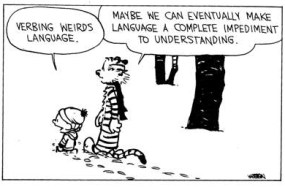
 Novel Readings