“The Sensation of a Near-Miss”: Maggie O’Farrell, I Am, I Am, I Am

iam-iam-iam

Instead of an intimation of mortality, what is solidifying, taking root inside me, is something else, a welding together of this place with the sensation of a near-miss, an escape from something beyond my control. The feeling of having pulled my head, one more time, out of the noose becomes intermingled with, indivisible from, the mimosa trees, the goats, the wave that turned me over, the toasted-resin smell of cinnamon bark.

I don’t know what I expected, really, from Maggie O’Farrell’s I Am, I Am, I Am. Its subtitle is Seventeen Brushes with Death and the book offers exactly that and no more: seventeen vignettes about moments in O’Farrell’s life when it was (whether she knew it in the moment or not) a toss-up whether she would live or die–or, in the episode I found most difficult to read, whether her daughter would. She offers no larger framework, either of narrative or of meaning; the insight of the book is nothing more or less than what Doctor Lydgate offers Mr. Casaubon in Middlemarch: “one can hardly increase appreciably the tremendous uncertainty of life.”

Mr. Casaubon is, understandably, unconsoled by Lydgate’s remark. I didn’t pick up I Am, I Am, I Am looking for consolation–and a good thing, too, because if anything, it turned out to be a book finely calculated to exacerbate my everyday anxieties–but I did expect it would add up to more than it did. Its point is intrinsically episodic, I suppose: things happen, dangerous things, scary things, things that start out benign but take a sudden turn for the worse, and the more we realize that basic fact of our existence the more we can appreciate that we are–somehow, for now–still alive instead of dead. “We are, all of us,” O’Farrell observes,

wandering about in a state of oblivion, borrowing our time, seizing our days, escaping our fates, slipping through loopholes, unaware of when the axe may fall.

Her aim, I think, is just to breach that oblivion and thus to heighten our awareness of both the “tremendous uncertainty of life” and its potential for beauty and grace, which may themselves emerge from the shadow left as death once again recedes.

iam-iam-iam-2It’s inconsistent, I realize, to say that I found I Am, I Am, I Am disappointingly slight and to say that I’m also glad it did not fall into philosophizing. But my dissatisfaction and my relief actually go hand in hand: it’s hard to be profound, and books that try and fail seem worse, to me, than a book with fewer pretensions. That’s why I preferred Atul Gawande’s Being Mortal to Paul Kalanithi’s When Breath Becomes Airthough of course I was moved by Kalanithi’s story and he writes much more poetically than Gawande. What O’Farrell sets out to do, she does beautifully, I thought: for once, I agreed with the blurbers who said they couldn’t put the book down, and that’s not just because a lot of the vignettes are quite suspenseful, like miniature thrillers. It was just a genuine pleasure to read O’Farrell’s prose. It’s not ornate or elaborate; its moments of eloquence, its shivery effects of fear or joy or release, come from its precise details–a smell, a touch, a word or phrase in just the right place. She nearly drowns swimming in the Indian Ocean:

I am aware, first, of being pulled sideways, as if on a sleeper train. The current is drawing into itself, gathering together, with abrupt and decisive force. I right myself in time to see the beach pulling away from me, like disappearing theatre scenery. . . .

The wave turns me over like an acrobat, like St. Catherine in her wheel. I feel my feet lift, feel my body invert, my head pooling with heat and pressure. There is a sharp blow to the side of my face and my eyes, shut tight against the salt, streak with technicolour, my teeth snapping together over my tongue. The noise inside a riptide is astonishing, a rushing, deafening rumble of water, air, pressure, force.

An armed robber in Chile holds his knife to her throat and she is “aware of the onion-tang of his armpits.” During a terrifying emergency c-section, when she “can feel hands rummaging through my innards, as far up as my ribs,” a man whose official role she never knows takes her hand as she lies engulfed in “loneliness, isolation, bafflement”:

His touch is infinitely gentle but firm and sure. There is no way he is letting go, he is telling me, entirely without words. He is going to stay right here and I am going to stay right here. I clutch at him with the force of a drowning woman.

“The people who teach us something,” she reflects about that incident,

retain a particularly vivid place in our memories. I’d been a parent for about ten minutes when I met the man, but he taught me, with a small gesture, one of the most important things about the job: kindness, intuition, touch, and that sometimes you don’t even need words.

In the book’s final episode, as she and her husband frantically drive towards a hospital in Italy, all she can do is hold their daughter, who has had a severe allergic reaction:

The delicate features of her face are sunken, swollen, distorted. Her hands clutch mine but her eyes are rolling back in her head. I touch her cheek, I say her name. I say, stay awake, stay with us.

Her own brushes with death, terrifying as many of them are, have (in the telling, at least) an artistic distance wholly undone in this final chapter: the fear she has felt for her own life pales beside her desperation to preserve her child’s. Once she is a parent herself, she better understands how her own mother sometimes clung to her:

We’re on the platform of the local station, I have my backpack at my feet and the branch-line train is coming through the tunnel. I’m about to get onto it and I won’t be back for a long, long time. She doesn’t tell me not to go but the grip of her fingers on my shoulders is the same: heartfelt, insistent, infused with the awareness that I was always going to leave, that we both knew, on some level that the urge had always been in me.

Accidents, illness, evil: O’Farrell has faced, it seems, more than the average share of all of these, and that in itself makes her memoir interesting. As in her fiction, she moves deftly between past and present, in the larger structure of the book and within individual chapters; through these anecdotes of escaped fatality, we get many pieces of a more conventional memoir of her childhood, including her life-changing bout of encephalitis, her awkward growing up, and her discovery that writing is the work that will define her life and give it meaning. In many ways I Am, I Am, I Am reads like a fitting culmination of that story. Still, I can’t shake my own lingering sense that O’Farrell has left the book somehow incomplete–that she, and we, ought to learn more from all those near misses, or that she should have done more to earn our attention to them than just surviving or enduring. Yes, life is uncertain: now what? But at the same time I understand: there is no enveloping story to be told about it all. It just is. We just are, until we aren’t.


This Week In My Classes: Tears and Tough Guys

We’re back from our February break and now nothing stands between us and the end of term except everything we have to get done before then!

In the short term, that means pressing on with East Lynne in “Victorian Sensations.” The portion we are reading this week could be subtitled “Crime and Punishment”: Lady Isabel, having, in a fit of jealous pique, abandoned her kind but somewhat distracted husband for a handsome cad, has been living abroad, miserable and repentant, for a year. Things only get worse after she gives birth to the sad little baby who could have been legitimate if only her lover weren’t such a complete jerk. How much of a jerk is he? Well, after initially hiding from her the news that her divorce is final so that she can’t insist he marry her, he then tells her that he can’t lower himself to marry a divorced women–even though her husband’s grounds of her divorce is her affair with him! Double standards ftw.

On the bright side, by that time she wants nothing more to do with him–even though her only other options are poverty, despair, and death. Then [spoiler alert] a train wreck (a bit conveniently, we thought) kills the poor baby and everyone thinks it has also killed Isabel, so she is free (if that’s the right word) to roam the world like a miserable, repentant ghost…an opportunity she uses to go back to the home and children she abandoned, where thanks to the literally defacing effects of the accident and her “grief and remorse,” she is able to serve, unrecognized, as her own children’s governess under the management of her husband’s new wife.

Although I am more and more convinced that East Lynne is overall a pretty bad novel, it is certainly a provoking one, and our discussions have been much livelier than Isabel herself ever is. Our previous two novels have offered significant critiques of the many constraints on Victorian women’s lives–economic, social, political, and sexual. The most transgressive women don’t necessarily fare well–Marian Halcombe, for instance, may outwit her enemies and climb around on rooftops in the first half of The Woman in White but she loses her gumption in the second half and ends up happy just to be an honorary aunt, while Lady Audley is “buried alive” (metaphorically! but still…) for her sins. Still, it’s impossible to read either of those novels and not appreciate these subversive characters as contrasts to the tedious passivity of their more angelic counterparts. Isabel’s grievances, on the other hand, are mostly in her mind, and while we can see that things would have gone better for her if she’d been differently raised and more self-sufficient, it’s hard to conclude that she’s anything more than a cautionary tale. “Oh reader, believe me!” exclaims our narrator:

Lady–wife–mother! should you ever be tempted to abandon your home, so will you waken! Whatever trials may be the lot of your married life, though they may magnify themselves to your crushed spirit as beyond the endurance of woman to bear, resolve to bear them; fall down upon your knees and pray to bear them: pray for patience; pray for strength to resist the demon that would urge you to escape; bear unto death, rather than forfeit your fair name and your good conscience; for be assured that the alternative, if you rush on to it, will be found far worse than death!

Lady Isabel certainly thinks so: she is not so unladylike as to pray for her own death, the narrator reassures us, “but she did wish that death might come to her,” which seems rather a hair-splitting distinction to me. I think my students would be glad if she used her undercover job as a chance to strike back at the woman who has taken her place, as Lady Audley surely would in such a situation–but alas! From here to the end of the book things are only going to get more miserable, for her and thus for us.

Lady Audley has a closer cousin in Brigid O’Shaughnessy, whose acquaintaince we are just making in Pulp Fiction. Like Lady Audley, she’s a dame making her way in a man’s world, using her beauty as a resource, playing the damsel in distress (the noir version of the angel in the house!) when it suits her purposes and showing her more demonic side when she can’t win any other way. Sam is a better match for her than Robert Audley is (at first) for Lady Audley, though, because he is never under any illusions: he’s always suspicious, of everyone, and so never beguiled by her beauty. Or is he? One of the subtler mysteries of The Maltese Falcon is whether he does in fact love her–a question which in its turn provokes more questions about what exactly we mean by “love.” “If they hang you, I’ll always remember you” may not sound very romantic to us, but coming from Sam it’s a lot, I’d say. And yet of these two novels I think it is The Maltese Falcon that–if only implicitly–puts the higher value on idealism and tender feelings. By the end of Lady Audley’s Secret it’s pretty clear that to be a hero Robert has to toughen up and fulfill his role and duties as a real man. Sam lives up to a similarly hardhearted standard in The Maltese Falcon, but I always find Effie’s “broken” request that he keep his distance–“You’re right. But don’t touch me–not now”–suggestive of the price he has paid, as is the fate he faces with his own shiver of distaste: “Iva is here.” Braddon’s novel concludes, as she blithely declares, with “all the good people happy and at peace.” There’s little peace and even less happiness for Sam.

This Week In My Classes: February Break

bones-season1Not only is February a short month already but it includes two of the winter term’s time-outs (times-out?): Munro Day and Reading Week. Because February is often one of our most difficult months weather-wise, it’s usually a big relief to have the pressure ease up at work a bit, even if there’s always still plenty to do. This year, the February weather actually hasn’t been that bad, but the change of pace is welcome just the same.

So what’s on my to-do list for this week? Well, of course, though there are no classroom hours, I still have teaching-related work to do. The students in Pulp Fiction turned in their first formal assignments last week, and I’d like to make a dent in my portion of them before lectures start up again. They’ll also be wanting details about their next assignment soon, so I will be finalizing the topics and instructions. Then I have to be ready to go for next Monday’s class, which means rereading our first installment of The Maltese Falcon and refreshing my lecture notes–which reminds me that I also need to post the topic for their next Reading Journals in time for them to write on it for Monday, which is just the kind of routine business it’s easy to lose track of when we aren’t otherwise following our weekly routine! For Sensation Fiction, I need to keep rereading East Lynne and prepare some notes for our class discussion. In this class I have the luxury of a group of students who are generally both well prepared and keen, so I get to play coach and prompter more than teacher, which is as it should be (but isn’t always) in an upper-level seminar.

east-lynne.jpg

I’d have all that to do even if we didn’t have a week “off.” But in that case I wouldn’t also be hoping to write a book review (I finished reading the book for the first time this morning, so that’s one task well underway), and I wouldn’t have been able to schedule nearly two full days’ worth of meetings–I’m one of two members of an “internal review committee” for the MFA in Creative Nonfiction at King’s. Reviews of this kind are a regular part of academic life; I’ve been on many such committees doing reviews of individual departments in the Faculty of Arts and Social Sciences and this year my own department is itself the subject of just such a review. The review I’m working on now is on behalf of the Faculty of Graduate Studies, but the process is basically the same; we’ve got a lot of documents to read and this week we will be interviewing faculty, staff, and students. It’s a program I’ve taken a peripheral interest in since it was launched, so I’m glad to be getting a closer look.

Finally, in terms of formal obligations, I have two reference letters to take care of a.s.a.p. This has been kind of a slow year for reference requests (though that can always change). I think one factor is that fewer and fewer students are asking me for letters to MA or PhD programs (and thus for letters for SSHRC funding). Students applying to graduate programs need multiple letters, as do graduate students moving into the academic job market, so when their numbers decline there’s an exponential decline in references. One reason I don’t have a lot of these requests this year is presumably that I’m not teaching in our own graduate program right now, so I’m not a highly visible resource for them, but I’ve also stopped actively encouraging students I know to apply for MA or PhD programs. This puts me somewhat at odds with some of my colleagues, who in response to the decline in applicants to our own MA and PhD programs (and thus a corresponding slump in admissions) have been urging the rest of us to do what we can to improve the numbers. If students approach me about graduate school on their own, I’m happy to talk over the pros and cons and support them if they are sure about their direction, but knowing what I know, I just can’t bring myself to recruit them. (On that topic, I thought this recent piece in University Affairs did a good job pointing out some problems with the narrative about how valuable PhDs are for non-academic jobs.) In any case, more of the letters I’ve been asked for in recent years have been for options such as Dal’s MLIS or MPA programs, as well as (as always) for law school and education degrees.

devils-cubI haven’t started a new book since I finished Tinker, Tailor, Soldier, Spy, though I did reread Georgette Heyer’s Devil’s Cub last week after recommending it to a Twitter friend looking for a Valentine’s Day present for his wife. I hope she liked it! Sometimes I reread just the final third but this time I started from the beginning. It does take a little while for all the pieces of Heyer’s plot to get lined up, but once they’re in place it’s comedy gold, I think, and also pretty romantic–though YMMV depending on your tolerance for bad boy heroes. (But Mary is so having none of his self-indulgent nonsense!) It’s also good preparation for teaching Lord of Scoundrels, which will be up in Pulp Fiction in just a few weeks!
Then when I’ve had enough of feeling busy and just want to relax and be entertained, I’m watching Bones, which I am really enjoying. It’s strangely perky for a show about grisly deaths and serial killers! The plots can be kind of absurd (I just finished Season 3, and the whole Gormogon plot was pretty annoying, especially the twist ending!) but I like the camaraderie between Booth and Bones a lot. Although I have avoided more specific details, I do know that their relationship eventually changes, but for now what I like best about it is precisely that it is a partnership and not a romance. The idea that a man and a woman actually can be just colleagues and friends seems not just realistic and refreshing but, in this #metoo era, valuable.

And that’s how my February break looks from here! I’ve had busier ones, and snowier ones: this one looks like it might be a good balance of useful work and welcome diversion, with minimal shoveling.

“This Blind Night Walk”: John Le Carré, Tinker, Tailor, Soldier, Spy

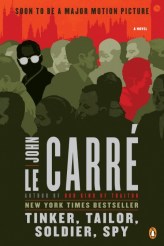
tinker-tailor

He did not like to leave her there in the dark, swaying under the trees, so he walked her halfway back to the house, neither of them talking. As he went down the road, he heard her humming again, so loud it was like a scream. But it was nothing to the mayhem inside him just then, the currents of alarm and anger and disgust at this blind night walk, with God knew what bodies at the end.

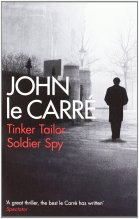
Like The Spy Who Came In From the ColdTinker, Tailor, Soldier, Spy uses its spy-thriller plot as a vehicle for the exploration of character. It has a more intricate and layered plot, though, and it involves a larger cast of characters, so in both respects it makes greater demands on the reader–and the reader reaps correspondingly greater rewards. Because it takes so long to unpick the knot at the center of the novel, we have more time to recognize the stakes, and to appreciate the toll such protracted suspicion and interrogation–of the past, of other people, of one’s own motives–take on everyone involved, but especially on George Smiley, who is an unlikely and often unwilling protagonist in this quest for ugly revelations.

I was fascinated by the structure of Tinker, Tailor, Soldier, Spy. It begins not at the beginning, and not in medias res, but afterwards, when everything it is ostensibly about has already happened. It is a drama, then, not of action but of hard-won retrospective understanding–of memories, scattered, repressed, and painstakingly (often painfully) collated until the whole story is finally present and can be brought to its uneasy resolution. Collation is a strange form of heroism, but then Smiley–“small, podgy, and at best middle-aged”–is a strange kind of hero, with his unsettling blend of avuncular calm and predatory focus.

tinker-tailor-2As I did with Spy, I read Tinker, Tailor with mostly passive fascination, not trying to get ahead of Smiley to the truth about the mole known as “Gerald”–which is not to say I didn’t have my guesses, but the novel is not written to satisfy fair play conventions, and we only get information as it is doled out, by Le Carré as he chooses whose story to tell next and by Smiley, whose tactical reticence is its own form of genius. Smiley is of course the greatest of the characters here, but they are all–from gruff Jim Prideaux and his “watcher,” little Bill “Jumbo” Roach, to the four members of the Circus who give the novel its name–rendered with memorable specificity. Le Carré creates not just a world but multiple worlds, too, the best of them the damp, grubby, second-hand London in which Smiley conducts his backwards investigation. As he carries out his inquiries, we make excursions to other times and places, some louder and more lively, some even darker and more fraught with menace. But we always come back with Smiley to the Hotel Islay in Sussex Gardens, where he stays still while moving, in his mind, without cease:

As Smiley retraced path after path into his own past, there was no longer any difference between the two: forwards or backwards, it was the same journey and its destination lay ahead of him. There was nothing in that room, no object among that whole magpie collection of tattered hotel junk, that separated him from the rooms of his recollection. . . .This mental transposition was so complete in Smiley that when his phone rang . . .  he had to give himself time to remember where he was.

There’s intellectual satisfaction as the pieces come together, and I felt a touch of pride that by the end I could grasp the plot Smiley eventually unravels for us, though of course that’s Le Carré’s accomplishment, not mine–to make the facts elusive and yet also to make their revelation both clear and seemingly inevitable.

guiness-tinker-tailorWhat’s particularly brilliant, though, is the way that in its very final chapters–once the mole’s identity is confirmed and thus the puzzle that is supposedly central to the novel has been solved–Tinker, Tailor, Soldier, Spy turns on itself. After all that time and work, there is no satisfaction, no triumph, for Smiley, in his own success. Instead, abruptly, what was almost an abstract research exercise becomes all too real, its consequences all too human:

The wave of angry doubt that had swept over him in Lacon’s garden, and that ever since had pulled against his progress like a worrying tide, drove him now on to the rocks of despair, and then to mutiny: I refuse. Nothing is worth the destruction of another human being. Somewhere the path of pain and betrayal must end. Until that happened, there was no future; there was only a continued slide into still more terrifying versions of the present. This man was my friend and Ann’s lover, Jim’s friend and–for all I know–Jim’s lover, too; it was the treason, not the man, that belonged to the public domain.

What is it all for, after all, this ruthless pursuit? Is it not, in its own way, a betrayal as bad? What can or should command the kind of loyalty that exacts such a price?

Smiley felt not only disgust, but, despite all that the moment meant to him, a surge of resentment against the institutions he was supposed to be protecting. . . . such men invalidated any contract–why should anyone be loyal to them?

It’s not that Smiley has ever been naive or idealistic–not in this novel anyway, though we get hints of an earlier, more openhearted version. He’s lived throughout Tinker, Tailor, Soldier, Spy with a more personal betrayal, after all, and there’s no sign at the end of any redemption there either: “tall and puckish, extraordinarily beautiful, essentially another man’s woman.” For all the shopworn disillusionment that haunts the novel, though, Smiley’s grief at the outcome he himself has brought about is its own kind of bittersweet grace, and there’s a bit of comfort in sensing that even after all of this, he holds on to the possibility of something better: “Illusion? Was that really Karla’s name for love?”

The Shadow World: Jennifer Egan, Manhattan Beach

manhattan-beach

They were staring at him as if he’d gone unhinged. How to explain the workings of the shadow world in a way that would persuade them? He didn’t have to, of course, but Dexter always preferred argument to brute force. “I’m saying we’ve different rules,” he said. “Different practices. What can’t happen in your world can in mine. Including bodies disappearing.”

I was engrossed in Jennifer Egan’s Manhattan Beach from start to finish. It is (as pretty much everyone else writing about it has already pointed out) the opposite in almost every way of A Visit from the Goon Squad, which was clever and formally playful but which, to me, seemed insubstantial, “more like the pleasures of a tapas bar than the satisfaction of a full meal.” Lots of other people thought more highly of Goon Squad than I did, or, to put it another way, understood it better; I enjoyed parts of it but never got my critical bearings. Predictably, I felt much more at home with Manhattan Beach–though here too I was ultimately puzzled by the rapturous reviews quoted on the cover: one calls it “ravishing” and “revelatory,” proclaiming that it will “transport and transform every reader”!! (The jacket copy itself says it is a “magnificent novel” by “one of the great writers of our time,” hyperbole that reminds me of the hilarious book launch for Kafka’s Motorbike in Bridget Jones’s Diary.)

goon_squadAnyway, hype aside (and as I was once reminded, it’s not as if publicists are going to put nuanced commentary on the cover instead of high praise or pitch it to readers with modest claims such as “a good traditional novel by one of the top 30 American writers of our time”) Manhattan Beach is an excellent traditional historical novel. By “traditional” I mean it is deeply researched and refreshingly (to me) laden with the results of that work. I like exposition, I like artfully displayed period detail, I like neepery–and Manhattan Beach has plenty of all three. Since Goon Squad was my only previous experience with Egan’s fiction, I didn’t know what to expect of her as a historical novelist, or even really as a prose stylist (at least not at any length). I was glad she did not opt for the currently fashionable minimalism. She does not go into Dunnett-like detail, but both the criminal underworld–what gangster Dexter Styles thinks of as the “shadow world”–and the bustling, hi-tech world of the navy yard where Anna Kerrigan works are evoked with great specificity. It is a very atmospheric novel: Egan moves us repeatedly through several different environments, from the upper-crust world of the city’s elite to the rowdy bars where gangsters and dock workers mingle, from the grime and clamor of life aboard ship to the murkily dreamlike underwater world accessible only to divers like (eventually) Anna:

On the last of the ladder’s fourteen rungs, she paused to increase her air supply. Sure enough: the [diving] dress inflated slightly, easing the water’s pressure on her legs. She felt for the descending line, swung her left leg around its manila cord, and let it slide through her left glove as she drifted down, the weight of the dress lulling her toward the bottom, the water darkening as she left the surface behind. At last her shoes met the bottom of Wallabout Bay. Anna couldn’t see it: just the wisps of her legs disappearing into dark. She felt a rush of well-being whose source was not instantly clear. Then she realized: the pain of the dress had vanished. The air pressure from within it was just enough to balance the pressure from outside while maintaining negative buoyancy. . . . She found herself smiling.

I found all of this material really interesting, and Egan’s writing is elegant without being mannered, full but also fast-paced: it drew me right along. I read with consistent curiosity, too, about what would happen with her cast of characters, who all have enough complexity to keep their next moves unpredictable and enough humanity to make me care about them. Anna in particular is an easy heroine to root for: smart, tough, daring, but emotionally bruised by her father Eddie’s unexplained disappearance, which we know much sooner than she does is somehow the result of his connection with Dexter Styles.

diverThough there’s some mystery around Eddie Kerrigan’s fate, Manhattan Beach isn’t really built as a mystery novel; its gangster elements add suspense and occasionally give it twists like a thriller’s, but I thought it was really a novel of character, or rather of characters–tangled, most of them, in circumstances they are trying (with very mixed success) to change. The ruthlessness of the gangster story line is tinged with unexpected pathos, and Anna’s pursuit of work below the surface of the sea she has always loved to watch is both a professional and a personal quest that connects (in ways she eventually learns) to her father’s story, as if she has been unconsciously drawn all her life to the one place she might find answers.

By the end, though, I thought the novel’s dense atmosphere somewhat overwhelmed its interconnected plots. Though there’s a nice fitness to some of the twists the stories take, I don’t have much sense of what it all added up to. Though it is unified artistically around motifs of drowning, diving, and rising from the deeps (literally as well as metaphorically), I’m not sure its elements converge on any particular idea or vision of the world. They don’t need to, of course, for Manhattan Beach to be a good novel, but for me a great novel goes that step further, providing not just effective plot, characters, and setting but also in some way a revelation. The ending of Manhattan Beach is not revelatory: in fact, I found it a bit sentimental and also a bit too pat. Still, overall I liked the novel a lot and read it with pleasure.

“The Doctor Drinks His Tea”: Taking a Time Out with Trollope

doctor-thorne-adaptation2When I visited my parents in Vancouver last May, one of the many nice things we did was watch the recent adaptation of Doctor Thorne. I thoroughly enjoyed it. Trollope (like Austen) adapts very well–much better, in my opinion, than Dickens or George Eliot, the brilliance of whose fiction lies so much in the narrator’s voice and in the other very written qualities of their novels that (for me) adaptations almost always seem inadequate.

It has been many years since I read Doctor Thorne: I think it was in 2002 or thereabouts that I read straight through both the complete Barsetshire series and all of the Palliser novels. What I remember most about that experience is how after a while you just accept the pace of Trollope’s fiction, and how complete and engrossing his world becomes–as Nathaniel Hawthorne said, it  seems “as real as if some giant had hewn a great lump out of the earth and put it under a glass case, with its inhabitants going about their daily business, and not suspecting they were made a show of.”

the-wardenThe very qualities that make Trollope such a pleasure to read, though, also make him a bit challenging to teach. The thing about people just “going about their daily business” is that often not much is really happening–there’s not much action, or at least not much dramatic action. To put it another way, the action and the drama in Trollope are often internal, and usually subtle: the characters puzzle through personal and moral problems in infinite shades of grey, rather than the more “glaring colours” of a writer like Dickens (that’s Trollope’s own characterization of Dickens’s method, from the parody of him as “Mr. Popular Sentiment” in The Warden). Given that Trollope’s novels are mostly also quite long, there’s a significant risk that students’ reaction will be boredom: pressed for time as they are, and unaccustomed to fiction that rolls out quite so slowly, they can struggle to find pleasure or interest in the process.

barchester-towersThat, at least, has been my experience with Barchester Towers, which I have tried in my standard 19th-century fiction class a couple of times. I’ve had somewhat better reactions to The Warden, which is delightful (if odd) and also short. He Knew He Was Right was a surprise hit in my undergraduate seminar on the ‘Woman Question,’ though I’ve never dared try to replicate that success; The Eustace Diamonds went just okay (as I recall) when I assigned it in a graduate seminar.

I bring up teaching because by and large I only reread 19th-century fiction these days for work. Much as I liked the Doctor Thorne adaptation, I didn’t rush back to that or any other Trollope novel. One reason is that my non-work reading is a zero sum game and when there are so many other novels (including other classic novels) I want to read for the first time, rereading seems (perhaps oddly) kind of wasteful. Another is that when I’m reading “just” for pleasure there’s always, in the back of my mind, the distracting hum of other things I need to get to, and so I too can get restless taking a leisurely stroll in Trollope’s world: I start looking around and lose the rhythm.

new-oxford-doctor-thorneIt was the longing to get away from just those humming distractions that sent me back to Doctor Thorne last week: not just my own to-do list, but the overwhelming clatter and clutter of the rest of the world. Especially on the news and on social media, what a constant clamor of catastrophes there is, big and small, near and far away, with everything from Can Lit to the CDC in crisis, all demanding attention, all generating takes and counter-takes in an unceasing cascade of anger, fear, and weaponized self-righteousness–much of it wholly justified, but all of it eventually exhausting. It’s all very well to advise simply “unplugging,” but even setting aside the obligation we might have to be informed citizens of both our personal and our political worlds, for me there’s a lot of good mixed in with the bad–a lot of people and issues I don’t want to lose contact with or miss insight into.

What I needed was an alternative reality to visit for a while, a place where there’s room for nuance and indecision and confusion over competing and seemingly incompatible goods; where not knowing exactly what to do is a strength, not a weakness; where, above all, there’s time to spend thinking things through. Trollope’s Barsetshire is just such a place. Most of its people are decent, kind, and loving, but they’re often imperfect, as are their circumstances. There are villains in Barsetshire, but usually they aren’t so bad; even when they do irreparable harm, it’s more often out of flawed humanity than real malevolence.

Barsetshire

There’s a chapter in Doctor Thorne called “The Doctor Drinks His Tea.” The chapter title alone epitomizes the small scale of Trollopian drama! But of course it’s not just about the doctor’s tea, though he does knock back a fair amount of it (six “jorums” by the end). It’s actually about his struggle to decide what to do about the possibility that his beloved niece will inherit a fortune. How could that be a bad thing? Well, for lots of reasons, from Doctor Thorne’s uneasy knowledge that the relevant will was made without knowing Mary’s true identity to his longstanding view “that of all the vile objects of a man’s ambition, wealth, wealth merely for its own sake, was the vilest.” But what about wealth for Mary’s sake? Would he be right to “fling away the golden chance which might accrue to his niece”? “After all,” he remarks to Mary, apropos (as far as she knows) of nothing in particular,

“money is a fine thing.”

“Very fine, when it is well come by,” she answered; “that is, without detriment to the heart or soul.”

Mary, it seems, is immune to the lure of “wealth merely for its own sake,” but what else might be the consequences of such an upset to her life, and their life together, the doctor can hardly imagine. And so for the moment he does nothing in particular, not because he doesn’t care but because he cares too much to risk doing the wrong thing. Virtue, in Trollope’s world, is a process as  much as a product; what makes Doctor Thorne the hero of his novel is less any specific action that he takes than his determination to act with integrity. Then there’s Mary herself–smart, proud, and loving–and Frank Gresham, who grows from being “an arrant puppy, and an egregious ass” (“but then, it must be remembered in his favour that he was only twenty-one”) into a resolute, principled man who not only loves her but deserves her. There is not a moment of doubt from the beginning to the end of the novel about how things will turn out–but that certainty makes the twists and turns of the journey all the more enjoyable.

I’ve been thinking since I finished rereading Doctor Thorne that right now the real world seems to be dominated by those “glaring” and surreal Dickensian colors–certainly by a glaringly Dickensian villain. I think that’s one reason it gets so exhausting. Of course, Dickens offers us salvation, too, or rather he reminds us that it lies within our own hearts (“Dear readers,” he concludes Hard Times, “it rests with you and me…”). Trollope’s world offers some welcome respite from the noise and the glare, but in his quiet way he makes the same point: the real world is what we make it. Wouldn’t it be nice if we could make it a little more like Barsetshire! In the meantime, at least we can take a time out there and come back soothed by its charm, moderation, and fundamental optimism.

This Week In My Classes: Men, Mopes, and Munro Day

valdezBoth of my classes are focusing a lot on masculinity right now, particularly on representations of or challenges to ideas of masculine heroism.

In Pulp Fiction, we’re working our way through Valdez Is Coming. Valdez epitomizes a certain kind of Western hero: he is a man of few words, a man whose actions speak for him, whose principles are hard for him to articulate but are nonetheless non-negotiable for him. Leonard really emphasizes, though, that living up to his principles is not a no-brainer for Valdez, who often seems a bit frustrated with his own compulsion to do what he thinks is right. “What do you need besides this?”he wonders, sitting with the horse-breaker Diego Luz listening to Diego’s children play around the house:

To have a place, a family. Very quiet except for the children sometimes, and no trouble. No Apaches. No bandits raiding from across the border. Trees and water and a good house.

But he doesn’t stay put: he goes back again to Mr. Tanner, the man who instigated the situation that led to Valdez shooting an innocent man, the man Valdez needs to persuade to go along with his plan to provide restitution to the dead man’s wife. “I’m talking about what’s fair,” he tells Mr. Tanner, a seemingly simple statement that says everything about the difference between them.

Valdez doesn’t particularly want to be a tough guy: he doesn’t go to Tanner’s seeking a confrontation, though it’s clear to him by this point that he’s going to get one. He is resolute, and once the conflict begins he’s prepared to do whatever it takes to win it, but I find it interesting that Leonard makes it seem like an act of will, not an inevitability, as if to say that being such a man is a difficult but necessary choice. That puts the novel’s less principled characters (like the miserable mope R. L. Davis) in a worse light, because they aren’t just weak (Valdez too has weaknesses) but choose their weaknesses (including moral weakness) over real strength, including moral strength.

Valdez is a somewhat reluctant hero. He doesn’t ride into the novel like a man on a mission–at first, he’s just a man doing his job, and he’s not even that committed to his job:

He didn’t have to say here. He didn’t have to be a town constable. He didn’t have to work for the stage company. He didn’t have to listen to Mr. Beaudry and Mr. Malson and smile when they said those things. He didn’t have a wife or kids. He didn’t have land that he owned. He could go anywhere he wanted.

ladyaudleyOnce he faces injustice, though, and especially once he’s felt the full force of Tanner’s malicious bullying, he becomes the unrelenting agent of retribution he needs to be. In that sense he’s an interesting parallel to Robert Audley, whom we are currently discussing in Victorian Sensations. When his novel begins, he just wants to laze around Fig Tree Court and read French novels and not be bothered; like Valdez, he’s forced out of his relative placidity by an injustice he can’t leave unaddressed. The morality of Robert’s mission is murkier, though: what exactly the stakes are in his pursuit of the truth about Lady Audley is something we’re discussing a lot at the moment. It’s true he believes she has murdered his best friend, but he often seems more concerned about the pain her presumed duplicity will cause his uncle than anything else.


Also like Valdez, Robert Audley is not 100% committed to his quest for justice–again, at least at first. We talked this week about his initial lack of interest in “being a man,” from his general indolence to his indifference to his besotted cousin, who keeps throwing herself at him. Robert Audley starts the novel as a mope, albeit a charming and good-hearted one, and only his strong bond with the mysteriously vanished George Talboys eventually stimulates him to principled action and self-assertion. It’s a bit hard to tell if the newly amped-up Robert is supposed to be truly heroic or whether Braddon is poking fun at him, especially when he starts ranting about how much he hates women for always causing so much trouble:ingres-joan-of-arc

They don’t know what it is to be quiet. They are Semiramides, and Cleopatras, and Joan of Arcs, Queen Elizabeths and Catherine the Seconds, and they riot in battle, and murder, and clamour, and desperation. If they can’t agitate the universe and play at ball with hemispheres, they’ll make mountains of warfare and vexation out of domestic molehills; and social storms in household teacups. . . . They’re bold, brazen, abominable creatures, invented for the annoyance and destruction of their superiors. Look at this business of poor George’s! It’s all woman’s work from one end to the other.

Robert’s maturation into a responsible adult is certainly the result of women’s interference with his privileged do-nothing existence. They may end up making a man of him, but he clearly resents it, and one way of reading the ending of the novel is that he gets his revenge–which may or may not be heroic, depending on how you read the rest of the novel, especially Lady Audley herself.

My personal hero this week is George Munro, patron saint of Dalhousie’s much-appreciated February long weekend. It has been a tough couple of weeks of bad weather and frayed nerves, so I am happy to have no classes tomorrow. I have tests to mark and reading to do, but neither of these tasks requires me to venture out in the snow.

In the Gallery: A Study in Contrasts

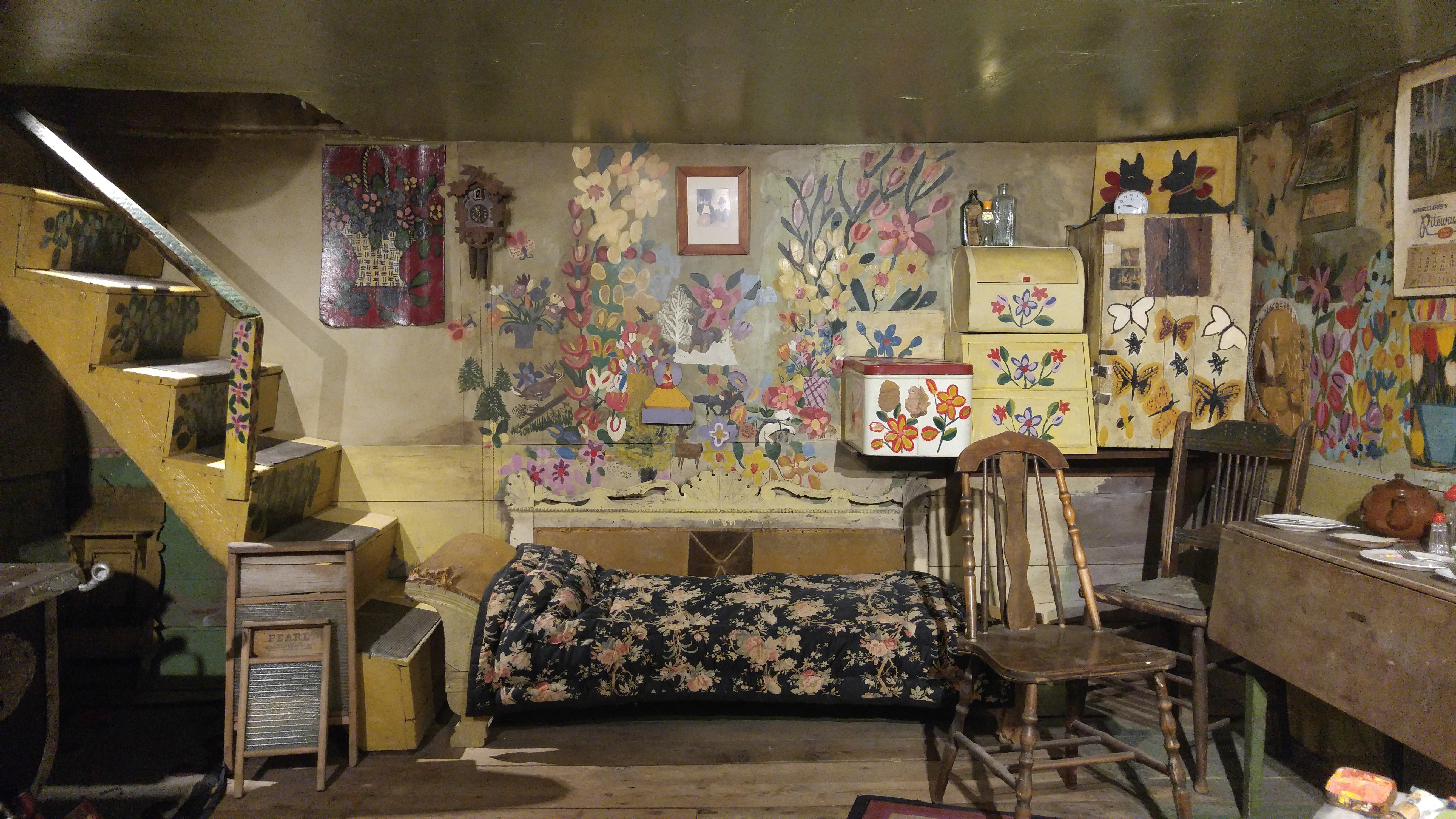
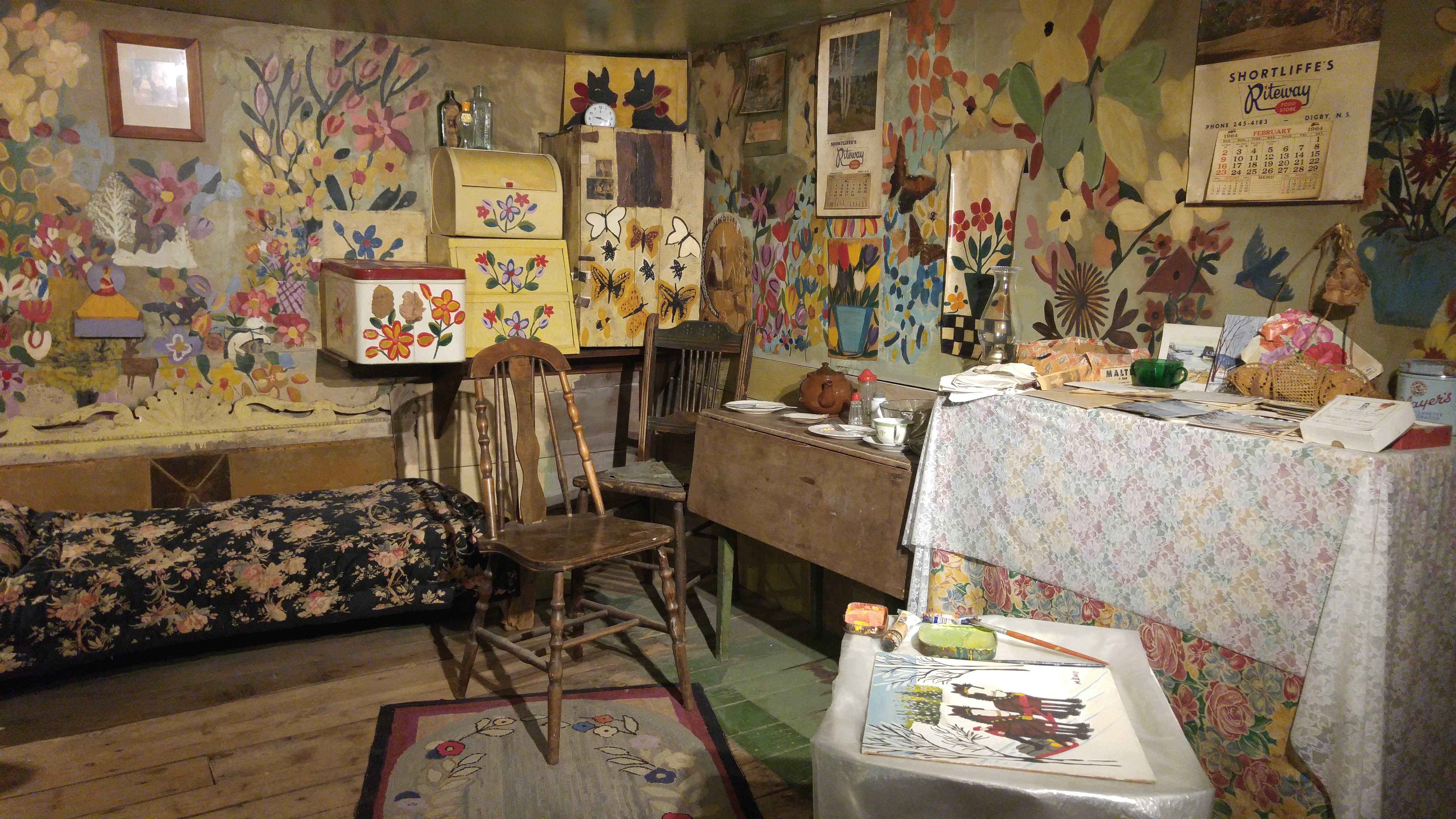
Maud Lewis WindowWe are enjoying a nice snow-free interlude in Halifax this weekend so I thought I should make the most of it and actually go do something today (besides the grocery shopping, which is my standard Saturday chore). I settled on a trip to the Art Gallery of Nova Scotia, where I haven’t been in many years.

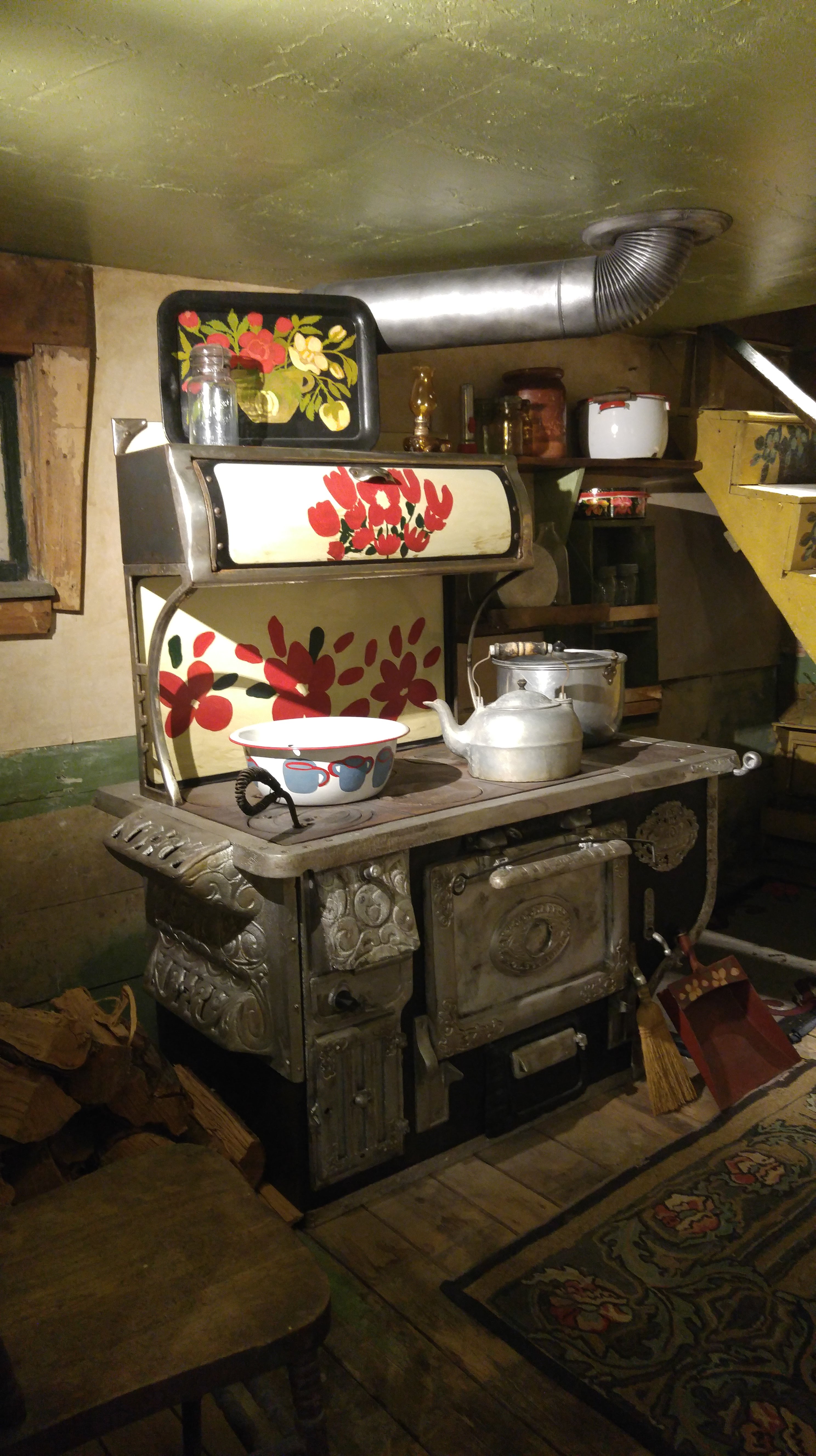
The AGNS is probably best known (especially since the release of Maudie) for its Maud Lewis collection, which includes her improbably tiny and delightfully colorful house–yes, the entire house:

Charming and joyful as the house is, with all its vibrant colours and free-spirited florals, it is hard to imagine two people actually living in it: it looks like a playhouse when you first see it, and at about 12′ x 12′ it is about the size of a single room in most contemporary homes.

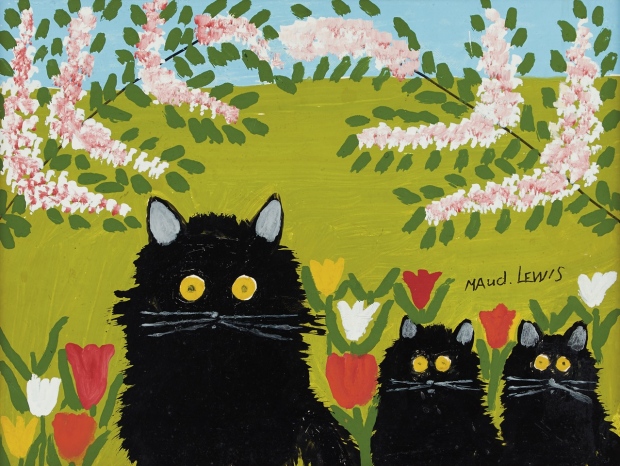
Lewis was a folk artist and her work is bright and simple and unsophisticated. I find it cheering but also fairly uninteresting:

It has a childlike quality to it that is particularly endearing, for me anyway, in her cartoon-like animals:

While these creatures amuse me and the landscapes charm me, nothing about Lewis’s work engages me deeply: I have no urge to linger over it. I suppose that’s consistent with its naive or primitive style–it’s not supposed to be layered or sophisticated. Still, just as a matter of personal taste, I prefer art that’s more complex and less cute. The Maud Lewis gallery has a lot of personality, but its interest for me is not really aesthetic.

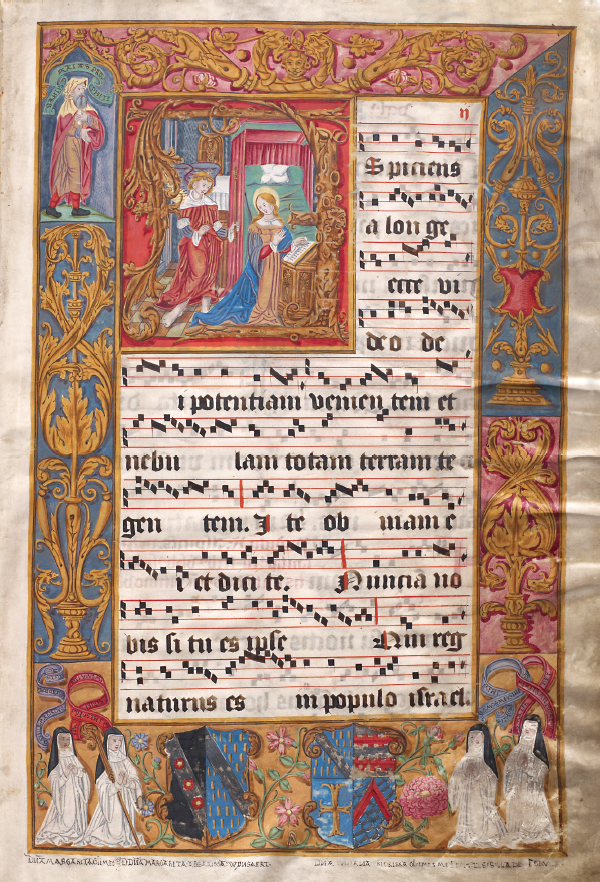
Also in the AGNS (but only until January 28, so I am very glad I went when I did) is an exhibit called “Centuries of Silence: the Discovery of the Salzinnes Antiphonal.” This is a completely different experience: intellectually and historically fascinating, and aesthetically thrilling.

The Salzinnes Antiphonal is a 16th-century manuscript that was discovered in the library of Saint Mary’s University here in Halifax. It has been painstakingly restored and is displayed along with a fine and thoughtful collection of related materials, including portraits of some of the abbesses who presided over the Abbey of Salzinnes in Belgium at the time of its creation:

The volume itself has stunning full-page illustrations:

The music has been recreated in modern notation and recorded; as you explore the exhibit its ethereal, otherworldly beauty surrounds, calms, and inspires you.

The exhibit includes other works of art collected by the Archbishop who was most likely responsible for bringing the Antiphonal to Halifax; paintings of and records from the Abbey that was its source and original home (including three 16th-century papal bulls); a video demonstrating the process of creating an object so beautiful and lasting, from preparing the vellum to layering in the gold leaf; and these hand-sewn recreations of the nuns’ habits, a project by a student in Dalhousie’s Costume Studies program:

I found it all fascinating, as you can probably tell! Though the Antiphonal is in some ways quite an imposing object, and though of course the original volume, though on display, is inaccessible behind its protective glass, still in its own way it felt every bit as intimate as Maud Lewis’s house. The illustrations, reproductions of which are displayed on the walls, have many details that personalize them, reminding us that this work too was done by very human hands.

It was a nice afternoon, especially rounded off with tea and a browse at the Halifax Central Library. I should get out more–and weather permitting, I will!

“Things That Happen In the World”: Ali Smith, Autumn

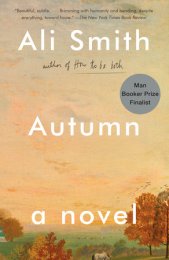
autumn-cover

What pictures? Pictures of what? her mother said.

Things. Things that happen in the world, Elizabeth said. A sunflower. A man with a machine gun like out of a gangster film. A factory. A Russian-looking politician. An owl, an exploding airship —

Ali Smith’s Autumn seemed incoherent to me, though artfully so. It is composed of many pieces, some of which fit together in the orderly way we expect of a novel, with interconnected characters moving forwards (and sometimes backwards) through a shared plot, but other sections don’t belong to that plot, or they are related to it tangentially or associatively; instead of completing the picture, they add color or shape or contrast or interest of their own.

There’s a lot of attention to collages within the more conventional narrative parts of the novel, and it occurred to me after a while that Autumn was designed to be collage-like itself. After hearing her friend Daniel describe a work that we later learn is by the British Pop artist Pauline Boty, the novel’s main character Elisabeth, then a child, comments, “I like the idea of the blue and pink together”:

Pink lace. Deep blue pigment, Daniel said.

I like that maybe you could touch the pink, if it was made of lace, I mean, and it would feel different from the blue.

Oh, that’s good, Daniel said. That’s very good.

“Today I myself particularly like the ship,” Daniel adds; “The galleon with the sails up.” Juxtaposition brings out texture; our own interest and attention vary and need different provocations at different times. These both seem like ideas that illuminate the process of Autumn itself.

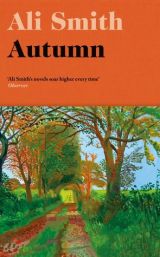
autumn-2-coverWhat did “I myself particularly like” in Autumn? I liked the meticulous descriptions of the landscape as it changes with the season:

October’s a blink of the eye. The apples weighing down the tree a minute ago are gone and the tree’s leaves are yellow and thinning. A frost has snapped millions of trees all across the country into brightness. The ones that aren’t evergreen are a combination of beautiful and tawdry, red orange gold the leaves, then brown, and down.

I liked Elisabeth’s unruly mother, especially her timely and heartfelt outburst:

I’m tired of the news. I’m tired of the way it makes things spectacular that aren’t, and deals so simplistically with what’s truly appalling. I’m tired of the vitriol. I’m tired of the anger. I’m tired of the meanness. I’m tired of the selfishness. I’m tired of how we’re doing nothing to stop it. I’m tired of how we’re encouraging it. . . . I’m tired of how those liars have let this happen. I’m tired of having to wonder whether they did it out of stupidity or did it on purpose. I’m tired of lying governments. I’m tired of people not caring whether they’re being lied to or not.

I liked the riff on “things from the past” accumulating and spilling out across the nation. I liked learning about Pauline Boty. I liked Elisabeth and Daniel a lot. I liked the nods to Dickens, beginning with the opening line (“It was the worst of times, it was the worst of times”). I liked reading the more fantastical, dream-like bits–but those are also the parts that most frustrated my desire to make collective sense of what I was reading.

offillI liked all of these parts and more about the novel, and yet while I could find a lot more examples to quote with pleasure or admiration, I don’t know quite how to talk about or conceptualize the novel as a whole, and that leaves me somewhat frustrated with it overall. I trusted Smith’s bricolage more than that of some other more fragmented novels I’ve read in recent years (Jenny Offil’s Department of Speculation, for instance, or Jennifer Egan’s A Visit From the Goon Squad, neither of which I actually enjoyed much at all). I think that’s because there’s a stronger narrative thread running through Autumn, and it gives a deeper grounding in its central characters while still (especially in Daniel’s case) leaving them somewhat opaque or enigmatic. There was enough in Autumn for a reader like me to enjoy in my usual way, though Smith clearly wants to do something more, or something other, than that.

I’ve been thinking lately (not without some anxiety, to be honest) that my reading taste and habits are hopelessly conventional, mainstream, middlebrow–choose your poisonous label! I don’t seek out experimental fiction or make my critical home in some interesting and underpopulated niche, whether literature in translation or obscure mid-century novelists of the NYRB Classics kind. This is a disadvantage for someone trying to define a critical voice or personality: what (I wonder in my bleaker moments) if I don’t really have such a thing? But then I remind myself that it’s OK just to read as well as you can, and that besides, I can’t become a reader I’m not (though of course it’s good to question and challenge my own taste). It’s a bit disconcerting to think that Autumn, which is hardly a fringe work, is very nearly outside my comfort zone. For all the things I liked about it, I admit I do not feel inspired to follow up with Winter.

This Week In My Classes: Counts, Cowboys, and Critics

I have to stop putting pressure on myself to make these update posts more than they have to be. When I started doing this, all I had in mind was opening up my classroom to anyone curious to know more about what English professors actually get up to–rather than fulminating against what they imagine we’re doing. The reality is both more mundane and (I think, anyway) more inspirational than people who think we should “ALL be flushed down the toilet” believe. I thought I could at least illustrate this widely misrepresented aspect of my professional life–the day to day (or at least week by week) effort I make to guide students towards being better (more thoughtful, more experienced, better informed) readers and writers–while also giving a sense of the kinds of books we read in my own classes and the kinds of discussions we have about them.

A lot of what I’ve written in this series is more or less straight reportage along those lines but then I began writing posts with more of a conceptual angle, and that seemed to raise the stakes. I still hope to do that, and often that’s actually what generates the teaching posts I look back on with the most satisfaction–but sometimes I just don’t have anything that profound to say! Lately that has made me hesitate about posting at all, and then I end up missing it. I like the process of it: as usual, I need to stop fretting so much about the product and just get on with it.

So, without more ado, here are some updates on my classes this week!

In Pulp Fiction we have just begun our discussions of Elmore Leonard’s Valdez Is Coming. I still feel as if I’m doing a lot of preparatory work in this class–maybe too much, I thought today, as I went on and on about issues of terminology and then the methods of close reading until by the time I actually tried to get the students involved in doing some close reading, they didn’t have much energy. That’s my fault: lesson learned! I also felt off my game the whole class: I was well prepared, in theory anyway, but the things I had planned to say didn’t come out that coherently, and once I started worrying about that and second-guessing myself, of course it just got harder to keep my focus! Self-consciousness is indeed, as Carlyle said, the beginning of disease: when things are going well I’m just absorbed in the discussion, with none of this meta-level anxiety. Of course, who really knows if that means I’m doing a better job then–or that today’s class really was in some way worse than usual! It was probably fine, and there are lots more chances to make up for it if it wasn’t.

I thought the discussion was a bit stuttering in Victorian Sensations this morning too–maybe that’s what set me up for my unease in the afternoon! We’ve been having very lively discussions of The Woman in White, but today was the first of our sessions focused on ‘critical approaches’: we read a selection of contemporary reviews, then a couple of modern critical essays, one from 1977 and one from 2006. My idea is that over the term these classes will add up to a mini-seminar in critical trends, though I haven’t chosen the readings that systematically–I just want us to engage with a range of different kinds of critical approaches and see how the conversation about these books has changed over time. That kind of meta-critical conversation is not as easy or familiar as talking directly about Marian’s subversion of gender norms or Count Fosco and the mysterious Brotherhood–and students understandably seemed less certain where or how to jump in. As always, a couple of students brought in discussion prompts for us, and these were very good. Next time I’m going to prepare a bit differently myself–particularly for the 19th-century material, which is (as we discussed) more diffuse and–to students more accustomed to working with very focused and analytical modern scholarship–more difficult to recognize or engage with as criticism, because the apparatus is much less explicit.

Friday is a very student-centered day: in Victorian Sensations we have our first group presentation, and I’m looking forward to that, as there’s usually so much intelligence and creativity on display, and then in Pulp Fiction it’s tutorials, which this week will be focused on a close reading activity.

I haven’t had much marking yet, beyond the reading journals I collect in random clusters in Pulp Fiction. That will change soon, though, and more generally I can already feel the term picking up speed. Next week we have Friday off for Munro Day, then it’s not long until Reading Week–and then it will feel like a mad rush to April and exams. But for now, it’s just one foot in front of the other. And that’s what’s up this week in my classes!